

Saved Bookmarks
This section includes 7 InterviewSolutions, each offering curated multiple-choice questions to sharpen your Current Affairs knowledge and support exam preparation. Choose a topic below to get started.
| 1. |
If angle between veca and vecb is (pi)/(3) then angle between vec2a and vec-3b is |
|
Answer» `(PI)/(3)` |
|
| 2. |
In the, Ohm's law experiment to find resistance of unknown resistor R, following two arrangement (a) and (b) are possible. The resistance measured is given by R_(measured)=(V)/(i) V= voltage reading of voltmeter, i= current Reading of ammeter. But unfortunately the ammeters and voltmeter used are not ideal, but having resistance R_(A) and R_(V) respectively. You are given two resistor X and Y. Whose resistance is to be determined , using an ammeter of R_(A)=0.5Omega and a voltmeter of R_(V)=20 KOmega. It is known that X is in range of a few Ohm and Y is in range of several kilo ohm. Which of the circuit is preferable to measure X and Y-Resistor Circute |
|
Answer» `x to (a)`, `y to (b)` 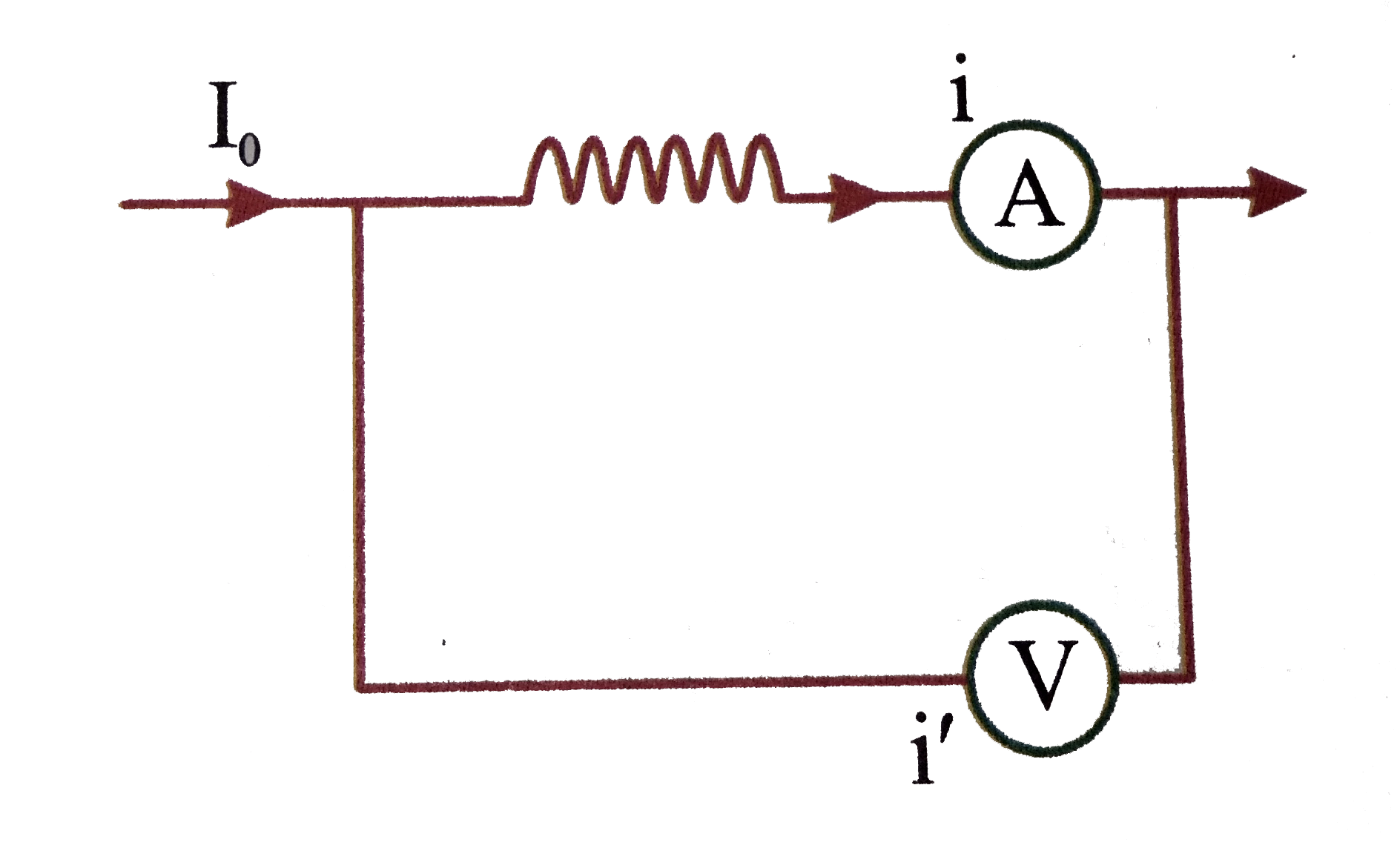 `i=(R_(V))/(R+R_(A)+R_(V))xxI_(0)` So `(V)/(I)=R+R_(A)=R_(measured)` in circuit (`b`) 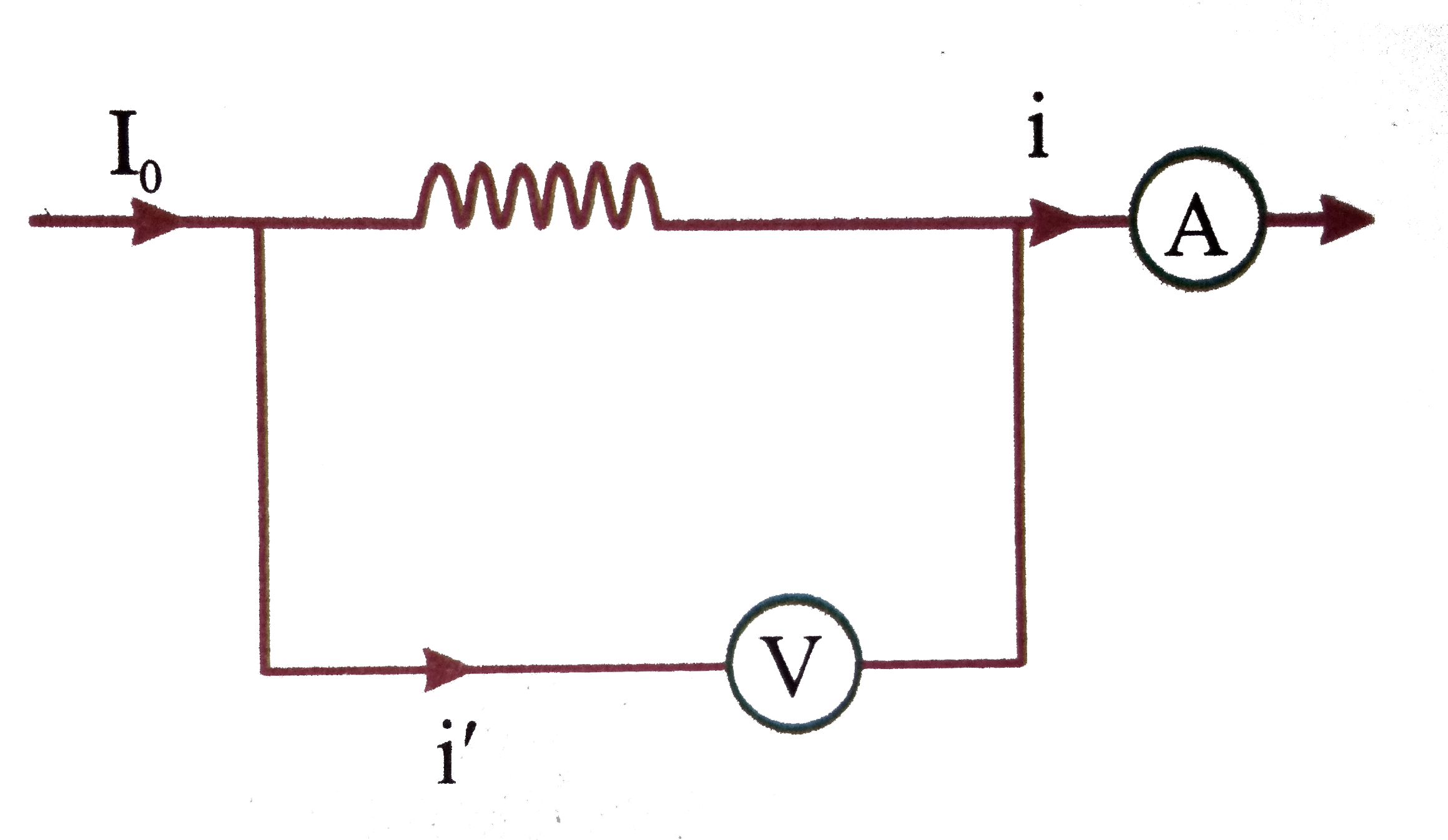 `V=I'xxR_(V)=(RR_(V))/(R+R_(V))xxi` So `R_(measured)=(RR_(V))/(R+R_(V))` To measure `x`, circuit (`b`) should be USED, as `R_(measured)=(R R_(V))/(R+R_(V)) gt gtR` as `R gt gt R_(A)` |
|
| 3. |
Two long straight conductors AOB and COD are perpendicular to each other and carry currents I_1 and I_2. Find the magnitude of the magnetic inductions at a point 'P' at a distance 'a' from the point O in a direction perpendicular to the plane ACBD. |
| Answer» SOLUTION :`(mu_0)/(2 PI a)(I_1^(2) + I_2^(2))^(1//2)` | |
| 4. |
Find the relation between the three wavelengths lamda1,lamda2and lamda3 from the energy level diagram shown below. |
|
Answer» SOLUTION :`E_c-E_B=(hc)/lamda_1""...(1)` `E_B-E_A=(hc)/lamda_2"" ...(2) ` `E_C-E_A=(hc)/lamda_3""...(3)` Adding (1) and (2), we have `E_C-E_A=(hc)/lamda_1+(hc)/lamda_2""...(4)` From (3) and (4), we have `(hc)/lamda_3=(hc)/lamda_1+(hc)/lamda_2rArr1/lamda_3=1/lamda_1+1/lamda_2` `implieslamda_3=(lamda_1lamda_2)/(lamda_1+lamda_2)` |
|
| 5. |
The ratio of the dimensions of Planck constant and that of moment of inertia has the dimensions of |
|
Answer» velocity |
|
| 6. |
The sensitivity of potentiometer wire can be increased by |
|
Answer» DECREASING the length of potentiometer WIRE |
|
| 7. |
The atomic mass of natural boron is 10.811. It consists of two isotopes with masses of 10.013 and 11.009. Find their fractions. |
|
Answer» `10.013x+11.009y=10.811,X+y=1` where x and y are the FRACTIONS of the LIGHT and the heavy isotopes, respectively. |
|
| 8. |
A heating element using nichrome connected to a 230 V supply draws an initial current of 3.2 A which settles after a few seconds to a steady value of 2.8A. What is the steady temperature of the heating element if the room temperature is 27.0^@C. Temperature coefficient of resistance of nichrome averaged over the temperature range involved is 1.70 xx 10^(-4) ""^@C^(-1) |
| Answer» SOLUTION :`867^@ C` | |
| 9. |
The correct relation is |
|
Answer» `B=(B_(V))/(B_(H))` |
|
| 10. |
Statement-1 : A shell at rest, explodes. The centre of mass of fragments moves along a straight path. Statement-2 : In explosion the linear momentum of the system remains always conserved. |
|
Answer» Statement-1 is True, Statement-2 is True, |
|
| 11. |
A equilateral prism provides the least deflection angle 46^(@) in air. Find the refracting index of an unknown liquid in which same prism gives least deflection angle of 30^(@). |
|
Answer» |
|
| 13. |
When electron is incident on molyblednum then by changing energy of electron :- |
|
Answer» `lambda_("min")` changes |
|
| 14. |
Describe the motion of a charged particle in a combined electric and magnetic field. |
|
Answer» Solution :Let E be the uniform electric field applied in the y direction and B be the uniform magnetic FILED applied along the z direction. Let the change q MOVE with a speed v along the X direction. i.e., `VEC(E)=Ehat(j), vec(B)=Bvec(k) " and " vec(v)=vhat(i)` `therefore ""vec(F)_(e)=qEvec(j)` (electric force) magnetic force `""vec(F)_(mag)=qvec(v) times B=qvhat(i) times Bhat(k)` i.e.,`""vec(F)_(m)=qvB(-vec(j))` By applying Fleming's Left Hand Rule, we note that the resultant force on the charged particle `""vec(F)=qEhat(j)-qvBhat(j)` i.e.,`""vec(F)=q(E-vB)hat(j)` If QE = qvB, then net force on the change will be zero and the charge continues to move along x direction without deflection. Since qE = qvB, `v=E/B` where 'v' is called the velocity. E and B are called crossed fields. The crossed fields `vec(E) " and " vec(B)` may be used to select charged particles of a particular velocity out of a beam containing charges moving with different speeds. 
|
|
| 15. |
Monochromatic light of wavelength 600 nm is used in a Young's double slit experiment. One of the slits is covered by a transperent sheet of thickness 1.8xx10^(-5)m made of a material refrective index1.6. How many fringes will shift due to the introduction of the sheet ? |
|
Answer» |
|
| 16. |
Assertion: The electric flux emanating out and entering a closed surface are 8 xx 10^3 and 2 xx 10^3 volt-metre respectively. The charge enclosed by the surface is 0.053 mu C. Reason:Gauss's theorem in electrostatics may be applied to verify the above case. |
|
Answer» Both Assertion and Reason are TRUE and Reason is the correct explanation of Assertion |
|
| 17. |
A bar of length 1 m is supported at its two ends. The breadth and depth of the bar are 5 cm and 0.5 cm., respectively , A body of mass 0.1 is suspended at the centre of the bar. Calculate the depression produced in the bar. |
|
Answer» Solution :Data : L = 1 m, b = 5 cm= ` 5 xx 10^(-2) m .d = 0.5 cm = 5 xx 10^(-3) ` m `M = 0.1 KG,Y = 2 xx 10^(11) N//m^(2)` Load, W = MG = ` 0.1 xx 9.8 = 0.98 N` The DEPRESSION (sag) produced in the bar. ` delta = W/(4by) (l/d)^(3) = 0.98/(4 (5 xx 10^(-2)) (2xx 10^(11)) . (1/(5 xx 10^(-3)))^(3)` ` = 0.98/(4xx 10^(16) . (2 xx 10^(2))^(3) = (0.98 xx 8 xx 10^(6))/( 4 xx 10^(10)) = 1.96 xx 10^(-4) m = 0.196 mm` |
|
| 18. |
Magnetic dipole moment of a current carrying loop is given by M = N/A _____ |
| Answer» SOLUTION :`ABS Am^2` | |
| 19. |
The speed of longitudinal wave is ten times the speed of transverse waves in a tight brass wire. If young's modulus of the wire is Y , then strain in the wire is |
| Answer» Answer :B | |
| 20. |
A particle is moving with velocity vec(v)=K(yhati + xhatj), where K is a constant. The general equation for its path is: |
|
Answer» `y^(2)=X^(2)` + constant 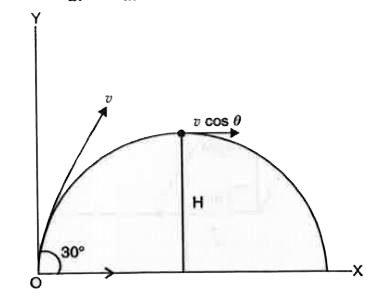 `:.dx/dt=Ky` and `(dy)/(dt)=Kx` `implies dx/dt=y/x` and xdx=ydv or integrating `x^(2)=y^(2)+c` |
|
| 21. |
Brilliance of a diamond is due to |
|
Answer» shape |
|
| 23. |
Which of the following is not correct about nuclear forces? |
|
Answer» They are short range attractive FORCES |
|
| 24. |
Calculate the smallest angular separation between two stars which are just resolved by the telescope having objective lens of diameter 25 cm. Assume 555 nm as mean wavelength of light. |
|
Answer» Solution :SMALLEST angle RESOLVED by the telescope is given by the following formula : ` theta = (1.22 LAMBDA)/(alpha)` `implies theta = (1.22 XX 555 xx 10^(-9))/(0.25)` `implies theta = 2.708 xx 10^(-6) rad`. |
|
| 25. |
The ratio of the speeds of ultraviolet rays infrared rays in the earth's atmosphere is: |
| Answer» ANSWER :C | |
| 26. |
A man walks over a rough surface. The angle between the force of friction and the instantaneous velocity of the person is |
| Answer» Answer :D | |
| 27. |
Three difference dielectrics are filled in a paralled plate capactior as shown. What should be the dielectric constant of a material, which when fully filled between the plates produces same capacitance ? |
|
Answer» 4 |
|
| 28. |
Fe, Co, Ni किस प्रकार के चुम्बकीय पदार्थ है |
|
Answer» अनुचुम्बकीय |
|
| 29. |
Whom did Mandela wanted to thank but couldn't? |
|
Answer» his family |
|
| 30. |
How many 500 kHz waves can be on a 10 km transmission line simultaneously ? |
|
Answer» Solution :Let `lamda` be the WAVELENGTH of 500 kHz SIGNAL. Then, `lamda=(C )/(F)=(3.0xx10^(8))/(5.0xx10^(4))m=600m` The number of waves on the line can found from, `n=(d)/(lamda)=(10xx10^(3))/(600)=16.67` |
|
| 31. |
Which amongthe curve shown in cannot posiblyrepresentelectrostaticfield lines? |
|
Answer» Solution :(i)Fig (a) cann not REPRESENT electrostatic fieldlines because fieldlines must start normallyfrom the SURFACE of a conductor. (ii)Fig . (b)Cannot represent electrostatic FIELD lines because electric field lines must start from +ve CHARGE and end at -ve charge. field lines cannot end at +vecharge. (iii)Fig. (c)representelectrostatic field lines. Moreover from field lines we GUESS that the two +ve charges are equal or almost equal. (vi)Fig (d). Cannot representfield lines because field lines can never interest with each other. Moreover, they cannot end on +ve charges. (v) Fig. (e)cannot represent field lines because electrostatic field lines cannot form closed loops and must start and end at the surface of a charged conductor normally. |
|
| 32. |
The velocity of a particle is zero at t = 0. (a) The acceleration at t= 0 must be zero. (b) The acceleration at t = 0 may be zero. (c) If the acceleration is zero from t = 0 tot=10s, the speed is also zero in this interval. (d) If the speed is zero from t=0 to t=10 s the acceleration is also zero in this interval. |
|
Answer» a, B & d are correct |
|
| 33. |
Four lenses A, B, C and D power +100D,-50 D, 20 D and 5 D. Which lenses will you use to design a compound microscopefbr best v? ' magnification ? |
|
Answer» A and C |
|
| 34. |
A charge of 2xx10^(-9) C is placed on a corner of a cube of side1m. Find the electricflux passing throguh a faceof the givencube ? |
Answer» 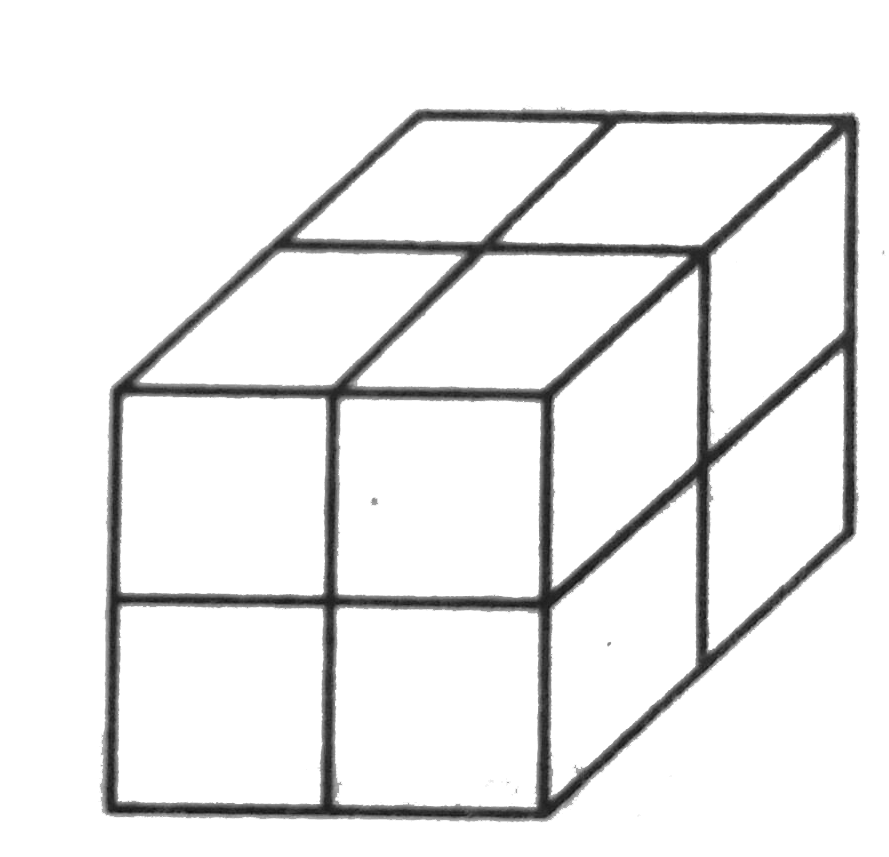 Thus ELECTRIC flux passing through given small cube `phi = (1)/(8)((q)/(in_(0))) = (1)/(8) xx 28.25 NC^(-1) m^(2)` `= 9.42 NC^(-1) m^(2)` |
|
| 35. |
Describe the use of transistor as an oscillator. |
|
Answer» Solution :An L-C CIRCUIT can be used to produce oscillations of desired frequency. It consists of a tank circuit consisting of inductor L and capacitor C connected in parallel. The frequency of the tank circuit is given by `v=(1)/(2pisqrt(LC))` Due to the resistance of inductive coil, there occurs a SMALL but constant energy loss and oscillations thus produced are damped. To transmit speech or MUSIC, we require undamped electromagnetic waves called carrier waves.  To do so an L-C circuit is coupled with transistor in such a way that there is a proper feedback to the L-C circuit at the proper timings so that the energy of L-C circuit remains the same throughout oscillaitons. When key K is pressed, the collector ATTAINS POSITIVE potential due to which a weak collector current will start rising in `L_(1)`. The increasing magnetic flux is linked with `L_(1)` and hence with L. |
|
| 36. |
A microscope consists of two convex lenses of focal lengths 2.0 cm and 6.25 cm placed 15.0 cm apart. Where must the object be placed so that the final virtual image is at a distance of 25 cm from the eye ? |
| Answer» Answer :A | |
| 37. |
The half life of a radioactive substance is 20 minutes. The approximate time interval (t_2 - t_1) between the time t_(2)" when "2/3 of it has decayed and timet_(1)" when "1/3 of it had decayed is : |
|
Answer» 14 min `N=N_(0)e^(-lambdat_(2)) lambdat_(1)=ln 3` `2/3 N_(0)=N_(0)e^(-lambdat_(2)) ""t_(1)=1/LAMBDA ln 3` `2/3 N_(0)=N_(0)e^(-lambda t_(2))` `t_(2)=1/lambda ln 3/2` `t_(2)-t_(1)=1/lambda [ln 3/2-ln 3]` `=1/lambda ln [1/2]=(0.693)/(lambda)` |
|
| 38. |
If the charge on the capacitor is 1 mC in the given circuit,then(R_(1)R_(2))/(R_(3))= . . . . . Omega . |
|
Answer» 6 `V_("capacitro")= (Q)/(C) =(1 xx 10^(-3))/(5 xx 10^(-6)) = (1000)/(5)` = 200 V So,current THROUGHT `R_(5)` `I=(V)/(R)` `=(200)/(10)` 20 A Hence, we have following currentdistribution . In loop BCDB, `- 15 R_(3) + 10 xx 5 + 5R_(2) = 0 "". . . (i)` In loop ABCDA, ` - 200 - 15 R_(3) + 50 + 250 = 0 ` `15 R_(3) = 100` `R_(3) = (100)/(15) OMEGA` From Eq. (i), weget `5R_(2) = 50` `R_(2) = 10 Omega` and from loop ADCA, ` - 250 - 50n+ 310 - 25 R_(1) = 0 ` ` 25 R_(1) = 10` `rArr R_(1) = (10)/(25) Omega` So, ` (R_(1) xx R_(2))/(R_(3)) = ((10)/(25)xx10)/(((100)/(15)))` `= (15)/(25) = (3)/(5) = 0 . 6 ` 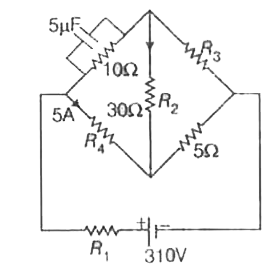 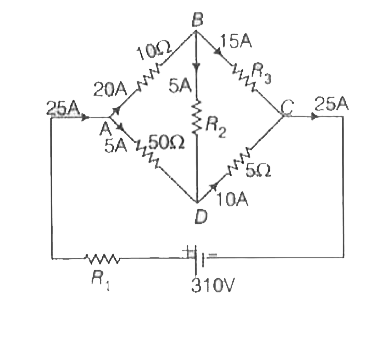
|
|
| 39. |
From your answer to (a) , guess what order of accelerating voltage( for electrons ) isrequired in such a tube? |
|
Answer» SOLUTION :In X - ray tube , accelerating voltage provides the energy to the electrons which produceX - RAYS . For getting X - rays , photons OFOF 27.51KeV is required that the incident electronsmust posesskineticenergyof27.61 KeV Energy = eV = E ,eV= 27.6 KeV, V = 27.6 KV So , the ORDER of accelerating voltageis 30 KV |
|
| 40. |
A metallic sphere is charged negatively, Will its mass increase, decrease or remain the same? |
| Answer» Solution :When the sphere is negatively charged, it means ELECTRONS have been added to it. SINCE electrons have INFINITE mass, the mass of the negatively charged sphere will INCREASE. | |
| 41. |
(A): Inductance coil are made of copper.(R): Induced current is more in wire having less resistance. |
|
Answer» Both .A. and .R. are TRUE and .R. is the CORRECT EXPLANATION of .A. |
|
| 42. |
What is the time period of a satellite very close of the earth surface? |
|
Answer» |
|
| 43. |
Find an expression for the minimum speed at which an object of mass m must be launched in order to escape Earth's gravitational field. (this is called escape speed). |
|
Answer» Solution :When LAUNCHED, the object is at the surface of the earth `(r_(0)=r_(E))` and has an upward, initial velocity of magnitude `v_(0)`. To get it far away from the earth, we WANT to bring its gravitational potential energy to zero. But to find the MINIMUM launch speed, we want the object 's final speed to be zero by the time it gets to this distant location. so, by conservation of energy `K_(0)+U_(0)=K_(F)+U_(f)` `(1)/(2)mv_(i)^(2)+(-GM_(E)m)/(r_(E))=0+0` `(1)/(2)mv_(0)^(2)=(GM_(E)m)/(r_(E))implies v_(0)=sqrt((2GM_(E))/(r_(E)))`. |
|
| 44. |
A charge of mass .m. charge .2e. is released from rest in a uniform electric field of strength .E.. The time taken by it to travel a distance .d. in the field is |
|
Answer» `t= SQRT((dm)/(Ee))` |
|
| 45. |
What happens to the capacitor when the charge is doubled and the P.D. across is doubled . |
|
Answer» 7 |
|
| 46. |
A particle slides down a smooth inclined plane of elevation fixed in an elevator going with an acceleration a as shown in the figure. The base of the incline has a length L. If the elevator going up with constant velocity, the time taken by the particle to reach the bottom is |
|
Answer» `((2L)/((gsin THETA cos theta)))^(1//2)` |
|
| 47. |
In a single slit diffraction experiment ,the width of the slit is made double the originals width.How does this affect the size and intensity of the central diffraction band ?Explain. |
|
Answer» Solution :Size of central maxima reduces to HALF (size of central maxima = ) Intensity increases. This is because the amount of light , ENTERING the slit , has increased and the area , over which it falls , decreases. (ALSO accept if the student just writes that the intensity becomes FOUR FOLD ) |
|
| 48. |
An amateur astronomer wishes to estimate roughly the size of the Sun using his crude telescope consisting of an objective lens of focal length 200 cm and an eyepiece of focal length 10 cm. By adjusting the distance of the eyepiece from the objective, he obtains an image of the Sun on a screen 40 cm behind the eyepiece. the diameter of the sun's image is measured to be 6.0 cm. What is his estimate of the Sun's size given that the average Earth-sun distance is 1.5 xx 10^(11) m ? |
|
Answer» |
|
| 49. |
Which of the following is not a unit of time A) par sec B) light year C) micron D) sec |
|
Answer» Only A |
|
| 50. |
निम्नलिखित में से किस वैज्ञानिक ने सर्वप्रथम जीवाणु (bacteria) नाम दिया : |
|
Answer» लुईस पाश्चर |
|