Saved Bookmarks
This section includes 7 InterviewSolutions, each offering curated multiple-choice questions to sharpen your Current Affairs knowledge and support exam preparation. Choose a topic below to get started.
| 1. |
According to Bolir's theory, the energy of an electron in hydrogen atom starts corresponding to n=1,2,3,4 is -13.6 eV, -3.4 eV, - 1.51 eV and -0.85 eV respectively. In order to obtain emission of H_(beta) line of Balmer series, the energy that has to be given to a normal hydrogen atom is |
|
Answer» `12.75eV` MUST be excited to the energy LEVEL with n = 4 (i.e., `-0.85eV`) must be excited to the energy level with n = 4 (i.e., `-0.85eV`) so as to have `H_(BETA)` line. |
|
| 2. |
A hemispherical open bowl of radius R is placed on a smooth floor. A massive ball falls from some height and collides on the circumference of the bowl. Considering contact point of the floor as origin, position vector of the initial contact point of the bowl when the bowl turns 90^(@) will be : |
|
Answer» `-(R )/(2)hat(i)+R hat(J)` |
|
| 3. |
In the diagram shown is ciruclar loop carrying current I. show the direction of the magnetic field with the help of lines of force. |
Answer» Solution :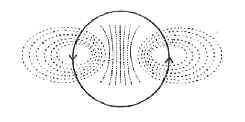 The magnetic LINES of force of a circular LOOP CARRYING current I are shown below. |
|
| 4. |
Two identical metallic sphere's A and B having charges+4 Q and -10 Qare kept a certain distance apart. A third identical unchargedsphere C is first placed in contact with sphere A and then with sphere B. Spheres A and B are then broughtin contact and then separated. Find the charges on the spheres A and B. |
|
Answer» Solution :Initial charge onsphere `A, q_A = +4Qand "charges"on B , q_B = - 10Q .` When an identical UNCHARGED SPHERE C is PLACED in contact with sphere A , it SHARES its charge and charge on `C, q_C =(q_A)/( 2)= +(4Q)/( 2) ` =2Qand the remainingcharge on A BECOMES `q_A =+2Q ` Now sphere C having charge `q_C =+2Q ` is brought in contact with sphere B having charge `q_B = -10 Q `. The two spheres share their charges and acquire charges ` ""q_C. =q_B. =((+2Q-10Q))/(2) =-4Q` Now finally spheres A ( charges `q_A. =+2Q) `and B (charges `q_B. =-4Q ) ` are brought in contact and then separated. On contact A and B share their charges equally and final value of charge on A or B will be ` ""q_A.. ""q_B.. =(+2Q-4Q)/( 2) = -Q ` |
|
| 5. |
A, B and C arc voltmeters of resistance R, 1.5R and 3R respectively as shown in the figure. When some potential difference is applied between X and Y, the voltmeter readings are V_(A) , V_(B) and V_(C) repsectively. Then : |
|
Answer» `V_(A) = V_(B) = V_(C) ` EQUIVALENT capacitance between B and C ` = (1.5R XX 3R)/(1.5R + 3R)` `= (4.5 R)/(4.5) = R `  Potential in series connection, V `prop ` R `therefore ` Voltage in A = Voltage in B and C As B and C are in PARALLEL, so that `V_(B) = V_(C)` `therefore V_(A) = V_(B)= V_(C)` |
|
| 6. |
Assume the graph of specific binding energy versus mass number is as shown in the figure. Using this graph, select the correct choice from the following : |
|
Answer» Fusion of two NUCLEI of mass number LYING in the RANGE of `100ltAlt200` will release energy |
|
| 7. |
If the two slits in Young's double slit experiment have width ratio 1:25, then the ratio of the intensity of maxima and minima in the interference pattern will ..... |
|
Answer» `(4)/(9)` Now `I prop W` `:.(I_(1))/(I_(2))=(W_(1))/(W_(2))=(1)/(25)` `:.(I_(1))/(I_(1))=(25)/(I)` `:. (sqrt(I_(2)))/(sqrt(I_(1)))=(5)/(I)` but `I prop A^(2)` (A is AMPLITUDE) `:. (I_(2))/(I_(1))=((A_(2))/(A_(1)))^(2)` `:. (A_(2))/(A_(1))= sqrt((I_(2))/(I_(1)))` `:. A_(2)= sqrt(I_(2)) and A_(1)=sqrt(I_(1))` Now `(I_("max"))/(I_(""min"))=((A_(2)+A_(1))^(2))/((A_(2)-A_(1))^(2))=([sqrt(I_(2))+sqrt(I_(1))]^(2))/([sqrt(I_(2))-sqrt(I_(1))]^(2))` `=[((sqrt(1_(2)))/(sqrt(I_(2))/(sqrt(I_(1)))+1))/((sqrt(I_(2)))/(sqrt(I_(1)))-1)]^(2)` `=[((5)/(1)+1)/((5)/(1)-1)]^(2)` `=((6)/(4))^(2)=((3)/(2))^(2)` `=(9)/(4)` |
|
| 8. |
Under what condition does a biconvex lens of glass having a certain refractive index act as a plan glass sheet when immersed in a liquid? |
| Answer» Solution :When the REFRACTIVE INDEX of GLASS is equal to the refractive index of the liquid. ( ALTERNATIVELY, when `mu_(l) = mu_(g))` | |
| 9. |
The characteristic photosynthetic pigments in cyanobacteria are |
|
Answer» CHLOROPHYLL a and c |
|
| 10. |
A hydrogen atom at rest de-excites from n = 2 state to n = 1 state. Calculate the percentage error in calculation of momentum of photon if recoil of atom is not taken into account. The energy equivalent of rest mass of hydrogen atom is 940 MeV. |
|
Answer» |
|
| 11. |
Two polarising sheetshave their polarising directionsparallelto eachother suchthat theintensityof the transmitted light s maximum . Through what angle must eithe sheet be turnedso that the intensity becomes one - halfthe intial value ? |
|
Answer» `30^(@)` |
|
| 12. |
A current I flows in a long straight wire whose cross section is in the shape of a thin quarter ring of radius R. Find the induction of the magnetic field (B) at point O on the axis. |
|
Answer» |
|
| 13. |
A compound microscope conists of an objective lens of focal length 2.0 cm and an eyepiece of focal length 6.25 cm separated by a distance of 15 cm. How far from the objective should an object be placed in order to obtain the final image at (a) the least distance of distinct vision (25cm), and (b) at infinity? What is the magnifying power of the microscope in each case? |
|
Answer» Solution :Here `f_(0) = + 2.0`cm and `f_(e) = + 6.25 ` cm and distance between the lenses L = 15 cm (a) If the final image is formed at the least distance of distinct vision (i.e. `v_(e) = -D = -25 cm)` Then, `1/v_(e) - 1/u_(e) = 1/f_(e)` i.e., `1/(-25) -1/u_(e) =1/(6.25)` `therefore -1/u_(e) =1/6.25 + 1/25 = 1/5` or `u_(e) = -5 cm` `therefore v_(0) = L-|u_(e)| = 15-5 = 10 cm` Now applying lens formula for objective lens, we have `1/10 - 1/u_(0) = 1/2 rArr u_(0) = -10/4 = -2.5 cm` `therefore` Multiplying power of microscope `m=-v_(0)/u_(0) (1+D/f_(e)) = -10/2.5 (1+ 25/6.25) = 20` (b) When the final image is formed at infinity, `v_(e) = INFTY`. Hence, applying lens formula for EYE lens, we have `1/infty -1/mu_(e) = 1/(6.25) rArr u_(e) = -6.25 cm` `therefore v_(0) = L -|mu_(e)| = 15-6.25 = 8.75 cm` Using lens formula for objective lens, we GET `1/(+8.75) - 1/u_(0) =1/2` or `-1/u_(0) =1/2 -1/(8.75) = 6.75/17.5 rArr u_(0) = -(17.5)/(6.75) = -2.6 cm` `therefore` Magnifying power of microscope `m=-v_(0)/u_(0) (D/f_(e)) =-8.75/2.6 (25/6.25) = 13.5` |
|
| 14. |
An electric dipole of moment vec(p) is placed normal to the lines of force of electric intensity vec(E ), then the work done in deflecting it through an angle of 180^(@) is |
|
Answer» PE |
|
| 15. |
The value ofoverset-1+overset-1 is |
|
Answer» 2 |
|
| 16. |
A cylinder of radis R and length L is placed in a uniform electric field E parallel to the cylinder axis. The total flux from the curved surface of the cylinder is given by |
| Answer» Answer :D | |
| 17. |
Read the followingpassage and then answer questions (a) - (e) on the basis of your understand- ing of the passage and the related studied concepts.A semiconductor diode is basically a p-n junction and is thus a two terminal device, when an external voltage is applied across a semiconductor diode such that p-side is connected to the positive terminal of the battery and n-side to the negative terminal, it is forward biased. The direction of the applied voltage is opposite to the built in barrier potential. As a result, the depletion layer width decreases and the barrier height is reduced. If the applied voltage is increased, it may overcome the barrier potential altogether and a large current flows across the junction. When an external voltage (V) is applied across the diode such that n-side is positive and p-side is negative, it is said to be reverse biased. The direction of applied voltage is same as the direction of barrier potential. As a result, the barrier height increases and the depletion region widens. So current flowing across the junction decreases enormously (practically becomes zero) as compared to the diode under forward bias. If an alternating voltage is applied across a diode, the current flows only in that part of the cycle when the diode is forward biased. Draw circuit arrangement of a p-n junction in forward bias and in revene bias arrangement. |
Answer» SOLUTION :CIRCUIT ARRANGEMENTS [FIG. 14.2) are GIVEN here : 
|
|
| 18. |
Read the followingpassage and then answer questions (a) - (e) on the basis of your understand- ing of the passage and the related studied concepts.A semiconductor diode is basically a p-n junction and is thus a two terminal device, when an external voltage is applied across a semiconductor diode such that p-side is connected to the positive terminal of the battery and n-side to the negative terminal, it is forward biased. The direction of the applied voltage is opposite to the built in barrier potential. As a result, the depletion layer width decreases and the barrier height is reduced. If the applied voltage is increased, it may overcome the barrier potential altogether and a large current flows across the junction. When an external voltage (V) is applied across the diode such that n-side is positive and p-side is negative, it is said to be reverse biased. The direction of applied voltage is same as the direction of barrier potential. As a result, the barrier height increases and the depletion region widens. So current flowing across the junction decreases enormously (practically becomes zero) as compared to the diode under forward bias. If an alternating voltage is applied across a diode, the current flows only in that part of the cycle when the diode is forward biased. What is a rectifier ? Draw a circuit diagram of a half-wave rectifier. |
|
Answer» Solution :A rectifier is a DEVICE which is used to rectify alternating voltages i.e., to CONVERT alternating voltage input into direct voltage output. CIRCUIT diagram of a half-wave rectifier is DRAWN here |
|
| 19. |
Read the followingpassage and then answer questions (a) - (e) on the basis of your understand- ing of the passage and the related studied concepts.A semiconductor diode is basically a p-n junction and is thus a two terminal device, when an external voltage is applied across a semiconductor diode such that p-side is connected to the positive terminal of the battery and n-side to the negative terminal, it is forward biased. The direction of the applied voltage is opposite to the built in barrier potential. As a result, the depletion layer width decreases and the barrier height is reduced. If the applied voltage is increased, it may overcome the barrier potential altogether and a large current flows across the junction. When an external voltage (V) is applied across the diode such that n-side is positive and p-side is negative, it is said to be reverse biased. The direction of applied voltage is same as the direction of barrier potential. As a result, the barrier height increases and the depletion region widens. So current flowing across the junction decreases enormously (practically becomes zero) as compared to the diode under forward bias. If an alternating voltage is applied across a diode, the current flows only in that part of the cycle when the diode is forward biased. Distinguish between forward bias and reverse bias arrangements of a semiconductor diode. |
Answer» SOLUTION :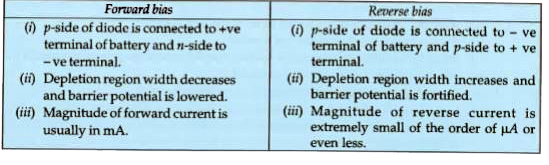
|
|
| 20. |
An engine develops 10 KW of power. How much time will it take to lift a mass of 200 kg toheight of 40 m(g=10 m//s^2) |
|
Answer» 4 s |
|
| 21. |
A quartz wedge with refracting angle Theta = 3.5 is inserted between two crossed Polaroids. The optical axis of the wedge is parallel to its edge and forms an angle of 45^(@) with the principal directions of the Polaroids. On transmittion of light with wavelength lambda = 550 nm through this system, an interference fringe pattern is formed. The width of each fringe is Deltax = 1.0 mm. Find teh difference of refractive indices of quartz for ordinary and extraodianry rays at the wavelength indicated above. |
|
Answer» Solution :If a ray TRAVERSE the WEDGE at a distance `x` below the joint, then the distance that the ray moves in the wedge is `2x tan((Theta)/(2))` and this cause a phase difference `delta = (2pi)/(lambda) (n_(e) - n_(0)) 2x tan ((Theta)/(2))` between the `E` and `O` wave components of the ray. For a general `x` the resuling light is ellipically polarized and is nor completely quenched by the analyser polariod. The CONDITION fro complete quenching is `delta = 2K pi bar` DARK fringe That for maximum brightness is `delta = (2k + 1) pi-` bright fringe. The fringe width is given by `Deltax = (lambda)/(2(n_(e) - n_(0))tan((Theta)/(2)))` Hence `(n_(e) - n_(0)) = (lambda)/(2Delta xtan Theta//2)` `tan(Theta//2) = tan 175^(@) = 0.03055`, using `lambda = 0.55mu m` and `Delta x = 1mm`, we get `n_(e) - n_(0) = 9.001 xx 10^(-3)` 
|
|
| 22. |
When high energy neutron bombards a _7N^14 nucleus producing a _6C^14 nucleus, the other particle released is |
|
Answer» electron |
|
| 23. |
a unifrom surface charge density 8sigma exists over the entire x-y plane except for acircular hole of radius of a point p(0,0,sqrt(3)) on the z-axis is found to be 2sqrt(x)(sigma)/(epsilon_(0)) ,Find the value of x. |
|
Answer» `rArr E_(net)=(sigma')/(2epsilon_(0))-(sigma)/(2epsilon_(0))(1-(z)/(sqrt(z^(2)+a^(2))))` `E_("net")=(sigma')/(2epsilon_(0)sqrt(z^(2)+a^(2)))` ` rArr E_("net")=((8sigma)sqrt(3)a)/(2epsilon_(0)(2A))=sqrt(12)(sigma)/(epsilon_(0))=2sqrt(3)(sigma)/(epsilon_(0))` `rArr x=3` 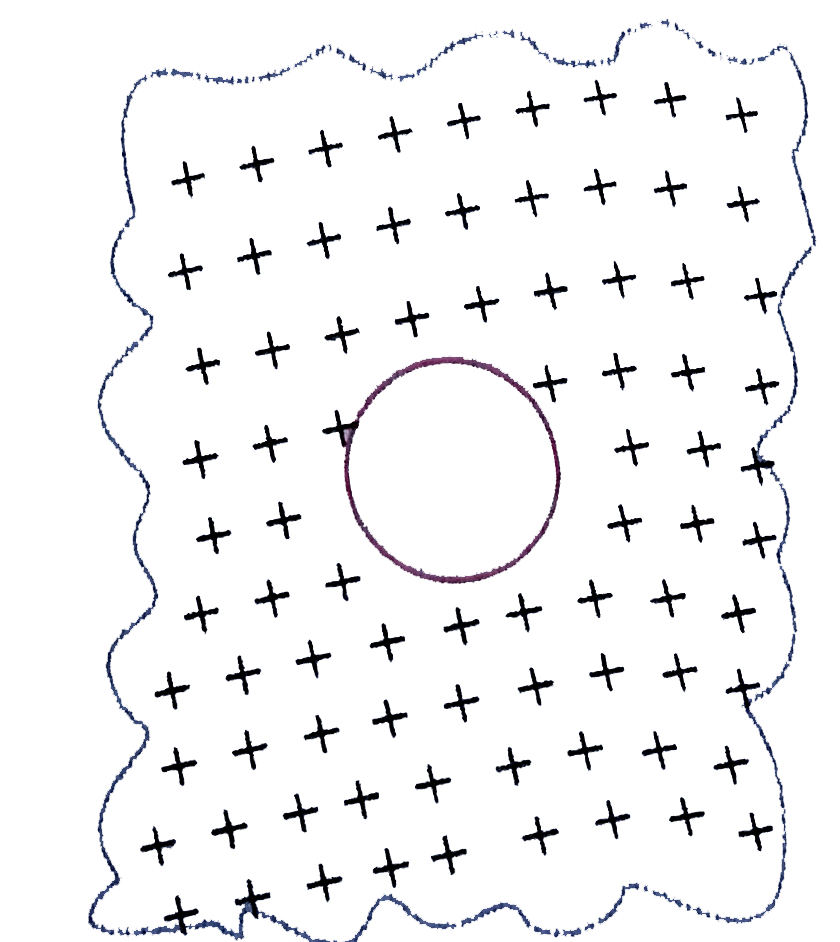
|
|
| 24. |
Read the followingpassage and then answer questions (a) - (e) on the basis of your understand- ing of the passage and the related studied concepts.A semiconductor diode is basically a p-n junction and is thus a two terminal device, when an external voltage is applied across a semiconductor diode such that p-side is connected to the positive terminal of the battery and n-side to the negative terminal, it is forward biased. The direction of the applied voltage is opposite to the built in barrier potential. As a result, the depletion layer width decreases and the barrier height is reduced. If the applied voltage is increased, it may overcome the barrier potential altogether and a large current flows across the junction. When an external voltage (V) is applied across the diode such that n-side is positive and p-side is negative, it is said to be reverse biased. The direction of applied voltage is same as the direction of barrier potential. As a result, the barrier height increases and the depletion region widens. So current flowing across the junction decreases enormously (practically becomes zero) as compared to the diode under forward bias. If an alternating voltage is applied across a diode, the current flows only in that part of the cycle when the diode is forward biased. Name two main components of your mobile phone charger. |
Answer» Solution :TWO main COMPONENTS of the commonly used MOBILE phone charger are (i) step down transformer and (ii) full WAVE rectifier.
|
|
| 25. |
Read the following passage and then answer questions (a) - (e) on the basis of your understand- ing of the passage and the related studied concepts. India is lucky to receive solar energy for the greater part of the year. Energy received from the sun is about 1.4 kW m^(-2) and it is estimated that during a year India receives energy equivalent to more than 5000 trillion kWh from the sun. Solar energy can be harnessed by the use of solar panels. Each solar panel consists of a number of solar cells which work on photovoltaic effect. With continuous enhancement in technology cost of installing solar power has come down and is now comparable with thermal power stations. As a result, solar power is a fast developing industry in India. During last few years country's installed solar capacity has grown by leaps and bounds and reached 30.1 GW as on 31-07-2019. India aims to have an installed solar power capacity of 100 GW by 2022 and 250 GW by 2030. Which material is ideal for solar cell fabrication and why ? |
| Answer» Solution :SEMICONDUCTORS with band gap close to 1.5 eV are ideal material for solar cell fabrication because peak of solar radiation spectrum LIES at 1.5 eV. | |
| 26. |
Read the following passage and then answer questions (a) - (e) on the basis of your understand- ing of the passage and the related studied concepts. India is lucky to receive solar energy for the greater part of the year. Energy received from the sun is about 1.4 kW m^(-2) and it is estimated that during a year India receives energy equivalent to more than 5000 trillion kWh from the sun. Solar energy can be harnessed by the use of solar panels. Each solar panel consists of a number of solar cells which work on photovoltaic effect. With continuous enhancement in technology cost of installing solar power has come down and is now comparable with thermal power stations. As a result, solar power is a fast developing industry in India. During last few years country's installed solar capacity has grown by leaps and bounds and reached 30.1 GW as on 31-07-2019. India aims to have an installed solar power capacity of 100 GW by 2022 and 250 GW by 2030. What a.re the three basic processes due to which the generation of emf takes place in a sol?- cell? |
|
Answer» Solution :Three basic processes are (i) generation of e - N pairs due to solar radiation close to the JUNCTION, (ii) separation of electrons and HOLES due to ELECTRIC field of the depletion region, and (iii) collection of the electrons REACHING with n-side and holes reaching p-side by metal contacts. |
|
| 27. |
A projectile is projected tangentially from the surface of a planet of radius R. If it is at a height of 3R at the farthest point of its trajectory, then thevelocity of projection V_(0) is given by ( acceleration due to gravity on surface=g) |
|
Answer» `v_(0)=SQRT(1.5gR)` |
|
| 28. |
An inductor20 mH , a capacitor 50 muF anda resistor 40 Omegaare connectedin seriesacross asourceof emf v = 10 sin 340 t. The powerloss in AC circuitis ………. . |
|
Answer» `0.76 W` |
|
| 29. |
Does each incident photon essentially eject a photon electron ? |
| Answer» SOLUTION :No, It MAY be absorbed in some other way. When the frequency of incident PHOTON is LESS than the threshold frequency, then there will be no EMISSION of photoelectrons. | |
| 30. |
According to Curie's law, the magnetic susceptibility of a substance at an absolute temperature T is proportional to |
|
Answer» A)1/T |
|
| 31. |
Two particles of mass m and 2m carry a charge +q each. Initially the heavier particle is at rest on a smooth horizontal plane and the other is projected along the plane directly towards the first from a distance d with speed u. Find their closest distance of approach. |
|
Answer» |
|
| 32. |
The magnetic field perpendicular to the plane of a conducting ring of radius r change ate the rate (dB)/(dt) |
|
Answer» The EMF induced in the RING is `pir^(2)(dB)/(dt)` |
|
| 33. |
A star is moving away from the earth with a velocity of 100 km/s If the velocity of light is 3xx10^(8) m/s then the shift of its spectral line of wavelength 5700Å due to Doppler's effect will be : |
|
Answer» `0.63Å` |
|
| 34. |
Which of the following elastic constant will be dimensionless? |
|
Answer» YOUNG's modulus |
|
| 35. |
The potential difference between the plates of a parallel plate capacitor is changing at the rate of 10^(6) Vs^(-1). If the capacitance is 2mu F, the displacement current in the dielectric of the capacitor will be : |
|
Answer» 1 A |
|
| 36. |
Sketchagraphshowingvariationofresistivitywithtemperatureof(i)Copper(ii) Carbon. |
Answer» SOLUTION :
|
|
| 37. |
Statement-I : It is not posible for a system, unaided by an external energy to transfer heat from a body at lower temperature to another body a higher temperature. Statement-II: It is not possible to violate second law of thermodynamics. |
|
Answer» Statement-I is TRUE, statement-II is true and So correct CHOICE is(a). |
|
| 38. |
A beam of relativistic particles with kinetic energy T strikes against an absorbing target. The beam current equals I, the charge and rest mass of each particle are equal to e and m_0 respectively. Find the pressure developed by the beam on the target surface, and the power liberated there. |
|
Answer» Solution :Let the total force exerted by the BEAM on the target surface be F and the power liberated there be P. Then, using the result of the PREVIOUS problem we SEE `F=Np=N/csqrt(T(T+2m_0c^2))=(I)/(ec)sqrt(T(T+2m_0c^2))` since `I=Ne`, N being the number of particles striking the target per SECOND. Also, `P=N((m_0c^2)/(sqrt(1-v^2//c^2))-m_0c^2)=I/eT` These will be, respectively, equal to the pressure and power developed per unit area of the target if I is current DENSITY. |
|
| 39. |
A rectangular block ofmass m and area of cross-section A floats in a liquid of density rho. If it is given a small vertical displacement from equilibrium it undergoes oscillation with a time period T. Then : |
|
Answer» `T prop (1)/(SQRT(m))` `IMPLIES""T prop (1)/(sqrt(A))` Correct choice is ( c ). |
|
| 40. |
Using the following data calculate the refractive index of the material of the convex lens. Radii of curvature of both the surface are 0.2m . Data recorded in the shift method to determine the focal length of the convex lens are a follows : |
|
Answer» SOLUTION :`f = (D^(2) -S^(2))/( 4D)` `f = ( D^(2) - S^(2))/( 4D) = ( 0.82^(2) -0.128^(2))/( 4 XX 0.82) = 0.2m` `f = ( D^(2) - S^(2))/( 4D ) = ( 0.9^(2) - 0.3^(2))/( 4 xx 0.9) = 0.2m` `f_(av) =0.2m` `N = 1+ ( 1)/( f) ( R_(1) R_(2))/( (R_(1)+R_(2)))` `n = 1+ ( 1)/( 0.2) (0.2 xx 0.2)/( ( 0.2+ 0.2))` n = 1.5 |
|
| 41. |
There is one infinitely long strip of current with a large width , carrying current K per unit width. There is onelong solenoid which carries current I. The solenoid is kept near the sheet with its axis parallel to the width of sheet and it is found that the magnetic field near the centre of the solenoid is zero. If the solenoid is further rotated in such a manner that its length is perpendicular to the sheet and current and one end of the solenoid is near the sheet, what will be the net magnetic field at the centre of this end of solenoid? |
|
Answer» `(mu_(0)Ksqrt5)/4` , parallel to the strip `B_("net") = sqrt(((mu_(0)K)/2)^(2) + ((mu_(0)K)/4)^(2)) = (mu_(0)K)/4 sqrt(4 + 1) = (mu_(0)Ksqrt5)/4` `tan theta = 4/((mu_(0)K)/2) = 1/2 rArr theta = tan^(-1) (1//2)` |
|
| 42. |
There is one infinitely long strip of current with a large width , carrying current K per unit width. There is onelong solenoid which carries current I. The solenoid is kept near the sheet with its axis parallel to the width of sheet and it is found that the magnetic field near the centre of the solenoid is zero. If the solenoid is rotated by a 90^(@) angle from theprevious placement, in such a manner that its axis is parallel to the direction of current, what will be the net magnetic field near the centre of the solenoid? |
|
Answer» `(mu_(0)K)/2 sqrt2`, perpendicular to the PLANE of strip When the solenoid is ROTATED by `90^(@)`in such a MANNER that its axis is parallel to current, then its magnetic field becomes perpendicular to the magnetic field of strip but both the fields are still parallel to the plane of strip. Thus, the net magnetic field will be `(mu_(0)K)/2 sqrt2`parallel to the plane of strip. |
|
| 43. |
A charged particle carrying charge q = 1μC moves in uniform magnetic field with velocity v_(1) = 10^(6)m/s at angle 45° with x-axis in x-y plane and experiences a force F_(1)= 5sqrt2mN along the negative z-axis. When the same particle moves with velocity, v_(2) = 10^(6) mis along the z-axis it experiences a force F_(2) in y-direction. Find a) magnitude direction of the magnetic field b) the magnitude of the force F_(2). |
|
Answer» Solution :`F_(2)` is in y-direction when velocity is along z-axis. Therefore, magnetic field should be along x-axis. So let, B = `vecB_(0)hati` a) GIVEN `vecV_(1)=(10^(6))/(sqrt2)hati+(10^(6))/(sqrt2)hatj` and `hatvecF_(1)=-5sqrt2xx10^(3)hatk` From the equation, `vecF=q(vecvxxvecB)`, we have `(-5sqrt2xx10^(-3))hatk=(10^(-6))[((10^(6))/(sqrt2)hati+(10^(6))/(sqrt2)hatj)xx(B_(0)hati)]=-(B_(0))/(sqrt2)hatk` `therefore(B_(0))/(sqrt2)=5sqrtxx10^(-3)` or `B_(0)=10^(-2)T` Therefore, the magnetic field is, `vecB=(10^(-2)hati)T` b) `F_(2)=B_(0)qv_(2)sin90^(@)` As the angle between `vecB` and `vecv` in this CASE is 90°. `thereforeF_(2)=(10^(-2))(10^(-6))(10^(6))=10^(-2)N` |
|
| 44. |
A horizontal straight wire 10m long extending from east to west is falling with a speed of 5.0m/s at right angles to the horizontal component of earths magnetic field 0.3xx10^(-4) tesla. The emf induced across the ends of wire is |
|
Answer» 1.5 MV with higher POTENTIAL at eastern end |
|
| 45. |
To a real object, magnification and image distance graph is as shown in the figure. Find (a) the nature of the mirror and image. (b) the power of the mirror. |
| Answer» SOLUTION :(a) CONVERGENT, VIRTUAL , (B) 5D | |
| 46. |
The relationship between kineticenergy (K) of alpha - particle bombarded on the goldfilm ant the distanceof closedapproch (r_(0)) is __________. |
| Answer» SOLUTION :`r_(0) XX (1)/(k)` | |
| 47. |
A distribution transformeer with an efficiency of 90% supplies to a colony of 10homes have electrical oven running at the same time, that draw 20 A current from 220 V lines. The power dissipated as heat in the transformer is |
|
Answer» `12.2kW` `P = 10 VI` `implies `Voltage , `V= 220V` Current, `I = 20A` `P = 10(220xx 20)` ` P = 44 xx 10^(3) W` As, EFFICIENCY of transformer is `90%` so power dilivered by transformer `implies p '= (100)/(90) xxp = (10)/(9) xx 44 xx 10 ^(3)` `p' =48.9 xx10^(3) W` Power wasted or dissipated as heat Heat, `H = p'-p=(48.9-44)10^(3)` `=4.89KW~~4.9KW` |
|
| 48. |
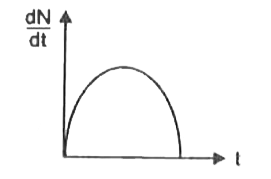
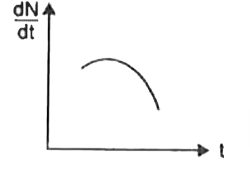
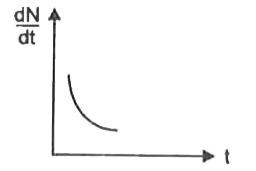
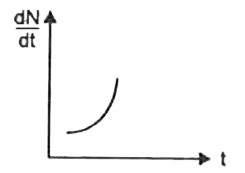
Radioactive element decays to form a stable nuclide, then the rate of decay of reactant ((dN)/(dt)) will vary with time (t) as shown in figure |
|
Answer»
i.e, Rate of decay `((d N)/(dt))` varies exponentially with time (t). |
|
| 49. |
A square loop of side 2cm carrying current I_(0) is placed in x-y plane in a magnetic field B= (4hat(i)+3hat(j)) T Find the unit vector along the axis about which it will start rotating. |
|
Answer» `(4hat(j)+3HAT(i))/5` and`VEC(B)=4hat(i)+3hat(j)` `vec(B)=4/5hat(i)+3/5hat(j)` `mu=ivec(A)` `=-(4xx10^(-4)xxI_(0))hat(k)` `hat(tau)=muxxhat(B)` `hat(tau)=4/5hat(j)-3/5hat(i)` Thus the unit vector of the AXIS is `PM hat(tau)` |
|
| 50. |
Which one of the two , an ammeter or a milliammeter, has a higher resistance and why? |
|
Answer» Solution :To convert a GALVANOMETER into an ammeter of RANGE I we JOIN a shunt resistance `r_s` given by `r_s = (I_g)/(I - I_g) cdot R_G` and then net resistance of ammeter is `(r_s . R_G)/(r_s + R_G),` which is slightly less than even `r_s`. As range l of an ammeter is more than that of a milliammeter, hence value of shunt resistance is LESSER for an ammeter. CONSEQUENTLY, resistance of an ammeter is less or comparatively speaking resistance of a milliammeter is higher. |
|