

Saved Bookmarks
This section includes 7 InterviewSolutions, each offering curated multiple-choice questions to sharpen your Current Affairs knowledge and support exam preparation. Choose a topic below to get started.
| 1. |
A chargedparticle with specfic charge q//m starts movingin the regionof spacewhere there are unifrommutually perpendicular electricand magnitude fields. The magentic field is constant and has aninduction B while the strength of the electric field varies with time as E = E_(m) cosomega t, where omega = qB//m. For the non-relativistic case find the law of motion x(t) and y(t) of theparticle if at the moment t = 0 it was located at the pointO (see Fig). What is the appoximateshape of thetrajectory of the particle? |
|
Answer» Solution :The equactions are as in 3.392. `(dv_(x))/(dt) = (qB)/(m) v_(y), (dv_(y))/(dt) = (qE_(m))/(m) cos omega t - (qB)/(m) v_(x)` and`(dv_(x))/(dt)` with `omega = (qB)/(m), xi = v_(x) + iv_(y)`, we get, `(d xi)/(dt) = I (E_(m))/(B) omega cos omega t - i omegaxi` or mutiplying by `e^(i omega t)` `(d)/(dt) (xi, e^(i omega t)) = i (E_(m))/(2B) omega (e^(i omega t) + 1)` on intergrating, `xi e^(i omega t) + (E_(m))/(4B) e^(i omega t) + (E_(m))/(2B) i omega t` or, `xi= (E_(m))/(4B) (e^(i omega t) + 2 i omega t e^(i omega t)) + C e^(i omega t)` SINCE `xi = 0` at `t = 0, C = - (E_(m))/(4B)`, Thus, `xi = i (E_(m))/(2B) sin omega t + i (E_(m))/(2B) omega t e^(i omega t)` or, `v_(x) = (E_(m))/(2B) omega t sin omega t` and `v_(y) = (E_(m))/(2B) sin omega t + (E_(m))/(2B) omega t cos omega t` Intergrating again, `x = (a)/(2 omega^(2)) (sin omega t- omega t cos omega t), y = (a)/(2 omega) t sin omega t`. where, `a = (qE_(m))/(m)`, and we have used `x = y = 0`, at `t = 0` The TRAJECTORY is an UNWINDING spiral. |
|
| 2. |
The increase in length of a wire on stretching is0.04 %. If it's poisson's ratio is 0.5, at what percentage the diameter will reduce ? |
| Answer» Solution :`(DELTA L) /L= (4)/(100 XX 100) = 4 xx 10^-4` there for `(delta D)/D = delta( delta L)/L =1/2 xx 4 xx 10^-4 = 2 xx 10^-4` `(delta D)/D = 0.02/100 = 0.02%` | |
| 3. |
How does conductivity of a semiconductor increase ? |
| Answer» Solution :By INCREASING the temperature of by doping with SUITABLE IMPURITIES . | |
| 4. |
Assertion : A balloon stops risingafter attaininga certain maxium height . Reason : Upthrust due to air decreases with height till it just balancesthe weightof the balloon. |
|
Answer» If both the assertion and reason are true statement andreason is correct explanation of the assertion . |
|
| 5. |
If the capacity of each condenser is 10 mu F, the equivalent capacity between x and y is |
|
Answer» `10 mu F ` |
|
| 6. |
Find the static resistance of a P-N junction germanium diode if temperature is 27^(@)C and I_(s) = 1 mu A for an applied forward bias of 0.2 volt. |
| Answer» SOLUTION :`2xx105Omega` | |
| 7. |
A series LCR circuit with L = 0.12 H, C = 480 nF, R = 232 is connected to a 230 V variable frequency supply. (a) What is the source frequency for which current amplitude is maximum ? Obtain this maximum value. (b) What is the source frequency for which average power absorbed by the circuit is maximum ?Obtain the value of this maximum power. (c) For which frequencies of the source is the power transferred to the circuit half the power at resonant frequency ? What is the current amplitude at these frequencies? (d) What is the Q-factor of the given circuit ? |
|
Answer» <P> Solution :(a) Here L = 0.12 H, C = 480 nF `=480 xx 10^(-9) F, R = 23 Omega` and `V_(rms) = 230 V`Resonant frequency when the current is maximum `v_(r) =1/(2pisqrt(LC)) = 1/(2 xx 3.14 xx sqrt(0.12xx 480 xx 10^(-19))) = 663` Hz and maximum current `I_(m) = V_(m)/R = (sqrt(2) xx 230)/23 = 14.1 A` (b) Power absorbed is maximum at resonance frequency `v_(r)` The maximum power `= I_(rms) V_(rms) = (14.1)/sqrt(2) xx 230 = 2300 V` ( c) For `Deltaomega = +- R/(2L)`, the power transferred is half as that at resonating frequency i.e. `omega_(2) = omega_(r) + R/(2L)` or `v_(2) =v_(r) + R/(4pi L) = 663+ (23)/(4 xx 3.14 xx 0.12) = 678 Hz` At these frequencies, the power transferred to the CIRCUIT is half the power at resonant frequency `P = 1/2 P_("max") = 1/2 I^(2)R = 1/2 xx 1/2 I_(m)^(2)R rArr I = I_(m)/sqrt(2) = (14.1)/sqrt(2) = 10 A` (d) The Q-factor `=(omega_(r)L)/R = (2PI v_(r)L)/R = (2 xx 3.14 xx 663 xx 0.12)/23 = 21.7` |
|
| 8. |
Define decay constant of a radioactive sample. |
| Answer» SOLUTION :DECAY CONSTANT of a radioactive sample is the reciprocal of the time during which the NUMBER of nuclides LEFT undecayed is `1/e` times the original number. | |
| 9. |
What is an ideal cell? |
|
Answer» Solution :A cell or BATTERY whose internal RESISTANCE is ZERO, is CALLED ideal cell. For ideal cell p.d., is EQUAL to e.m.f. |
|
| 10. |
A bar of length l canying a small mass m at one of its ends rotates with a uniform angular speed omega in a vertical plane about the mid-point of the bar. During the rotation, at some instant of time when the bar is horizontal, the mass is detached from the bar but the bar continues to rotate with same omega. The mass moves ve1tically up, comes back and reaches the bar at the same point. At that place, the acceleration due to gravity is g. |
|
Answer» this is possible if the quantity `(OMEGA^(2)l)/(2pig)` is an integer So, time period, T`=(2v)/g=(omegal)/g` or `nxx(2pi)/omega=(omegal)/g` (as the bar completes .n. rotations within time period T.) `thereforen=(lomega^(2))/(2pig)=(omega^(2)l)/(2pig)` will be an integer. So, distance travelled = `2h=(2v^(2))/(2g)=(l^(2)omega^(2))/(4g)` `therefore` Distance travelled `PROP omega^(2)` So, option (a), (C) and (d) are correct. |
|
| 11. |
What is mean life of a radioactive element? |
| Answer» Solution :The RATIO of total LIFE time of all the ATOMS ofradioactive element and the total NUMBER of atoms PRESENT initially. | |
| 12. |
A force between the two stationary charges separated by certain distance a) obeys Newton's third law b) is a central force c) is non conservative force d) is a scalar |
|
Answer» a is CORRECT |
|
| 13. |
Two infinite line charges, each having a uniform density lambda. Pass through the midpoints of two pairs of opposite faces of a cube of edge L as shown in figure. The modulus of the total electric flux due to both the line charges through the face is ABCD is lambda L//(k epsilon_(0)) find the value of k ? |
|
Answer» |
|
| 14. |
A: Transducer in communication system converts electrical singal into a physical quantity. R: For information signal to be transmitted directly to long distances, modulation is not a necessary process. |
|
Answer» |
|
| 15. |
In a transistor circuit, when the base current is increased by 501A, keeping the collector voltage fixed at 2V, the collector current increases by 1mA. The current gain of the transistot is |
|
Answer» 20 |
|
| 16. |
The size of the nucleus of an atom of mass number A is proportional to |
|
Answer» `A^(3/4)` |
|
| 17. |
Figure shows two capacitors of capacitance 2muF and 4muF and a cell of 90 V. The switch 'k' is such that when it is in position 1, the circuit ABCD is closed and when it is in position 2, the circuit BCEF is closed.the resistance of both the circuits is negligible os that the capacitor gets fully charged instantly. Initially the switch is in position1. then it is turned in position 1 and then in position2. Now two cycles are completed. Find the charge ("in" mu C) after two cycles. |
|
Answer» |
|
| 19. |
5 mole of an ideal gas with gamma = 7/5 initially at STP are compressed adiabatically so that its temperature becomes 400^@C. The increase in the internal energy of gas in kJ is |
|
Answer» 21.55 `dU=(nR DT)/(gamma-1)` `=(5xx8.31xx(400-0))/((7//5)-1)`= 41550 J = 41.55 kJ |
|
| 20. |
The movie was not good. The writing was sloppy and direction was pointless she ....... |
|
Answer» Stammered |
|
| 21. |
Find the equation of the equipotential for an infinite cylinder of radius r_(0) carrying charge of linear density lambda. |
Answer» Solution :Take a Gaussian surface of radius R and length l 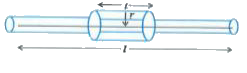 `int_(0)^(2pil)vecE.dvecS= (Q)/(in_(0))` `= (lambdal)/(in_(0))` From Gauss.s LAW `[ E_(r) S cos theta]_(0)^(2pirl) = (lambdal)/(in_(0))` `E_(r)xx2pirl=(lambdal)/(in_(0))[ theta=0 :. cos 0^(@)= 1]` `:. E_(r)= (lambda)/(2pi in_(0)r)` The radius of infinite cylinder is `r_(0)` `V(r)- V(r_(0))=-int_(r_(0))^(r)Edl` `= -(lambda)/(2piin_(0))"log"_(E)(r)/(r_(0))=(lambda)/(2piin_(0))="log"_(e)(r_(0))/(r)` because `int_(r_(0))^(r)(lambda)/(2piin_(0))dr= (lambda)/(2p in_(0))int_(r_(0))^(r)(1)/(r) dr` `V = (lambda)/(2pi in_(0))"log"_(e)(r)/(r_(0))` For given V , `"log"_(e)(r)/(r_(0))=-(2piin_(0))/(lambda)xx[V(r)-V(r_(0))]r=r_(0)e ^((2pi in_(0))/(lambda)[V(r)-V(r_(0))])` `:. r = r_(0)e^(-(2pi in_(0))/(lambda)[V(r)-V(r_(0))])` |
|
| 22. |
Slowest movement is |
|
Answer» flagellated |
|
| 23. |
An em wave exers pressure on the surface on which it is incident. Justify? |
| Answer» Solution :An ELECTROMAGNETIC WAVE exerts pressure on the surface on which it is incident because these WAVES CARRY both ENERGY and momentum. | |
| 24. |
In the propagation of electromagnetic waves the angle between the direction of propagation and plane of polarization is |
| Answer» ANSWER :A | |
| 25. |
(i) Distinguish between unpolarised and linearly polarised light. (ii) What does a polaroid consist of? How does it produce a linearly polarised light ? (iii) Explain briefly how sunlight is polarised by scattering through atmospheric particles. |
|
Answer» Solution :(i) In a beam of unpolarized light, the vibrations of light vectors are in all directions in a plane perpendicular to direction of propagation. In polarized light, these vibrations are only along one direction. (ii) Polaroids CONSIST of long chain of molecules aligned in a particular direction. It polarizes light as it alllows only one component of light (electric vectors PARALLEL to the pass axis) to pass through it while the other component is absorbed. (iii) The OBSERVER receives scattered light corresponding to only one of two sets of accelerated charges i.e. ELECTRONS oscillating perpendicular to the direction of propagation. |
|
| 26. |
When the temperature of a conductor increase the ratio of its resistivity and conductivity ...... |
|
Answer» remain constant `(sigma )/(rho ) = (1)/(rho^(2))` and according to `rho = (m)/("ne"^(2) tau.) tau` decreases WITHINCREASE in TEMPERATURE Hence `rho ` INCREASES and `(1)/(rho^(2))` decreases. |
|
| 27. |
What is the shape of the wavefront in each of the following cases? a. Light diverging from a point source. b. Light emerging out of a convex lens when a point source is placed at its focus. c. The portion of the wavefront of light from a distanct star intercepted by the Earth. |
| Answer» SOLUTION :a. SPHERICAL B. PLANE C. plane | |
| 28. |
If the mass of neutron = 1.7 xx 10^(-27) kg, then the de Broglie wavelength of neutron of energy 3 e V is: (h = 6.6 xx 10^(-34)Js) |
|
Answer» `1.6 XX 10^(-16) m` |
|
| 29. |
(a) Write the basic nuclear process involved in the emission of beta^(+) in asymbolic form, by a radioactive nucleus. (b) In the reactions given below: (i) " "_(6)^(11)Cto" "_(y)^(z)B+x+nu "" (ii)" "_(6)^(12)C+" "_(6)^(12)Cto" "_(a)^(20)Ne + " "_(b)^(c)He Find the values of x, y and z and a, b and c. |
|
Answer» Solution :(a) See SHORT Answer Question Number 34(II). (b) The completed reactions are as given below : (i) `" "_(6)^(11)Cto" "_(5)^(11)B+" "_(+1)^(0)e+nu "" (ii)" "_(6)^(12)C+" "_(6)^(12)Cto" "_(10)^(20)Ne + " "_(2)^(4)He` |
|
| 30. |
The direction of magnetic lines of forces close to a straight conductor carrying current will be ______. |
|
Answer» ALONG the length of the conductor |
|
| 31. |
The Vernier scale of an instrument has 50 divisions which coincide with 49 main scale divisions. If each main scale division is 0.5 mm, then using this instrument the minimum inaccuracy in the measurement ofdistance is |
|
Answer» `0.01`MM |
|
| 32. |
The angular speed of a motor increases from 600 rpm to 1200 rpm in 10 seconds. What is the angular acceleration of the motor |
|
Answer» |
|
| 33. |
The ratio of SI unit to CGS unit of a physical constant is 10^(7). That constant is |
|
Answer» UNIVERSAL gas constant |
|
| 34. |
In a problem of differentiation of(f(x))/(g(x)), one student writes the derivative of(f(x))/(g(x)) as(f'(x))/(g'(x))and he finds the correct result . If g(x)=x^(2)and lim_(xtooo)f(x)=4On the basis of above information , answer the following questions :sum_(r=1)^(n+2)(r^(2))/(f(r)) is |
|
Answer» `(N(n+1)(2n+1))/(6)` |
|
| 35. |
In Young.s double slit experiment S_(1) andS_(2) are two slits. Films of thicknesses t_(1) and t_(2) refractive indices mu_(1) and mu_(2) are placed in front ofS_(1) and S_(2)repectively.If mu_(1) t_(1) = mu_(2) t_(2), thenthe centralmaximum will |
|
Answer» Not shift |
|
| 36. |
In a problem of differentiation of(f(x))/(g(x)), one student writes the derivative of(f(x))/(g(x)) as(f'(x))/(g'(x))and he finds the correct result . If g(x)=x^(2)and lim_(xtooo)f(x)=4On the basis of above information , answer the following questions :The function f(x) is |
|
Answer» `(4X)/((X-2))` |
|
| 37. |
In the circuit shown in fig., the potential difference between the points C and D is balanced against 40cm length of potentiometer wire of total length 100cm. In order to balance the potential difference between the points D and E. The jockey be pressed on potentiometer wire at a distance of |
|
Answer» 16cm |
|
| 38. |
A plane electromagnetic wave3 of wavelength lambda has an indentsity I. It is propagating along the position Y - direction. The allowed expressions for the electric and magnetic fields are given by |
|
Answer» `vecE=sqrt((I)/(epsilon_(0)C))cos[(2pi)/(lambda)(y-ct)]hati,vecB=(1)/(c)Ehatk` `E_(0)=(E_(0))/(C )` Direction of `vecExx vecB` will be ALONG `+HATJ` |
|
| 39. |
Name the phenomenon which shows the quantum nature of electromagnetic radiation. |
| Answer» Solution :PHENOMENON of PHOTOELECTRIC EFFECT SHOWS the quantum nature of electromagnetic RADIATION. | |
| 40. |
Examine table 3 and express (a) energy required to break one bond in DNA in eV, (b) typical energy of a proton in a nucleus in eV, (c ) energy released in burining 1000 kg of coal in kilicalories |
|
Answer» Solution :(a)Energy REQUIRED to break one bond of DNA `=(10^(-20))/(1.6xx10^(-19)J//eV)=0.06eV` (B) Typical energy of a PROTON in a nucleus `=(10^(-13))/(1.6xx10^(-19)J//eV)=625000eV` (c ) Energy RELEASED in burning 1000 kg of coal `=(3xx10^(-10))/(4.2xx10^(3)J//Kcal)=7142857. 14 kcal` |
|
| 41. |
Obtain the expression for the magnetic energy stored in a coil (solenoid). |
|
Answer» Solution :When a current is established in a coil , work has to be done against the BACKEMF. This work done is stored in the form of magnetic energy in the coil. LET dw be the work done in ESTABLISHING a currentI in the coil in a time dt. Then dw=-`epsilon` I dt Where `epsilon` is induced emf. Since `epsilon=-L(DI)/(dt)` We have `dw=L(dI)/(canceldI)Icanceldt rArr dw=L I dI` The total work done is establishing current is `w=int dw = int_0^1L I dI = L[1^2/2]_0^I=1/2LI^2` This work is stored in the coil in the form of magnetic potential energy `U=1/2LI^2` |
|
| 42. |
Estimate the rate that heat can be conducted from the interior of the body to the surface. Assume that the thickness of tissue is 4.0 cm, that the skin is at 34^(@)C and the interior at 37^(@)C, and that the surface area is 1.5m^(2). Compare this to the measured value of about 225 W that must be dissipated by a person working lightly. This clearly shows the necessity of conveclive cooling by the blood. Given that the thermal conductivity of the blood cells is 0.2 W//mK |
|
Answer» |
|
| 43. |
Show that ifthe rate of change oftemperature with height dT//dh called lapse rate is a constant, a sound wave travelling horizontally is refracted along an arc of radius of curvature |
|
Answer» |
|
| 44. |
In the figure shown ‘O’ is point object. AB is principal axis of the converging lens of focal length F. Find the distance of the final image from the lens. |
|
Answer» |
|
| 45. |
The phenomenon of polarization shows that light has .......nature. |
|
Answer» dual |
|
| 46. |
आर्कीडेक्टोमी शल्य चिकित्सा द्वारा निकाला जाता हैं - |
|
Answer» लिवर |
|
| 47. |
A solenoid of infinite length consists of a single layer 1000 turns per unit length of a wire carrying a current of 2mA. Calculate the magnetic field on the axis at the middle of the solenoid. |
| Answer» SOLUTION :`2.5 XX 10^(-6)T` | |
| 48. |
Why do you select your answer? |
| Answer» SOLUTION :SINCE all other QUANTITIES DEPENDS on the AREA of cross-section | |
| 50. |
A piece of metal of mass 17 g is tied to cork of mass 5 g and the combination floats without sinking in water. If relative density of cork is 0.25 and water 1, the relative density of metal is : |
|
Answer» 2 = R.D. of combination `=(m_(1)+m_(2))/([(m_(1))/(d_(1))(m_(2))/(d_(2))])=(17+5)/(17/(d_(1))+5/(0.25))` or `d_(1)=8.5`. CORRECT choice is (c). |
|