Saved Bookmarks
This section includes 7 InterviewSolutions, each offering curated multiple-choice questions to sharpen your Current Affairs knowledge and support exam preparation. Choose a topic below to get started.
| 1. |
Can the average velocity of a particle, moving in one dimensional motion be equal to its instantaneous velocity. |
| Answer» SOLUTION :YES , this is possible in case of uniform MOTION ALONG a STRAIGHT line. | |
| 2. |
The refractive index of diamond is much greater than the of ordinary glass. is this fact of some use to a diamond cutter ? |
| Answer» Solution :Yes. The refractive index of diamond is 2.42 and vertical ANGLE `24^(@)`. any plane of the diamond, if faces with angle of incidence `gt 24^(@)`, can produce total internal REFLECTION from MANY faces than PRODUCING sparkling effect. | |
| 3. |
The e.m.f. of one accumulator is e, its internal resistance is r. Find the e.m.f. epsi and the internal resistance R_(i) of a battery of n accumulators connected (Fig. 26.10): (a) in series, (b) in parallel, (c) in m series-connected groups of k accumulators, m lt n. k = n/m, where the accumulators are connected in parallel. |
|
Answer» (b) When the cells are connected in parallel, the e.m.f. remaias unchanged, but the internal conductances are added. (c) in a mixed connection we calculate first the e.m.i. and the internal RESISTANCE of a group, and then the game parameters for the battery as a WHOLE. |
|
| 4. |
The inputs A , B and C to be given in order to get an output Y = 1 from the following circuit are |
|
Answer» A) 0 , 1 , 0 |
|
| 5. |
(a) Consider an arbitrary electrostatic field configuration. A small test charge is placed at a null point (i.e., where E = 0) of the configuration. Show that the equilibrium of the test charge is necessarily unstable. (b) Verify this result for the simple configuration of two charges of the same magnitude and sign placed a certain distance apart. |
Answer» Solution :(a) For any electrostatic field configuration, test charge `q_0` (extremely small, point like positive charge) when placed at null point (where resultant electric field is zero) remains certainly under unstable equilibrium condition. Let us prove this by method of contradiction. 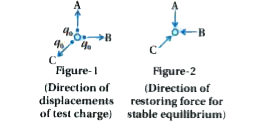 Suppose point 0 is null point and suppose test charge `q_0` is under stable equilibrium condition at that point. If really it is so then when `q_0`is displaced in any direction like `vec(OA), vec(OB)` or `vec(OC)`...... and then released, it should return back to same point O. For this to happen, restoring force MUST act towards null point O from all the directions for which all the electric field lines at point 0 should be radially inward. This can happen if Gaussian SURFACE imagined around point O encloses some negative charge ! But actually it is not so. Hence, our assumption is wrong. This means that test charge placed at null point remains under unstable equilibrium condition, (b) Consider a system of two identical point charges q and q lying respectively at POINTS A and B. 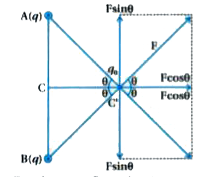 For above configuration (arrangement) null point is C which is midpoint of `bar(AB)`. Now, when test charge `q_0` is displaced from C to C. resultant Coulombian force on `q_0` is `2Fcostheta`, which is pointing away from null point C, which means that test charge `q_(0)` will never come back to its equilibrium POSITION at C. Thus, test charge qQ placed at C is under unstable equilibrium condition (because it had been stable equilibrium condition then test charge would have returned to position C from all the directions). |
|
| 6. |
Assertion: When radius of circular loop carrying current is doubled, its magnetic moment becomes four times. Reason : magnetic moment depends on area of the loop. |
|
Answer» If both assertion and reason are true and reason is the correct explanation of assertion. Explanation : Magnetic moment M = IA = I `(pi R^(2))` NEW magnetic moment M 1 = I `pi` (2r) 2 = 4 `pi` I r 2 = 4 M |
|
| 7. |
The resolution limit of a normal human eye is 1 minute. A person wants to see two pillars at a distance of 11 km as separate ones. The distance between the two pillars should be approximately |
|
Answer» 1.6 m |
|
| 8. |
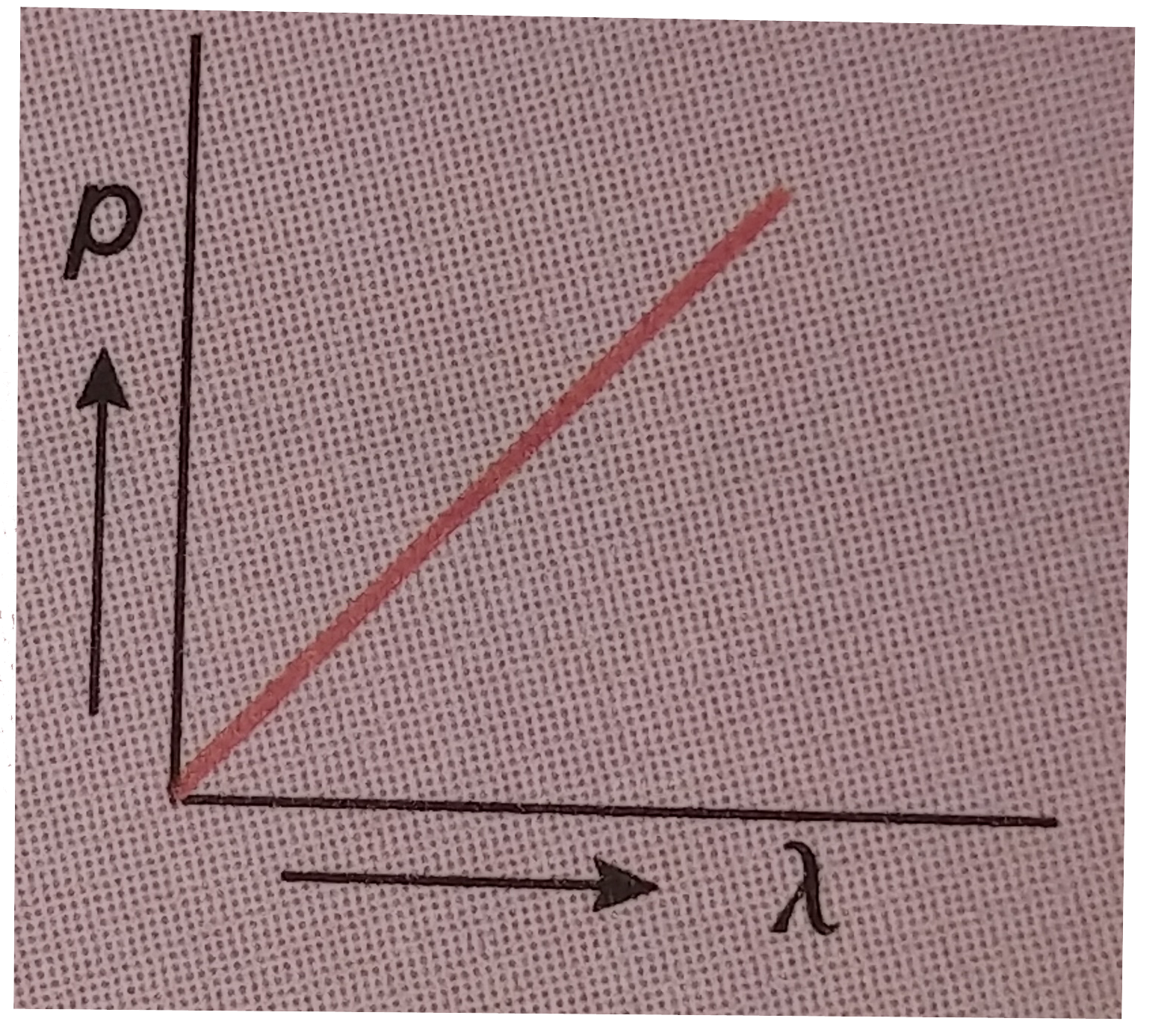
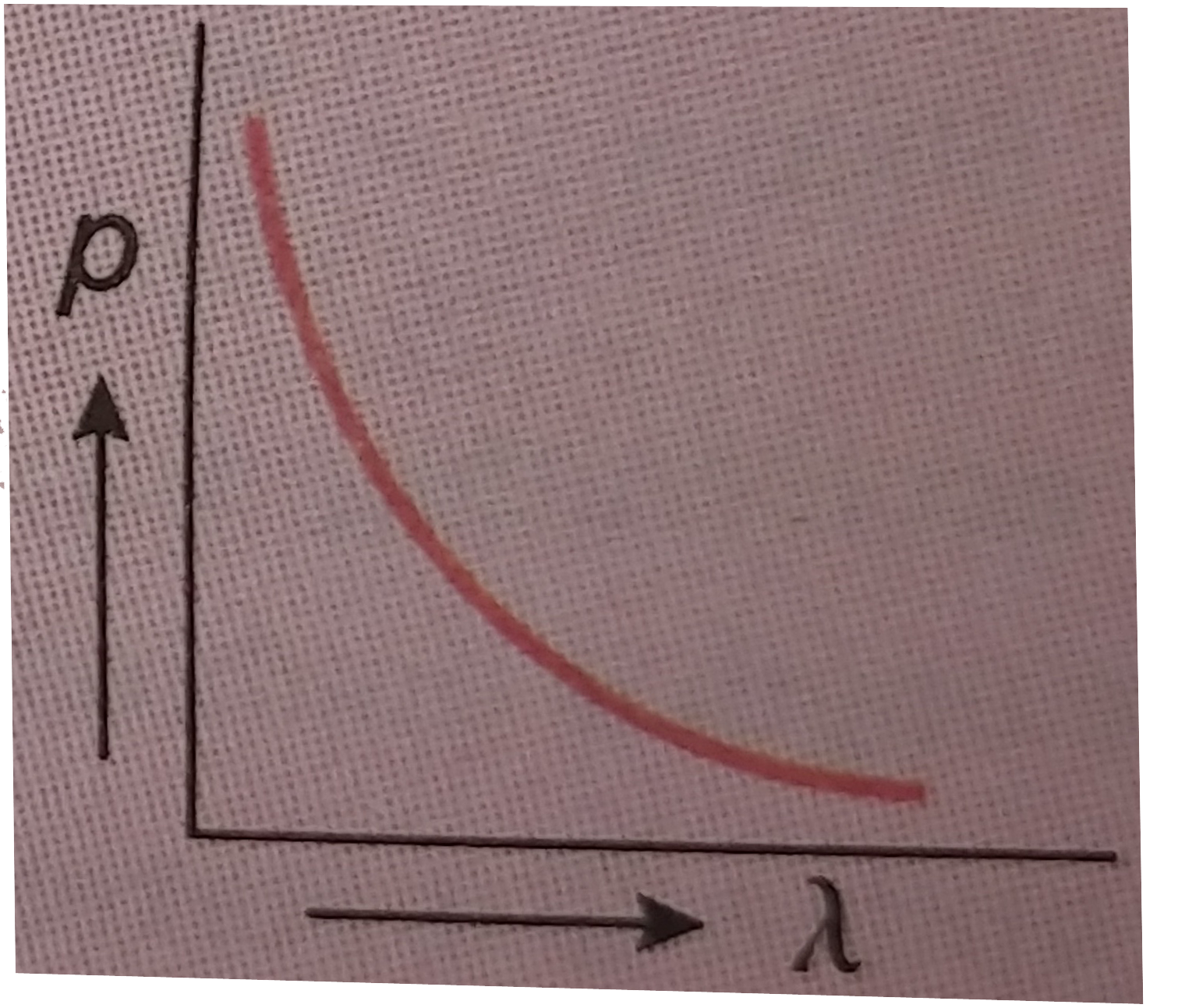
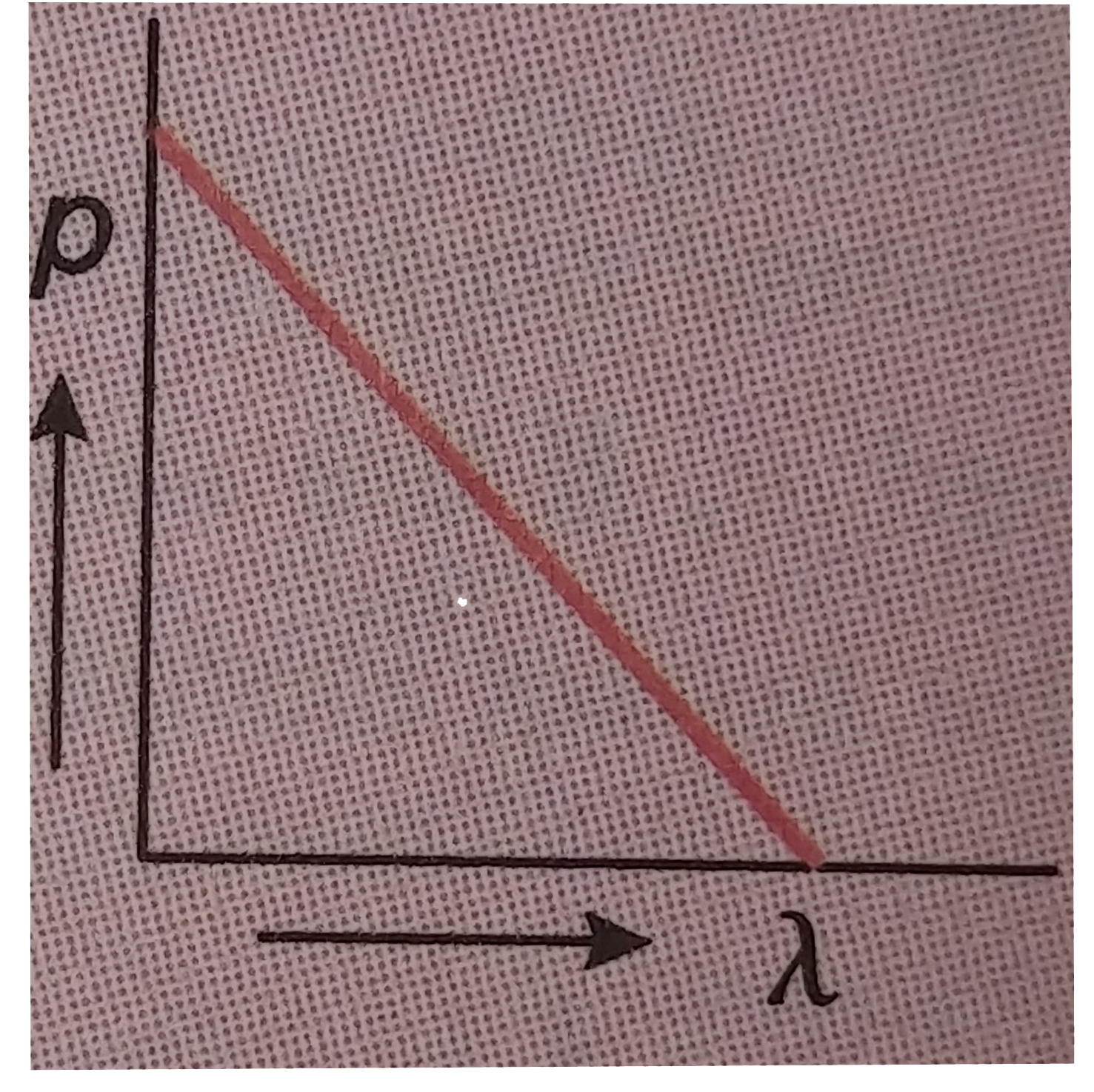
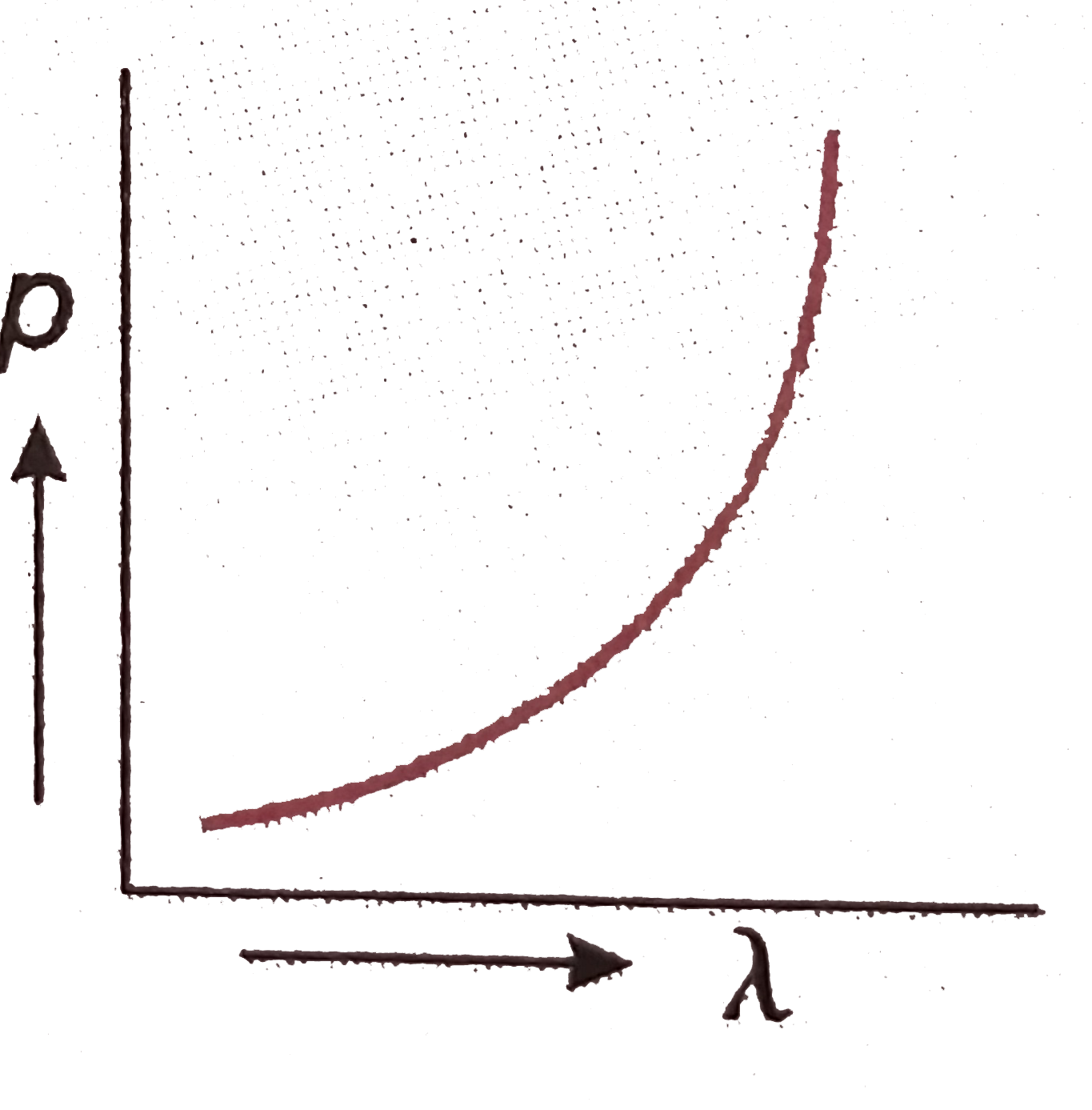
Which of the following figures represent the variation of particle momentum and the associated de Broglie wavelength? |
|
Answer» <P> so, `p lamda = h=` CONSTANT `:.` The `lamda -p` GRAPH will be rectangular hyperbola. |
|
| 9. |
A wire of length 0.1m moves with a speed of 10 ms^(-1) perpendicular to a magnetic field of induction 1Wbm^(-2). Calculate induced emf |
|
Answer» |
|
| 10. |
Unit and dimensional formula of volume charge density are....... |
|
Answer» `CM^(-3),M^(0)L^(-3)T^(1)A^(1)` `|rho|= |q|/|V| =(A^(1)T^(1))/L^(3) = M^(0)L^(-3)T^(1)A^(1)` |
|
| 11. |
A ring, a solid cylinder,a hollow sphere and a solid sphere are released from rest on an inclined plane from same level.If there is no sliping then which one of these will reach the ground at last? |
|
Answer» RING |
|
| 12. |
Figure gives a system of logic gates . From the study of truth table it can be found that to produce a high output (1) at R , we must have |
|
Answer» X = 0 , Y = 1 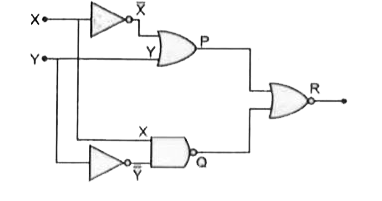 The truth table can be written as 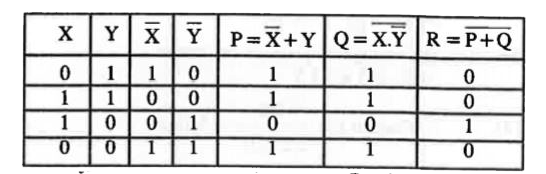 Hence X = 1 , Y = 0 GIVES OUTPUT R = 1 . |
|
| 13. |
What is the wavelength of light for the least energetic photon emitted in the Lyman series of the hydrogen spectrum? |
|
Answer» 150nm `(1)/(lamda) = R ((1)/(n_(1)^(2))- (1)/(n_(2)^(2))) RARR (1)/(lamda) = 1.097 XX 10^(7) ((1)/(1^(2))-(1)/(2))` `lamda= (4)/(3 xx 1.097 xx 10^(7))= 112nm` |
|
| 14. |
In the previousd question If R and S are interchanged the blanced point is shifted by . |
|
Answer» `30cm` `l = 75 100 - l = 25` Balance point will be shifted by `75 -25 = 50 cm` . |
|
| 15. |
A parallel beam of light of all wavelength greater than 3000Å falls on a double slit in a Young's double slit experiment. It is observed that the wavelength 3600Å and 6000Å are absent at a distance of 31.5 mm from the position of the centre maximum and the orders of the interference at this point for the two wavelength differ by 7. If the distance between the slit and the screen in 1m, the sepration between the two slits is |
|
Answer» 0.08 MM |
|
| 16. |
Derive the relation between f and R for a spherical mirror. |
|
Answer» Solution :Let C be the centre of curvature of the mirror. Consider a light RAY parallel to the PRINCIPAL axis is incident on the mirror at M andpassesthrough theprincipal focus F after reflection. The geometry of reflection of the incident ray is shown in figure. The line CM is the normal to the mirrorat M. Let i be the angle of incidence and same will be the angle of reflection. If MP is the perpendicular from M on the principal axis, then from the geometry. The angles `angle MCP = i and angle MFP = 2i` From right angle trianagles `DeltaMCP and Delta MFP`. `tan i = (PM)/(PC) and tan2i = (PM)/(PF)` Asthe angles are small, `tiapproxi,i=(PM)/(PC)and2i=(PM)/(PF)` Simplifying further, `2(PM)/(PC) = (PM)/(PF):2PF=PC` PF is focal lenght f and PC is the radius of curvature R. `2f = R (or) f = (R)/(2)` `f = (R)/(2)` is the relation between f and R. 
|
|
| 17. |
Give main characteristics of holes present in semiconductor. |
|
Answer» Solution :Characteristics of holes `(i)` Hole carries a UNIT POSITIVE CHARGE. `(ii)` Mass of hole is equal to mass of electron. `(iii)` ABSENCE of electron means PRESENCE of a hole. `(iv)` Energy of hole is higher than electron. `(v)` Mobility of hole is less than electron. |
|
| 18. |
In communication with help of antenna if height is doubled, then the range covered w which was initially r would become |
|
Answer» `sqrt(2)`r When HEIGHT of antenna is DOUBLED, `r.=sqrt(2Rxx2h)=sqrt(2r)` |
|
| 19. |
Ultraviolet radiation in incident on sodium metal.Then visible light is incident.Potential difference is measured in both case.Stopping potential…. |
|
Answer» Will be same for both metals Energy of ultraviolet radiation (hf)`gt` energy of visible light `therefore (V_(0))"ultraviolet" gt(V_(0))"visible"` |
|
| 20. |
An electromagnetic wave of electric field E=10 sin (omega t-Kx)N//C is incident normal to the cross - sectional area of a cylinder of 10 cm^(2) and having length 100 cm, lying along X - axis. Find (a) the energy density,(b) energy contained in the cylinder, (c ) the intensity of the wave, (d) momentum transferred to the cross - sectional area of the cylinder in 1 s, considering total absorption, (e ) radiation pressure.[epsilon_(0)=8.854xx10^(12)C^(2)N^(-1)m^(-2), c=3xx10^(8)ms^(-1)] |
|
Answer» Solution :For relative cylinder, area `A=10cm^(2)=10xx10^(-4)m^(2)` length l = 100 cm = 1 meter (unit length) For the electromagnetic WAVE incident perpendicularly, `E=10 sin(omega t-kx)N//C` (a)Energy density `rho = epsilon_(0)E_(rms)^(2)` `=epsilon_(0)(E_(0)^(2))/(2) ""(E_(0)=10 N//C)` `therefore rho = (8.85xx10^(-12)xx100)/(2)=4.425xx10^(-10)J//m^(3)` (b)Energy contained in the cylinder U = energy density `xx` volume `therefore U = 4.425xx10^(-10)xx10xx10^(-4)XX1` `=4.425xx10^(-13)J` (c ) Intensity `I = rho` `therefore I=4.425xx10^(-10)xx3xx10^(8)` `=1.3275xx10^(-1)Wm^(-2)` (d)MOMENTUM transferred to the cross - section area of the cylinder in 1 sec considering total absorption (means forces) `P=(rho Al)/(c )=(4.425xx10^(-10)xx10^(-3)xx1)/(3xx10^(8))` `=1.475xx10^(-21)N` (e ) Radiation pressure `=("force")/("area")=(1.475xx10^(-21))/(10^(-3))` `=1.475xx10^(-18)Nm^(-2)`. |
|
| 21. |
The total energy of an electron in the first excited state of the hydrogen atom is about – 3.4 eV. What is (c ) Which of the answers above would change if the choice of the zero of potential energy in changed to (i) + 0.5 eV (ii) – 0.5 eV. |
|
Answer» Solution :f the ZERO of P.E. is CHOSEN DIFFERENTLY, K.E. does not change. The P.E. and T.E. of the state, however WOULD alter if a different zero of the P.E. is chosen. When P.E. at `oo` is+ 0.5 eV, P.E. of first EXCITED state will be– 3.4 – 0.5 = – 3.9 eV. When P.E. at `oo` is + 0.5 eV, P.E. of first excited state will be– 3.4 – (– 0.5) = – 2.9 eV. |
|
| 22. |
Obtain the resonant frequency 0, of a series LCR circuit with L = 2.0 H, C = 32 uF and R = 10 Omega . What is the Q-value of this circuit? |
|
Answer» SOLUTION :Here, L = 2.0 H, C = 32 `muF = 32 xx 10^(-6) F` and `R = 10 OMEGA` `THEREFORE` Resonance frequency `omega_(r) = 1/sqrt(LC) = 1/sqrt(2.0 xx 32 xx 10^(-6)) = 125 rad s^(-1)` and the Q-value of the circuit `=(Lomega_(r))/R =(2.0 xx 125)/10 = 25` |
|
| 23. |
State scientists research about electricity and magnetism after Oersted's observation. |
|
Answer» Solution :1. After Oersted.s observation, scientists has done below research. 2. In 1864, the LAWS obeyed by electricity and internet magnetism were unified and formulated by James Maxwell who then realised that LIGHT was electromagnetic WAVES. 3. Radio waves were discovered by Hertz and produced by J. C. BOSE and G. Marconi by the end of the `19^(th)` century. 4. A remarkable scientific and technological progress has taken place in the 20th century, this is due to our increased understanding of electromagnetism and the invention of devices for production, amplification, transmission and detection of electromagnetic waves. |
|
| 24. |
Four identical charges each ‘q’ are placed at four corners of a square of side 'a'. Find the charge to be placed at the centre of the square so than the system of charges is in equilibrium. |
Answer» Solution : Due to four identical charges kept at four corners of a square, null point (E = 0) is formed at centre O. Let .Q. be the charge placed at centre of square then the charge .Q. is in equilibrium. For system to be in equilibrium the force on each charge MUST be zero. Consider the FORCES on charge at C. Let `F_A, F_B, F_D and F_O` be the forces on the charge at .C. due to the charges at A, B, D, and .O’respectively `F_B = F_D = 1/(4 pi epsilon_0) (q^2)/(a^2)` The direction of resultant is ALONG AC. The force `F_A = 1/(4 pi epsilon_0) (q^2)/((sqrt(2)a)^2) = 2 xx 1/(4 pi epsilon_0) (q^2)/(a^2)` The resultant force on charge at C is zero. `vec(F) = vec(F_A) + vec(F_B) + vec(F_D) + vec(F_O) = 0` `F = 1/(4 pi epsilon_0) [(q^2)/(2a^2) + sqrt(2) . (q^2)/(2a^2) + (2Qq)/(a^2)] = 0` `q/(a^2) [q/2 + sqrt(2) q + 2Q] = 0 implies q [(1 + 2sqrt(2))/(2)] + 2Q = 0` `2Q = -q ((1 + 2 sqrt(2))/(2)) implies Q= (-q)/(4) (2sqrt(2) + 1)` Negative sign indicates that the force `vec(F_O)` is opposite to the resultant of `vec(F_A), vec(F_B) and vec(F_D)` i.e., along `bar(CO)`. |
|
| 25. |
As the e.m. waves travel in free space |
|
Answer» ABSORPTION TAKES place |
|
| 26. |
The angle of minimumdeviation for a prism is 37^(@).If the angle of prism is 60^(@) , find the refractive index of the material of the prism. |
|
Answer» Solution :GIVE: A = `60^(@) , , D = 37^(@!)` Equation for refractive index is, `n=(sin((A+D)/(2)))/(sin((A)/(2)))` Substituting the values `n=(sin((60^(@)+37^(@))/(2)))/(sin((60^(@))/(2)))=(sin(48.5))/(sin(30^(@)))=(0.75)/(0.5)=1.5` The refractive index of the FLINT glass is, `omega = 0.0306` |
|
| 27. |
Check that the ratio (ke^(2))/(Gm_(e)m_(p))is dimensionless. Look up a table of physical constants and determine the value of this ratio. What does the ratio signify ? |
|
Answer» Solution :Given ratio is `(ke^(2))/(Gm_(e)m_(p))`………(1) Now, above ratio is EQUIVALENT to, `((ke^(2))/(r^(2)))/((Gm_(e)m_(p))/r^(2)) =- F_(e)/F_(g)` Obviously above ratio is UNITLESS and HENCE dimensionless because it is a ratio of TWO IDENTICAL physical quantities. |
|
| 28. |
The household supply voltage as measured by an a.c. supply is 50 Hz, then the equation of the line voltage, will be : |
|
Answer» `V = 220 sin (100 pit)` |
|
| 29. |
T.V. transmission tower at a particular station has a height of 160 m. (a) What is the coverage range ? (b) How much population is covered by transmission, if the average population density around the tower is 1200 per km^(2) ? (c ) What should be the height of tower to double the coverage range |
|
Answer» SOLUTION :(a) Coverage range `d=sqrt(2Rh)` `=sqrt(2xx6400xx10^(3)xx160m)=45.254` KM (b) Population covered = (population density) `xx` (area covered) = `(1200)xx(pid^(2))` `=(2400pi" RH")=2400xx3.14xx6.4xx10^(3)xx0.16=77.17` lac (c) Therefore civerage range can be soubled by making height of the tower FOUR times to 640m. So, height of the tower should be increased by 480 m |
|
| 30. |
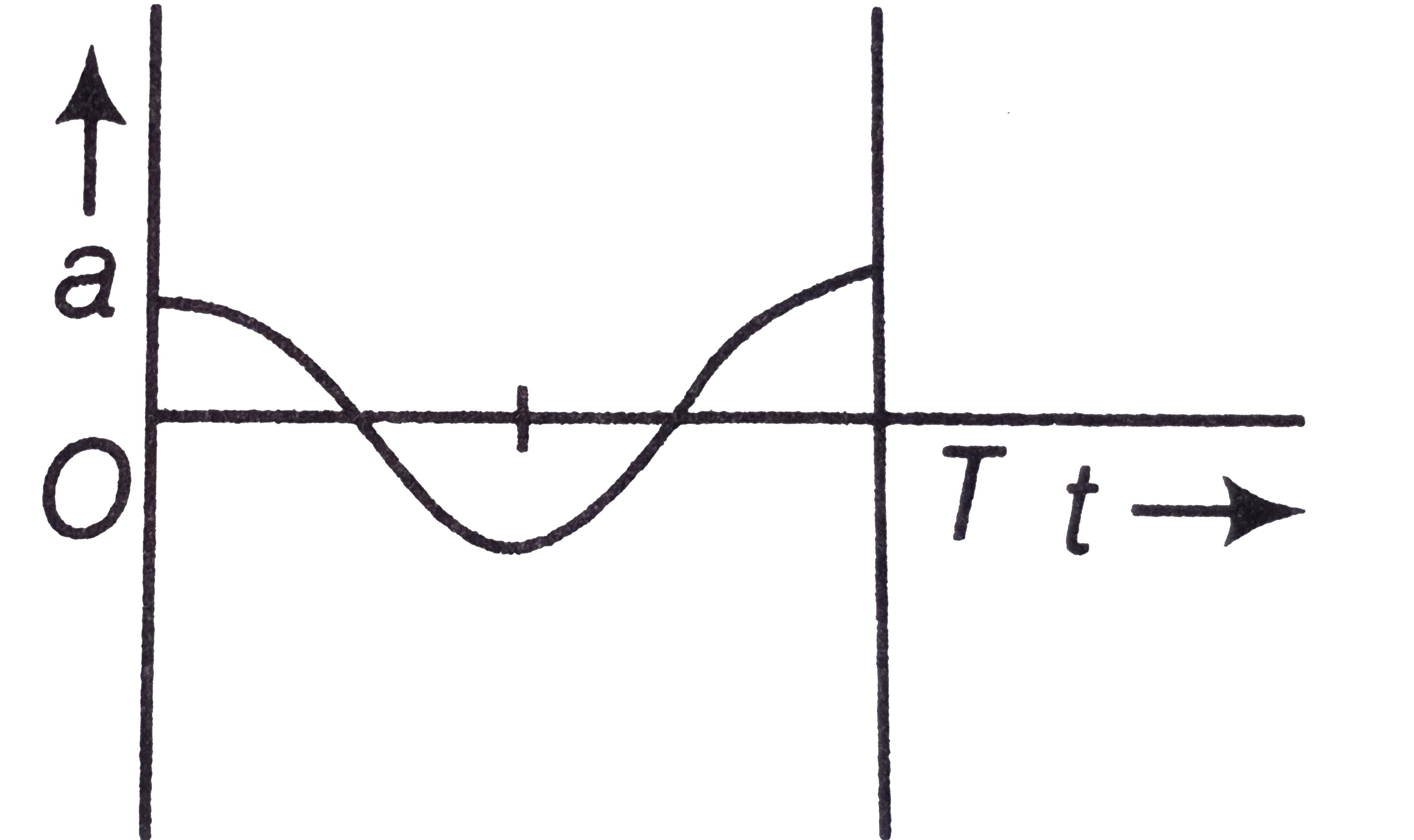
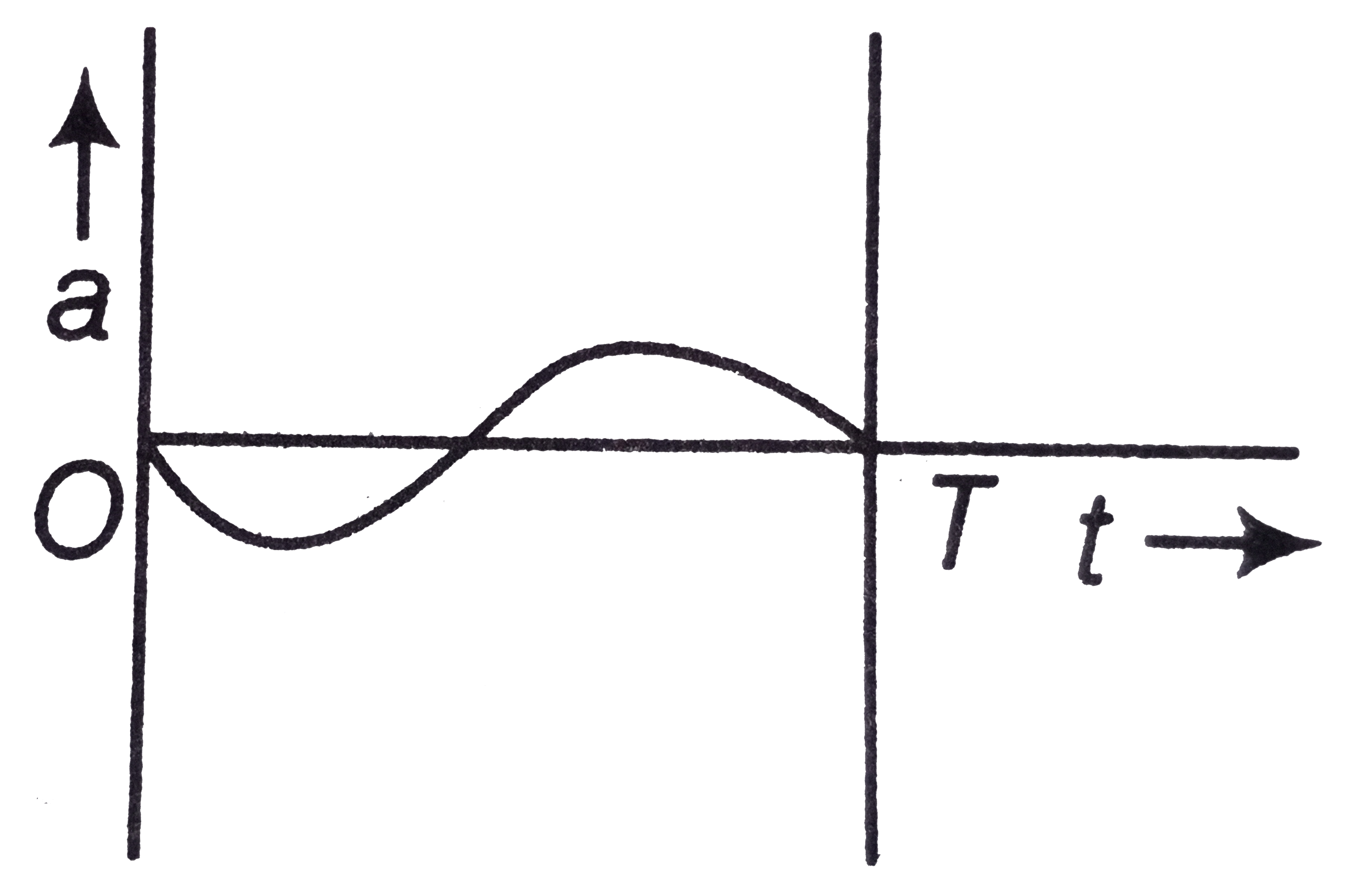
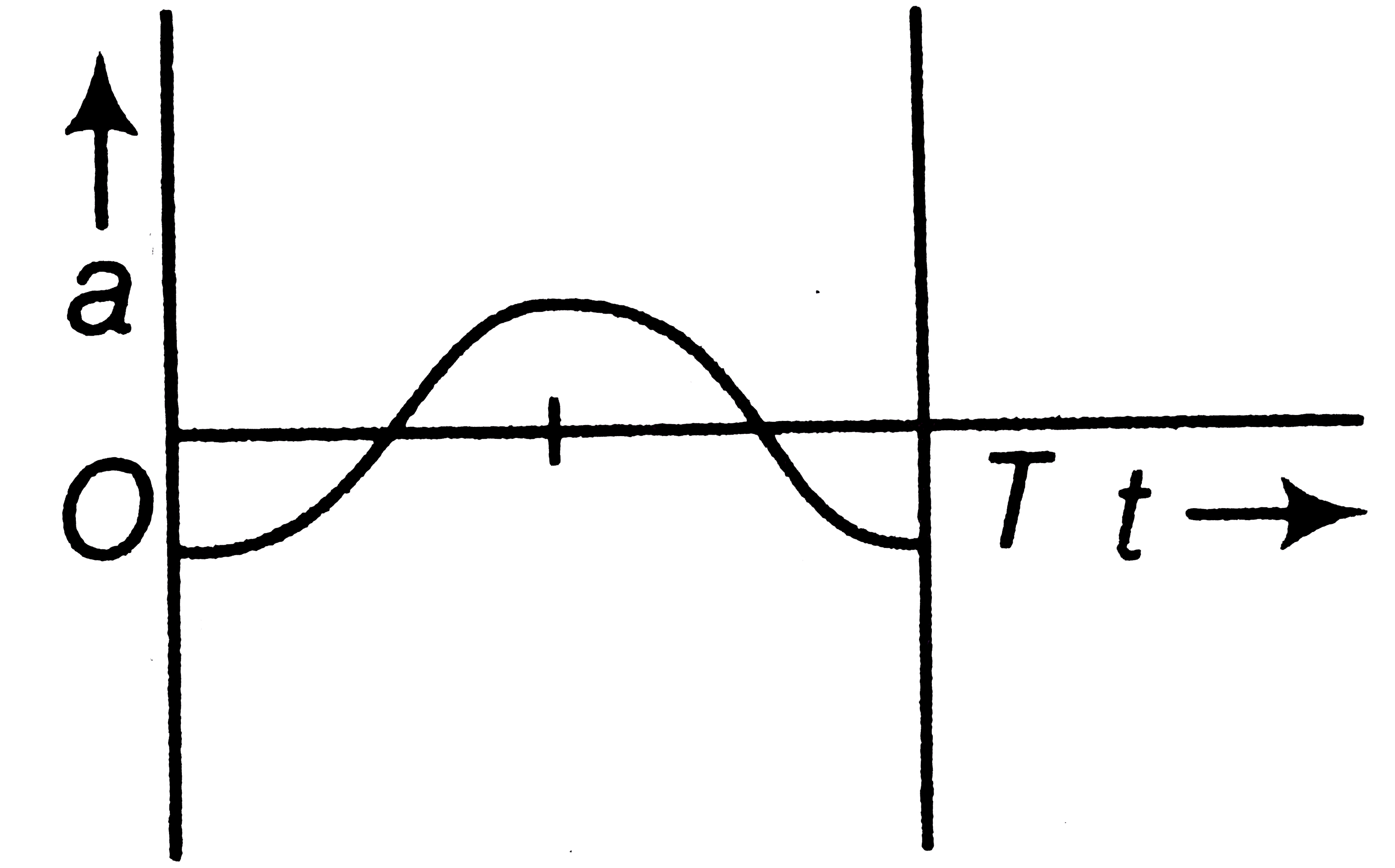
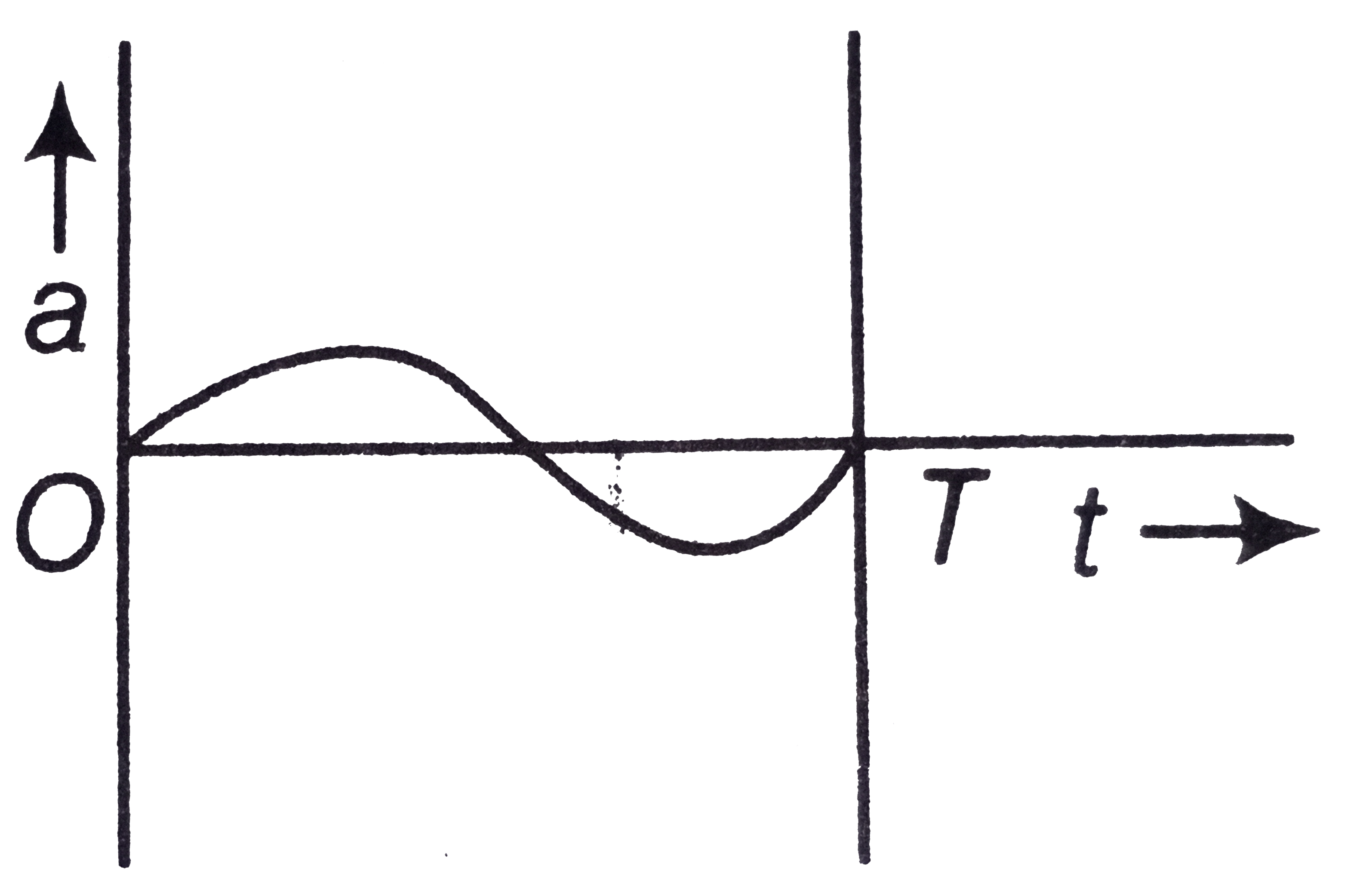
The oscillation of a body on a smooth horizontal surface is represented by the equation, X = A cos (omega t) where X = displacement at time t omega = frequency of oscillation Which one of the following graphs shows correctly the variation a with t ? |
|
Answer»
and `t = (T)/(4),x = A cos ((2pi)/(T)XX(T)/(4))=A cos (pi//2)=0` Again `t = (T)/(2),x = A cos ((2pi)/(T)xx(T)/(2))=A cos pi =- A` We can see that, only graph (i) will SATISFY the above results 
|
|
| 31. |
The process of changing some characteristics (amplitude, frequency r phase) of carrier wave in accordance with the intensity of signal is known as? |
| Answer» SOLUTION :MODULATION | |
| 32. |
Two waves y_(1) = a sin (omegat - kx) and y_(2) = a cos(omegat - kx) superimpose at a point : |
|
Answer» The resultant amplitude is `sqrt(2)a` |
|
| 33. |
The cell wall of which of these is not made up of cellulose |
|
Answer» Bacteria |
|
| 34. |
Whatare thepossiblepathsof freeelectrons insidea conductor ? |
|
Answer» SOLUTION :In THEABSENCE of ELECTRICFIELD insdieconductor,freeelectrons are unaccelerated,sotheirpathbetween consecutivecollisions isstraight LINE . In thepresenceof electricfieldinsideconductor,freeelectronsare acceleratedso their pathisgenerally CURVED. |
|
| 35. |
An electric lamp connected in series with capacitor and an a.c. source is glowing with certain beightness. How does the brightness of the lamp change on reducing the capacitance ? |
| Answer» Solution :BRIGHTNESS of the lamp DECREASES. This is because on reducing `C, X_(C)` increases Z increases and I decreases. | |
| 36. |
In a metre bridge, metal wire is connected in the left gap, standard resistance is connected in the right gap and balance point is found. If the metal wire in the left gap is heated, the balance point |
|
Answer» shifts towards LEFT |
|
| 37. |
The magnetic field in a plane electromagnetic wave is given by: By=12 xx 10^(-8) sin (1.20 xx 10^7z+3.60 xx 10^(15)t)T. Calculate the Energy density associated with the Electromagnetic wave. |
| Answer» SOLUTION :Energy density `MU=B^(2)/mu_(0)`. | |
| 38. |
A large straight current carrying conductor is bent in the form of L shape. Find vec(B) at P. |
|
Answer» <P> Solution :Let us divide the conductor into two semi infinite SEGMENTS 1 and 2. Then, induction at `P` is `vec(B)=vec(B_(1))+vec(B_(2))...(i)` `vec(B_(1))=(mu_(0)i)/(4pia)(sin(90^(@)-theta_(1))+sin90^(@))hat(k)...(ii)` `vec(B_(2))=(mu_(0)i)/(4pia)(sin(90^(@)-theta_(2))+sin90^(@))hat(k)....(iii)` then `vec(B)=(mu_(0)i)/(4pia)(costheta_(1)+costheta_(2)+2)hat(k)`,where `costheta_(1)=costheta_(2)=(1)/(sqrt(2))`Hence, ` vec(B)=(2+sqrt(2))(mu_(0)ihat(k))/(4pia)` |
|
| 39. |
Does wave theory give proper explanation for photoelectric effect? |
| Answer» SOLUTION :No. On the BASIS of wave theory, photoelectric effect cannot be instantaneous and ALSO it should occur even for light of frequencyless than threshold FREQUENCY. | |
| 41. |
Name the absorbing material used to control the reaction rate ofneutrons in a nuclear reactor. |
| Answer» Solution :Cadmium of Boron are absorbed of neutrons. They serve as CONTROLLERS of REACTION RATE of neutrons in the NUCLEAR reactor. | |
| 42. |
Which of the following is weakly repelled by a magnetic field ? |
| Answer» Solution :Copper | |
| 43. |
Derive the expression for a due Broglie wavelength lambda of a relativistic particle moving with kinetic energy T. At what value of T does the error in deremining lambda using the non-relativistic forumula not exceed 1% for an electron and a proton? |
|
Answer» Solution :For a relative particle `T=mc^(2)= ` total energy `=sqrt(c^(2)p^(2)+m^(2)c^(4))` squaring `sqrt(T(T+2MC^(2)))=CP` Hence `lambda=(2pi ħc)/(sqrt(T(T+2mc^(2))))` `=(2pi ħ)/(sqrt(2mT(1+(T)/(2mc^(2)))))` If we use non relativistic FORMULA, `lambda_(NR)=(2pi ħ)/(sqrt(2mT))` `(Delta lambda)/(lambda)=(lambda_(NR)-lambda)/(lambda_(NR))~=(T)/(4MC^(2))` (If `T//2mc^(2)lt lt1`, we can write`(1+(T)/(2mc^(2)))^(1//2)~= 1-(T)/(4mc^(2)))` Thus `T le (4mc^(2)Delta lambda)/(lambda)` if the ERROR is less than `Delta lambda` For electron the error is not more than `1%` if ` T le 4xx0.511xx0.1MeV` For a proton, the error is not more than `1%` if `T le 4xx938xx0.01MeV` i.e., `T le 37.5MeV`. |
|
| 44. |
Explain current formed in solid conductors in presence of external electric field. |
Answer» Solution :`rArr` Consider cylinder of radius R as shown in figure.  ` rArr` We consider TWO thin circular DISC which have + Q and - Q charge DISTRIBUTED over them. `rArr`lf we ATTACH two disc on two fiat surface of the cylinder current will be produced which is directed from positive to negative charge. `rArr` Due to this electric field in cylinder electron will be accelerated due to this field toward + Q charge. `rArr` These electron as long as they are moving will constitute electric current. `rArr`In this condition current will be formed for very short time and will stop. `rArr`Consider mechanism like cell or battery in which whatever amount of charge + Q be neutral similar charge of - Q is obtained at other end. In this situation by battery or cell current can be obtained continuously. |
|
| 45. |
a. The near point of a hypermetropic person is 75 cm from the eye. What is the power of the lens required to enable the person to read clearly a book held at 25 cm from the eye? b . In what way does the corrective lens help the above person? Does the lens magnify objects held near the eye ? c. The above person prefers to remove the spectacles withlooking at the sky. Explain why . |
|
Answer» SOLUTION :u = -25 cm , u = -75 cm `(1)/(f) = (1)/(25) - (1)/(75) `, i.e, f = 37.5 cm The corrective lens needs to have a converging power of + 2.67 dioptres. b . The correctively lens produces a virtual image (at 75 cm ) of an object at 25 cm . The angular size of this image is the same as that of the object. In this sense the lens does not magnify the object but merely brings the object to the near point of hte HYPERMETRIC eye, which then gets focussed on the retina. HOWEVER, the angular size is greater than that of he same object at the near point (75 cm ) viewed without the spectacles. c. A hypermetropic eye may have NORMAL far point. i.e., it may have enough converging power to focus parallel rays from infinity on the retina of the shortened eyeball. Wearing spectacles of converging lenses (used for near vision) will amount to more converging power than needed for parallel rays. Hence the person prefers not to use the spectacles for far objects. |
|
| 46. |
If three wires of equal resistance are given then number of combinations they can be made to give different resistance is |
|
Answer» 4 |
|
| 47. |
If the nucleus of ._13Al^27 has a nuclear radius of about 3.6 fm, then ._52Te^125 would have its radius approximately as |
|
Answer» 9.6 FM As, `R_2/R_1=(A_2/A_1)^(1//3)=(125/27)^(1//3)=5/3` `THEREFORE R_2=5/3R_1=5/3xx3.6=6` fm |
|
| 48. |
The capacitance of a parallel plate capacitor depends upon_____ of the plates. |
|
Answer» |
|
| 49. |
In an experiment it was found that a sonometer in its fundamental mode of vibration and a tuning fork gave 5 beats when length of wire is 1.05 metre of 1 metre. The velocity of tranverse waves in sonometer wire is |
|
Answer» 400 m/s |
|
| 50. |
Draw a schematic arrangement of the Geiger-Marsden experiment. How did the scattering of a-particles by a thin foil of gold provide an important way to determine an upper limit on the size of the nucleus ? Explain briefly. |
|
Answer» Solution :A schematic arrangement of the Geiger-Marsden experiment is shown in Fig. 12.11. In their experiment it was observed that most of the alpha-particles pass through the gold foil without any APPRECIABLE deflection. Some a particles are scattered through different angles and a very small number of particles suffers large angle scattering of about `180^(@)` Large angle scattering can be explained if we consider the ENTIRE positive charge and almostwhole mass of gold foil atom to be concentrated in a tiny central core of the atom. When an `alpha`-particle with kinetic energy K approaches the gold nucleus DIRECTLY along itscentral line it SLOWS down, as it approaches the a-particles gold nucleus, due to coulombian repulsion force between nucleus and `alpha`-particle. The `alpha` -particle can come up to a certain minimumdistance is calledthe distanceof closed approach . Obviously valueof distanceof closest approach provides the upperlimit onthe SIZE of thenucleus . 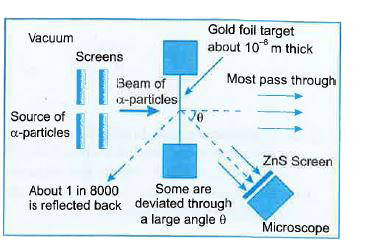
|
|