

Saved Bookmarks
This section includes 7 InterviewSolutions, each offering curated multiple-choice questions to sharpen your Current Affairs knowledge and support exam preparation. Choose a topic below to get started.
| 1. |
Ratio of centripetal acceleration in 4^th and 6^th Bohr's orbit of hydrogen atom is: |
|
Answer» `2/3` |
|
| 2. |
If a charged particle enters perpendicular in the uniform magnetic field then |
|
Answer» ENERGY REMAINS CONSTANT but MOMENT changes |
|
| 3. |
An electric field line emerges from a positive poit charge +q at angle alpha to the striaght line connecting it to a negative point charge - 2q as shown in figure. At what angle beta wil the field line enter the charger - 2q? |
|
Answer» `alpha` |
|
| 4. |
A hollow sphere of radius 2R is charged to V volts and another smaller sphere of radius R is charged to V/2 volts. Now the smaller sphere is placed inside the bigger sphere without changing the net charge on each sphere. The potential difference between the two spheres would be : |
|
Answer» `(3V )/(2 )` |
|
| 5. |
The magnetic potential energy stored in a certain inductor is 25 mJ, when the current in the inductor is 60 mA. This inductor is of inductance. |
|
Answer» 13.89 H `therefore L=(2xxP.E)/I^2` `=(2xx25xx10^(-3))/(60xx10^(-3))^2` `=(50xx10^3)/3600` `=0.013888xx10^3` H `therefore L approx` 13.89 H |
|
| 6. |
The phase difference between the waves arriving at a point from spreading from two corresponding points of successive half period zones is |
| Answer» Answer :C | |
| 8. |
Did the author bother to learn the morning prayers that his grandmother recited? |
|
Answer» yes |
|
| 9. |
A particle of charge -q and mass m moves in a circular orbit about a fixed charge +Q. Show that the ''r^(3) alpha T^(2)'' law, is satisfied, where r is the radius of orbit and T is time period. |
| Answer» | |
| 10. |
Due to Doppler's effect, the shift in wavelength observed is 0.1 Å for a star producing wavelength 6000 Å. Velocity of recession of the star will be |
|
Answer» `2.5 (km)/(s)` |
|
| 12. |
A log of wood floats in water (3)/(4) immersed. What is its volume if it is just submerged when a body of mass 50 kg stands on it? |
|
Answer» `0. 1 m^(3)` |
|
| 13. |
In Young's double slit experiment, the distance between the two slits is 0.1 mm, the distance between the slits and the screen is 1 m and the wavelength of the light used is 600 nm.The intensity at a point on the screen is 75% of the maximum intensity.What is the smallest distance of this point from the central fringe ? |
|
Answer» 1.0mm |
|
| 14. |
What is the sure check of presence of charges - repulsion or attraction ? |
| Answer» SOLUTION :REPULSION. Becsause attraction can be between a CHARGED BODY and a neutral body as well. | |
| 15. |
Obtain the relation between the real depth and apparent depth of bottom of tank filled with water when observed from air. |
Answer» Solution :As shown in figure, the bottom of tank is at `h_2` DEPTH in denser MEDIUM (water) of refractive index `n_2=n`. When the bottom is viewed normally, it is observed at O. instead of O as shown in figure (a). When it is viewed at some ANGLE from normal, it is observed at O. as shown in figure (b). Real depth is `h_2` and APPARENT depth is `h_1`. `therefore ("refractive index of air "n_1)/("refractive index of denser medium "n_2)` `therefore 1/n = h_1/h_2 [therefore "For air "n_1=1]` `therefore n=h_2/h_1=("real depth")/("apparent depth")` `therefore` Apparent depth `h_1=("real depth "h_2)/("refractive index of denser medium n")` REMEMBER : `("n(denser)")/("n(rarer)")=("apparent depth")/("real depth")` |
|
| 16. |
A sinusoidal voltage of peak value 283 V and frequency 50 Hz is applied to a series LCR circuit in which R=6Omega,L=50.96 mH and C=398 muF. Find the power factor |
| Answer» SOLUTION :POWER FACTOR = 0.6 | |
| 17. |
When a constant force acts on a mass m which is at rest initially, the velocity acquired in a given direction is proportional to |
|
Answer» `SQRT m` |
|
| 18. |
An electron of mass m and charge q is travelling with a speed v along a circular path of radius r at right angles to a uniform of magnetic field B. If speed of the electron is doubled and the magnetic field is halved, then resulting path would have a radius of ____ . |
|
Answer» `R/4` `Bqv=(mv^(2))/rrArrr=(mv)/(qB)" If "v_(1)=2v`, and taking `B_(1)=B_(2)` The RADIUS of path `r_(1)=(2mv)/q^(B/2)=(4mv)/(qB)=4r` |
|
| 19. |
Assertion: The process of retrieval of information from the carrier wave at the reciever is termed as modulation. Reason: Repeater helps to modulate the signals. |
|
Answer» |
|
| 20. |
A sinusoidal voltage of peak value 283 V and frequency 50 Hz is applied to a series LCR circuit in which R=6Omega,L=50.96 mH and C=398 muF. Find the power dissipated in the circuit |
| Answer» SOLUTION :P=2400 W WASTE of POWER | |
| 21. |
A sinusoidal voltage of peak value 283 V and frequency 50 Hz is applied to a series LCR circuit in which R=6Omega,L=50.96 mH and C=398 muF. Findthe impedance of the circuit |
| Answer» SOLUTION :Z=10 `OMEGA` | |
| 22. |
A sinusoidal voltage of peak value 283 V and frequency 50 Hz is applied to a series LCR circuit in which R=6Omega,L=50.96 mH and C=398 muF. Find the phase difference between the voltage across the source and the current . |
| Answer» SOLUTION :PHASE DIFFERENCE `phi=-53.1^@` | |
| 23. |
A small body A starts sliding off the top of a smooth sphere of radius R. Find the angle theta (figure) corresponding to the point at which the body breaks off the sphere, as well as the break-off velocity of the body. |
|
Answer» Solution :Let us depict the forces acting on the body A (which are the force of GRAVITY `mvecg` and the normal reaction `VECN`) and write equation `vecF=mvecw` via projection on the unit vectors `hatu_t` and `hatu_n` (figure). From `F_t=mw_t` `mg sin THETA=m(dv)/(dt)` `=m(vdv)/(DS)=m(vdv)/(Rd theta)` or, `gRsin theta d theta=vdv` Integrating both sides for obtaining `v(theta)` `UNDERSET(0)overset(theta)int gR sin theta d theta=underset(0)overset(v)int v dv` or, `v^2=2gR(1-cos theta)` (1) From `F_n=mw_n` `mg cos theta-N=mv^2/R` (2) At the moment the body loses contact with the surface, `N=0` and therefore the Eq. (2) becomes `v^2=gRcos theta` (3) where `v` and `theta` corresponds to the moment when the body loses contact with the surface. Solving Eqs. (1) and (3) we obtain `cos theta=2/3`or, `theta=cos^-1(2//3)` and `v=sqrt(2gR//3)`. 
|
|
| 24. |
When a low flying aeroplane passes over head, we sometimes notice a slight shaking of the picture on our TV screen. This is due to |
|
Answer» diffraction of the signal received from the antenna. |
|
| 25. |
If the density of hydrogen gas at N.T.P. is 0.0000893 gm/cm^3, then the root mean square velocity of hydrogen molecules at NTP is |
|
Answer» 1840 cm/sec |
|
| 26. |
What is saturation current? |
| Answer» Solution :The maximum VALUE of PHOTOELECTRIC current obtained by increasing the ACCELERATING positive potential is called SATURATION current. Saturation current is proportional to intensity of INCIDENT radiation. | |
| 27. |
How do we save petrol when the tyres of the motor cycle are fully inflated ? |
| Answer» Solution :When the tyres are FULLY inflated, DEFORMATION of tyres will be small. Thus, amount of force of rolling friction shall be LESS. The motor cycle will cover more DISTANCE for the GIVEN petrol consumed by it. | |
| 28. |
(a) A normal eye has retina 2cm behind the eye lens. What is the power of the eye lens ehen the eye is (i) fully relaxed, (ii) most strained ? (b) The near point and the far point of a hild are at 10cm and 100cm. If the retain is 2.0cm behind the eye lens, what is the range of the power of the eye lens? (c) A young boy can adjust the power of his eye lens between 50D and 60D. His fat point is infinity. (i) what is the distance of his retina from the ye lens? (ii) What is near point? |
Answer» Solution :(a) (i) 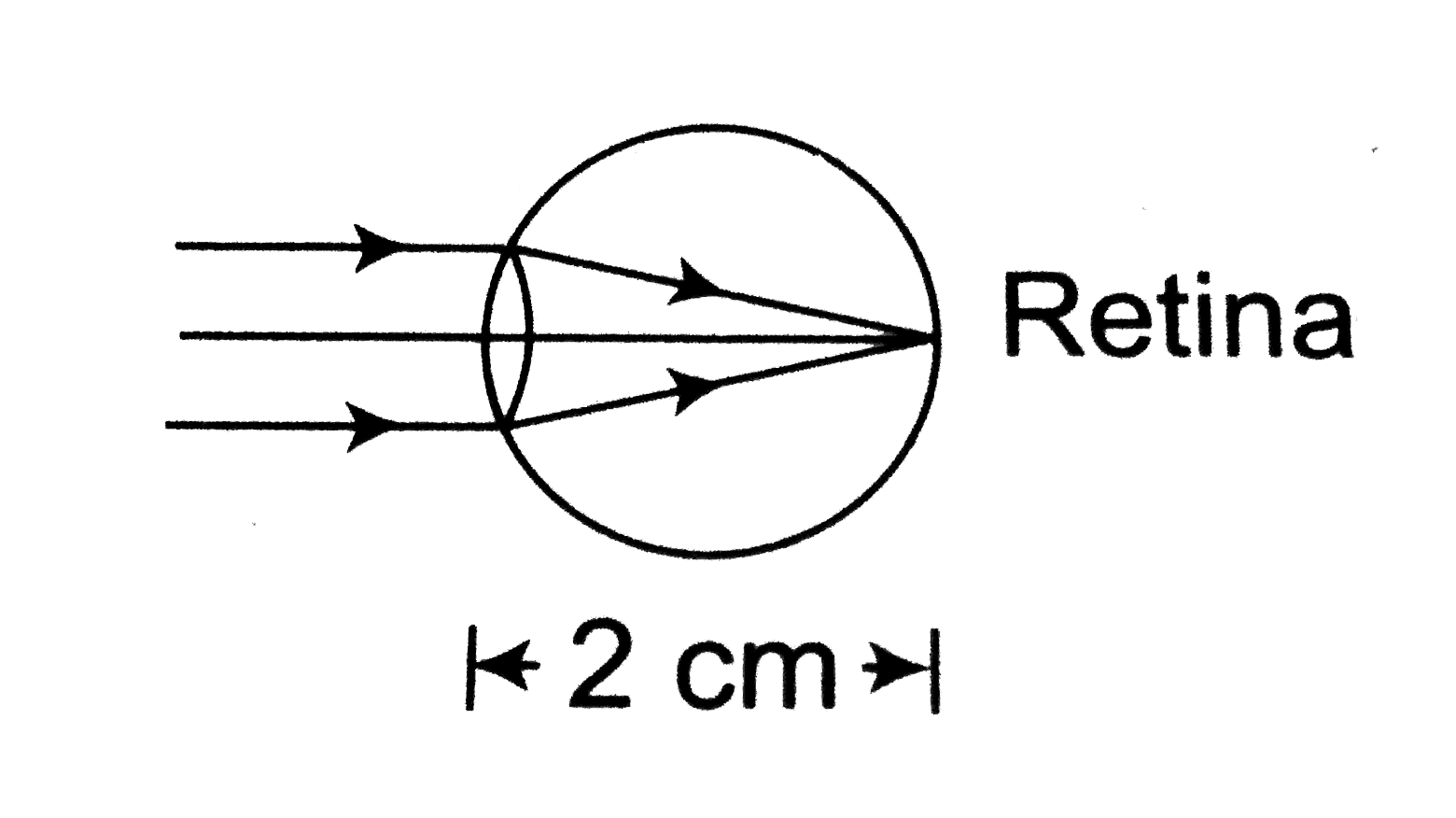 `u = oo, v = 2CM` `(1)/(v)-(1)/(u)=(1)/(f) rArr f = v = 2cm` `P = (100)/(f(cm)) = (100)/(2) = 50D` (ii) 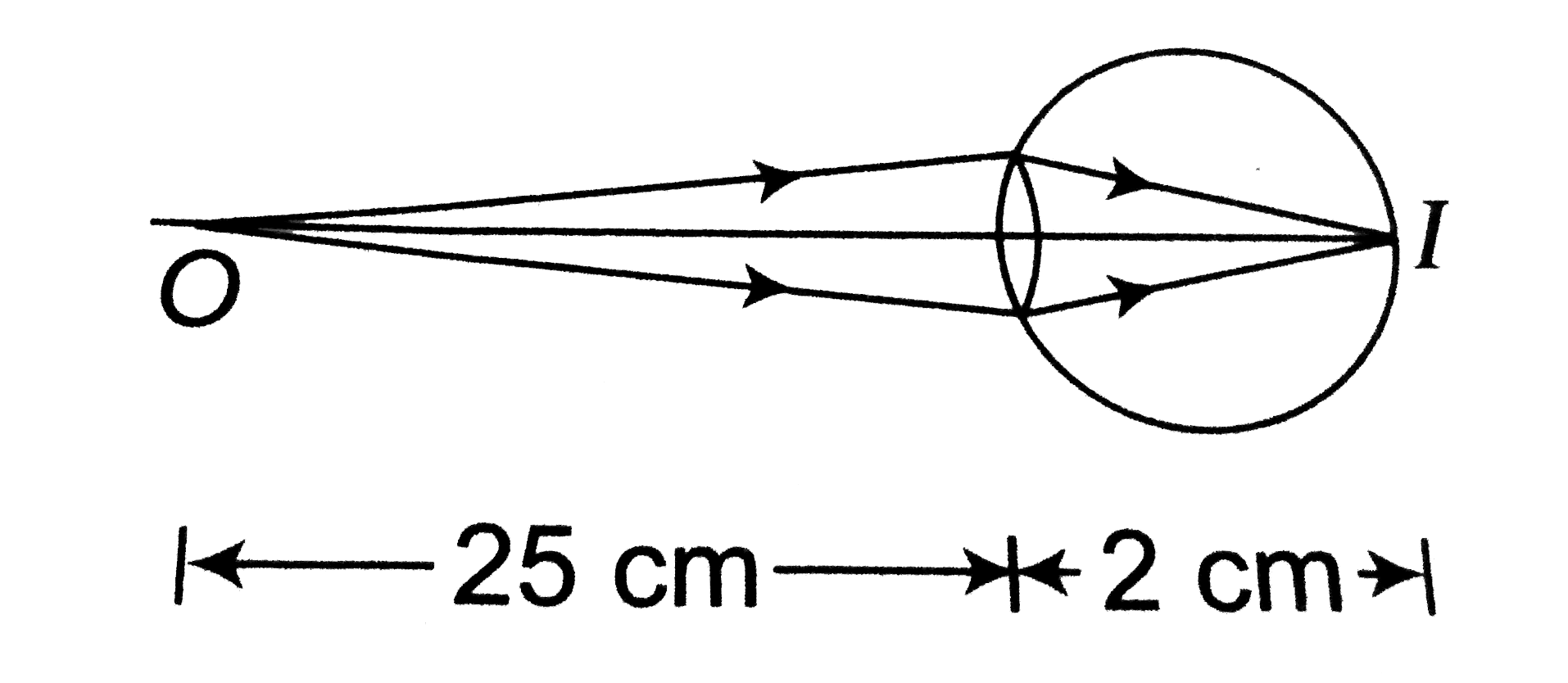 `(1)/(f)=(1)/(v)-(1)/(u)=(1)/(2)-(1)/(-25) = (17)/(50) rArr f = 50//27` `P = (100)/(f(cm)) = (100)/(50//27) = 54D` (B) 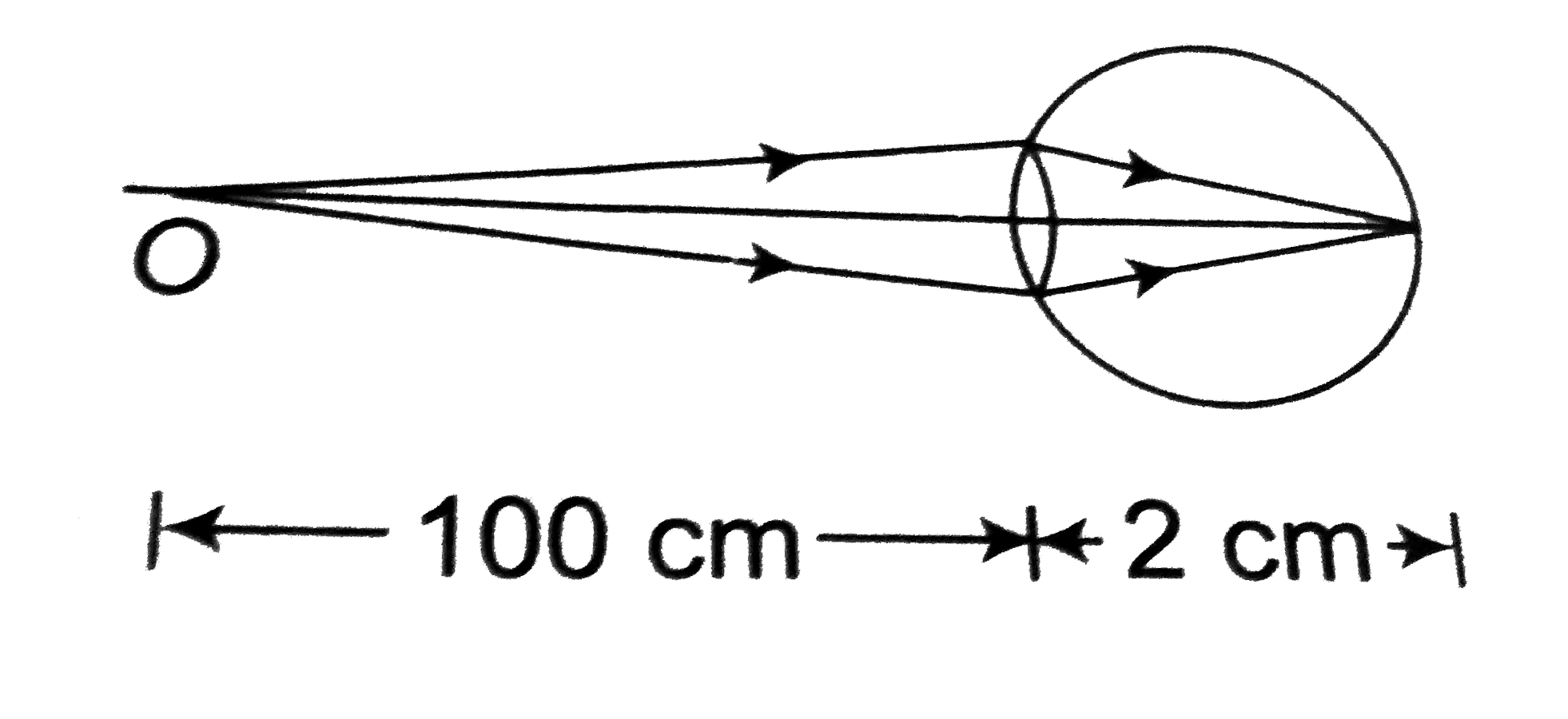 `(1)/(f)=(1)/(v)-(1)/(u)=(1)/(2)-(1)/(-100)=(50+1)/(100)=(51)/(100) rArr f=(100)/(51)cm` `P = (100)/(f(cm))=(100)/(100//51) = 51D` 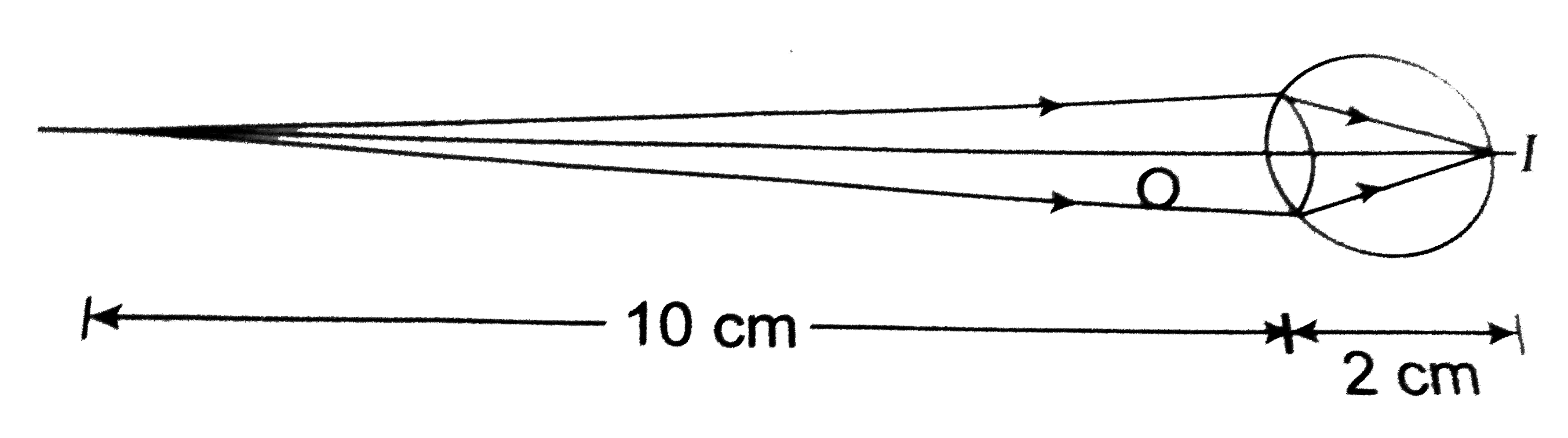 `(1)/(f)=(1)/(v)-(1)/(u)=(1)/(2)-(1)/(-10)=(6)/(10) rArr f = (10)/(6)=(5)/(3)cm` `P = (100)/(f(cm)) = (100)/(5//3) = 60D` Range: `51D` to `60D` (c) when the eye is most relaxed, focal length is maximum or power is minimum HENCE in most relaxed case, `P = 50D`, `f = (100)/(P)=(100)/(50) = 2cm`. The rays coming from infinite are FOCUSED at retina, hence `v = 2 cm = f` 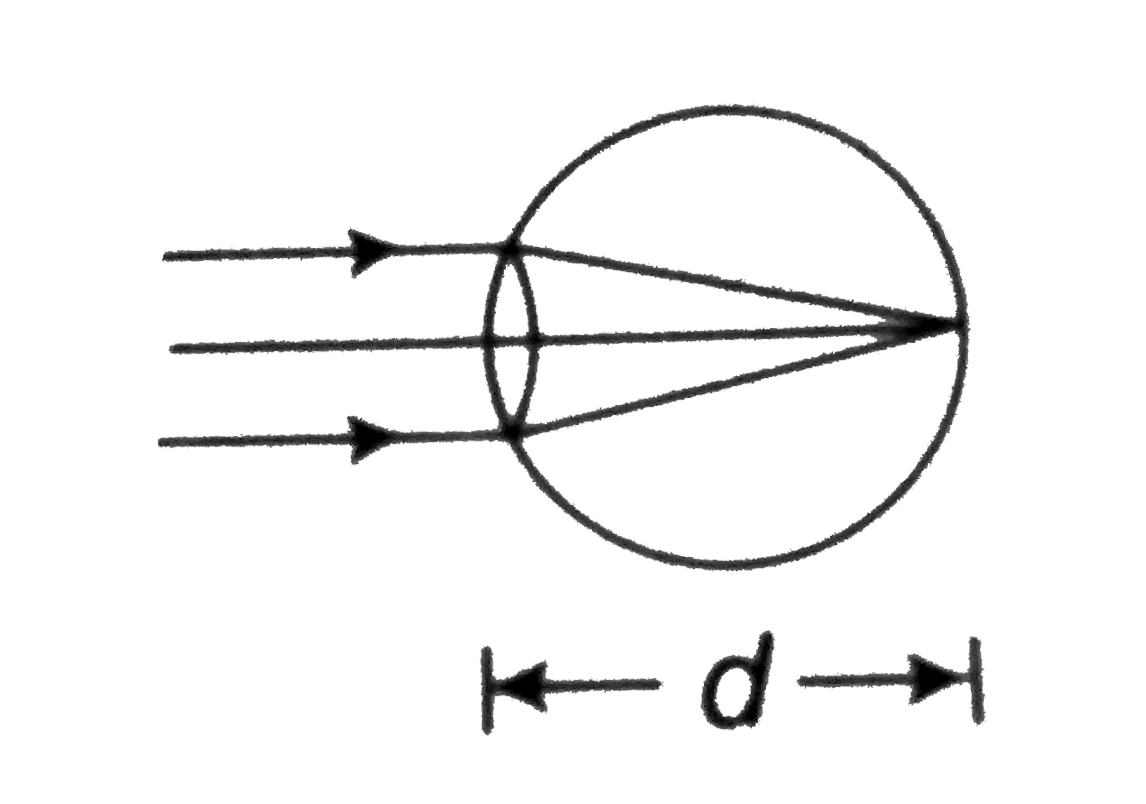 `(1)/(v)-(1)/(u)=(1)/(f) rArr (1)/(v)-(1)/(oo)=(1)/(2) rArr v = 2cm` Distance of retina from lens `d =v=2cm` The eye is most strained when object is at near point. Hence focal length is minimum or power is maximum i.e `60 D`, `f = (100)/(60) = (5)/(3)cm`. The image is formed at retina. 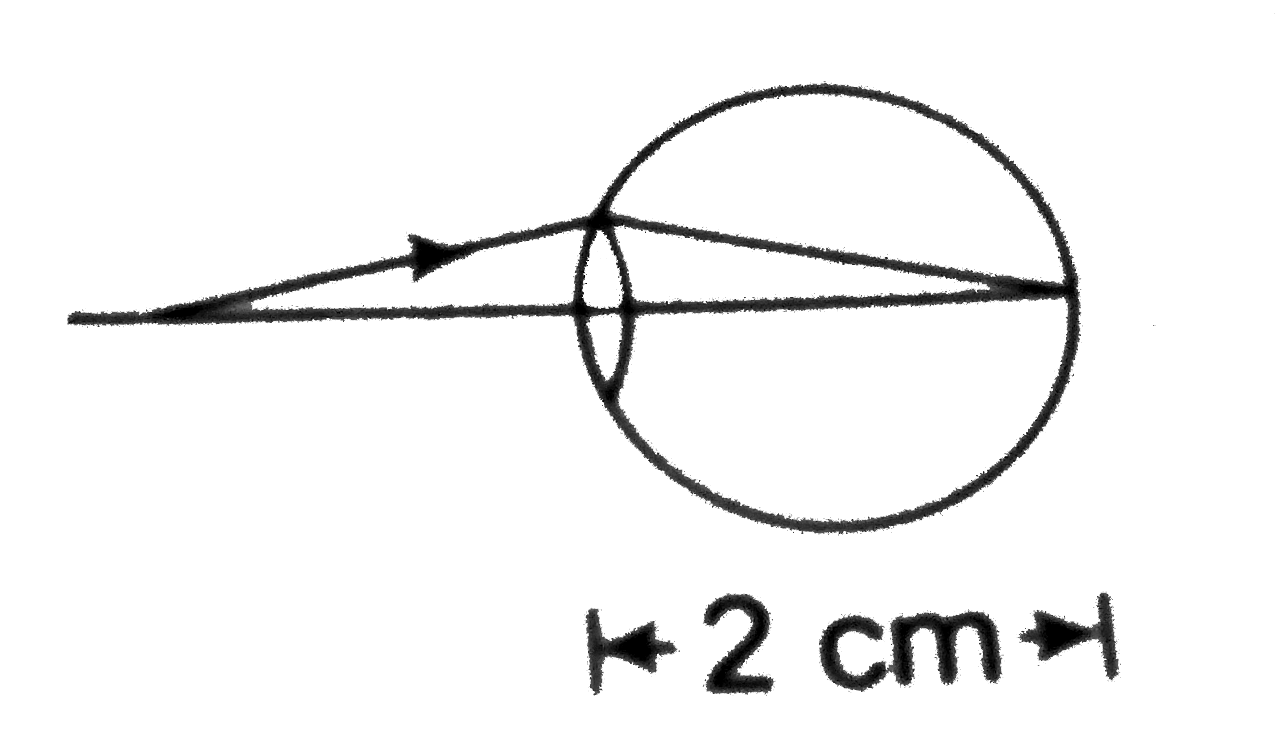 `(1)/(v)-(1)/(u)=(1)/(f)` `(1)/(2)-(1)/(u)=(1)/(5//3) rArr (1)/(u)=(1)/(2)-(3)/(5)=(5-6)/(10) rArr u =- 10cm` `N.P. = 10cm` |
|
| 29. |
A pendulum is first vibrated on the surface of earth. Its period is T. It is then taken to the surface of moon where acceleration due to gravity is 1/6th of that on earth. Its period will be : |
|
Answer» `(T)/(6)` `:. T_(2)=T sqrt((g)/(g//6))=T sqrt(6)` Thus CORRECT choice is (d). |
|
| 30. |
In an n-p-n transistor, the collector current is alwaysless than the emitter current because |
|
Answer» COLLECTOR SIDE is REVERSE biased and the emitter side is FORWARD biased |
|
| 31. |
In the circuit shown in the fig., R_(1): R_(2) : R_(3) = 4 : 1 : 2. (a) Will the current through R_(1) increase or decrease when a new resistance R_(4) is added in parallel to R_(2) ? (b) Change in current through R_(1) when R_(4) is added is found to be 0.2 A. Calculate the current through R_(4). |
|
Answer» (B) `I_(4) = 1.4 A` |
|
| 32. |
A projectile is thrown at angel with vertical. It reaches a maximum height H. The time taken to reach the highest point of its path is : |
|
Answer» `sqrt(H/g)` But the time of FLIGHT is `t=(vcosbeta)/g=sqrt(2gh)/g` or `t=sqrt((2H)/g)` |
|
| 33. |
A particle is dropped from height H. At a point its kinetic energy is x times of its potential energy. Find the speed of the particle at that point - |
|
Answer» `[2gxH]^(1//2)` `Or K.E.=((x)/(x+1))T.E.=((x)/(X+1))MGH` `v=sqrt(2gH((x)/(x+1)))` |
|
| 34. |
Let P(r)=(Q )/(pi R^4) r be the charge density distribution for a solid sphere of radius R and total charge Q for a point 'p' inside the sphere at distancer, from the centre of the sphere, the magnitude of electric field is |
|
Answer» `(Qr_(1)^(2))/( 3 PI epis_0 R^4) ` |
|
| 35. |
What is permeability ? |
| Answer» Solution :It is defined as the ratio of magnetic INDUCTION to MAGNETISING FIELD i.e. , `mu = B/H` | |
| 36. |
In the circuit shown in the figure, the value of Resistance X, when potential difference between the points B and D is zero will be |
|
Answer» `9Omega` |
|
| 37. |
A hollow sphere of outer radius R is rolling down aninclined plane without slipping and attains a speed v_0 at the bottom. Now the inclined plane is made smooth and the sphere is allowed to slide without rolling. Now it attains a speed (5v_0)/4. What is the radius of gyration of sphere? |
|
Answer» `sqrt(2/5)R` where K is the RADIUS of gyration. Using `v^2-u^2=2as` `RARR (5/4v_0)^2=2aS`….(i) `v_0^2=(2aS)/(1+K^2//R^2)` …(ii) From (i) and (ii) we get `1+K^2/R^2=25/16` or `K^2/R^2=25/16-1` `rArr K^2=(9R^2)/16` or `K=(3R)/4` |
|
| 38. |
Which of the following statement does not hold good for thermal radiation? |
|
Answer» the wavelength changes when it travels from one MEDIUM to ANOTHER. Thermal radiation obeys the law of refraction. Hence, when it travels from one medium to another, its wavelength and speed changes whereas frequency REMAINS unchanged as frequency is thecharacteristics of SOURCE of thermal radiation. |
|
| 39. |
A cubical vessel with non - transparent walls is so located that eye E of observer cannot see its bottom but can see all of the wall CD. To what height should water be filled in vessel for the observer to see an object O placed at a distance b = 10 cm from the corner C(.^(a)mu_(omega)=(4)/(3)) |
|
Answer» 16.5 cm `angle ACB =45^(@)` Let h be the required height NO =h - b = h tan r  or `h = (b)/(1 - tan r)` Now `mu = (SIN 45)/(sin r)` `sin r = (1)/(sqrt(2)r) "" therefore COS r = sqrt(1 - sin^(2) r)` so `h=(b)/(1-(1)/(sqrt(2MU^(2)-1)))=(bsqrt(2mu^(2)-1))/(sqrt(2mu^(2)-1-1))` `therefore h = 26.7 cm` |
|
| 41. |
The average translational K.E. in one millitre volume of oxygen at NTP is |
|
Answer» 0.15 J |
|
| 42. |
The apparent flattening of the sun at sunset and sunrise is due to |
|
Answer» REFRACTION |
|
| 43. |
A beam of light passing from one transparent medium to another obliquely, undergoes an abrupt change in direction. This phenomenon is known as refraction of light. a.Name the law which satisfies during this refraction. b. Draw the figure which shows refraction through a parallel sided glass slab. (Ray passing from air ) c. Using the figure obtaind in (b). Show that the incident ray and the emergent ray are parallel to each other. |
|
Answer» SOLUTION :a.Snell.s law. b. 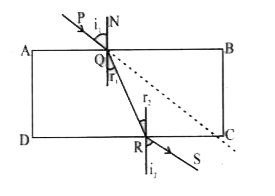 c.Let ABCD be a RECTANGULAR refracting glass slab. PQRS is the course of RAY through a parallel-sided glass slab placed in air. CONSIDERING the refraction at face `AB, n = (sin i_(1))/(sin r_(1)) ` For refraction at face `DC, (1)/(n) = (sin r_(2))/(sin i_(2)) "therefore, " n = (sin i_(2))/(sin r_(2)) ` Hence `i_(1) = i_(2) and r_(1) = r_(2)` We can see that the angle of incidence is equal to angle of emergence. Thus we can conclude that the emergent ray RS is parallel to incident ray. PQ , but is laterally displaced. |
|
| 44. |
A force of 147N is required to just slide a sledgeweighing 500N over a surface of ice. Calculate the coefficient the coefficient of friction between the surface of contact of the sledge and the ice. |
|
Answer» 0.472 |
|
| 45. |
Verify the Gauss's law for magnetic field of a point dipole of dipole moment overset(to)( M) at the originfor the surface which is a sphere of radius R. |
|
Answer» SOLUTION :Gauss.s law of magnetism `oint OVERSET(to) (B).d overset(to)(S) = 0`. Now, magnetic moment of dipole at origin "O" is along z-axis `overset(to)(M) = M hat(k)` Let P be a point at distance r from O and OP makes an angle `theta` with z-axis component of `overset(to)(M)` along `OP= M cos theta` Now, the magnetic field induction at P due to dipole of moment `overset(to)(M)cos theta` is `overset(to)(B)= (mu_0)/( 4 pi) (2M cos theta)/( r^3) hat(r)`  From the diagram, r is the radius of SPHERE with centre at O lying in yz-plane. Take an elementary area `d overset(to)(S)` of the surface at P, then `therefore doverset(to)(S) = r (r sin theta) hat(r) = r^(2) sin theta d theta hat(r)` `therefore oint overset(to)(B). d overset(to)(S) = oint (mu_0)/( 4 pi) (2M cos theta) /( r^3) hat(r) ( r^(2) sin theta d theta) hat(r)` `= (mu_0)/( 4pi) (M)/( r) int_(0)^(2pi) 2 sin theta cos theta d theta` `= (mu_0)/( 4 pi) (M)/( r) int_(0)^(2pi) sin 2 theta d theta` `= (mu_0)/( 4 pi ) (M)/(r ) (- ( cos 2 theta)/( 2))_(0)^(2pi)` `= (mu_0)/( 4 pi) (M)/( r) [ ( cos2 theta)/( 2)]_(0)^(2pi)` `= -(mu_0)/( 4 pi) (M)/( 2r) [ cos 4 pi - cos 0]` `= (mu_(0) M)/(4 pi (2r) ) [ 1-1]` `=0` |
|
| 46. |
When two light waves of same amplitude 'a' traveling though medium arrive at a point in same phase then the resultant amplitude R at that point is : |
|
Answer» R = 0 |
|
| 47. |
What is the function of a uniform radial magnetic field in the moving coil galvanometer? |
| Answer» Solution :For a UNIFORM radial magnetic field angle `THETA` between `VECA and vecB` is `90^@`. Hence, TORQUE ACTING on the galvanometer coil `tau n A I B sin theta = n A I B`, which is constant for all orientations of the coil. | |
| 48. |
When a ray of light enters a glass slab from air. |
|
Answer» its WAVELENGTH DECREASES In moving from air to glass, f remains unchanges while v decreases. HENCE, `lambda` should decrease. |
|
| 49. |
Two point charges of +2xx10^(-8) C are placed 6 apart. Determine the force on a point charge of +1xx10^(-8) Cplaced at a distance of 5 cm from each of the two given charges. |
|
Answer» |
|
| 50. |
The figureshows a modelof perfume atomizer . Whenthe bulbA is compressed , air ("density "rho_(a))flows throughthe verticaltubeand emerges throughthe end . If excesspressure appliedto the bulbins progress beDelta p thenthe minimu speed ofair in the tubeto liftperfume is : |
|
Answer» ` sqrt((2 [ Delta p +o gh ])/(rho_(a)))` `P_(1) +1/2 rho_(a)v_(1)^(2) = P_(2) + 1/2 rho_(a) v_(2)^(2)` Putting` v_(1) = 0 `since of the air is at REST inside the BULB , `P_(1) = P_(10) + DeltaP_(r) P_(2) = P_(0) - rho gh ` whre `rho = ` densityof liquid( perfume) ` rho_(a)` densityof air `v_(a)`= minimumvelocityof airto lift the liquidthrough the heighth = v (say) ` P_(0)` = atmosphericpressure Hence ( A) is CORRECT 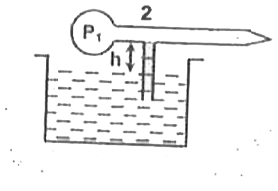
|
|