Saved Bookmarks
This section includes 7 InterviewSolutions, each offering curated multiple-choice questions to sharpen your Current Affairs knowledge and support exam preparation. Choose a topic below to get started.
| 1. |
Explain the principle of working of a meter bridge. Draw the circuit diagram for determination of an unknown resistance using it. |
|
Answer» Solution :Working of a.metre bridge is based on the principle of Wheatstone.s bridge in which 4 resistances P, Q, R and SALONG with a cell e and galvanometer G are connected as shown. VALUE of four resistances are so adjusted that galvanometer gives no deflection even where kays `K_(1) and K_(2)` are PLUGGED. In such a situation `P/Q=R/S` 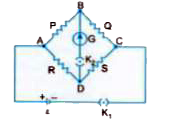 Thus, knowing, values of P, Q and R. we can find the value of unknown resistance by using the formula `S=(QR)/(P)`. Circuit diagram for determination of an unknown resistance X using metre bridge is drawn here 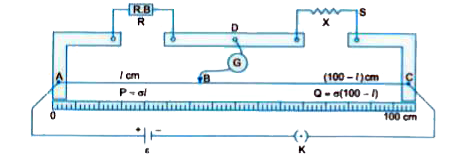
|
|
| 2. |
A ray of light is incident at an angle of 45^@ with a velocity 3xx10^8 m/s on a plane boumdary of a second medium. The angle of refraction in the second medium is 30^@. The velocity of light in second medium is: |
|
Answer» `1.5 XX 10^8 m//s` |
|
| 3. |
A light ray is incident on a transparent slab of refractive index mu=sqrt(2) at an angle of incidence pi//4. Find the ratio of the lateral displacement suffered by the right ray to the maximum value which it could have suffered. |
|
Answer» `(sqrt(3)-1)/(sqrt(6))` |
|
| 4. |
Initial angular velocity of a circular disc of mass M is omega_(1). Then two small spheres of mass m are attached gently to two diametrically opposite points on the edge of the disc. What is the final angular velocity of the disc? |
|
Answer» `((M+m)/(M))omega_(1)` Here `I_(1)=(1)/(2)MR^(2)andI_(2)=(1)/(2)(M+2m)R^(2)` `therefore (1)/(2)MR^(2).omega_(1)=(1)/(2)(M+2m)R^(2).omega_(2)` or `omega_(2)=((M)/(M+2m))omega_(1)` |
|
| 5. |
A square loop of wire of side a carries a current i . Calculate the magnetic field at the centre of the loop |
| Answer» SOLUTION :`B_(1) = (mu_0i)/(4pia) [ SIN theta_1 + sin theta_2] and B = AB_1]` | |
| 6. |
Which of the following is a true statements? |
|
Answer» `PI` and 22/7 are both RATIONALS. |
|
| 7. |
At a place horizontal and vertical components of earths magnetic field are as follows BH=1G 5^⋅ East of northBV=1G vertically upward Then inclination and declination are respectively |
|
Answer» `45^ CIRC , 5^circ W` |
|
| 8. |
A concave mirror and a converging lens (glass with mu = 1.5) both have a focal length of 3 cm when in air. When they are in water (mu=4/3), their new focal length are |
|
Answer» `f_("LENS") = 12 cm , f_("MIRROR") = 3 cm` |
|
| 9. |
The period of oscillation of a simple pendulum of length / suspended from the roof of a vehicle, which moves without friction down an inclined plane of inclination alpha , is given by |
|
Answer» `2pi SQRT(l/(G COSALPHA))` |
|
| 10. |
As is known, all mater is made up of atoms/molecules. Every atom consits of a central of a central core, called the atomic nucleus, aroundwhich negatvely charged electrons revole in ciruclar orbits. Every atom is electricallyneutral. Containing as many electron as the number of protons in the nucleas. Thus, even though normally, the materails are electrically neutral, theydo contains charges, butthier chargesare exactlybalanced. Thevast amount of charge in anobject is usually hidden as theobject is usually hiddenas the objectis saidto be electracally neutral charge. With such an equality or balance of chargesthe object is said to be electrically neutralor uncharged. To electrify or chargea neutralbody,actully transfer to the otherbody. The body which gainselectrons become negatively chargedand the body which loses electronsbecomes positivelyh charged. Further, like charges repel adn unlike charges attract. Read the abovepassageand answer the followingquestions : (i) Every body, whethera conductoror an insulator is electrically neutral. Is it true ? (ii) Charging lies in chargeimbalance, i.e, excess charge, comment. (iii) How do you visualizethis principle being applied in our daily life ? |
|
Answer» Solution :(i) Yes, it is true. Everyconductor/inssularor is elecrtricallyneutral, asit contains equal AMOUNTS of POSITIVE charge and negativecharge. (ii)This statementis true. Charginglies really in charge imbalance. When a body loses some electrons, it becomespositively charged becauseit hasexcessof PROTONS over electrons. The reverse is alsotrue. (iii) Nature/God has createdthe universse. In original,all bodiesare neutralwith noforces fo attraction/repuslsion. Whenintersts of any two PERSONS clash (i.e., twobodies are rubbed against eachother), theybecomecharged. Fromthe charging, arise the forces of attractions/repulsion, i.e., pulls and pressures of life. Nature/God wantsus to livein PEACE withoutstress and tensions in life. We get charged over petty things in life and invite all sorts of pulls, pressures and tensions. |
|
| 11. |
In the above question the retardation is given by : |
|
Answer» 1 `ms^(-2)` |
|
| 12. |
A codon has sequence ofUnderlineA, and specifies a particular underlineB that is to be incorporated into underlineC. What are underlineA. underlineB,underlineC? |
|
Answer» underlineA |
|
| 13. |
Comparing L-C oscillation with the oscillation if spring-block-system, match the following table. Comparing L-C oscillations with the oscillations of spring-block sytem, match the following table {:(,,underset(("LC oscillations"))"Table-1",,underset(("Spring-block oscillations"))"Table-2"),(,(A),L,(P),k),(,(B),C,(Q),m),(,(C),i,(R),v),(,(D),(di)/(dt),(S),x),(,,,(T),"None"):} |
|
Answer» |
|
| 14. |
A radioactive sample contains 2.2 mg of pure " "_(6)^(11)C which has half-life period of 1224 seconds. Calculate : (i) the number of atoms present initially. (ii) the activity when 5 mug of the sample will be left. |
|
Answer» Solution :Here half-life period `T_(1/2) = 1224s` (i) As 11 g of `" "_(6)^(11)C` CONTAINS `N_(A) = 6.023 xx 10^(23)` atoms, hence number of atoms present initially in `2.2 mg = 2.2 xx 10^(-3) g` of SAMPLE `N_(0)=(2.2xx10^(-3)xx6.023xx10^(23))/11=1.2046xx10^(20)` (ii) Number of atoms ACTUALLY present in `5mug =5xx 10^(-6) g` of sample `N=(5xx10^(-6)xx6.023xx10^(23))/11=(5xx6.023)/11xx10^(17)` and decay constant `lambda=0.6931/T_(1/2)=0.6931/1224s^(-1)` `THEREFORE` Activity of the sample `R= lambdaN= 0.6931/1224 xx (5xx6.023)/11 xx 10^(17) = 1.55 xx 10^(14) Bq`. |
|
| 15. |
Study the circuit (a) and (b) shown in Fig. and answer the following questions. (a) Under which conditions would the rms currents in the two circuits be the same ? Can the rms curent in circuit (b) be larger than that in (a) ? |
|
Answer» Solution :`I_("RMS(a)") = (V_("ms"))/(R )= (V)/( R)I_("rms(b)")= (V_("ms"))/(Z) = (V)/(SQRT(R^2 + (X_(L) - X_( C))^2))` (a) `I_("rms(a)" = I_("rms(b)")` when `X_(L) = X_( c)` (resonance condition) `I_("rms(a)")/(I_("rms(b)")) = (Z)/(R )= 1` (b) As `z ge RI_("rms(a)") ge I_("rms(b)")` No, the rms current in circuit (b), cannot be larger than that in (a). |
|
| 16. |
A solid cylinder with base radius jis placed on top of an inclined plane of length land slope angle alpha(Fig). The cylinder rolls down without slipping. Find the speed of the centre of mass of the cylinder at the bottom of the plane, if the coefficient of rolling friction is k. Can rolling friction be neglected? Do the calculation for the following conditions:l= 1 m, alpha= 30^@, r = 10 cm, k = 5 xx 10^(-4) m . What would be the speed if, in the absence of friction, the cylinder slides down? |
|
Answer» `U- M_(tr)=K, "or " mg(lsin alpha+ r cos alpha)- T _("rol")l=(mv^2)/2+(Iomega^2)/2` The force of rolling friction is `T_("rol") = kmg cos alpha//r` , the MOMENT of inertia of a solid cylinder is `I = 1//2mr^2` , and the angular velocity is `omega=v//r` . We have `mg(l sin alpha+r cos alpha)-(lkmgcos alpha)/r=(mv^2)/2+(mv^2)/4` from which `v=sqrt((4g)/2(l sin alpha+ r cos alpha -(lk cos alpha)/r))` In principle the friction may not be neglected SINCE in the absence of friction the disk will not roll down, but will slide down, and in this cage the kinetic energy of rolling should not be taken into account. But if the friction is small enough, the work of the force of frictionmay be neglected. The necessary condition for this is `(lk)/rltltl tan alpha+r` For the numerical example contained in the problem we have `(lk)/r=(1xx5 xx10^(-4))/(10^(-1))=5 xx10^(-3), l tan alpha +r(sqrt3)/3+0.1=0.68` i.e. the work of the force of rolling friction may be neglected in the calculation When the cylinder slides down `mg(l sin alpha+ r cos alpha)=1/2mv^2,v = sqrt(2g (l sin alpha + r cos alpha))` |
|
| 17. |
A capacitor of capacity C has reactance X. If the capacitance and frequency are doubled, the reactance would be |
|
Answer» 4X |
|
| 18. |
Two dielectric slabs of dielectric constants K_(1) and K_(2) are filled in between the two plates, eachof area A of the parallel plate capacitor as shown in the figure. Find the net capacitance of the capacitor. |
|
Answer» Solution :The ARRANGEMENT is equivalent to a parallel of two capacitors, each with plate area `A/2` and separation d. So net capacitance is `C=C_(1)+C_(2) =(epsi_(0) ""A/2 K_(1))/(d)(epsi_(0)""A/2 K_(2))/(d)` `=(epsi_(0) A(K_(1)+K_(2)))/(2d)` 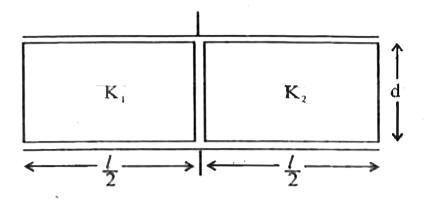
|
|
| 19. |
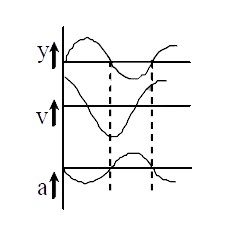
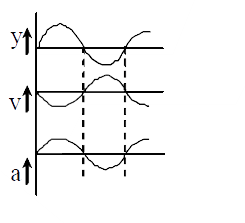
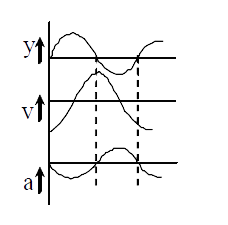
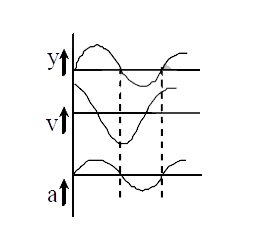
Which of the following diagrams correctly relate displacement velocity and acceleration with time for a particle executing SHM |
|
Answer»
|
|
| 20. |
In the diagram resistance between any two junctions is R. Equivalent resistance across terminals A and B is |
|
Answer» `(11R)/(7)` |
|
| 21. |
In which transformation the change of hydridization and shape about underlined atom take place? |
|
Answer» `UNDERSET(-)(C)H_(3)CH_(3) to underset(-)(C)H_(3)^(-)+CH_(3)^(+)` `ep=0"" ep=0` `bp=3"" bp=4` `"PLANE Triangle""" "Tetrahedral"` |
|
| 23. |
Consider a collision between two particles one of which is at rest and the other strikes it head on with momentum P_(1). Calculate the energy of reaction Q in terms of the kinetic energy of the particles before and they collide. |
|
Answer» Solution :Initially, `m_(1)` has a momentum `P_(1)` and `m_(2)` is at rest `(P_(2) =0)` in the lab frame. The masses of the particles after the collision are `m'_(1)` and `m'_(2)` . The conservation of momentum gives `P'_(1) +P'_(2) =P'_(1)` or `P'_(2) =P'_(1) - P'_(1)` Squaring this equation , we have `P'_(1) = P_(1)^(2) + P'_(1)^(2) -2 P_(1) P'_(1)` ` =P_(1)^(2) + P'_(1)^(2) -2P_(1)P'_(1) COS theta` 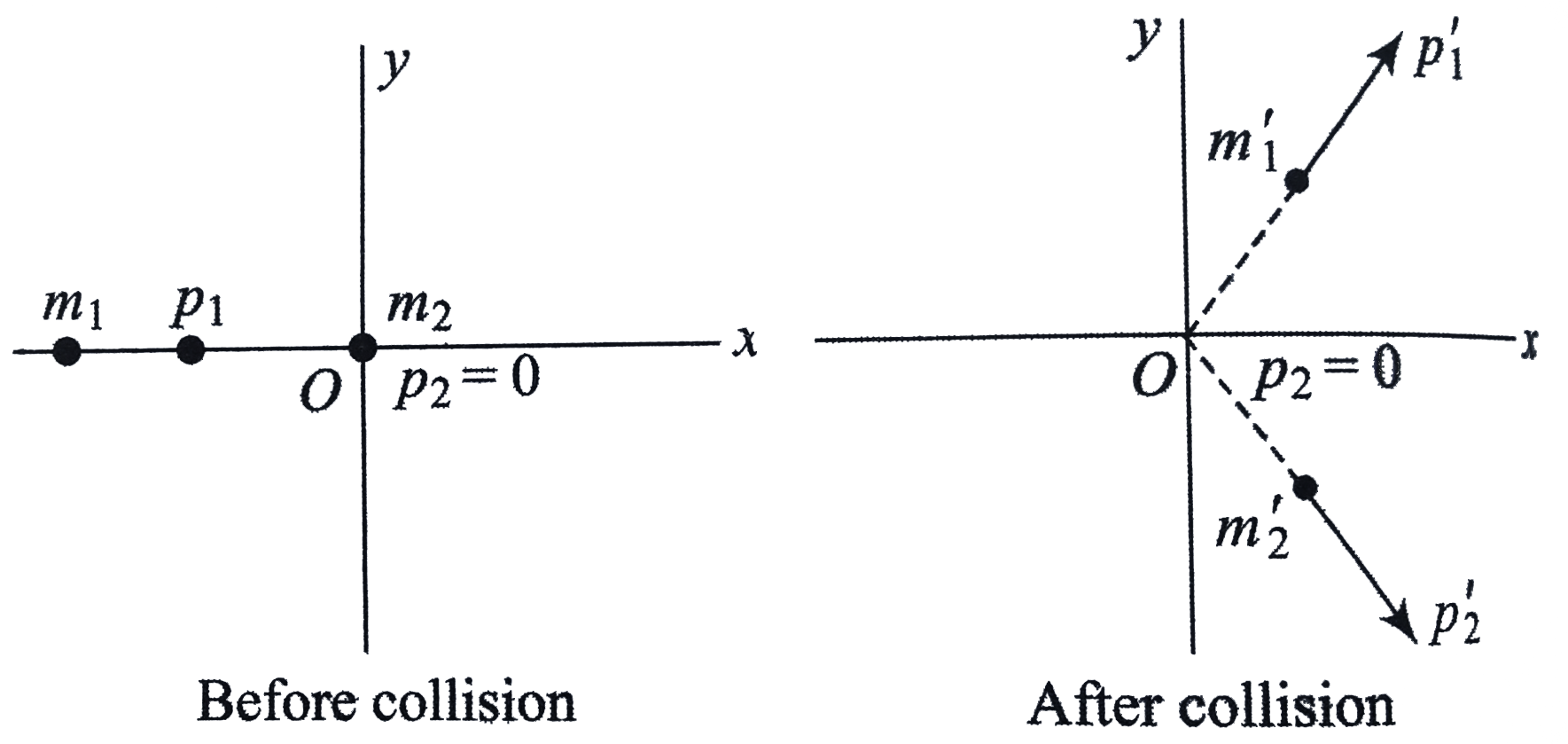 We have `Q =(P'_(1)^(2))/(2m'_(1)) +(P'_(2)^(2))/(2m'_(2)) -(P_(1)^(2))/(2) m'_(1)` `+ (1)/(2m'_(2)) (P_(1)^(2)) +P'_1^2 -2 P_(1)P'_(1) cos theta-(P_(1)^(2))/(2m_(1))` or` Q=(1)/(2) ((1)/(m_(1'))+(1)/(m_(2')))p'_(1)^(2)+(1)/(2)((1)/(m_(2'))-(1)/(m_(1)))p_(1)^(2)-(p_(1)p_(1)p)/(m_(2')) cos theta` Note that the KINETIC energy of a particle can be EXPRESSED in terms of momnetum of particles as `E_(K) =(P^(2))/(2m)` . Now, we can express the above results as `Q=D_(k,1')(1-(m_(1))/(m_(2')))=-(2(m_(1)m_(1')E_(k,1))^(1//2))/(m_(2'))cos theta ` (iii) The equation derived above is called `Q` equation . It is applied in ANALYSIS of nuclear collisions. |
|
| 24. |
Out of the two Kirchhoffs laws which one explicitly shows that electrostatic force is a conservative force? |
| Answer» SOLUTION :Kirchhoff.s SECOND LAW. | |
| 25. |
Explain the working principle of a parallel plate capacitor. |
|
Answer» Solution :To understand the principle of a capacitor consider an insulated conductor plate A and give charge Q to it [Fig. ] so that it acquires a POTENTIAL `V_1`. Now bring another metallic plate B of same SIZE near A. As shown in Fig. equal amount of -ve and +vecharges are induced on plate B.Induced + ve charge on B tends to raise the potential of plate A but induced – ve charge tends to lower the potential of A. HOWEVER, if plate B is EARTHED [Fig.] then induced positive charge, being free, passes to earth. Now due to - ve charge of B electric potential of A is lowered by a large VALUE to V (say) and consequently its capacitance is raised appreciably. It is the basic principle of a capacitor. 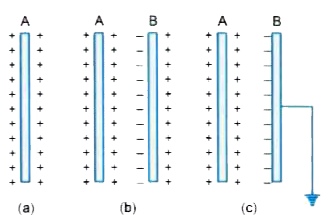
|
|
| 26. |
An electromagnetic wave has 5 joules of electric energy. The magnetic energy is |
|
Answer» zero |
|
| 27. |
A ray of light falls on the surface of a spherical glass paper weight making an angle alpha with the normal and is refracted in the medium at an angle beta. The angle of deviation of the emergent ray from the direction of the incident ray |
|
Answer» `(alpha-beta)` |
|
| 28. |
Arrange 32 identical cells of emf 2 V each with internal resistance 0.5 Omega such current passing through an external resistance of 1 Omega is maximum. what will be the value of current ? |
|
Answer» |
|
| 29. |
The polarisation of light proved that light is composed of ...... |
|
Answer» LONGITUDINAL WAVES |
|
| 30. |
(a) Draw the circuit arrangement for studying the input and output characteristics of an n-p-n transistor in CE configuration . With the help of these characteristics define (i) input resistance , (ii) current amplification factor . (b) Describe briefly with the help of a circuit diagram how an n-p-n transistoris used to produce self-sustained oscillations . |
|
Answer» Solution :(a) Common emitter (CE) transistor characteristic : The transistor is most widely USED in the CE configuration . When a transistor is used in CE configuration , the input is between the base and emitter and the output is between the collector and emitter . The input and output characteristics of an n-p-n transistor in CE configuration can be studied by using the given circuit . 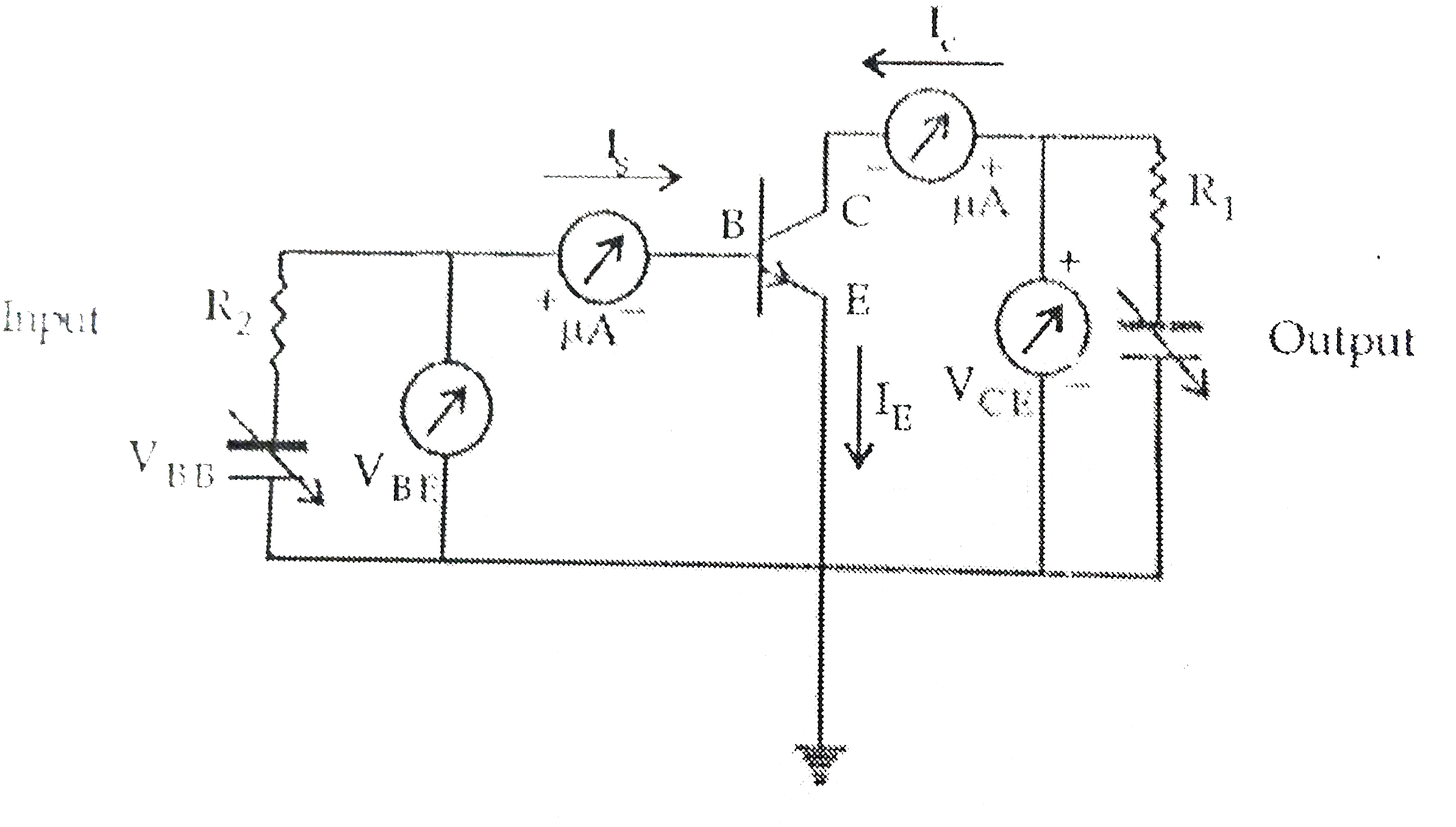 (i) Input characteristics : The variation of the base current `I_(B)` with the base emitter voltage `V_(BE)` is called the input characteristics keeping `V_(CE)` fixed . A CURVE is plotted between the base current `I_(B)` against the base emitter voltage `V_(CE)` is kept fixed . Since `V_(CE) = V_(CB) + V_(BE)` and for Silicon (Si) transistor `V_(BE)` is 0.6 to 0.7 `V , V_(CE)` must be larger than 0.7 V . The input characteristics of a transistor is shown in FIG. (a) . (ii) Output characteristics : The variations of the collector current `I_(C)` with the collector emitter voltage `V_(CE)` , keeping the base current`I_(B)` constant is called output characteristics . The plot of `I_(C)` versus `V_(CE)` for different fixed values of `I_(B)` gives one output characteristic . The different output characteristics for different values of `I_(B)` is shown in ltbegt 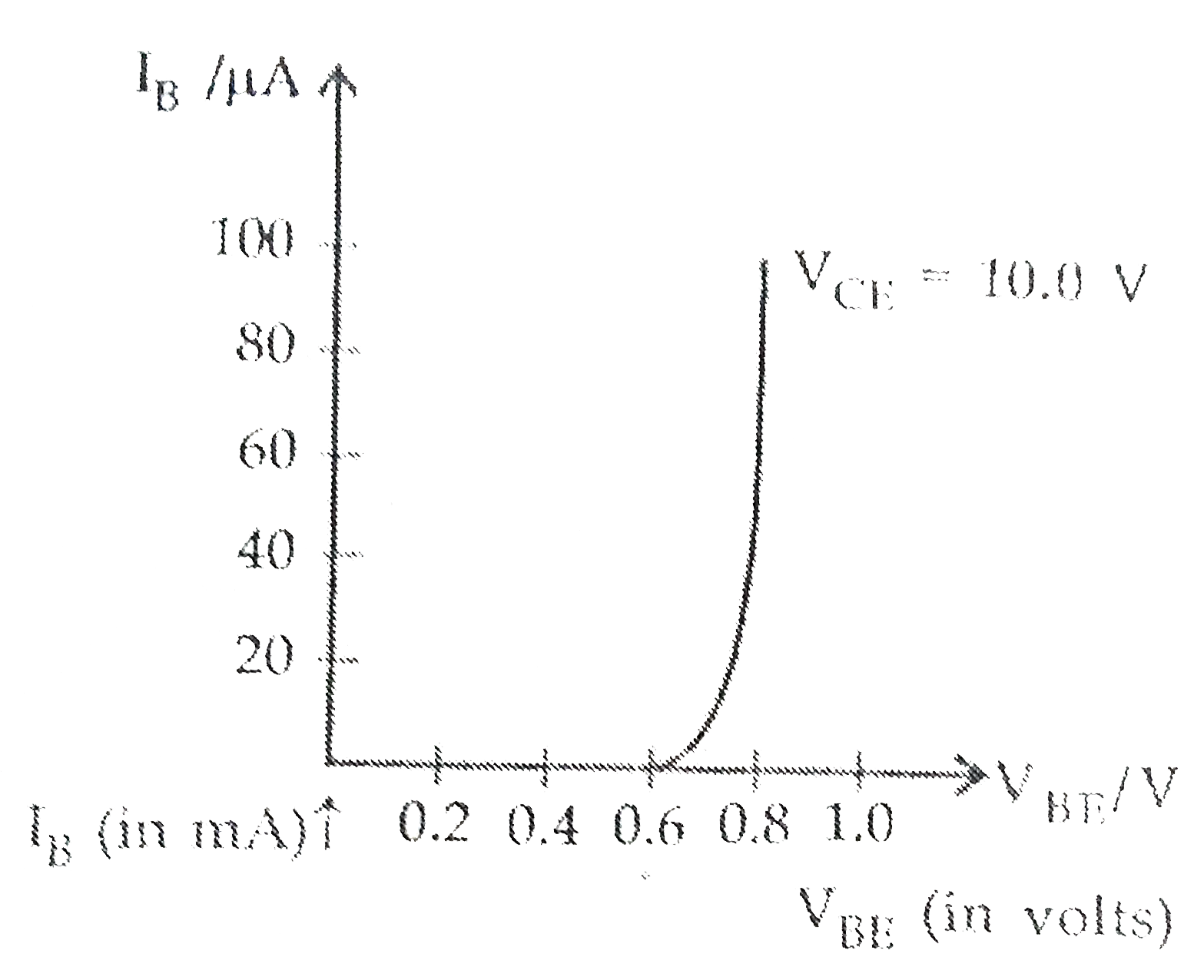 (iii) Input Resistance : This is defined as the ratio of the change in collector-emitter voltage `(DeltaV_(CE))` to the resulting change in base current `(Delta I_(B))` at constant collector-emitter voltage `(V_(CE))`. `therefore "" r_(i) = ((DeltaV_(BE))/(DeltaI_(B)))_(V_(CE))` (iv) Output Resistance : This is defined as the ratio of the change in base-emitter voltage `(Delta_(VE))` to the change in collector current `(DeltaI_(C))` at constant base current `I_(B)`. `therefore "" r_(0) = ((DeltaV_(CE))/(DeltaI_(C)))_(I_(B))` (v) Current Amplification Factor `(beta)`: This is defined as the ratio of the change in collector current `(DeltaI_(C))` to change in base current `(Delta I_(B))` at constant `V_(CB)`. `beta_(ac) = ((DeltaI_(C))/(DeltaI_(B)))_(V_(CE))` This is also known as current gain . |
|
| 31. |
A rectangular frame of 25 cm x 15 cm is placed normal to 2 xx 10^4 NC^(-1) uniform field. If this frame is formed in circular shape, then flux associated will be......Nm^(2)C^(-1).(a) 750 (b) 1019.1 (c) 800 (d) 2015.5 |
|
Answer» 750 `l=2(25 + 15) = 2 XX 40` =80 cm Radius of circle of length r, `r=l/(2pi) = 80/(2 xx 3.14) = 40/pi xx 10^(-2) m` Area. `A = pir^(2) = pi xx (40 xx 10^(-2))^(2)/pi^(2) =(1600 xx 10^(-4))/pi m^(2)` `therefore` FLUX associated with circular frame, `phi =EAcostheta` `=2 xx 10^(4) xx (1600 xx 10^(-4))/pi xx cos0^(@)` `therefore 1019.1 Nm^(2)C^(-1)` |
|
| 32. |
A liquid is flowing throw a tube of varying diameter. The rate (R ) of flows of liquid in any cross section and diameter (D ) of the tube in that position are related as |
| Answer» Answer :D | |
| 33. |
The threshold wavelength for photo electric emission from a material is 5000A^(0). Photo electrons will be emitted when the material is illuminated with monochromatic radiation from |
|
Answer» 100 watt infrared lamp |
|
| 34. |
(A): A voltage supply from which one needs high currents must have very low internal resistance. (R): The maximum current drawn from a cell is e/r only. |
|
Answer» Both 'A' and 'R' are TRUE and 'R' is the CORRECT explanation of 'A' |
|
| 35. |
The energy of the electron in hydrogen atom is known to be expressible in the form E_(n) = - (13.6)/(n^(2)) eV (n = 1,2,3,…..). Use this expressionto show thatthe . (i) electron in the hydrogen atom cannot have an energy of -2 eV.(ii) spacing between the lines (consecutive energy levels) within the given set of the observed hydrogen spectrum decreases as increases. |
|
Answer» Solution :(i) From the relation`E_(N) =- (13.6)/(n^(2))eV`,we have . `E_(1) = - (13.6)/((1)^(2)) = - 13.6eV,"" E_(2) = - (13.6)/((2)^(2)) = - 3.4 eV` `E_(3) =- (13.6)/((3)^(2)) = - 1.51 eV,""E_(4) = - (13.6)/((4)^(2)) = - 0.85 eV` andso on...... Thus , it is very MUCH clear the electron in thehydrogenatomcannot havean energyof -2eV. (iii) Energydifferencebetweenconsecutiveenergylevelsis : `Delta E_(1) = E_(2)- E_(1) = - 3.4 - (-13.6) eV = 10.2eV` `Delta E_(2) =- E_(3) - E_(2) = -1.51 - (-3.4) eV = 1.89 eV` `Delta E_(4) -E_(3) = - 0.85- (-1.51) eV = 0.66 `eV and so on. Thus, ITIS clear thatspacingbetween the lines within the GIVEN set of observedhydrogenspectrumdecreases as n increases. |
|
| 37. |
If the rate of change of current in primary coil is doubled, the induced emf in secondary coil become |
|
Answer» half |
|
| 38. |
A coil of self-inductance L is placed in an external magnetic field (no current flows in the coil). The total magnetic flux linked with the coil is phi. The magnetic field energy stored in the coil is |
|
Answer» ZERO |
|
| 39. |
The distance between the slit and the biprism and between the biprims and the screen50 cm each. The angle of the biprism is 179^(@) and itsrefractive index is 1.5. If the distance between successive bright fringes is 0.0135 cm, then the wavelenghts of lights is |
|
Answer» `5893xx10^(-10) cm` `:. Alpha=0.5^(@)=(0.5xx pi)/(180) "rad"` Thus, `d= 2U (mu-1)alpha` `=2xx0.5(1.5-1)(0.5 xxpi)/(180)` `=0.004361m` `:. Lambda=(d)/(D) beta=(0.004361xx0.00135xx10^(-2))/(1)` `=5893Å=5893xx10^(-8) cm` |
|
| 40. |
What are important features of J.J. Thomson's atom model ? Why was it discarded ? |
|
Answer» 1. Electron is present in all atoms. 2. Since an atom is electrically neutral, so number of electron is EQUAL to number of positive charge presentin the atom. Reasons for discardingthis model This model was discarded DUE to following reasons : 1. It could not explain in Rutherford `ALPHA`-particles through large angles in Rutherford `alpha`-particle scattering experiment. 2. It could not explain the origin of spectral lines in the FORM of series in hydrogen atom. |
|
| 41. |
What do 'ugly sights' mean? |
|
Answer» To SEE SOMETHING good |
|
| 42. |
Which of the following is an essential requirement for initiating the fusion reaction ? |
|
Answer» High TEMPERATURE |
|
| 43. |
Can we accelerate neutrons and electrons by a cyclotron ? |
| Answer» Solution :No. NEUTRONS are ELECTRICALLY neutral . In the case of electrons RELATIVISTIC VARIATION of MASS with velocity is prominent. So both of them can not accelerate in a cyclotron. | |
| 44. |
Let the potential energy of hydrogen atom in the ground state be zero. Then its total energy in the first excited state will be |
|
Answer» 27.2 EV Energy in 1ST EXCITED state `= -(13.6)/(4) = -3.4eV` `:.` Energy `=-3.4 + 13.6 = 10.2eV` |
|
| 45. |
Shunt wire should be ...... . |
|
Answer» Thichk and long Shunt should have LOW resistance R = `(rho l)/(A)` l should be LESS A should be LARGE |
|
| 46. |
A man of mass m_1 = 80 kg is standing on a platform of mass m_2 = 20 kg that lies on a frictionless horizontal surface. The man starts moving on the platform with a velocity v_r = 10 m/s relative to the platform. Find the recoil speed of the platform. |
|
Answer» |
|
| 47. |
The effective focal length of the lens combination shown in figure is - 60 cm. The radii of curvature of the curved surfaces of the plano-convex lenses are 12 cm each and refractive index of the material of the lens is 1.5. The refractive index of the liquid is |
|
Answer» 1.33 |
|
| 48. |
A: Ampere circuital law is not independent of the Biot- Savart's law. R: Ampere's Circuital law can be derived from the Blot Savart law. |
|
Answer» If both Assertion & Reason are true and the reason is the correct EXPLANATION of the assertion then mark (1) |
|
| 49. |
Two full turns of the circular scale of a screw gauge cover a distance of 1 mm on its main scale. The total number of divisions on the circular scale is 50. Further it is found that the screw gauge has a zero error of -0.03 mm. While measuring the diameter of a thin wire, a student notes the main scale reading of 3 mm and the number of circular scale division in line with the main scale as 35. The diameter of the wire is |
|
Answer» `3.32` MM MAIN scale reading =`3mm`. Vernier scale reading =`35` `:.`Observed reading `=3+0.35=3.35` zero ERROR`=-0.03` `:.`ACTUAL diameter of the the wire `=3.35-(-0.03)` `=3.38mm` `(d)` is the correct CHOICE. |
|
| 50. |
Define power of lens, obtain its equation and write its SI unit. |
|
Answer» <P> Solution :Power of a lens is a measure of the convergence or divergence, which a lens introduces in the light falling on it.Clearly a lens of shorter focal length bends the incident light more, while converging it in case of a convex lens and diverging it in case of a concave lens. The power P of a lens is defined as the tangent of the ANGLE by which it converges or diverges a beam of light falling at unit distant from the optical centre.  From figure `TAN delta=h/f` If h=1 `tan delta=1/f` and for small value of `delta" "tan delta=delta` `therefore delta=1/f` `therefore` Power P=`1/f` The SI unit for power of a lens is dioptre (D) `therefore1D=1m^(-1)` The power of a lens of focal length of 1 metre is one dioptre. Power of a lens is POSITIVE for a converging lens and negative for a diverging lens. Thus, when an optician prescribes a corrective lens of power + 2.5 D, the required lens is a convex lens of focal length + 40 cm. `f=1/P=(1)/(2.5)m` `thereforef=(1000)/(25)cm=+40 ` cm A lens of power of – 4.0 D means a concave lens of focal length f = `(1)/(-4)`m = - 25 cm By using lens maker.s formula, `P = 1/f = (n-1)(1/R_1-1/R_2)`power of lens can be obtained. |
|