

Saved Bookmarks
This section includes 7 InterviewSolutions, each offering curated multiple-choice questions to sharpen your Current Affairs knowledge and support exam preparation. Choose a topic below to get started.
| 1. |
In a metal in the solid state, such as a copper wire, the atoms are strongly bound to one another and occupý fixed positions. Some electrons (called the conductor electrons) are free to move in the body of the metal while the other are strongly bound to their atoms. In good conductors, the number of free electrons is very large of the order of 10^(28) electrons per cubic metre in copper. The free electrons are in random motion and keep colliding with atoms. At room temperature, they move with velocities of the order of 10^5 m/s. These velocities are completely random and there is not net flow of charge in any directions. If a potential difference is maintained between the ends of the metal wire (by connecting it across a battery), an electric field is set up which accelerates the free electrons: These accelerated electrons frequently collide with the atoms of the conductor, as a result, they acquire a constant speed called the drift speed which is given by V_e = 1/enA where I = current in the conductor due to drifting electrons, e = charge of electron, n = number of free electrons per unit volume of the conductor and A = area of cross-section of the conductor.Choose the current statements |
|
Answer» copper the NUMBER of free electrons is of the ORDER of `10^(23)`electrons per cubicIncentimetre |
|
| 2. |
An aperture of size a is illuninated by a parallel beam of light of wavelength gamma. The distance at which ray optics has a good approximation is |
|
Answer» a. `(a^(2))/(LAMBDA)` |
|
| 3. |
आवृतबीजी (पुष्पीय पौधों) में भ्रूणपोष होता है |
|
Answer» द्विगुणित |
|
| 4. |
In an electromagnetic wave the average energy density associated with electric field is : |
|
Answer» `CV^(2) // 2` |
|
| 5. |
In a metal in the solid state, such as a copper wire, the atoms are strongly bound to one another and occupý fixed positions. Some electrons (called the conductor electrons) are free to move in the body of the metal while the other are strongly bound to their atoms. In good conductors, the number of free electrons is very large of the order of 10^(28) electrons per cubic metre in copper. The free electrons are in random motion and keep colliding with atoms. At room temperature, they move with velocities of the order of 10^5 m/s. These velocities are completely random and there is not net flow of charge in any directions. If a potential difference is maintained between the ends of the metal wire (by connecting it across a battery), an electric field is set up which accelerates the free electrons: These accelerated electrons frequently collide with the atoms of the conductor, as a result, they acquire a constant speed called the drift speed which is given by V_e = 1/enA where I = current in the conductor due to drifting electrons, e = charge of electron, n = number of free electrons per unit volume of the conductor and A = area of cross-section of the conductor.A current of 1 A flows through a copper wire. The number of electrons passing through any cross-section of the wire in 1.6 sec is (charge of a electron = 1.6 xx 10^(-19 c). |
|
Answer» `10^(25)` |
|
| 6. |
The total energy of an electron in second excited state is - 2E. What is potential energy with proper sign in this state? |
| Answer» SOLUTION :`-4E` | |
| 7. |
(a) Using the phenomenon of polarisation, show how transverse nature of light can be demonstrated. (b) Two polaroids P_(1) and P_(2) are placed with their pass axes perpendicular to each other. Unpolarised light of intensity I_(0) is incident on P_(1). A third polaroid P_(3) is kept in between P_(1) and P_(2) such that its pass axis makes an angle of 30^(@) with that of P_(1). Determine the intensity of light transmitted through P_(1), P_(2) and P_(3). |
|
Answer» <P> Solution :(a) Light from the sodium LAMP passing through the single POLAROID sheet `(P_(1))` does not show any variation in INTENSITY when this sheet is rotated. However, if the light transmitted by `P_(1)`, is made to pass through another polaraied sheet `(P_(2))`, the light intensity coming out of `P_(2)`, varies from a maximum to zero, and again to maximum, when `P_(2)` is rotated. These observations are consistent only with the transverse nature of light waves. `(b)` Intensity of light transmitted through `P_(1)=(I_(0))/(2)` Intensitiy of light transmitted through `P_(3)=((I_(0))/(2))xxcos^(2)30^(@)` `=(3I_(0))/(8)` Intensity of light transmitted through `P_(2)=P_(3)xxcos^(2)(90^(@)-30^(@))=(3)/(8)I_(0)cos^(2)60^(@)` `=(3)/(32)I_(0)` |
|
| 8. |
The number of polynomials having zeores as-2 and 5 is |
|
Answer» 1 |
|
| 9. |
A y-ray photon is emitted |
|
Answer» after IONIZATION of an atom |
|
| 10. |
In a metal in the solid state, such as a copper wire, the atoms are strongly bound to one another and occupý fixed positions. Some electrons (called the conductor electrons) are free to move in the body of the metal while the other are strongly bound to their atoms. In good conductors, the number of free electrons is very large of the order of 10^(28) electrons per cubic metre in copper. The free electrons are in random motion and keep colliding with atoms. At room temperature, they move with velocities of the order of 10^5 m/s. These velocities are completely random and there is not net flow of charge in any directions. If a potential difference is maintained between the ends of the metal wire (by connecting it across a battery), an electric field is set up which accelerates the free electrons: These accelerated electrons frequently collide with the atoms of the conductor, as a result, they acquire a constant speed called the drift speed which is given by V_e = 1/enA where I = current in the conductor due to drifting electrons, e = charge of electron, n = number of free electrons per unit volume of the conductor and A = area of cross-section of the conductor.The drift speed of free electrons in a conductor depends upon |
|
Answer» the MATERIAL of the conductor |
|
| 11. |
Describe the short history of light. |
|
Answer» Solution :The wave theory was not accepted because Newton.s authority and also because light coul travel through vacuum and a wave would alway require a medium to propagate from one poin to the other. But in 1801, Thomas Young performer interference experiment and firmly establisher that light is a wave phenomenon. Since the wavelength of the visible light is much smaller than the dimensions of typical mirro and lenses, light can be assumed to approximately travel in straight lines. The BRANCH of optics in which one completely NEGLECTS the finiteness of the wavelength is called geometrical optics. A ray is defined as the PATH of energy propagation in the limit of wavelength tending to zero. MANY EXPERIMENTS were carried out involving the interference and diffraction of light waves. These experiments be statisfactorily explained. Thus around the middle of the nineteenth century, the wave theory seemed to be very well established. |
|
| 12. |
In a metal in the solid state, such as a copper wire, the atoms are strongly bound to one another and occupý fixed positions. Some electrons (called the conductor electrons) are free to move in the body of the metal while the other are strongly bound to their atoms. In good conductors, the number of free electrons is very large of the order of 10^(28) electrons per cubic metre in copper. The free electrons are in random motion and keep colliding with atoms. At room temperature, they move with velocities of the order of 10^5 m/s. These velocities are completely random and there is not net flow of charge in any directions. If a potential difference is maintained between the ends of the metal wire (by connecting it across a battery), an electric field is set up which accelerates the free electrons: These accelerated electrons frequently collide with the atoms of the conductor, as a result, they acquire a constant speed called the drift speed which is given by V_e = 1/enA where I = current in the conductor due to drifting electrons, e = charge of electron, n = number of free electrons per unit volume of the conductor and A = area of cross-section of the conductor.A constant potential difference is maintained between the ends of a conductor having nonuniform cross-section. Which of the following quantities will not change along the length of the conductor |
| Answer» Answer :D | |
| 13. |
How does the energy gap of an instrinsic semiconductorvary, when doped with a pentavalent impurity? |
| Answer» SOLUTION :The ENERGY GAP DECREASES. | |
| 14. |
The fringe separation, for a light of wavelength 700 mm , if the slits are made one milimeter apart and screen are placed one metre away |
|
Answer» 0.7 cm `beta = 7 xx 10^(-4) = 0.7 m` |
|
| 15. |
In conjugate focal method, d_1 = 2 mm and d_2 = 8 mm so the distance between the two virtual images of slit is : |
|
Answer» 2 mm |
|
| 16. |
An electron is revolving around the nucleus with a constant speed of 2.2 xx 10^(8) m//s. Find the de-Broglie wavelength associated with it. |
|
Answer» Solution :`lambda=(H)/(mv)` `=(6.63xx10^(-34))/(9.1xx10^(-31)xx2.2xx10^(8))` `=3.31xx10^(-12)m` |
|
| 17. |
The modulation index for an amplitude modulated wave, for which the maximum amplitude is A and the minimum amplitude is B, is |
|
Answer» `(A)/(B)` |
|
| 18. |
Two waves are approaching each other with velocity 100m/s and frequency 'n' the distance between two consecutives nodes is |
|
Answer» 100N |
|
| 19. |
The power of a AM transmitter is 100 W. If the modulation index is 0.5 and the transmission is having signal side band, the percentage of useful power is |
|
Answer» `1.1` W |
|
| 20. |
A circular copper disc 100cm in radius rotates at 20pi "rad"//s about an axis through its centre and perpendicular to the disc. A uniform magnetic field of 0.2T acts perpendicular to the disc. Calculate the potential difference developed between the axis of the disc and the rim |
| Answer» SOLUTION :`6.28 XX 10^(-2)V` | |
| 21. |
Two H atoms in the ground state collide inelastically. The maximum amount by which their combined kinetic energy is reduced is |
|
Answer» `10.20eV` `=2E=2(-13.6)=-27.eV` `rArr` Total kinetic energy of electron in both the atoms `2K=2(-E)=-2E=-(-27.2)=27.2eV ( :. K=-E)` Now, after collision, total kinetic energy remaining with both the atoms is `(K_(1)+K_(2).)`. For this VALUE to become maximum, amount of energy EXCHANGED in the inelastic collision must be minimum. For this if electron does not do any transition in both the atoms then there will not be any decrease in total kinetic energy of two atoms. So this can not be accepted. There is another way. Suppose electron in any one atom remains in ground state only. And electron in another atom transits from n = 1 to n = 2 by absorbing minimum amount of energy so that energy exchange will TAKE place and that too with minimum amount. Here in this case total kinetic energy of both the atoms after collision will be `=K_(1).+K_(2).` `=-E_(1).+(-E_(2).)` `=-(-13.6)-(-3.4)` `( :. E_(2).=-(13.6)/(n^(2))=-(13.6)/(4)=-3.4eV)` `=13.6+3.4=17eV` Decrease in total kinetic energy of both the atoms, |
|
| 22. |
Atomic mass of boron is 10.81 and it has two isotopes " "_(5)^(10)B and " "_(5)^(11)B. The ratio of " "_(5)^(10)B to " "_(5)^(11)B in nature would be |
|
Answer» `19:81` |
|
| 23. |
In a metal in the solid state, such as a copper wire, the atoms are strongly bound to one another and occupý fixed positions. Some electrons (called the conductor electrons) are free to move in the body of the metal while the other are strongly bound to their atoms. In good conductors, the number of free electrons is very large of the order of 10^(28) electrons per cubic metre in copper. The free electrons are in random motion and keep colliding with atoms. At room temperature, they move with velocities of the order of 10^5 m/s. These velocities are completely random and there is not net flow of charge in any directions. If a potential difference is maintained between the ends of the metal wire (by connecting it across a battery), an electric field is set up which accelerates the free electrons: These accelerated electrons frequently collide with the atoms of the conductor, as a result, they acquire a constant speed called the drift speed which is given by V_e = 1/enA where I = current in the conductor due to drifting electrons, e = charge of electron, n = number of free electrons per unit volume of the conductor and A = area of cross-section of the conductor.A uniform wire of length 2.0 m and cross-sectional area 10^(-7) m^(2) carries a current of 1.6 A. If there are 10^(28) free electrons per m in copper, the drift speed of electrons in copper is |
|
Answer» `2 mm//s` |
|
| 24. |
When a current is passed in a moving coil galvanometer the coil gets deflected because |
|
Answer» the current deflects any thing |
|
| 25. |
Minimum excitation potential of Bohr's first orbit in hydrogen atom is |
|
Answer» 13.6V |
|
| 26. |
A small photocell is placed at a distance of 4 m from a photosensitive surface. When light falls on the surface the current is 5 mA. If the distance of cell is decreased to 1 m, the current will become |
|
Answer» `1.25 mA` |
|
| 27. |
The binding energy per nucleon for C^(12) is 7.68 MeV and that for C^(13) is 7.47 MeV. What is the energy required to remove a neutron from C^(13) ? |
|
Answer» `0.21 MEV` |
|
| 28. |
Which of the following electromagnetic wave has maximum wavelength ? |
|
Answer» RADIOWAVES |
|
| 29. |
(A): When two conducting wires of different resistivity having same cross section are joined in series, the electric field in them would be equal when they carry equal current (R): When wires are in series they carry unequal current |
|
Answer» Both 'A' and 'R' are true and 'R' is the correct EXPLANATION of 'A' |
|
| 30. |
A parallel-plateair capacitorwhose platesare separatedby a distanced = 5.0 mm is firstchagredto potantialdufferebceV = 90 Vand then disconnecedfrom a dcvoltage the capacitordecreasesby eta= 1.0 %taking intoaccountthat theaveragenumber of ion pairsformedin air understandard contionsper unit volumeper unittime is equalto n_(1) = 5.0 cm^(-3) s^(-1) and thatthe givenvoltage correspondsto thesaturations current. |
|
Answer» Solution :Ions PRODUCED will CAUSE charge to decay. Clearly, `eta CV ` = decrease of charge `= dotn_(i) e A DT = (epsilon_(0)A)/(d) V eta` or, `t = (epsilon_(0) V eta)/(dotn_(i) e d^(2)) = 4.6` DAYS Note, that `n_(p)` here, is the number of ion pairs produced. |
|
| 31. |
If the HCF of 65 and 117 is expressible in the form 65m - 117, then the value of m is |
|
Answer» 1 |
|
| 32. |
In Young's double slit experiment, the band width on a screen is double when the screen is moved through 1m. If te distance between the slits is 0.4mm and the wavelength of light used is 600nm , find the band width. |
|
Answer» |
|
| 33. |
During refraction of light from one medium to onther______,______and_____of the wave changes. |
| Answer» SOLUTION :AMPLITUDE,INTENSITY and velocidty | |
| 34. |
Explain centre frequency or resting frequency in frequency modulation. |
| Answer» Solution :When the FREQUENCY of the baseband SIGNAL is zero (no INPUT signal), there is no CHANGE in the frequency of the CARRIER wave. It is at its normal frequency and is called as centre frequency or resting frequency | |
| 35. |
The wavelength 5890 Å and 5896 Å of sodium doublet correspond to …. region of the electromagnetic spectrum. |
|
Answer» (A) infrared |
|
| 36. |
मेरे मित्र एक ऐसे देश के निवासी हैं जिस देश की सीमा भारत के साथ नहीं लगती है। आप बताइए वह कौन सा देश है? |
|
Answer» बांग्लादेश |
|
| 38. |
Calculate the mean lifetime of excited atoms if it is known that the intensity of the spectral line appering due to transition to the ground state diminishes by a factor eta=25 over a distance l=2.5mm along the stream of atoms whose velocity is v=600m//s. |
|
Answer» Solution :Let `T=` mean life time of the EXCITED atoms. Then the number of exicted atoms will DECREASE with time as `E^(-t//T)`. In time `t` the atom travels a distance `vt` so `t=(l)/(v)`. Thus the number of excited atoms a in a beam that has travesed a distance `l` has decreased by `e^(-l//vT)` The INTENSITY of the line is proportional to the number of excited atoms in the beam. Thus `e^(-l//vtau)=(1)/(eta) or TAU=(l)/(V i n eta)=1.29xx10^(-16)` second. |
|
| 39. |
An OR gate |
|
Answer» IMPLEMENTS LOGIC addition |
|
| 40. |
The catalyst used in the manufacture of polyethylene Zeigler method is - |
|
Answer» titanium TETRACHLORIDE and tripbenyl aluminium |
|
| 41. |
In a hypothetical uniform and spherical planet of mass M and radius R, a tunel is dug radiay from its surface to its centre as shown. The minimum energy required to carry a unit mass from its centre to the surface is kmgR. Find value of k. Acceleration due to gravity at the surface of the planet is g. |
|
Answer» |
|
| 42. |
What is cladding? |
| Answer» Solution :The OPTICAL medium of higher refractive index is bonded by an optical medium of lower refractive index. This process of bonding is KNOWN as CLADDING. | |
| 43. |
Consider a source of sound S and an observer P. The sound source is of frequency n_0. The frequency observed by P is found to be n_(1)if P approaches S at speed v and S is stationary, n_2 if S approaches P at a speed v and P is stationary and n_3 if each of P and S has speed v/2 towards one another. Now, |
|
Answer» `n_(1) = n_(2) =n_(3)` |
|
| 44. |
Consider a wheatstone bridge PQRS as shown in Fig. 7.19 where current I is in the circuit of four resistances 10 ,20 ,30, and 40 Omega. Find the ratio of the heat generated in the four arms PQ,QR, PS, and SR. |
|
Answer» Solution :Given ` R_(1) = 10 omega , R_(2) = 20 Omega , R_(3) = 20 Omega , and R_(4) = 40 Omega`. Now, `(R_(1))/( R_(2)) = ( 10) / ( 20) = (1) /(2)` and `(R_(3))/(R_(4)) = ( 20) /( 40) = (1)/( 2)` ltbgt `:. (R_(1))/(R_(2)) = (R_(3))/(R_(4))` Hence , wheatstone bridge is balanced . Now as the bridge is balanced , no current will flow through arm `QS`. Let `I_(1) and I_(2)` be the currents flowing in arms `PQ and PS`. respectively. Then POTENTIAL differences across `P and Q` is equal to potential difference across `P and S`. That is , `I_(1) XX 10 = I_(2) xx 20 or I_(1) = 2I_(2)` Therefore, heat produced in arm `PQ` is `H_(1) xx I_(1)^(2) xx 10 = 40 I_(2)^(2) J` Also heat produced in arm `QR` is `H_(2)= I_(1)^(2) xx 20 = 80 I_(2)^(2) J` Similarly , heat produced in arm `PS` is `H_(3) = I_(2)^(2) xx 20 = 20 I_(2)^(2) J` And heat produced in arm `SR` is `H_(4) = I_(2)^(2) xx 40 = 40 I_(2)^(2) J` `:. H_(1) : H_(2) : H_(3) : H_(4) = 40 I_(2)^(2): 80 I_(2)^(2) : 20 I_(2)^(2) : 40 I_(2)^(2) = 2 : 4 : 1 : 2`, which is the required ratio. 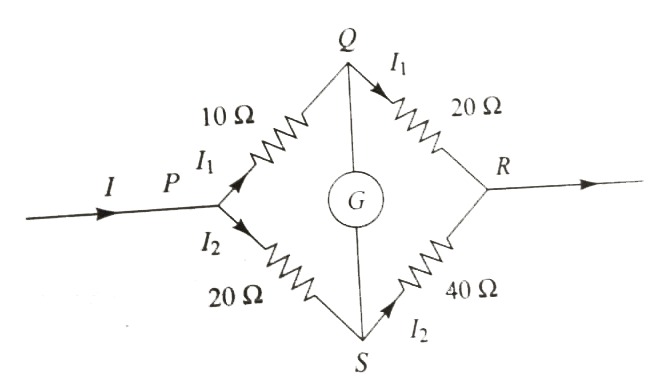
|
|
| 45. |
A wire of resistance 3 Omegais stretched uniformly then the length is doubled. The wire is now bent in the form of an equilateral triangle then the effective resistance between the ends of any side of the triangle |
|
Answer» `9 /2 OMEGA ` |
|
| 46. |
The r.m.s. velocity of molecules 2m/s, 4m/s and 6m/s sec is |
|
Answer» 4.3 m/s |
|
| 47. |
A ray of light is incident on the surface of separation of a medium at an angle 45^(@) and is refracted in the medium at an angle 30^(@). What will be the speed of light in the medium? |
|
Answer» `1.96xx10^(8)ms^(-1)` Hence `v=( c sin r)/(sin i)=(3XX10^(8)xxsin30^(@))/(sin 45^(@))` `=(3xx10^(8))/(sqrt(2))=2.12xx10^(8)ms^(-1)` |
|
| 48. |
The mean kinetic energy of one gram-mole of a perfect gas at abolute temperature T is |
|
Answer» `(1)/(2)KT` |
|
| 49. |
यदिA={a,b,c} , B={b, c, d}, C={a, b, d, e) तोAnn(BuuC) होगा - |
|
Answer» {C} |
|
| 50. |
Comparing the L-C oscillations with the oscillations of a spring-block system (force constant of spring=k and mass of block=m), the physical quantity mk is similar to |
| Answer» Answer :D | |