

Saved Bookmarks
This section includes 7 InterviewSolutions, each offering curated multiple-choice questions to sharpen your Current Affairs knowledge and support exam preparation. Choose a topic below to get started.
| 1. |
A resistance R is connected across a cell of emf eand internal resistance r. A potentiometer now measures the potential difference between the terminals of the cell as V. Write the expression for r in terms of epsi, V and R. |
| Answer» SOLUTION :`R= (EPSI - V)/(V) . R` | |
| 2. |
An aircraft executes a horizontal loop at a speed of 720 km/h with its wings banked at 15^(@). The radius of the loop is (tan 15^(@) = 0.268) |
| Answer» Answer :A | |
| 3. |
An electric dipole placed in a non-uniform electric field at an angle theta experiences |
|
Answer» |
|
| 4. |
A ball is thrown vertically upwards from the ground with a velocity of 24.5m/s. If g=9.8m/s^2 , then the ball will be at a height of 29.4 metres from the ground after time |
|
Answer» 2 sec only |
|
| 5. |
Figure shows a Young's double slit experiment set-up. The source S of wavelength 4000Å oscillates along y-axis according to the equation y-sinpit, where y is in millimeters and t is in seconds. The distance two slits S_(1) and S_(2) is 0.5 mm. |
|
Answer» The position of CENTRAL maxima as a function of time is `4 SIN pi t` |
|
| 6. |
Questions 55 and 56 are based on following paragraph : In Young's double slit experiment, the distance between two slits is 1 mm. And distance between slits and screen is 1.0 meter. The wavelength of light used is 6000 Å. Two waves are equal. 55. The fringe width is |
|
Answer» `0.3 mm` |
|
| 7. |
What is the work done in moving a test charge q through a distance of 1 cm along the equatorial axis of an electric dipole ? |
| Answer» Solution :ZERO, because ELECTRIC POTENTIAL at all POINTS on the equatorial axis of a dipole is zero. | |
| 8. |
An equiconvex lens of refractive index n, focal length/and radius of curvature R is immersed in a liquid medium of refractive index n_m. For (?) n_m gt n, and (ii) n_m lt n, draw the ray diagrams in the two cases when a beam of light coming parallel to the principal axis is incident on the lens. Also find the focal length of the lens in terms of the original focal length and the refractive indices of the lens and that of the medium. |
|
Answer» Solution :Ray diagrams have been shown in FIG. 9.62 (i) and (ii) RESPECTIVELY. For an equiconvex lens `|R_(1)| = |R_(2)| =R` and sign of `R_(1)`is positive but that of `R_2` is negative. Hence, in air MEDIUM, the focal length of lens is given as :  `1/f = (n-1) [1/(+R) - 1/(-R)]` `rArr 1/f = (n-1) 2/R`..........(i) When the lens is immersed in a liquid medium, its focal length changes to `f_(m)` where `1/f_(m) =(n/n_(m)-1) 2/R` dividing (i) by (ii), we GET `f_(m)/f = (n-1)/(n/n_(m)-1) = ((n-1)n_(m))/(n-n_(m)) rArr f_(m) ((n-1)n_(m))/(n-n_(m)).f` |
|
| 9. |
Draw the graph showing variation of potential energy of a pair of nucleons as a function of their separation. Indicate the region in which nuclear force is (a) attractive (b) repulsive. |
|
Answer» Solution :The variation of potential ENERGY of a PAIR of nucleus as a function of their separation (r) is shown in FIG. We find that corresponding to r=OC=0.8fm, P.E. is minimum. At this DISTANCE, force between nucleons=0. for distance `gt OC`, negative P.E. goes on decreasing. The nuclear force are attractive. for distance `lt OC`, negative P.E. decreases, becomes zero and then increases. The nuclear forces in this region are REPULSIVE. 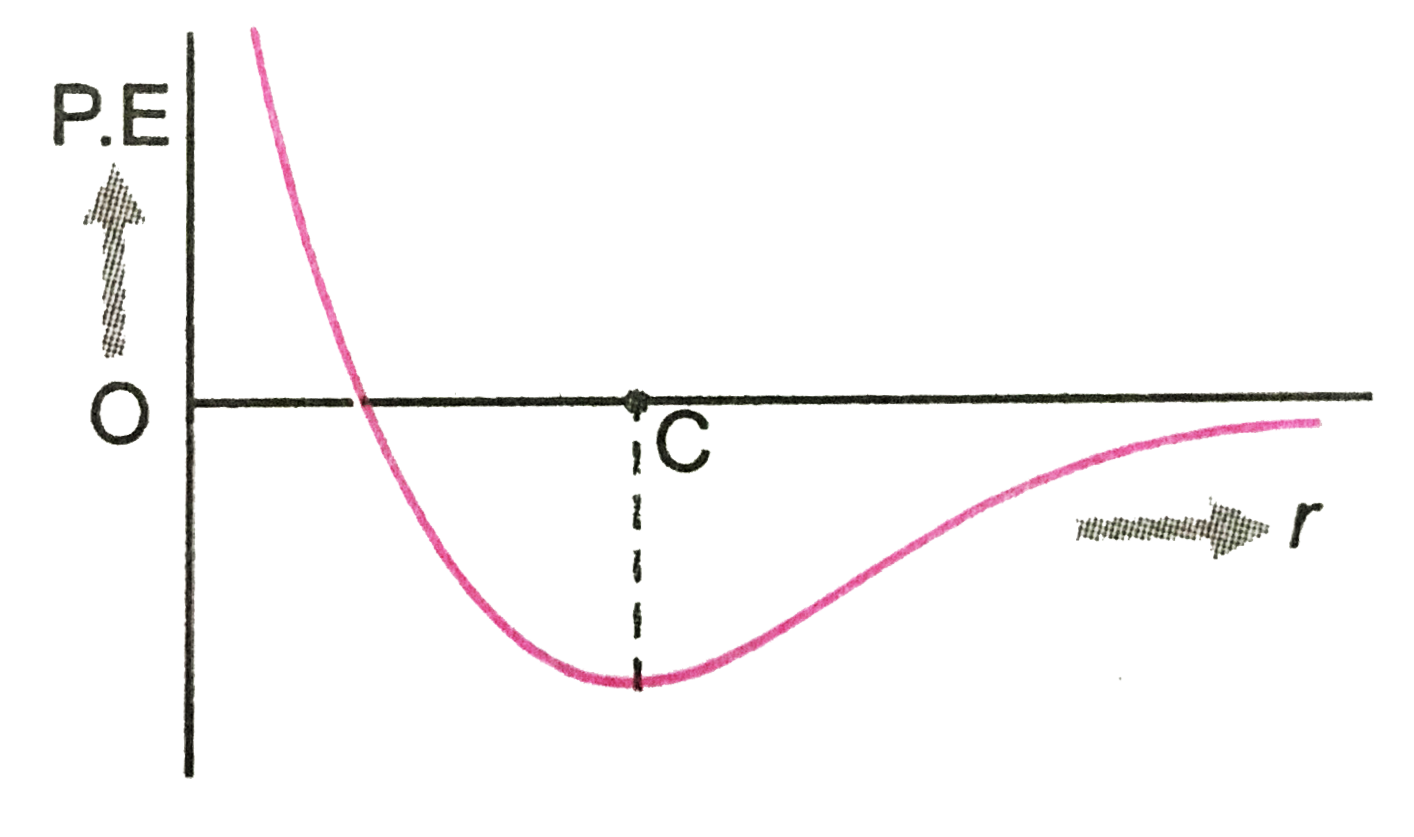
|
|
| 10. |
A ray of light passes through an equilateral glass prism in such a way that the angle of incidence is equal to the angle of emergence and each of these angles is 3/4times the angle of the prism. Determine the angle of deviation and the refractive index of the glass prism. |
|
Answer» SOLUTION :Here angle of prism A = 60°, angle of incidence i = angle of emergence = e and under this CONDITION angle of deviation is minimum: `therefore i=e = 3/4A = 3/4 xx 60^(@) = 45^(@)` and `I + e=A + DELTA`, hence `D_(m) =2i -A = 2 xx 45^(@) - 60^(@) = 30^(@)` `therefore` Refractive index of glass prism `n=(sin(A+D_(m))/2)/(sinA/2) =(sin(60^(@) + 30^(@))/2)/(sin 60^(@)/2) = (sin 45^(@))/(sin 30^(@)) =(1//sqrt(2))/(1//2) = sqrt(2)` |
|
| 11. |
The equation of an alternative currents is I=20 sin 300pit. Calculate the frequency and r.m.s value of current. |
|
Answer» SOLUTION :Here `I=20 sin 300pit` 1. Compare it with STANDARD EQUATION `I=I_(0)sin omega t=I_(0)sin 2pivt` we GET `I_(0)=20A and 2pivt=300pit or v=150 Hz` we get `I_(0)=20A and 2pivt=300pit or v=150Hz` 2. We know, `I_("rms")=(I_(0))/(sqrt2)""thereforeI_("rms")=(20)/(sqrt2)=14.14A.` |
|
| 12. |
A coil with inductive resistance X_(L)=30 Omega and impedance Z=50 Omega is connected to the mains with effective oltage value V=100V. Find the phase differencebetween the current and the voltage, as well as the heat power generated in the coil. |
|
Answer» Solution :`cancel(Z)=SQRT(R^(2)+ X_(L)^(2))` or ` R_(0)=sqrt(cancel(Z^(2))-X_(L)^(2))` The `TAN theta=(X_(L))/( sqrt(cancel(Z^(2))-X_(L)^(2)))` So ` cos varphi=(sqrt(cancel(Z^(2))-X_(L)^(2)))/(cancel(Z))=sqrt(1-((X_(L))/(cancel(Z)))^(2))` `varphi=cos ^(-1) sqrt(1- ((X_(L))/( cancel(Z)))^(2))=37^(@)`. The current lags by `varphi` BEHIND the voltage. also `P=VI cos varphi=(V^(2))/( cancel(Z^(2)))sqrt(cancel(Z^(2))-X_(L)^(2))=.160kW.` |
|
| 13. |
What should be the angle between two plane mirror so that whatever be the angle of incidence, the incident ray and the reflected ray from the two mirrors be parallel to each other |
| Answer» Answer :B | |
| 14. |
firstlawof thermodynamics (##MST_AG_JEE_MA_PHY_V01_C21_E03_074_Q01.png" width="80%"> whichcombinationhas -98.6Kas thechangein temperature? |
|
Answer» (III) (II ) ( L) |
|
| 15. |
What colours does the new South African flag possess? |
|
Answer» BLACK, red, GREEN, BLUE and gold |
|
| 16. |
A bulb connected in series with an air-cored solenoid is lit by an a.c. source. If a soft iron core is introduced in the solenoid. |
|
Answer» The bulb stops glowing |
|
| 17. |
The correct order of second ionization energy of C,N,O and F are in the order: |
|
Answer» `FgtOgtNgtC` `2p^(1)"" 2p^(2)""2p^(3)""2p^(4)` ORDER of `1E_(2): C LT N lt F lt O` |
|
| 18. |
Do all the electrons that absorb a photon come out as photoelectrons? |
| Answer» Solution :No.Only those ELECTRONS are EMITTED which absorb energy from INCIDENT PHOTONS,more than their binding energy. | |
| 19. |
A parallel plate capacitor has smooth square plates of side ''a''. It is connected to battery of emf .V.Now a smooth dielectric slab of length a which can fill the space between the plates is introduced between the plates from one side as shown in the figure. Now . |
|
Answer» The SLAB can execute `SHM` between the plates. `F=(in_(0)bV^(2)(K-1))/(2D)`. |
|
| 20. |
Mrs, Rashmi Singh brokeher readings glasses. When she went toshopkeeper to order new spects, he suggested that she shouldget spectacleswith plastic lensesinstead ofgalss lenses. On gettingthe new spectacles,she foundthat the new ones were thickerthan the earlierones.She askedthis questionto the shopkeeperbut he could not offer satisfactory explanation for this. At home, Mrs. Singh raised the same question to her daughter Anuja who explained whyplasticlenses were thicker. (a) Write two qualitiesdisplayedeach by Anuja and her mother . (b) How do youexplainthis fact using lens maker's formula ? |
|
Answer» Solution :(a) Anuja `rarr`Aware/ Explainer Mrs Rashimi `rarr` Curious/Observant (b) Lens maker FORMULA `1/f = (mu - 1) (1/(R_(1)) - 1/(R_(2))), mu_(g) gt mu_(p)` `g rarr "glass p" rarr "plastic"` So, `(mu_(g) - 1) gt (mu_(p) - 1)` From lens maker formula , focal length f is INVERSELY proportionalto `(mu - 1)`. So, `f_(p) gt f_(g)`thickness of plasticlens is to be increasedto keep focal length of the glass euqal. |
|
| 21. |
In a system of two crossed polarisers, it is found that the intensity of light from the second polariser is half from that of first polariser. The angle between their pass axes is |
|
Answer» `45^(@)` `I=I_(0)cos^(2)THETA` Here, `I=(I_(0))/(2)` Now, `(I_(0))/(2)=I_(0)cos^(2)theta` `rArr cos^(2)theta = (1)/(2)` `rArr cos theta = (1)/(sqrt(2))` `rArr theta = "cos"^(-1)(1)/(sqrt(2))=45^(@)` |
|
| 22. |
A straight conductor 2m long carrying of 15 A is kept at right angles to a uniform magnetic field of induction 5xx10^(-3) (Wb)//m^2. What is the force acting upon it ? |
|
Answer» SOLUTION :We have `F=ilBsintheta` Here i=15amp, l=2m, `B=5xx10^(-3) (WB)//m^2` and `theta=90^@` `THEREFORE F=15xx2xx5xx10^(-3)=0.15N` |
|
| 23. |
A positive charge 'q' of mass 'm' is moving along the +x axis. We wish to apply a uniform magnetic field B for time Delta t so that the charge reverses its direction crossing the y axis at a distance d. Then : |
|
Answer» `b=(m upsilon)/(2 QD) and DELTAT= ( PI d )/( 2 upsilon )` |
|
| 24. |
A parallel plate capacitor has a capacity 80 xx 10^(-6) F when air is present between the plates. The volume between the plates is then completely filled with a dielectric slab of dielectric constant 20. The capacitor is now connected to a battery of 30 V by wires. The dielectric slab is then removed. Then, the charge that passes now through the wire is |
|
Answer» `45.6xx 10^(-3) C` |
|
| 25. |
In YDSE the distance between the slits is 1mm and screen is 25nm away from intensities IF the wavelength of light is 6000A the fringe width on the screen is |
|
Answer» 0.15MM |
|
| 26. |
Explain with the help of a diagram , the working of a step - down transformer. Why is a laminated iron core used in a transformer ? |
|
Answer» Solution :A step down transformer is a device to convert a high alternating voltage into a low alternating voltage and works on the PRINCIPLE of mutual inductance . Construction of a step down transformer is shown here. We USE a primary coil of largeno. turns `(N_p)` of thin enamelled copper wire and a secondary coil of few no . of turns `(N_s lt N_p)` of thick enamelled copper wrie. Two coils are wound over a laminated soft core. When an alternating emf/voltage source is applied across the P coil , the input current and , hence , magnetic flux through P coil keeps on changing with TIME. The changing magnetic flux gets linked coil, the input current and , hence, magnetic flux gets linked up with S coil through the iron core, which in turn produces induced voltage across the secondary coil If coupling of two coils is good then all flux lines across P coil link up with S coil too. Ifat any time , the flux linked per unit turn of primary be `phi_B` , then Total magnetic flux of P coil , `phi_p = N_p . phi_B` [where `N_p` = Total number of turns in P coil] and instantaneous value of induced efm in P coil , `epsilon_p=-(dphi_p)/(dt)=-N_p(dphi_B)/(dt)` If total number of turns is S coil be `N_s`, then magnetic flux of S coil, `phi_s = N_s.phi_B` and instantaneous value of induced emf in S coil, `epsilon_s=-(dphi_s)/(dt)=-N_s(dphi_B)/(dt)` For an ideal transformer `|epsilon_p|` = input voltage `V_p and epsilon_s=V_s` = output voltage obtained across secondary coil . Then , `(|epsilon_s|)/(|epsilon_p|)=V_s/V_p=N_s/N_p` Again for an ideal transformer input POWER = output power `:. V_p .I_p = V_s . I_s` `implies V_s/V_p = I_p/I_s=N_s/N_p=k` (the transformer or transformation turn ratio) Since `N_s lt N_p` in a step down transformer , transformation turn ratio `k lt 1` and CONSEQUENTLY `V_s lt V_p` but `I_s gt I_p` . A laminated iron core is used in a transformer so as to minimise setting of induced eddy currents in the iron core. 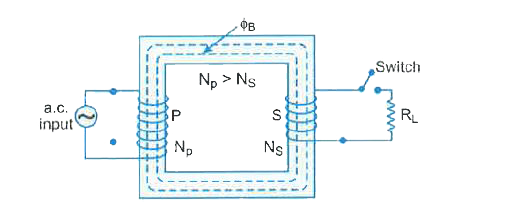
|
|
| 27. |
Obtain an expression for the electric potential energy of a systemof two point charges in the absence of an externalelectric field. |
|
Answer» Solution :Consider a system consisting of two point charges `q_1` and `q_2` separated by a distance `r_12` in free SPACE. Let the charge `q_1` be moved from infinityto the pointA . No WORK is doneduring this process as the charge `q_1` is moved in a field free region. Withthe charge `q_1` FIXED at A, let the other charge `q_2` be moved from infinityto the point B against the fielddue to charge `q_1`. Work done in this process is `W=V_Bq_2`...(1 ) `V_B` is potential at B due to `q_1` But `V_B=1/(4piepsilon_0)q_1/r_12` So equation (1) becomes `W=1/(4piepsilon_0)(q_1q_2)/r_12` This work done is stored in the FORM of potential energy of the system of two charges `q_1` and `q_2`. Hence `U=1/(4piepsilon_0)(q_1q_2)/r_12`. 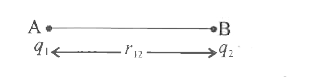
|
|
| 28. |
State Lenz's law. Explain by giving examples that Lenz's law is a consequence of conservation law of energy. |
|
Answer» Solution :According to Lenz.s law, the direction of the induced current in a closed circuit is such so as to oppose the change in magnetic flux, that produces it. Lenz.s law is a consequence of the law of conservation of energy. To show it, let us CONSIDER a bar magnet PUSHED towards a conducting loop. When N-pole moves towards the loop, the face of the loop facing the north pole develops north polarity as PER Lenz.s law so as to oppose the motion of magnet. Again, when N-pole moves away from the loop, the nearby face develops SOUTH polarity, thus opposing the motion of magnet away from the loop. It means that motion of magnet is automatically opposed every time. Hence, some work is to be done on the magnet to move it towards or away from the loop and this MECHANICAL work is transformed into electrical energy. Thus, conservation law of energy is strictly followed. 
|
|
| 29. |
Identify the increasing order of angular velocities of following (a) Earth rotating about its own axis (b) Hour's hand of clock (c) Seconds hand of clock (d) Fly wheel of radius 2m making 300 r.p.m. |
| Answer» Answer :A | |
| 30. |
An electric charge moves with a constant velocity v parallel to the lines of force of a uniform magnetic field H, the force experienced by the charge is |
|
Answer» evH |
|
| 31. |
The units of radioactivity are : |
|
Answer» SOLUTION :1 bacquerl=`1dis//sec` 1 RUTHERFORD=`10^6 dis//sec` 1 CURIE = `3.7xx10^(11) dis//sec`. |
|
| 32. |
Two equal charges are sepreated by a distance d. A third charge placed on a perpendicular bisector at x distance will experience maximum coulomb force when |
|
Answer» `x=(d)/(sqrt(2))` 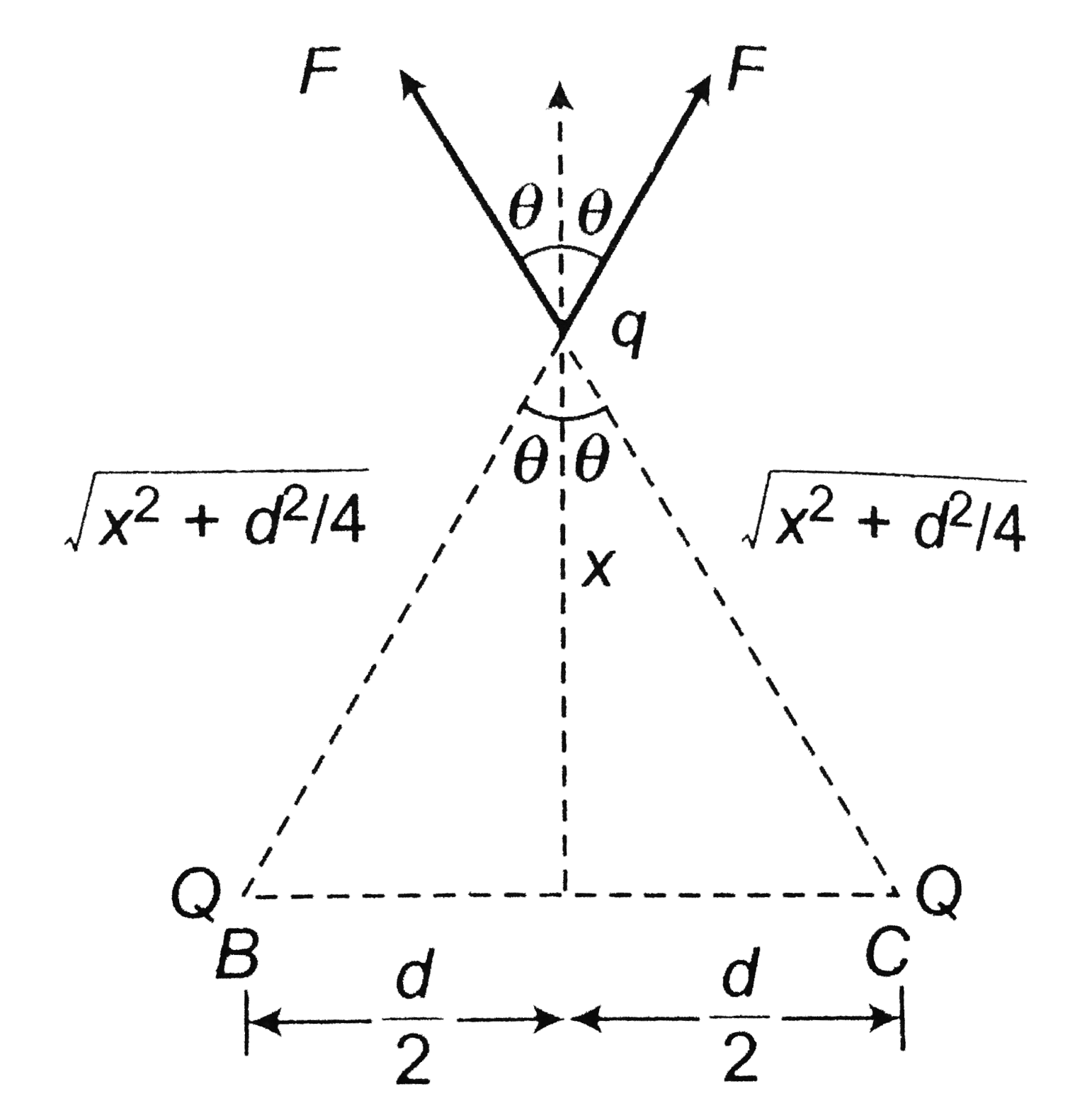 So net FORCE on it `F_(n ET)= 2F cos theta` Where `F=(1)/(4pi epsilon_(0)).(Qq)/((x^(2)+(d^(2))/(4)))` and `cos theta=(x)/(sqrt(x^(2)+(d^(2))/(4)))` `:. F_(n et)= 2xx(1)/(4pi epsilon_(0)).(Qq)/((x^(2)+(d^(2))/(4)))XX(x)/((x^(2)+(d^(2))/(4))^(1//2))` `=(2Qqx)/(4pi epsilon_(0)(x^(2)+(d^(2))/(4))^(3//2))` For `F_(n et)` to be maximum `(dF_(n et))/(dx)=0` `e.(d)/(dx)[(2Qqx)/(4pi epsilon_(0)(x^(2)+(d^(2))/(4))^(3//2))]=0` or `[(x^(2)+(d^(2))/(4))^(-3//2)-3x^(2)(x^(2)+(d^(2))/(4))^(-5//2)]=0` i.e., `x=+-(d)/(2sqrt(2))` |
|
| 33. |
A 20 kg monkey slides down a vertical rope with a constant acceleration of 7 m/ s^2. If g = 10 m s^-2. What is the tension in the rope ? |
|
Answer» 60N |
|
| 34. |
Draw V-I graph for ohmic and non-ohmic materials. Give one example for each. |
|
Answer» Solution :V - I graph for ohmic material is shown in Fig. Example : COPPER WIRE, nichrome, aluminium etc. V-I graph for non-ohmic material is as shown in Fig.(a) and (B). It can have any SHAPE other than a straight line passing through the origin. Example : Junction diode, transistor, fluorescent tube etc. 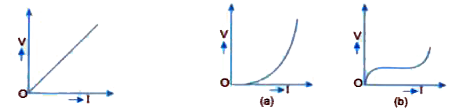
|
|
| 35. |
What is the angle between x-axis and a force represented by vec(F) = 2hat(i) + 3hat(j) + 4hat(k) ? |
|
Answer» `cos^(-1)(3/sqrt(29))` `theta=cos^(-1)(2/sqrt(29))` |
|
| 36. |
A point object is kept in front of a plane mirror. The plane mirror is doing SHM of amplitude 2 cm.The plane mirror moves along the x-axis and x-axis is normal to the mirror. The amplitude of the mirror is such that the object is always infront of the mirror. The amplitude of SHM of the image is |
|
Answer» |
|
| 37. |
Two particles A and B of equal masses are suspended from two massless springs of spring constants k_(1) and k_(2), respectively, If the maximum velocities, during oscillation, are equal, the ratio of amplitude of A and B is |
|
Answer» `SQRT((k_(1))/(k_(2)))` But `K=m omega^(2)` `:.""omega=sqrt((k)/(m))"":." Maximum velocity "A sqrt((k)/(m))` Here the maximum velocity is same and m is also same `:.""A_(1)sqrt(k_(1))=A_(2)sqrt(k_(2))"":.(A_(1))/(A_(2))=sqrt((k_(2))/(k_(1)))` |
|
| 38. |
A solid body rotates about a stationary axis accordig to the law theta=6t-2t^(3). Here theta, is in radian and t in seconds. Find (a). The mean values of thhe angular velocity and angular acceleration averaged over the time interval between t=0 and the complete stop. (b). The angular acceleration at the moment when the body stops. Hint: if y=y(t). then mean/averagevalue of y between t_(1) and t_(2) is ltygt=(int_(t_(1))^(t_(2))y(t)dt))/(t_(2)-t_(1)) |
|
Answer» |
|
| 39. |
The total energy of the electron in the hydrogen atom in ground state is -13.6 eV. The kinetic energy of it is: |
|
Answer» `-13.6 EV` |
|
| 40. |
The reading of brass scale at room temperature is L_1 . Above room temperature reading is L_2 and below room temperature reading is L_3 . Then , relation between the readings is |
|
Answer» `L_1 gtL_2 gtL_3` |
|
| 41. |
A convex lens has a focal length f. It is cut into two parts along a line perpendicular to principal axis. The focal length of each part is |
|
Answer» `F/2` |
|
| 42. |
What should be the distance between the object in Exercise 28 and the magnifying glass if the virtual image of each square in the figure is to have an area of 6.25 mm^(2) Would you be able to see the squares distinctly with your eyes very close to the magnifier? |
|
Answer» Solution :New area = 6.25 `mm^(2)` `THEREFORE` LENGTH of each side = 2.5 mm Linear magnification = `(v)/(U) = (2.5)/(1) = 2.5` v = 2.5 u, `"" therefore (1)/(v) - (1)/(u) = (1)/(f) ` `(1)/(v)- (1)/(u) = (1)/(2.5 u) - (1)/(u) = (1 - 2.5)/(2.5u) = (1.5)/(2.5 u) = (1)/(10)` i.e., u = - 6 CM since |v| = 15 cm `lt` 25 cm. The imagelies at a distance LESS than the least distance of distance vision and cannot be observed distanctly. |
|
| 43. |
If the separation between the plates of a capacitor is 5 mm , then area of the plate of a 3 F parallel plate capacitor is |
|
Answer» `4.259xx10^(9) m^(2)` |
|
| 44. |
What happens during regulation action of aZener diode? |
|
Answer» The current and voltage across the ZENER remains fixed. (n the present case, output voltage `V_(Z)` remains constant across zener diode. But after the breakdown, resistance of zener diode goes on decreasing gradually and so zener current `I_(Z)` goes on increasing rapidly. Thus, option (D) is also correct. |
|
| 45. |
Find the voltage V_(2) across R_(2) for the given circuit |
|
Answer» 0.56V `12V= 8i_(1)+2(i_(1)-i_(2))` ... `6V = 2(i_(2)-i_(1))+ i_(2)R_(3)+2i_(2)` … 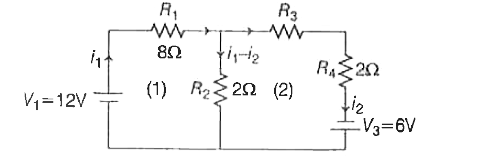 As value of `R_(3)` is not GIVEN solution cannot be found (data INSUFFICIENT). |
|
| 46. |
Electric charge is uniformly distributed along a straight wire of radius 1 mm. The charge per cm length of the wire is Q coulomb. Another cylindrical surface of radius 50 cm and length 1 m symmetrically enclonses the wire as shown in the figure. The total electric flux passing through the cylindrical surface is |
|
Answer» `(Q)/(epsilon_(0))` |
|
| 47. |
A 100 W bulb B_(1) and two 60W bulbs B_(2) and B_(3) , are connected to a 250 V source as shown in the figure . Now W_(1) , W_(2) and W_(3) are the output powers of the bulbs B_(1) , B_(2) and B_(3) respectively, then |
|
Answer» `W_(1) gt W_(2) = W_(3)` Resistance `R_(1)` of sphere `B_(1)= (V^(2))/(P_(1)) ` `= ((250)^(2))/(100)` = `625 Omega ` ` = 1042 Omega` Resistance`R_(3) ` of sphere `B_(3) = (V^(2))/(P_(3)) = ((250)^(2))/(60)` = ` 1042 Omega`  Now Output power of `B_(1) , W_(1) = (V^(2))/((R_(1)+ R_(2))^(2)). R_(1)` `= ((250)^(2))/((625 + 1042)^(2)) xx 625 ` = 14.1 W Output power of `B_(2) , W_(2)= (V^(2))/((R_(1) + R_(2))^(2)) xx R_(2)` `= ((250)^(2))/((625 + 1042)^(2)) xx 1042` 23.4 W Output power of `B_(3) , W_(3) = (V^(2))/(R_(3)^(2)) xx R_(3)` ` =((250)^(2))/( 1042) = 60 ` W `therefore W_(1) lt W_(2) lt W_(3)` |
|
| 48. |
Three bars each of area of cross section A and length L are connected in series as shown in the figure. Thermal conductivities of their materials are K, 2K and 1.5K. If the temperatures of free end of first and the last bar are 200^(@)C and 18^(@)C. The value of theta_(1) and theta_(2) are (in steady state): |
|
Answer» `120^(@)C,80^(@)C` `rArr``(Delta Q)/(Deltat) =(2 K)(Atheta_(1) - theta_(2))/(2L)` `rArr``(Delta Q)/(Delta t) =(1.5 K)A((theta_(2)-18))/(2L)` or , `200 - theta_(1) = 2 theta_(1) - 2 theta_(2) = 1.5 theta_(2) - 27` `theta_(1) = 116^(@)C, theta_(2) = 74^(@)C` |
|
| 49. |
Two parallel wires in the plane of the paper are distance X_0 apart. A point charge is moving with speed u between the wires in the same plane at a distance X_1 from one of the wires. When the wires carry current of magnitude I in the same direction, the radius of curvature of the path of the point charge is R_1 In contrast, if the currents I in the two wires have directions opposite to each other, the radius of curvature of the path is R_2. If (X_0)/(X_1)=3, the value of (R_1)/(R_2) is |
|
Answer» `r=(m u)/(qB)` Hence RATIO of radian `(R_1)/(R_2)=(B_2)/(B_1)` CASE `I` `B_1=(mu_0I)/(2pi)(1/(x_1)-1/(x_2))=(mu_0I)/(2pi)(3/(x_0)-3/(2x_2))=(2mu_0I)/(4pix_0)` Case `II` `B_2=(mu_0I)/(2pi)(1/(x_1)+1/(x_2))=(9mu_0I)/(4pix_0) implies (R_1)/(R_2)=(B_2)/(B_1)=3` 
|
|
| 50. |
Which of the following is not used in analog communication? |
|
Answer» PAM |
|