

Saved Bookmarks
This section includes InterviewSolutions, each offering curated multiple-choice questions to sharpen your knowledge and support exam preparation. Choose a topic below to get started.
| 6951. |
A voltmeter of range 3V and resistance 200Omega cannot be converted to an ammeter of range : |
|
Answer» 10mA |
|
| 6952. |
What is the effect on the interference fringes in a Young's double-slit experiment due to each of the following operations : the monochromatic source is replaced by a source of white light ? (In each operation, take all parameters, other than the one specified, to remain unchanged.) |
| Answer» SOLUTION :The interference patterns due to different COMPONENT colours of white LIGHT overlap (INCOHERENTLY). The central bright fringes for different colours are at the same position. Therefore, the central fringe is white. For a POINT P for which `S_2P-S_1P =lambda_(b)//2`, where `lambda_(b) (approx 4000 Å)` represents the wavelength for the blue colour, the blue component will be absent and the fringe will appear red in colour. Slightly farther vay where `S_2Q- S_1Q = lambda_b= lambda_2//2` where `lambda_r (approx 8000. Å)` is the wavelength for the red colour, the fringe will be predominantly blue. Thus, the fringe closest on either side of the central white fringe is red and the farthest will appear blue. After a few fringes, no clear fringe pattern is seen. | |
| 6953. |
A proton moves with a momentum p=10.0GeV//c, where c is the velocity of light. How much (in per cent) does the proton velocity differ from the velocity of light? |
|
Answer» <P> Solution :We have`(m_0v)/(SQRT(1-V^2/c^2))=p` or, `(m_0)/(sqrt(1-v^2/c^2))=sqrt(m_0^2+p^2/c^2)` or `1-v^2/c^2=(m_0^2c^2)/(m_0^2c^2+p^2)=1-(p^2)/(p^2+m_0^2c^2)` or `v=(c_p)/(sqrt(p^2+m_0^2c^2))=(c)/(sqrt(1+((m_0c)/(p))^2)` So `(c-v)/(c)=[1-(1+((m_0c)/(p))^2)^(-1//2)]xx100%~=1/2((m_0c)/(p))^2xx100%` |
|
| 6954. |
A: An inductor is called the inertia of an electric circuit. R: An inductor tends to keep the flux constant. |
|
Answer» If both ASSERTION & Reason are TRUE and the reason is the CORRECT EXPLANATION of the assertion. |
|
| 6955. |
Substances like _____, _____ and _____ give line spectrum. |
| Answer» SOLUTION :SODIUM, POTASSIUM, HYDROGEN. | |
| 6956. |
When a pn-junction is formed, |
|
Answer» the electrons COMBINE with the positively charged donor IONS |
|
| 6957. |
Amplitude modulation has |
|
Answer» one carrier with HIGH frequency |
|
| 6958. |
In the arrangement shown ,a screen is placed normal to the joining the two point coherent sources S_(1) andS_(2) .The interference patternconsists circles. lambda is thewavelength of light (D gt gt d). The phase difference of the interferinglight at pint P is |
|
Answer» `(2PI)/lambda d COS THETA ` |
|
| 6959. |
In the arrangement shown ,a screen is placed normal to the joining the two point coherent sources S_(1) andS_(2) .The interference patternconsists circles. lambda is thewavelength of light (D gt gt d). The radius of the n^(th)brightring is |
|
Answer» `(nlambdaD)/d` |
|
| 6960. |
Lencho Symbolize the employees as |
|
Answer» BUNCH of crooks |
|
| 6962. |
Sketch a graph toillustrate radioactive decay. Define the half life of a radioactive element and find its value in terms of decay constant lambda |
|
Answer» `N=N_(0)E^(-lambdaT)` A GRAPH between N and t is as SHOWN in the figure. 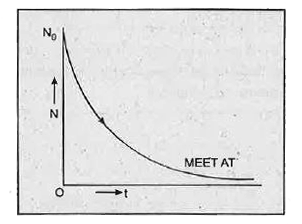
|
|
| 6963. |
According to Nanaji how can one show their love towards their country? |
|
Answer» RESPECT for Language |
|
| 6964. |
The first diffractionminimum due to a single slit Frauhoffer diffraction is at the angle of diffraction 30^(@)for a lightof wavelength 5460 A^(@).The widthof the slit is |
|
Answer» `1.082 xx10^(-4)` CM |
|
| 6965. |
A person cannot see object clearly beyond 2.0 m. The power of lens requred to correct his vision will be : |
|
Answer» `+ 2.0 D` |
|
| 6966. |
In the arrangement shown ,a screen is placed normal to the joining the two point coherent sources S_(1) andS_(2) .The interference patternconsists circles. lambda is thewavelength of light (D gt gt d). If d = 0.5 mm, lambda = 5000 A^(0) , D = 1 m , at the point .O. lying on he intersection of screenand the line joining the sources, the orfer of the fringe formed is |
|
Answer» 1000th DARK FRINGE |
|
| 6967. |
Why do metals have a large number of free electrons? |
| Answer» Solution :In metals, the electrons in the OUTER most shells are loosely BOUND to the nucleus. EVEN at ROOM TEMPERATURE, there are a large number of free electrons which are moving inside the metal in a random manner. | |
| 6968. |
C_(p) and C_(v) denote the molar specific heat capacities of a gas at constant volume and constant pressure respectively. Then |
|
Answer» <P>`C_(p)-C_(v)` a larger to a diatomic ideal gas than for a monoatomic ideal gas. For manoatomic gas `C_(v)=(3)/(2) RC_(P) =(5)/(2)R=gamma ""(C_(p))/(C_(v))=(5)/(3)` `C_(p)C_(v)=(15)/(4)C_(p)-C_(v)=4` For diatomic gas `C_(v)=(5)/(2)RxxC_(p) =(7)/(2)R gamma =(C_(p))/(C_(v))=(7)/(5) and C_(p)C_(v)=(35)/(4)=C_(p)+C_(v)=6` So, correct choices are (b,d). |
|
| 6969. |
Statement I. An Astronaut feels weightlessness while inside the satellite. Statement II. The value of acceleration due to gravity is zero inside the satellite. |
|
Answer» STATEMENT-I is TRUE, Statement-II is true and Statement-II is CORRECT explanation for Statement-I. So correct choice is C. |
|
| 6970. |
A 2m long solenoid having diameter 6cm and 2000 turns has a secondary of 500 turns wound closely near its mid-point.calculate the mutual inductance between the two coils. |
| Answer» SOLUTION :M=`mu_0N_1N_2A//l`=`4pixx10^-7xx2000xx500xx[pixx(3xx10^-2)^2]//2`=`1.77xx10^-3H` | |
| 6971. |
किस जीव में पादप तथा जन्तु दोनों के लक्षण होते है ? |
|
Answer» बैक्टीरियल |
|
| 6972. |
Find the magnetic field at P due to the arrangement shown |
|
Answer» SOLUTION :`B_("net") = 2 xx (mu_0I)/(4pir)(sin""(PI)/(2)-sin""pi/4)` where `r = d//sqrt(2)=(mu_0I)/(sqrt(2)PID) (1- (1)/(sqrt2))` |
|
| 6973. |
Dr. Zakir Hussain says that education is a........ |
|
Answer» PRIME INSTRUMENT of NATIONAL purpose |
|
| 6974. |
Define the terms (i) 'cut-off voltage' and (ii) threshold frequency' in relation to the phenomenon of photoelectric effect. Using Einstein's photoelectric equation show how the cut-off voltage and threshold frequency for a given photosensitive material can be determined with the help of a suitable "plot" // "graph". |
|
Answer» Solution :(i) Cut-off voltage : The minimum negative potential (`V_(0)`) applied to the plate or anode (A) for which the photoelectric CURRENT just becomes zero. (II) Threshold frequency : The minimum frequency of incident radiation which is required to have photoelectrons emitted from a GIVEN metal surface. As per Einstein.s photoelectric equation `eV_(0)= vh-hv_(0)`, for `v gt v_(0)` `V_(0)=(h)/(e)(v-v_(0))` Hence the intercept, on the Y - axis, gives `v_(0)`. (ONE can READ `V_(0)` for any v, from the graph) 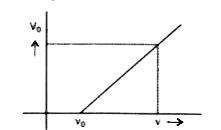
|
|
| 6975. |
What are eddy currents? |
| Answer» SOLUTION :Eddy currents are the current flow through the conductor due to change in MAGNETIC FLUX LINKED through it. | |
| 6976. |
What direct current will produce the same amount of thermal energy, in a particular resistor, as an alternating current that has a maximum value of 7.82 A? |
|
Answer» |
|
| 6977. |
Explain why a transistor is preferred in CE configuration over the CB configuration? |
| Answer» SOLUTION :CE CONFIGURATION is preferred over the CB configuration as the former has LARGE voltage and power gain. | |
| 6978. |
Let f: Rrarr R be defined by f (x) = 1/x AA x in R then f is- |
|
Answer» surjective |
|
| 6979. |
The short wavelength limit for the Lyman series of the hydrogen spectrum is 913.4 Å. Calculate the short wavelength limit for Balmer series of the hydrogen spectrum. |
|
Answer» Solution :As PER question `(1)/((lambda_("limit"))_("Lyman")) = R [(1)/((1)^(2)) - (1)/((oo)^(2))] = R = 913.4 Å` and `""(1)/((lambda_("limit"))_("BALMER")) =R [(1)/((2)^(2)) - (1)/((oo)^(2))] = (R)/(4) ` `rArr""(lambda_("limit"))_("Balmer") = 4 (lambda_("limit"))_("Lyman") = 4 XX 913.4 Å = 3653.6 Å` |
|
| 6980. |
A solenoidof radius 2.50cm has 400turns and a length of 20.0cm. The current in the coil is changing with time such that to produce an emf of 75.0 mV.the self-induced emf in the solenoid is |
|
Answer» 38.0mA/s |
|
| 6981. |
An oscillating LC circuit consisting of a 1.0 muF capacitor and a 9.0 mH coil has a maximum voltage of 3.0 V. What are (a) the maximum charge on the capacitor, (b) the maximum current through the circuit, and (c) the maximum energy stored in the magnetic field of the coil? |
|
Answer» |
|
| 6982. |
A solenoidof radius 2.50cm has 400turns and a length of 20.0cm. The current in the coil is changing with time such that to produce an emf of 75.0 mV. the inductance (L) of this solenoid is |
|
Answer» 4mH |
|
| 6983. |
A parallel beam of monochromatic light falls normally on a narrow slit of width 'a' to produce a diffraction pattern on the screen placed parallel to the plane of the slit. Use Huygens' principle to explain that (i) The central bright maxima is twice as wide as the other maxima. (ii) The intensity falls as we move to successive maxima away from the centre on either side. |
Answer» Solution :Explanation , As per Huygen.s Principle , NET Effect at any point = Sum of total of contrubution of all wavelets with proper phase difference.  At the central point (O) contribution from each half in `SS_(1)` is in phase with that from the corresponding part in `SS_(2)`. Hence, O is a MAXIMA.  At the point M where `M-S_(1)M=lambda//2` Phase difference between each wavelet from `SS_(1)` and corresponding wavelet from `SS_(2)=lambda//2` Hence, M would be a minima, All such points (path difference `=nlambda//2`) are also minima . Similarly , all points, for which path difference `=(2n+1)lambda//2`, are in maxima but with decreasing intensity. From the FIGURE, Half angular width of central maxima `=lambda//a` `:.` SIZE of central maxima will be reduced to half and intensity of central maxima will be four TIMES if slit is made double the original width. |
|
| 6984. |
Two equal point charges each of 3 muC are separated by a certain distance in metres. If they are located at (hati+hatj+hatk) and (2 hati+3hatj+hatk). then the elestastatic force between them is |
|
Answer» `9 xx 10^(3)N` |
|
| 6985. |
Internal energy of n_(1) moles of hydrogen at temperature T is equal to the internal energy of n_(2) moles of helium at temperature 2T. Then the ratio n_(1)//n_(2) is |
|
Answer» `3//5` `U=(f)/(2)nRT` (f = DEGREES of freedom) Given, `U_(1)` (Hydrogen) = `U_(2)` (Helium) `therefore f_(1)n_(1)T_(1)=f_(2)n_(2)T_(2)` `therefore (n_(1))/(n_(2))=(f_(2)T_(2))/(f_(1)T_(1))=((3)(2))/((5)(1))=(6)/(5)` Here `f_(2)` = degrees of freedom of `He=3andf_(1)` = degrees of freedom of `H_(2)=5` |
|
| 6986. |
From brewster's law for polarisation, it follows that the angle polarisation depends upon |
|
Answer» the WAVELENGTH of light |
|
| 6987. |
Why choke is preffered to ordinary resistor in controlling ac supply ? |
| Answer» Solution :CHOKE is an IDEAL inductor which reduces the CURRENT without energy LOSS. In ordinary resistors energy dissipated in the form of heat. | |
| 6988. |
A parallel plate capacitor of capacity C_0is charged to a potential V_0 (1)The energy stored in the capacitor when the battery is disconnected and the plate separation isdoublcd is E_1 (2)The energy stored in the capacitor when the charging battery is kept connected and the separation between the capacitor plates is doubled is E_2Then E_1// E_2 |
| Answer» ANSWER :A | |
| 6989. |
Find out the difference of wave number between second and first spectral lines of Lyman series of hydrogen atom's spectrum. R=10.9xx10^(7)m^(-1) |
|
Answer» Solution :For SECOND line of Lyman series of hydrogen atom and for first line of Lyman series `(1)/(lambda_(2))=R[(1)/(1^(2))-(1)/(3^(2))]=R[(1)/(1)-(1)/(9)]` `(1)/(lambda_(2))=(8R)/(9) ....(1)` and for first line of Lyman series, `(1)/(lambda_(1))=R[(1)/(1^(2))-(1)/(2^(2))]=R[(1)/(1)-(1)/(4)]` `(1)/(lambda_(1))=(3R)/(4)".....(2)` `rArr`Different of wave number. `(1)/(lambda_(2))-(1)/(lambda_(1))=(8R)/(9)-(3R)/(4)=R[(8)/(9)-(3)/(4)]` `=1.09xx10^(7)[(32-27)/(36)]` `=1.09xx10^(7)xx(5)/(36)` |
|
| 6990. |
How will you connect a voltmeter in a circuit? |
| Answer» Solution :Parallel to the TERMINALS ACROSS which voltage is to be read with proper POLARITY. | |
| 6991. |
A gas undergoes a change at constant temperature. Which of the following quantitiesremain fixed ? |
|
Answer» Pressure |
|
| 6992. |
In bringing an electron towards another electron, the electrostatic potential energy of the system. |
|
Answer» increases |
|
| 6993. |
Three pieces of string, each of length L, are joined together end-to-end, to make a combined string of length 3L. The first piece of string has mass per unit length mu_1, the second piece has mass per unit length mu_2 = 4mu_1 and the third piece has mass per unit lengthmu_3 = mu_1//A. If the combined string is under tension F, how much time does it take a transverse wave to travel the entire length 3L ? Give you answer in terms of L, F and mu_1. |
| Answer» SOLUTION :`72.2 SQRT(mu_1/F)` | |
| 6994. |
Derive an expression for the torque acting on a current carrying loop suspended in a uniform magnetic field. |
Answer» Solution :1. As shown in FIGURE, consider a rectangular coil ABCD suspended in a uniform magnetic field `vecB`, with its AXIS perpendicular to the field.   2. Suppose, current flowing through coil ABCD be I, AB = DC = b and AD = BC = a and area be A = ab. 2. The field exerts no force on the two arms AD and BC of the loop, because `I_(a)andvecB` both are parallel to each other, `|vecF|=|IvecaxxvecB|` `|vecF|=(IaxxB)SIN0^(@)=0""...(1)` 3. Sides AB and CD of coils are perpendicular to magnetic field. 4. So, force on side AB is, `vecF_(1)=|IvecbxxvecB|=Ib"sin"pi/2` `|vecF_(1)|=IbB""...(2)` 5. Similarly it exerts a force `vecF_(2)` on the arm CD and `vecF_(2)` is directed out of the plane of the paper, `|vecF_(2)|=|IvecbxxvecB|=|Ib"sin"pi/2|` `thereforeF_(2)=IbB=F_(1)""...(2)` 6. Thus, the net force on the loop is zero. There is a torque on the loop due to the pair of forces `vecF_(1)andvecF_(2)`. 7. Figure (b) shows a view of the loop from the AD end. It shows that the torque on the loop tends to rotate it anti-clockwise. 8. Resultant torque on coil is given by, `tau=tau_(1)+tau_(2)` `tau=F_(1)(a/2)+F_(2)(a/2)` = `IbB(a/2)+IbB(a/2)` = `I(ab)B` `tau=IAB""...(3)` where A = ab that is area of RECTANGLE. |
|
| 6996. |
A parallel plate capacitor in the figure made of circular plates each of radius R=6.0 cm has a capacitance C=100 pF. The capacitor is connected to a 230 V ac supply with a (angular) frequency of 300 rad s^(-1) . What is the rms value of the conduction current ? |
|
Answer» Solution :(a) `I_("rms") =V_("rms") omega C=6.9 mu A` (b) Yes. The derivation in EXERCISE 8.1(b) is true even if i is oscillating in time. (c ) The formula `B =(mu_(0) r)/(2 pi R^(2)) i_(d)` goes through even if `i_(d)` (and therefore B) oscillates in time. The formula SHOWS they oscillate in phase. Since `i_(d)= i`, we have `B_(0)=(mu_(0) r)/(2 pi R^(2)) i_(0)`," where "B_(0) and i_(0)` are the amplitudes of the oscillating magnetic FIELD and CURRENT, respectively. `i_(0) =sqrt(2) I_("rms")=9.76 mu A.` For `r=3 cm, R=6 cm, B_(0)=1.63xx10^(-11) T.` |
|
| 6997. |
यदिalpha,beta बहुपद x^2-8x+k के मूल इस प्रकार है कि alpha^2+beta^2=40 तब k= |
|
Answer» 10 |
|
| 6998. |
रेत का पानी में विलयन..........मिश्रण का उदाहरण है |
|
Answer» समांगी |
|
| 6999. |
Do all photons have same mass ? If not why ? |
|
Answer» SOLUTION :Mass of a PHOTON = `E/C^2 = (hv)/C^2` Different RADIATIONS have different frequencies. So, their photons will have different MASSES. |
|
| 7000. |
A paperweight in the form of a hemisphere of radius 3.0 cm is used to hold down a printed page such that flat surface touch the paper. An observer looks at the page vertically through the paperweight. At what height above the page will the printed letters near the centre appear to the observer? |
| Answer» SOLUTION :no SHIFT is OBSERVED | |