

Saved Bookmarks
This section includes InterviewSolutions, each offering curated multiple-choice questions to sharpen your knowledge and support exam preparation. Choose a topic below to get started.
| 6901. |
The value of electrostatic force constant in free space is ……… . |
|
Answer» `9xx10^(19) NM^(2) C^(-2)`. |
|
| 6902. |
Two long parallel wires separated by 0.1m carry currents of 1A and 2A respectively in opposite directions. A third current carrying wire parallel to both of them is placed in the same plane such that it feels no net magnetic force. It is placed at a distance of |
|
Answer» 0.5m from the `1^(st)` WIRE, towards the `2^(nd)` wire 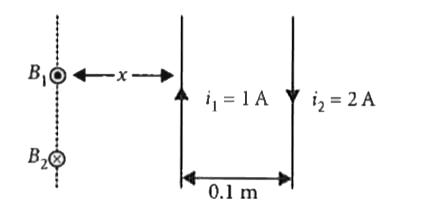 Magnetic FIELD due to first wire at the location of third wire, `vec(B)_(L)= (mu_(0)i_(1))/(2pi x) o.` Magnetic field due to SECOND wire at the location of third wire, `vec(B)_(2)= (mu_(0)i_(2))/(2pi (x+0.1)) ox` Net magnetic field at the location of third wire would be zero if there is no net magnetic force, `:. B_(1)= B_(2) rArr (mu_(0)i_(1))/(2pi x)= (mu_(0)i_(2))/(2pi (x+0.1)) [ :. i_(1) =1 A and i_(2)= 2A]` `rArr (1)/(x)= (2)/(x+0.1) or x= 0.1m` |
|
| 6903. |
Consider the circuit in the figure. (a) how much energy is absorbed by electrons from the initial state of no current (ignore thermal motion) to the state of drift velocity? (b) Electrons give up energy at the rate of Rl^(2) per second to the thermal energy. What time scale would the number associate with energy in problem (a)? n = number of electron/volume =10^(29)//m^(3). Length of circuit = 10cm cross-section = A = (1mm)^(2). |
|
Answer» |
|
| 6904. |
Find the energy stored to the capacitor. |
|
Answer» SOLUTION :ENERGY STORED in the CAPACITOR `=1/2CV^2=1/2times10muFtimes(1V)^2=5mul=5times 10^6l` |
|
| 6905. |
A place where the vertical component of Earth's magnetic field is zero has the angle of dip equal to ......... . |
|
Answer» SOLUTION :In `TAN phi = (B_V)/( B_h) , B_V = 0` `THEREFORE tan phi = (0)/(B_h)` `therefore tan phi = 0 therefore phi = tan^(-1) (0) therefore phi=0^@` |
|
| 6906. |
Which one of the following is an equation of magnetic energy density ? |
|
Answer» `1/2mu_0B^2` |
|
| 6907. |
In magnitude and direction the centripetal force is given by- |
|
Answer» `m w^2 HAT R` |
|
| 6908. |
Two charges 4 xx 10^(-9) and - 16 xx 10^(-9) C are separated by a distance 20 cm in air. The position of theh neutral point from the small charge is |
|
Answer» 40/3 cm |
|
| 6909. |
The electromagnetic waves travel in a vaccum or air with a valocity ? |
| Answer» SOLUTION :1/(sqrtmu_0epsilon_0) | |
| 6910. |
Four point + 8 mu C, -1 mu C, -1 mu C, and + 8 mu C are fixed at the points -sqrt(27//2) m, - sqrt(3//2) m, +sqrt(3//2) m, and +sqrt(27//2) m, respectively, on the y - axis. A particle of mass 6 xx 10^-4 kg and charge + 0.1 mu C moves along the x- direction. Its speed at x = + oo is V_0. Find the least value of V_0 for which the particle will cross the origin. Find also the kinetic energy of the particle at the origin. Find also the kinetic energy of the particle at the origin. Assume that space is gravity free. Given (1// 4 pi epsilon_0) = 9 xx 10^9 Nm^2 C^-2. |
Answer» 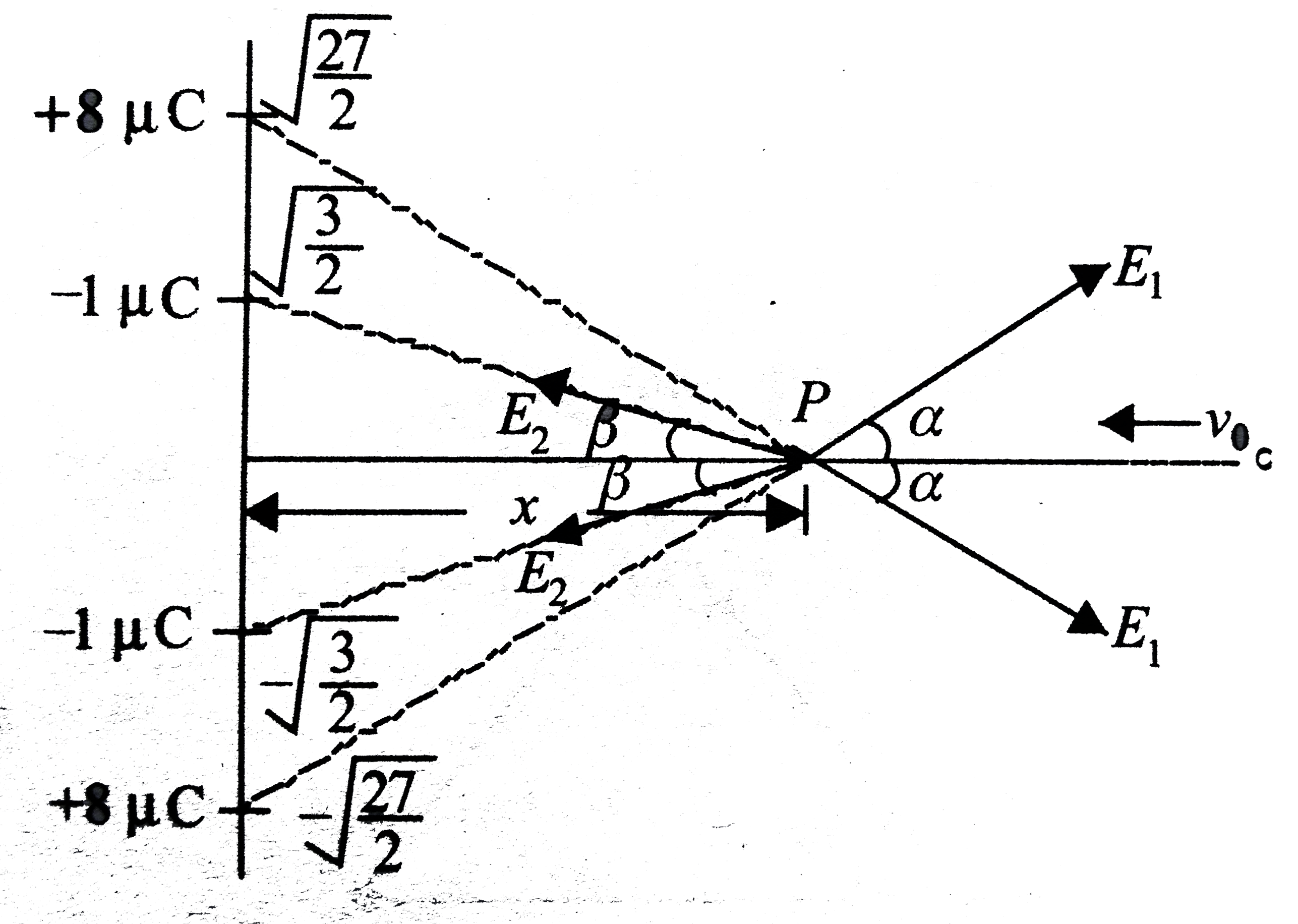 . . `2 E_1 cos alpha = 2 E_2 cos beta` or `(2 K xx 8 xx 10^-6 x)/((x^2 + 27 // 2)^(3//2))= (2 k xx 1 xx 10^-6 x)/((x^2 + 3 // 2)^(3//2))` or `x = sqrt((5)/(2)) m` Beyond P, E is toward right. To the left of `P, E` is toward left Once the charge crosses point P, attractive forces will pull the charge to origin. Applying conservation of energy between `oo` and P, we get `(1)/(2) mv_0^2 = 2k [(8 xx 10^6)/(sqrt(27/(2) + (5)/(2)))- (1 xx 10^6)/(sqrt((3)/(2)+ (5)/(2)))] xx 0.1 xx 1 xx 10^6` or `v_0 = 3 ms^-1` To find K E at origin, apply conservation of energy between `oo` and origin. `K E_(x = 0) = 2 k xx 0.1 xx 10^-12 [(8)/(sqrt(27 //2)) -(1)/(sqrt(3 // 2))] = (1)/(2) m v_0^2` =`2.5 xx 10^-4 J`. |
|
| 6911. |
Outline some of the latest methods of correcting myopia (short sightedness) without the use of corrective specs. |
|
Answer» Solution :In most of the cases, myopia is caused by the cornea being too BULGED. Therefore, latest mathodsof correcting myopia, WITHOUT use of spectacles, are designed to flatten the cornea. For example :(i) in radial kerotomy (RK), small slits are made in a pattern like the spokes of a wheel. Because of side slits, side vision is less clear than straight head vision. (ii) the top layer of the cornea is removed as is a thin slice below it. The top layer is then sewnback on. The double slice technique requires a highly skilled surgeon to sew the top piece of corneaon again. (iii) A low power laser is used to produce a map of teh shape of cornea, and a computer decideshow much cornea has to be removed. A high power laser is than used to vaporize the optimumnumber of cellsin the centre of teh cornea. The laser technique MAY LEAVE the cornea too rough for good vision. THUS all the three latest technique require perfection before they become operative. |
|
| 6912. |
For photoelectric effect in sodium, the figure shows the plot of cut-off voltage versus frequency of incident radiation. Calculate threshold frequency |
|
Answer» Solution :The THRESHOLD frequency is the frequency of incident light at which kinetic enegy of ejected photoelectrons is zero. `:.` From FIGURE threshold frequency. `V_(0) = 4.5 xx 10^(14) Hz`. |
|
| 6913. |
In the following list of nuclides, identify (a) those with filled nucleon shells, (b) those with one nucleon outside a filled shell, and (c) those with one vacancy in an otherwise filled shell: ""^(13)C,""^(18)O,""^(40)K,""^(49)Ti,""^(60)Ni,""^(91)Zr,""^(92)Mo,""^(121)Sb,""^(143)Nd,""^(144)Sm,""^(205)Tl and ""^(207)pb. |
|
Answer» |
|
| 6915. |
A book of weight 20N is pressed between two hands and each hand exerts a force of 40N. If book just starts to slide down. Coefficient of friction is |
|
Answer» 0.25 |
|
| 6916. |
Suppose that the particle in Exercise in 1.33 is an electron projected with velocity v_x = 2.0 xx 10^6 ms^(-1) . If E between the plates separated by 0.5 cm is 9.1 xx 10^2 N/C, where will the electron strike the upper plate ? (|e| = 1.6 xx 10^(-19) C, m_(e) = 9.1 xx 10^(-31) kg) |
Answer» Solution :Here, electron strikes UPPER plate and so upper plate must be positive. 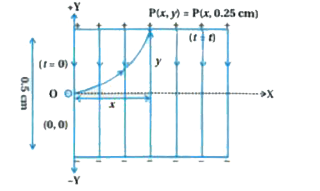 Now from equation (5) of above example no. 33 we have, `y=(QEX^(2))/(2mv_(s)^(2))` `therefore x^(2) = (2ymv_(x)^(2))/(qE)` `therefore x=((2ymv_(x)^(2))/(qE))^(1//2)` `therefore x = 1.125 XX 10^(-2)` m |
|
| 6917. |
Explain self induction and obtain equation of self induced emf in a coil. |
|
Answer» Solution :When magnetic flux linked with coil itself change due to change in CURRENT flowing in it then such emf is called SELF induced emf. This phenomena is called self induction. In this case, flux linkage through a coil of N turns is proportional to the current through the coil and is expressed as `Nphi_B=prop I` `Nphi_B`=LI ...(1) Where constant of PROPORTIONALITY L is called self-inductance of the coil. It is also called the COEFFICIENT of self-induction of the coil. When the current is varied, the flux linked with the coil also changes and an emf is induced in the coil. Using equation (1), the induced emf is given by `epsilon=-(d(Nphi_B))/(dt)=(-d(dI))/(dt)` `therefore epsilon=-L(dI)/(dt)`...(2) Thus, the self-induced emf always opposes any change (increase or decrease) of current in the coil. |
|
| 6918. |
The gravitational potential at a height'h' above earth's surface is -5.12xx10^(7)J//kgand acceleration due to gravity at this point is 6.4ms^(-2). If R = 6400 km the value of h is : (Mass of objectm=1 kg) |
|
Answer» 1200 km `therefore` Gravitational potential`=-(GM)/((R+h))` Also valueof .g. at height .h. `g.=(GM)/((R+h)^(2))` `therefore ` Gravitational pentential `V_(g)= -(g.(R+h)^(2))/((R+h))= -g.(R+h)` `-5.12xx10^(7)=-6.4(6400+h)xx10^(3)` where .h. is in KILOMETRES. `6400+h=(5.12xx10^(4))/(6.4)=8xx10^(3)=8000` `h=1600km`. Correct choice is (b). |
|
| 6919. |
The figure above shows the two unbalanced forces acting on a block. If the velocity of the block is to the left, then |
|
Answer» The work DONE by `F_(1)` is positive |
|
| 6920. |
Total internal reflection in a prism What is the relationship between A and n so, that no rays come out of second face ? |
|
Answer» Solution :(1) Here we want to choose the refractive index of the prism such that a RAY will always undergo TOTAL internal reflection . NOTE that this total internal reflection can occur only when the light ray goes from DENSER to rarer medium. In other words, this will occur only when the ray is INCIDENT on the second surface. (2) The situation implies that for the smallest angle `r_(2)` also, the total internal reflection should occur. (3) `r_(1)+r_(2)=A`. So, when `r_(2)` is minimum `r_(1)` is maximum. The angle of incidence `i` is also maximum by Snell.s law. But the maximum angle of incidence can be `90^(@)`. This problem implies that if a total internal reflection occurs when angle of incidence is `90^(@)`, then total internal reflection will occur at all the angles Calculation : Applying Snell.s law at the first surface `1xxsin90^(@)=nsinr_(1)` `r_(1)=sin^(-1)((1)/(n))` `r_(2)=A-sin^(-1)((1)/(n))` But for total internal reflection at the second surface : `r_(2) gt theta_(c )` `sinr_(2) gt 1sintheta_(c )((1)/(n))` `A-sin^(-1)((1)/(n)) gt sin^(-1) ((1)/(n))` Thus, the condition becomes `n gt cosec((A)/(2))`. Note : Many optical instruments such as binoculars periscopes, and telescopes, use glass prisms and total internal reflection to turn a beam of light through `90^(@)` or `180^(@)`. 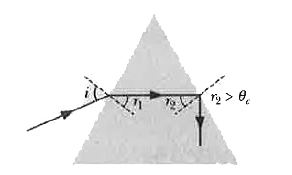
|
|
| 6921. |
The significance of |Psi|^(2)x is |
|
Answer» PROBABILITY |
|
| 6922. |
The equivalent capacitance of the combination between A and B in the given figure is 4 mu F. Calculate capacitance of the capacitor C. |
| Answer» Solution :As capacitance of SERIES combination of two capacitors of capacity `20 MU F ` and C are `4 mu F ` , HENCE , `C_(eq) = 4 mu F = (20 mu F XX C)/((20 mu F xx C)) implies C = 5 mu F ` | |
| 6923. |
The equivalent capacitance of the combination between A and B in the given figure is 4 mu F. Calculate charge on each capacitor if a 12 V battery is connected across terminals A and B . |
|
Answer» Solution :As `C_(eq) = 4 mu F ` and `V = 12 V` `therefore` Total charge `Q = C_(eq) V = 4 mu F xx 12 V = 48 mu C` In SERIES combination charge on each CAPACITOR is same HENCE , `C_(1) = C_(2) = 48 mu C` |
|
| 6924. |
The electron gun assembly contains a _____________ |
|
Answer» CRO |
|
| 6925. |
एक वक्र की समीकरण द्वारा दी जाती है वक्र x अक्ष को काटेगा |
|
Answer» (1, 0) पर |
|
| 6926. |
A concave mirror of focal length 100 cmis used to obtain the image of the sun which subtends an angle of . 30^(@)The diameter of the image of the sun will be |
|
Answer» `1.74 CM` |
|
| 6927. |
At room temperature (27.0^@ C) the resistance of a heating element is 100Omega . What is the temperature of the element if the resistance is found to be 117Omega , given that the temperature coefficient of the material of the resistor is 1.70xx10^(-4^@) C^(-1)at 27^@C. |
| Answer» SOLUTION :`1027^@ C` | |
| 6928. |
A uniform electric field E is present horizontally along the paper throughout region but uniform magnetic field B_(0) is present horizontally (perpendicular to plane of paper in inward direction) right to the line AB as shown. A charge particle having charge q and mass m is projected vertically upward and crosses the line AB after time t_(0). Find the speed of projection if particle moves after t_(0) with constant velocity. (given qE = mg) |
|
Answer» `g t_(0)` |
|
| 6929. |
A combination of two magnets has a froquency of 16 ascillations oscillation//min. with dissimilar poles together Find the ratio of magnetic moments of magnets |
|
Answer» Solution :When SIMILAR poles are together, net MAGNETIC moment `=M_(1)-M_(2)` `f_(1)=1/2pi sqrt((M_(1)+M_(2))B/1)=16` When dissimilar poles together, net magnetic moment `=M_(1)-M_(2)` `f_(2)=1/2pi sqrt((M_(1)-M_(2))B/1)=12` Dividing (i) by (ii) we GET  `sqrt((M_1 + M_2)/(M_1-M_2))=(16)/(12)=4/3`On SOLVING we get`M_(1)/M_(2)=25/7` 
|
|
| 6930. |
What is valence band ? |
| Answer» SOLUTION :The range of energies ASSOCIATED with VALENCE electrons is called valence band. | |
| 6931. |
The magnetic field in a plane electromagnetic wave is given by B. =(2 xx 10^(-7)T) sin[500x+1.5 xx 10^(11) t]Write an expression for the electric field vector. |
| Answer» SOLUTION :`E= 60sin ( 500x + 1.5xx 10^(11) t)` | |
| 6932. |
Define 'relaxation time'. Derive the expressionfor electrical conductivity of a material in terms of relaxation time. |
|
Answer» SOLUTION :The average time between two successive collisions of free electrons is known as relaxation time. We know that drift velocity `V_d=(eEtau)/m` We have `I=heAV_d` …(1) SUBSTITUTE for `V_d` in equation (1) and we get `I=("ne"AeEtau)/m=("ne"^2AEtau)/m rArr I/A=("ne"^2Etau)/m` `J=("ne"^2Etau)/m ""because j=I/A` We know that `j=sigma E` `therefore sigma cancelE=("ne"^2 cancelE tau)/m` `sigma=("ne"^2TAU)/m`. |
|
| 6933. |
write the truth table and bolean expresion of AND gat. |
| Answer» | |
| 6934. |
A satellite of mass m revolves around the earth of radius R at a height x from its surface. If g is the acceleration due to gravityon the surface of the earth, the orbital speed of the satellite is: |
|
Answer» gX THUS correct choice is (B). |
|
| 6935. |
If |vec(A)xxvec(B)|=sqrt(3)vec(A).vec(B) then the value of |vec(A) + vec(B)|is : |
|
Answer» `(A^(2) + B^(2) + (AB)/sqrt(3))^(1//2)` DIVIDING `tantheta=(vec(A)xxvec(B))/(vec(A).vec(B))` ALSO `|vec(A)xxvec(B)|=sqrt(3)vec(A).vec(B)` `:.tantheta=(sqrt(3)vec(A).vec(B))/(vec(A).vec(B))=sqrt(3)` or `theta=60^@` Let `vec(R )=vec(A)+vec(B)` NOw by ||GM law, we have `|vec(R)|=sqrt(A^(2)+B^(2)+2ABcostheta)` `=sqrt(A^(2)+B^(2)+AB)` `vec(A)+vec(B)=(A^(2)+B^(2)+AB)^(2)` |
|
| 6936. |
The nature of ions knocked out from hot surface is |
|
Answer» protons |
|
| 6937. |
The frame K^' moves with a constant velocity V relative to the frame K. Find the acceleration w^' of a particle in the frame K^', if in the frame K this particle moves with a velocity v and acceleration w along a straight line (a) in the direction of the vector V, (b) perpendicular to the vector V. |
|
Answer» SOLUTION :`--underset(vecv)overset(t)-----underset(vecv+vecwdt)overset(l+dt)---(K)` In K the velocities at time t and `t+dt` are respectively v and `v+WDT` along x-axis which is parallel to the VECTOR `vecV`. In the frame `K^'` moving with velocity `vecV` with respect to `K`, the velocities are respectively, `(v-V)/(1-(vV)/(c^2))` and `(v+wdt-V)/(1-(v+wdt)(V)/(c^2))` The latter velocity is written as `(v-V)/(1-v(V)/(c^2))+(wdt)/(1-v(V)/(c^2))+(v-V)/((1-(vV)/(c^2)))(wV)/(c^2)dt=(v-V)/(1-v(V)/(c^2))+(wdt(1-V^2/c^2))/((1-(vV)/(c^2))^2)` Also by LORENTZ transformation `dt^'=(dt-Vdx//c^2)/(sqrt(1-V^2//c^2))=dt(1-vV//c^2)/(sqrt(1-V^2//c^2))` Thus the acceleration in the `K^'` frame is `w^'=(dv^')/(dt^')=(w)/((1-(vV)/(c^2))^3)(1-V^2/c^2)^(3//2)` (b) In the K frame the velocities of the particle at the time t and `t+dt` are respectively `(0,v,0)` and `(0,v+wdt,0)` where `vecV` is along x-axis. In the `K^'` frame the velocities are `(-V, vsqrt(1-V^2//c^2),0)` and `(-V,(v+wdt)sqrt(1-V^2//c^2),0)` respectively Thus the acceleration `w^'=(wdtsqrt((1-V^2//c^2)))/(dt^')=w(1-V^2/c^2)` along the y-axis. We have USED `dt^'=(dt)/(sqrt(1-V^2//c^2))` |
|
| 6938. |
Questions 59 and 60 are based on following paragraph : A beam of light consisting of two wavelengths 6500 Å and 5200 Å is used to get interference fringes in Young's double slit experiment with slit distance 2 mm and screen distance 120 cm. 59.The distance of 3rd fringe on screen from central maxima for wavelength 6500 Å is |
|
Answer» `2.02 mm` `therefore x_(3) = (3 XX 6500 xx 10^(-10) xx 120)/(0.2) = 0.117cm` ` = 1.17 mm`. |
|
| 6939. |
Two point charges 5 mu C " and 10 mu C are separated by a distance 'r' in air. If an additional charge of -4 mu C is given to each, by what factor does the force between the charges change ? |
|
Answer» |
|
| 6940. |
Estimate the linear separation of two objects on Mars that can just be resolved under ideal conditions by an observer on Earth (a) using the naked eye and (b) using the 200 in. (= 5.1 m) Mount Palomar telescope. Use the following data: distance to "Mars" = 8.0 xx 10^(7) km, diameter of pupil = 5.0 mm, wavelength of light = 550 nm. |
| Answer» Solution :(a) `1.1 xx 10^(7) m = 1.1 xx 10^(4)` KM, (b) `1.1 xx 10^(4) m = 11 km` | |
| 6941. |
The mean lifetime of stationary muons is measured to be 2.2000 mus. The mean lifetime of high-speed muons in a burst of cosmic rays observed from Earth is measured to be 20.000 mus. To five significant figures, what is the speed parameter beta of these cosmic-ray muons relative to Earth? |
|
Answer» |
|
| 6942. |
Describe a method to determine Young's modulus of the material of a thin wire. |
|
Answer» Solution :Apparatus : The experimental wire B is suspended from a rigid wallsupport along with a compensating or reference wire A of the same length, material and cross section. A manin SCALE is attached to the wire A. Avernier scale attached to the wire B can move alongside the main scale. A dead load is attached to the compensating wire to keep it taut. Slotted WEIGHTS may be added to a hanger attached to the experimental wire. 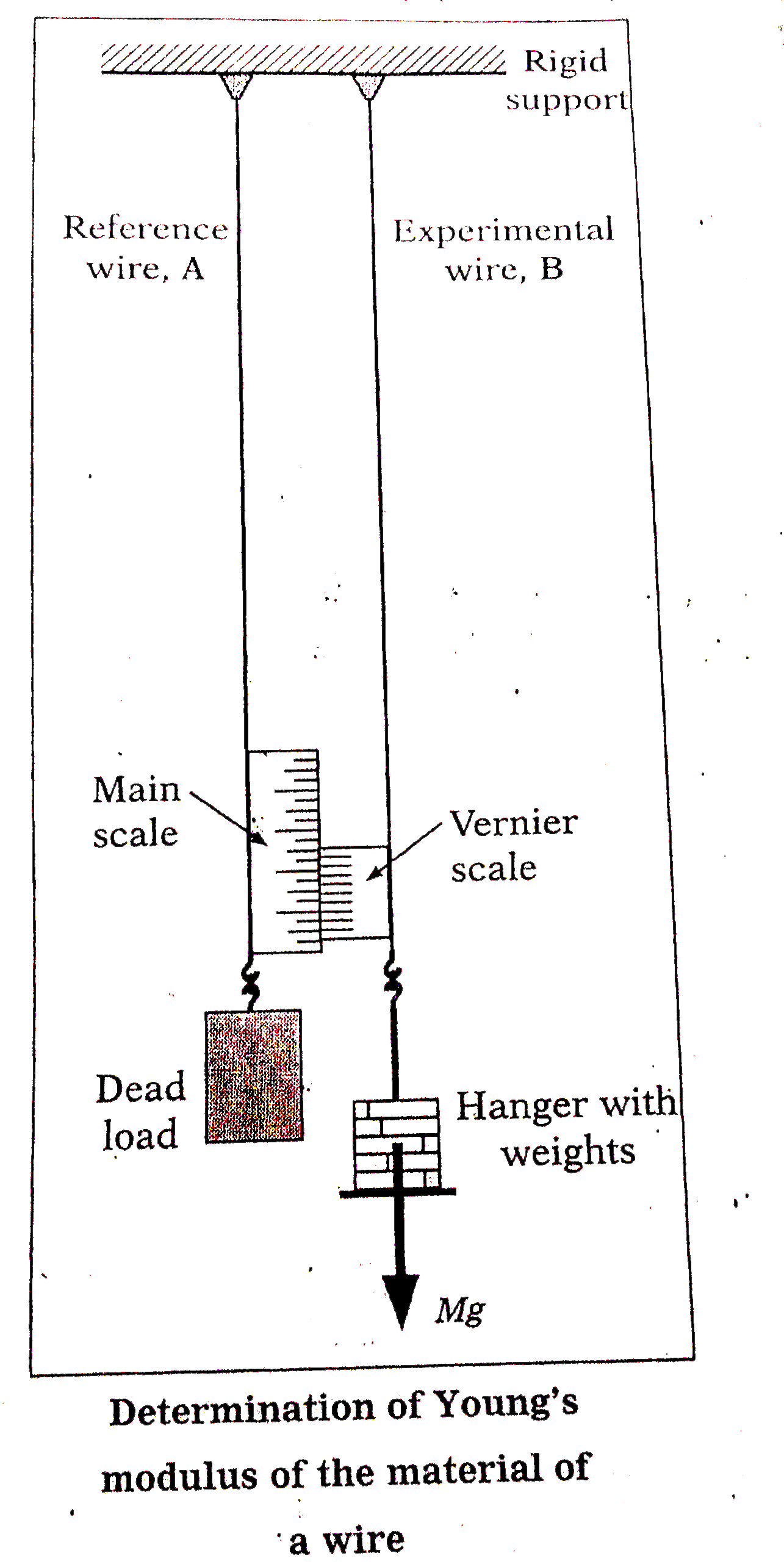 Procedure: (1) The length L and radius r of the experimental wire are measured. (2) The experimental wire is initially loaded with 1 kg to 2 kg to keep it taut and free from kinks. It is treated as a zeroload. The main scale and Vernier scale readings are noted as those for zero-load. (3) The stretching load Mg on the experimental wire is increased by 0.5 kg at a time. the scale readings are noted for each increase in load, after allowing SUFFICIENT time for the wire to elongate. (4) After 6-8 such readings, the wire is unloaded 0.5 kg at a time, and the corresponding scale readings are noted. Within limits of experimental error, the readings for the same load-while loading and unloading- should be the same. (5) The average ELONGATION per unit mass, `DeltaL//M` is found. (6) Young's modulus of the material of the wire is calculated using the formula `Y=("longitudinal stress")/("longitudinal strain") =(Mg//pir^(2))/(Delta L//L)=(gL)/(PI r^(2) (DeltaL//M))` |
|
| 6943. |
A currentof 10 Ais mainatainedin a conductor of cross - section1 cm^(2) . If thefree electron densityin the conductoris9 xx 10^(28) m^(-3),then driftvelocityof free electrons is . |
|
Answer» ` 6.94 XX 10^(-6) m//s` |
|
| 6944. |
Which of the following cannot be accelerated by cyclotron ? |
|
Answer» `alpha`-particle |
|
| 6945. |
In the circuit shown all the resistors are of same resistance R = 11 Omega and C = 2 muF. They are connected through a battery of 10 V. When the cell is switched on, find (a) maximum current in the circuit, and (b) energy stored in the capacitor after time t |
| Answer» SOLUTION :`0.666A,(1)/(2)CV^(2)(1-e^(-t//RC))^(2)` | |
| 6946. |
A person can see objects as near as 40 cm and as far as 3 m. What kind of spectacles will be required (a) for reading purposes, (b) for seeing distant objects? Least distance of distinct vision = 25 cm. What is the range of clear vision with each pair of spectacles? |
|
Answer» |
|
| 6947. |
In electrolytic conduction,the current is due to |
|
Answer» electons |
|
| 6948. |
A parallel resonance circuit can be used: |
|
Answer» as acircuit of ZERO impedance |
|
| 6949. |
A charged particle moves with a velocity vecv in a uniform magnetic field vecB. The magnetic force experienced by the particle is |
|
Answer» always ZERO |
|
| 6950. |
If vec(A)xxvec(B)=vec(B)xxvec(A), then the angle between A and B is: |
|
Answer» Never ZERO |
|
