

Saved Bookmarks
This section includes InterviewSolutions, each offering curated multiple-choice questions to sharpen your knowledge and support exam preparation. Choose a topic below to get started.
| 7201. |
Ratio of the wavelengths of line of Lyman series and first line of Balmer series is. |
|
Answer» `1:3` ANDFOR FIRSTLINE of Balmer series `(1)/(lambda_(B)) = R[(1)/((2)^(2)) - (1)/((3)^(2))] =(5R)/(36)` `RARR (lambda_(L))/(lambda_(B)) = (5)/(27)` |
|
| 7202. |
Consider an extended object immersed in water contained in a plane trough. When seen from close to th edge of the through the object looks distroted because |
|
Answer» the APPARENT depth of the POINTS close to the edge are nearer the surface of the water compared of the points away from the edge. |
|
| 7203. |
The fission properties of " "_(94)^(239)Pu are very similar to those of " "_(92)^(235)U. The average energy released per fission is 180 MeV. How much energy, in MeV, is released if all the atoms in 1 kg of pure " "_(94)^(239)Pu undergo fission ? |
|
Answer» Solution :Number of atoms in 1 kg of `" "_(94)^(239)PU = N_(A)/A =(6.023xx10^(23))/0.239 =2.52 xx10^(24)` Energy RELEASED = Number of atoms `xx` Energy released PER fission` = (2.52 xx 10^(24)) xx (180) MeV = 4.536 xx 10^(26) MeV`. |
|
| 7204. |
A moving coil galvanometer is a sensitive device which can be used as a detector to check if a curretn is flowing in a circuit. A galvanometer works on the principle that a current carrying coil placed in a radial magnetic field experiences a deflecting torque whose magnitudes is directly proportional to the electric current passing through it. The deflection phi is indicated by a pointer and is give as phi = (NAB)/k cdot I. A galvonometer can be used to measure electric current flowing througha circuit direcly in ampere and its submultiples. For this purpose we join a small resistance 'r_s' in parallel to the galvonometer. Such a shunted galvonometer is called an ammeter. If a galvanomter, having a resistance R_G, givens full scale deflection for a current I_g and we want to measure a current ranging from 0 - I_g A, then the value of shunt resistance will be r_s = (R_G cdot I_g)/(I - I_g) If you want to measure a current ranging 0 - 1.5 A using the above galvonometer. What shunt resistance should be joined with it ? Resistance of galvanometer coil is 300 Omega. |
| Answer» SOLUTION :Shunt resistance `r_s = (R_G.I_g)/(I - I_g) = (300 XX (600 xx 10^(-6)))/(1.5 - (600 xx 10^(-6))) = 0.12 Omega` | |
| 7205. |
What is de Broglie wavelength of an electron moving with 1/(20)th of velocity of light ? Mass = 9.1 xx 10^(-31) kg. |
|
Answer» SOLUTION :`V=(1/20)XXC=(1/20)xx3xx10^8 m//s` `lambda=h/(MV)=(6.62xx10^-34xx20)/(9.1 xx10^-31xx3xx10^8)=4.85xx10^-11m` |
|
| 7206. |
A moving coil galvanometer is a sensitive device which can be used as a detector to check if a curretn is flowing in a circuit. A galvanometer works on the principle that a current carrying coil placed in a radial magnetic field experiences a deflecting torque whose magnitudes is directly proportional to the electric current passing through it. The deflection phi is indicated by a pointer and is give as phi = (NAB)/k cdot I. A galvonometer can be used to measure electric current flowing througha circuit direcly in ampere and its submultiples. For this purpose we join a small resistance 'r_s' in parallel to the galvonometer. Such a shunted galvonometer is called an ammeter. If a galvanomter, having a resistance R_G, givens full scale deflection for a current I_g and we want to measure a current ranging from 0 - I_g A, then the value of shunt resistance will be r_s = (R_G cdot I_g)/(I - I_g) What is the net resistance of shunted galvanomter? |
| Answer» SOLUTION :Net resistance of SHUNTED galvanometer = `(r_s R_G)/(r_s + R_G) = (0.12 XX 300)/((0.12 + 300)) = 0.12 OMEGA`. | |
| 7207. |
A beam of light of intensity 12 W/cm^(2) in incident on a totally reflecting plane mirror of area 1.5 cm^(2) . The force in Newton's acting on the mirror will be |
|
Answer» `2.4xx10^(6)` |
|
| 7208. |
A material with a negative temperature coefficient is called a ………………… . |
| Answer» SOLUTION :THERMISTOR | |
| 7209. |
A moving coil galvanometer is a sensitive device which can be used as a detector to check if a curretn is flowing in a circuit. A galvanometer works on the principle that a current carrying coil placed in a radial magnetic field experiences a deflecting torque whose magnitudes is directly proportional to the electric current passing through it. The deflection phi is indicated by a pointer and is give as phi = (NAB)/k cdot I. A galvonometer can be used to measure electric current flowing througha circuit direcly in ampere and its submultiples. For this purpose we join a small resistance 'r_s' in parallel to the galvonometer. Such a shunted galvonometer is called an ammeter. If a galvanomter, having a resistance R_G, givens full scale deflection for a current I_g and we want to measure a current ranging from 0 - I_g A, then the value of shunt resistance will be r_s = (R_G cdot I_g)/(I - I_g) Why do we use a radial magnetic field in a moving coil galvonometer? |
|
Answer» Solution :Torque experienced by a COIL placed in a magnetic field B is given by `tau = N A I B SIN theta`, where `theta` is the angle between `vecA and vecB`. RADIAL magnetic field is that in which `theta` is always `90^@` irrespective of the ORIENTATION of coil within the magnetic field so that `tau = N A I B` |
|
| 7210. |
The equation for an alternating currentis given by i=77sin 314t. Find the peak value . |
|
Answer» Solution :i=77 SIN 314, t = t =2 ms = `2xx 10^(-3) s ` The generaleqution of an alternatingcurrentis ` I = I_(s)`sin `omegat` . On comparison . (i) Peak VALUE, ` I_(m) = 77A` (ii)Frequency , `f = (omega)/(2pi) = (314)/(2 xx 3.14) = 50Hz` (iii)Time period,` T= (1)/(f)= (1)/(50) = 0.02s` (iv) At `""t = 2 ms` Instataneous value` i= 77 sin (314 xx 2 xx 10^(-3)) = 42.24 A` |
|
| 7211. |
In an experiment with a potentiometer, V_B=10 V. R is adjusted to be 50 Omega (see figure) . A student wanting to measure voltage E_1 of a battery ( approx. 8V) finds no null point on the last (4th) segment of the potentiometer.Find the resistance of the potentiometer wire and potential drop per unit length across the wire in the second case. |
|
Answer» |
|
| 7212. |
Two identical p -junctions may be connected in series with a battery in three ways as shown . The potential drops across the two p - n junctions are equal in : |
|
Answer» CIRCUIT 1 and 2 |
|
| 7213. |
यदि N ,Rऔर Q क्रमशः प्राकृत संख्याओ वास्तविक संख्याओ और परिमेय संख्याओ का समुच्चय है ,तो निम्नलिखित मे से कौन सा सत्य है ? |
|
Answer» `NsubRsubQ` |
|
| 7214. |
A body is whirled in a horizontal circle of radius 20 cm. It has an angular velocity of 10 rad/s. What is the linear velocity at any point on the circular path? |
| Answer» ANSWER :B | |
| 7215. |
Two men A and B are sitting at th eend of a plank of length L, if plank is rotating with angular velocity omega about an axis perpendicular to its length and passing through a point at a distance of L//3 from A. The angular velocity of B with respect to A is |
|
Answer» `omega` |
|
| 7216. |
What is emission spectra? Give their types |
Answer» Solution :Emission spectra: When the spectrum of self luminous source is taken, we get emission spectrum. Each source has its own characteristic emission spectrum. The emission spectrum can be divided into three types: (i) CONTINUOUS emission spectra (or continuous spectra): If the light from incandescent lamp (FILAMENT bulb) is allowed to pass through prism (simplest spectroscope), it splits into seven colours. THUS, it consists of wavelengths containing all the visible colours ranging from violet to red. Examples: spectrum obtained from carbon arc, incandescent solids, liquids gives continuous spectra.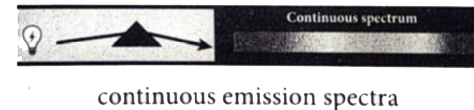 (ii) Line emission spectrum (or line spectrum): Suppose light from hot gas is allowed to pass through prism, line spectrum is observed. Line spectra are also KNOWN as discontinuous spectra. The line spectra are sharp lines of definite wavelengths or frequencies. Such spectra arise due to excited ATOMS of elements. These lines are the characteristics of the element which means it is different for different elements. Examples: spectra of atomic hydrogen, helium, etc. 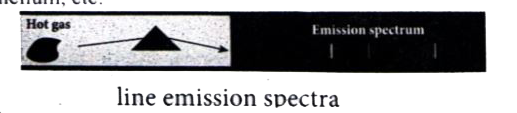 (iii) Band emission spectrum (or band spectrum): Band spectrum consists of several number of very closely spaced spectral lines which overlapped together forming specific bands which are separated by dark spaces, known as band spectra. This spectrum has a sharp edge at one end and fades out at the other end. Such spectra arise when the molecules are excited. Band spectrum is the characteristic of the molecule hence, the structure of the molecules can be studied using their band spectra. Examples, spectra of hydrogen gas, ammonia gas in the discharge tube etc. |
|
| 7217. |
In Young's experiment , two slits are 15 xx 10^(-5) m apart . The interference fringes are obtained on a screen 0.75 m away . The third dark band is 55 xx 10^(-4) m from the central fringe , find the wavelength of light used . How far is the first bright band from the centre ? |
|
Answer» |
|
| 7218. |
A small satellite is revolving near earth's surface. Its orbital velocity will be nearly |
|
Answer» `11.2km//s` |
|
| 7219. |
Two longparallel horizonal rails , a distanced apartand eachhavinga resistance lambdaper unit lengthare jointed at oneendby a resitance R. A perfectlyconducting rodMN of massm is free to slide along the rails . AvariableforceF is appliedto the rodMN , such that ,as therd moves, a constantcurrent i flowsthrough R. (a) Find the velocity v and the forceF as functionof thefunction ofthe distance x of the rod from R. (b) Whatfractioneta of the work done by Fpersecondinconverted into heat ? |
|
Answer» |
|
| 7220. |
Statement -1 :A real image is formed when two rays, starting from a point , and moving along different paths, meet again at some other point. because Statement -2 : A real image can never to formed by reflection in a convex mirror or refraction in a concave lens. |
|
Answer» Statement -1 is True, statement -2 is True, Statement -2 is a CORRECT EXPLANATION for Statement -1. |
|
| 7221. |
An infinitely long rod lies along the axisof a concave mirror of focal length f. The near end of the rod is at a distance ugtf from the mirror. Its image will have a length. |
|
Answer» `(UF)/(u-F)` |
|
| 7222. |
In which of the following cases,force acting on the dipole could be zero |
|
Answer»
|
|
| 7223. |
A magnetic pole of bar magnet with pole strength of 100 Am is 20 cm away from the centre of a bar magnet. Bar magnet has pole-strength of 200 Am and has a length of 5 cm. If the magnetic pole is on the axis of the bar magnet, find the force on the magnetic pole. |
|
Answer» Solution :Here, `p= 200` Am `Z= 20 cm = 0.2`m `2l = 5 cm = 0.05 m` `p_1 = 100` Am `F=?` The MAGNETIC moment of bar magnet `m= 2pl = p(2l)` `= 200 xx 0.05 = 10 "Am"^2` The magnetic FIELD at the pole of bar magnet, `B= (mu_0)/( 4pi ) (2m)/( z^3)` `B= (2m)/(z^3) xx 10^(-7)` `= (2 xx 10 xx 10^(-7) )/( (0.2) ^(3) )` `therefore B= 2.5 xx 10^(-4)` T Now the force on the magnetic pole `p_(1) = 100` Am `F= p_(1) B` `= 100 xx 2.5 xx 10^(-4)` `therefore F= 2.5 xx 10^(-2) N` |
|
| 7224. |
A straight wire of length L and carrying a curretn I stays suspended horizontally in mid air in a region where there is a uniform magnetic field vecB. The linear mass density of the wire is lambda. Obtain the magnitude and direction of this magnitude field. |
|
Answer» Solution :Magnitude field `vecB` should be such that force acting on current carrying conductor due to it acts vertically UPWARD and just balances the weight of the conductor so that conductor remains freely SUSPENDED in MID AIR. `:. BLI = mg = lambda L g "" [ :. m = lambda L` = mass of wire] `implies B = (lambda g)/I` Keeping in mind Fleming.s left hand rule, we can say that `vecB` MUST act horizontally in a direction perpendicular to the wire carrying current. |
|
| 7225. |
The pair of equation x = - 4 and y = -5 graphically represents lines which are |
|
Answer» INTERSECTING at (-5, -4) |
|
| 7226. |
If 10 power 9electrons move out of body to another body every seconds. How much time is required to get a total charges of 1 C on the other body? |
| Answer» SOLUTION :In one second `10^(@) `electrons move out the body. Thereofore ther CHAGES given out in second is ` 1.6 xx 10 ^(-19) xx 10 ^(@) C. `The time requiredto accumulatea charges of 1 C can then be estimated to be ` 1C + ( 1.6 xx 10^(-10) C//s)= 6.25 xx10 ^(9)s = 6.25 xx 10 ^(9) +( 365xx 24xx 3600)` years = 198 years.Thus to collecta charges of one coulomb from ABODY from which `10^(9) `electrons move out very seconds. we will need approximately200 years. | |
| 7227. |
A thin biconvex lens of focal length f=25cm forms a real image of a real object an a screen. The object is separated by 5cm from the lens. The screen is drawn closer to the lens by a distance 18cm. Through what distance (approximately) must the object be shifted so that its image is again formed on the screen ? |
|
Answer» 0.5mm TOWARD left |
|
| 7228. |
A radiation of energy E falls normally on a reflecting surface. The momentum transferred to the surface is : |
|
Answer» `E/c'` |
|
| 7229. |
The length of an open organ pipe is twice the length of another closed organ pipe. The fundamental frequency of the open pipe is 100 Hz. The frequency of the third harmonic of the closed pipe is |
|
Answer» Solution :Let, LENGTH of open ORGAN PIPE `=I_(a)`and length of closed organ pipe `=I_( c)` and `I_(a) = 2l_( c)` Fundamental frequency of the open pipe, `v_(0) = 100 Hz` Also, `v_(0) =v/(2l_(0)) = 100` `v/l_(0) = 200, v/(2l_(0))= 200` or `v/l_(c ) = 400` Fundamental frequency of closed organ pipe `v_( c) =v/(4l_( c)) = 400/4 = 100 Hz` |
|
| 7230. |
The two ends of a train moving with a constant acceleration pass a certain point with velocities M and w. The velocity with which the middle point of a train passes the same point is: |
|
Answer» `(v_(1)+v_(2))/(2)` |
|
| 7231. |
A ring of radius R is suspended from its circumference and is made to oscillate about a horizontal axis in a vertical plane. The length equivalent to a simple pendulum will be : |
| Answer» ANSWER :A | |
| 7232. |
What is the effect of temperature on the resistivity of alloys ? |
| Answer» Solution :Usually the resistivity of alloys increases with TEMPERATURE, but this increases is in GENERAL very small in comparison to the resistivity of the metals . In other WORDS , we can say that the temperature coefficient of resistance of alloys is very small. We always PREFER alloys to MAKE standard resistance, so that the magnitude of resistance does not change appereciably with temperature. | |
| 7233. |
Radiation of energy E is incident on complete reflecting surface.Momentum imparted to surface will be…… |
|
Answer» <P>`(E )/(c )` Momentum of reflected photon `p_(2)=(E )/(c )` Momentum imparted to surface =-change in momentum, `(-2E)/(c )`=-change in momentum of surface `therefore` Momentum imparted to surface =`(2E)/(c )` |
|
| 7234. |
Aniline is a liquid which does not mix with water. When a small quantity of it is poured into a beaker of water at 20^(@)C, it sinks to the bottom. The densities of aniline and water at 20^(@)C and 1021 kgm^(-3) and 998 kgm^(-3) respectively. Find the minimum temperature to which the mixture is to be heated so that aniline will form a globule and just start floating. gamma_("aniline")=85xx10^(-5).^(@)C^(-1), gamma_("water")=45xx10^(-5).^(@)C^(-1). |
|
Answer» |
|
| 7235. |
Name the seven crystal systems. |
| Answer» Solution :TRICLINIC system, Monocline system,RHOMBIC system, Tbfragonal system,TRIGONAL system,HEXAGONAL system,Cubic system. | |
| 7236. |
A conducting bar of 3m length is allowed to fall freely from 80m high tower, keeping it aligned along the East-West direction. Find the emf induced in the rod when it is 20m below the top of tower. g=10 ms^(-2) , B_h=0.7xx10^(-4)T and angle of deep = 60^@ . |
|
Answer» 2.5 mV h=80 m d=20 m `g=10 ms^(-2)` `B_h=0.7xx10^(-4)`T `phi=60^@` Put `v_0=0` in kinetic equation `V^2-v_0^2=2gd` `therefore v^2=2gd` `therefore v^2=2xx10xx20` `therefore v^2=400` `therefore` v=20 m/s `rArr` Kinetic EMF E=Bvl `=B_h COS phi vl` `=0.7xx10^(-4) XX cos60^@xx20xx3` `=0.7xx10^(-4)xx1/2xx20xx3` `=2.1xx10^(-3)` V `therefore` E=2.1 mV |
|
| 7237. |
Two charges + 4q , Q are placed in a straight line of length l at points distance (0,1/2) and l respectively. What should be Q in order to make the net force on q to be zero ? |
| Answer» Answer :A | |
| 7238. |
In early days long distance message was sent by _____, _____ and _____. |
| Answer» SOLUTION :TRAINED PIGEONS, harkara MESSENGER | |
| 7239. |
Beats are produced by two progressivewaves. Maximum loudness at the waxing is x times the loudness of each wave. The value of x is |
| Answer» Answer :D | |
| 7240. |
Two bodies A and B of mass 1 kg and 2 kg are soldered to two ends of vertical spring of force constant 400 N/m. A being at the upper end and B resting on a table. A is now compressed and then released. The freq. of osillation is : |
|
Answer» `(10)/(pi)` Hz Correct choice is (a). |
|
| 7241. |
A parallelplate capacitor is charged and then isolated . The effect if increasing the plate separation on charge, potential and capacitancerespectively are |
|
Answer» constant, increase, decrease  Potential difference `V= EL = (sigma)/(epsi_(0)) L` Since Lincreases, Vincreases CAPACITANCE `C= (epsi_(0)A)/(L)` as L increases C decreases Caution: The plate separation cannot be increased indefinitely OTHERWISE `vec(E )= (sigma)/(epsi_(0)) hat(n)` can.t bemaintainced within the capacitor plates |
|
| 7242. |
A bar magnet whose poles are 10 cm apart in the magnetic meridian with its north pole pointing south. The neutral point is at a distance of 20 cm from the nearest pole. Find the intensity of the resultant field at a point on the perpendicular magnet. (B-vector of earth's field along the horizontal = 4 xx 10^(-5) tesla) |
|
Answer» |
|
| 7243. |
Name the device D which is used as a voltage regulator in the given circuit and give its symbol. |
Answer» SOLUTION :The device D is a ZENER diode WHOSE SYMBOL is as given in . 
|
|
| 7244. |
Suppose that three point charges q_(a), q_(b) and q_(c) are arranged at the vertices of a right -angled triangle as shown . What is the absolute electric potential at the position of the third charge if q_(a)=- 6.0 mu C , q_(b)=+4.0muC , q_(c)=+2.0 mu C , a= 4.0 mand b=3.0 m ? Suppose that the third charge which is initially at rest is repelled to infinity by the combined electric field of the other two charges which are held fixed . What is the final kinetic energy of the third charge ? |
|
Answer» Solution :The electric POTENTIAL at P (the position of the third charge ) due to the presence of the first charge is `V_(a)=K_(e)(q_(a))/(c)=(9XX10^(9))((-6xx10^(-6)))/((sqrt(4^(2))+3^(2)))=-1.08xx10^(4)`V Likewise the electric potential due to the presence of the second charge is `V_(b)=K_(e)(q_(b))/(b)=(9xx10^(9))((4xx10^(-6)))/((3))=1.20xx10^(4)`V. The net potential of the third charge `V_(c)` is simply the algebraic sum of the potentials due to the OTHERS two CHARGES taken in isolation . Thus `V_(c)=V_(a)+V_(b)=1.20xx10^(3)V` |
|
| 7245. |
A magnetic field is measuredby |
|
Answer» avometer |
|
| 7246. |
If k_1 and k_2 are maximum kinetic energies of photoelectrons emitted when lights of wavelengths lamda_1 and lamda_2 respectively incident on a metallic surface and lamda_1 = 3 lamda_2, then : |
|
Answer» `k_1 GT (k_2/3)` |
|
| 7247. |
Light appears to travel in straight line because |
|
Answer» its VELOCITY is large |
|
| 7248. |
what is the displacement of the particle during the motion is? |
| Answer» Answer :B | |
| 7249. |
The condition under which amicrowave oven heats up a food item containing water molecules most efficiently is |
|
Answer» the FREQUENCY of the microwave MUST watch the RESONANT frequency of the water molecules |
|
| 7250. |
The current i in an induction coil varies with time t according to the graph Draw the graph of induced e.m.f. with time. |
Answer» SOLUTION :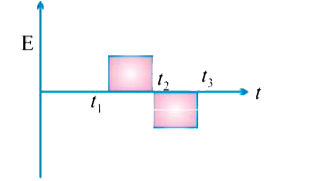
|
|


