Saved Bookmarks
This section includes InterviewSolutions, each offering curated multiple-choice questions to sharpen your knowledge and support exam preparation. Choose a topic below to get started.
| 7701. |
Kinetic energy of a mass m travelling through some distance d, starting from rest, under action of a constant force F is directly proportional to |
|
Answer» INDEPENDENT of m Since F and x are FIXED `:.` K.E. is also fixed. |
|
| 7702. |
Two bodies are projected with the same initial speed at different angles of projection alpha_1 and alpha_2 repectively. The corresponding times of flight are t_1 and t_2. If both of them have the same range, the ratio t_1//t_2 is |
|
Answer» 1 |
|
| 7703. |
The mass of the nucleus is less than the sum of the masses of the nucleons forming it, why? |
| Answer» Solution :In the formation of the nucleus, the neutrons and protons have to collect in a very small SPACE whos size of the order of `10^(-15)m`. The energy required for this purpose is spent by the nucleons at the cost of their MASSES. As a result of this, the mass of the nucleus formed becomes LESS than the sum of the masses of the INDIVIDUAL nucleons. | |
| 7704. |
At the mean position, the potential energy of a particle performing S.H.M. is |
|
Answer» MINIMUM |
|
| 7705. |
For sustained interference fringes in double slit experiment , essential condition/s is / are (1) sources must be coherent . (2) the intensities of the two sources must be equal . Here , the correct option/s is/are |
|
Answer» both (1) (2) |
|
| 7706. |
Explain Curie's law of magnetism. |
|
Answer» SOLUTION :When temperature is increased, thermal vibration will upset the alignment of MAGNETIC dipole moments. Therefore, the magnetic susceptibility decreases with increase in temperature. In many cases. The suscptibility of the MATERIALS is `X_(m) prop (L)/(T) "or" X_(m) = ( C)/(T)` this RELATION is called curie.s law. |
|
| 7707. |
Three capacitors each of capacitance 9 pF are connected in series. (a) What is the total capacitance of the combination ? (b) What is the potential difference across each capacitor if the combination is connected to a 120 V supply ? |
|
Answer» SOLUTION :Here `C_1 = C_2 = C_3 = 9 pF` (a)In SERIES combination the resultant capacitance `1/C= 1/C_1+ 1/C_2 + 1/C_3= 1/9 + 1/9 + 1/9 = 1/3 rArrC = 3pF= 3xx 10^(-12) F`. (b) As total POTENTIAL difference V = 120 V `V_1+ V_2 + V_3 = 120V` As all the 3 CAPACITORS are identical, hence `V_1 = V_2= V_3= V/3 = 120/3= 40V` |
|
| 7708. |
Nuclear forces are |
|
Answer» Non-central forces |
|
| 7709. |
ff the work done in blowing a bubble of radius R is \W, then the work done in blowing a bubble of radius 2R from that solution is : |
|
Answer» W/2 `thereforeW_(1)=T.2[4piR^(2)-0]` `W_(1)=8piR^(2)T.` & `W_(2)=T.2[4pi(2R)^(2)-0]` `=32piR^(2)T.` `THEREFORE(W_(2))/(W_(1))=(32piR^(2)T)/(8piR^(2)T)RARR(W_(2))/(W_(1))=4` `rArrW_(2)=4W_(1)` Thus correct choice is (c). |
|
| 7710. |
A silicon optical fibre with a core diameter large enough has a core refractive index of 1.50 and acladding refrcative index 1.47.Determine(i)the critical angle at the core cladding interface.(ii)the numerical aperture for the fibre.(iii)the acceptanceangle in air for the fibre. |
| Answer» Solution :(i) Here `mu_(1)=1.50,mu_(2)=1.47`, `mu_(0)=1`, CRITICAL angle `theta_(c)` at the core - cladding interface is GIVEN by, `theta_(c)= sin ^(-1)((1.47)/(1.50))=78.5^(0)`(ii) Here `mu_(1)=1.50,mu_(2)=1.47`, `mu_(0)=1`,Numerical Aperture, NA =`(mu_(1)^(2)-mu_(2)^(2))^((1)/(2))` =`[(1.50)^(2)-(1.47)^(2)]^((1)/(2))=(2.25-2.16)^((1)/(2))=0.30`(iii) Here `mu_(1)=1.50,mu_(2)=1.47`, `mu_(0)=1`, Acceptance angle `theta_(a) =sin^(-1)(NA)`, =`sin^(-1) (0.30) =17.4^(0)`(iii) Here `mu_(1)=1.50,mu_(2)=1.47`, `mu_(0)=1`, Acceptance angle `theta_(a) =sin^(-1)(NA)`, =`sin^(-1) (0.30) =17.4^(0)` | |
| 7711. |
A small body with relative density d_(1) falls in air from a height 'h' on to the surface of a liquid of relative density d_(2) where d_(2)gt d_(1).The time elapsed after entering the liquid to the instant when it comes to instantaneous rest inside liquid |
|
Answer» `SQRT((2h)/(G))(d_(2))/(d_(1))` `(dQ)/(dt)=-alphaAT(dT)/(dx)impliesi=-alphaAT(dT)/(dx)implies iintdx =- alphaAunderset(T_(1))OVERSET(T_(2))intTdT` `implies i(l)=alphaA((T_(1)^(2)-T_(1)^(2)))/(2)implies i=(alphaA)/(2l)(T_(1)^(2)-T_(2)^(2))` |
|
| 7712. |
A wire of 10^(-2) kgm^(-1)passes over a frictionless light pulley fixed on the top of a frictionless inclined plane which makes an angle of 30^@with the horizontal. Masses m and M are tied at two ends of wire such that m rests. on the plane and M hangs freely vertically downwards. The entire system is in equilibrium and a transverse wave propagates along the wire with a velocity of 100 ms^(-1). Then |
|
Answer» M = 5KG |
|
| 7713. |
When a thin film of thickness t is placed in the path of light wave emerging out of the slit , then increase in the length of optical path will be |
|
Answer» `(MU - 1)t` |
|
| 7714. |
Which of the following constructed on the principle of electromagnetic induction? |
|
Answer» Galvanometer |
|
| 7715. |
Name the band to which electomagnetic wave of frequency 120 MHz belongs. |
| Answer» SOLUTION :Very HIGH FREQUENCY `(VHF)` of radio waves belong to `120 MHZ`. | |
| 7716. |
Solar energy is due to : |
|
Answer» FUSION reactions |
|
| 7717. |
The resistance offered by the stream of water on motor boat moving with uniform velocity of 30 m sec^(-1) is 5000 N. The power of motor boat is: |
|
Answer» 1.50 kw |
|
| 7718. |
Development of female gametophyte directly from megaspore mother cell without meiosis is called |
|
Answer» Diplospory |
|
| 7719. |
Pick up the correct statements of the following. a) Threshold frequency does not depends on intensity of incident light. b) Threshold frequency is different for different metals. (c ) The intercept on X-axis of a graph drawn between stopping potential on Y-axis and frequency on X-axis gives threshold frequency. |
|
Answer» Only a,B are CORRECT |
|
| 7720. |
In the above problem, the luminous flux emitted by sun will be |
|
Answer» `4.43 xx 10^(25) lm` |
|
| 7721. |
If one of the two electrons of a H_(2) molecule is removed, we get a hydrogen molecular ion H_(2)^(+). In the ground state of an H_(2)^(+), the two protons are separated by roughly 1.5Å, and the electron is roughly 1Å from each proton. Determine the potential energy of the system. Specific your choice of the zero of potential energy. |
Answer» Solution :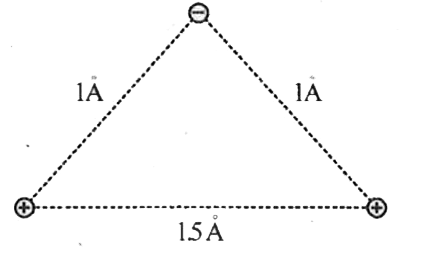 `U=U_(1)+U_(2)+U_(3) ""U_(1)=(9 XX 10^(9) E^(2))/(1.5 xx 10^(-10)) U_(2)=U_(3)` `U_(2)+U_(3)=(9 xx 10^(9) xx -2E^(2))/(1 xx 10^(-10))` `U=(9 xx 10^(9) e^(2))/(10^(10)) (1/(1.5) -2/1)=(9 xx 10^(9) xx (1.6)^(2) xx 10^(38) xx -2)/(10^(-10) xx 1.5 xx 1.6 xx 10^(-19))eV` `=(-9 xx 1.6 xx 2)/(1.5) =(-9 xx 16 xx 4)/(30)=-19.2eV` |
|
| 7723. |
What is potentiometer ? Explain principle of potentiometer. |
|
Answer» Solution :`rArr` Potentiometer is a device in which continously varying POTENTIAL difference can be obtained and measured also. `rArr` Device measuring potential difference is called potentiometer. Principle:  `rArr` As shown in figure, a BATTERY having emf t and INTERNAL resistance r is connected with resistance box R and wire with uniform cross- section and uniform resistance per unit length (AB) are connected in series. `rArr`Resistance box (R) is always not needed. `rArr` length of AB wire = L `rArr` Let resistance of wire per unit length is `rho` . `therefore ` Resistance of wire AB = L `rho` `rArr` Let value of resistance obtained (used) from resistance box is R. `thereforre ` Current flowing in the wire, `I = (epsilon)/(R + L rho + r)"" `.... (1) `rArr ` If length of AC wire is l then, resistance of AC wire = `rho ` l `rArr` Potential difference between A and C = current`xx ` (resistance of AC ) `therefore V_(l) = epsilon (l) = I rho l ""`....(2) `rArr thereforeepsilon (l) = ((epsilon rho )/(L rho + R + r)) . l ` `therefore epsilon (l) = V = phi `l Where `phi ` or `sigma ` of K is called potential gradient. `rArr` Principle : Potential difference between two point of wire is directly proportional to distance between two points. `rArr` Its unit is `Vm^(-1) ` and dimensional formula `[M^(1) L^(1) T^(-3) A^(-1) ] ` |
|
| 7724. |
The amount of mechanical heat to be done to completely melt one gram of ice at 0^@C is |
|
Answer» 4.2 J |
|
| 7725. |
The radius of the dees of a cyclotron is 60cm and the magnetic field applied is 650 mT. The maximum KE of a proton accelerated through it is [m_p = 1.67 xx 10^(-27)kg ,q = 1.6 xx 10^(-19)C ] |
|
Answer» `12 xx 10^(-12) J` |
|
| 7726. |
The voltge-current variarton of two metallic wires X and Y at constant temperature are as in the figure Assuming that the wires have the same length and same diameter explain which of the wires will have larger resistivity.(ANE_RJB_PHY_XII_C03_E03_006_Q01.png" width="80%"> |
Answer» Solution :For a given voltage V the current FLOWING through X is greater than that throughY`(I_xgtI_y)` that means RESISTANCE of X is smaller than that of Y For a given length area and temperature `Rproprho`. `THEREFORE RESISTIVITY of Y is greater than that of X.
|
|
| 7727. |
An archer pulls the bowstring back for a distance of 0.470m befor releasing the arrow. The bow and string act like a spring whose spring constant is 425N/m. (a) What is the elastic potential energy of the drawn bow? |
|
Answer» 93.8J |
|
| 7728. |
All the photoelectrons are not emitted with same energy. Give reason. |
| Answer» SOLUTION :The energy of the INCIDENT photons is spent for PROVIDING work function and KE. Work function is the same for all electrons then `KE_("max")` changes DEPENDING on its ENERGYSTATE. | |
| 7729. |
Which is the wrong relation from the following ? At resonance, in a series L.C.R a.c. circuit: |
|
Answer» `omega=1/sqrtLC` |
|
| 7730. |
Number of fission required in one second to attain a power level of 1 MW in an atom bomb will be: |
|
Answer» `3.13 XX 10^(16)` Energy/fission=200MeV `=3.2 xx 10^(-11)J` No. of fission REQUIRED PER set `=(10^(6))/(3.2 xx 10^(-11))` `=3.13 xx 10^(16)` |
|
| 7731. |
A ring of radius R has charge Q distributed uniformly on it. At a distance x (!=0) from centre on its axis. (consider axial points only) |
|
Answer» POTENTIAL cannot be greater than `(Q)/(4piepsilon_(0)R)` |
|
| 7732. |
Given the sets A = {1, 3, 5}, B = {2, 4, 6} and C={2,4, 6, 8}, which of the following may be considered as universal sets(s) for all the three sets A, B and C: |
|
Answer» {0, 1, 2, 3, 4, 5, 6} |
|
| 7733. |
The intensity of a light pulse travelling along a communication channel decreases exponetially with distance x according to the relation I=I_(0)e^(-ax) where I_(0) is the intensity at x=0 and alpha is the attenuation constant. The percentage decrease in intensity after a distance of (("In"4)/(alpha)) is |
|
Answer» 0.7 |
|
| 7734. |
For monoatomic gases gamma = 1.66 pm pm 0.01. Find specific heats of helium and of neon. |
|
Answer» `1.24 xx 10^4 le C_(mv) le 1.28 xx 10^(4) ` J/(kmole.K). Accordingly `2.07 xx 10^4 le C_(mp) le 2.11 xx 10^4 ` J/(kmole.K)`. To OBTAIN the specific heats, divide the molar heats by the molar MASS. |
|
| 7735. |
The temperature of hot and cold end of a 20 cm long rod in steady state with no side losses is 100^(@)C and 20^(@)C respectively. Temperature at the centre of the rod is : |
|
Answer» `50^(@)C` |
|
| 7736. |
When two charged conductors are connected by a conducting wire, then charge will not flow if the conductors are of |
|
Answer» same capacity |
|
| 7738. |
A positively charged particle of charge q and mass m is suspended from a point by a string of length l. In the space a uniform horizontal electric field E exists . The particle is drawn aside so that it is projected horizontally with velocity v such that the particle starts to move along a circle with same constant speed v. Find the speed v. |
|
Answer» `(2QE)/m(sqrtl/g)` `F=sqrt((mg)^(2)+(qE)^(2))` `TANTHETA=(qE)/(mg)` `Tcostheta=F` `Tsintheta=(mv^(2))/(r)` where `r=lsin theta` Solve to get `v=(qE)/(m) sqrt((l)/(g))` 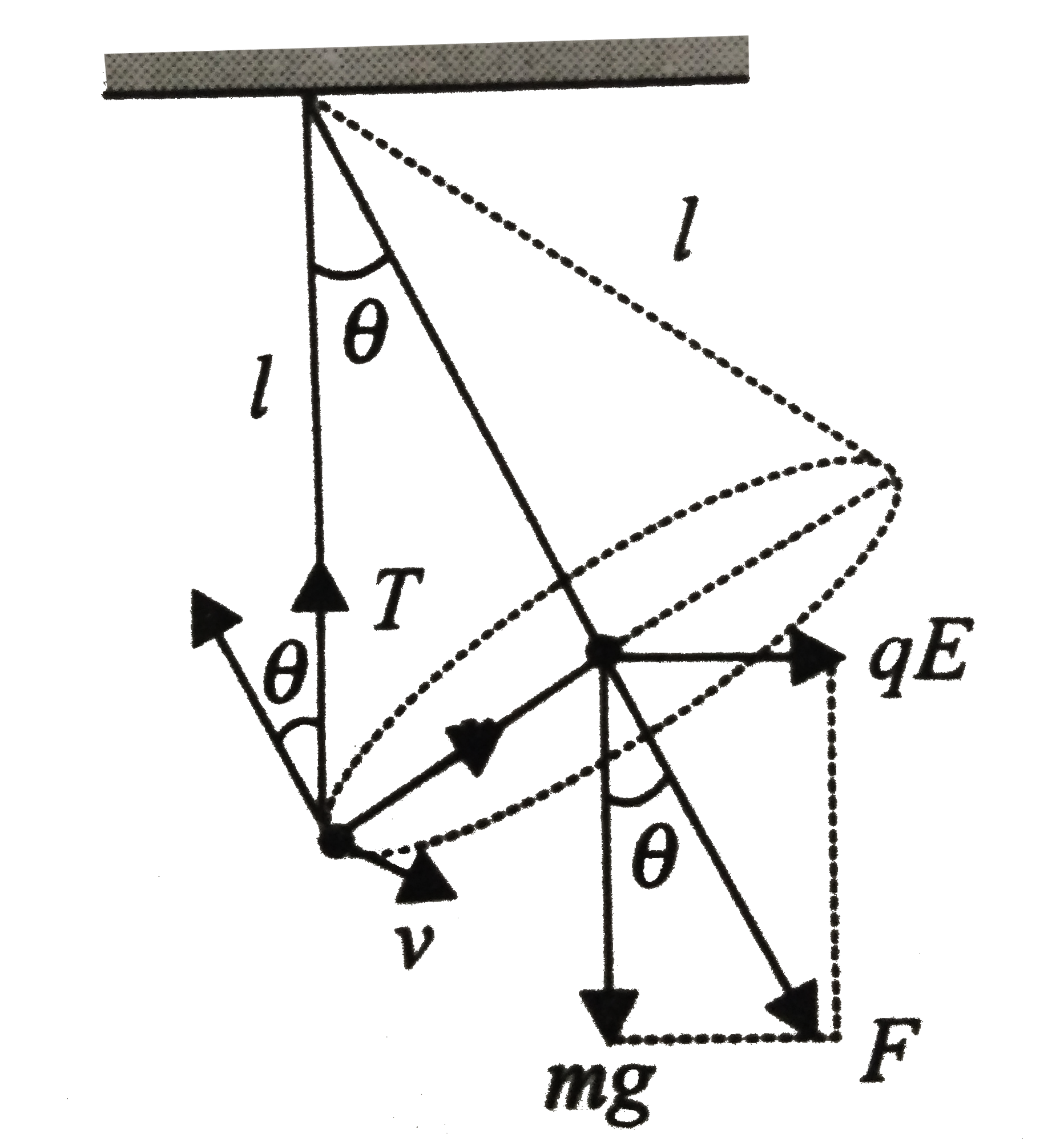
|
|
| 7739. |
Astronomical unit is the unit of |
|
Answer» time |
|
| 7740. |
A solid cylinder of height h and mass m floats in a liquid of density rho such that three fourth of its height is immersed. Now, the cylinder is released inside a liquid of density (rho)/(4), contained in a downward accelerated vessel. Find the magnitude of acceleration of vessel A, for which cylinder sinks with relative acceleration of (A)/(3) w.r.t. vessel. |
| Answer» SOLUTION :`(2G)/(3)` | |
| 7741. |
A capacitor of capacitance Cis connected to a battery of emf E at t = 0 through a resistance R. Find the maximum rate at which energy is stored in the capacitor. When does the rate has this maximum value? |
|
Answer» `E^(2)//4R`, 2CR LN 2 |
|
| 7742. |
AB is a cylinder of length lm fitted with a thin flexible diaphragm C at middle and two other thin flexible diaphragms A and B at the ends, the portions AC and BC contain hydrogen and oxygen gases respectively. The diaphragms A and B are set into vibrations of the same frequency. The minimum frequency of these vibrations for which for diaphragm C is a node is 1.65 xx 10^y Hz (Under the conditions of the experiment velocity of sound in hydrogen is 1100 m/s and in oxygen 300 m/s). Then y |
|
Answer» |
|
| 7743. |
A finite ladder circuit is constructedby connecting several sectionsof 6 mu F, 8 mu F capacitor combinationsas shown in the figure. Circuit is terminatedby a capacitor of capacitance C. Find the value of C, such that the equivalent capacitance of the ladder between the points A and B becomesindependentof the number of sections in between ? |
|
Answer» |
|
| 7744. |
An electron moves on a straight line path XY as shown in the figure. The coil abed is adjacent to the path of the electron. What will be the direction of current, if any, induced in the coil? |
|
Answer» The current will REVERSE its DIRECTION as the ELECTRON GOES past the coil |
|
| 7745. |
The I - V characteristic of an LED is : |
|
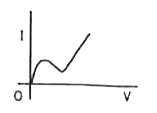
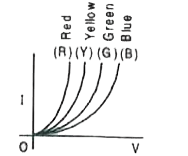
Answer»
|
|
| 7746. |
A coil of resistance 20Omega and inductance 5 H is connected with 100 V battery. Energy stored in the coil will be |
|
Answer» 41.5 J |
|
| 7747. |
How does the electric field (E) vary with distance (r) in the following cases? i. Uniformly charged spherical shell ii. Uniformly charged solid sphere. iii. Uniformly charged plane sheet of large size. Also plot a graph between E and r in each case. |
|
Answer» Solution :i. OUTSIDE `ALPHA 1/r^(2)," on surface "=1/r^(2)," inside =zero"` II. On the surface `=1/r^(2)," inside "alpha r` III. Constant `E=sigma/(2 epsi_(0)), " INDEPENDENT of r"` |
|
| 7748. |
A long solenoid with 15 turns per cm has a small loop of area 2.0 cm^(2) placed inside the solenoid normal to its axis. If the current carried by the solenoid changes steadily from 2.0 A to 4.0 A in 0.1 s, what is the induced emf in the loop while the current is changing ? |
|
Answer» Solution :Here number of turns per unit length N = 15 turns/cm = 15 x 100 turns/m = 1,500 turns/m, area of loop `A = 2.0 cm^(2) = 2 x 10^(-4)m^(2), I_(1) = 2.0 A, I_(2) = 4.0 A and t = 0.1 s` `therefore "Induced EMF" |VAREPSILON|=(phi_(2)-phi_(1))/t=(B_(2)A-B_(1)A)/t=(B_(2)-B_(1))A/t=(mu_(0)n(I_(2)-I_(1))A)/t` `(4pixx10^(-7)xx1,500xx(4.0-2.0)xx2xx10^(-4))/0.1=7.5xx 10^(-6)V or 7.5muV` |
|
| 7749. |
Einstein held that time, mass, length and space are "__________". |
|
Answer» independent |
|
| 7750. |
Why are microwaves used in radar ? |
| Answer» SOLUTION :DUE to its short wavelength, they are not bent MUCH by normal OBJECTS. | |