

Saved Bookmarks
This section includes InterviewSolutions, each offering curated multiple-choice questions to sharpen your knowledge and support exam preparation. Choose a topic below to get started.
| 7651. |
The fraction (f) of the number of electrons raised from valence band to conduction band at temperature TK in intrinsic semiconductor is given by........ |
|
Answer» |
|
| 7652. |
What is the charge on a metal when 5 electrons are removed from it? |
| Answer» Answer :A | |
| 7653. |
In the previousd question if the length of the cylindeer is measured as 25mm and mass of the cylinder is measured as 50.0gm find the density of the cylinder (gm//cm^(3)) in proper significant . |
|
Answer» Solution :`rho=(m)/(PI(d^(2)//4)h)` `rho = ((50.0)GM)/(3.14xx(3.09//2)^(2)XX(25xx10^(-1))cm^(3))=2.7gm//cm^(3)` . |
|
| 7654. |
A ray of light is incident normally on the prism (mu = (3)/(2)) immersed in a liquid as shown in the figure. The largest value for the angle alpha so that ray is totally reflected at the face AC is 30^(@). The refractive index of the given liquid is |
|
Answer» `(SQRT(3))/(2)` |
|
| 7655. |
A wave of frequency 500 Hz has a wave velocity of 350 m/s. Find the phase difference between two displacements at a certain point at times 10^(-3)s apart. |
| Answer» SOLUTION :`180^@C` | |
| 7656. |
A stone is projected vertically up from theground with velocity 40 ms^(-1) .The interval of time between the two instants at which the stone is at a height of 60 m above the ground is |
|
Answer» 4s |
|
| 7657. |
A 12.3 eV electron beam is used to bombard gaseous hydrogen at room temperature. Upto which energy level the hydrogen atoms would be excited ? Calculate the wavelengths of the second member of Lyman series and second member of Balmer series. |
|
Answer» Solution :The energy of electron in the `N^(TH)` ORBIT ofhydrogen ATOM is `E _(n) = - ( 13.6)/( n^(2)) eV` incident beam of energy 12.3eV is absorbed by hydrogen atom. Let the electron jump fromn =1 to n =n level. `E = E_(n) -E_(1)` `12.3 = ( 13.6)/( n^(2)) - ( - ( 13.6)/1^(2))` `rArr 12.3 = 13.6 | 1- (1)/(n^(2)) | rArr ( 12.3)/( 13.6) = 1- (1)/(n^(2))` `rArr 0.9 = 1 - (1)/( n^(2)) rArr (1)/( n^(2)) = 1.09 = 0.1` `rArr n^(2) = (1)/( 0.1) = 10` `:. n = 3` That is the hydrogen atom would be excited upto second excited state. For Lyman Series `(1)/(lambda) = R[ (1)/( n_(f)^(2)) - (1)/( n_(i)^(2))]` `rArr (1)/( lambda) = 1.097 xx 10^(7) [ (1)/(1) - (1)/(9)] = 1.097 xx 10^(7) xx (8)/( 9)` ` :. lambda = ( 9)/( 1.097 xx 10^(7) xx 8) = ( 9)/( 8 xx 1.097 xx 10^(8))` `= 1.025 xx 10^(-7) = 102.5nm` For Balmer Series `(1)/( lambda) = 1.097 xx 10^(7) [ (1)/( 4) - ( 1)/( 16)]` `rArr (1)/( lambda) = 1.097 xx 10^(7) xx (3)/( 16)` `rArr lambda = 4.86 xx 10^(-7) m rArr lambda = 486nm` |
|
| 7658. |
Which one of the following properties distinguishes ultrasound from normal audible sound? |
|
Answer» INTENSITY |
|
| 7659. |
A man throws a ball at an angle of 45^@ with thehorizontal plane from a height of 15 m. If the shot strikes the ground at a horizontal distance of 30 in, the velocity of throw is (Takeg=10 m s^(-2)) |
|
Answer» 10 m `s^(-1)` so, `30=u cos 45^@ t = u/sqrt2t` …(i) For vertical DOWNWARD motion , -y=u sin `45^@ t -1/2 g t^2` or `-15=u/sqrt2 t- 1/2 xx 10 xx t^2` or t=3s (Using (i)) `therefore` Velocity of the THROW , `u=(30sqrt2)/t=10sqrt2 m s^(-1)` |
|
| 7660. |
Absolute refractive index of a medium is 'X'. Refractive index of same medium w.r.t. to air is 'Y' and absolute refractive index of air is 'Z'. Then, the relation between them is |
|
Answer» X = Y/Z |
|
| 7662. |
By rubbing comb in dry hairs ...... |
|
Answer» (A) DRY hairs GAIN electrons. |
|
| 7663. |
If alpha_(1) is the temperature coefficient of resistance at t_(1)^(@)C find alpha_(2) at t_(2)^(@)C [hint: alpha=1/R(dR)/dt) and R=R_(0)(1+at+btp^(2))] |
|
Answer» |
|
| 7664. |
Negative points with kinetic energy T=100 MeV travel an average distance l=11m from origin to decay. Find the proper lifetime of these poins. |
|
Answer» SOLUTION :Energy of pions is `(1+eta)m_(0)C^(2)` so `(1+eta)m_(0)c^(2)=(m_(0)c^(2))/(sqrt(1-beta^(2)))` Hence`(1)/(sqrt(1-beta^(2)))=1+eta or beta=(sqrt(eta(2+eta)))/(1+eta)` Here `beta=(V)/(c )` of pion. Hence time dilation factor is `1+eta` and the distance traversed by the pion in its lifetime will be `(c betatau_(0))/(sqrt(1-beta^(2)))=ctau_(0)sqrt(eta(2+eta))= 15.0 meters` on SUBSTITUTING the values of various quantities. (Note. The factor `(1)/(sqrt(1-beta^(2))` can be looked at as a time dilation effect in the laboratory frame or as length contraction factor brought to the other side in the PROPER frame of the pion). |
|
| 7665. |
A 1000 kg automobile is at rest at a traffic signal. At the instant the light turns green, the auto mobile starts to move with a constant acceleration of 3.0 m//s^2. At the same instant a 2000 kg truck, traveling at a constant speed of 8.0 m/s, overtakes and passes the automobile. (a) How far is the com of the automobile-truck system from the traffic light at t = 5.0 s? (b) What is the speed of the com then? |
|
Answer» |
|
| 7666. |
A block of mass m is placed on a surface with a vertical cross section given by y =(x^(3))/(6)If the coefficient of friction is 0.5, the maximum height above the ground at which the block can be placed without slipping is : |
|
Answer» `(1)/(2)m` `:. y =(x^(3))/(6)`(vol. of one) At the POINT of just SLIDING `MG SIN theta = umg cos theta` `tan theta=mu,(dy)/(dx) = tan theta=mu=(1)/(2), (x^(2))/(2) =(1)/(2),.y =(x^(3))/(6)` m. `:.y=1//6m` 
|
|
| 7667. |
Discuss the phenomena experienced due to electrostatics. |
|
Answer» Solution :All of US have the experience of SEEING a spark or hearing a crackle when we take off our synthetic clothes or sweater, particularly in dry weather, and also with LADIES garments like a polyester saree. Another common example is the lightning that we SEE in the sky during thunderstorms. We also experience a sensation of an electric shock either while opening the door of a car or HOLDING the iron bar of a bus after sliding from our seat. The reason for these experiences is discharge of electric charges through our body due to rubbing of insulating surfaces. Electrostatics deals with the study of forces, fields and potentials arising from static charges. |
|
| 7668. |
The material suitable for making electromagnets should have |
|
Answer» HIGH retentivity and high coercivity |
|
| 7669. |
What large scattering of angle of alpha-particle suggested ? |
| Answer» Solution :As atom contains `+ve` charge and `99.9%`, mass, `alpha-particle travelling CLOSE to NUCLEUS will have large SCATTERING angle. | |
| 7670. |
Two identical bar magnets each of dipole moment p and length l are perpendicular to each other. The dipole moment of the combination is : |
|
Answer» <P>0.58333333333333 |
|
| 7671. |
चन्द्रमा पर गुरुत्वीय त्वरण है |
|
Answer» पृथ्वी का (1/6) वाँ भाग |
|
| 7672. |
Two amplifiers are connected one after the other in series (cascaded) . The first amplifier has a voltage gain of 10 and the second has a voltage gain of 20 .If the input signal is 0.01 volt, calculate the output ac signal. |
|
Answer» 1 V `:.` Net voltage gain `A_v = A_(v_1)xxA_(v_2) = 10xx20=200` Now using `A_v = (V_o)/V_i` `:. V_o=A_v.V_i=0.01 xx200=2V` |
|
| 7673. |
Four charges of equal magnitude 2mu C are kept at the four corners of a square of side 5cm. The force experienced by any one of them |
| Answer» Answer :B | |
| 7674. |
If we place a bar magnet in the magnetic meridian with its north pole towards geographic north, the neutral point will be : |
|
Answer» On the axial line |
|
| 7675. |
A Carnot engine takes 3 xx 10^(6) cals of heat from a reservoir at 627^(@)C and gives it to a sink at 27^(@)C. The work done by the engine is: |
|
Answer» `4 cdot 2xx10^(6)J` Work `=N cdot Q_(1)=(2)/(3) xx 3xx 10^(6)=2xx10^(6)` cal. `=8 cdot 4xx10^(6)` J `therefore` Correct choice is (c ). |
|
| 7676. |
Constantan is used for making standard resistance because it has |
|
Answer» HIGH resistivity |
|
| 7677. |
APT is used ______ |
|
Answer» In inventory management |
|
| 7678. |
An electron in hydrogen atom experiences a transition from n = 6 to n = 3. Find out the frequency of the radiation. |
|
Answer» Solution :WAVE number of radiation emitted in H atom, `(1)/(lambda)=R[(1)/(3^(2))-(1)/(6^(2))]=R[(1)/(9)-(1)/(36)]` `(1)/(lambda)=(27R)/(324)=(R)/(12)....(1)` `rArr` Now `c=lambda v` `:.(1)/(lambda)=(v)/(c)` `:.(v)/(c)=(R)/(12)[ :.` From EQUATION (1)] `:.v=(Rc)/(12)=(1.09xx10^(7)xx3xx10^(8))/(12)` `:.v=0.275xx10^(15)Hz` |
|
| 7679. |
A: Power of lens of goggles is zero.R: Radii of curvature of both surfaces of lens of goggles is same. |
|
Answer» Both ASSERTION and REASON are TRUE and the reason is CORRECT EXPLANATION of the assertion. |
|
| 7680. |
In the last question let us assume that the uniform electric field makes an angle theta with the vertical in downward direction. With the uniformly charged rod in vertical position the field is switched on. Mass of the rod, its length and charge per unit length is M, L and lamda respectively. (a) Find the strength of field (E) such that the rod can reach the horizontal position if theta = 30^(@) (b) Find the minimum strength of field (E) such that the rod can reach the horizontal position if theta = 60^(@)(c) However high the field might be, the rod cannot become horizontal if theta lt theta_(0) find theta_(0) |
|
Answer» (b). `E=((2)/(sqrt(3)-1))(MG)/(lamdaL)` (c) `theta_(0)=45^(@)` |
|
| 7681. |
Consider an ideal gas confined in an isolated closed chamber. As the gas undergoes an adiabatic expansion, he average time of collision between molecules increases as V^(q), where V is the volume of gas. The value of q is: (gamma =(C_(p))/(C_(v))) |
|
Answer» `(3 gamma -5)/(6)` `tau prop (V)/(sqrt(T))" ….(ii)"` `TV^(gamma-1)=K"….(iii)"` `THEREFORE tau prop V^((gamma+1)/(2))` So CORRECT CHOICE is (b). |
|
| 7682. |
If the air medium between the two charges is replaced by water what change you expect in the electrostatic force and why? |
| Answer» SOLUTION :The relative dielectric constant of water is 81. HENCE the force between two CHARGES is REDUCED by 1/81 | |
| 7683. |
Keeping voltage on anode of photocell,wavelength of light is changed periodically.How does current of photocell I and lambda change out of the following graphs ? |
|
Answer»
|
|
| 7684. |
Three point charges of +2q, +2q and -4q are placed at the corners A, B and C of an equilateral triangle ABC of side 'x'. The magnitude of the electric dipole moment of this system is. |
|
Answer» `2qx` The magnitude of electric dipole MOMENT  `P_("net")=sqrt(p^(2)+p^(2)+2P p cos 60^(@))` `= sqrt(2p^(2)+2p^(2)xx(1)/(2))` `= sqrt(3).p` We know that, p = 2q.x `= sqrt(3).2qx = 2sqrt(3)qx` |
|
| 7685. |
(a) Fibre optic cables-Data speed of 1 Gbps (b) Satellite communication-Radio repeater in sky (c ) Oscillator-Sinusoidaly wave (d) Transmitting antenna -5xx10^4ms^(-1) |
|
Answer» |
|
| 7686. |
A two slit Young's interference experiment is done with monochromatic light of wavelength 6000 Å.The slits are 2 mm apart. The fringes are observed on a screen placed 10 cm away from the slits. Now a transparent plate of thickness 0.5 mm is placed in front of one of the slits and it is found that the interference pattern shifts by 5 mm. What is the refractive index of the transparent plate? |
| Answer» SOLUTION :`MU = 1.2` | |
| 7687. |
A point charges + Q is placed in the vicinity of a conducting surface Draw. The electric field lines between the surface and the charges. |
Answer» SOLUTION :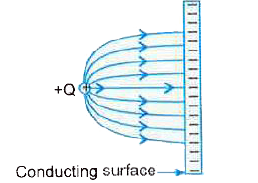
|
|
| 7688. |
A glass plate of 1.2xx10^(-6)m thickness is placed in the path of one of the interfering beams in a biprism arrangement using monochromatic light of wavelength 6000 Å. If the central bands shifts by a distance equal to the width of the bands, find the refractive index of glass |
|
Answer» |
|
| 7689. |
What do you mean by modulation ? What are its types ? |
|
Answer» SOLUTION :Modulation is the PROCESS of producing a high frequency wave, some CHARACTERISTICS of which varies as a result of the INSTANTANEOUS value of audio signal. It is of THREE types : `(a)` Amplitude modulation `(b)` Frequency modulation `(c )` Phase modulation. |
|
| 7690. |
The equation of a wave is given by y = 10 ((2 pi )/(45) t + alpha ) . If the displacement is 5 cm at t = 0 , then the total phase at t = 7.5 sec. is : |
|
Answer» `(pi)/(3)` at t = 0, y = 25 cm `therefore ` 5 = 10 sin `(0 + alpha) rArr(1)/(2) = sin alpha` `therefore alpha = 30^(@) or (pi)/(6)` radians. Now att = 7.5s. Total phase is `phi = (2pi xx 7.5)/(45) + (pi)/(6) ` `phi = (pi)/(3) + (pi)/(6)= (pi)/(2) ` So correct CHOICE is (b). |
|
| 7691. |
The intensity at the maximum in a Young's double slit experiment is I_(0). Distance between two slits is d=5 lambda where lambda is the wavelength of light used in the experiment. What will be the intensity in front of one of the slits on the screen placed at a distance D=10d ? |
|
Answer» `(I_(0))/(4)` `=(dxx(d)/(2))/(10d)` `=(d)/(20)=(5 lambda)/(20)` `"sin" theta=(lambda)/(4)` `:. sin theta=(2pi)/(4) [ :. lambda= 2pi]` `:. sin theta=(pi)/(2)` `:. theta=90^(@)` From Malus, law, `I=I_(0)"cos"^(2)(phi)/(2)=I_(0)cos^(2)45^(@)` `:.I=I_(0)XX((1)/(sqrt(2)))^(2) :.I=(I_(0))/(2)` |
|
| 7692. |
What are examples of space communication? |
| Answer» SOLUTION :RADIO, TV and SETELLITE COMMUNICATIONS. | |
| 7693. |
In the circuit shows in Fig the switch is closed at t = 0. |
|
Answer» At `t = 0,I_(1) = I_(2) = 0` `L_(1) (dI_(1))/(dt) = L_(2) (dI_(2))/(dt) RARR int L_(1) dI_(1) = int L_(1) dI_(2)` `rArr` Initially `I_(1) = 0`, `I_(2) = 0 rArr C = 0` So `L_(1) I_(1) = L_(2)I_(2)` |
|
| 7694. |
यदि n(A)=12,n(B)=8,n(AnnB)=4 तो n(A-B) का मान ज्ञात कीजिए। |
|
Answer» 8 |
|
| 7695. |
A box of mass 40 kg is pusched in a straight line across a horizontal floor by an 80 N force. If the force of kinetic friction acting on the box has a magnitude of 60 N, what is the acceleration of the box? |
|
Answer» `0.25m//s^(2)` |
|
| 7696. |
(A): The fusion process is achieved by raising the temperature of the system (R) : The fusion particles have enough K.E to overcome the coulomb repulsive behaviour. |
|
Answer» Both .A. and .R. are TRUE and .R. is the CORRECT explanation of .A. |
|
| 7697. |
A charged particle +q of mass m is placed at a distanced from another charged particle -2q of mass 2m in a uniform magnetic field B as shown in Fig. 1.28. If the particles are projected towards each other with same speed v, a. find the maximum value of projected speed v_m so that the two particles do not collide. b. find the time after which collision occurs between the particles if projection speed equals 2v_m. c. Assuming the collision to be perfectly inelastic, find the radius of the particle in subsequent motion. (Neglect the electric force between the charges.) |
|
Answer» So, for collision not to take PLACE, `r_1+r_2ltd` `(mv)/(Bq)+(2mv)/(2Bq)LTD`or `VLT(Bqd)/(2m)` Therefore, maximum speed should be `(Bqd)/(2m)` i.e., `v_mlt(Bqd)/(2m)` (b) From symmetry, it can be concluded that collision occurs at `d//2` if `v=2v_m=(qBd)/m` `r=(mv)/(qB)=d, sin theta=(d//2)/d=1/2, theta=pi/6` `t=T( theta/(2pi))=(2pim)/(qB)((pi//6)/(2pi))=(pim)/(6qB)` 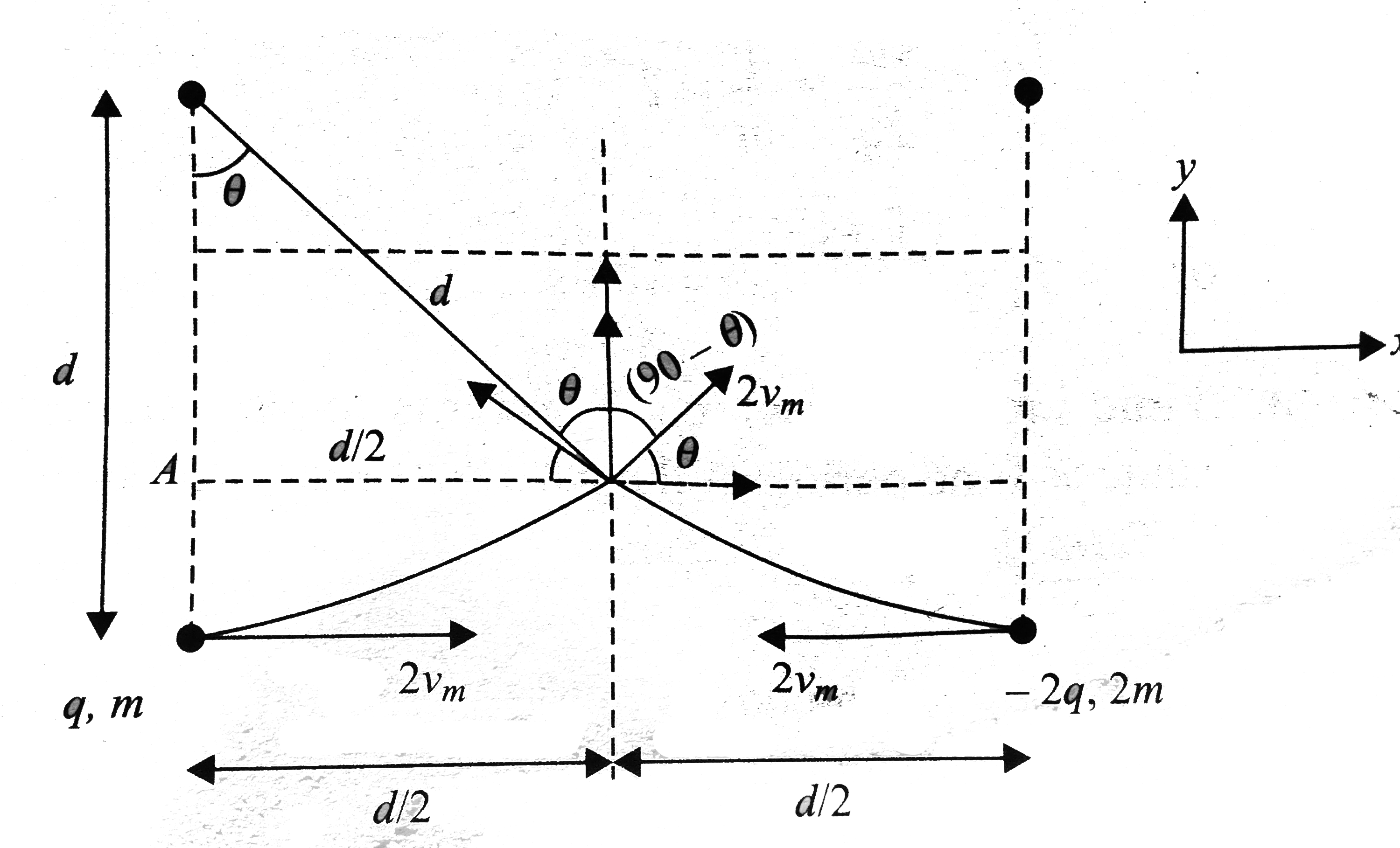 (c) After collision, charge on the combined particle `=-q`, Mass `=3m` The combined particle will have velocity in y direction just after collision. Using conservation of linear momentum `(mv cos thetai+mvsin thetaj)+(-2mvcos thetai+2mv sin thetaj)=3mvecv` `3mvecv=-mv cos thetai+3mvsin thetaj` `VECV=(-v/(2sqrt3)hati+v/2hatj)` `|vecv|=vsqrt((1/(4xx3)+1/4))=vsqrt(1/4(4/3))=v/(sqrt3)` `|v|=1/(sqrt3)xx2xx(qBd)/(2m)=(qBd)/(sqrt3m)` `:. r=3mxx(qBd)/(sqrt3mxxqB)=sqrt3d`. |
|
| 7698. |
A non-relativistic pointcharge q moveswith aconstant velocity v. Usingthe fieldtransformation formula.Find themagnetic inductionB producedby this chargeat the pointwhoseposition relativeto the chargeis determind by the radius vector r. |
|
Answer» SOLUTION :In the referenceframe `K'` movingwith the particle, `vec(E) = vec(E) + vec(v)_(0) XX vec(B) = (q vec(r))/(4pi epsilon_(0) r^(3))` `vec(B) = vec(B) - vec(v_(0)) xx vec(E)//C^(2) = 0` Here, `vec(v_(0))` = velocity of `K'` relative to the `K` framein whichthe particle has velocity `vec(v)` Clearly, `vec(v_(0)) = vec(v)`. Fromthe secoundequaction, `vec(B) = (vec(v) xx vec(E))/(c^(2)) = epsilon_(0) mu_(0) xx (q)/(4pi epsilon_(0)) (vec(v) xx vec(r))/(r^(3)) = (mu_(0))/(4pi) (q(vec(v) xx vec(r)))/(r^(3))` |
|
| 7699. |
What is the velocity of electron in second orbital of He^(+) ion. |
|
Answer» SOLUTION :`V=(2pi^(2)Kme^(2))/(h).z/n` `V=2.18xx10^(6)xxz/n` `V=2.18xx10^(6)xx2/2=2.18xx10^(6)m//sec` |
|
| 7700. |
(a) Figure 9.32 shows a cross-section of a 'light pipe' made of a glass fibre of refractive index 1.68. The outer covering of the pipe is made of a material of refractive index 1.44. What is the range of the angles of the incident rays with the axis of the pipe for which total reflections inside the pipe take place, as shown in the figure. (b) What is the answer if there is no outer covering of the pipe? |
|
Answer» SOLUTION :`sini._(c)=1.44/1.68" which gives "i._(c)=59^(@)`. Total internal REFLECTION takes place when `i gt 59^(@)` or when `r LT r_("max")=31^(@)`. Now, `(sin i_("max")//sinr_("max"))=1.68`, which gives `i_("max")~=60^(@)`. Thus, all incident rays of ANGLES in the range `0ltilt60^(@)` will suffer total internal reflections in the pipe.(If the length of the pipe is finite, which it is in PRACTICE, there will be a lower limit on i determined by the ratio of the diameter to the length of the pipe.) (b) If there is no outer coating, `i._(c)=sin^(-1)(1//1.68)=36.5^(@),." Now "i=90^(@)`will have `r = 36.5^(@) and i′_(c) = 53.5^(@)` which is greater than `i′_(c)` . Thus, all incident rays `("in the range "53.5^(@) lt i lt 90^(@))` will suffer total internal reflections. |
|


