

Saved Bookmarks
This section includes InterviewSolutions, each offering curated multiple-choice questions to sharpen your knowledge and support exam preparation. Choose a topic below to get started.
| 7751. |
Figure shows a series LCR circuit connected to a variable frequency 230 V source. L = 5.0 H, C = 80muF, R = 40 Omega. (a) Determine the source frequency which drives the circuit in resonance. (b) Obtain the impedance of the circuit and the amplitude of current at the resonating frequency. (c) Determine the rms potential drops across the three elements of the circuit. Show that the potential drop across the LC combination is zero at the resonating frequency. |
|
Answer» SOLUTION :(a) `50 RAD s^(-1)` (b) `40 Omega, 8.1A` (c ) `V_(Lrms)=1437.5V, V_(Crms)=1437.5V, V_(Rrms)=230V` `V_(LCrms)=I_(rms)=(omega_(0)L-(1)/(omega_(0)C))=0` |
|
| 7753. |
A copper wire of length 2 m and area of cross-section 1.7xx10^(-6)m^(2) has a resistance of 2xx10^(-2)Omega. The resistivity of copper is |
|
Answer» `1.7xx10^(-8)Omegam` |
|
| 7754. |
Two particles having positive charges +Q and +2Q are fixed at equal distance x from centre of a conducting sphere having zero net charge and radius r as shown. Initially the switch S is open. After the switch S is closed, the net charge flowing out of sphere is ((5-P)Qr)/(x). find P |
|
Answer» |
|
| 7755. |
A capacitor is made of a flat plate of area A and second plate having a stair-like structure as shown in figure. The width of each plate is 'a' and the height is 'b'. The capacitance of the capacitor is |
|
Answer» `(2 A in_0)/( 3 (d+B ))` |
|
| 7756. |
A compass needle whose magnetic moment is 60 amp xx m^(2)pointing geopgraphical northat a certain placewhere the horitontalcoponent of earth 's magneticwhat is the declination at this place |
|
Answer» `30^(@)` |
|
| 7757. |
A cannon ball is fired with a velocity of 200ms 1 at an angle of 60^(@) with the horizontal. At the heighest point of its flight it explodes into 3 equal fragments. One fragment is going vertically upwards with a velocity of 100m/s and second going vertically downwards with a velocity of 100 ms^(-1). The third fragment will be moving with a velocity of |
|
Answer» `600 ms^(-1)` in the horizontal direction |
|
| 7758. |
When a car of 3mass 1000 kg is moving with a velocity of 20 ms^(-1) on a rough horizontal road, its engine is switched off. How far does the car move before it comes to rest if the coefficient of kinetic friction between the road and tyres of the car is 0.75 ? |
|
Answer» Solution :Here `V=20 ms^(-2), mu_(K)=0.75, g=10 ms^(-2)` STOPPING DISTANCE `S=(v^(2))/(2mu kg)=26.67 m` |
|
| 7759. |
A charge praticle of charge q is kept at the centre of the semicircular charged, ring . If linearcharge density is lambda every where, as shown in the figure. Then net electrostatic force on the particle is - |
|
Answer» `(lambdaq)/(4piepsi_(0)R)` `vecF_(1)=(lambdaq)/(4piepsi_(0)R)` Due to SEMICIRCLE only `vecF_(2)=(lambdaq)/(2piepsi_(0)R)` `F_("NET")sqrt(F_(1)^(2)+F_(2)^(2))rArrF_("net")=sqrt(5lambda_(q))/(4piepsi_(0)R)` |
|
| 7760. |
The ground wave eventually disappears, as one moves away from the transmitter, because of |
|
Answer» interference from the sky wave |
|
| 7761. |
The telescope used to view distant object is called? |
| Answer» SOLUTION :ASTRONOMICAL | |
| 7762. |
To draw maximum current from a combination of cells, how should the cells be grouped: |
|
Answer» Series |
|
| 7763. |
The rectangular components of a vector lying in xy plane are (n+1) and 1. If coordinate system is turned by 60^(@). They are n & 3 respectively the value of 'n |
|
Answer» 2 |
|
| 7764. |
How are kineticenergyK andpotentialenergy U of an electron in nthestateof hydrogenatomrelated to ? |
| Answer» SOLUTION :`K = - (U)/(2) ` or `U = 02 K` IE, POTENTIAL energyis negativehavinga magntiudetwice thatof its kinetic energy . | |
| 7765. |
An electron moves on a straight line path XY as shown. The abcd is a coil adjacent to the path of electron. What will be the direction of current, if any, induced in the coil ? |
|
Answer» No current induced |
|
| 7766. |
Two equal and opposite charges of masses m_(1) and m_(2) are acceleratedin an uniform electric field through the same distance. What is the ratio of their accelerations if their ratio of mass is (m_(1))/(m_(2))= 0.5 ? |
|
Answer» `(a_(1))/(a_(2)) = 0.5` `(a_(1))/(a_(2)) = (F//m_(1))/(F//m_(2)) = (m_(2))/(m_(1)) = 2` |
|
| 7767. |
The number of turns makes four times keeping the radius of plane circular coil same then its self inductance becomes :- |
|
Answer» 16 TIMES |
|
| 7768. |
The magnitude of electric intensity at a distance .x. from a charge .q. is E. An idential charge is placed at a distance .2x. from it. Then the magnitude of the force it experience is |
| Answer» ANSWER :D | |
| 7769. |
A system of long four parallel conductors whose sections with the plane of the drawing lie at the vertices of a square carry four equal currents. The directions of these currents are as follows: those marked ox point away from the reader, while those marked with a dot point towards the reader. How is the vector of magnetic induction directed at the centre of the square? |
| Answer» SOLUTION :In the PLANE of the DRAWING from RIGHT to LEFT. | |
| 7770. |
An object is placed asymmetrically between two plane mirrors inclined at an angle of 72^(@). The number of images formed is |
|
Answer» 5 |
|
| 7771. |
Self energy of non conducting sphere of radius .R. carrying charge .Q. is _____ [k=(1)/(4piepsilon_(0))] |
|
Answer» `(2)/(5)(kq^(2))/(R)` |
|
| 7772. |
A beam of light parallel to the principal axis is focused on a screen with the help of lens, forming a circular spot with a diameter of A. If we put a plane - parallel glass plate of thickness h and refractive index n between the lens and the screen, the diameter of the bright spot on the screen increases. The diameter of the lens is d and focal length F. Find the new diameter in mm. (Take F=10 cm, A = 1 cm, n=1.5,d=2 cm, h=3 cm) |
Answer» 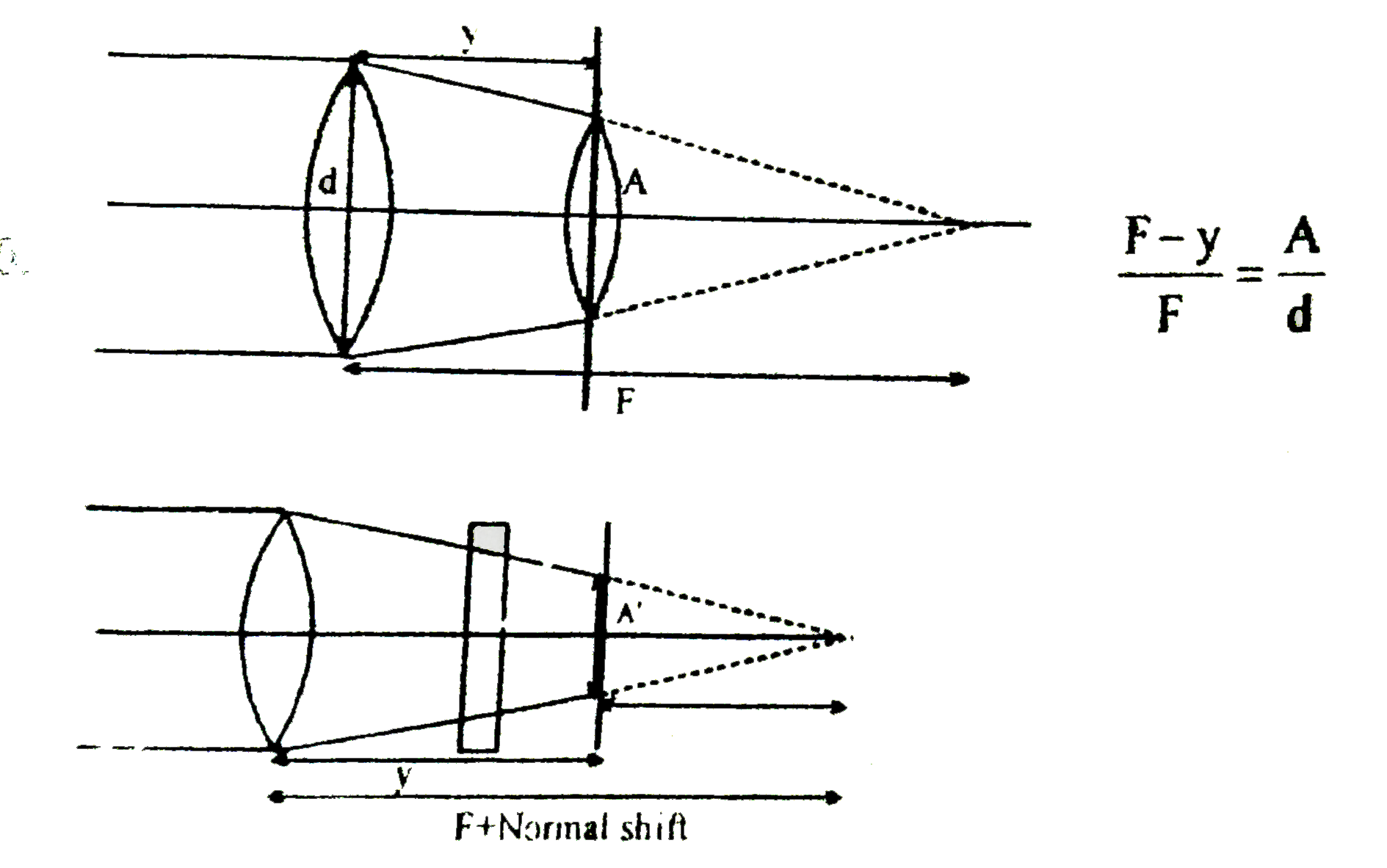 `A/(F-y)=(A')/(F-y+h(1-1/n))` `A'=A[1+h/(F-y)(1-1/n)]` `F-y=(AF)/d` `A'=A[1+(DH)/(AF)(1-1/n)]` `=1[1+(2xx3)/(1XX10)(1-1/1.5)]=1.2 CM = 12mm` 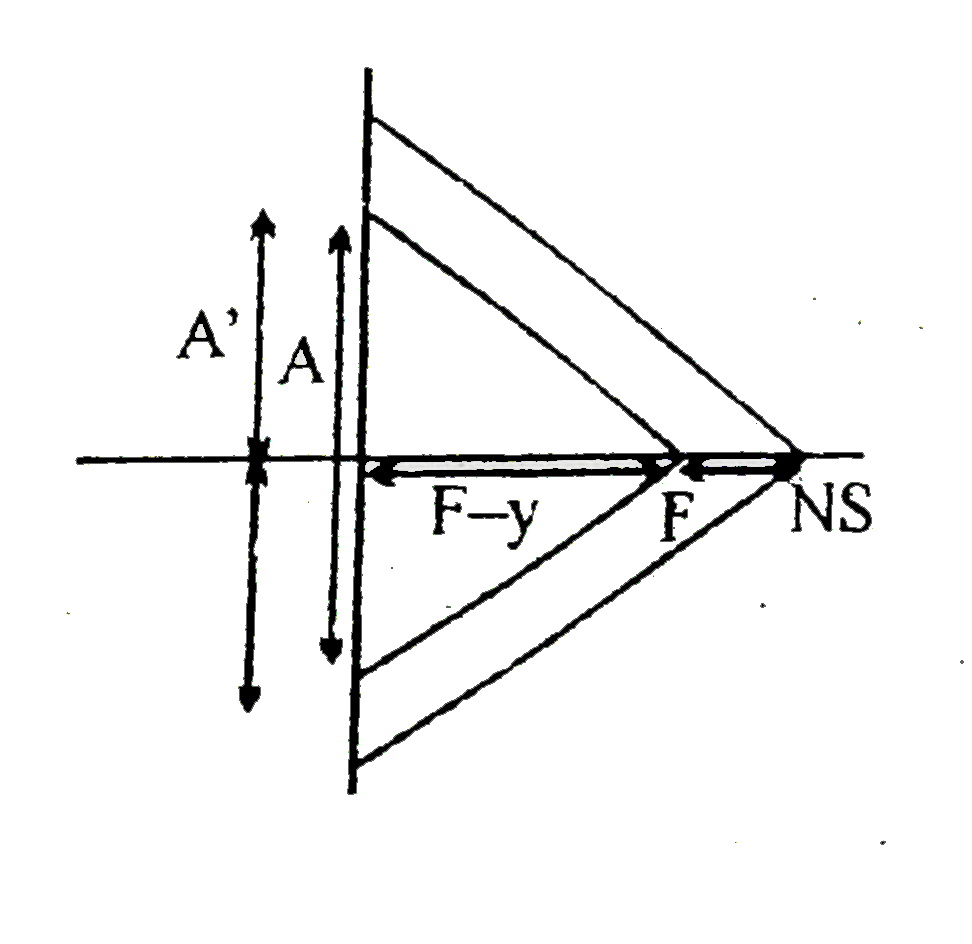
|
|
| 7773. |
In Young.s double slit experiment both the slits are similar. If width of one of the slits is doubled then |
|
Answer» dark FRINGES become narrower |
|
| 7774. |
A hollowing metallic sphere of radius 10cm is charged such that potential on its surface is 80V. the potential at the center of the sphere would be. |
|
Answer» 80 V |
|
| 7775. |
A long silver teaspoon is placed in a cup filled with hot tea. After some time, the exposed end (the end which is not dipped in tea) of the spoon becomes hot even without direct contact with the tea. This phenomenon can be explained mainly by |
|
Answer» CONDUCTION |
|
| 7776. |
The binding energy per nucleon for deuteron (""_(1)^(2)H)" helium "(""_(2)^(4)He) are 1.1MeV and 7.0 MeV. The energy released when deuterons fuse to form a helium nucleus is: |
|
Answer» 2.3 MeV `B.E. of ""_(1)^(2)H=1.1 xx 2=2.2 MeV` ENERGY RELEASED `=29.0-(2 xx 2.2) =23.6 MeV` |
|
| 7777. |
A body is thrown horizontally from the top of a tower of 5m height. It touches the ground at a distance of 10m from the foot of the tower. Then initial velocity of the body is |
| Answer» Answer :C | |
| 7778. |
Resultant of two vectors of magnitudes P and Q is of magnitude 'Q'. If the magnitude of vecQ is doubled now the angle made by new resultant with vecP is |
|
Answer» `30^(@)` |
|
| 7780. |
The capacitor shown has square plates of side L and has gap d between the photos. In the dielectricconstantof the materiale of the slab is k , the capacitance of the capacitor is |
|
Answer» `C_(EQ)=(epsilon_(0)L^2(1+2K))/(d(1+K))` |
|
| 7781. |
The period of a body under S.H.M. is represented by TpropP^(a)D^(b)S^(c), where P is the pressure, D is the density and S is surface tension then the values of a,b and c are : |
|
Answer» `1,2,(1)/(3)` `M^(0)L^(0)T^(1)PROP[ML^(-1)T^(-2)]^(a)[ML^(-3)]^(b)[ML^(0)T^(-2)]^(C)` `M^(0)L^(0)TpropM^(a+b+c)L^(-a-3b)T^(-2a-2c)` Comparing dimensions on both SIDES, `a+b+c=0…(i)` `-a-3b=0…(ii)` `-2a-2c=1…(iii)` `(ii)+3(i)` gives `2a+3c=0`...`(iv)` Now `(iii) + (iv)` gives `c=1` `:.-2a-2xx1=1impliesa=-3//2` from `(i),-(3)/(2)+b+1=0impliesb=(1)/(2)` `:.` The correct CHOICE is `(b)`. |
|
| 7782. |
Obtain the dimensional formula for magnetic flux density or magnetic induction |
| Answer» SOLUTION :`F = BIL, B= F/IL = (MLT^-2)/(AL) = A ^-1MT^-2` | |
| 7783. |
If a car covers 2/5 the of the total distance with V_(1) speed and 3//5^(th) distance with V_(2) then average speed is |
|
Answer» `(1)/(2)sqrt(V_(1)V_(2))` |
|
| 7784. |
A wheel with 8 metallic spokes is 50 cm long is rotated with the speed of 120 rev/min in a plane normal to the horizontal component of the earth magnetic field. The Earth's magnetic field at the place of 0.4 G and the angle of dip is 60^(@). Calculate the emf induced between the axel and the rim of the wheel. How will the value of emf be affected if the number of spokes were increased. |
|
Answer» Solution :`H = B cos theta = 0.4 cos 60^(@)` `= 0.2 G = 0.2 xx 10^(-4)T` This component is parallel to the plane of the wheel. Thus, the emf induced is `E = (1)/(2) Bl^(2) omega`, where `omega = (2pi N)/(t)` `:. E = (1)/(2) xx 0.2 xx 10^(-4) xx (0.5)^(2) xx (2 xx 3.14 xx 120)/(60)` `= 3.14 xx 10^(-5) V`. The VALUE of emf will not be affected if number of spokes were increased. |
|
| 7785. |
A short bar magnet placed with its axis at 30^@ with an external field of0.25 T experiences a torque of magnitude to 4.5xx10^(-2)J . What is the magnitude of magnetic moment of the magnet ? |
|
Answer» SOLUTION :`theta=30^@, B = 0.25T, tau=4.5xx10^(-2)J, ""m=? ""tau=mBsintheta` `:.m=tau/(BSINTHETA)=(4.5xx10^(-2))/(0.25xxsin30^@)=(4.5xx10^(-2)xx2)/(0.25)=36.0xx10^(-2)=0.36Am^2(" or" JT^(-1))` |
|
| 7786. |
A uniform non-conducting rod of mass m and length l has linear charge densities+lambda and -lambda on its two halves, as shown in the figure. It is hinged at its midpoint, so that it can rotate freely about the mid-point in a uniform electric field E parallel to X-axis. The rod is rotated by a small angle theta(lt 4^(@)) and released. Calculate the time period of small oscillations of the rod. |
|
Answer» Solution :The torque DUE to the electrostatic force on a length dx of the rod at point A (about point O), `d tau_(1)=x(dF_(1))sin theta=x lambda dx E sin theta` Similarly, torque due to the electrostaticforce on a length dx of the rod at point B (about point O), `d tau_(2)=x(dF_(2)) sin theta=x lambda dx E sin theta` 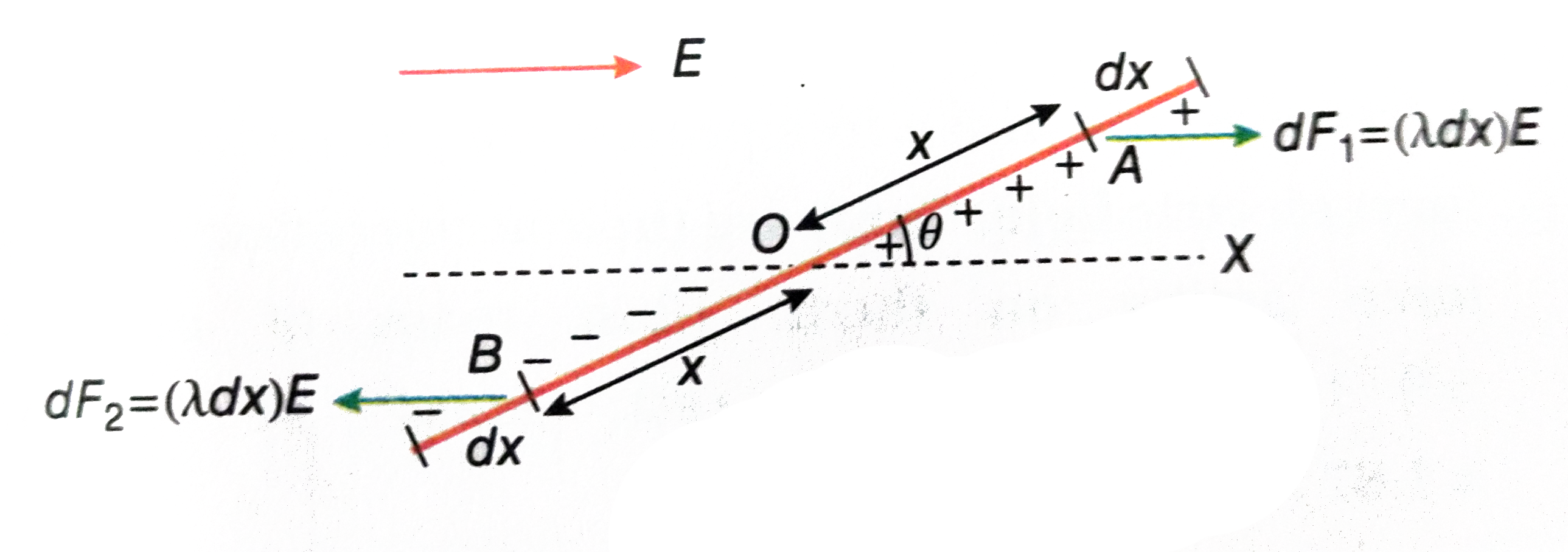 `therefore` Net torqueon the rod, `tau=int_(0)^((l)/(2))d tau_(1)+int_(0)^((l)/(2))d tau_(2)` `=2 int_(0)^((l)/(2))E lambda dx x sin theta""[ d tau_(1)=d tau_(2)]` `=2E lambda theta =int_(0)^((l)/(2))x dx""[ because theta" is small," sin theta~~theta]` `therefore tau=(E lambda l^(2))/(4)theta""`...(1) In this case moment of intertia of rod, `I=(ml^(2))/(12)` `therefore tau =I ALPHA =(ml^(2))/(12)alpha""`...(2) Fromequations (1) and (2) we get, ` (ml^(2))/(12)alpha=(E lambda l^(2)theta)/(4) or, alpha=(3E lambda )/(m) theta` `therefore ` Time period of oscillationsof the rod, `T=2PI sqrt((theta)/(alpha))=2pi sqrt((m)/(3E lambda))` |
|
| 7787. |
Two particles of mass m each are rotating parallel to xz plane in circle of radius R as shown. They are connected by a mass less rod of length 2sqrt(2) R as shown. Consider the situation when the particles are at (R, R,0) and (-R, -R, 0). Neglect gravity and any kind of friction. Answer following questions Choose the correct statement |
|
Answer» The y-component of the total torque ACTING on the system is non-zero 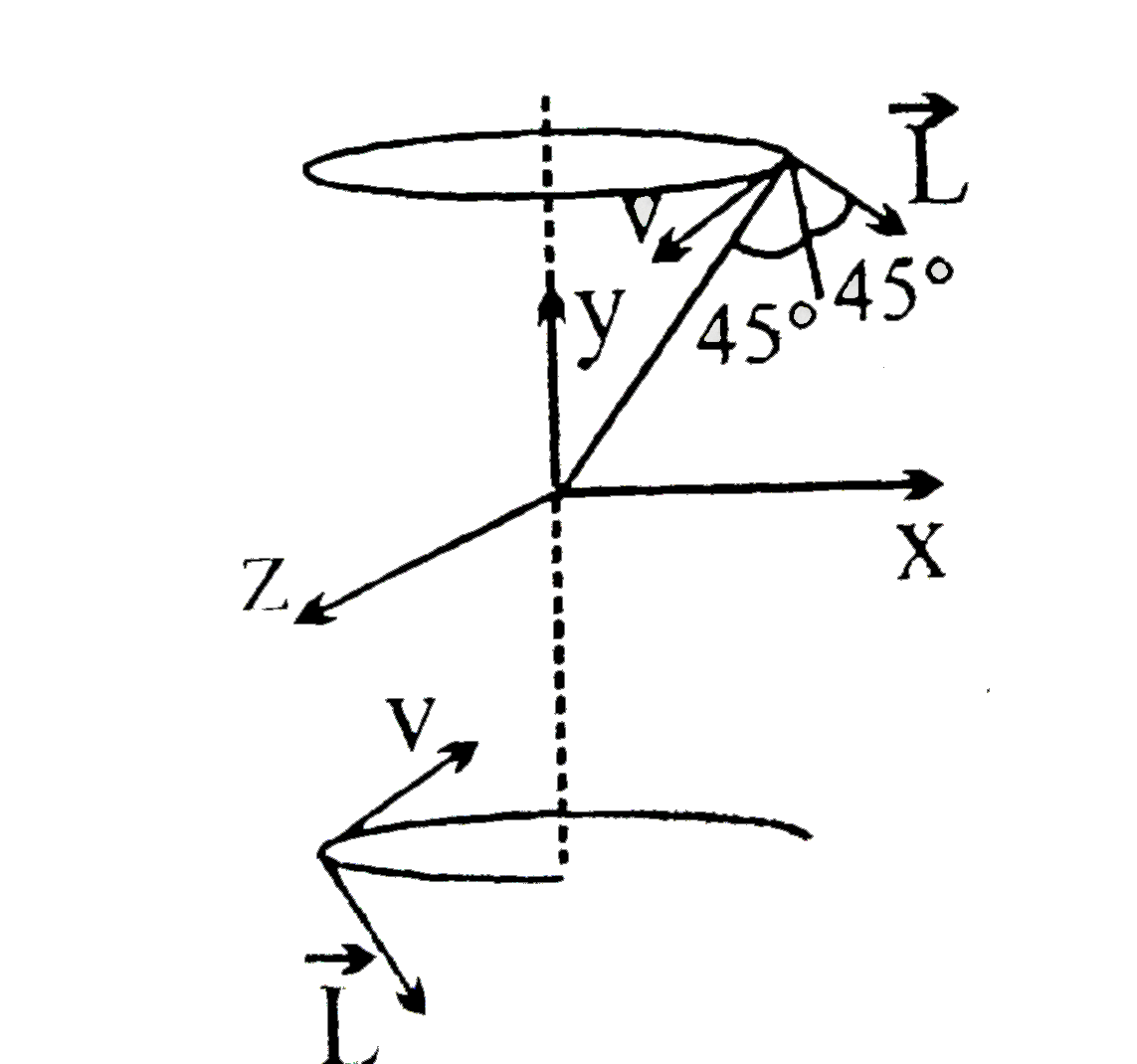 L at this instant is along x direction & rotates in xz PLANE `rArr Deltavec(L)` rotates in xz plane |
|
| 7788. |
An electric field is acting vertically upwards . A particle of mass 1 mg and charge -1 mu C is projected with a velocity 20m//s at an angle 45^(@) with the horizontal . Its horizontal range is 10 m, then the intensity of electric field is (g= 10 m//s^(2)) |
| Answer» Answer :C | |
| 7789. |
Draw a plot showing the variation of (i) electric fieldE, and (ii) electric potential V with distance 'r' due to a point charge Q. |
|
Answer» Solution :(i) Electric field E at a point situated at a distance r from a given point CHARGE Q is given as : `E = 1/(4pi epsi_0). Q/r^2` (II) The electric POTENTIAL at a point varies as `V = 1/(4pi epsi_0) . Q/r` As a result, the graphical VARIATION of E as well as V with r is as being SHOWN in Fig. 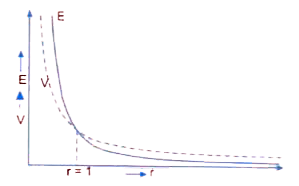
|
|
| 7790. |
A small object of height 0.5 cm is placed in front of a convex surface of glass ( mu = 1.5) of radius of curvature 10 cm. Find the height of the image formed in glass. |
| Answer» SOLUTION :1 CM, REAL, INVERTED | |
| 7791. |
Electric field given by the vector E = x hat(i) + y hat (i) is present in the XY plane. A small ring carrying charge +Q. which can freely slide on a smooth non conducting rod, is projected along the rod from the point (O,L) such that it cann reach the other end of the rod which is a at (I,O). What minimum velocity should be given to the ring ? (Assume zero gravity) |
|
Answer» `(QL^(2)//m)^(1//2)` |
|
| 7792. |
If a body coated black at 600 k surrounded by atmosphere at, 300 k has cooling rate r1the same body at 900 k surrounded by the same atmosphere , will have cooling rate equal to |
| Answer» ANSWER :A | |
| 7793. |
When a crest of one wave coincides the crest of other wave, the resultant amplitude is maximum at the point, then that point looks: |
|
Answer» DARK |
|
| 7794. |
When light travels from a rater to a denser medium. The speed decreases. Does the reduction in speed imply a reduction in the energy carried by the light wave? |
| Answer» SOLUTION :No. ENERGY carried by a wave depends on the AMPLITUDE of the wave, not on the SPEED of wave propagation. | |
| 7795. |
Speeds of two indentical cars are u and 4u at a specific instant. The ratio of the respective distances in which the two cars are stopped from that instant is : |
|
Answer» `1:1` `S=(1/2mv^2)/(mu MG)=(v^2)/(2mug)` Here,`(S_(1))/(S_2)=(u^2)/((4u)^2)=(1)/(16)`. |
|
| 7796. |
What we call to the range of energies associated with conduction electrons ? |
|
Answer» |
|
| 7797. |
The velocity-time plot for a particle moving on a straight line is shown in figure. Choose correctoptions . (##VMC_PHY_XI_WOR_BOK_01_C02_E03_026_Q01.png" width="80%"> |
|
Answer» The particle has a constant acceleration |
|
| 7798. |
A particle is moving along a circular path in xy-plane. When it crosses x-axis, it has an acceleration along the path of 1.5m//s^(2), and is moving with a speed of 10m/s in -ve y - direction. The total acceleration is |
|
Answer» `50hati-1.5hatjm//s^(2)` |
|
| 7799. |
A nucleus " "_(92)^(238)U undergoes alpha decay and transforms to thorium. What is (i) the mass number, and (ii) atomic number of the nucleus formed ? |
| Answer» Solution :The mass NUMBER of the thorium NUCLEUS formed is 238-4 = 234 and its atomic number is 92-2 = 90. | |
| 7800. |
Determine the number of density of donor atoms which have to be added to an intrisic germanium semiconductor to produce an n-type semiconductor of conductivity 5mho//cm. Given that the mobility of electrons in n-type semiconductor is 3850cm^(2)//volt-sec. |
|
Answer» Solution :Assuming `N_(D)=n_(e)` `sigma=n_(e)emu_(e)` `5xx10^(2)=n_(e)xx1.6xx10^(-19)xx3850xx10^(-4)` `n_(e)8.1xx10^(21)//m^(3)` |
|