

Saved Bookmarks
This section includes InterviewSolutions, each offering curated multiple-choice questions to sharpen your knowledge and support exam preparation. Choose a topic below to get started.
| 36701. |
A body is projected with an initial speed of 100sqrt(3) ms^(-1)at an angle of 60° above the horizontal. If g = 10 ms^(-2)then velocity of the projectile instant t = 15 sec. b) Is perpendicular to initial velocity of projection at t = 20 sec. c) Is minimum at the highest point d) Changes both in magnitude and direction, during its flight. Mark the answer as |
|
Answer» If a, B, C and d are CORRECT |
|
| 36702. |
The waves produced by a motorboat , sailing in water, are : |
|
Answer» stationary CORRECT choice is (D). |
|
| 36703. |
The number obtained on rationalising the denominator of 1/(sqrt7-2) is |
|
Answer» `(sqrt7+2)/3` |
|
| 36704. |
Find the de-Broglie wavelength of a neutron ,in thermal equilibrium with matter,having an average kinetic energy of ((3)/(2)) kT at 300 K. |
|
Answer» 0.146 nm |
|
| 36705. |
निम्नलिखित मे से कौन परिमेय संख्या है :- |
|
Answer» `2-sqrt3` |
|
| 36706. |
किसी कण का त्वरण परिवर्तित होता है, यदि |
|
Answer» वेग की दिशा बदलती है |
|
| 36707. |
If nu_(s),nu_(x) and nu_(m) are the speeds of gamma rays X- rays and microwaves respectively in vacuum then |
|
Answer» `nu_(s) GT nu_(X) gt nu_(m)` |
|
| 36708. |
Young.s double slit experiment is first performed in air and then in a medium other than air it is found that 8th bright fringe in the medium lies where 5th dark fringe lies in air. The refractive index of the medium is nearly : |
|
Answer» `1.78` |
|
| 36709. |
de-Broglie wavelength of electron in ground state is 2.116Å then its velocity will be………. ms^(-1) |
|
Answer» `0.034xx10^(8)` `:.V=(h)/(mlamda)=(6.62xx10^(-34))/(9.1xx10^(-31)xx2.116xx10^(-10))` `:.v=0.034xx10^(8)ms^(-1)` |
|
| 36710. |
SI unit of electric capacitance is: |
| Answer» Answer :C | |
| 36711. |
If the dispersion through a prism does not follow, the order given by 'VIBGYOR' what we call it ? |
| Answer» SOLUTION :ANOMALOUS DISPERSION | |
| 36712. |
Assertion: In a region where uniform electric field exists, the net charge within volume of any size is zero. Reason:The electric flux whith in any closed surface in region of uniform electric field is zero. |
|
Answer» Both ASSERTION and Reason are true and Reason is the CORRECT explanation of Assertion |
|
| 36713. |
Usually in A.C. circuit …….. |
|
Answer» average CURRENT is zero. |
|
| 36714. |
Pipe A, which is 1.80 m long and open at both ends, oscillates at its third lowest harmonic frequency. It is filled with air for which the speed of sound is 343 m/s. Pipe B, which is closed at one end, oscillates at its second lowest harmonic frequency. This frequency of B happens to match the frequency of A. An x axis extends along the interior of B, with x = 0 at the closed end. (a) How many nodes are along that axis? What are the (b) smallest and (c) second smallest value of x locating those nodes? (d) What is the fundamental frequency of B? |
| Answer» Solution :`(a) 2 NODES , (b) x = 0 , (c ) 0.60 m, (d) 95.3 Hz` | |
| 36715. |
Why do baseball catchers wear mitts rather than just using their bare hands to catch pitched baseballs? |
|
Answer» The impulse delivered to the catcher's hand is reduced DUE to the presence of the mitt. |
|
| 36716. |
An electron projected with velocity vec(v) = v_0hati in the electric field vec(E ) = E_0 hatj.Trace the path followed by the electron E_0 |
|
Answer» parabola |
|
| 36717. |
Using lens maker's formula, derive the thin less formula 1/f=1/v-1/u for a biconevex lens. |
|
Answer» Solution :Consider a point object O situated on the principal axis of a bloonvex lens, WHOSE two surfaces have radii of curvature `R_1 and R_2` respectively. As SHOWN in figure due to refraction at 1st surface of lens an IMAGE!. is formed for the object of OC = u,Cl. = v., then using the refraction formula at a single SPHERICAL surface, we have `(n_(2))/(v.)-n_(1)/u=(n_(2)-n_(1))/(R_(1))` The image I. behaves as a virtual object for refraction at the second surface of the lens and the final real image is formed at I. Thus, for second surface applying refraction formula, we have `n_(1)/v-n_(2)/(v.)=(n_(1)-n_(2))/(R_(2))=(n_(2)-n_(1))/((-R_(2))` Addng (i) and (ii), we have `n_(1)/v-n_(1)/u=(n_(2)-n_(1)) (1/R_(1)-1/R_(2))` 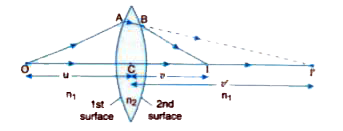 `=(n_(21)-1) (1/R_(1)-1/R_(2))` However, we know that as per lens maker.s formula `1/f=(n_(21)-1) (1/R_(1)-1/R_(2))` Comparing (iii) and (iv), we get the thin lens formula `1/f=1/v-1/u` |
|
| 36718. |
Abomb is designed to explode 2.00 s after it is armed. The bomb is launched from Earth and accelerated to an unknown final speed. After reaching its final speed, however, the bomb is observed by people on Earth to explode 4.25 s after it is armed. What is the final speed of the bomb just before it explodes (in terms of c)? |
|
Answer» |
|
| 36719. |
10^(6) positrons are flowingnormallythrough an area in forward directionand sameamountof electrons are flowing in backward directionin the interval of 10 ms. Findthe current through thearea. |
|
Answer» Solution :`q_(+) = 10^(6) xx 1.6 xx 10^(-19) C = 1.6 xx 10^(-13)C` `q_(-) = 10^(16) xx (- 1.6 xx 10^(-19) C)= - 1.6 xx 10^(-13) C` Net chargethrough THEAREA q = ` q_(+)- q_(-) = 1.6 xx 10^(-13) C- (-1.6 xx 10^(-13)C)` ` = 3.2 xx 10^(-13)C` Currentthrough thearea ` L = (q)/(t) = ( 3.2 xx 10^(-13) C)/(10 xx 10^(-13) S) = 3.2 X 10^(-11) A ` |
|
| 36720. |
Arrangethe followingcarbocationin orderofstability : |
|
Answer» `igtiigtiiigtiv` 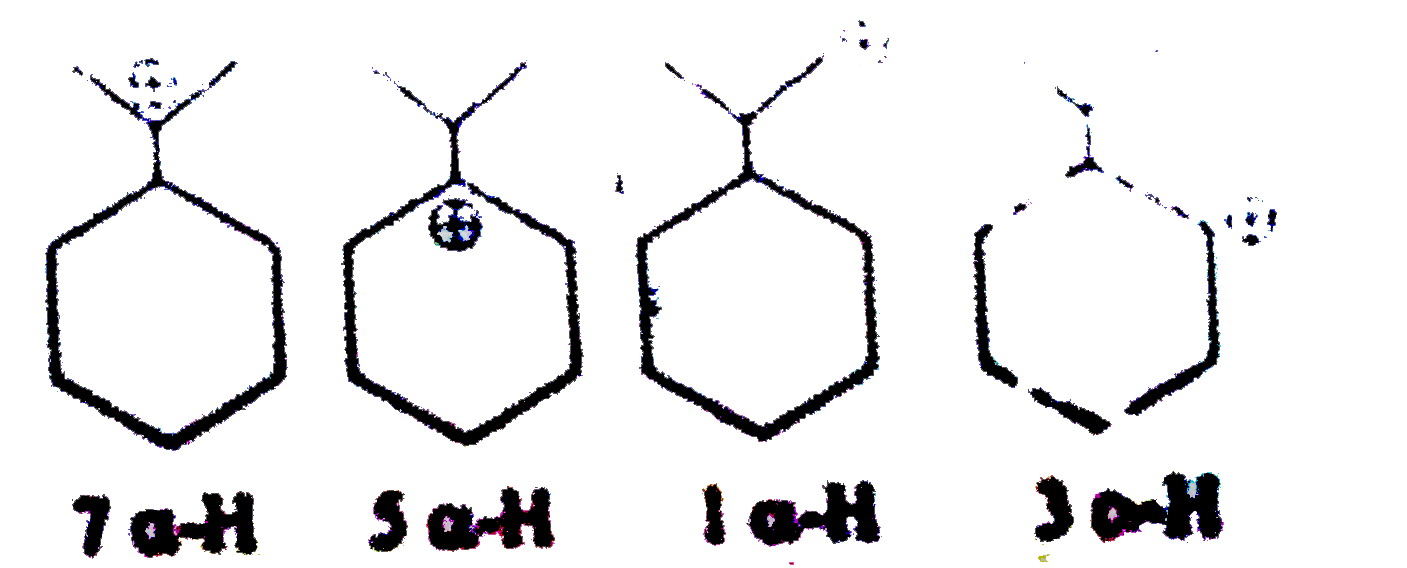
|
|
| 36721. |
Statement - I : In electrostatic electric lines of force can never be closed loops, as a line can never start and end on the same charge. Statement - II : The number of electric lines of force orginating ot terminating on a charge is proportional to the magnitude of charge. |
|
Answer» If both STATEMENT-I and Statement-II are true, and Statement-II is the correct EXPLANATION of Statement -I. |
|
| 36722. |
What we call the gaseous envelope surrounding the earth? |
| Answer» SOLUTION :Earth.s ATMOSPHERE | |
| 36723. |
The aeroplane are so designed that the speed of air. |
|
Answer» One TOP SIDE is more than on lower side |
|
| 36724. |
A : Light waves are transverse waves R : The electric field vector vecE and magnetic field vector vecB oscillates in a direction perpendicular to the velocity vector vecV |
|
Answer» Both A and R are true and R is the CORRECT explanation of A |
|
| 36725. |
When you charge a balloon by rubbing it on your hair this is example of what method of charging |
|
Answer» friction |
|
| 36726. |
The sum of the given two numbers with regard to significant figures is(5.0 xx 10^(-8)) + (4.5x10^(-6)) = |
|
Answer» `4.55 XX 10^(-6)` |
|
| 36727. |
Ultraviolet light of wavelength 2271 Å from a 100 W mercury source irradiates a photo-cell made of molybdenum metal. If the stopping potential is -1.3 V, estimate the work function of the metal. How would the photo-cell respond to a high intensity (~10^(5) W m^(2)) red light of wavelength 6328 Å produced by a He-Ne laser ? |
| Answer» SOLUTION :`phi_(0)=hv-eV_(0)=6.7xx10^(-19)J=4.2eV,v_(0)=(phi_(0))/(h)=1.0xx10^(15)HZ, lambda=6328Å` CORRESPONDS to `v=4.7xx10^(14)Hz lt v_(0)`. The photo - CELL will not respond howsoever high be the intensity of laster LIGHT. | |
| 36728. |
A square loop of side 10 cm and resistance 0.5 Omega is placed vertically in the east-west plane. A uniform magnetic field of 0.10 T is set up across the plane in the north-east direction. The magnetic field is decreased to zero in 0.70 s at a steady rate. Determine the magnitudes of induced emf and current during this time-interval. |
|
Answer» Solution :The angle `theta`made by the area vector of the coil with the magnetic FIELD is `45^@` . From EQ. (6.1), the initial magnetic flux is `Phi = BA cos theta` `=(0.1xx10^(-2))/(sqrt2)WB` Final flux, `Phi_(min)=0` The CHANGE in flux is brought about in 0.70 s. From Eq. (6.3), the magnitude of the INDUCED emf is given by `epsi =(|DeltaPhi_(B)|)/(Deltat) = (|Phi-0|)/(Deltat) = (10^(-3))/(sqrt2 xx 0.7) = 1.0 m V` And the magnitude of the current is `I = epsi/R = (10^(-3)V)/(0.5 Omega) = 2mA` Note that the earth’s magnetic field also produces a flux through the loop. But it is a steady field (which does not change within the time span of the experiment) and hence does not induce any emf. |
|
| 36729. |
The given circuit has two ideal diodes connected as shown in figure below. Calculate the current flowing through the resistance R_(1) |
|
Answer» Solution :Diode `D_1` is reversebiasedso , it will block the CURRENT and Diode `D_2` is forwardbiased , SOIT will pass the current . Current in the circuitis `I=(V)/(R_s)=(10)/(2+2) = (10)/(4) = 2.5A` `I=2.5 A ` |
|
| 36730. |
A parallel plate capacitor having capacitance C Farad is connected with a bettery of emf V volts. Keeping the capacitor connected with the bettery, a dieletric slab of dielectric consutant K is inserted between the plates. The dimensions of the slab are such that it fills the space between the capacitor plates, consider the following sttements (i) Potential difference between the capacitor plated remains the same (ii) The capacitance increases by a factor K (iii)The energy stored increases by a factor K Then the correct statements are |
|
Answer» (i),(ii) `therefore` V=constant `C=(epsi_(0)KA)/(d)` `C prop K` `U=(1)/(2)CV^(2)` `U prop C` `U prop K` |
|
| 36731. |
(a) Obtain the expression for the magnetic energy stored in a solenoid in terms of magnetic field B, area A and length l of the solenoid. (b) How does this magnetic energy compare with the electrostatic energy stored in a capacitor? |
|
Answer» SOLUTION :When a current is established in a solenoid (coil), work has to bedone against the BACK emf. This work done is stored in the form of magnetic energy in the coil. For a current I in the coil, the rate of work done (power) is : `P = (DW)/(dt) = |EPSILON|` I (since power `P=VI` ) But we know that , `epsilon = L (dI)/(dt)` Therefore, `(dW)/(dt) = L I (dI)/(dt) rArr dW = LI dI` Therefore, the total work done in establishing a current I is given by `W = int d W = int_(0)^(1) L I d I = ""_(1//2)LI^(2)` This work is stored in the coil in the form of magnetic potential energy, `U= 1/2 L I^(2)` |
|
| 36732. |
A card sheet divided into squares eachof size "1 mm"^(2) is being viewed at a distance of 9 cm through a magnifyingglass (a converging lens of focal length 9 cm) held close to the eye. Is the magnification in (a) equal to the magnifying power in (b) ? Explain. |
| Answer» SOLUTION :c) No, MAGNIFICATION in (a) which is `(upsilon//u)` cannot be equal to magnifying power in (b) which is (dlu) unless V = d ie., IMAGE is located at the least distance of distinct vision. | |
| 36733. |
A wheel with 10 metallic spokes each 0.5 m long is rotated with a speed of 120 rev/min in a plane normal to the horizontal component of earth’s magnetic field H_Eat a place. If H_E= 0.4 G at the place, what is the induced emf between the axle and the rim of the wheel? Note that 1 G = 10^(-4) T. |
|
Answer» SOLUTION :INDUCED EMF `= 1/2 omega B R^(2)` `=1/2 xx 4 pi xx 0.4 xx 10^(-4) xx (0.5)^(2)` `=6.28 xx 10^(-5)V` The NUMBER of spokes is immaterial because the emf.s ACROSS the spokes are in parallel. |
|
| 36734. |
How are microwaves produced ? Why is it necessary in microwave ovens to select the frequency of microwaves to match the resonant frequency of water molecules ? |
|
Answer» Solution :Microwaves are PRODUCED by special vacuum tubes LIKE the klystron, / Magnetron / Gunn DIODE. The FREQUENCY of microwaves is selected to match the resonant frequency of WATER molecules, so that energy is transferred efficiently to the kinetic energy of the molecules. |
|
| 36735. |
A body of mass 2 kg moving with a velocity of 6 m/s strikes inelastically another body of same mass at rest . The amount of heat evolved during collision is |
| Answer» Answer :B | |
| 36736. |
A monochromatic light is incident on asequallateral prism at an angle 30^(@) and emerge at an angle of 75^(@). What is the angle of deviation produced by the prism? |
|
Answer» Solution :Give: as the prism is equilateral. `A = 60^(@) , l_(1) = 30^(@) , l_(2) = 75^(@)` Equation for ANGLE of DEVIATION, `d = l_(1) + l_(2) - A` SUBSTITUTING the VALUES, `d = 30^(@) + 75^(@) - 60^(@) - 45^(@)` The angle of deviation produced is, `d - 45^(@)` |
|
| 36737. |
Obtain an equation of current for AC voltage applied to an inductor and draw a graph of V and I. |
Answer» Solution :In figure shows an AC source connected to an inductor.  Inductor has negligible resistance. Thus, the CIRCUIT is a purely INDUCTIVE AC circuit. Let the voltage across the source be `V= V_(m) sin omega t ` . Using the Kirchoff.s loop rule, `V - L (dI)/(dt ) = 0 ` where `- L (dI )/(dt)` is the self induced emf. `:. V = L ( dI )/( dt ) ` ` :. (dI)/(dt) = ( V )/( L )` But `V = V_(m) sin omega t ` `:. ( dI )/( dt ) = ( V_(m) sin omega t )/( L )` `:. dI = ( V _(m))/( L ) sin omega dt `.....(1) where L is the self inductance. Equation (1) indicates that current I ( t) as a function of time,must be such that its slope `(dI)/(dt)` is sine an sinusoidally varying quantity with the same phase as the source voltage and an amplitude given by `(V_(m))/( L )`. To obtain the current integrate equations (1) with respective to time, `:. int dI = (V_(m))/( L ) int sin omega t dt ` `:. I = ( V_(m))/( L )XX ( cos omega t )/( omega ) +` constant....(2) Here, integration constant has the dimension of current and is time INDEPENDENT At t=0, time I = 0 `:.` 0 `+` constant `:.` Constant =0 `:.` From equation (2), `:. I = - (V_(m))/( L omega ) cos omega t ` `:. I = ( V_(m))/( omega L ) sin ( omega t - ( pi )/( 2)) [ :. - cos omega t = sin ( omega t - ( pi )/( 2))]` `omega L` is called inductive reactance denoted by `X_(L)`. `:. X_(l) = omega L ` and its unit is Ohm. The inductive reactance limits the current in a purely inductive circuit in the same way as the resistance limits the current in a purely resistivecircuit. The inductive reactance is directly proportional to the inductance and frequency of the current. Hence , for the source voltage and the current in an indeuctor `V = V_(m) sin omega t ` and `I = I _(m) sin( omega t - ( pi )/( 2))` . This shows the that hte current lags the voltag by `( pi )/(2)` or one -quarter `((1)/(4))` cycle. In this case figure (a) shows that voltage and current phasors in the presentcase at instant `( t_(1))`.  The current PHASOR I is `( pi )/(2)` behind the voltage phasor V. ( Lags) `( pi )/(2) = ( T )/( 4):. ( pi )/( 2) = ( T )/( 2pi )xx ( 2pi )/( 4) = (( pi )/( 2))/( omega ) = ( pi )/( 2 omega )` When rotated with frequency `omega ` counter clockwise, they generate the voltage and current given by `V = V_(m) sin omega t ` and `I = I _(m) sin ( omega t - ( pi )/( 2))` respectively and as shown by figure (b). This graphs is for V and I versus `omega t `. |
|
| 36738. |
An object is placed at the focus of convex mirror. The image will be at |
|
Answer» `c` 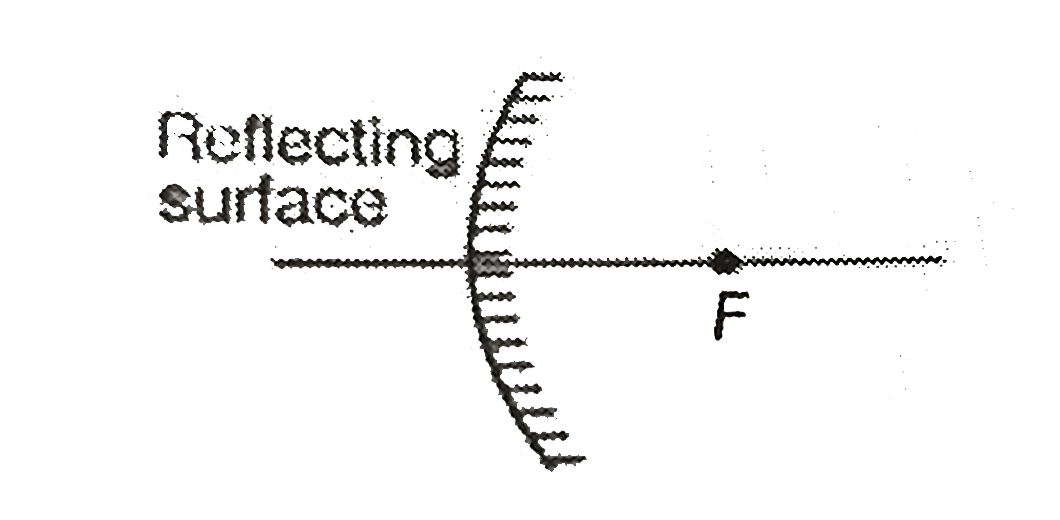
|
|
| 36739. |
In the shown wire frame, each side of a square (the smallest square) has a resistance R. The equivalent resistance of the circuit between the points A and B is |
|
Answer» R 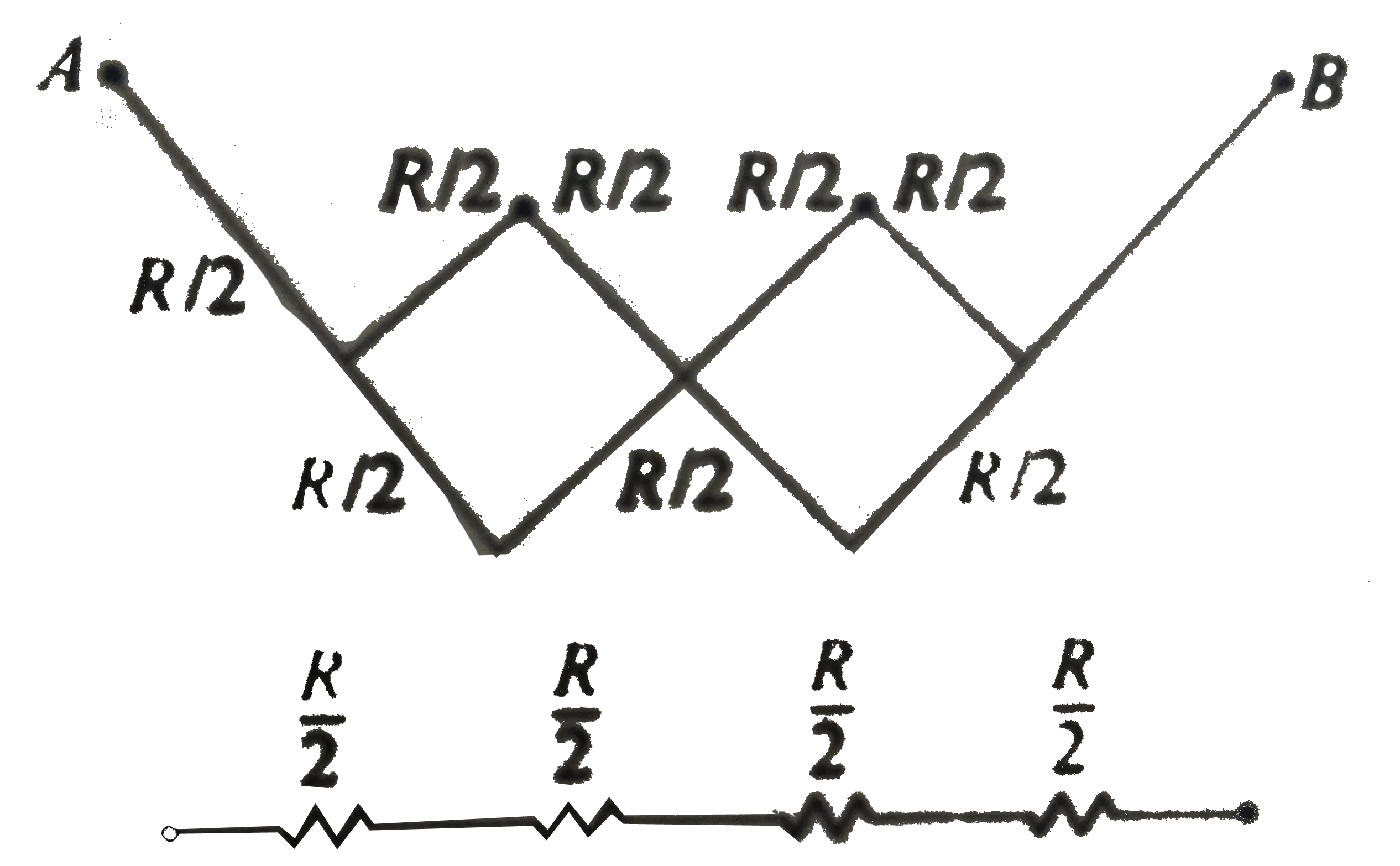 . . Hence, the EQUIVALENT resistance between A and B is 2R. |
|
| 36740. |
If photo-electric effect is not seen with the ultraviolet radiation ina given metal ,photo-electrons may be emitted with the…… |
|
Answer» infrared waves |
|
| 36741. |
The half-life of ""_(92)^(238)U undergoing alpha-decay is 4.5 xx 10^9 years. What is the activity of 1g sample of ""_(92)^(238)U ? |
|
Answer» Solution :`T_(1//2) = 4.5 xx 10^9 y = 4.5 xx 3.16 xx 10^7 s//y` `= 1.42 xx 10^(17) s` One k mol of any isotope CONTAINS Avogadro.s number of atoms, and so 1g of `""_(92)^(238)U` contains `1/(238 xx 10^(-3)) kmol xx 6.025 xx 10^(26) "atom"//kmol = 25.3 xx 10^(20) "atoms"` The decay rate R is `R = lambda N = (0.693)/(T_(1//2)) N` `= (0.693 xx 25.3 xx 10^(20))/(1.42 xx 10^(17)) s^(-1) = 1.23 xx 10^4 s^(-1) = 1.23 xx 10^4 BQ`. |
|
| 36742. |
The work function of caesium is 2.14 eV. Find (a) the threshold frequency for caesium, and (b) the wavelengthof the incident light if the photocurrent is brought to zero by a stopping potential of 0.60 V. |
|
Answer» Solution :a. For the cut-off or THRESHOLD frequency,the energy `h upsilon_(0)` of the incidentradiation must be equal to work function `phi_(0)`, so that `upsilon_(0)=(phi_(0))/(h)=(2.14)/(6.63xx10^(-34))=(2.14xx1.6xx10^(-19))/(6.63xx10^(-34))=5.16xx10^(14)H_(z)` Thus, for frequencies less than this threshold frequency, no photoelectrons are ejected. b. Photocurrent reduces to zero, when maximum kinetic energyof the emitted photoelectrons equals the potential energye `V_(0)` by the retarding potential `V_(0)`. Einstein.s Photoelectric equation is, `eV_(0)=h upsilon-phi_(0)=(hc)/(LAMBDA)-phi_(0) or, lambda=hc//(eV_(0)+phi_(0))` `=((6.63xx10^(-34))xx(3xx10^(8)))/((0.60+2.14))=(19.89xx10^(-26))/((2.74))` `lambda=(19.89xx10^(-26))/(2.74xx1.6xx10^(-19))=454nm` |
|
| 36743. |
Derive lens maker's formula for a thin biconvex lens. |
|
Answer» Solution :Lens maker.s formula for biconvex lens Sign Conventions 1. All the distances are measured from the optical CENTRE of lens. 2. Distance measured in the DIRECTION of incident light is + ve. 3. Distance measured in the direction opposite to the direction of incident light is negative. Assumptions 1. OBJECT is a point object. 2. Lens is thin so that distances are measured fromthe poles of its surfaces. 3. The aperture of the lens is small. 4. Angles of incidence and refraction are small. Let `C_(1)` and `C_(2)` be centres of curvature of two SPHERICAL surfaces ABC and ADC with optical centre C. Let `mu_(1)` be the refractive index of the material of the lens and `mu_(1)` that of the medium surrounding the lens where `mu_(2) gt mu_(1)`. Consider a point object O lying on the principal axis of the lens. Refraction at the surface ABC. A ray of light `OAL_(1)` starting from O strikes the surface ABC at `A_(1)` with `A_(1)C_(1)` is a normal. On refraction it bends towards the normal and proceeds along `A_(1)I_(1)`. Another ray OB starting from O and incident at B, passes through optical centre C. If the lens material were continuous, the two refracted rays would actually meet at `I_(1)`. Thus `I_(1)`, would be the real image of the point object. 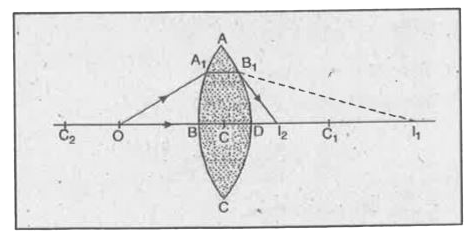 Applying spherical equation for surface ABC `(mu_(1))/(OB)+(mu_(2))/(BI_(1))=((mu_(2)-mu_(1)))/(BC_(1))` ...(1) This image `I_(1)`, acts as an object for spherical interface ADC and thus final image `I_(2)` is formed. `I_(2)` is the effective position of the image CORRESPONDING to the lens ABCD as a whole. `:.` For surface ADC, `-(mu_(2))/(DI_(1))+(mu_(1))/(DI_(2))=((mu_(2)-mu_(1))/(DC_(2)))` But `DI_(1)~~BI_(1)` (`:.` lens is thin) `-(mu_(2))/(DI_(1))+(mu_(1))/(DI_(2))=[(mu_(2)-mu_(1))/(DC_(2))]` ...(2) Adding (1) and (2), we get `(mu_(1))/(OB)+(mu_(1))/(DI_(2))=(mu_(2)-mu_(1))((1)/(BC_(1))+(1)/(DC_(2)))` If O is at infinity [i.e. `OB=infty`] the image will be formed at principal focus, [i.e. `DI_(2)=f`] `(mu_(1))/(f)=(mu_(2)-mu_(1))((1)/(BC_(1))+(1)/(DC_(2)))` ...(3) Applying new cartesian sign conventions, we get `BC_(1)=R_(1)` and `DC_(2)= -R_(2)` So Eq. (3) becomes `(mu_(1))/(f)=(mu_(2)-mu_(1))((1)/(R_(1))-(1)/(R_(2)))` or `(1)/(f)=((mu_(2))/(mu_(1))-1)((1)/(R_(1))-(1)/(R_(2)))` or `(1)/(f)=(mu-1)((1)/(R_(1))-(1)/(R_(2)))` where `mu=(mu_(2))/(mu_(1))`, and is called relative refractive index of lens w.r.t. surroundings. |
|
| 36744. |
The eccentricity of earth's orbit is 0.017. The ratio of the maximum speed in its orbitto its minimum speed is : |
|
Answer» 1.034 THUS correct CHOICE is (a). |
|
| 36745. |
Current I is following through a toroidal solenoid of radius r, length l and area A. If the number of turns of toroidal solenoid is N, then energy stored in the toroidal solenoid is ….. |
|
Answer» `1/2 (mu_0N^2 A I^2)/(PIR)` But for toroid `l=2pir` `therefore U=1/2xx(mu_0N^2 AI^2)/(2pir)` `therefore U=1/4 XX (mu_0N^2AI^2)/(pir)` |
|
| 36746. |
In a circuit, assuming voltmeter to be an ideal one, what will happen if the student interchanges the position of the voltmeter and ammeter? |
| Answer» SOLUTION :No CURRENT flows, because an ideal voltmeter has infinite RESISTANCE. | |
| 36747. |
Sun is about 330 times heavier and 100 times bigger in radius than earth. The ratio of mean density of the sun to that of earth is |
|
Answer» `3.3xx10^(-6)` `:. (rho_(s))/(rho_(e ))=(M_(s))/(M_(e ))XX(R_(e )^(3))/(R_(s)^(3))=330xx((1)/(100))^(3)=3.3xx10^(-4)`. |
|
| 36748. |
What is an AC waveform? |
| Answer» Solution :A GRAPH of AC voltage VERSUS TIME is called an AC waveform. | |
| 36749. |
A student measure the distance traversed in freely fall of a body initially at rest in a given time. He uses this date to estimate the accele ration due to gravity (g). If the maximum percentage error in measurement of the distance and the time are e_(1) and e_(2) respectively. the percent age error in the estimation of g is |
|
Answer» `e_(1) + 2e_(2) ` |
|
| 36750. |
Ina Carnot engine, the temperature of the reservoir is 927^@C and that of the sink is 27^@C. The work done by the engine when it transfers heat from the reservoir to the sink is 12.6xx10^6J What is the quantity of heat absorbed by the engine from the reservoir? |
|
Answer» `16.8xx10^6J` |
|