

Saved Bookmarks
This section includes InterviewSolutions, each offering curated multiple-choice questions to sharpen your knowledge and support exam preparation. Choose a topic below to get started.
| 36751. |
When a battery is connected across series connection of two unequal resistances. |
|
Answer» CURRENT passing through both the resistances WOULD be EQUAL. It is the speciality of series connection of resistors, OBTAINED from law of conservation of electric charge. |
|
| 36752. |
A vehicle of mass 20kg is moving with a velocity of 4ms! Find the magnitude of the force that is to be applied on the vehicle so that the vehicle have a velocity of lms after travelling a distance of 20m. |
|
Answer» |
|
| 36753. |
A metal ball of mass 2 kg moving with a velocity of 36 km./h has a head on collision with a stationary ball of mass 3 kg. If after the collision the two balls move together, the loss in K.E. due to collision is : |
|
Answer» 140 J `m_(1)v_(1)+m_(2)v_(2)=(m_(1)+m_(2))V` `implies 2xx10+0-(2+3)vimpliesv=4 m//s` `:.` LOSS in K.E. = INITIAL K.E. - Final K.E. =`1/2m_(1)u^(2)-1/2(m_(1)+m_(2))v^(2)` =`1/2xx2xx100-1/2xx5xx16=100-40=60 J`. |
|
| 36754. |
A gun is mounted on a stationary rail road car. The mass of the car, the gun, the shells and the operator is 50 m, where m is the mass of one shell. Two shells are fired one after the other along same horizontal line in same direction. If the muzzle velocity of the shells is 200 m/s, then find the speed of the car after second shot. |
|
Answer» Solution :Let `vec(u)` be the muzzle velocity of the SHELL and `vec(v)` be the velocity of the car after first shot. `p_(i)=0 ""`(1) [initial momentum of the system] `p_(f)=49 m vec(v)+m(vec(u)+vec(v))""`(2) [final momentum of the system] `because p_(i)=p_(f)` `rArr 50 m vec(v)+m vec(u)=0` `rArr vec(v)=-(vec(u))/(50) ""`(3) Negative sign SHOWS that `vec(u)` and `vec(v)` are oppositely directed. For the second shot, before second shot momentum of the system is `p_(1).=49 m vec(v)""`(4) If `vec(v).` be the velocity of the car after second shot then `p_(f). = 49 m vec(v)+m vec(u)""` (5) From COM we get `49 vec(v).+vec(u)=49vec(v)` `rArr 49 vec(v).=49 vec(v)-vec(u)=-(49)/(50)vec(u)-vec(u)` as`vec(v)=-(vec(u))/(50)` `rArr vec(v).=-vec(u)((1)/(50)+(1)/(49))` |
|
| 36755. |
When a soccer ball is kicked toward a player and the player defiects the ball by " iteading" it, the acceleration of the head during the collision can be significant. Figure 2-23 gives the measured acceleration a(t) of a soccer player'shead for a bare head and a helmeted head, starting from rest. the scaling on the vertical axis is set by a_(s)=200m//s^(2). At time t=7.0 ms, what is the difference in the speed acquired by the bare head and the speed acquired by the helmeted head ? |
|
Answer» |
|
| 36756. |
A potentiometer wire has resistance of 10 ohms. A resistance box with a resistance 19990 ohm is connected in series with the wire. The emf of the battery in the primary circuit is 2V. A thermo couple produces 2mV for a temperature difference 1^@ C between its jucntion. When the hot junction is at 200°C and cold junction at 0^@ C, can the thermo emf be balanced on the potentiometer wire? |
|
Answer» THERMO EMF is balanced |
|
| 36757. |
If the position vector of a particle is vecr=(3hati+4hatj) meter and Its angular velocity is vecomega(hatj+2hatk) rad/sec then find its linear velocity(in m/s)? |
| Answer» SOLUTION :`vecv=vecomegaxxvecr=(3hati+4hatj+0hatk)XX(0hati+hatj+2hatk)=8hati-6hatj+3hatk`. | |
| 36758. |
Explain why, the Earth without its atmosphere would be inhospitably cold. |
| Answer» Solution : Average SURFACE temperature will be LOWER. Because there will be no green HOUSE effect in absence of ATMOSPHERE. | |
| 36759. |
Obtain the macrscopic form of Ohm's law form its microscopic form and discuss its limitation. |
Answer» Solution :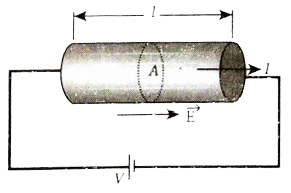 Ohm.s law: The Ohm.s law can be derived from the equation `J=sigma E`. Consider a SEGMENT of WIRE of length `l` and cross sectional AREA A. When a potential difference V is APPLIED across the wire, a net electric field is created in the wire which constitutes the current. For simplicity, we assume that the electric field is uniform in the entire length of the wire, the potential difference (voltage V) can be written as `V=El` As we know, the magnitude of current density `J=sigmaE=sigma (V)/(l)"" ...(1)` But `J=(I)/(A)`, so we wire the equation as `(I)/(A)=sigma(V)/(l)` by rearranging the above equation, we get `V=I((l)/(sigmaA))"" ...(2)` The QUANTITY`(l)/(sigmaA)` is called resistance of the conductor and it is denoted as R. Note that the resistance is directly proportional to the length of the conductor and inversely proportional to area of cross section. Therefore, the macroscopic form of Ohm.s law can be stated as `V=IR""...(2)` |
|
| 36760. |
A P-N photo diode is fabricated from a semiconductor with a band gap of 2.5eV.The signal wavelength is |
|
Answer» `6000overset@A` |
|
| 36761. |
A force of 200N is required to keep an object sliding at a constant speed of 2 m/s across a rough floor. How much power is being expended to maintain this motion? |
| Answer» Solution :Using the EQUATION `P=Fv`, we find that P=(200N)(2m/s)=400W. | |
| 36762. |
(A): The force of repulsion between atomic nucleus and a-particle varies with distance according to inverse square law. (R) : Rutherford did a-particle scattering experiment. |
|
Answer» Both .A. and .R. are true and .R. is the CORRECT EXPLANATION of .A. |
|
| 36763. |
A car is driven round a curved path of radiu 18 m without the danger of skidding. The coefficient of friction between the tyres of the car and the surface of the curved path is 0.2. What is the maximum speed in kmph of the car for safe driving ? (g=10 ms^(-2)) |
|
Answer» SOLUTION :Maximum speed.`v=SQRT(mu_(s)gr)` `v=sqrt(0.2xx10xx18)=sqrt(36)=6ms^(-1)` |
|
| 36764. |
Two light sources of intensities I and 4I are used to make interference pattern on a screen. What will be ratio of maximum to minimum intensity on the screen ? {:(0,1,2,3,4,5,6,7,8,9):} |
|
Answer» |
|
| 36765. |
Manifestation of band structure in solids is due to : |
|
Answer» Pauli's EXCLUSION principle |
|
| 36766. |
A forward biased diode is treated as |
|
Answer»
|
|
| 36767. |
the number of electric field lines leaving the positive 0.5 C charge placed in the medium of dielectric constant K = 10 are ....... |
|
Answer» `5.65 xx 10^(9)` `therefore phi = 0.5/(10 xx 8.85 xx 10^(-12))` `=0.5649 xx 10^(10)` `=5.65 xx 10^(9)` |
|
| 36768. |
The tension in a piano wire is 10 N. What should be the tension in the wire to produces a note of double the frequency ? |
|
Answer» 5 N `v = (1)/(2L) sqrt((T)/(m)) rArr "" v prop sqrt(T)` `THEREFORE (v_(2))/(v_(1)) = sqrt((T_(2))/(T_(1)))` `rArr " " (2v)/(V)= sqrt((T_(2))/(10))rArrT_(2) = 40 N ` Correct choice is (c). |
|
| 36769. |
A point charge of magnitude +1 mu C is fixed at (0,0,0). An isolated uncharged spherical conductor, is fixed with its center at (4, 0, 0) cm. I'he potential and the induced electric field at the centre of the sphere is : |
|
Answer» `1.8 XX 10^5 V and- 5.625 xx10^6V//m ` |
|
| 36770. |
Define electron motion in a semiconductor. |
| Answer» Solution :To movetheholein a givedirection, the valenceelectronsmovein the oppositedirection. ELECTRON flowin anN - typesemiconductoris similarto electrons movingin a metallicwire . TheN - typedopant atomswill YIELD electronavailablefor CONDUCTION . | |
| 36771. |
A bullet loses half of its velocity in penetrating 18 cm into a block. Further distance covered by bullet before coming to rest is: |
|
Answer» 9 cm |
|
| 36772. |
Figure shows four tubes with lengths 1.0 m or 2.0 m, with one ortwo open ends asdrawn. The fifth harmonic is set upin each tube, and some of the sound that escapes from them is detected by detector D, which moves directly away from the tubes. In terms of the speed of sound v, what speed must the detector have such that the detected frequency of the sound from (a) tube 1, (b) tube 2, (c) tube 3, and (d) tube 4 is equal to the tube's fundamental frequency? |
| Answer» SOLUTION :`(a) 0.80 V, (B) 0.80 v, (C ) 0.80 v, (d) 2v//3` | |
| 36773. |
The frequency from 3xx10^(9) Hz to 3 xx10^(10) Hz is |
|
Answer» High FREQUENCY band |
|
| 36774. |
The current is flowing in two coaxial coils in the same direction. On increasing the distance between the two, the electric current in each coil will |
|
Answer» INCREASE |
|
| 36775. |
(A) The positively charged nucleus of an atom has a radius of almost 10^(-15)m : (R) : In alpha -particle scattering experiment, the distance of closest approach for a - particles is ~= 10^(-15)m. |
|
Answer» Both 'A' and 'R' are TRUE and 'R' is the CORRECT explanation of 'A'. |
|
| 36776. |
(A) : Free electrons always keep on moving in a conductor even then no magnetic force act on them in magnetic field unless a current is passed through it. (R) : The average velocity of free electron in a conductor is zero in the absence of the electric field in it. |
|
Answer» Both 'A' and 'R' are TRUE and 'R' is the CORRECT explanation of 'A'. |
|
| 36777. |
Which of the following relation is true ? |
|
Answer» `Y = 2 ETA (1 - 2 SIGMA)` |
|
| 36778. |
A plane monochromatic light wave falls normally on an opaque screen with a long slit whose shape is shown in Fig. Making use of Fig. find the ratio of intensities of light at points 1, 2 and 3 located behind the screen at equal distances from it. For point 3 the rounded-off edge of the slit coincides with the boundary line of the first Fresnel zone. |
|
Answer» Solution :From the statement of the problem we know that the width of the slit `=` diameter of the first FRESNEL zone `= 2sqrt(b lambda)` where `b` is the distance of the observation point from the slit. We calaculate the amplitudes by evaluating the intergral of problem `5.103` We get `A_(1) = (a_(0))/(b) underset(-sqrt(b lambda))overset(sqrt(b lambda))int e^(-ikb) e^(-IK(x^(2))/(2b)) dx underset(0)overset(oo)int e^(-ik(y^(2))/(2b)) dy` `= (a_(0))/(b) e^(-ikb) (b lambda)/(2) underset(-sqrt(2))overset(sqrt(2))int e^(-ipiu^(2)//2) du xx underset(0)overset(oo)int e^(-iku^(2)//2) du` `= (a_(0))/(2)(1 - i) e^(-ikb) (C(sqrt(2)) - iS(sqrt(2)))` `A_(2) = (a_(0))/(b) underset(-sqrt(b lambda))overset(sqrt(b lambda))int e^(-ikb) e^(-ik(x^(2))/(2b)) dx underset(0)overset(oo)int e^(-ik(y^(2))/(2b)) dy` `= 2A_(1)` `A_(3) =-ia_(0)lambda e^(-ikb) + (a_(0)lambda(1-i))/(2) (C(sqrt(2)) - iS (sqrt(2)))e^(-ikb)` where the COMTRIBUTION of the `1^(st)` half Fresnel zone (in `A_(3)`, first term) has been obtained from the least peoblem `I_(1) = a_(0)^(2)lambda^(2) |((1 - i)(0.53 - 0.72i))/(2)|^(2)` (on using `(C(sqrt(2)) = 0.53, S(sqrt(2)) = 0.72)` `= a_(0)^(2)lambda^(2) |-0.095 - 0.625i|^(2) = 0.3996a_(0)^(2)lambda^(2)` `I_(2) = 4I_(1)` `I_(3) = a_(0)^(2)lambda^(2) |-0.095 - 0.625i - i|^(2)` `= a_(0)^(2)lambda^(2) |-0.095 - 1.625i|^(2)` `= 2.6496 a_(0)^(2)lambda^(2)` So `I_(3) = 6.6I_(1)` Thus `I_(1):I_(2):I_(3) ~~1:4:7` 
|
|
| 36779. |
कौन सी जाति संकटग्रस्त की श्रेणी में आती है? |
|
Answer» चीड़ |
|
| 36780. |
The modulating wave is given by V_(m) = 6 sin omegat and the carrier wave is given by V_(c) =12 sin omegat. The percentage of modulation is |
|
Answer» 20 |
|
| 36781. |
Two identical objects A and B (emissivitye_(A) and e_(B),e_(A)!=e_(B)) are placed in an enclosure. Temperatuure of body A,B and enclosure are same and constant: |
|
Answer» Heat emitted by body `A` is not equal to heat emitted by body `B`  EMISSIVITY of body `e` Area of body `A` Temperature of body `T_(B)` Temperature of environment `T_(0)` Heat ENERGY radiated by body `=esigmaAT_(B)^(4)` Absorbed by body `=esigmaAT_(0)^(4)`  `e_(A)!=e_(B)` Then heat emitted by a body is not equal to `B` |
|
| 36782. |
In telescope of objective diameter (2a), the radius of the central bright region (r_0) is |
|
Answer» `(0.61 LAMBDA""F)/(a)` |
|
| 36783. |
A ring is oscillating about a horizontal axis passes through its rim. Determine time period of oscillation. |
|
Answer» Solution :For RING `I= MK^2 = MR^2` So, `K= R` 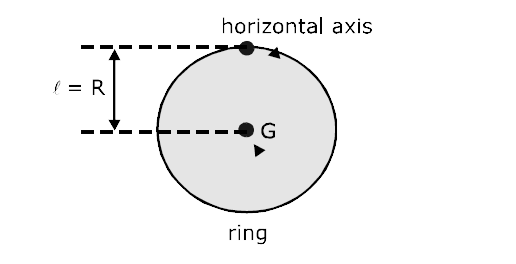 `L=l + (K^2)/(l)= R+ (R^2)/(R )= 2R` `T= 2 pi sqrt((2R)/(G))` |
|
| 36784. |
The separation L between the objective (f_(0) =0.5 cm) and the eye piece (f_(e) =5cm) of a compound microscope is 7.0 cm. Where should a small object be placed so that the eye is least strained ? |
| Answer» Solution :`L=v_(0) + f_(E),1/v_(0)=1/u_(0)=1/f_(0)` | |
| 36785. |
Suppose, we think of fission of a ""_(26)^(56)Fenucleus into two equal fragments ""_(13)^(28)Al. Is the fission energetically possible? Argue by working out Q of the process. Given m (""_(26)^(56)Fe) = 55.93494 u and m(""_(13)^(28)Al) = 27.98191 u. |
|
Answer» Solution :`Q = [m ""_(26)^(56)Fe - 2m(""_(13)^(28)AL)c^2` `Q = [m ""_(26)^(56)Fe - 2m (""_(13)^(28)Al)]c^2` `=[55.93494 - 2 xx 27.98191] 931` `= 26.88 MeV` (not POSSIBLE) |
|
| 36786. |
A ballon is rising with a velocity of 9.8 m/s and a bag is dropped from it when it is at a height of 39.2 m. Calculate the time taken by the bag to reach the ground. |
|
Answer» SOLUTION :TAKING vector quantities in the upward DIRECTION as negative and DOWNWARD as positive Now u = -9.8 m / s G =9.8 m/s^2, S = 39.2 m `S = ut+1/2 g t^2, 39.2 = -9.8t+1/2t^2, or t^2-2t-8=0 or t=4s` |
|
| 36787. |
The half-life period of radium is 1600 yr. The fraction of a sample of radium that would remain after 6400 yr is: |
|
Answer» `1//4` |
|
| 36788. |
Derive the Bernoulli equation for an incompressible liquid flowing in an inclined tube of variable cross section in a gravitational field. |
|
Answer» `W = F_1l_1 - F_2 l_2 = p_1 S_1 l_1 - p_2 S_2 l_2 = (p_2 - p_1) V` Subtituting the result obtained into the expression for the change in energy , we obtain `(p_1 - p_2) V = (mv_2^2)/(2) + mgh_2 - (mv_1^2)/(2) - mgh_1` WHENCE `p_1 + (rho v_1^2)/(2) + rho gh_1 = p_2 = (rho v_2^2)/(2) + rho gh_2` 
|
|
| 36789. |
Two particles of mass m_(1) and m_(2) (m_(1)gtm_(2)) attract each other with a force inversely proportional to the square of the distance between them. If the particles are initially held at rest and then released, the centre of mass will |
|
Answer» move towards `m_(1)` |
|
| 36790. |
Frequencies in the UHF range normally propagate by means of: |
|
Answer» GROUND waves |
|
| 36791. |
How does the magnetic energy compare with the electrostatic energy stored in a capacitor? |
|
Answer» Solution :The magnetic energy per unit VOLUME is `mu_(B)=(U_(B))/(V)` [where V is volume that contains flux) `=(U_(B))/(Al)=(B)/(2mu_(0)).....(1)` We have already obatined the relation for the electrostatic energy stored per unit volume in parallel plate capacitor. `u_(E)=1/2 epsi_(0)E^(2)....(2)` In both the cases energy is proportional to the square of the field strength. |
|
| 36792. |
Assertion : Eddy currents heat up the core and dissipate electrical energy in the form of heat. Reason : Eddy currents are always undesirable. |
|
Answer»
|
|
| 36793. |
Many side particles are produced when radioactive decay takes place.In the given table, Column I shows the charge of the different side particles, Column II shows the mass and Column III shows the ionization power of these side particles. What the characteristics of gamma - particles? |
|
Answer» (IV)(iii)(L) |
|
| 36794. |
Many side particles are produced when radioactive decay takes place.In the given table, Column I shows the charge of the different side particles, Column II shows the mass and Column III shows the ionization power of these side particles. What the characteristics of beta- particle? |
|
Answer» (III)(II)(J) |
|
| 36795. |
Many side particles are produced when radioactive decay takes place.In the given table, Column I shows the charge of the different side particles, Column II shows the mass and Column III shows the ionization power of these side particles. What are the characteristics of alpha- particle? |
|
Answer» (I)(II)(J) |
|
| 36796. |
What is the nature of the path inside the 'dee'? |
| Answer» SOLUTION :SEMICIRCULAR | |
| 36797. |
The angular velocity of an hour hand of a watch is, |
|
Answer» `1.456xx10^(-4)`rad/sec |
|
| 36798. |
The mutual inductance of a pair of coils is 5 H. In the primary coil currents falls from 5 A to zero in 10^(-3) s. The magnitude of induced emf in the secondary coil will be |
| Answer» Answer :A::B::C | |
| 36799. |
Compute the torque experimenced by a magnetic needle in a uniform magnetic field. |
|
Answer» Solution :Torque Acting on a Bar Magnet in Uniform Magnetic Field. : Consider a magnet of length 2l of POLE STRENGTH `q_(m)` kept in a uniform magnetic field `vec(B)`. Each pole experinences a force of magnitude `q_(m)` B but acts in opposite direction. Therefore, the net force exerted on the magnet is zero, so that there is no translatory motion. These two forces constitute a couple (about midpoint of bar magnet ) which will ROTATE and try to align in the direction of the magnetic field `vec(B)` . The force experienced by NORTH pole, `vec(F_(N)) = q_(m) vec(B)` The force `e^(x)` perienced by south pole, `vec(F_(S)) = - q_(m) vec(B)` Adding equations (1) and (2), we get the net force acting on the dipole as `vec(F ) = vec(F_(N)) = vec(0)` This implies , that the net force acting on the dipole is zero, but forms a couple which tends to rotate the ber magnet clockwise (here) in order to align it along `vec(B)`. The moment of force or torque experiencedby north and south pole about point O is `vec(tau) = vec(ON) xx vec(F_(N)) + vec(OS) xx vec(F_(s))` `vec(tau) = vec(ON) xx q_(m) vec(B) + vec(OS) xx (-q_(m) vec(B))`, By using right hand cork screw rule, we coclude that the total torque is pointing into the paper. Since the magnitudes `|vec(ON)|= |vec(OS)| = l and |q_(m) vec(B)| = |-q_(m) vec(B)|` The magnitude of total torque about point O `tau = l xx q_(m) B sin theta + l xx q_(m) B sin theta` `tau = 2l xx q_(m) B sin theta` `tau = p_(m) B sin theta "" (thetafore q_(m) xx 2l = p_(m))` In vector notation, `tau = p_(m) xx vec(B)` 
|
|
| 36800. |
It is proposed to use the nuclear fusion reaction ""_(1) H^(2) + ""_(1)H^2rarr""_(2)He^(4) Het in a nuclear reactor of 200 MW rating. If the energy from the above reaction is used with a 25% efficiency in the reactor, how many grams of deuterium fuel will be needed per day. (the masses of ""_(1)H^2 and ""_(1)He^(4)are 2.0141 atomic mass units and 4.0026 atomic mass units respectively). |
|
Answer» |
|


