

Saved Bookmarks
This section includes InterviewSolutions, each offering curated multiple-choice questions to sharpen your knowledge and support exam preparation. Choose a topic below to get started.
| 37501. |
A person applies a sine wave and square wave to an AND gate as shown in the figure (i) and (ii). Assuming that both the voltages are applied in phase, the person observes the output at E and F on (i) and (ii), respectively. [Assume minimun voltage of 5 V is equivalent to logic (i)] |
|
Answer» Square wave at 50 Hz and square wave at 100 Hz. (i) Sine weve , 50 Hz , 2 V ` (##ARH_5Y_SP_06_05_19_01_E02_038_S01.png" width="80%"> (ii) sine wave , 100 Hz , 8V 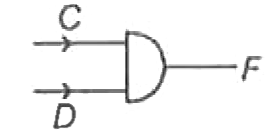 In figure (i) , sine wave and square wave both have different frequency , respectively , 50 Hz and 107 Hz. Hence, these voltages are not processed by AND gate, THEREFORE no output is obtined from gate (i) In figure (ii), sicnce wave and squarewave VOLTAGE are processed by AND gate . Since , logic gate (AND gate) gives output in two level (0 and 1) only at same frequency of input . Therefore , the output of gate (ii) will ve pulsed wave of 100 Hz. |
|
| 37502. |
What is meant by chain reaction ? |
|
Answer» Solution :a. i. Atom bomb - Nuclear fission ii. Hydrogen bomb - Nuclear FUSION B. CHAIN reaction is a series of fission process. c.A huge AMOUNT of ENERGY is released which will lead world to a disaster. d. Yes. |
|
| 37503. |
String-1 is connected with string-2. The mass per unit length in string-1 is mu_(1) : and the mass per unit length in string-2 is 4mu_(1). The tension in the strings is T. A travelling wave is coming from the left. What fraction of the energy in the incident wave goes into string-2 ? |
|
Answer» `1//8` |
|
| 37504. |
Draw labelled ray diagram to show image formation in a compound microscope. Write the expression for its magnifying power. |
Answer» Solution :The labelled ray diagram showing image formation in a compound microscope has been SHOWN in Fig 9.49. Magnifyingpowerofatravelling microscope is given by the relation :  `m=L/f_(0)(1+D/f_(E))` where L = length of microscope TUBE, D =least DISTANCE of distinct VISION and `f_(0)` and `f_e` are the respective focal lengths of objective and eyepiece of microscope. |
|
| 37505. |
At a certain location in Africa, a compass 12^@ west of the geographic north. The northe tip of the magnetic needle of a dip circle in the plane of magnetic meridian points 60^@ above the horizontal . The horizontal component of the earth's field measured to be 0.16 G. Specify the direction and magnitude of the earth's field at the location. |
|
Answer» SOLUTION :`phi=12^@, theta=60^@,H_E=0.16G` `:.H_E=B_Ecostheta,"":.B_E=H_E/(COSTHETA)=(0.16)/(cos60^@)=(0.16)/(1//2)=0.32G` The TOTA magnetic field at the place is inclined at `12^@` TOWARDS west from GEOGRAPHIC north. |
|
| 37506. |
Assertion : When a dielectric is placed in an electric field, the electric field with in the dielectric as well as. Potential difference across the capacitor plates are reduced by a factor K (battery is not connected). Reason : The dielectric constant is the ratio of the absolute permittivity of the dielectric to the [ermittivity of the dielectric to the permittivity of the free space. |
|
Answer» If both ASSERTION and Reason are TRUE and Reason is the correct EXPLANATION of Assertion. |
|
| 37507. |
A proton and an alpha particle are accelerated, using the same potential difference How are the de Brogie wavelengths lambda_p and lambda_alpha are related to each other? |
|
Answer» SOLUTION :By DE Broglie wavelength, `lambda=h/SQRT(2mqV) lambda_alpha 1/sqrt(mq)` Then `lambda_p/lambda_alpha=(sqrt(m_alpha q_alpha)/(sqrtm_pq_p))=(sqrt(4m_pxx2e)/(sqrt(m_pxxe))=sqrt(8)/1` |
|
| 37508. |
A transparent solid sphere of radius 2 cm and density p floats in a transparent liquid of density 2rho kept in a beaker. The bottom of the beaker is spherical in shape with its radius of curvature 8 cm and is silvered to make it a concave mirror as shown in Fig. When an object is placed a 10 cm directly above the centre of the sphere its final image coincide with it. If 'h' is the height of liquid surface from the apex of the bottom as shown in figure. Consider paraxial rays only for image formation. The refractive index of the sphere is 3/2and that of the liquid is 4/3 .Answer the following questions.The image formed by transparent solid sphere (measured from the bottom point of the sphere) is nearly equal to |
|
Answer» 2cm |
|
| 37509. |
A : Diffraction is common is sound but not common in light waves R : Wavelengths of light is more than the wavelength of sound. |
|
Answer» Both A and R are true and R is the CORRECT EXPLANATION of A |
|
| 37510. |
A transparent solid sphere of radius 2 cm and density p floats in a transparent liquid of density 2rho kept in a beaker. The bottom of the beaker is spherical in shape with its radius of curvature 8 cm and is silvered to make it a concave mirror as shown in Fig. When an object is placed a 10 cm directly above the centre of the sphere its final image coincide with it. If 'h' is the height of liquid surface from the apex of the bottom as shown in figure. Consider paraxial rays only for image formation. The refractive index of the sphere is 3/2 and that of the liquid is 4/3 .Answer the following questions.The value of h is (nearly equal to) |
|
Answer» 8cm |
|
| 37511. |
How velocity of electron in stationary orbit is represented ? |
| Answer» SOLUTION :The general expresion for the velocity of ELECTRON in the VARIOUS orbits of the ATOM is GIVEN by `v_n = (Ze^2)/(2epsilon_0nh)`. | |
| 37512. |
Solve the forgoing problem for the casewhen half the gap is filled with the dielectric in theway shown in fig. |
|
Answer» Solution :(a) Constant VOLTAGE acros the PLATES, `E_(1) =E_(2) = E_(0). D_(1) = epsilon_(0) E_(0) D_(2) = epsilon_(0) epsilon E_(0)` (b) Constant charge across the plates, `E_(1) = E_(2) . D_(1) = epsilon_(0) E_(1). D_(2) = epsilon epsilon_(0) E_(2) = e D_(1)` `E_(1) (1 + epsilon) = 2E_(0)` or `E_(1) = E_(2) = (2 E_(1))/(epsilon + 1)` |
|
| 37513. |
A force vec(F)=5 hat(i)+2hat(j)-5hat(k) acts on a particle whose position vector is vec(r)=hat(i)-2hat(j)+hat(k). What is the torque about the origin ? |
|
Answer» `8 HAT(i) + 10 hat(j) + 12 hat(k)` |
|
| 37514. |
A transparent solid sphere of radius 2 cm and density p floats in a transparent liquid of density 2rho kept in a beaker. The bottom of the beaker is spherical in shape with its radius of curvature 8 cm and is silvered to make it a concave mirror as shown in Fig. When an object is placed a 10 cm directly above the centre of the sphere its final image coincide with it. If 'h' is the height of liquid surface from the apex of the bottom as shown in figure. Consider paraxial rays only for image formation. The refractive index of the sphere is 3/2and that of the liquid is 4/3 .Answer the following questions.The image formed by the top spherical portion of sphere is (as measured from top of spherical ball) |
|
Answer» 6cm |
|
| 37515. |
Cell-The fundamental Unit of life |
|
Answer» 5 |
|
| 37516. |
What modifications were made to make the MKS system more useful? |
| Answer» Solution :There were three fundamental units which COULD not cater the NEEDS of study of all branches of physics. This could be helped by INCREASING the number of fundamental units from three to SEVEN and the system was known as SIsystem (System International) | |
| 37517. |
Distinguish between n-type and p-type semiconductos. |
Answer» SOLUTION :
|
|
| 37518. |
Due to capillary action, a liquid will rise in the capillary tube if the angle of contact is |
|
Answer» acute |
|
| 37519. |
In the caseof single slit Fraunhoffer diffraction the angleof diffraction is thetafor the second secondarymaximum . If .a. is width of the slit , the wavelength of the light is |
|
Answer» `(2a sin theta)/3 ` |
|
| 37520. |
(A):Body may be moving with uniform speed and non uniform acceleration (R ):A body may have uniform velocity and nonzero acceleration . |
|
Answer» |
|
| 37521. |
A thin biconvex lens of focal length 6.25 cm is made of material of refractive index 1.5. It is cut into two identical pieces perpendicular to its principal axis. One of the pieces is placed in water of refractive index 4/3. The focal power of the piece immersed in water in diopter is |
|
Answer» |
|
| 37522. |
Assertion: In S.H.M., the velocity and displacement of the particle are in the same phase. Reason: Velocity is the ratio of displacement to the time taken. |
|
Answer» ASSERTION is True, Reason is True, Reason is a CORRECT EXPLANATION for Assertion |
|
| 37523. |
A string of length 0.4m and mass 10^(-2)kg is tightly clamped at its ends. The tension in the string is 1.6N. Identical wave pulses are produced at one end al equal intervals of time Delta t . The minimum value of Delta t , which allows constructive interference between successive pulses is |
|
Answer» 0.05s |
|
| 37524. |
Hydrogen atom in its ground state is excited by means of a monochromatic radiation of wavelength 970.6 Å. How many different transitions are possible in the resulting emission spectrum? Find the longest wavelength amongst these. (lonisation energy of hydrogen atom in its ground state is 13.6 eV and take h=6.6xx10^(-34)Js) Data : Wavelength of incident radiation = 970.6 Å = 970.6 X 10^(-10)m Ionisation energy of hydrogen atom in its ground state = 13.6 eV (i) Number of possible transitions = ? (ii) Longest wavelength emitted = ? |
|
Answer» Solution :(i) Energy of the excited state, `E=(HC)/(LAMBDA)=(6.6xx10^(-34)xx3xx10^(8))/(970.6xx10^(-10)xx1.6xx10^(-19))=12.75eV` `E_(n)=-13.6+12.75=0.85eV` `E_(n)=(-13.6)/(n^(2))` or `n^(2)=(-13.6)/(E_(n))=(-13.6)/(-0.85)=16` (ii) or n=4 (ii) The number of POSSIBLE transitions in going to the lower state and HENCE the number of different wavelengths in the spectrum will be six (shown in the FIGURE). The longest wavelength corresponds to minimum energy difference. (i.e., for transition 4 `to `3) `E_(3)=(-13.6)/(3^(2))+-1.151eV` `(hc)/(lambda_("max"))=E_(4)-E_(3)` or `lambda_("max")=(6.6xx10^(-34)xx3xx10^(8))/((1.51xx0.85)xx1.6xx10^(-19))` `=18750Åm` `lambda_("max")=18750Å` 
|
|
| 37525. |
energy is absorbed in the hydrogen atom giving absorption spectra when transition takes place from |
|
Answer» `N=1ton`'where ' n'`gt1` |
|
| 37526. |
A galvanometer having a resistance 50Omega gives full scale deflection for a current of 0.05 A.It is intended to convert the galvanometer into an ammeter reading current the galvanometer into an ammeter reading current upto 5 A by using a shunt wire of 2mm diameter Then the length of wire is (rho of material =5xx10^(-7)Wm) |
|
Answer» 3.2 m |
|
| 37527. |
calculate the energy in an inductor of inductance 50mH when a current 2A is passing through it . |
| Answer» SOLUTION :U=(1/2)LI^2=(1/2)xx50xx10^-3xx(2)^2=0.1J | |
| 37528. |
In the above problem velocity after 3 seconds is - |
|
Answer» `20 hati+20 SQRT(3)HATJ` |
|
| 37529. |
Au^(196) to A^(X) + beta^(-) antineutrino A and X are |
|
Answer» HG and 199, RESPECTIVELY |
|
| 37530. |
Two charges –q and +q are located at points (0, 0, –a) and (0, 0, a), respectively. (a) What is the electrostatic potential at the points (0, 0, z) and (x, y, 0) ? (b) Obtain the dependence of potential on the distance r of a point from the origin when r//a gt gt 1 . (c) How much work is done in moving a small test charge from thepoint (5,0,0) to (–7,0,0) along the x-axis? Does the answer change if the path of the test charge between the same points is not along the x-axis? |
|
Answer» Solution :(a) On the axis of the dipole, potential is `(+- 1//4 pi epsilon_(0)) p//(X^(2)-a^(2))`where p =2qa is the magnitude of the dipole moment, the + sign when the point is closer to q and the – sign when it is closer to –q. Normal to the axis, at points (x, y, 0), potential is zero. (B) The DEPENDENCE on r is `1//r^(2)`type. (c) Zero. No, because work done by ELECTROSTATIC field between two points is independent of the path connecting the two points. |
|
| 37531. |
If the electric field strength of air is3 xx 10 ^(6) V//m, what will be the maximum potential at the surface of a metal sphere of radius 1m. |
| Answer» Solution : ` V =3 XX 10^(6) `VOLT | |
| 37532. |
The flat insulating disc of radius 'a' carries an excess charge on its surface with surface charge density sigmaC//m^2. Let the disc rotate around the axis passing through its centre and perpendicular to its plane with angular speed omega rad/s. If a magnetic field vec B is directed perpendicular to the rotation axis, then find the torque acting on the disc. |
| Answer» Solution :`pi SIGMA omega r^3 Bdr and tau= pi sigmaomegaB int_(0)^(a)r^3 DR = (pi sigmaomegaBa^4)/(4)` | |
| 37533. |
What is the energy of an alpha particle that has been accelerated through 50,000 V ? |
|
Answer» Solution :`V=50,000V, K_("MAX")=?"" n = 2 "" e=1.6xx10^(-19)C` `K_("max")=n EV=2xx1.6xx10^(-19) xx 50,000 J =(2xx1.6xx10^(-19)xx50,000)/(1.6xx10^(-19))=10^(5)eV` |
|
| 37534. |
Suggest a possible explanation. As you have learnt in the text, the principle of linear super position of wave displacement is basic to understanding intensity distributionsin diffraction and interference patterns. What is the justidication of this principle? |
|
Answer» Solution :a. Interference of the direct SIGNAL received by the antema with the (weak) signal reflected by the PASSING aircraft. b. Superposition principle follows from the linear character of the solution of (differentia) eaquation governign wave motion. If `y_(1)` and `y_(2)` are solutions of the wave equation so is any linear combination of `y_(1)` and `y_(2)`. When the amplitudes are large (e.g. high INTENSITY laser beams) and non linear effects are important the situation is FAR more complicated. |
|
| 37535. |
The circuit shown in figure consisting of three identical lamps and two coils is connected to a direct current source. The ohmic resistance of the coils is negligible After some time switch S is opened. Which of the following statement(s) is // are correct for the instant immediately after opening the switch? |
|
Answer» All the lamps are TURNED off |
|
| 37536. |
Whena slide body is negatively charged by friction, it means that the body has |
|
Answer» ACQUIRED EXCESS of ELECTRONS |
|
| 37537. |
ABCD is a square loop made of a uniform conductivity wire. The current enters the loop at A and leaves at D. The magneitic field is |
|
Answer» zero only at the centre of the loop `B_(2) prop 3xxI/r`. Clearly, the two field are equal in magnitude the opposite in direction. |
|
| 37538. |
The angle subtended at the eye by an object is equal to the angle subtended at the eye by the virtual image produced by a magnifying glass. In what sense then does magnifying glass produce angular magnification? |
| Answer» Solution :The ABSOLUTE image size is BIGGER than object size, the magnifier helps in BRINGING the object closer to the eye and hence it has larger angular size than the same object at 25 cm, thus angular MAGNIFICATION is ACHIEVED. | |
| 37539. |
In a mercury thermometer the ice point (lower fixed point) is marked as 10o and the steam point (upper fixed point) is marked as 130^@ . At 40^@ C temperature, what will this thermometer read? |
|
Answer» `78^@` `(40-0 )/( 100-0 )=(T-10)/( 130-10)implies48 -T-10t= 58^@ ` |
|
| 37540. |
For the circuit shown in Fig. find 1) the output voltage, 2) the voltage drop across series resistance, 3) the current through Zener diode |
|
Answer» Solution :From the figure `R=5kOmega=5xx10^(3)Omega`, Input voltage `V_("in")=120V`, zener voltage, `V_(Z)=50V` 1) OUTPUT voltage, `V_(Z)=50V` 2) Voltage drop across SERIES resistance `R=V_("in")-V_(Z)=120-50=70V`. 3) Load current `I_(L)=(V_(Z))/(R_(L))=(50)/(10xx10^(3))=5xx10^(-3)A` Current through R = `i=(V_("in")-V_(z))/(R )=(70)/(5xx10^(3))=14xx10^(-3)A` ACCORDING to the Kirchoff’s first law `I=I_(L)+I_(Z)` `therefore` Zener current, `I_(Z)=I-I_(L)=14xx10^(-3)-5xx10^(-3)=9xx10^(-3)=9xx10^(-3)=9mA` 
|
|
| 37541. |
A point charge .Q. is placed at the centre of a spherical cavity of radius .b. created inside a solid conducting sphere of radius .a.. Then total electrostatic potential energy of the system is : [k=(1)/(4pi epsilon_(0))] |
|
Answer» `(KQ^(2))/(2)[(1)/(a)-(1)/(B)]` |
|
| 37542. |
A: The process of demodulation is carried out to retrieve the message signal. R: The range of the line-of -sight propagatin is limited mainly due to earth's curvature. |
|
Answer» If both ASSERTION and reason are true and reason is the correct EXPLANATION of assertion |
|
| 37543. |
A circular coil of cross-sectional area 200 cm^(2) and 20 turns is rotated about the vertical diameter with angular speed of 50 rad//s in a uniform magnetic of 3.0 xx 10^(-2) T. Calculate the maximum value of current in the coil. |
|
Answer» Solution :CALCULATION of MAXIMUM value of current. Maximum value of emf `e_(0)=NBAv` `=20xx200xx10^(-4)xx3xx10^(-2)xx50V` `=600MV` Maximum induced current `i_(0)=(e_(0))/R=600/R MA` |
|
| 37544. |
Mass of moon is 7.3 xx 10^(22) kg and its radius is1.74 xx 10^(6) m. Find the value of the acceleration due to gravity on the moon. |
|
Answer» `1.45 N KG^(-1)` |
|
| 37545. |
Which of the following is correct explanatio for mobility mu? |
|
Answer» `MU=(mtau)/e` `therefore mu=1/(n e) TIMES (n e ^2 tau)/m=( e tau)/m` |
|
| 37546. |
A magnetised needle in uniform magnetic field experiences a torque but no net force. An iron nail near a bar magnet, however, experiences a force of attraction in addition to a torque. Why? |
| Answer» Solution :A bar MAGNET produces non - UNIFORM FIELD. Hence iron nail experiences a FORCE of attraction in addition to a torque | |
| 37547. |
The length and breadth of a block are 2.00 cm and 3.50 cm. They are measured with the help of vernier callipers having least count 0.01 cm. The sum of the four sides of the block with estimated error is |
|
Answer» `(11.00pm0.00)` CM Sum of four SIDES of of BLOCK, `L=2(l+b)=(l+b)+(l+b)=11.00cm `:.DeltaL=(Deltal+Deltab)+(Deltal+Deltab)=0.01xx4=0.04cm` `:.` Error in sum of four sides of block, `PM(LpmDeltaL)=(11.00pm0.04)cm`. |
|
| 37548. |
Which of the following is used for line of sight (LOS) communication? |
|
Answer» SKY waves |
|
| 37549. |
A soap film of refractive index4/3 and thickness 1.5xx10^(-4)cm is illuminated by white light incident at angle 45^(@). The reflected light is examinedby a spectroscope in which a dark band corresponding to the wavelength 5xx10^(-5) cm is found. Find the order of the interference band |
|
Answer» |
|
| 37550. |
A ball dropped on to the floor from a height of 10 m rebounds to a height of 2.5 m .If the ball is in contact with the floor for 0.02s,its average acceleration during contact is |
|
Answer» `2100ms^(-2)` |
|