

Saved Bookmarks
This section includes InterviewSolutions, each offering curated multiple-choice questions to sharpen your knowledge and support exam preparation. Choose a topic below to get started.
| 37751. |
From Brewster's law, except for polished metallic surfaces, the polarising angle |
|
Answer» depends on wavelength and SI DIFFERENT for different colours i.e., the polarising ANGLE depends on refractive INDEX and hence on wavelength and therefore is different for different colours. |
|
| 37752. |
A magnet was inserted into a wire ring connected to a ballistic galvanometer of 30 ohm resistance, this causing 20 division deflection of the galvonometer printer. What magnetic flux passes through the pole pices of the magnet. If the galvonometer constant is 3 xx 10^(-5)"C/div"? Neglect the resistance of the resistance of the ring and of the leads. |
|
Answer» It is equal to the galvonometer CONSTANT multiplied by the number of scale DIVISIONS q=CN. |
|
| 37753. |
A tuning fork of frequency 340 Hz is vibrated just above a cylindrical tube of length 120 cm. Water is slowly poured in the tube. If the speed of sound is 340 ms^(-1)then the minimum height of water required for resonance is: |
|
Answer» 95cm |
|
| 37754. |
A car weighing 100kg is on a slope that makes an angle 30^(@) with the horizontal. The component of car's weight parallel to the slope is (g=10 ms^(-2)) |
|
Answer» 500 N |
|
| 37755. |
Light with an energy flux of 18W//cm^(2) falls on a non-reflecting surface at normal incidence. If the surface has an area of 20cm^(2), find the average force exerted on the surface during a 30 minute time span. |
|
Answer» <P> Solution :The total energy falling on the surface is`U=(18 W//cm^(2))xx(20 cm^(2))xx(30xx60 s)` `=6.48 xx10^(5) J` Therefore, the total MOMENTUM delivered (for complete absorption) is `p=(U)/(c )=(6.48xx10^(5) J)/(3xx10^(8) m//s)=2.16 xx10^(-3) kg m//s` The AVERAGE force EXERTED on the surface is `F=(p)/(t) =(2.16 xx10^(-3)/(0.18xx10^(4))=1.2xx10^(-6) N` How will your result be modified if the surface is a perfect reflector? |
|
| 37756. |
Two Rods of same cross sectional area and same length but different thermal conductivity K_(1) and K_(2) are first connected in series and then connected in parallel between same temperature difference in both cases Then the ratio of rates of heat flow in both cases is. |
|
Answer» `(4k_(1)k_(2))/((k_(1)+k_(2))^(2))` `(v_("PARTICLE"))_("max")=Aomega=(2piAV)/(lambda)` WAVE speed `=v=(omega)/(k)` |
|
| 37757. |
In figure, light refracts from material 1 to a thin layer of material 2, crosses that layer, and then is incident at the critical angle on the interface between materials 2 and 3. (a) What is the angle theta? (b) if theta is decreased, is there refraction of light into material 3? |
|
Answer» `(1.6) sin THETA=(1.80)(1.30/1.80)` `:.theta=sin^-1(13/16)` If `theta` decreased, then `i_2` will decrease from the VALUE `theta_C.` Hence, refraction will take place in medium-3. |
|
| 37758. |
The relation between Young's modulus (Y) modulus of rigidity (eta) and Poisson's ratio (sigma) is |
|
Answer» `Y=2eta(1-sigma)` |
|
| 37759. |
In a gravity free space, there is a large spherical metal shell which is given a charge +Q_0. Inside the shell, a small particle having charge +q_0 is placed at the centre of the shell. Finally, what will be the co-ordinates of the particle? (Given that all the collisions are perfectly inelastic.) |
| Answer» ANSWER :A | |
| 37760. |
For the circuit shown, with R_1=1.0Omega, R_2=2.0Omega, E_1=2V and E_2=E_3=4V the potential difference between the points 'a' and 'b' is approximately (in V): |
|
Answer» 2.7 |
|
| 37761. |
The alternate discs of iron and carbon, having same area of cross-section are cemented together to make a cylinder whose temperature coefficient of resistivity is zero. The change in temperature in two alternate discs is same. The ratio of their thickness and ratio of heat produced in them is found out. The resistivity of iron and carbon at 20^@C" are "1 xx 10^(-7) and 3 xx 10^(-5)Omegam and their temperature coefficient of resistance are 5 xx 10^(-3)""^(@)C and -7.5 xx 10^(-4)""^(@)C, respectively, Thermal expansion is neglected. Here, triangleR_1 +triangleR_2= 0 (where triangleR_1, and triangleR_2, are the increase in resistances of iron and carbon, respectively, with the rise in temperature) because combined temperature coefficient of resistivity is given as zero. Ratio of heat produced in them is |
|
Answer» 0.51 |
|
| 37762. |
The ratio of magnetic potentials due to magnetic dipole in the end-on position to that in the broad side on position for the same distance from it is - |
|
Answer» Solution :V=(KMcostheta)/(R^(2)),V_("axis")=(KM)/(r^(2))becausetheta=0` `V_("equator")=0becausetheta=90^(@)RARR(V_("axis"))/(V_("equator"))=oo` |
|
| 37763. |
The alternate discs of iron and carbon, having same area of cross-section are cemented together to make a cylinder whose temperature coefficient of resistivity is zero. The change in temperature in two alternate discs is same. The ratio of their thickness and ratio of heat produced in them is found out. The resistivity of iron and carbon at 20^@C" are "1 xx 10^(-7) and 3 xx 10^(-5)Omegam and their temperature coefficient of resistance are 5 xx 10^(-3)""^(@)C and -7.5 xx 10^(-4)""^(@)C, respectively, Thermal expansion is neglected. Here, triangleR_1 +triangleR_2= 0 (where triangleR_1, and triangleR_2, are the increase in resistances of iron and carbon, respectively, with the rise in temperature) because combined temperature coefficient of resistivity is given as zero. Ratio of their thickness is |
|
Answer» 54 |
|
| 37764. |
The path difference between two interfering waves at a point on the screen is lambda"/"6from central maximum. The ratio of intensity at this point and that at the central fringe will be |
|
Answer» `0.75` |
|
| 37765. |
How long will light take in travelling a distance of 300 m in glass? R.l. of glass is 1.5 and velocity of light in vacuum 3xx10^8 m/s: |
|
Answer» `10^(-6)s` |
|
| 37766. |
Who is a protagonist? |
|
Answer» A Hero |
|
| 37767. |
Two simple harmonic motions are given by x_(1) = a sin omegat + a cos omega t and x_(2) = asin omegat + a/sqrt(3) 01. The ratio of the amplitudes of first and second motion and the phase difference between them are respectively |
|
Answer» `sqrt(3/2)` and `pi/12` `x_(1) = a sin omega t + a cos omegat` `=sqrt(2)a [1/sqrt(2) sin omegat + 1/sqrt(2) cos omegat]` `=sqrt(2)a sin (omegat + pi/4)` `THEREFORE` Amplitude of this simple harmonic motion is, `a_(1) = sqrt(2)a` and phase of the simple harmonic motion is, `phi_(1) =pi/4` For second simple harmonic motion, `x_(2) =a sin omegat + a/sqrt(3) cos omegat` `=(2a)/sqrt(3)[sqrt(3)/2 sin omegat + 1/2 cos omegat]` `(2a)/sqrt(3)sin(omegat + pi/6)` `therefore` Amplitude of this simple harmonic motion is, `a_(2) =(2a)/sqrt(3)` and phase of this simple harmonic motion is, `phi_(2) = pi/6` The ratio of their amplitudes is `a_(1)/a_(2) =(sqrt(2)a)/((2a)/sqrt(3)) = sqrt(3/2)` Phase difference between them is, `Deltaphi = phi_(1) - phi_(2) = pi/4 - pi/6 =(6pi - 4PI)/24 = (2pi)/24 = pi/12` |
|
| 37768. |
The alternate discs of iron and carbon, having same area of cross-section are cemented together to make a cylinder whose temperature coefficient of resistivity is zero. The change in temperature in two alternate discs is same. The ratio of their thickness and ratio of heat produced in them is found out. The resistivity of iron and carbon at 20^@C" are "1 xx 10^(-7) and 3 xx 10^(-5)Omegam and their temperature coefficient of resistance are 5 xx 10^(-3)""^(@)C and -7.5 xx 10^(-4)""^(@)C, respectively, Thermal expansion is neglected. Here, triangleR_1 +triangleR_2= 0 (where triangleR_1, and triangleR_2, are the increase in resistances of iron and carbon, respectively, with the rise in temperature) because combined temperature coefficient of resistivity is given as zero. A copper wire is stretched to make it 1% longer. The percentage change in its resistance is Electrical resistance of certain materials, known as super conductors changes abruptly from a non zero value to zero as their temperture is lowered below a critical temperature T_c(0) An interesting property of superconductors is that their critical temperature becomes smaller than T_c(0) if they are placed in a magnetic field, that is, the critical temperature T_c(B) is a function of the magnetic field strength B. The dependence of T_c(P) on magnetic field is shown in the below figure. |
|
Answer» 0.002 |
|
| 37769. |
Show that the de-Broglie wavelength A of an electron of energy E is given by the relation : lambda = h/sqrt(2mE). |
|
Answer» SOLUTION :Let E be energy and p MOMENTUM of electron, So `E = 1/2mv^(2) = (m^(2)v^(2))/(2m) =p^(2)/(2m)` or `p=sqrt(2mE)`……(i) Since de-Broglie wavelength associated by an electron is GIVEN by: `lambda = h/p` USING Eq. (i), we get `lambda = h/sqrt(2mE)`...........(ii) |
|
| 37770. |
Who was deaf in the lesson? |
|
Answer» Evelyn |
|
| 37771. |
A uniformly tapering circular bar has its diameter ranging from (D-a) to (D+a) along its length L. The bar is subjected to an axial force P and young's modulus is Y. The percentage error in the calculation of elongation of bar if mean diameter is used in calculation instead of actual diameter. |
|
Answer» `(2a^2)/(D^2)xx100` |
|
| 37772. |
Cosntant DC voltage is required from a variable AC voltage . Which of the following is correct order of operation ? |
|
Answer» REGULATOR, FILTER, RECTIFIER |
|
| 37773. |
Two shortbar magnets of magnetic moment M each are arranged at the opposite corners of a square of sided such that their centrecoincide withthecorners same directio the magneticinducition at any of theother corner of the squre is |
|
Answer» `(mu_(0))/(4pi)(m)/(d^(3))` `Z.B_(2)(mu_(0))/(4pi)(M)/(d^(3))` `because` like polesarein same DIRECTION so netmagnetic field`Z(B)=B_(1)-B_(2)=(mu_(0))/(4pi)(M)/(d^(3))` 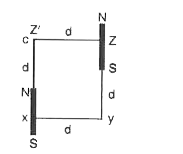
|
|
| 37774. |
What did Rutherford's experiments on alpha particles cattering indicate about the structure of the atom? |
|
Answer» Atoms are roughly sperical with a radius of about `10^(-10)`m. |
|
| 37775. |
A field of 100Vm^(-1) is directed at 30^(@) to positive x -axis. Find V_(BA) if OA = 2m and OB = 4m |
|
Answer» |
|
| 37776. |
A ray is incident at a small angle theta on a glass slab of thickness t. If the refractive index of glass is mu , show that the lateral displacement of the emergent ray from the slab is t theta(mu - 1) //mu. |
|
Answer» SOLUTION :Lateral DISPLACEMENT of the emergent ray BD relative to the INCIDENT ray AO is BC [Fig. 2.75]. `therefore "" BC = OB*(BC)/(OB) = OP*(OB)/(OP)*(BC)/(OB)` `= OP sec angleBOP * SIN angleBOC` `= t sec theta. sin(theta - theta.)` `theta and theta. "being small we have",` `sce theta. = (1)/(costheta) approx (1)/(1) = 1 and sin(theta - theta.) approx theta - theta.` `therefore "" BC = t(theta - theta.) = t theta(1 - (theta.)/(theta))` `"again," mu = (sintheta)/(sintheta.) approx = (theta)/(theta.) or, (1)/(mu) = (theta.)/(theta)` `therefore "" "Lateral displacement,"` `BC = t theta(1 - (1)/(mu)) = t theta((mu - 1))/(mu)` 
|
|
| 37777. |
A proton of charge 1.6 xx10^(-19)C is moving with a velocity 10^5m//s in auniform magnetic inductation 10^(-4)(Wb)//m^2,perpendicular to the direction of the motion of the proton ,force acting on the proton is : |
|
Answer» `1.6xx10^(-19)N` |
|
| 37778. |
At what temperature semiconductor behaves as conductor? |
| Answer» Answer :B | |
| 37779. |
Which of the statements below is correct? |
|
Answer» The angle of bank for a ROAD isobtained from a consideration of the centripetal force required |
|
| 37780. |
The pole near the geographic north pole is called ....... The pole near the geographic south pole is called …...... |
| Answer» SOLUTION :(i) NORTH MAGNETIC pole, (II) SOUTH magnetic pole | |
| 37781. |
Assuming the potential well to contain three bosons. The energy of the system is at its minimum. |
|
Answer» |
|
| 37782. |
A whistle producting sound waves of frequencies 9500 Hz and above is approaching a stationary person with v ms^(-1). The velocity of sound in air is 300 ms^(-1) . If a person can hear frequencies upto 10,000 Hz, the maximum value of v upto which he can hear the whistle is : |
|
Answer» `15 SQRT(2) ms^(-1) ` 10,000 = `((300)/(300 - U_(s)) ) . 9500` `rArr U_(s) = 15 ms^(-1)`. So correct CHOICE is (C). |
|
| 37783. |
Assertion (A): The surface of spherical conductor can be considered as an equipotentialsurface. Reason (R) : In a conductor charges can easily flow till potential is same at the entire surface. |
|
Answer» If both ASSERTION and REASON are true and the reason is the correct explanation of the assertion. |
|
| 37784. |
When a charged conductor is placed ln an external electric field, inside the conductor we have ...... . |
|
Answer» `E NE 0, V ne 0` |
|
| 37785. |
Referring to the above question, match Column-I and II. |
|
Answer» `{:("P","Q","R","S"),("2","3","1","4"):}` |
|
| 37786. |
In the circuit shown in fig. the capacitor is initially uncharged. Two way switch (s) is placed in position 1 for a very short interval of time (Delta t) and then is moved to position 2. The switch is held in position 2 for equally short interval Delta t and is then moved back to position 1. The process is repeated a large number of times until the charge on the capacitor stops changing. find this final a value of charge on the capacitor. [Assume that in each contact the charge on the capacitor changes by a very small amount] |
|
Answer» |
|
| 37787. |
The wavelength of light received from a galaxy is 10% greater than that received from identical source on the earth. The velocity of the galaxy relative to the earth is |
|
Answer» `3XX 10^(8) MS^(-1)` |
|
| 37788. |
When we raise the temperature of a body, the molecules and atoms move with greater kinetic enery. Assume that "the temperature" is the manifestation of only the kinetic energy is atomic and subatomic levels and no mass change (excess//defect) occurs due to heating. Now a solid material is supplied with heat at a constant rate.The temperature of the material is changing with the heat input as shown in the graph. BC and DE are parallel to the Heat-input axis In AB, CD and EF, the energy of the system increases. Here "energy" refers to |
|
Answer» KINETIC energy TEMPERATURE INCREASES `rArr K.E.` increases |
|
| 37789. |
When we raise the temperature of a body, the molecules and atoms move with greater kinetic enery. Assume that "the temperature" is the manifestation of only the kinetic energy is atomic and subatomic levels and no mass change (excess//defect) occurs due to heating. Now a solid material is supplied with heat at a constant rate.The temperature of the material is changing with the heat input as shown in the graph. BC and DE are parallel to the Heat-input axis In which of the following phase the assumption made in the above comprehension is most precise ? |
|
Answer» solid |
|
| 37790. |
When we raise the temperature of a body, the molecules and atoms move with greater kinetic enery. Assume that "the temperature" is the manifestation of only the kinetic energy is atomic and subatomic levels and no mass change (excess//defect) occurs due to heating. Now a solid material is supplied with heat at a constant rate.The temperature of the material is changing with the heat input as shown in the graph. BC and DE are parallel to the Heat-input axis In BC and DE |
|
Answer» kinetic ENERGY increases `rArr K.E.` remains constant `rArr` HEAT goes to increasing the `P.E.` |
|
| 37791. |
The following ligure shows the cross section of a wire. Which of the following statement(s) about current (l) and drift velocity (v) is true? |
|
Answer» `I_(A)=I_(B)=I_(C) and v_(A)=v_(C) GT v_(B)` |
|
| 37792. |
In the question number 66, the flux through the same square if the line normal to its plane makes a 60^(@) angle with the x-axis is |
|
Answer» `30NC^(-1)m^(2)` `phi=Escostheta=2xx10^(3)xx10^(-2)cos60^(@)=10NC^(-1)m^(2)` |
|
| 37793. |
The magnetic susceptibility of a superconductor is |
|
Answer» `chi_m=1` |
|
| 37794. |
Area vector of a coil of 5 xx 10^(-3)m^2makes an angle of 0^@ with a uniform magnetic field. If from this position the coil is rotated in 0.5 sec., so that the angle made by area vector with the field becomes 90^@. Find the average emf induced in the coil. The magnetic field intensity is 0.3 T. Number of turns in the coil is 500. |
|
Answer» 1.5 V `A=5xx10^(-3) m^2` `Deltat` = 0.5 s `theta_1=0^@` `theta_2=90^@` B=0.3 T `rArr` FLUX in coil `phi_1=AB COS theta_1` and `phi_2=AB cos theta_2` Change in flux `Deltaphi=phi_2-phi_1` `=AB cos theta_2-AB cos theta_1` `=AB[cos theta_2-cos theta_1]` `=AB [cos 90^@ - cos 0^@]` =AB[0-1]=-AB `therefore` Induced EMF in coil, `E=-N(Deltaphi)/(Deltat)` `=-N((-AB))/(Deltat)` `=(NAB)/(Deltat)` `=(500xx5xx10^(-3)xx0.3)/0.5` `therefore` E=1.5 V |
|
| 37795. |
Statement I: Nuclear forces' are charge independent. Statement II: The nuclear forces act between nucleons only. |
|
Answer» A Statement I is TRUE, statement II is false. |
|
| 37796. |
In a double slit experiment, the distance between the slits is 3 mm and the slits are 2 m away from the screen. Two interference patterns can be seen on the screen one due to light with wavelength 480 nm, and the other due to light with wavelength 600 nm. What is the separation on the screen between the fifth order bright fringes of the two interference patterns? |
|
Answer» Solution :`beta=lambda.D//d` 5th BRIGHT `=5beta_(1)=5lambdaD//d=5 XX 480 xx 10^(-9) xx 2//3 xx 10^(-3)=16 xx 10^(-4)m` 5th bright `=5beta_(2)=Slambda1D//d=5 xx 600 xx 10^(-9) xx 2//3 xx 10^(-3) =20 xx 10^(-4)m` distance between two 5th bright fringes `=(20-16)xx 10^(-4) =4 xx 10^(-4)m` |
|
| 37798. |
(A):The relative velocity between any two bodies moving In opposite direction Is equal to sum of the velocities of two bodies. (R ):Sometimes relative velocity between two bodies is equal to difference in velocities of the two bodies. |
|
Answer» |
|
| 37799. |
One morning an old man walked bare-foot to replacce the fuse wire in kit kat fitted with the power supply mains for his house. Suddenly he screamed and collapsed on the floor. His wife cried loudly for help. His neighbour's son Anil heard the crises and rushed to the place with shoes on. He took a wooden baton and used it to switch off the main supply . Answer the following questions. (i) what is the voltage and frequency of mains supply in India ? (iii) Can a transformer be used to step up d.c. voltage ? (iv) write two qualities displayed by Anil by his action. |
|
Answer» Solution :(i) Voltage = 220 V Frequency = 50 Hz. (ii) (a) AC CURRENT is MUCH easier to produce. (b) The cost of DC to AC is reltively high. © The direction of the current flow is reversed. Due to this property, we can jerk, and avoid from SUPPLY to step up. (iii) No, reason-This is only possible if the primary current is also changing . Hence the transforme on a.c. supply to step up. (iv) (i) He switched off the main supply which MEANS, he stopped to flow of current from further electric shocks. (v) (a) He saved the precious life of human. (b) , He used safety rules to protect an old man. |
|
| 37800. |
Figure shows a series LCR circuit connected to a variable frequency 230 V source. L = 5.0 H, C = 80 muF, R= 40Omega a. Determine the source frequency which drives the circuit in resonanceb. Obtain the impedance of the circuit and the amplitude of current at the resonating frequency. c. Determine the rms potential drops across the three elements of the circuit. Show that the potential drop across the LC combination is zero at the rasonating frequency. |
|
Answer» Solution :a. `omega = (1)/(sqrtLC) = (1)/(sqrt(5 xx 80 xx 10^(-6) )`= 50 rad/sec b. At RESONANCE `Z = R = 40 Omega` `I_(RMS) = (V_(rms) )/(R ) = (230 sqrt2)/(40) = 8A` c.`V_L = IX_L = I omega L = 8 xx 50 xx 5= 2000 V` `V_C = IX_C = (I)/(omega C) = (8)/(50 xx 80 xx 10^(-6) ) = 200 V, V_R = 230 V , V_L- V_C = 0` i.e., potential drop across LC combination is zero . |
|