

Saved Bookmarks
This section includes InterviewSolutions, each offering curated multiple-choice questions to sharpen your knowledge and support exam preparation. Choose a topic below to get started.
| 40351. |
Quantity that remains unchanged in a transformer is ........... |
| Answer» Answer :C | |
| 40352. |
An electromagnetic wave, whose wave normal makes an angle of 40^@ with the vertical, travelling in air strikes a horizontal liquid surface. While travelling through the liquid it gets deviated through 15^@. What is the speed of the electro magnetic wave in the liquid, if the speed of electromagnetic wave in air is 3 xx 10^8 m//s ? |
|
Answer» `1.5 XX 10^8 m//s` |
|
| 40353. |
A force of (10 hat(i) - 3 hat(j) + 6hat(k)) newton acts on a body of mass 100 g and displaces it from (6hat(i) + 5hat(j) - 3hat(k)) metre to (10hat(i) - 2hat(j) + 7hat(k))m. The work done is: |
|
Answer» 21J `VEC(S)=vec(r_(2))- vec(r_(1))=(10hati - 2hatj+7hatk)-(6hati+5hatj-3hatk)` `=4hati -7hatj + 10hatk` Now work done, W`=vec(F).vec(S)` `=40 + 21 + 60=121J` |
|
| 40354. |
The incident in childhood had taken place at the beach in |
|
Answer» Florida |
|
| 40355. |
The wavelength of K_(alpha), X-rays for lead isotopes Pb^(208), Pb^(206), Pb^(204)" are "lambda_(1), lambda_(2), and lambda_(3) respectively. Then : |
|
Answer» `lambda_(1)=lambda_(2) gt lambda_(3)` or `lambda_(2)=sqrt(lambda_(1) lambda_(3))` |
|
| 40356. |
Two idential charges are placed at th two corners of an equilateral triangle. The potential energy of the system is V. The work done is bringing an identical charge from infinite to the third vertex is |
|
Answer» V |
|
| 40357. |
In the network of identical capacitors (figure 6.15), find the capacitance between (i) a and (b), (ii) c and d. |
|
Answer» |
|
| 40358. |
A large number of free electron are present in metals. Why is there no current in the absense of electric field across it ? |
| Answer» Solution :In the absense of electric field, the free electrons MOVE at RANDOM. Therefore, no NET FLOW of charge across any SECTION and hence no current flow. | |
| 40359. |
Calculate the (a) momentum, and (b) de Broglie wavelength of the electrons accelerated through a potential difference of 56 V. |
|
Answer» SOLUTION :(a) `4.04xx10^(-24)KGMS^(-1)` (B) 0.164 NM |
|
| 40360. |
In the shown arrangement of the experiment of the meter bridge if AC corresponding to null defle-ction of galvanometer is x, what would be its value if the radius of the wire AB is doubled? |
|
Answer» Solution :For null deflection of GALVANOMETER in a METREBRIDGE experiment, `(R_(1))/(R_(2))=(R_(AC))/(R_(CB))=(x)/((100-x))` Since `R_(1)//R_(2)` remains CONSTANT, `x//(100-x)` also remains constant. The VALUE of x remains as such. `therefore "Length of AC = x"` |
|
| 40361. |
A man with defective eyes cannot see distinctly object at a distance more than 60 cm from eyes. The power of the lens to be used is : |
|
Answer» `+60D` |
|
| 40362. |
Does the kinetic energy of a small negative charge increase or decrease in going from B to A ? |
| Answer» Solution :Due to FORCE of repulsion decreases and hence the KINETIC ENERGY decreases in going form B to A. | |
| 40363. |
In Fresnel's diffraction , wavefront must be |
|
Answer» spherical |
|
| 40364. |
In a compound microscope, the object is 1 cm from the objective lens. The lenses are 30 cm apart and the intermediate image is 5 cm from the eye-piece. What magnification is produced? |
|
Answer» Solution :As the lenses are 30cm apart and intermediate IMAGE is formed 5 cm in front of eye lens, `u_(E)=5cmandv=L-u_(e)=30-5=25cm` Now as in case of compound MICROSCOPE, `MP=mxxm_(theta)=-v/uxx[D/u_(e)]` Here u = 1 cm and D = 25 cm So, `MP=-25/1xx[25/5]=-125` Negative sign implies that final image is inverted. |
|
| 40365. |
A stoneis projected at angle of tan^(-1)(3//4) to thehorizontal with a speed of 30ms^(-1). Find its position after2 seconds. g = 10ms^(-1) ? |
| Answer» Solution :DISTANCEOF 48m and VERTICALL heightof 16 MFROM the POINTOF projection | |
| 40366. |
A relativistic particle with momentum p and total energy E moves along the x axis of the frame K. Demonstrate that in the frame K^' moving with a constant velocity V relative to the frame K in the positive direction of its axis x the momentum and the total energy of the given particle are defined by the formula: p_x^'=(p_x-EV//c^2)/(sqrt(1-beta^2)), E^'=(E-p_xV)/(sqrt(1-beta^2)) where beta=V//c |
|
Answer» Solution :By definition, `E=m_0(c^2)/(SQRT(1-(v_x^2)/(c^2)))=(m_0c^3dt)/(ds), p_x=m_0(v_x)/(sqrt(1-v^2/c^2))=(cm_0dx)/(ds)` where `ds^2=c^2dt^2-DX^2` is the INVARIANT INTERVAL `(dy=dz=0)` THUS, `p_x^'=cm_0(dx^')/(ds)=cm_0gamma((dx-Vdt))/(ds)=(p_x-VE//c^2)/(sqrt(1-V^2//c^2))` `E^'=m_0c^3(dt^')/(ds)-c^3m_0gamma((dt-(Vd_x)))/(ds)=(E-Vp_x)/(sqrt(1-V^2/c^2))` |
|
| 40367. |
A circular coil of radius 20 cm, 500 turns and resistance 4Omegais placed with its plane perpendicular to the horizontal component of the earth's magnetic field. It is rotated about its vertical diameter through 180^@ in 0.25 s. Estimate the magnitudes of the emf and current induced in the coil. Horizontal component of the earth's magnetic field at the place is 3.0xx10^(-5) T. |
|
Answer» |
|
| 40368. |
Draw a ray diagram to show the formation of the real image of a point object due to a convex spherical refracting surface, when the ray of light is travelling from a rarer medium of refractive index nx to a denser medium of refractive index n_(2) . Using this diagram derive the relation between object distance (w), image distance (v), radius of curvature (R) of a convex spherical surface. State the sign convention and the assumptions used. |
|
Answer» Solution :Sign Convention: (i) All distances are measured from the pole of the spherical refracting surface. (ii) Distances measured along the direction of incidence of light are taken as positive and the distances measured in a direction opposite to the direction of incidence of light are taken as negative. (iii) Heights upward from principal axis are taken as positive and distances downward from principal axis are taken as negative. Assumptions : (i) The object is a point object situated on the principal axis of the spherical refracting surface. Moreover, the object is situated such that the incident RAY travels from left to right. (ii) Aperture of the refracting surface is small so that values of angle of incidence and angle of refraction are small enough. (iii) A refracting surface is considered as concave or convex as seen from the side of rarer medium only. Refraction formula : Consider a spherical surface XPY, convex towards the rarer medium. As shown in Fig. 9.89 for a point object situated in rarer medium of refractive index n-y, the image is formed in denser medium of refractive index `n_2` at point I. If i and r be the angles of incidence and refraction RESPECTIVELY, then from Snell.s law  `(sin i)/(sin r) = n_(2)/n_(1)` or `n_(1)sini = n_(2)sin r` and for small aperture angles i and r are small and therefore sin i - i and sin r, hence `n_(1)i = n_(2)r` From `triangleOAC`, i `=(alpha + gamma)` and from `triangleIAC, lambda = BETA + r` or `r = lambda -beta`..... (ii) `therefore n_(2)i = n_(2)r` `alpha = tan alpha + gamma` and from `triangleIAC, gamma = beta + r` or `r = gamma - beta` `alpha = tan alpha = (AN)/(ON) = (AN)/(OP), beta = tan beta = (AN)/(IN) = (AN)/(PI)`, and `gamma = tan gamma = (AN)/(NC) =(AN)/(PC)` Substituting these values of `alpha, beta` and `gamm` in (iii), we have `n_(1)[(AN)/(OP) + (AN)/(PC)] =n_(2) [(AC)/(PC) -(AN)/(PI)]` or `n_(1)/(OP) + n_(1)/(PC) = n_(2)/(PC) -n_(2)/(PI)` As per sign convention followed, `OP=-u, PC =+R` and Pl `=+v`. Hence, equation (iii) Becomes `n_(1)/(-u) + n_(2)/(+R) = n_(2)/(+R) -n_(2)/(+v)` which is the relation between object distance u, image distance v and the radius R of the GIVEN spherical surface. |
|
| 40369. |
What do you understand by the cut off, active and saturation states of the transistor? In which of these state does the transistor not remain when being used as a switch? |
|
Answer» Solution :When an npn transistor with common emitter mode is mode is used as a switch, then if during working, there is no collector current, then the transistor is in cut off state. In case of silicon-transistor, so long as INPUT VOLTAGE` V_(i) lt 0.6V`, the transistor will be in cut off state. If during working, there is a situation, beyond cut off state, for which `V_(i) gt 0.6V` but less than `1.0V` the collector current increases almost linearly and the output voltage decreases linearly, till `V_(i)` becomes NEARLY `1.0V`. The transistor in this state is called in active state. If during working, there is a situation beyond active state for which `V_(i) gt =1.0V`, the VARIATION of `V_(i)` and `V_(0)` is non-linear, because with the increase in `V_(i), V_(0)` is found to decrease towards zero, but never becomes zero. In this situation the collector current `I_` becomes maximum and the transistor is in a saturation state. When a transistor is being used as a switch, it will not remain in active state. |
|
| 40370. |
The premise of the planet of the Apes movies and book is that hibernating astronauts travel far into Earth's future, to a time when human civilization has been replaced by an ape civilization. Considering only special relativity, determine how far into Earth's future the astronauts would travel if they slept for 120.0 y while traveling relative to Earth with a speed of 0.999 90c, first outward from Earth and then back again. |
|
Answer» |
|
| 40371. |
The angle of dip at the magnetic equator is |
|
Answer» `0^@` |
|
| 40372. |
Monochromatic light is incident on a glass prism of angle A. If the refractive index of the material of the prism is mu, a ray, incident at an angle theta, on the face AB would get transmitted through the face AC pf the prism provided. |
|
Answer» `THETA gt SIN^-1 [mu sin (A-sin-1((1)/(mu)))]`  For TRANSMISSION, `r_2lt i_c` (Critical ANGLE) `thereforeA-r_1 lt i_c``(because r_1+r_2=A)` `thereforesin(A-r_1) lt sini_c` `therefore sin(A-r_1) lt (1)/(mu)``(because sini_c=1/mu)` `therefore A-r_1 lt sin^(-1)(1/mu)` `thereforer_1 gt A-sin^(-1)(1/mu)` `thereforesinr_1 gt sin[A-sin^(-1)(1/mu)](because sin theta=mu sin r_1)` `therefore(sin theta)/(mu) gt sin[A-sin^(-1)((1)/(mu))]` `therefore sin theta gt mu sin(A-sin^(-1)""(1)/(mu))` `therefore theta gt sin^(-1)(musin(A-sin^(-1)""(1)/(mu)))` |
|
| 40373. |
A car of mass 1000 kg moves on a circular track of radius 20m. If the coefficient of friction is 0.64. What is the maximum velocity with which the car be moved |
|
Answer» 1.12 m/s |
|
| 40374. |
A N-pole of a very long magnetic needle is placed at a distance of 20 cm from a point 'P'. If the pole strength of the magnetic needle is 40 Am what is the magnetic induction at the point 'P'? |
|
Answer» Solution :Since the magnetic NEEDLE is very long, the INFLUENCE of S - pole can be neglected. Pole strength of the needle, m = 40 Am. DISTANCE between the N-pole and the POINT P is r = 20 cm = `20 xx 10^(-2) m` `:.` Magnetic induction due to the N-pole at P is `B = (mu_0)/(4pi)(m)/(r^(2))=(4pi xx 10^(-7))/(4pi ) xx (40)/((20 xx 10^(-2))^(2))=10^(-4)T` |
|
| 40375. |
An atwood machine is setup in an elevator moving upward at 5 m//s and slowing down at 2m//s^(2) The initial velocity of block B is 2m//s upward and the acceleration of block A is 3 m//s^(2) downwards Find the time (in sec) at which block B will return to its initial position. Assume the string remains taut and the acceleration of the elevator does not change during the required time interval |
|
Answer» <P> `2+v_(A)=10 Rightarrow v_(A)=8 uparrow` `a_(B)+a_(A)=2a_(P)=2xx-2` `a_(B) -3=-4` `a_(B)=-1` `s=0=2xxt-1/2xx1xxt^(2)` `t=4 SEC` |
|
| 40376. |
In a radioactive decay M_X, M_Ydenotes atomic masses of parent nuclei and daughter nuclei respectively. Q - value for beta^(-)decay is Q_(1)and B^(+)decay is Q_2If m_edenotes mass of an electron Then correct statement in the following is (Q value is energy released in that reaction) |
|
Answer» `Q_(1) = (M_(X) -M_(y))c^(2), Q_(2) = (M_(x)-M_(y)-2m_(e))c^2` |
|
| 40377. |
What are holes? |
| Answer» Solution :The VACANCY or absense of an electron in the bond of a COVALENTLY BONDED crystal is called a HOLE. | |
| 40378. |
When A.C. current with frequency v is passed through series connection of inductor and capacitor, current obtained is maximum. Now when they are connected in parallel, current would become minimum at ……… frequency. |
|
Answer» V For parallel LC combination, minimum CURRENTIS obtained at resonant frequency `1/(2pisqrt(LC))` Here, impedance is maximum. Thus, in above cases, resonant FREQUENCIES are same. |
|
| 40379. |
Find the equation of the equipotentials for an infinite cylinder of radius r_(0), carrying charge of linear density lambda. |
|
Answer» Solution :Fig SHOWS an infinite cyclinder of radius `r_(0)` carrying charge of lineardensity `lambda`, From symetry,we find that the fieldlines MUST be radially outwards. Imaginea cylindrical Gaussian surface of radius r and length L. According to Gauss's theroem, `ointvec(E), vec(DS) = (q)/(in_(0)) = (lambda l)/(in_(0))` `E(2 pi r l) = (lambda l)/(in_(0)) or E = (lambda)/(2pi in_(0) r)` ..(i) `:. V (r) - V(r_(0)) = int_(r_(0))^(r) vec(E). vec(dl) = (lamda)/(2pi in_(0)) log_(e) (r_(0))/(r)` For an equipotential surface of GIVEN V(r), `log_(e) (r)/(r_(0)) = (2pi in_(0))/(lambda) [V (r) - V (r_(0))] :. r = r_(0) e^(-2 pi in_(0) [V(r) - V(r_(0))]//lambda)`...(ii) Hence, equipotential surfaces are cylinders of radius r given by (ii). 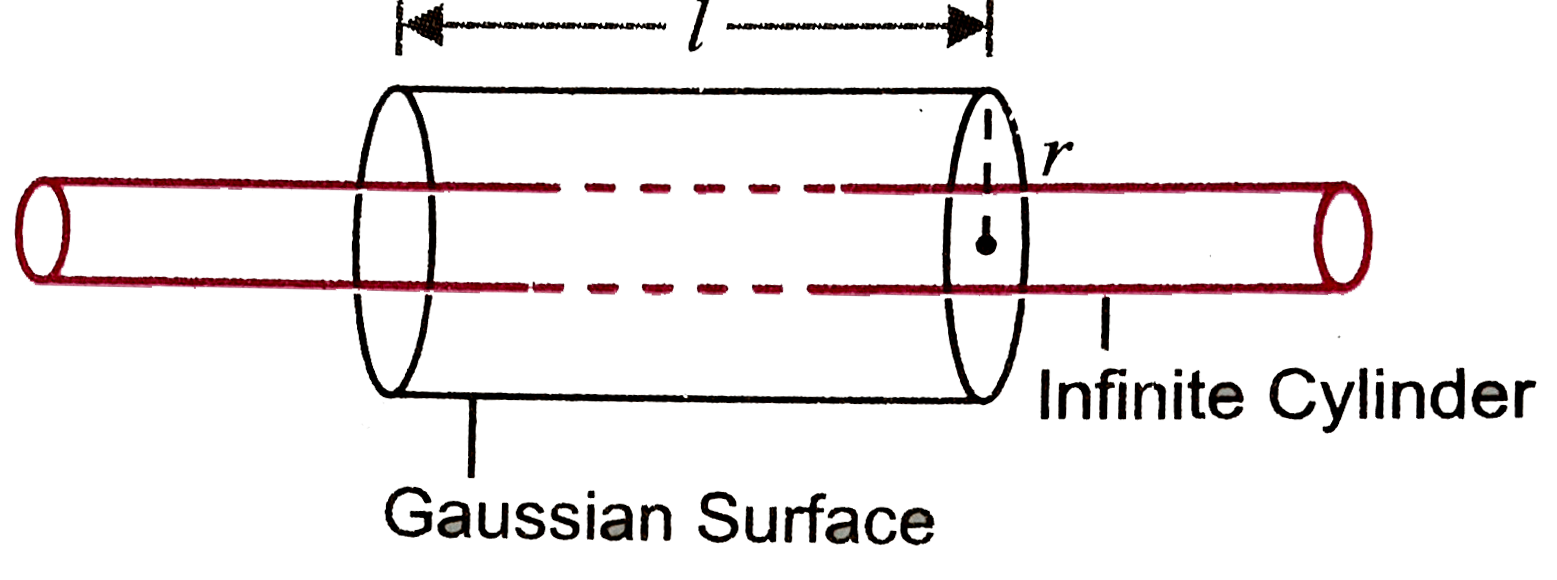
|
|
| 40380. |
Image distance |v| s object distance|u|, curve for two biconvex lens with sameradii ofcurvatures is shown in thefigure. Ifreflactive index of lens 1 is 1/5 find reflactive index of lens 2. |
|
Answer» |
|
| 40381. |
To make a p-type semiconductor out of pure silicon, it has to mix atoms of …… impurity. |
|
Answer» phosphorus |
|
| 40382. |
A ball of density d is dropped on to a horizontal solid surface. It bounces elastically from the surface and returns to its original position in a timet_1 Next, the ball is released and its falls through the same height before striking the surface of a liquid of densityd _ L. Neglect all frictional and other dissipative force. Assume the depth of the liquid to be large. Ifd lt d _ Lobtain an expression (in terms of d,t_1andd_L) for the timet _ 2 the ball takes to come back to the position from which it was released. |
|
Answer» `2t_1 ` timeoffall= time ofrice. Ortime offall `= (t_1 )/(2) ` Hence, velocity of the ball just before it COLLIDES with LIQUID is`v =g(t _ 1 )/(2) "" ...(i) ` RETARDATION inside the liquid `a = ("UPTHRUST -weight")/("mass") = (Vd_L g -V dg )/(Vd )= ((d_L - d )/(d))g "" `...(ii) Time taken to come to rest under this retardation will be`t =(V)/(a)=(g t _ 1 )/( 2 a )= (g t _1)/(2((d_L- d )/(d ))g )= (d t _ 1)/(2(d _ L - d )) ` same will be the time to come back on the liquid surface`because ` a is constant. Therefore, ` t_2 ` =time the ball takes to came back to the position from where it was released `= t _ 1+ 2t =t _ 1+ (dt _ 1 )/(d_L - d ) = t _ 1 [ 1 +(d)/(d_L - d )] ort_2= (t_1d _ L)/(d _ L - d ) ` |
|
| 40383. |
A man moves along the path abode as shown in the Fig. What is his displacement from the point of start? |
Answer» Solution :Here simple TRIGONOMETRICAL calculation gives 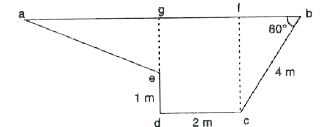 fb=2m gf=2m fc=3.46 m ge =2.46 m ga=4m `:.` Ae (displacement )`=[(2.46)^2 +4^2]^1//2` =4.7 m |
|
| 40384. |
A uranium U^(235) nucleus liberates an energy of 200 MeV in the process of fission. 1.5 kg of uranium take part in the reaction during the explosion of a uranium bomb. What is the mass of an equivalent TNT bomb, if the heating capacity of TNT is 4.1 MJ/kg? |
|
Answer» `W=(1.5xx6.02xx10^(26)xx200xx1.6xx10^(-13))/235J=1.2xx10^(14)J` Dividing by the calorific value of TNT, q, we obtain the TNT equivalent: `m_(TNT)=W//q`. |
|
| 40385. |
Intensity of light is direction proportional to the square____ |
| Answer» SOLUTION :SQUARE of AMPLITUDE | |
| 40386. |
A ball of 200 g is at one end of a string of length 20 cm. It is revolved in a horizontal circle at an angular frequency of 6 rpm. Find (i) the angular velocity, (ii) the linear velocity, (iii) the centripetal acceleration, (iv) the centripetal force and (v) the tension in the string. |
|
Answer» SOLUTION :(i) The ANGULAR velocity `omega =(2piN)/t =(2pi xx 6)/60 = pi/5 = 0.6284 "RAD" s^(-1)` (ii) The linear velocity, `v= romega` `=0.20 xx 0.6284 = 0.1257 MS^(-1)` (iii) The centripetal acceleration `a_( c)=r omega^(2)` `=0.20 xx (0.6284)^(2) = 0.0790 ms^(-2)` |
|
| 40387. |
A closed loop of vecB is produced by a changing electric field. Does it necessarily mean that vecE and dvecE//dt are non-zero at all points on the loop and in the area enclosed by the loop? |
|
Answer» Solution :Non necessarily. The basic requirement is that the TOTAL electric flux through the area ENCLOSED by the loop should very with time. The flux change may arise form any portion of the area. Elsewhere E or dE/dt may be ZERO. In particular, there NEED be no electric FIELD at points which make the loop. |
|
| 40388. |
On certain day, it is observed that the signals of higher than 5 MHz are not recived by reflection from F_(1) layer of ionosphere. The approximate maximum electron density of F_(1) layer ontheday is |
|
Answer» `7.9xx10^(11)//m^(3)` |
|
| 40389. |
An image is formed at a distance of 100 cm from the glass surface with refractive index 1.5, when a point object is placed in the air at a distance of 100 cm from the glass surface. The radius of curvature is of the surface is |
| Answer» Answer :A | |
| 40390. |
A thermally insulated vessel contains an ideal gas of molecular mass M and ratio o specific heats gamma. It is moving with speed v and is suddenly brought to rest. Assuming no heat is lost to surroundings, its temperature increases by |
|
Answer» `((gamma-1))/(2(gamma+1)R)Mv^(2)K` Increase in internal energy, `DeltaU=nC_(V)DeltaT` where n is the number of moles of the GAS in vessel. As the vessel is stopped suddenly, its kinetic energy is USED to increase the TEMPERATURE of the gas. `therefore (1)/(2)mv^(2)=DeltaU=nC_(V)DeltaT=(m)/(M)C_(V)DeltaT(because n=(m)/(M))` or `DeltaT=(Mv^(2))/(2C_(V))=(Mv^(2)(gamma-1))/(2R)K(because C_(V)=(R)/((gamma-1)))` |
|
| 40391. |
(A) : In a cyclotron the time for one revolution of an ion is independent of its speed or radius of its orbit. (R) : In a cyclotron the sign of the electric field changes alternately in tune with the circular motion of particle. |
|
Answer» Both 'A' and 'R' are true and 'R' is the correct EXPLANATION of 'A'. |
|
| 40392. |
A blue ray of light enters an optically denser medium from air. What happens to its frequency in denser medium ? |
| Answer» SOLUTION :FREQUENCY REMAINS CONSTANT. | |
| 40393. |
There is one conducting circular loop of radius R, which carries current I. There is another conducting circular loop of radius r placed coaxially at a distance x from it. Here r lt lt R and xgt gt R. Emf induced in the smaller loop when x starts increasing at a rate v. |
|
Answer» `(3mu_(0)IvR^(2)r^(2))/(4pix^(4))` `epsilon = (mu_(0)IR^(2)pir^(2))/(2)|(dx^(-3))/(dt)|` `epsilon = (mu_(0)IR^(2)pir^(2))/(2) (3)/(x^(4))(dx)/(dt)` `epsilon = (3mu_(0)IR^(2)pir^(2))/(2x^(4))v` `IMPLIES epsilon = (3mu_(0)IvR^(2)pir^(2))/(2x^(4))` |
|
| 40394. |
There is one conducting circular loop of radius R, which carries current I. There is another conducting circular loop of radius r placed coaxially at a distance x from it. Here r lt lt R and xgt gt R. Emf induced in the smaller loop when current in the bigger loop is changed at a rate of alpha is. |
|
Answer» `(mu_(0)alphaR^(2)r^(2))/(2pix^(3))` `epsilon= (dphi)/(dt)` Emf induced when current is CHANGED can be written as follows:`epsilon= (mu_(0)R^(2)pir^(2))/(2x^(3))(dI)/(dt)` `epsilon= (mu_(0)R^(2)pir^(2))/(2x^(3)) alpha` `epsilon= (mu_(0)alphaR^(2)pir^(2))/(2x^(3))` Hence, option (b) is correct. |
|
| 40395. |
There is one conducting circular loop of radius R, which carries current I. There is another conducting circular loop of radius r placed coaxially at a distance x from it. Here r lt lt R and xgt gt R. Magnetic flux linked smaller coil due to current in bigger coil is |
|
Answer» `(mu_(0)IR^(2)pir^(2))/(2x^(3))` `B= (mu_(0)IR)/(2(R^(2)+x^(2))^((3)/(2))` Here x is much greater than R hence we can NEGLECT R in denominator to write magnetic field as follows: `B= (mu_(0)IR)/(2x^(3))` Both loops are coaxial hence magnetic field due to bigger loop on smaller loop is PERPENDICULAR to the plane of smaller loop hence magnetic flux linked with smaller coil can be written as follows: `phi= Bpir^(2)= (mu_(0)IR^(2)pir^(2))/(2x^(3))`. Hence, option (a) is correct. |
|
| 40396. |
Electrons are emitted from photo-cell with maximum speed of 4xx10^(8) cm/s .Its stopping potential will be….. (Mass of electron =9xx10^(-31) kg. |
|
Answer» 30V `therefore ((1)/(2)xx9xx10^(-31)XX(4xx10^(6))^(2))/(e )=V_(0)` `therefore(9xx10^(-31)xx16xx10^(12))/(2xx1.6xx10^(-19))=V_(0)` `therefore V_(0)=45V` |
|
| 40397. |
Suppose that you are in a cave deep within the earth. Are yousafe from thunder and lightning? Why? |
| Answer» SOLUTION :We are SAFE because of ELECTROSTATIC SHIELDING | |
| 40398. |
A moving coil galvanometer can be converted into |
|
Answer» an AMMETER by connecting a high RESISTANCE in series with it |
|
| 40399. |
A point charge q moves from .P. to .S. along path PQRSin a unifrom electric field E directed parallel to positive X-axis. The co-ordinates of the points P,Q and S are (a,b,0), (2a,0,0),(0-b,(0) and (0,0,0) respectively The work done by field an the above process is given by |
|
Answer» `qEa` |
|
| 40400. |
Two concentric metallic shells are of radii r_(1) and r_(2) (r_(2) gt r_(1)). If charge given to outer sphere is q. and the inner sphere is ground. Then the charge on the inner sphere q^(1) is |
| Answer» Answer :C | |