

Saved Bookmarks
This section includes InterviewSolutions, each offering curated multiple-choice questions to sharpen your knowledge and support exam preparation. Choose a topic below to get started.
| 40551. |
The restoring force on the body of the above problem due to the spring when it is at its upper most position of its oscillation is |
|
Answer» 160 N `0.05-0.03=0.02` `F=kxxx=2xx10^(3)xx0.02=40N` |
|
| 40552. |
A point charge ‘q’ is placed at orgin. bar(E_A), bar(E_B) and bar(E_C) be the electric field at three points A(1,2,3), B(1, 1, -1) and C(2,2,2) due to changed. Then give the possible relations between the above field strengths. |
|
Answer» Solution :`BAR(E_A)` is along `bar(OA)` and `bar(E_B)`, is along `bar(OB)`. `bar(OA) = i + 2J + 3k` and `bar(OB) = i + j - k` SINCE `bar(OA).bar(OB) = 0` `vec(E_A) _|_ vec(E_B)` further `|bar(E)| prop 1/(r^2)` `:. |bar(OC)| = 2|bar(OB)| :. |bar(E_B)| = 4|bar(E_C)|`. |
|
| 40553. |
Half life of a radioacitve substance is 4 hours . In how much time 7/8 of the substance would decay? |
|
Answer» |
|
| 40554. |
In the Young's double slit experiment, the intensity of light at a point on the screen where the path difference is lambda is K. (K being the wavelength of light used). The intensity at 2 a point where the path difference is (lambda)/(4) will be..... |
|
Answer» Solution :In `I=I_(0) cos^(2)[(K(r_(1)-r_(2)))/(2)],r_(1)-r_(2)=1 rArr I=K` `:. K=I_(0) cos^(2)[(2pi)/(lambda)xx(lambda)/(2)]` `:. K=I_(0)cos^(2)pi` `:. K=I_(0)=....(I) "" [ :. Cos^(2)pi=(-1)^(2)=1]` Now again `I.=I_(0)cos^(2)[(K(r_(1)-r_(2)))/(2)],r_(1)-r_(2)=(lambda)/(4)` and `K=(2pi)/(lambda)` `:.I.= I_(2)cos^(2)[(2pi)/(lambda)xx(lambda)/(8)]` `=I_(0)cos^(2)(pi)/(4)` `=(I_(0))/(2) [ :."cos"^(2)(pi)/(4)=((1)/(sqrt(2)))^(2)=(1)/(2)]` `:. I=(K)/(2) [ :. I_(0)=` Kfrom EQUATION (1)] |
|
| 40555. |
T.V. transmission tower at a particular station has a height of 160 m. What should be the height of tower to double the coverage range |
|
Answer» Solution :`"COVERAGE RANGE" prop sqrt(h)` THEREFORE coverage range can be doubled by making height of the tower four times to 640m. So, height of the tower should be INCREASED by 480 m. |
|
| 40556. |
If the kinetic energy of a particle is increased by 16 times, the percentage change in the de Broglie wavelength of the particle is : |
|
Answer» 0.25 |
|
| 40557. |
यदि परावर्तन कोण का मान 30 डिग्री है तो आपतन कोण तथा परावर्तन कोण के मान का योग कितना होगा ? |
|
Answer» 90 |
|
| 40558. |
The difference between the principal specific heats of a gas is 300 J//kg K and ratio of its specific heats ((C_p)/(C_v)) is 1.4. Then the value of C_p expressed in J/kg K is |
|
Answer» 750 |
|
| 40559. |
A circular beam of light of diameter (width) falls on a plane surface of glass. The angle of incidence is .I., angle of refraction is .r. and refractive index of glass is mu. Then the diameter of the refracted beam d. is……. |
|
Answer» Solution :LET d be the diameter of incident beam and d. be the diameter of refracted beam. Then from figure `COS I = (d)/(PQ), d= PQ cos i` From figure `cos r = (d.)/(PQ)" and "d.= PQ cos r` i.e., `(d.)/(d)= (cos r)/(cos i) implies ("Diameter ofrefracted beam (d.)")/("Diameter of incident beam(d)")= (cos r)/(cos i)`. 
|
|
| 40560. |
Let A = (1,3,5 }. then the number of equivalence relations in a containing(1,3) is ? |
|
Answer» 1 |
|
| 40561. |
In the figure shown,initially the spring is in relaxed position. A bullet of mass m hits the block 'A' with horizontal speed v_(0) and gets embedded into it. Find the maximum compression in the spring. Stiffness of the spring is K. Neglect any friction and deformation in the spring during collision. |
|
Answer» Solution :SINCE no external force is associated with the system `(M+M+m)` conservation of horizontal MOMENTUM of the system yields. `mV_(0)=(M+m)v_(1)=(2M+m)v_(2)` Where `v_(1)=` velocity of (M+m) just after the impact & `v_(2)=` velocity of (M+M+m) just of the maximum compression of the SPRING. `RARR v_(1)=(mv_(0))/(M+m) & V_(2)=(mv_(0))/(2M+m)` The loss of K.E. between the two portion (a) and (b) is given as, `Delta KE=(1)/(2)(M+m)v_(1)^(2)-(1)/(2)(2M+m)v_(2)^(2)` 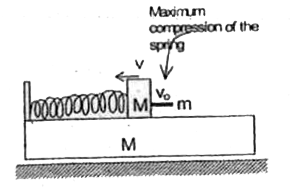 `rArr Delta KE=(m^(2)v_(0)^(2))/(2)[(1)/((M+m))-(1)/((2M+m))]=(m^(2)Mv_(0)^(2))/(2(M+m)(2M+m))` From conservation of mechanical energy `rArr (1)/(2)kx^(2)=(m^(2)Mv_(0)^(2))/(2(M+m)(2M+m))` `rArr x = SQRT((m^(2)Mv_(0)^(2))/(2k(M+m)(2M+m)))=mv_(0)sqrt((M)/(2k(M+m)(2M+m)))` |
|
| 40562. |
An uncharged sphere of metal is placed inside a charged parallel plate capacitor. The lines of force will look like : |
|
Answer»
|
|
| 40563. |
A non-ohmic resistor does not obey Ohm's law. Can such non- ohmic resistors be of any use? |
| Answer» Solution :ACTUALLY many useful COMPONENTS in the ELECTRICAL industry and in electronics are non-ohmic in nature. Diode, transistor, light emitting diodes (LED), THERMISTOR are all non-ohmic resistors (conductors). With out the non-ohmic resistors (conductors) there would have been no progress in electrons. | |
| 40564. |
Brilliance of diamond is due to the phenomenon of _____ |
| Answer» SOLUTION :TOTAL INTERNAL REFLECTION | |
| 40565. |
The path difference betweent the two waves y_(1)=a_(2) sin (omega t-(2pix)/(lambda)) and y_(2)= a_(2) cos (omega t-(2pi t)/(lambda)+phi) is |
|
Answer» `(LAMDA)/(2PI) PHI ` |
|
| 40566. |
A body of mass 10kg is on a rough inclined plane having an inclination of 30^(@) with the horizontal. If co-efficient of friciton between the surface of contact of the body and the plane is 0.25. Find the least force required to pull the body up. |
|
Answer» 70.2 N |
|
| 40567. |
The number of bands in TV broad casting is |
|
Answer» 1 |
|
| 40568. |
An equilateral prism is kept in air and for a particular ray angle of minimum deviation is38^@. If the prism is immersed in water theangle of minimum deviation =........ Refractive index of water is 1.33 |
|
Answer» SOLUTION :`RARR(n_g)/(n_a) = (sin""((60 + 38)/(20))^(@))/(sin 30^@)` Taking `n_a = 1 , n_g = (sin 49^@)/(sin 30^@) = 1.509` When prism is immersed in water, `n_(g)/(n_w) = (sin""((60 + delta_m)/(2)))/(sin 30^@)` But `n_w = 1.33` `therefore (1.509)/(1.33)=sin((60 + delta_m)/(2))^@/0.5` `thereforesin ((60 + delta_m)/(2))^@ = (0.5 xx 1509)/(1.33) = 0.5673` `therefore (60 + delta_m)/(2) = 34^@ 36.` `thereforedelta_m = 9^@ 12.` |
|
| 40569. |
A box and a solid sphere of equal mass are moving with the same velocity across a horizontal floor. The sphere rolls without slipping and the box without friction. They ecounter an upward slope in the floor and each move up the slope some distance before momentarily stopping and then moving downn again. The maximum vertical heights reached by the box and the sphere are H_(B) and H_(s) respectively. What is the ratio (5H_(s))/(H_(B)) ? |
|
Answer» `mgH_(s)=1/2mv^(2)+1/2Iomega^(2)=1/2mv^(2)+1/2xx1/2mr^(2)omega^(2)=1/2xx7/5mv^(2)` `(H_(s))/(H_(B))=7/5implies(5H_(s))/(H_(B))=7` |
|
| 40570. |
If the focal length of objective and eye lens are 1.2 cm and 3 cm respectively and the object is put 1.25 cm away from the objective lens and the final image is formed at infinity. The magnifying power of the microscope is |
| Answer» Answer :2 | |
| 40571. |
Discuss the diffraction at a grating and obtain the condition for the n^(th) maximum. |
|
Answer» Solution :A plane transmission grating is reperented by AB. Let a plane wavefront of monochromatic light with wavelenght `LAMBDA` be incident normally on the grating. As the slits SIZE is comparable to that of wavelenght, the incident light diffracts at the grating. A diffraction patteern is obtained on the screen when the diffracted waves are focused on a screen using a convex lens. Let US consider a point P at an angle `theta` with the normal drwan from the center of the gratng t the screen. The path difference `delta` between the diffracted waves from one pair of corresponding points is, `delta = (a + b) sin theta` This path difference is the same for any pair of corresponding points. The points P will be bright, when `delta = m lambda` where m = 0,1,2,3 Combining the above two equaitons, we get, `(a + b) sin theta = m lambda` Here, m is called order of diffraction. Condition for zero maximum, m = 0 For `(a + b) sin theta = 0`. the position, `theta = 0, sin 0 = 0 and m = 0`. This is called zero order diffraction or central maximum. Conditionfor second order maximum, m = 1, If `(a + b) sin thata_(1) = lambda`, the diffracted light MEET at an angle `theta_(1)` to the incidet direction and the first order maximum is obtained. Condition for second order maximum, m = 2 Similarly, `(a + b) sin theta_(2) = 2 lambda` forms the second order maximum at the angula positio `theta_(2)`. Condition for higher order maximum On EITHER side of central maxima different higher orders of diffraction maxima are formed at different angular position. It we take, `N = (1)/(a + b)` Then, N gives the number of grating elements or rulings drawn per unit width of the grating. Normally, this number N is specified on the grating itselt. Now, the equation becomes, `(1)/(N)sintheta=mlambda(or)sintheta=Nmlambda` 
|
|
| 40572. |
A uniform rope of length 5m is on a smooth horizontal surface. It is being pulled by a 5 horizontal force of 20 N at one end. The ratio of tension at a distance of 2m from force end i to tension at a distance of 2m from free end is, |
| Answer» ANSWER :D | |
| 40573. |
If radius of the sphere is doubled by keeping its mass constant, then the moment of inertia about any diameter. |
|
Answer» `I_2 = 2I_2` |
|
| 40574. |
Statement I : A signal which can have either O level or level is called a digital signal. Statement II : A signal which does not continuously vary with time is analog signal. |
|
Answer» STATEMENT I is true , statement II is false. |
|
| 40575. |
What is the distance on screen C in Fig. 35-11a between adjacent maxima near the center of the interference pat- tern? The wavelength lambda of the light is 546 nm, the slit separation d is 0.12 mm, and the slit-screen separation D is 55 cm. Assume that theta in Fig. 35-11 is small enough to permit use of the approximations sin theta ~~ tan theta ~~ theta, in which theta is expressed in radian measure. |
|
Answer» Solution :KEY IDEAS (1) First, let us pick a maximum with a low value of m to ensure that it is near the center of the pattern. Then, from the GEOMETRY of Fig. 35-11a, the maximum.s vertical distance `y_(m)` from the center of the pattern is related to its angle `theta` from the central axis by `tan theta ~~ theta =(y_(m))/(D)` (2) From Eq. 35-14, this angle o for the mth maximum is given by `sin theta ~~ theta =(m lambda)/(d)` Calculations: If we equate our two expressions for angle `theta` and then solve for `y_(m)`, we find `y_(m)=(m lambda D)/(d)""(35-20)` For the next maximum as we move away from the pattern.s center, we have `y_(m+1)=((m+1)lambda D)/(d)""(35-21)` We find the distance between these adjacent maxima by subtracting Eq. 35-20 from Eq. 35-21: `Delta y=y_(m+1)-y_(m)=(lambda D)/(d)` `=((546 xx 10^(-9) m)(55 xx 10^(-2) m))/(0.12 xx 10^(-3)m)` `= 2.50 xx 10^(-3) m ~~ 2.6 mm`. (ANSWER) As long as d and in Fig. 35-11a are SMALL, the separation of the interference fringes is independent of m, that is, the fringes are evenly spaced. |
|
| 40576. |
In beta-decay, the parent and daughter nuclei have the same number of |
|
Answer» |
|
| 40577. |
Thick/ follicular cells surrounding oocyte in Graafian follicle belong to |
|
Answer» ZONA pellucida |
|
| 40578. |
Write the advantages and disadvantages of robotic. |
|
Answer» SOLUTION :(i) Advantages of Robotics: • The robots are much cheaper than humans. Robots never get tired like humans. It can work for `24xx7`. Hence absenteeism in work place can be REDUCED. • Robots are more precise and error free in performing the task. (ii) Disadvantages of Robotics: • Robots have no sense of emotions or conscience. • They lack empathy and hence create an emotionless WORKPLACE. • If ultimately robots would do all the work, and the humans will just sit and monitor them, health HAZARDS will increase rapidly. |
|
| 40579. |
Explain the Motion of a charged particle in a uniform magnetic field. |
|
Answer» Solution :Consider a charged particle of charge q having mass m enters into a region of uniform magnetic field `vecB ` with VELOCITY `vecv` such that velocity is perpendicular to the magnetic field . As soon as the particle enters into the field , Lorentz force acts on it in a direction perpendicular to both magnetic field `vecB` and velocity `vecv`. `vecB` in  As a result, the charged particle moves in a circular orbit as shown in Figure . The Lorentz force on the charged particle is given by ` vecf = q( vecv xx vecB) ` Since Lorentz force aloneacts on the particle , the magnitude of the net force on the particle is ` sum_(i) F_(i) = F_(m) = q v B ` This Lorentz force acts as centripetal force for the particle to EXECUTE cirtular motion. Therefore, ` qvB = m v^(2)/r` The radius of the circular path is ` r = (mv)/(qB) = p/(qB) ` .......(1) where ` p = mv` is the magnitude of the LINEAR momentum of the particle. Let T be the time taken by the particle to finish one complete circular motion then ` T = (2 pi r)/ v` ......(2) Hence SUBSTITUTING (1) in (2) , we get ` T = (2pi m ) /( q B ) ` .....(3) Equation (3) is called the cyclotron period . The reciprocal of time period is the frequency f, which is ` f = 1/T` ` f = (qB)/(2 pi m) ` ......(4) In terms of angular frequency `omega`, ` omega = 2 pi f = q/m B` ......(5) Equation (4) and equation (5) are called as cyclotron frequency or gyrofrequency . From equations, we infer that time period and frequency depend only on charge - to - mass ratio ( specific charge ) but not velocityor the radius of the circular path . |
|
| 40580. |
If A={p,q,r,s} and B=(1,2,3), find which of the following is not a function from A to B? |
|
Answer» <P>R1 ={{p,1),(9,2).(r.1).(s.2) |
|
| 40582. |
How is Eddy current produced? How do they flow in a conductor ? |
| Answer» Solution :EVEN for a conductor in the form of a sheet or plate, an emf is induced when magnetic flux linked with it changes। But the difference is that there is no definite loop or path for induced current to flow away। As a result, the induced currents flow in concentric circular paths। As these ELECTRIC currents resemble EDDIES of water, these are KNOWN as Eddy currents। They are also CALLED Foucault currents. | |
| 40583. |
A bar has a magnetic moment equal to 5xx10^(-5) weberxxm. It is suspended in a magnetic field which has a magnetic induction (B) equal to 8pixx10^(-4) tesla. The magnet vibrates with a period of vibration equal to 15 sec. The moment of intertia of the magnet is |
|
Answer» `4.54 x 10^(4)` KG `m^(2)` |
|
| 40584. |
Briefly explain the nature of light. |
|
Answer» Solution :We have learnt that wave nature of light explains PHENOMENA such as interference, diffraction and polarization. Certain phenomena like black body radiation, photoelectric effect can be explained by assigning particle nature to light. Therefore, both theories have enough experimental evidences. In the past, many scientific theories have been either revised or discarded when they contradicted with new experimental results. Here, two different theories are needed to ANSWER the question : what is nature of light ? It is therefore concluded that light possesses DUAL nature, that of both particle and wave. It behaves like a wave at some circumstances and it behaves like a particle at some other circumstances. In other words, light behaves as a wave during its propagation and behaves as a particle during its interaction with matter. Both theories are NECESSARY for complete description of physical phenomena. Hence, the wave nature and QUANTUM nature complement each other. |
|
| 40585. |
The internal energy of a thermodynamic system remains constant when it undergoes |
|
Answer» any process in which the HEAT given out by the system equals to the WORK done when it undergoes |
|
| 40587. |
A wire PQ of mass 10 g is at on tow parallel horizontal metal rails. The spearation between the rails is 4.9 cm A magnetic field of 0.80 tesla is applied perpendicular to the plane of the rails, directed inwards . The resistance of the circuit is slowly decreased . When the resistance decreases to below 20 ohm, the wire PQ begins to slide on the rails. Calculate the coefficient of friction between the wire and the rails |
|
Answer» Solution :Wire PQ begins to slide When magnetic force is just EQUAL to the force of friction, i.e ., `mu mg = il B sin theta (theta=90^0)` Here, `i = (E)/(R) = 6/20 = 0.3 A, ` `mu= (ilB)/(mg) = ((0.3)XX(4.9 xx 10^(-2))(0.8))/((10xx 10^(-3))(9.8)) = 0.12` |
|
| 40588. |
Out of the two bubls marked 25W and 100W, which one has the higher resistance, if voltage rating is same? |
|
Answer» <P> Solution :Power, `P prop (1)/(R ):.` ONE with lower power rating will have HIGHER resistance. So, 25W will have more resistance. |
|
| 40589. |
A projective of 2kg was velocities 3mls and 4mls at two points during its flight in the uniform gravitational field of the earth. If these two velocities are botto each other then the minimum KE of the particle during its flight is |
Answer» Solution :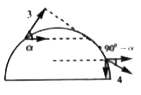 `V_(1)cos alpha =V_(2)cos(90-alpha)` `3COS alpha=4 sin alpha` `tan alpha =3/4` `KE_("man") =1/2mv_(1)^(2) cos^(2)alpha` `1/2 xx 2 xx 3 xx (4/5)^(2) =(9 xx 16)/25 = 5.76` J |
|
| 40590. |
What is plot a graph how for a given photosensitive material cutt off voltage and threshold frequency are related ? |
|
Answer» Solution :Acc. to Einstein.s photoelectric EQUATION the maximum K.E. of PHOTOELECTRONS is given by `K_max = hv - W_0`. If `V_0` is the atopping potential, then `K_max = eV_0` or `eV_0 = hv - W_0` `V_0`=(h/e)V-`W_0/e` So, if we plot a GRAPH `V_0 ~` v is a straight line. 
|
|
| 40591. |
ln a biprism experiment, 21 fringes are seen distinctly on a screen at a distance 1 m, when the sources are 0.5 mm apart. What is the coherent length and coherent time of the set-up. (lamda =6000 Å) |
|
Answer» |
|
| 40592. |
Effective resistance between A and B in the given circuit it is |
| Answer» ANSWER :D | |
| 40593. |
What is Gaussian surface ? |
| Answer» Solution :An imaginary CLOSED surface enclosing a CHARGE is CALLED the GAUSSIAN surface of that charge. | |
| 40594. |
A polyatomic gas has f virational degrees of freedom, then the ratio of the specific heat at constant pressure to that at constant volume will be |
|
Answer» <P>`(4 + f)/(3 +f )` Now, `C _(p) = C_(v) + R` ` C _(P)= (3+ f) R+R` `C_(p) = (4+f) R` Now, ratio of `C _(p) and C_(v)` `(C_(p))/(C_(v)) = (4+f )/(3+ f)` |
|
| 40595. |
In Lyman series the wavelength lambda of emitted radiation is given by (R is rydberg constant) |
|
Answer» `1/lambda=R(1/2^2-1/n^2), n=3,4,5,.....` |
|
| 40596. |
Derive an expression for the half-life of a radio active nuclide. |
Answer» SOLUTION :Radioactive law : The rate of disintegration of radio active ATOMS present in the SAMPLE of an element is directlyproportional to the number of radioactive atoms present at that instant. 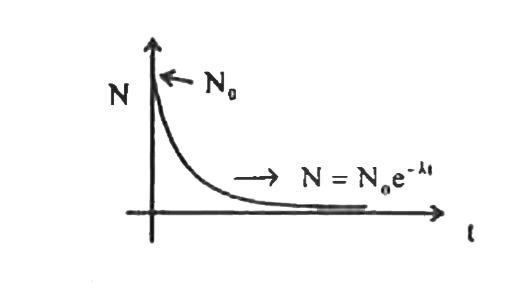 i.e.,`(dN)/(dt) prop N` or `(dv)/(dt)=-lambdaN` where `lambda` is known as the disintegration constant .The -ve sign indicates that thenumber of radioactive nuclei/atomsdecreases with the passage of TIME. Hence,`(dN)/N=-lambdadt` Integrating both sides we get `log_e=-lambda t +C` Applying the initial conditionfor `t=0 , N=N_0` We get , `C=log_e N_0` i.e.,`log_e (N/N_0)=-lambdat` or `N/N_0=e^(-lambdat)` Hence,`N=N_0e^(-lambdat)` A graph.N. v/s time .t. gives the exponential curve as shown in the figure. |
|
| 40597. |
An aeroplane of mass M requires a speed v for take off. The length of runway is s and the coefficient of friction between the tyres and the ground is mu. Assuming that the plane accelerates uniformly during the take-off, the minimum force required by the engine of the plane for take off is: |
|
Answer» `M((v^2)/(2S) + MU G)` |
|
| 40598. |
Charge Q on a capacitor varies with voltage V as shown in the figure, where Q is taken along the X-axis and V along the Y-axis. The area of triangle OAB represents |
|
Answer» capacitance |
|
| 40599. |
A diffraction pattern is obtained using a beam of redlight. What happens if the red light is replaced by blue light |
|
Answer» no change |
|
| 40600. |
A bar magnet has a pole strength of 3.6 A m and magnetie length 8 in. Then, choose the correct option(s). |
|
Answer» Magnetic field at a point on the axis at a distance of 6 cm from the CENTRE towards the north pole is `8.6 xx 10^(-4)` T. `B = mu_(0)/(4pi)(2Md)/((d^(2)-l^(2))^(2))` `10^(-7) = (Tm)/A xx(2xx3.6Am xx0.08m xx 0.06m)/([(0.06)^(2)-(0.04m)^(2)]^(2))` ` = 8.6 xx 10^(-4)T` The field will be away from the magnet. when, the point is in broadside-on position so the field is, `B = mu_(0)/(4pi)M/(d^(2)+l^(2))^(3//2)` `= 10^(-7) (Tm)/A xx (3.6Am xx 0.08m)/([(0.06 m)^(2)+(0.04m)^(2)]^(3//2))` `= 7.7 xx 10^(-5) T` The field will be parallel to the magnet. |
|


