

Saved Bookmarks
This section includes 7 InterviewSolutions, each offering curated multiple-choice questions to sharpen your Current Affairs knowledge and support exam preparation. Choose a topic below to get started.
| 1. |
Alkylhalides have polar C-X bond and undergo nucleophilic substitution reactions. These give a variety of products with nucleophiles such as -OH, -OR, -NH_(2), -CN, -NC, -NO_(2), -ONO, RCOO^(-), etc. They undergo mainly two types of nucleophilic substitution reactions, S_(N)1 and S_(N)2. S_(N)1 reactions are two steps reactions which proceed through the formation of carbocations while S_(N)2 reactions are one step reaction which proceeds through the formation of transition state. The stability of carbocation and transition state determine the reactivity of alkyl halides. Write the main products A and B in the following reaction. A overset(KNO_(2))larr CH_(3)CH_(2)Br overset(AgNO_(2))to B. |
|
Answer» SOLUTION :A: `CH_(3)CH_(2)-O-N=O` (ETHYL nitrite) B: `CH_(3)CH_(2)NO_(2)` (NITROETHANE) |
|
| 2. |
Alkylation of phenoxide anion with allyl chloride gives |
|
Answer» Phenyl allyl 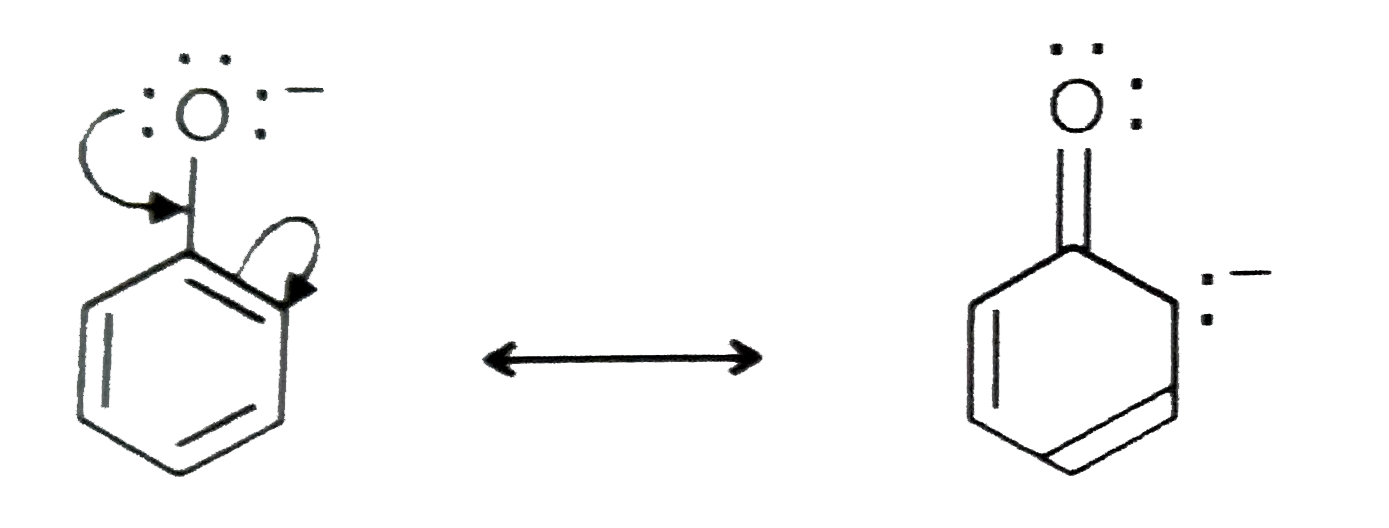
|
|
| 3. |
Alkyl halides undergo nucleophilic substitution reactions in which halogen atom is replaced by other atom. RX + Nu:^(-) to Nu-R + X^(-) These reactions follow S_(N)1 and S_(N)2 type mechanism, in which S_(N)1 takes place in two steps while S_(N)2 takes place in single step. Due to their tendency to undergo substitution by a large number of nucleophiles, they form a variety of products. In which of the following pairs, the first compound is better S_(N)2 substrate ? |
|
Answer» 1-bromo-1-methyl cyclohexane, CYCLOHEXYL BROMIDE |
|
| 4. |
Alkyl halides undergo nucleophilic substitution reactions in which halogen atom is replaced by other atom. RX + Nu:^(-) to Nu-R + X^(-) These reactions follow S_(N)1 and S_(N)2 type mechanism, in which S_(N)1 takes place in two steps while S_(N)2 takes place in single step. Due to their tendency to undergo substitution by a large number of nucleophiles, they form a variety of products. In which of the following pairs, the first nucleophile is stronger? |
|
Answer» `Cl^(-), I^(-)` |
|
| 5. |
Alkyl halides undergo nucleophilic substitution reactions in which halogen atom is replaced by other atom. RX + Nu:^(-) to Nu-R + X^(-) These reactions follow S_(N)1 and S_(N)2 type mechanism, in which S_(N)1 takes place in two steps while S_(N)2 takes place in single step. Due to their tendency to undergo substitution by a large number of nucleophiles, they form a variety of products. Which of the following is least reactive towards S_(N)2 mechanism ? |
|
Answer» `(CH_(3))_(2)CHCH_(2)BR` |
|
| 6. |
Alkyl halides react with dialkyl copper reagent to give |
|
Answer» ALKYL COPPER halides |
|
| 7. |
Alkylhalides onreductionwiththe Zn-Cucoupleand alcohol, givecorrespondingalkanes . Theorderof reactivityof alkylhalidesthereactiionis __________. |
|
Answer» R-ClgtR-BrgtR-I |
|
| 8. |
Alkyl halides can be obtained by all methods except : |
|
Answer» `CH_(3)CH_(2)OH+HCl//ZnCl_(2)to` 
|
|
| 9. |
Alkyl halides are prepared from alcohol by treating with: |
|
Answer» `HCl+ZnCl_(2)` |
|
| 10. |
Alkoxides of beryllium [Be(OR)_(2)]_(6) usually have associated strutures with both mu_(2) - bridging and terminal OR groups. For example [Be(OCH_(3))_(2)]_(6) is a high polymer insoluble in hydrocarbon solvents. On the other hand, tertiary - butoxy derivative is less condensed being only a trimer [Be(O-t-Bu)_(2)]_(3) The vapour phase, BeCI_(2) is |
|
Answer» two coordinate with lienar STRUCTURE |
|
| 11. |
Alkoxides of beryllium [Be(OR)_(2)]_(6) usually have associated strutures with both mu_(2) - bridging and terminal OR groups. For example [Be(OCH_(3))_(2)]_(6) is a high polymer insoluble in hydrocarbon solvents. On the other hand, tertiary - butoxy derivative is less condensed being only a trimer [Be(O-t-Bu)_(2)]_(3)The C - Be - C angle [Be(CH_(3))_(2)]_(n) is |
|
Answer» Equal to CI - Be - C angle in `[Be(CI_(2))]_(n)` |
|
| 12. |
Alkoxides of beryllium [Be(OR)_(2)]_(6) usually have associated strutures with both mu_(2) - bridging and terminal OR groups. For example [Be(OCH_(3))_(2)]_(6) is a high polymer insoluble in hydrocarbon solvents. On the other hand, tertiary - butoxy derivative is less condensed being only a trimer [Be(O-t-Bu)_(2)]_(3) With bulky alkoxide groups the beryllium compound exists as monomers which have |
|
Answer» Linear structure with `180^(@)` BOND angle |
|
| 13. |
Alkenes usually show which type of reaction |
|
Answer» ADDITION |
|
| 14. |
Alkenes undergo electrophilic addition with many reagents like HX, H_2O, HOCI etc. Except in the case of addition of X_2^(-) in other additions carbocation is formed as intermediate. The rate of such reactions depends on the stability of carbocation. Rearrangements and ring expansion are also common in such reactions. Propene on reaction with HI in presence of peroxide will give |
|
Answer» 2-iodo PROPANE |
|
| 15. |
Alkenes undergo electrophilic addition with many reagents like HX, H_2O, HOCI etc. Except in the case of addition of X_2^(-) in other additions carbocation is formed as intermediate. The rate of such reactions depends on the stability of carbocation. Rearrangements and ring expansion are also common in such reactions. 1-methylcyclohex-1-ene is subjected to hydro-boration oxidation. The product is |
|
Answer» Cis-2-methyl CYCLOHEXANOL 
|
|
| 16. |
Alkenes undergo electrophilic addition with many reagents like HX, H_2O, HOCI etc. Except in the case of addition of X_2^(-) in other additions carbocation is formed as intermediate. The rate of such reactions depends on the stability of carbocation. Rearrangements and ring expansion are also common in such reactions. The correct order of reactivity of the following towards electrophilic addition is P) Vinyl chlorideQ) Pent-2-ene R) 3-methyl pent-2-eneS) 2,3-dimethyl but-2-ene |
|
Answer» `P gt Q gt R gt S `  Stability DECREASES a number of `alpha-H` atom decreases reactively decreases. |
|
| 17. |
Alkenes are also known as |
| Answer» Answer :A | |
| 18. |
Alkenes andalkynes are unsaturatedhydrocarbons and undergo electrophilic addition reactions. In alkenes, the addition occursin one step while in alkynes the addition occurs in twosteps. Alkenes show geometrical isomerism but alkynes do not. Alkynes are more acidic than alkenes which are more acidic than alkanes. Both alkenes and alkynes can be preparedby the electrolysisofsodium orpotassium salts of carboxylic acids. Which of the followingreacts with [Cu(NH_(3))_(2)]OH ? (i) But-1-yne(ii) But-2-yne(iii) But-1-ene |
| Answer» SOLUTION :(i) But-1-yne | |
| 19. |
Alkene R-CH=CH_(2) react with B_(2)H_(6) in the presence of H_(2)O_(2) to give |
|
Answer» `R-UNDERSET(O)underset(||)(C)-CH_(3)` This is called as Hydroboration OXIDATION. |
|
| 20. |
Alkene and alkyne gives electrophilic addition reaction, while benzene gives electrophilic substitution reaction. Give reason. |
|
Answer» Solution :Due to resonance effect, wide spreaded delocalised `pi`-electron and aromaticity benzene RING is stable, so in benzene substitution reaction occurs easily with respect to addition reaction. Also BREAKING of `pi`-BOND in benzene is DIFFICULT so benzene gives substitution reaction. In substitution reaction, stability of benzene ring remains, sosubstitution reaction occurs easily in comparison to addition reaction. In alkene and alkyne, `pi`-bond easily breaks and hence, it favour the addition reaction. |
|
| 21. |
Alkene can be converted in to oxirane by using which of the following |
|
Answer» `O_2// AG ` |
|
| 22. |
Alkene(A) and (B) yield the same alcohol (C) on hydration. On vigorous oxidation with KMnO_4, (A) gives a carbonyl compound (D) and an acid (E) each containing four carbon atoms. On the other hand (B) gives an aicd (F) and a carbonyl compound (G), In (G), no two identical groups are attached to the same carbon atom. Give structures of (A) to (G) with proper resoning. |
|
Answer» Solution :Akene (A) on OXIDATION gives a CARBONYL compound (D) and an acid (E). Each having for carbon atoms. THUS, the probable structure of (A) may be, `CH_3-CH_2underset(CH_3)underset(|)C=CH-CH_2-CH_3` or `CH_3-CH_2-underset(CH_3)underset(|)C=CH-underset(CH_3)underset(|)CH-CH_3`. Alkene (B) gives an acid (F) and a carbonyl compound (G). Alkene (B) gives same alcohol on hydration and is ISOMERIC to (A) the carbonyl compound (G) has no carbon atom having two identical groups. Thus, the structure of (B) should be , `underset((B))(CH_3-CH=underset(CH_3)underset(|)C-CH_2-CH_2-CH_2-CH_3)` The alkene (A) should also posses the corresponding structure, thus , structures of (A) is ,`underset((A))(CH_3-CH_2-underset(CH_3)underset(|)C=CH-CH_2-CH_2-CH_3)` REACTIONS : 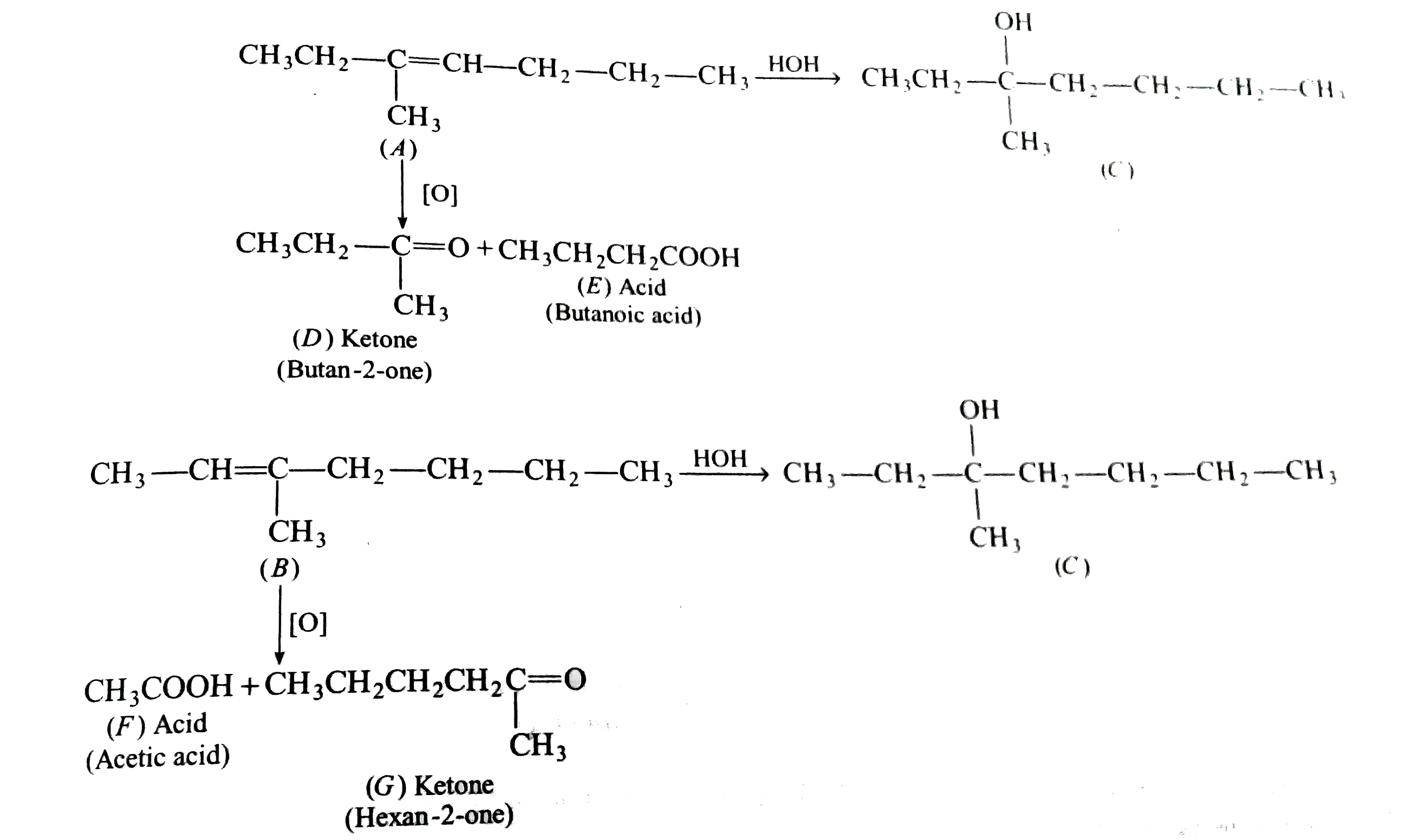
|
|
| 23. |
Alkanes with how many carbons are solids at rooms temperature |
|
Answer» above `C_(17)` |
|
| 24. |
Alkanes with how many carbons are solids at room temperature |
|
Answer» Above `C_(17)` |
|
| 25. |
Alkanes mainly undergo substitution reactions using the free - radical mechanism. |
|
Answer» |
|
| 26. |
Alkanesmainlyexhibit ______reaction. |
|
Answer» |
|
| 27. |
Alkanes having odd carbons cannot be prepared in A) Wurtz reaction B) Frankland reaction C) Kolbe's electrolysis D) Sabatier-sendersen reaction |
| Answer» Answer :B | |
| 28. |
Alkanes containing even number of carbon atoms possess higher melting points than those containing odd number of carbon atoms. |
|
Answer» |
|
| 29. |
Why do alkynes not show geometrical isomerism ? |
|
Answer» |
|
| 30. |
Alkanes can be prepared from sodium (or) potassium salts of carboxylic acid by using Kolbe'selectrolysis or decarboxylation with the help of sodalime. (NaOH and CaO)Sodium salt of carboxylic acid required to prepare Butane by Kolbe's electrolysis |
|
Answer»

|
|
| 31. |
Alkanes can be prepared from sodium (or) potassium salts of carboxylic acid by using Kolbe'selectrolysis or decarboxylation with the help of sodalime. (NaOH and CaO)Which of the Alkane cannot be prepared by Kolbe's electrolysis |
|
Answer» `C_4H_(10)` 
|
|
| 33. |
Alkanes are also referred to as............. and have the general formula …… . |
| Answer» SOLUTION :PARAFFINS, `C_nH_(2N + 2)` | |
| 34. |
Alkane may be prepared from alkyl halide by Wurtz method where alkyl halide reacted with Na in presence of ether . 2R - X underset(Delta)overset("Ether")to R - R + 2NaX Which of the following compound is most reactive for Wurtz reaction ? |
|
Answer» `CH_3-OVERSET(BR)overset(|)CH-CH_3` 
|
|
| 35. |
Alkane may be prepared from alkyl halide by Wurtz method where alkyl halide reacted with Na in presence of ether . 2R - X underset(Delta)overset("Ether")to R - R + 2NaX CH_3 - underset(CH_3)underset(|) overset(CH_3)overset(|)C-Br underset(Delta)overset("Na/ether")to Major product : |
|
Answer»

|
|
| 36. |
CH_3 - CH_2 - Cl underset(Delta)overset("Na/ether")(to)which of the following products may not be formed |
|
Answer» |
|
| 37. |
"Alkane compounds normally resist the oxidation", what it mean ? |
| Answer» Solution :Formation of oxidized product by DECOMPOSITION of C-H bond in ALKANE is not an easy process and HENCE we can CONSIDER alkane to resist the OXIDATION. | |
| 38. |
"Alkane compound resist the oxidation", so what is your opinion for the following reaction ? C_(4)H_(10(g)) + (13)/(2)O_(2(g)) rarr 4CO_(2(g)) + 5H_(2)O_((l)) |
|
Answer» Solution :The given REACTION is of combustion of butane. Combustion is also an oxidation reaction, so in this reaction also oxidation occur. The negativity of C (2.5) and H (2.1) in reactant `C_(4)H_(10)`, so negativity of carbon is more and so it possess negativestate, while in product `CO_(2)`, carbon possess +4 oxidation state. So in this reaction oxidation number of carbon INCREASES and so this reaction is of oxidation. "Combustion of all alkane is ultimately oxidation reaction only". |
|
| 39. |
Alkane (A) reacts with bromine by substitution to form an alkyl bromide which by Wurtz reaction is converted into another alkane containing less than four carbon atoms. (A) is |
|
Answer» Solution :(i)Let A beR-H, on BROMINATION , it will give R-Br `underset"Alkane (A)" (R-H)+ Br_2 overset"hv"to underset"Alkyl bromide"(R-Br)+HBR ` (ii)Now Wurtz reaction of alkyl bromide gives alkane (B) `R-Br + 2Na + Br-R overset"Heat"to underset"Alkane (B)"(R-R) + 2NaBr` (iii)SINCE alkane (B) contains less than four carbon atoms, therefore , R can have only one carbon atom. In other words , R is `CH_3` and hence alkane (A) is `CH_4` All the reactions INVOLVED here are : `underset"Methane (A)"(CH_4)underset"-HBr"overset(Br_2)to underset"Methyl bromide "(CH_3Br) underset"(Wurtz reaction)"overset"Na, Dry ether"to underset"(Less than 4 carbon atoms )"(CH_3-CH_3)` |
|
| 40. |
Alkaline KMnO_(4) solution converts acetylene into |
|
Answer» ACETALDEHYDE |
|
| 41. |
Alkaline hydrolysis of urea with dill. NaOH gives |
|
Answer» BIURET and ammonia 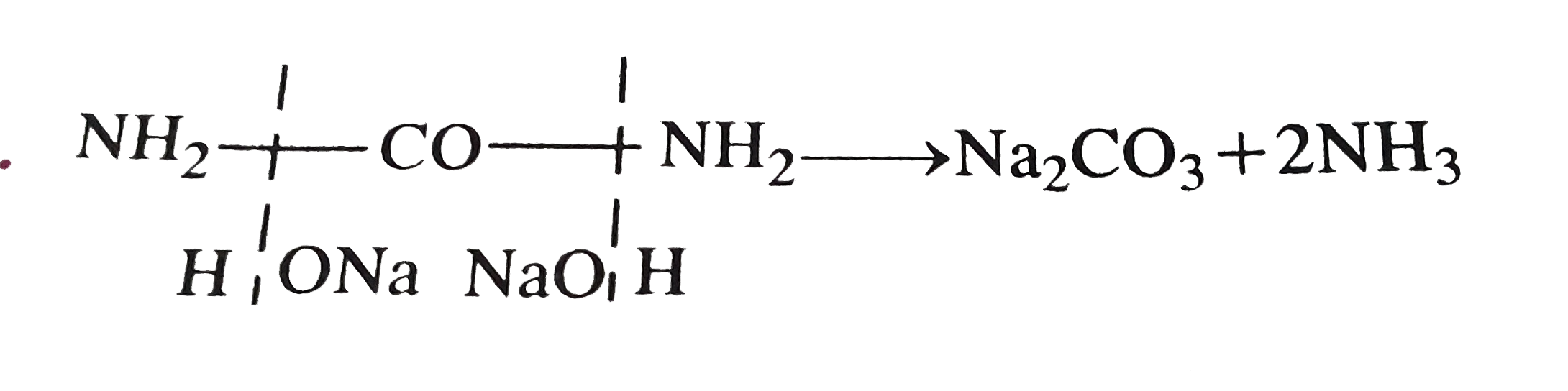
|
|
| 42. |
Alkaline earth metals produce ....... color on solubilizing in ammonia solution. |
|
Answer» Brown |
|
| 43. |
Alkaline earth metals form basic hydroxides. The metal hydroxide which is most basic is ___________ |
| Answer» Answer :D | |
| 44. |
Alkaline earth metals form halides of the type MX_(2) Which is false about them ? |
|
Answer» They can be PREPARED by the direct reaction of METAL and halogens |
|
| 45. |
Alkaline earth metals exhibit +2 oxidation state in aqueous solution due to |
|
Answer» SMALL SIZE of metal atoms |
|
| 46. |
Alkalineearthmetalsbelong to the |
|
Answer» <P>S- BLOCKIN PERIODICTABLE |
|
| 47. |
Alkaline earth metals are |
|
Answer» Monovalent |
|
| 48. |
Alkaline earth metals always form divalent cations even through their second ionization enthalpies are almost double than their first ionization enthalpies . Explain . |
| Answer» Solution :In the solid state , higher enthalpy of lattice formationby `M^(2+)` ions (as compared to `M^(+)`ions) more than compensates the higher SECOND ionization enthalpies of METALS and in AQUEOUS solution , higher enthalpy of HYDRATION of `M^(2+)` ions (as compared to `M^(+)` ions) more than compensates the higher second ionization enthalpy | |


