

Saved Bookmarks
This section includes 7 InterviewSolutions, each offering curated multiple-choice questions to sharpen your Current Affairs knowledge and support exam preparation. Choose a topic below to get started.
| 1. |
Alk aline earth metal (A), belongs to 3rd period reacts with oxygen and nitrogen to form compound (B) and (C) respectively. It undergo metal displacement reaction with AgNO_3 solution to form compound (D). |
|
Answer» Solution :(i) An alkaline earth (A) metal belongs to third period is magnesium (Mg) (ii) Magnesium REACTS with oxygen to form magnesium oxide (MgO) (B) `2Mg +O_(2)tounderset(Magnesium oxide)(2MgO_(2))` (iii) Magnesium reacts with NITROGEN to form magnesium nitride `Mg_(3)N_(2)(C)` `3Mg+N_(2)O_(2)tounderset("Magnesium nitride")(Mg_(3)O)` (iv) Magnesium UNDERGOES metal displacement reaction with `AgNO_(3)` solution to form magnesium nitrate `Mg(NO_(3))_(2) (D)` `Mg+2AgNO_(3) tounderset("Magnesium nitrate") (Mg(NO_(3))_(2) +)2AG` 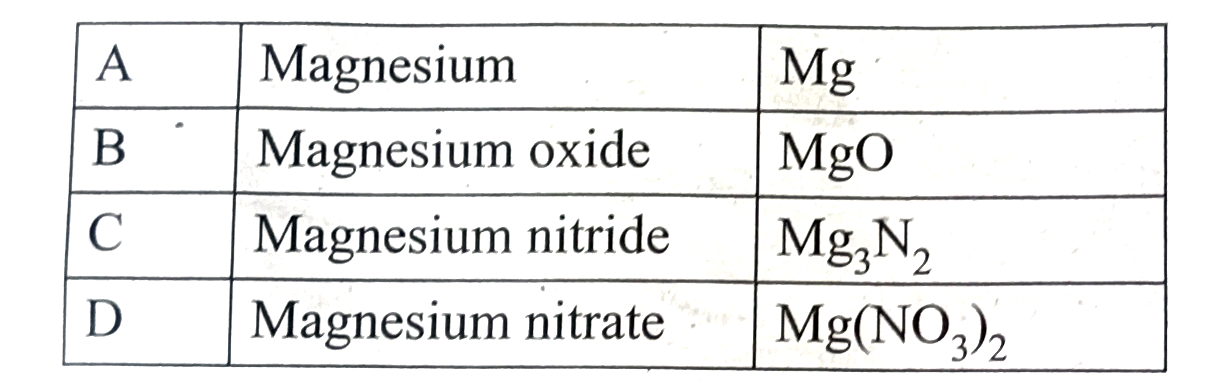
|
|
| 2. |
Alkali metals when exposed to air tarnish quickly due to the |
|
Answer» FORMATION of their HYDROXIDES |
|
| 4. |
Alkali metalstaenishin dryairbecause______. |
|
Answer» theyreactwithoxygento formcorrespodingoxides |
|
| 5. |
Alkali metals readily react with oxyacids forming corresponding salts (like M_(2)CO_(3), MHCO_(3), MNO_(3), M_(2)SO_(4) etc) with evolution of hydrogen. They also dissolve in liquid NH3 but without the evolution of hydrogen. The colour of its dilute solution is blue when it is heated and concentrated, then its colour becomes bronze Among the carbonates of alkali metals which one has highest stability |
|
Answer» `Cs_(2)CO_(3)` |
|
| 6. |
Alkali metals react with water vigorously to form hydroxides and dihydrogen . Which of the following alkali metal reacts with water least vigorously ? |
|
Answer» Li Although the heat of reaction of Li is thehighest but DUE to its high melting POINT , EVEN the heat is not sufficient to melt the METAL thereby exposing greater surface to water for reaction . as a result , Li has the least reactivity by the reactivity increases as the m.p. of the alkali metals decrease down the group from Li to Cs . |
|
| 7. |
Alkali metals react with water vigorously to form hydroxides and dihydrogen. Which of the following alkali metals reacts with water least vigorously? |
|
Answer» Li |
|
| 8. |
Alkali metals react with water vigorously to form hydroxides and dihydrogen. Which of the following alkali metals reacts with water least vigorously |
|
Answer» LI `THEREFORE`Li has least REACTIVITY |
|
| 9. |
Alkali metalsreactoxygento form_______ |
|
Answer» NITROGENGAS |
|
| 10. |
Alkalimetals(otherthanlithium) formamidesof thegeneralformula ______. |
|
Answer» MNH |
|
| 11. |
Alkali metals on reaction with enough amount of oxygen can form... |
|
Answer» SUPER oxide |
|
| 12. |
Alkali metals never found in free state in nature. Why? |
| Answer» Solution :The loosely HELD "s" ELECTRON in the outermost shell of these elements make them electropositive METALS. They readily lose electron to give monovalent M ions. HEN never found in free state in nature. | |
| 13. |
Alkali metals loseelectronsin _______. |
|
Answer» <P>s-ORBITALS |
|
| 14. |
Alkali metals impart colour to bunsen flame due to |
|
Answer» low ionization ENERGIES |
|
| 15. |
Alkali metals have negative reduction potential and hence they behave as |
|
Answer» Oxidising agents |
|
| 16. |
Alkali metals have low melting and boiling point. Density of alkali metals is very low. Give reason |
| Answer» Solution :LT is DUE to weak metallic BONDS and large atomic SIZE. | |
| 17. |
Alkali metals give colour in Bunsen flame due to |
|
Answer» LOW IONISATION POTENTIAL |
|
| 18. |
Alkali metals exhibit high chemical reactivity Give reason. |
|
Answer» Solution :(i) Alkali metals exhibit high chemical reactivity because of their low ionization enhalphy and their larger SIZE (ii) The reactivity of alkali metals increases from Li to CS, since the value of ionization energy decreases down the group (from Li to Cs) (iii) All alkali metals are highly reactive TOWARDS the more ELECTRONEGATIVE elements such as oxygen and HALOGENS. |
|
| 19. |
Alkali metals are usually stored in hydrocarbon solvents to protect them from air and moisture but lithium cannot . Why ? |
| Answer» SOLUTION :Lithium cannot be STORED in KEROSENE oil since it floatsover kerosene and other hydrocarbon solvents because of its very low density . Therefore , lithium is usually kept WRAPPED in paraffin wax. | |
| 20. |
Alkali metals contain |
|
Answer» 7 VALENCE electrons |
|
| 21. |
Alkali metals are strongly electropositive or metalic in character. Why ? |
| Answer» SOLUTION :Alkali metals are strongly electropositve because of their low IONIZATION enthalpies, these metals have a strong tendency to LOSE their valence electrons. | |
| 22. |
Alkali metals are soft and have low melting point and boiling point due to |
|
Answer» INTER atomic BONDS are weak |
|
| 23. |
Alkali metals are stored under oil. Give reason. |
| Answer» Solution :ALKALI METALS are so REACTIVE and they have to be STORED under OIL. Because when they are kept in air, they will burn immediately. | |
| 24. |
Alkali metals are stored in... |
|
Answer» Water |
|
| 25. |
Alkali metals are so named because |
|
Answer» of their LARGE atomic sizes |
|
| 26. |
Alkali metals are paramagentic but their salts are diamagnetic . Explain . |
| Answer» Solution :Alkali metals contain one unpaired electron `(ns^(1))` and hence are paramagnetic . However , during SALT formation , this unpaired electron is transferred to the non-metallic atom forming its anion . As a result , salt has PAIRED ELECTRONS both in the CATION as well as in the anion and hence alkali metal salts are diamagnetic in NATURE . | |
| 27. |
Alkali metals are kept under ........because they are highly........and get .....when exposed to air. |
| Answer» SOLUTION :KEROSENE, REACTIVE, TARNISHED | |
| 28. |
Alkali metals are highly reactive due to.... |
|
Answer» SMALLER SIZE and low IONIZATION ENERGY. |
|
| 29. |
Alkali metals are good conductors of electricity. Why? |
| Answer» Solution :Alkali metals have low ionization energy. Hence they SHOW METALLIC CHARACTER. They are good conductors of electricity DUE to the presence of mobile valence ELECTRONS. | |
| 30. |
Alkali metals are good |
|
Answer» OXIDISING AGENTS |
|
| 31. |
Alkali metals are characterised by |
|
Answer» GOOD CONDUCTOR of heat and electricity |
|
| 32. |
Alkali metal iodide(s) aqueous solution(s) of which can dissolve I_(2) to form MI_(3) is (are) |
|
Answer» K |
|
| 33. |
Alkali metal oxides are soluble in |
|
Answer» Carbon tetrachloride |
|
| 34. |
Alkali metal hydrides are strong reducing agents. Prove this statement. |
| Answer» Solution :The decrease in IONIZATION ENTHALPY down the group permits easy availability of electrons to forms `H^(+)` ions. So, the hydrides BEHAVE as reducing agent. Their reducing nature INCREASES down the group | |
| 35. |
Alkali metal halides can be prepared by the reaction of aquesous hydrohalic acid with |
|
Answer» Alkali METAL oxide |
|
| 36. |
Alkali metal element have low melting point and boiling point, because... |
|
Answer» WEAK metallic bond. |
|
| 37. |
Alkali metal carbonates are stable but carbonates of alkaline earth metals decompose on heating to liberate CO_(2) Why? |
|
Answer» Solution :Polarising power of ALKALINE earth metal cations is more than that of alkali metal cations because of small size and HIGH charge. Alkaline earth metal cations polarise a large `CO_(3)^(2-)` ion leading to the formation of more stable oxide (MO) and liberate `CO_(2)` gas. `MCO_(3)rarrMO+CO_(2)UARR` |
|
| 38. |
Alkali metal are __________ reactive. |
|
Answer» highly |
|
| 40. |
Alkali and alkaline earth metals along with hydrogen and helium constitute s-block elements . They have low ionization enthalpies and hence exhibit characteristic flame colouration . They have highly negative electrode potentials and hence are strong reducing agents . Their solutions in liquid ammonia are conducting and also act as strong reducing agents than hydrogen , they are usually prepared by electrolysis of their fused chlorides . Their oxides are basic and the basic strength increases down the group . The solubility of carbonates and sulphates of alkali and alkaline earth metals show opposite trends . The carbonates of alkaline earth metals and lithium carbonate decompose on heating while the carbonates of other alkali metals do not decompose on heating . The bicarbonates of both alkali and alkaline earth metals on heating give carbonates . Which of the following process is used in the extractive metallurgy of magnesium ? |
|
Answer» fused salt electrolysis |
|
| 41. |
Alkali and alkaline earth metals along with hydrogen and helium constitute s-block elements . They have low ionization enthalpies and hence exhibit characteristic flame colouration . They have highly negative electrode potentials and hence are strong reducing agents . Their solutions in liquid ammonia are conducting and also act as strong reducing agents than hydrogen , they are usually prepared by electrolysis of their fused chlorides . Their oxides are basic and the basic strength increases down the group . The solubility of carbonates and sulphates of alkali and alkaline earth metals show opposite trends . The carbonates of alkaline earth metals and lithium carbonate decompose on heating while the carbonates of other alkali metals do not decompose on heating . The bicarbonates of both alkali and alkaline earth metals on heating give carbonates . The metal that produces red-violed colour in the non-luminous flame is |
| Answer» ANSWER :B | |
| 42. |
Alkali and alkaline earth metals along with hydrogen and helium constitute s-block elements . They have low ionization enthalpies and hence exhibit characteristic flame colouration . They have highly negative electrode potentials and hence are strong reducing agents . Their solutions in liquid ammonia are conducting and also act as strong reducing agents than hydrogen , they are usually prepared by electrolysis of their fused chlorides . Their oxides are basic and the basic strength increases down the group . The solubility of carbonates and sulphates of alkali and alkaline earth metals show opposite trends . The carbonates of alkaline earth metals and lithium carbonate decompose on heating while the carbonates of other alkali metals do not decompose on heating . The bicarbonates of both alkali and alkaline earth metals on heating give carbonates . The compound insoluble in acetic acid is |
|
Answer» calcium oxide |
|
| 43. |
Alkali and alkaline earth metals cannot be obtained by chemical reduction method . Explain . |
| Answer» SOLUTION :SINCE they are themselves stronger REDUCING agents thanmajority of the COMMON reducing agents used . | |
| 44. |
Alkali and alkaline earth metals along with hydrogen and helium constitute s-block elements . They have low ionization enthalpies and hence exhibit characteristic flame colouration . They have highly negative electrode potentials and hence are strong reducing agents . Their solutions in liquid ammonia are conducting and also act as strong reducing agents than hydrogen , they are usually prepared by electrolysis of their fused chlorides . Their oxides are basic and the basic strength increases down the group . The solubility of carbonates and sulphates of alkali and alkaline earth metals show opposite trends . The carbonates of alkaline earth metals and lithium carbonate decompose on heating while the carbonates of other alkali metals do not decompose on heating . The bicarbonates of both alkali and alkaline earth metals on heating give carbonates . Which of the following are arranged in increasing order of solubilities ? |
|
Answer» `CaCO_(3) lt KHCO_(3) lt NaHCO_(3)` |
|
| 45. |
Alkali and alkaline earth metals along with hydrogen and helium constitute s-block elements . They have low ionization enthalpies and hence exhibit characteristic flame colouration . They have highly negative electrode potentials and hence are strong reducing agents . Their solutions in liquid ammonia are conducting and also act as strong reducing agents than hydrogen , they are usually prepared by electrolysis of their fused chlorides . Their oxides are basic and the basic strength increases down the group . The solubility of carbonates and sulphates of alkali and alkaline earth metals show opposite trends . The carbonates of alkaline earth metals and lithium carbonate decompose on heating while the carbonates of other alkali metals do not decompose on heating . The bicarbonates of both alkali and alkaline earth metals on heating give carbonates . The basic character of the oxides , MgO , SrO , K_(2)O , NiO and Cs_(2)O increases in the order : |
|
Answer» `MGO gt Sr O gt K_(2)O gt NIO gt Cs_(2)` |
|
| 46. |
Aliphatic saturated hydrocarbon can give |
|
Answer» Addition reaction |
|
| 47. |
Aliphatic nulcleophilic substitution reactions take places either by ______ or _______ mechanism . |
|
Answer» `S_(N)""^(1) , S_(N)""^(2)` |
|
| 48. |
Alicyclic compounds are : |
|
Answer» AROMATIC compounds |
|
| 49. |
AlH_(3) is an example for |
|
Answer» INTERSTITIAL hydride |
|
| 50. |
AlF_(3) soluble in HF only in presence of KF. It is due to the formation of |
|
Answer» `K_(3)[AlF_(3)H_(3)]` `AlF_(3) + 3KF rarr K_(3)[AlF_(6)]` |
|