

Saved Bookmarks
This section includes 7 InterviewSolutions, each offering curated multiple-choice questions to sharpen your Current Affairs knowledge and support exam preparation. Choose a topic below to get started.
| 1. |
Among ortho, meta and para substituted diahalobenzenes which has high melting point? Give reasonw ith example. |
|
Answer» Solution :The boiling POINTS of isomeric dihalobenzene are nearly the same. The melting point of para of para ISOMER is generally higher than the melting points of ortho and meta isomers. The higher melting point of p-isomer is due to its symmetry which leands to more close packing of its molecules in the crystal lattice and consequently strong INTERMOLECULAR attractive FORCE which requires more energy for melting. p-Dihalobenzene`GT`o-Dichlorobenzene`gt`m-Dichloro benzene. |
|
| 2. |
Among OH^(-), CH_(3)O^(oplus), CH_(3)-CH_(2)-OH, CH_(3)-OH which solution in water has maximum pH value |
|
Answer» OH- |
|
| 3. |
Among NH_3, H_2O and HF which would you expect to have highest magnitude of hydrogen bonding? Why? |
| Answer» SOLUTION :HF.Due to high ELECTRONEGATIVITY of F,H - BONDING will be the strongest in HF. | |
| 4. |
Among NH_3,H_2Oand HF which would you expect to have highest-magnitude of hydrogen bonding and why ? |
|
Answer» Solution :On the basis of molecular masses of `NH_3, H_2O` and HF, their boiling points are expected to be lower than those of the subsequent group MEMBER hydrides. However, DUE to higher electronegativity of N, O and F, the MAGNITUDE of HYDROGEN bonding in their hydrides will be quite appreciable. Hence,the boiling points `NH_3, H_2O`and HF will be higher than the hydrides of their subsequent group MEMBERS. |
|
| 5. |
Among NH_(3),H_(2)O and HF, which would you expect to have highest magnitude of hydrogen bonding and why? |
|
Answer» |
|
| 6. |
Among NH_(3), H_(2)O and HF, which would you expect to have highest magnitude of hydrogen bonding and why? |
Answer» Solution :Hydrogen bondling represents dipolar attraction. Its strength DEPENDS UPON the magnitude of the polarity of the bond. The electronegativities of threee non metals F, O and N involved in these COMPOUNDS are 4,3.5and 3respectively. This means that H-F bond is MAXIMUM POLAR and as a result, highest magnitude of hydrogen bonding is HF molecules 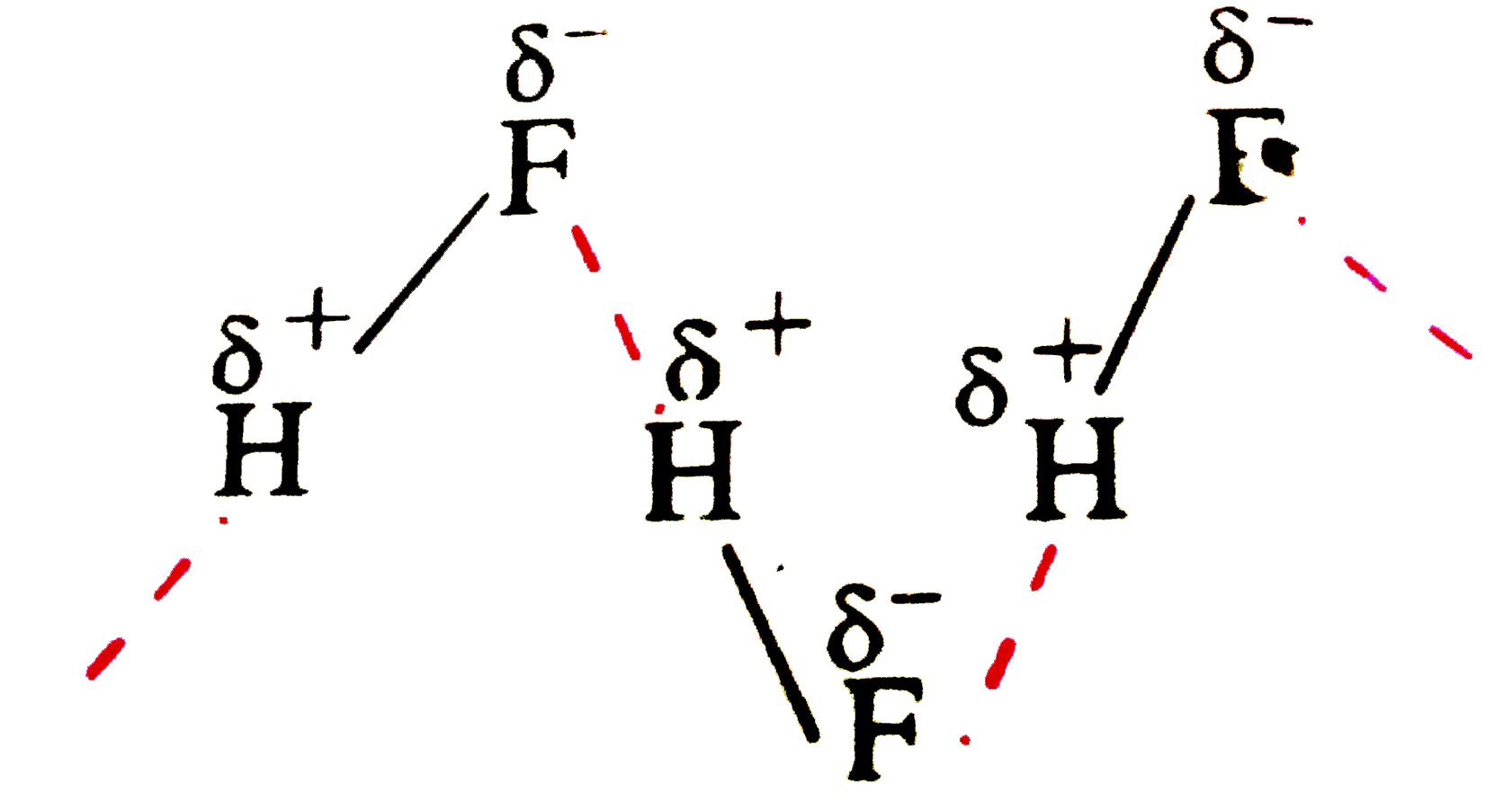
|
|
| 7. |
Among NH_(3), H_(2)O and HF , which would you expect to have highest magnitude of hydrogen bonding and why ? |
Answer» Solution :Due to GREATER electronegativity of N, O and F over, H, all these molecules undergo intermolecular H-bonding 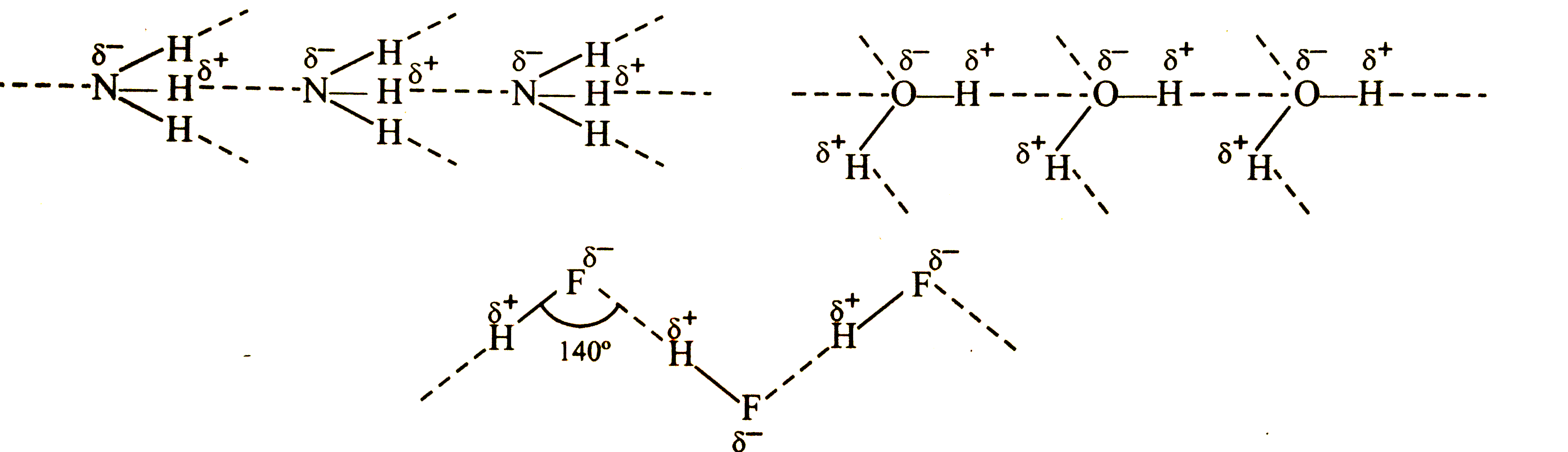 However,since electronegativity of F is the highest, THEREFORE, magnitude of the +ve charge on HYDORGEN and -ve charge of F is the highest and HENCE electrostatic attraction or the H-bonding is the strongest in H-F |
|
| 8. |
Among NaF, RbF, CsF more ionic and strong ionic are |
|
Answer» CSF, CsF |
|
| 9. |
Arrange NaCl, MgCl_(2) and AlCl_(3) in the increasing order of covalent character. |
| Answer» Solution :Among the ionic compounds `NACL, MgCl_(2) and AlCl_(3)` the charge of the cation INCREASES in the order `Na^(+)lt Mg^(2+)ltAl^(3+),`thus the covalent character also FOLLOWS the same order `NaCl lt MgCl_(2) lt AlCl_(3).` shows more covalent character. | |
| 10. |
Among N, Cu, Rn and U, identify the element that (i) belongs to d-block, (ii) is an actionid. |
|
Answer» |
|
| 11. |
Among N^(-3), O^(-2) , Mg^(+2) and Al^(+3) (a) What is common in them. (b) Arrange them in the increasing ionic radii |
|
Answer» |
|
| 12. |
Among MgSO_4, CaSO_4, SrSO_4 and BaSO_4, which one is most soluble in water ? |
| Answer» SOLUTION :`MgSO_4` | |
| 13. |
AmongMg, Mg^(2+) ,A1 and A1^(3+) which willhas the largestand the smallestsizerespectively ? |
|
Answer» `Mg, A1^(3+)` Amongstisoelectronicions (i.e., `Mg^(2+) =12-2=10` electronicand `A1^(3+)=13- 3 =10 ` electrons ) , higherthe + Vechargesmallerthe ionicradiusThus `A1^(3+)` has smallerionicradiusthan `Mg^(2+)` Combining thetwo trendsMg hasthe largestadn `A1^(3+)` has thesmallestsize i.e.,OPTION(a) ISCORRECT. |
|
| 14. |
AmongMe_(3)N, C_(5)H_(5)N andMe CN (Me= methylgroup) , theelectronegativityof N is theorder |
|
Answer» `MeCN GT C_(5) H_(5) N gt Me_(3)N` 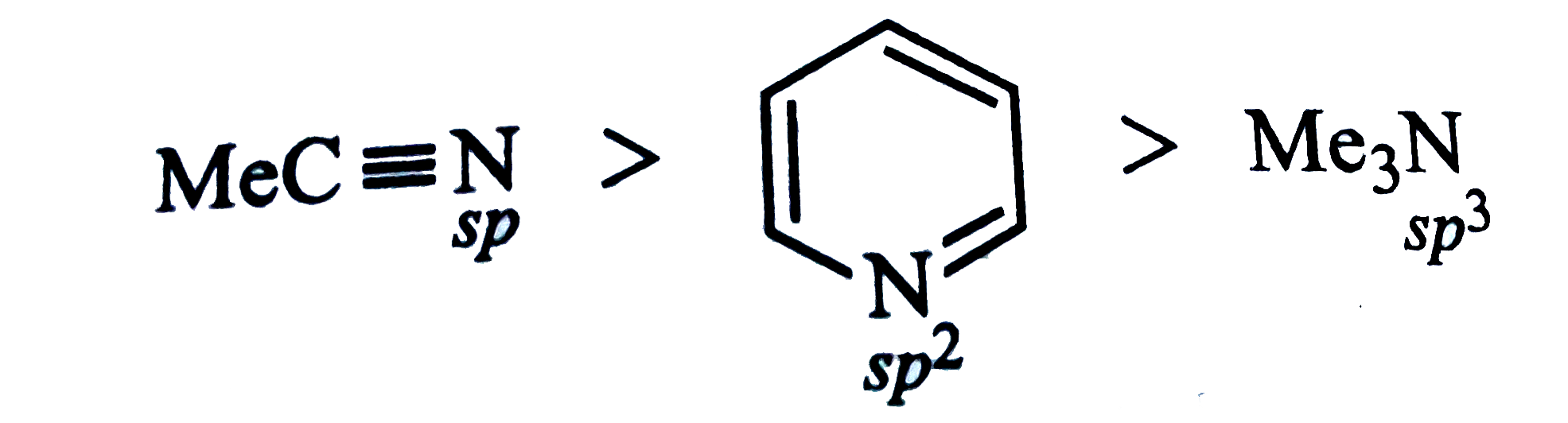 Thusoption (a) is correct. |
|
| 15. |
Among LiCl, RbCl, BeCl_2, MgCl_2, the compounds with greatest and least ionic character respectively are |
|
Answer» `LICL, RBCL` |
|
| 16. |
Among Licl, BeCl_(2), BCl_(3) and "CC"l_(4) the covalent bond character follows the order |
|
Answer» `LiCl LT BeCl_(2)gt BCl_(3)gt"CC"l_(4)` |
|
| 17. |
Among KO_(2), AlO_(2)^(-), BeO_(2) and NO_(2)^(+), unpaired electron is present in |
|
Answer» `NO_(2)^(+) and BaO_(2)` `NO_(2)^(+) = 7 + 16 - 1 = 22 , BaO_(2) = 56 + 16 = 72 ` `AlO_(2)^(-) = 13 + 16 + 1 = 30 ` and `KO_(2) = 19 + 16 = 35` Thus , OLNY `KO_(2)` is odd electron species. |
|
| 18. |
AmongKO_(2), AlO_(2)^(-), BaO_(2) and NO_(2)^(+), unpaired electrons is present in |
|
Answer» `NO_(2)^(+)` and `BaO_(2)` |
|
| 19. |
Among KO_(2), AlO_(2)^(-), BaO_(2) and NO_(2)^(+), unpaired electron is present in |
|
Answer» `NA^(+) and BaO_(2)` |
|
| 20. |
Among KO_(2), AlO_(2)^(-), BaO_(2) and NO_(2)^(+), unpaired electron is present in ………… |
|
Answer» `NO_(2)^(+) and BaO_(2)` |
|
| 21. |
Among KO_2, AlO_2 , BaO_2 and NO_2^+ unpaired electron is present in ….. |
|
Answer» `NO_2^+` and `BaO_2` |
|
| 22. |
Among isomeric butenes, .................is the most stable. |
|
Answer» |
|
| 23. |
Among : I.18 g water at 298 K II . 18 g ice at 263 K III . 18 g steam at 373 K IV. 9 g ice at 263 K , correct order of "U" |
|
Answer» `IV gt II gt I gt III` |
|
| 24. |
Among HCl, HBr and HI which reactant gives Kharash reaction with alkene ? |
| Answer» SOLUTION :Only HBR | |
| 25. |
Among halogens, the correct order of amount of energy released in electron gain enthalpy is: |
|
Answer» `FgtClgtBrgtI` |
|
| 26. |
Among halogens, the correct order of amount of energy released in electron gain (electron gain enthalpy) is : |
|
Answer» `F gt Ci gt Br gt I` (Electron gain ecthalphy = ENERGY RELEASED when electron is GAINED). Electron enthalpy of F is less negative as of CI, due to its small size. Order for electron gain enthalpy is as follows `F lt CI gt Br gt I` |
|
| 27. |
Amonghalogens the correctorder of amountof energyreleasedin electron gain (electron gainenthalpy ) is : |
|
Answer» `F gt C1 gt BR gt I` |
|
| 28. |
Among halides of alkaline earth metals fluorides are less soluble, but BeF_(2) is more soluble. Why? |
|
Answer» Solution :Lattice energies of ionicfluridesare HIGH . HENCE , floridesof ALKALINE earth metals are less SOLUBLE . `BeF_(2)`is covalentand has the tendency toformhydorgenbondingwith water . `BeF_(2)`is more solublein water due to high hydration energy of `Be^(2+)` ion . |
|
| 29. |
Among H_(2),He_(2)^(+) ,Li_(2),Be_(2)_,C_(2),N_(2),O_(2)^(-) and F_(2) , the number of diamagnetic species is (Atomic numbers : H=1, He=2, Li=3, Be=4, B=5, C=6, N=7, O=8, F=9) |
|
Answer» `H_(2)(2) = sigma (1s)^(2)` (Diamagnetic) `He_(2)^(+) = sigma (1s)^(2), sigma^(**)(1s)^(1)` (Paramagnetic) `LI (2) (6) = sigma (1s)^(2) , sigma^(**) (1s)^(2) , sigma(2S)^(2) ` (Diamgnetic) ` Be_(2) (8) = sigma (1s)^(2) , sigma^(**) (1s)^(2) , sigma(2s)^(2) , sigma^(**) (2s)^(2)` (Diamagnetic) ` Be_(2) (10) = sigma (1s)^(2) , sigma^(**) (1s)^(2) , sigma(2s)^(2) , sigma^(**) (2s)^(2), ` `pi(2p_(x))^(1) = pi(2p_(y))^(1)`(Paramagnetic) ` C_(2) (12) = sigma (1s)^(2) , sigma^(**) (1s)^(2) , sigma(2s)^(2) , sigma^(**) (2s)^(2), ` `pi(2p_(x))^(2) = pi(2p_(y))^(2)`(Diamagnetic) ` N_(2) (14) = sigma (1s)^(2) , sigma^(**) (1s)^(2) , sigma(2s)^(2) , sigma^(**) (2s)^(2), ` `pi(2p_(x))^(2) = pi(2p_(y))^(2),sigma(2p_(z))^(2)`(Diamagnetic) ` O_(2)^(-) (17) = sigma (1s)^(2) , sigma^(**) (1s)^(2) , sigma(2s)^(2) , sigma^(**) (2s)^(2), ` `sigma(2p_(z))^(2) = pi(2p_(y))^(2),sigma(2p_(z))^(2)` ` pi^(**) (2p_(x))^(2) = pi^(**) (2p_(y))^(1) ` (paramagnetic) ` F_(2) (18) = sigma (1s)^(2) , sigma^(**) (1s)^(2) , sigma(2s)^(2) , sigma^(**) (2s)^(2), ` `sigma(2p_(z))^(2) = pi(2p_(x))^(2),sigma(2p_(y))^(2)` `pi^(**) (2p_(x))^(2) = pi^(**) (2p_(y))^(2)`(Diamagnetic) THEREFORE , the TOTAL NUMBER of diamagnetic species is six . |
|
| 31. |
Among groups 1 and 2, the elements of which group have higher ionisation enthalpies ? |
| Answer» SOLUTION :GROUP 14 | |
| 32. |
Among ethanol (I), acetic acid (II), phenol (III) and benzoic acid (IV), the correct order of increasing acid strength is |
|
Answer» `I LT II lt III lt IV` |
|
| 33. |
Among elements with the following electronic configurations, the one with the largest radius is |
|
Answer» `1s^2 2s^2 2p^6 3s^2` |
|
| 34. |
Among elements of carbon family, which act as 7 semi conductors? |
| Answer» SOLUTION :SILICON and GERMANIUM ACT as SEMICONDUCTORS. | |
| 35. |
Among diamond and graphite, which is a good conductor of electricity ? |
| Answer» SOLUTION :GRAPHITE | |
| 36. |
Among chalcogens electron affinity is highest for |
|
Answer» O |
|
| 37. |
Among CH_(3)F, CH_(3)Cl, CH_(3)Br and CH_(3)I which does not give methane on reduction ? |
| Answer» SOLUTION :`CH_(3)F` | |
| 38. |
Among CH_3CH_2CH_2CH_2Cl, CH_3 -underset(Cl)underset(|)CH - CH_2 - CH_3, (CH_3)_3 C - Cl. Which one has low boling point ? Give reason. |
|
Answer» Solution :For a compound with MOLECULAR formula `C_5H_9Cl_3` isomers `(1^@, 2^@, 3^@)` are possible. AMONG the isomeric alkyl halides, the boiling point decreases with the increase in branching in the alkyl chain. This is because with increase in branching, the MOLECULE attains spherical shape with less surface area. As a result, the intermolecular forces become weak, resulting in LOWER boiling point. Therefore the boiling point decreases in the order: `underset(351.5 K)(CH_3-CH_2 - CH_2)-CH_2Cl gt underset((341 K))(CH_3-underset(Cl)underset(|)CH-CH_3) - CH_3 gt underset((324K))(CH_3 - underset(Cl)underset(|)overset(CH_3)overset(|)C-CH_3)` Hence, `(CH_3)_3C -Cl`has the lowest boiling point. |
|
| 39. |
Among the hydrides given below which are reasonable good acids |
|
Answer» `NH_3 and B_2H_6` |
|
| 40. |
Among CaH_(2) , BeH_(2) , BaH_(2) , the order of ionic character is |
|
Answer» `BeH_(2) lt CaH_(2) lt BaH_(2)` |
|
| 41. |
Among CaH_2, BeH_2, BaH_2the order of ionic character is : |
|
Answer» `BaH_2 lt BeH_2 lt CaH_2` |
|
| 42. |
Among CaH_(2),BeH_(2),BaH_(2), the order of ionic character is- |
|
Answer» `BeH_(2) lt CaH_(2) lt BaH_(2)` |
|
| 43. |
Among CaH_2, BeH_2 , BaH_2, the order of ionic character is |
|
Answer» `BeH_2 LT CaH_2 lt BaH_2` |
|
| 44. |
Among CaH_(2), BeH_(2), BaH_(2) the order of ionic character is : |
|
Answer» `BaH_(2) LT BeH_(2) lt CaH_(2)` |
|
| 45. |
Among [BeCl_(2)]_(n), [BeH_(2)]_(n), B_(2)H_(6), Al_(2)(CH_(3))_(6), Al_(2)Cl_(6), Be(BH_(4))_(2), Al(BH_(4))_(3), the number of compounds having 3c-2e bonds are : |
|
Answer» |
|
| 46. |
Among Be ,B,Mg andA1 thesecondionizationpotential ismaximumfor |
|
Answer» B `B^(+) (1s^(2)2s^(2) ) ,Mg^(+)(1s^(2)2s^(2)3s^(1))` and `A1^(+)(1s^(2) 2p^(2)2p^(6)3s^(2))` Since`Mg^(+)` and `A1^(+)` belongto 3rdperiodwhile `Be^(+)` and `B^(+)`belongto 2ndperiod , thereforedue tobiggersize the`Delta_(i)H_(2) `of `Mg^(+)` and `A1^(+)` are lowerthan thoseof `Be^(+)`and `B^(+)` Since `B^(+)`the nextelectronhas to beremovedfrom amorestabletally filled 2s-orbital whilein`Be^(+)` it has to belost fromthe lessstable hafl- filled2s- orbital adn furthermore LOSS of anelectronfrom `Be^(+)` givesmorestable `Be^(2+)` ion withinet gasconfigurationtherefore`Delta_(i)H_(2)` ofB ishigherthanthat of Be , i.e.,option( a) ISCORRECT. |
|
| 47. |
Write the general valence shell electronic configuration of group 13 elements. |
| Answer» SOLUTION :`B_2 O_3` | |
| 48. |
Between atoms of a molecule, there exists |
|
Answer» only attractive forces |
|
| 49. |
Among alpha-nitro acetic acid (I), alpha- fluoroacetic (II), alpha-bromoacetic acid (III) and alpha-cyanoacetic acid (IV), the order of increasing acid strength is |
|
Answer» `III LT II lt IV lt I` `-NO_(2) gt -CN gt - F gt -Br` The ACID strength is `III lt II lt IV lt I` |
|
| 50. |
Among all the isomers of pentane which has the lowest boiling point ? |
| Answer» SOLUTION :neo-pentane | |
