

Saved Bookmarks
This section includes 7 InterviewSolutions, each offering curated multiple-choice questions to sharpen your Current Affairs knowledge and support exam preparation. Choose a topic below to get started.
| 1. |
An atom of an element contains 29 electrons and 35 neutrons. Deduce (i) the number of protons and (ii) the electronic configuration of the element. |
|
Answer» Solution :For neutral atom, number of protons = number of electrons `=29` THUS, atomic number of the element `=29` Electronic configuration of element with `Z=29` will be : `1s^(2) 2s^(2) 2p^(6) 3s^(2) 3P^(6) 3d^(10) 4s^(1) or [Ar]^(18) 3d^(10) 4s^(1)`, i.e., `._(29)CU`. Mass number = No. of protons + No. of NEUTRONS `=29+35=64` |
|
| 2. |
An atomof anelementcontains29electron and 35neutrons .Deduce(i) The number ofprotonsand (ii)the electronicconfigurationofthe element . |
|
Answer» Solution :(i) Numberof ELECTRON= no of PROTON = 29 (ii) Z=29so electronconfiguratin `1s^(2)2s^(2) 2p^(6)3s^(2) 3P^(6) 3d^(10)4S^(1)` 3dsubshellis complete |
|
| 3. |
An atom is 40.08 times as heavier as 1/12 mass of an atom of Cl_2. What is its atomic mass ? |
|
Answer» |
|
| 4. |
An atom having atomic mass number 13 and 7 neutrons. What is the atomic number of the atom ? |
| Answer» SOLUTION :`A = 13, N=7` As `A = n + p:. p = A -n = 13 - 7 = 6`. Hence, `Z = p = 6` | |
| 5. |
An atomhas the electronicconfigurationof1s^(2) ,2s^(2) 2p^(6),3s^(2) 3d^(10) , 4s^(2) 4p^(5).Itsatomicweight is 80 . Its atomicnumberand thenumberof neutronsin itsnucleusshall be |
|
Answer» 35 and 45 Atomicnumberof is 35 and no of neutronis45. |
|
| 6. |
An atom having atom ic m ass num ber 13 has 7 neutrons. W hat is the atom ic n u m b er of the atom ? |
| Answer» Solution :N EUTRON is neutral so, no deflection from the p ath on passing through an electric field. Proton, cathode RAYS an d ELECTRON being the charged particle will show deflection from the p ath on passing through an electric field. | |
| 7. |
An atom has a mass number of 23 and atomic number 11. The number of protons are ______ |
|
Answer» 23 |
|
| 8. |
An atom of an element 'A' has three electrons in its outermost shell and that of 'B' has six electrons in the outrer most shell. The formula of the compound formed between these two elements is |
|
Answer» `A_(3)B_(4)` |
|
| 9. |
An atom A belongs to IIA group and another atm B belongs to VA group. The fomula of the compound formed is |
|
Answer» `A_(3)B_(6)` |
|
| 10. |
An atom differs from its ion in |
|
Answer» <P>NUCLEAR charge |
|
| 11. |
An athlete is given 100 g of glucose ( C_(6)H_(12)O_(6)) of energy equivalent to 1560 kJ . He utilizes50 percent of this gained energy in the event. In order to avoid storage of energyin the body, calculate the weight of water thehe would need to perspire. The enthalpyof evaporation of wateris 44 kJ // mol . |
|
Answer» Solution :Energy left unutilized `=(1560)/(2)kJ = 780kJ` For losing 44kJ of energy, WATER to be EVAPORATED `= 1` MOLE`= 18G` `:. `For losing 780 kJ of energy,water to beevaporated`= ( 18)/( 44) xx780 g = 319 g` |
|
| 12. |
An athelete is given 100 g of glucose (C_(6)H_(12)O_(6)) of energy equivalent to 1560 kJ. He utilizes 50% of this gained energy in the event. In order to avoid storage of energy in body , the weight of water he would need to perspire is : (The enthalpy of evaporation of water is 44 kJ//mole) |
|
Answer» 319 g |
|
| 13. |
An astronaut receives the energy required in his body by the combustion of 34gm of sucrose per hour. How much oxygen he has to carry along with him for his energy requirement in a day? |
| Answer» SOLUTION :916.21 GM | |
| 14. |
An astronaut receives the energy required in his body by the combustion of 34g of sucrose per hour. How much oxygen he has to carry along with him for his energy requirement in a day? |
|
Answer» |
|
| 15. |
An aromatic molecule will |
|
Answer» have `4npi`-electrons (D) cyclic structure (due to presence of `sp^(2)`-hybdird CARBON atoms. |
|
| 16. |
An aromatic compound having C_(7)H_(8)O as the molecular formula has.................isomers. |
|
Answer» |
|
| 17. |
An aromatic compound has molecular formula C_(7)H_(8)O. The number of phenolic isomers for this compound is |
|
Answer» 4 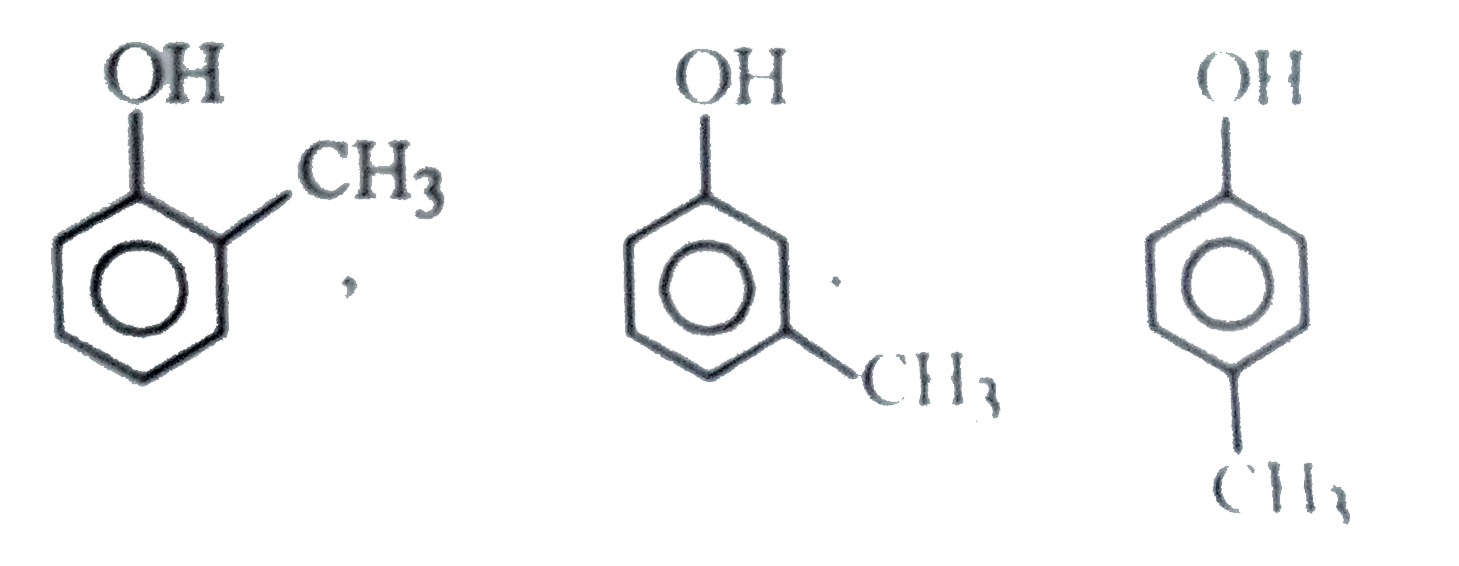
|
|
| 18. |
An archeological speciment containing .^(14)C gives 40 counts in 5 mintues per gram of carbon.A specimen of freshlycut wood gives 20.3 counts per gram of carbon per minute. The counter used recorded a background count of 5 counts per mintue in absence of any .^(14)C containing sample. What is the age of the speciment? (T_(50) of .^(14)C = 5668 year) |
|
Answer» |
|
| 19. |
An aqueous solution of sucrose, C_(12)H_(22)O_(11), containing 23.2g/L has an osmotic pressure of 2.38 atmosphere at 17^(@)C, For an aqueous solution of glucose, C_(6)H_(12)O_(6), to be isotonic with this solution, it would have : |
|
Answer» 34.3 g/L |
|
| 20. |
An aqueous solution of sodium sulphate is electrolysed using inert electrodes. The products at the cathode and anode are respectively |
|
Answer» `H_(2), O_(2)` |
|
| 21. |
An aqueous solution of sodium acetate has pH greater than 7. Explain with equation. |
|
Answer» Solution :Sodium ACETATE is a salt of a strong and a weak ACID which UNDERGOES hydrolysis to from strong alkaline (basic) solution. Hence the pH is GREATER than 7. `CH_(3)COONa+H_(2)OhArrCH_(3)COOH+nNaOH` |
|
| 22. |
An aqueous solution of silver nitrate gives a white precipitate with |
|
Answer» `C_(2)H_(5)CL` |
|
| 23. |
An aqueous solution of salt (P) gives white precipitate with barium chloride solution which is insoluble in dilute HCI and dilute HNO_(3). When ammonia (aq) is added to the aqueous solution of salt (P) blue precipitate is obtained which dissolves in excess ammonia producing deep blue colouration due to formation complex (Q). With KCN, (P) gives first a yellow precipitate which quickly decomposes to white precipitate along with liberating highly poisonous gas (R).(R) on hydrogenation produces (S) which gives yellowish orange coloured complex (T) with CoCI_(3). Which of the following options is correct with respect to P,Q,R,S and T? |
|
Answer» P is `Ag_(2)SO_(4)'Q'` is `[Ag(NH_(3))_(2)]_(2)SO_(4)` `{:(S rarr,CH_(2)-NH_(2)),(,""|),(,CH_(2)-NH_(2)):}` `T rarr[Co(en)_(3)]^(3+)` `Q rarr` Paramagnetic square planar `T rarr` Diamagnetic, octahedral |
|
| 24. |
An aqueous solution of salt (P) gives white precipitate with barium chloride solution which is insoluble in dilute HCI and dilute HNO_(3). When ammonia (aq) is added to the aqueous solution of salt (P) blue precipitate is obtained which dissolves in excess ammonia producing deep blue colouration due to formation complex (Q). With KCN, (P) gives first a yellow precipitate which quickly decomposes to white precipitate along with liberating highly poisonous gas (R).(R) on hydrogenation produces (S) which gives yellowish orange coloured complex (T) with CoCI_(3). Which of the following options regarding complex Q and T is not correct? |
|
Answer» Q is PARAMAGNETIC where as T is diamagnetic `{:(S rarr,CH_(2)-NH_(2)),(,""|),(,CH_(2)-NH_(2)):}` `T rarr[Co(EN)_(3)]^(3+)` `Q rarr` Paramagnetic square planar `T rarr` Diamagnetic, octahedral |
|
| 25. |
An aqueous solution of NH_(4)Cl is acidic. Give reason. |
| Answer» SOLUTION :Due to hydrolysis PRODUCE HCl, reaction `NH_(4)Cl+H_(2)Oto underset("Strong acid")(HCl)+underset("Weak base")(NH_(4)OH)` | |
| 26. |
An aqueous solution of metal ion M_(1) reacts separately with reagents Q and R in excess to give tetrahedral and square planar complexes, respectively. An aqueous solution of anotherr metal ion M_(2) always forms tetrahedral complex with these reagents. Aqueous solution of M_(2) on reaction with reagent S gives white precipitate which dissolves in excess of S. The reactions are summarized in the scheme given ahead. SCHEME: Tetrahedral overset(Q)underset("excess")larr M_(1)overset(R)underset("excess")rarr Square planar {:("Tetrahedral"overset(Q)underset("excess")larrM_(2)overset(R)underset("excess")rarr"Tetrahedral"),(""darrS."stoichiometric amount"),("""White ppt" overset(S)underset("excess")rarr."Precipitate dissolves"):} Reagent S is: |
|
Answer» `K_(4)[Fe(CN)_(6)]` |
|
| 27. |
An aqueous solution of metal ion M_(1) reacts separately with reagents Q and R in excess to give tetrahedral and square planar complexes, respectively. An aqueous solution of anotherr metal ion M_(2) always forms tetrahedral complex with these reagents. Aqueous solution of M_(2) on reaction with reagent S gives white precipitate which dissolves in excess of S. The reactions are summarized in the scheme given ahead. SCHEME: Tetrahedral overset(Q)underset("excess")larr M_(1)overset(R)underset("excess")rarr Square planar {:("Tetrahedral"overset(Q)underset("excess")larrM_(2)overset(R)underset("excess")rarr"Tetrahedral"),(""darrS."stoichiometric amount"),("""White ppt" overset(S)underset("excess")rarr."Precipitate dissolves"):} M_(1),Q and R, respectively are: |
|
Answer» `ZN^(2+),KCN` and `HCI` |
|
| 28. |
An aqueous solution of H_(2)O_(2) is purified by |
|
Answer» Distillations |
|
| 29. |
The aqueous solution of glucose is 10% w/w of solution, the percentage of w/w of solvent is |
|
Answer» 18 litres `impliesV=(180xx100)/(10)mL=1.8L` |
|
| 30. |
An aqueous solution of H_(2)O_(2) is labeled as 33.6 vol. The amount of H_(2)O_(2) present is 50ml of such an aqueous solution is |
|
Answer» `5.1` GM |
|
| 31. |
An aqueous solution of compound A gives ethane or electrolysis. The compound A is : |
|
Answer» Ethyl ACETATE |
|
| 32. |
An aqueous solution of boric acid is found to be weakly acidic in nature. This acidic character arises due to the following reasons. |
|
Answer» It is a protic acid which donates protons in aqueous solution. |
|
| 33. |
An aqueous solutionof boraxis (a) neutral , (b)amphoteric , (c ) basic, (d) acidic |
| Answer» Solution :BORAX is a salt of astrong base `(NAOH)`and a weak acid `(H_(3)BO_(3))`,THEREFORE, it is basic in NATURE, i.e, option (c ) is correct. | |
| 34. |
An aqueous solution of borax is |
|
Answer» Neutral `Na_(2)B_(4)O_(7)+7H_(2)Otounderset("base")underset("Strong")(2NaOH)+underset("acid")underset("Weak")(4B(OH)_(3))` THEREFORE, aqueous solution will be basic in nature. |
|
| 36. |
An aqueous solution of aniline of concentration 0.24 M is prepared. What concentraton of sodium hydroxide is needed in this solution so that anilinium ion concentration remains at 1xx10^(-8) M? (K_(a) "for" C_(6)H_(5)NH_(3)^(+)=2.4xx10^(-6)M) |
|
Answer» Solution :In aqueous solution, ANILINE is hydrolysed as `C_(6)H_(5)NH_(2)+ H_(2)O hArr C_(6)H_(5)overset(+)N H_(3)+OH^(-)` When NAOH is added, hydrolysis will be supressed so that in the final solution, `[C_(6)H_(5) overset(+)NH_(3)]=10^(-8)M` (Given) In conc. of NaOH added is x mol `L^(-1)`, then at EQUILIBRIUM `[C_(6)H_(5)NH_(2)]=0.24-10^(-8) ~= 0.24` `[C_(6)H_(5)overset(+)NH_(3)]=10^(-8)M` (Given) `[OH^(-)]=10^(-8)+x ~= x M` Hydrolysis constant, `K_(h) = ([C_(6)H_(5)overset(+)H_(3)][OH^(-)])/([C_(6)H_(5)NH_(2)])` ...(i) Further, we are given `C_(6)H_(5)overset(N)H_(3) hArr C_(6)H_(5)NH_(2)+H^(+)` `K_(a) = ([C_(6)H_(5)NH_(2)][H^(+)])/([C_(6)H_(5)overset(N)H_(3)])` ...(ii) Also `[H^(+)][OH^(-)]=K_(w)`...(iii) Combining eqns. (i), (ii) and (iii) `k_(h)=(K_(w))/(K_(a))=(10^(-14))/(2.4xx10^(-6))=(10^(-8))/(2.4)` Substituting the values in eqn. (i), we get, `(10^(-8))/(2.4)=(10^(-8)xx x)/(0.24)` which gives `x=10^(-2)M` |
|
| 37. |
An aqueous solution of an inorganic compound (X) shows the following reactions : (i) It decolourises an acidifed KMnO_(4) solution accomopained by evolution of oxygen . (ii) It libirates iodine from an acidified potassium iodide solution . (iii) It gives brown precipitate with an alkaline KMnO_(4) solution with the evolution of oxygen. (iv) It removes black stains from oil paintings. Identify (X) and write equations for the reactions involved. |
|
Answer» Solution :(i) Compound (X) acts as a reducing AGENT both in acidic as well as in the BASIC medium because it decolourises an acidified solution of `KMnO_(4)` with evolution of `O_(2)` and produces a brown ppt. (probably of `MnO_(2)`) with evolution of `O_(2)` in the basic medium. (II) Compound (X) also acts as an oxidising agent since it liberates `I_(2)` from an acidified solution of KI. All these reactions of characteristic of `H_(2)O_(2)`. Therefore , compound (X) is `H_(2)O_(2)` (iii) Further `H_(2)O_(2)` is known to remove black stains from old oil paintins DUE to oxidation of black PbS to with `PbSO_(4)`. If compound (X) is `H_(2)O_(2)`, then all the reactions involved in this problem may be explained as FOLLOWS : `(i) 2KMnO_(4) + 3H_(2)SO_(4) + 5H_(2)O_(2) to 2K_(2)SO_(4) + 2MnSO_(4) = 3H_(2)O + 5O_(2)` `(ii) 2KMnO_(4) + 3H_(2)O_(2) to underset("Brown ppt.")(2MnO_(2))+ 2KOH + 2H_(2)O+ 3O_(2)` `(iii) 2KI + H_(2)SO_(4) + H_(2)O_(2)to K_(2)SO_(4) + I_(2) + 2H_(2)O` `(iv) underset("Black")(PbS) + 4H_(2)O_(2) to underset("White")(PbSO_(4))+4H_(2)O` |
|
| 38. |
An aqueous solution of an inorganic compound (X) shows the following reactions : (i) It decolourises an acidified KMnO_4 solution accompanied with evolution of oxygen gas. (ii) It liberates iodine from acidified potassium iodide solution. (iii) It gives brown precipitate with alkaline KMnO_4 solution with evolution of oxygen gas. (iv) It removes black stains from old oil paintings. Identify (X) and give chemical reactions for steps (i) to (iv). |
|
Answer» Solution :Since X REMOVES black stains from old oil paintings, it is HYDROGEN peroxide `H_2 O_2` `(i) underset((X))(5H_2 O_2) + 2K MnO_4 + 3H_2 SO_4 to K_2 SO_4 + 2MnSO_4 + 8H_2 SO_4 + 5O_2` (ii) `H_2 O_2 + 2KI + H_2 SO_4 to I_2 + K_2 SO_4 + 2H_2 O` (iii) `underset((X))(3H_2 O_2) + 2KMnO_4) to underset("Brown PPT")(2MnO_2 +2KOH + 3O_2 + 2H_2 O` (iv) `4H_2 O_2 + underset("(black)")(PBS) to underset("white")(PbSO_4) + 4H_2 O` |
|
| 39. |
An aqueous solution of alum is |
|
Answer» ACIDIC |
|
| 40. |
An aqueous solution of a substance gives a white precipitate on treatment with NaCI solution, which dissolves on heating. When H_(2)S gas is passed through it's hot acidic solution, a black precipitate is obtained. The cations which are not associated with this test are: |
|
Answer» `Mg^(2+)` |
|
| 41. |
An aqueous solution of a mixture of two inorganic salts when treated with dilute HCl, gave a precipitate (P) and a filtrate (Q). The precipitate (P) was found to dissolve in hot water. The filtrate (Q) remained unchanged, when treated with H_(2)S in a dilute mineral acid medium. However, it gave a green precipitate (R) in an ammoniacal medical. The precipitate (R) gave a coloured solution (S), when treated with H_(2)O_(2) in an aqueous NaOH medium. Answer Question 62 and 63 The coloured solution (S) contains |
|
Answer» `Fe(SO_(4))_(3)` The AVAILABLE data suggests that the mixture contains `Pb^(2+)` and `Cr^(3+)` ions. The series of reactions involved are : 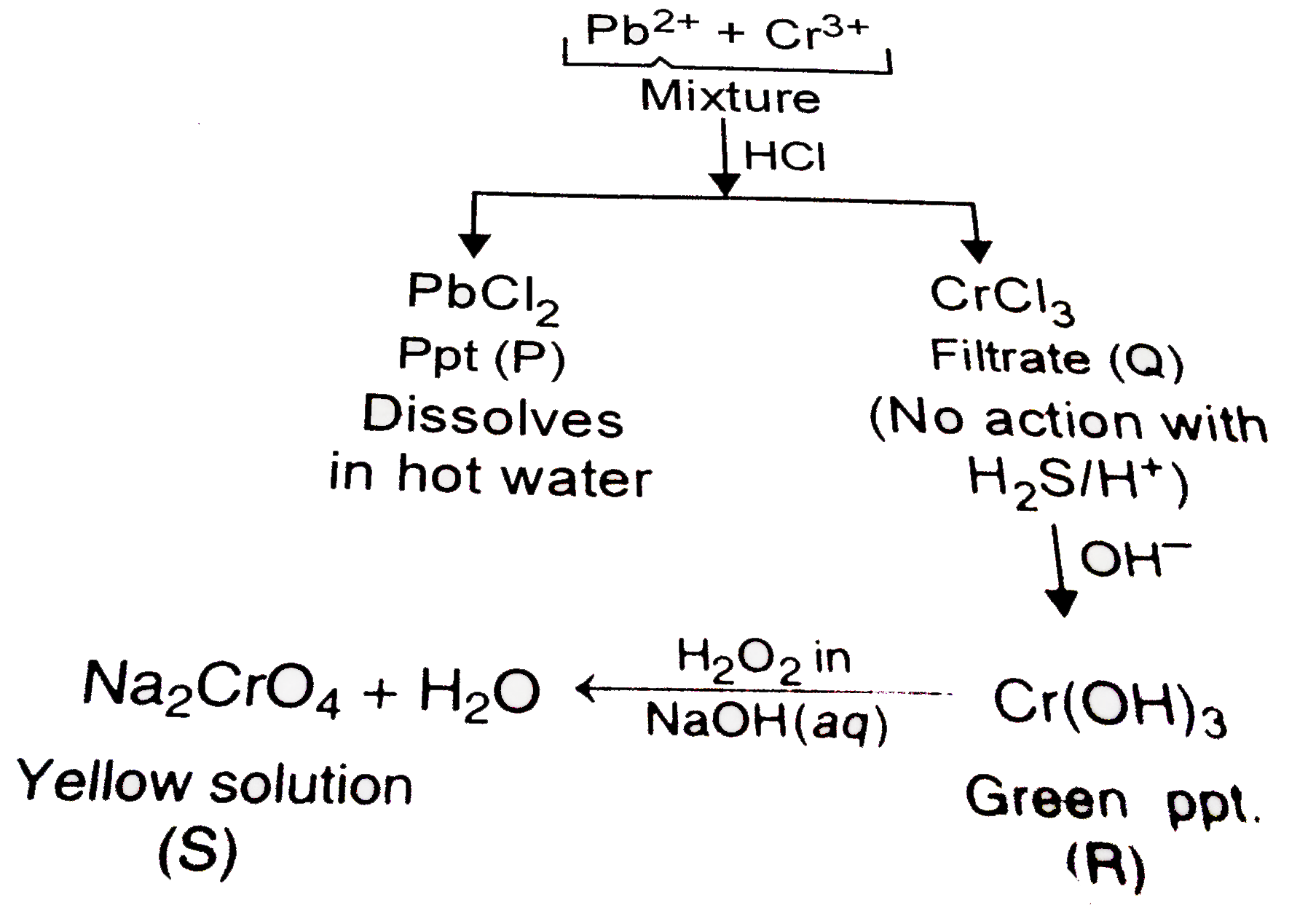
|
|
| 42. |
An aqueous solution of a mixture of two inorganic salts when treated with dilute HCl, gave a precipitate (P) and a filtrate (Q). The precipitate (P) was found to dissolve in hot water. The filtrate (Q) remained unchanged, when treated with H_(2)S in a dilute mineral acid medium. However, it gave a green precipitate (R) in an ammoniacal medical. The precipitate (R) gave a coloured solution (S), when treated with H_(2)O_(2) in an aqueous NaOH medium. Answer Question 62 and 63 The precipitate P contains |
|
Answer» <P>`Pb^(2+)` |
|
| 43. |
An aqueous solution of a mixture contains Br^(-) and I^(-) ions. On passing Cl_(2) gas and adding CHCl_(3), then organic layer will acquire : |
|
Answer» VIOLET colour |
|
| 44. |
An aqueous solution of a metal bromide MBr_(2) (0.05 M) is saturated with H_(2)S. What is the minimum pH at which MS will be precipitated ? (K_(sp) "for MS" = 6.0 xx 10^(-21), "concentration of saturated " H_(2)S=0.1M, K_(1)=10^(-7) and K_(2)=1.3xx10^(-13) "for " H_(2)S). |
|
Answer» Solution :`[M^(2+)]=[MBr_(2)]=0.05 M ` For the precipitation of MS, minimum `[S^(2-)]` can be calculated from `[S^(2-)][M^(2+)]=K_(SP)` i.e., `[0.05][S^(2-)]=6.0xx10^(-21) or [S^(2-)]=1.2xx10^(-19)` `S^(2-)` IONS are obtained from following dissociations `H_(2)S overset(K_(1)) hArr H^(+)+HS^(-)` `HS^(-) overset(K_(2))hArr H^(+)+S^(2-)` `K_(1) = ([H^(+)][HS^(-)])/([H_(2)S]),K_(2) = ([H^(+)][S^(2-)])/([HS^(-)])` `:. K_(1)K_(2)=([H^(+)]^(2)[S^(2-)])/([H_(2)S])` `10^(-7)xx1.3xx10^(-13)=([H^(+)]^(2)[1.2xx10^(-19)])/((0.1)) or [H^(2)]^(2)=(1.3xx10^(-20)xx10^(-1))/(1.2xx10^(-19))=1.083xx10^(-2)` or `[H^(+)]=1.041xx10^(-1)=0.1041 M` `:. pH = - log (0.1041)=0.9826` |
|
| 45. |
An aqueous solution of 6.3 g of oxalic acid dihydrate is made up to 250 mL. The volume of 0.1 N NaOH required to completely neutralise 10 mL of this solution is : |
|
Answer» 40 mL |
|
| 46. |
An aqueous solution of 2% nonvolatile solute exerts a pressure of 1. 004 bar at the boiling point of the solvent. What is the molar mass of the solute when P_(A) ^(@) is 1.013 bar ? |
|
Answer» Solution :VAPOUR pressure of pure WATER at the boiling point. `(P^(0)) =1 atm = 1.013` BAR Vapour pressure of solution `P _(S) = 1. 004` bar `M_(1) = 18 g mol ^(-1)` `M _(2) ` = ? Mass of solute `= W_(2) = 2g` Mass of solution = 100 g Mass of solvent `W_(1) = 98 g` Applying Ranoult.s law for dilute solution `(P ^(0) -P_(S))/(P ^(0)) = (n_(2))/(n _(1) + n _(2)) = (n_(2))/( n _(1))= ((W _(2))/( M _(2)))/( (W _(1))/( M _(2)))` `(P ^(0) -P_(S))/(P ^(0))= (W_(2))/(M _(2)) xx (M_(1))/(W _(1))` `(1.013-1,004)/(1.013) = (W_(2))/(M _(2)) xx (18 mol ^(-1))/(98G) (or)` `M _(2) = (2 xx 18 xx 1. 103)/(98 xx 0.009) = 41.35g mol ^(-1)` |
|
| 47. |
An aqueous solution of 0.10 g KIO_(3) was treated with an excess of KI solution the solution was acidified with HCI the liberated I_(2) consumed 45.0 mL ofthisuplhate solutoin to decolourise the blue starch iodine complex calculate the molarity of sodium thiossuphate solution |
|
Answer» SOLUTION :The reaction involved are `2IO_(3)^(-)+12 H^(+)+10 I^(-) rarr 6 I_(2)+6 H_(2)O` `2S_(2)O_(3)^(2-)+I_(2)rarrS_(4)O_(6)^(2-)+2I^(-)]xx6` `2IO_(3)^(-)+12 H^(+)+12 H^(+)+12 S_(2)O_(3)^(2-)rarr6S_(4)O_(6)^(2-)+2 I^(-)+6H_(2)O` Now of moles of `KIO_(3)=(0.1)/(214)` Now 2 moles of `KIO_(3)` react with `Na_(2)S_(2)_(3)`=12 moles `therefore (0.1)/(214)` mole of `KIO_(3)` will react with `Na_(2)S_(2)O_(3)=12/2xx(0.1)/(214)` mole Now `12/2xx(0.1)/(214)` mole of `Na_(2)S_(2)O_(3)` s present in 45 ML of the soluton `therefore` MOLARITY of `Na_(2)S_(2)O_(3)` solution =`12/2xx(0.1)/(214xx1000/45=0.0623 M` |
|
| 48. |
An aqueous solution is made by dissolving glucose (C_(6)H_(12)O_(6)) and urea (NH_(2)CONH_(2)) in water. Moleratio of glucose and water is 1:10 . If the masses of glucose and urea are in 3:1 ratio, then correct statement(s) regarding the solution is/are: |
|
Answer» The MOLE fraction of glucose in the solution is `(1)/(11)` |
|
| 49. |
An aqueous solution is 1 molal in KI. Which change will cause the vapour pressure of the solution to increase ? |
|
Answer» ADDITION of NaCl |
|
| 50. |
An aqueous solution contains an unknown concentration of Ba^(2+). When 50 ml of a 1M solution of Na_(2)SO_(4) is added. BaSO_(4)just begins to precipitate. The final volume is 500ml. The solubility product ofBaSO_(4) " is " 1 xx 10^(-10)Find the original concentration. |
|
Answer» Solution :`K_("SP") = [Ba^(2+)][SO_(4)^(2-)] = [Ba^(2+)][(50xx1)/500] = 10^(-9) xx 500 ` `Ba^(2+) = 10^(-9) M` ` 10^(-9) xx 500 = 450 xx M "" :. M = 1.11 xx 10^(-9) M ` |
|