Saved Bookmarks
This section includes 7 InterviewSolutions, each offering curated multiple-choice questions to sharpen your Current Affairs knowledge and support exam preparation. Choose a topic below to get started.
| 1. |
An aqueous solution contains an unknown concentration of Ba^(+). When 50 mL of 1 M solution of Na_(2)SO_(4) is added, BaSO_(4) is 1xx10^(-10). What is the original concentration of Ba^(2+)? |
|
Answer» `5xx10^(-9)M` `K_(sp) ` of `BaSO_(4) = 10^(-10)` `:. [BA^(2+)][SO_(4)^(2-)]=10^(-10)` `[Ba^(2+)][0.1]=10^(-10)` or `[Ba^(2+)]=10^(-9)M` i.e., conc. of `Ba^(2+)` ions in final solution `=10^(-9)`M Volume of final solution = 500 mL Volume of ORIGINAL solution = 500 - 50 = 490 mL Applying `underset("(INITIAL)") M_(1)V_(1)=underset("(Final)")M_(2)V_(2)` `M_(1)xx900=(10^(-9))(500)` or, `M_(1)=1.11xx10^(-9)M` |
|
| 2. |
An aqueous solution contains 10% ammonia by mass and has a densityof 0.99 g cm^(-3) . Calculate hydroxyl and hydrogen ion concentration in this solution . K_(a)for NH_(4)^(+)=5.0xx10^(-10). |
|
Answer» Solution :10% ammonia by mass means 10 g `NH_(3)` are present in 100 g of the solution. `:.` Molarity of the solution `=(10)/(17) xx (1)/(100//0.99)xx1000 = 5.82 M` `{:(,NH_(3) ,+,H_(2)O,rarr,NH_(4)OH,hArr,NH_(4)^(+),+,OH^(-),),("Initial conc.",,,,,C "MOL" L^(-1),,,,,),("After dissociation",,,,,C-Calpha,,C alpha,,C alpha,),(,,,,,=C(1-alpha),,,,,):}` `:. [OH^(-)] = C alpha = C SQRT((K_(b))/(C)) = sqrt(K_(b)C)= sqrt((K_(w))/(K_(a))xxC)=sqrt((10^(-14))/(5.0xx10^(-10))xx5.82)=1.079xx10^(-2)M(alpha = sqrt(K_(b)//C) and K_(a)xxK_(b)=K_(w))` `:. [H^(+)]=(K_(w))/([OH^(-)]) = (10^(-14))/(1.079xx10^(-2))=0.9268xx10^(-12) M = 9.268xx10^(-13)M` |
|
| 3. |
An aqueous solution contains0.10 M H_(2)S" is "1.0 xx 10^(-7)" and that of " S^(2-) "ion from " HS^(-) "ions is " 1.2 xx 10^(-3) ," then the concentration of " S^(2-) " ions in aqueous solution is " |
|
Answer» ` 5 xx 10^(-8)` `K_(a_(1)) = 1.0 xx 10^(-7)` (II) `HS^(-) hArr S^(2-) + H^(+), K_(a_(2))= 1.2 xx 10^(-13)` For the reaction , ` H_(2)S hArr 2 H^(+) + S^(2-)` (obtained by adding (i) and (ii) ) `K_(a) = K_(a_(1)) xx K_(a_(2))` ` :. (1.0 xx 10^(-7)) (1.2 xx 10^(-13))= ([H^(+)]^(2) [S^(2-)])/([H_(2)S]) ` In presence of HCL, `[H^(+)]` are obtained mainly from HCl. Hence , ` [H^(+)] = 0.20 M, [H_(2) S]= 0.1 M ` `:. 1.2 xx 10^(-20) = ((0.2 )^(2)[S^(2-)])/0.1` or `[S^(2-)] = 3 xx 10^(20)` |
|
| 4. |
An aqueous solution contains 0.10 M H_2Sand 0.20 M HCl. If the equilibrium constants for the formation of HS^- from H_2S is 1.0 xx 10^(-7) and that of S^(2-)from HS^-ions is 1.2 xx 10^(-13)then the concentration of S^(2-) ions in aqueous solution is : |
|
Answer» `5 xx 10^(-8)`  ` therefore KA(iii) = ka(i) xx ka(ii)` ` = (1 xx 10^(-7) (1.2 xx 10^(-13))` ` = 1.2 xx 10^(-20)` (iii) of ka (iii) = ([H^+][S^(2-)])/([H_2S])` Where , `[H_2S] = 0.1 M, [H^+]= 0.2M = [HCl]` ` therefore 1.2 xx 10^(-20) = (0.2)^2 (S^(2-) ) // 0.1` `therefore [S^(2-)] = (0.1 xx 1.2 xx 10^(-20))/((0.2)^2)` ` = 0.3 xx 10^(-20) = 3 xx 10^(-21)` |
|
| 5. |
An aqueous solution contains 0.10 M H2S and 0.20 M HCl. If the equilibrium constants for the formation of HS^(-)fromH_(2)S" is " 1.0 xx 10^(-7) " andthat of " S^(2-) " from " 4S^(-) " ionsis " 1.2 xx 10^(-13) ,then find the concentration of S^(-2) ions in aqueous solution |
|
Answer» Solution :`underset((0.1 - x))(H_(2)S(AQ.)) hArr underset((2x + 0.29))(2H^(+) )+ underset(x)(S^(2-) )` `K_(a) = K_(a_(1)) xx K_(a_(2)) = 1.2 xx 10^(-20) ` `1.2 xx 10^(-20) = ((0.2)^(2-) [S^(2-)])/(0.1) , [S^(2-)] = 3 xx 10^(-20) ` |
|
| 6. |
An aqueous solution containing 0.10 g KIO_(3) (formula weight =214.0) was treated with an excess of KI solution. The solution was acidified with HCl. The liberated iodine consumed 45.0 mL of thiosulphate solution to decolourise the blue starch-iodine complex. Calculate the molarity of the sodium thiosulphate solution. |
|
Answer» [`2Na_(2)S_(2)O_(3)+I_(2) to 2NaI+Na_(2)S_(4)O_(6)]xx6` `overlineul(underset(2"moles")(2KIO_(3))+10KI+underset(12"moles")(12Na_(2)S_(2)O_(3))+12HCl to 12KCl+12NaI+6Na_(2)S_(4)O_(6)+6H_(2)O)` No. of moles of `KIO_(3)=(0.10)/(214)` No. of moles of `Na_(2)S_(2)O_(3)` REQUIRED for `(0.10)/(214)` moles of `KIO_(3)` `=(12)/(2)xx(0.10)/(214)=(0.60)/(214)` Molarity of `Na_(2)S_(2)O_(3)=(0.6)/(214)xx(1000)/(45)=0.0623 M` |
|
| 7. |
An aqueous solution an unknown concentration of Ba^(2+) , When 50 mL of a 1 M solution of Na, S0, is added, BaSO_4 , just begins to precipitate. The final volume is 500 mL. The solubility product of BaSO_4is 1 xx 10^(-10). What is the original concentration of Ba^(2+) |
|
Answer» `5 xx 10^(-9) M` |
|
| 8. |
An aqueous sodium hydroxide solution contains, 80ppm NaOH. If one ml of the solution is mixed with 99 ml water, the molarity of the resultant solution is x xx10^(-5) what is x? (assume d=gm/cc) |
|
Answer» `M=(w_(1))/(40xx((w_(2))/(1000)))(because w_(2)=V_("SOLN (mL)"))` `=(w_(1))/(w_(2))XX(1000)/(40)=(80xx10^(-6)xx1000)/(40)=2xx10^(-3)M` `M_(1)V_(1)=M_(2)V_(2)` `1xx2xx10^(-3)=100xxM_(2)impliesM_(2)=2xx10^(-5)` |
|
| 9. |
An aqueous glucose solution contains 180 ppm glucose. If one .ml. of the solution is mixed with 99ml water, the molarity of the resultant solution is x xx10^(-y). What is y? (d=1 gm/cc) |
|
Answer» `M=(w_(1))/(180xx((w_(2))/(1000)))=(w_(1))/(w_(2))xx(10^(3))/(180)` `=(180)/(10^(6))xx(10^(3))/(180)=10^(-3)M` `M_(1)V_(1)=M_(2)V_(2)implies1xx10^(-3)=100xxM_(2)` `M_(2)=10^(-5)` |
|
| 10. |
An aqeous solution contains 10% ammonia by mass and has density of 0.99 gm cm^(-3). The pH of this solution is [Ka of NH_(3) = 5 xx 10^(-10)M] |
|
Answer» `11.033` `("wt. of" NH_(3))/("wt. of solution") = (10)/(100)` `100g` solution contains `10g NH_(3)` `M_(NH_(3)) = ((10 xx 1000))/([17 xx (100//0.99)]) = 5.82` `(':. V = ("mass")/("density"))` Now, `NH_(3) + H_(2)O rarr NH_(4)OH hArr NH_(4)^(+) + OH^(-)` `"Before dissociation" ,1,0,0` `"After dissociation",(1-Calpha),Calpha,Calpha` `[OH^(-)] = C.alpha = Csqrt(((K_(b))/(C))) = SQRT((K_(b).C))` `C = 5.82 M` and `K_(b) = K_(w)//K_(a)` `= 10^(-14)//(5 xx 10^(-10)) = 2 xx 10^(-5)]` `[OH^(-)] = sqrt([2 xx 10^(-5) xx 5.82]) = 1.07 xx 10^(-2) M` `[H^(+)] = 10^(-14)//1.07 xx 10^(-2)` `= 0.9268 xx 10^(-12) M` `pH = - "log"[H^(+)] = - "log" 0.9268 xx 10^(-12) = 12.0330`. |
|
| 12. |
An antifreeze solution is prepared for a laboratory experiment. In this solution 222.6g of ethylene glycol is dissolved in 200g of water. The density of resultant solution was found to be 1.072 "g mL"^(-1). Molal depression constant of water is "1.86 K kg mol"^(-1) and molar mass of ethylene glycol (C_(2)H_(6)O_(2)) is "62 g mol"^(-1). Freezing point of the solution will be : |
|
Answer» `-17.387^(@)C` |
|
| 13. |
An antifreeze solution is prepared for a laboratory experiment. In this solution 222.6g of ethylene glycol is dissolved in 200g of water. The density of resultant solution was found to be 1.072 "g mL"^(-1). Molal depression constant of water is "1.86 K kg mol"^(-1) and molar mass of ethylene glycol (C_(2)H_(6)O_(2)) is "62 g mol"^(-1). Molarity of solution is : |
|
Answer» 0.911 |
|
| 14. |
An antifreeze solution is prepared for a laboratory experiment. In this solution 222.6g of ethylene glycol is dissolved in 200g of water. The density of resultant solution was found to be 1.072 "g mL"^(-1). Molal depression constant of water is "1.86 K kg mol"^(-1) and molar mass of ethylene glycol (C_(2)H_(6)O_(2)) is "62 g mol"^(-1). Molality of solution is : |
|
Answer» 17.95 |
|
| 15. |
An anhydride R'COOCOR on reduction with LiAlH_(4) will give |
|
Answer» `R'CH_(2)OH` and ROH |
|
| 16. |
An amount of solid NH_(4) HS is placed in a flask already containing ammonia gas at a certain temperature and 0.50 atm, pressure . Ammonium hydrogen sulphide decomposes to yield NH_(3) and H_(2) S gases in the flask . When the decomposition reaction reaches equilibrium the total pressure in the flask rises to 0.84 atm . The equilibrium constant for NH_(4) HS decomposition at this temperature is |
|
Answer» `0.30` |
|
| 18. |
An amorphous solid 'A' burns in air to form a gas 'B' which turns lime water milky. The gas is also produced as a by-product during roasting of sulphide ore. This gas decolourises acidified aqueous KMnO_(4) solution and reduces Fe^(3+)" to "Fe^(2+). Identify the solid ''A'' and the gas ''B'' and write the reactions involved. |
|
Answer» Solution :(i) Since gas 'B' is obtained as a by -product during roasting of sulphide, THEREFORE, gas 'B' must be `SO_(2)`. `2ZnS+3O_(2)to2ZnO+2SO_(2)(B)` (ii) Since gas 'B' is obtained when amorphous solid 'A' burns in air, therefore, amorphous solid 'A' must be sulphur, `S_(8)`. `S_(8)(A)+8O_()to8S_(2)(B)` (iii) Gas 'B' reduces acidified `KMnO_(4)` solution and reduces `FE^(3+)" to "Fe^(2+)` salts as shown below : `{:underset("Purple")(2MnO_(4)^(-))+underset((B))5SO_(2)+2H_(2)Otounderset("COLOURLESS")(2Mn^(2+))+5SO_(4)^(2-)+4H^(+):}` `{:underset(("Yellow"))(2Fe^(3+))+underset((B))SO_(2)+2H_(2)Otounderset(("Green"))(2Fe^(2+))+SO_(4)^(2-)+4H^(+):}` Thus, solid 'A' = `S_(8)` and gas 'B' = `SO_(2)`. |
|
| 19. |
An amorphous is also called glassy material. Why ? |
| Answer» SOLUTION :Glass is an amorphous solid. It is not a TRUE solid, because SILICATE units are IRREGULAR both in size and orientation. | |
| 20. |
An amide is heated with a mixture of NaNO_(2)//HCl, the gas product is |
|
Answer» `N_(2)O` |
|
| 21. |
An alpha – particle having kinetic energy 5 MeV falls on a Cu-foil. The shortest distance from the nucleus of Cu to which alpha - particle reaches is (Atomic no. of Cu = 29, K= 9xx10^9 Nm^2//C^2) |
|
Answer» `2.35xx10^(-13)` m `r= (9xx10^9 xx 29xx 2xx1.6 xx 10^(-19)^2)/(5XX 1.6 xx 10^(-19) xx 10^(6))` `r= (9xx10^9 xx 29 xx 2 xx 1.6 xx 10^(-19))/(5xx 10^6)` `= 1.67 xx 10^(-14) m` |
|
| 22. |
An alpha-particle changes into a Helium atom. In the course of one year the volume of Helium collected from a sample of Radium was found to be 1.12 xx10^(-2)mL at STP. The number of alpha particles emitted by the sample of Radium in the same time is |
|
Answer» `6XX 10^(17)` |
|
| 23. |
An alloy of copper and aluminium which has beautiful golden yellow colour is called "…………..". |
|
Answer» |
|
| 24. |
Analloycontatining1- 15%Mgand 85-99%Al is knownas ______ . |
|
Answer» ELEKTRON |
|
| 25. |
An alkyne differs with an alkene when tested with A) Bromine water B) Tollen's reagent C) Baeyer's reagent |
|
Answer» A and C |
|
| 26. |
An alkyne combines with a conjugated diene of give an unconjugated cycloalkadiene. The most likely title of this reaction is |
|
Answer» SCHOTTEN Baumann reaction 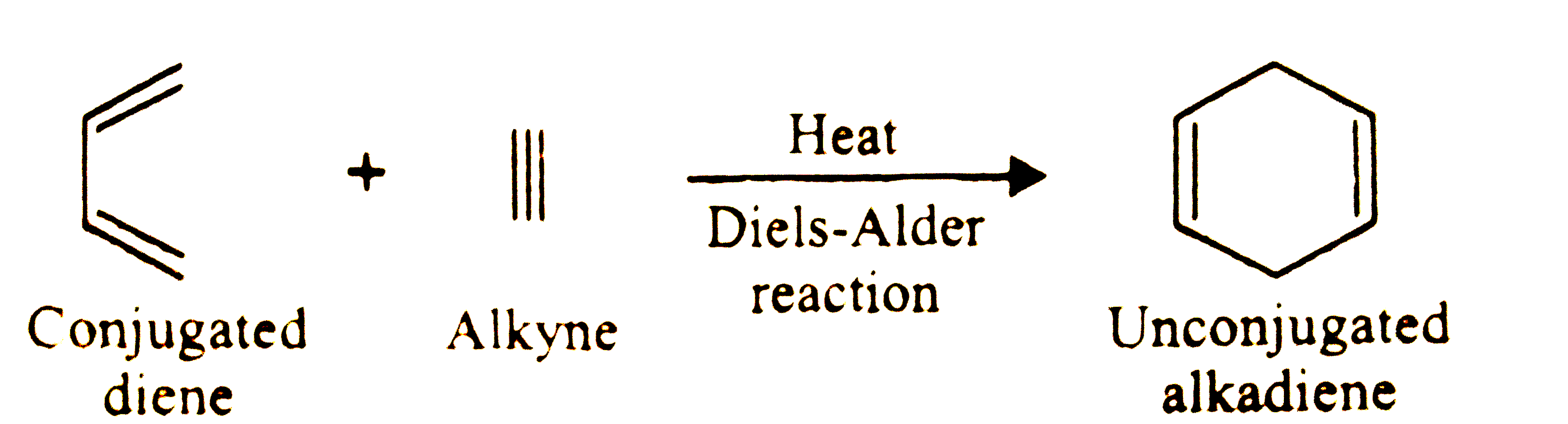
|
|
| 27. |
An alkylhalide with molecular formula C_(6)H_(13)Bron dehydro halogenation gave two isomeric alkenes Xand Y with molecular formula C_(6)H_(12) .On reductive ozonolysis , Xand Y gave four compounds CH_(3)COCH_(3), CH_(3)CHO, CH_(3)CH_(2)CHO and (CH_(3))_(2)CHCHO.Find the alkylhalide. |
|
Answer» Solution :`(i)` The alkyl halide with MOLECULAR FORMULA `C_(6)H_(13)BR` is bromohexane (`2`-"Bromo"`-2,3`-"dimethylbutane") `(ii)` `C_(6)H_(13)Br` on dehydro halogenation gives two isomeric alkenes `2`,`3`- dimethyl-`1`-BUTENE `(X)` and `2`,`3`-dimethyl-`2`-butene`(Y)` `H_(3)C-underset(CH_(3))underset(|)(C )H-overset(Br)overset(|)underset(CH_(3))underset(|)(C )-CH_(3) overset(."alc"KOH)(to)`  `(iii) X` and `Y` on reductive ozonolysis GAVE four compounds `CH_(3)COCH_(3)`, `CH_(3)CHO`, `CH_(3)CH_(2)CHO` and `(CH_(3))_(2)CHCHO`, `(iv)` `X-2,3` dimethyl -`1`-butene `Y-2,3` dimethyl -`2`-butene |
|
| 28. |
An alkyl halide (X) on reaction with ethanolic sodium hydroxide forms an alkene (Y) which on further reaction with HBr gives the same alkyl halide.The alkene (Y) on reaction with HBr/ peroxide followed by reaction with Hg metal followed by reaction with HCN produces an aldehyde (Z).Z is : |
|
Answer»
|
|
| 29. |
An alkyl halide , X, of formula C_6H_13Cl on treatment with potassium tertiary butoxide gives two isomeric alkenes X and Z (C_6H_12). Both alkenes on hydrogenation give 2,3-dimethylbutane. Predict the structures of X , Y and Z . |
Answer» SOLUTION :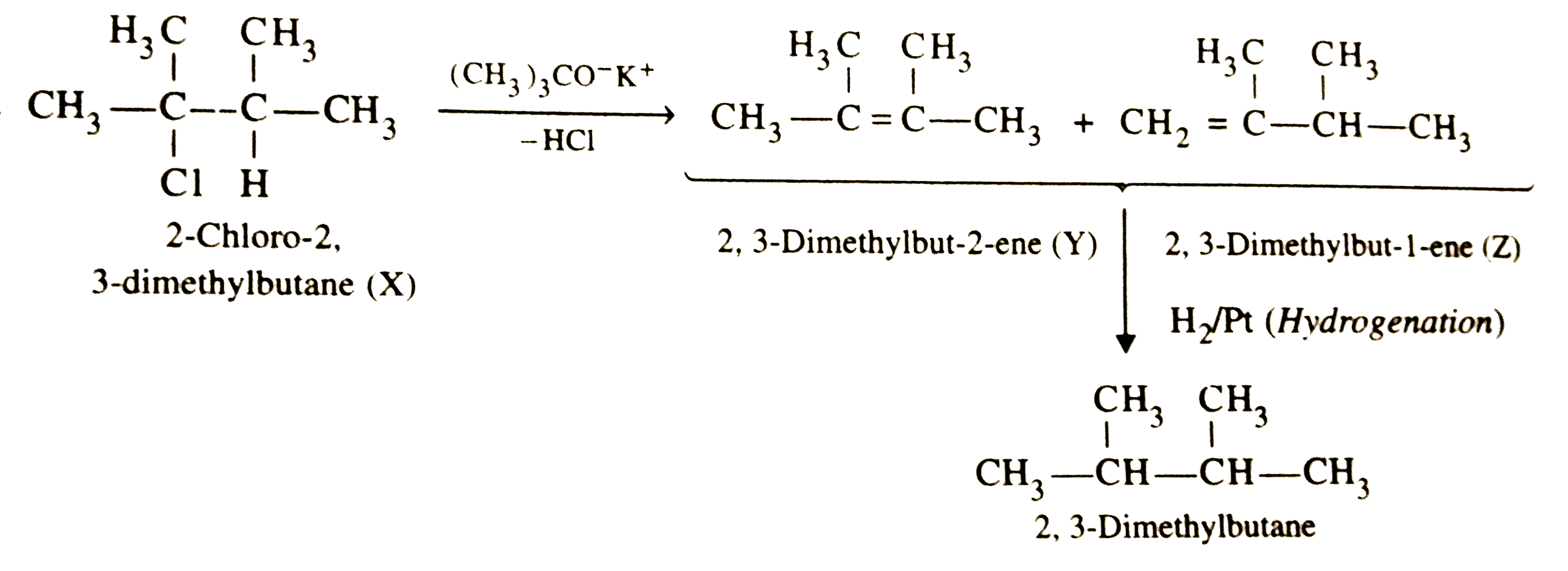
|
|
| 30. |
An alkyl halide with molecular formula C_(6)H_(13)Br on dehydrohalogenation gave two isomeric alkens X and Y with molecular formula C_(6)H_(12) on reductive ozonolysis X and Y gave fourcompounds CH_(3)COCH_(3)CH_(3)CHOCH_(3)CH_(2)CHO and (CH_(3))_(2) CHCHO find the alkyl halide |
|
Answer» Solution :`(i) C_(6) H_(13) Br ` is 3- Bromo -methylpentane. `CH_(3)-underset(CH_(3))underset(|)(CH ) - underset(H)underset(|) overset(Br) overset(|)(C ) -CH_(3)` (ii)3- Bromo-4methyl pentaneon dehydrogenation givetwoisomersx and yas FOLLOWS `CH_(3)- underset(CH)(underset(|)overset( Br)overset(|)(C )- CH_(3) -CH_(3)`  Therefore `C_6H_(13) Br`is 3 Bromo-4-methylpentane |
|
| 31. |
An alkyl halide C_5H_11Br (A) reacts with ethanolic KOH to give an alkene 'B', which reacts with Br_2 to give a compound 'C', which on dehydrobromination gives an alkyne 'D'. On treatment with sodium metal in liquid ammonia , one mole of 'D' gives one mole of the sodium salt of 'D' and half a mole of hydrogen gas . complete hydrogenation of 'D' yields a straight chain alkane. Identify A,B, C and D .Give the reactions involved. |
|
Answer» Solution :The outline of reaction scheme involved in the given problem is `underset"ALKYL halide (A)"(C_5H_11Br) overset"Alc. KOH"to underset"Alkene (B)"(C_5H_10) overset(Br_2//CS_2)to underset"(C )"(C_5H_10Br_2) underset"-2 HBR"overset"Alc. KOH"to underset"Alkyne (D)"(C_5H_8) overset(Na- liq. NH_3)to underset"Sod. Alkynide"(C_5H_7Na+1//2H_2)` (i)SINCE 1 mole of alkyne 'D' reacts with 1 mole of Na in liquid `NH_3` to form half a mole of `H_2`, therefore, (D) is a terminal alkyne. This means that triple bond is at the end of the carbon chain. The two structures for alkyne (D) are either (I) or (II) `underset"1-Pentyne (I)"(CH_3CH_2CH_2-C-=CH) " " underset"3-Methylbut-1-yne (II)"(CH_3-oversetoverset (CH_3)|CH-C-=CH)` Since alkyne 'D' on complete hydrogenation yields a straight chain alkane, therefore , the alkyne (D) is a straight chain alkyne, i.e., alkyne (D) is 1-pentyne (I). (ii)Since alkene (B) on reaction with `Br_2` forms a compound 'C' which one dehydrohalogenation gives the alkyne, i.e., 1-pentyne (D), therefore, (C ) MUST be 1,2-dibromopentane and alkene (B) must be 1-pentene . (iii)Furthersince alkene (B), i.e., 1-pentene is obtained by dehydrogenation of alkyl halide with M.F. `C_5H_11Br`, therefore,alkyl halide (A) must be 1-bromopentane. All the reactions involved in this question may now be explained as follows : `underset"1-Bromopentane (A)"(CH_3CH_2CH_2CH_2CH_2Br) underset"-HBr"overset(Alc. KOH, DELTA)tounderset"1-Pentene (B)"(CH_3CH_2CH_2CH=CH_2) overset(Br_2 "in" Cs_2)tounderset"1,2-Dibromopentane (C )"(CH_3CH_2CH_2-overset2CHBr-overset1CH_2Br) underset"-2HBr " overset(Alc. KOH, Delta)tounderset"1-Pentyne (D)" (CH_3CH_2CH_2C-=CH) overset("Na in liq." NH_3)to underset"Sodium 1-pentynide"(CH_2CH_2CH_2C-=CNa +1//2H_2)` Please not that alkyl halide (A) cannot be 2-bromopentane becausedehydrobromination of (A) would have given 2-pentane as the major product in accordance with Markovnikov's rule. |
|
| 32. |
An alkyl halide C_(5)H_(11)Br (A) reacts with ethanolic KOH to give an alkene 'B', which reacts with Br_(2) to give a compound 'C', which on dehydro-bromination gives an alkyne 'D'. On treatment with sodium metal inliquid ammonia one mole of 'D' gives one mole of the sodium salt of 'D' and half a mole of hydrogen gas. COmplete hydrogenation of 'D' yields a straight chain alkane. Identify A, B, C and D. Give the reactions involved. |
|
Answer» Solution :There actions involved in identification of A, B, C and D are as follows : `C_(5)H_(11)Br(A) + alc. KOH rarr C_(5)H_(10)(B)` `C_(5)H_(10)(B)+ Br_(2)//CS_(2) rarr C_(5)H_(10)Br_(2)(C)` `C_(5)H_(10)Br_(2)(C) + alc. KOH rarr C_(5)H_(8)(D)` Alkyne. `2C_(5)H_(8) + 2Na rarr 2C_(5)H_(7)Na + H_(2)` HYDROGENATION of alkyne (D) gives straight chain alkane hence all the compounds A, B, C and D must be straight chain compounds. Alkyne gives sodium alkenyde which proves D is terminalalkyne. |
|
| 33. |
An alkyl halide by formation of its Grignard reagent and heating with water gives propane. What is the original alkyl halide ? |
|
Answer» methyl iodide |
|
| 34. |
An alkyl bromide (X) reacts with sodium in ether to form 4,5-diethyloctane, the compound 'X' is |
|
Answer» `CH_3(CH_2)_3 Br` Thus , option (d) is CORRECT. |
|
| 35. |
An alkyl bromide produces a single alkene when it reacts with sodium ethoxide and ethanol. This alkene undergoes hydrogenation and products 2-methylbutane. What is the identify of the alkybromide ? |
|
Answer» 1-bromo-2-methylbutane |
|
| 36. |
An alkene with molecular formula C_7H_14 gives propanone and butanal on ozonolysis. Write down its structural formula. |
|
Answer» |
|
| 37. |
An alkene (W) having molecular formula C_6H_(12) gives a hydrocarbon (X) C_6H_(14) on catalytichydrogenation and compound (X) gives two monochloro structural isomeric product (Y) and (Z). The structure of alkene (W) is : |
|
Answer» `CH_3 - CH_2 - CH_2 -CH_2 - CH_2 -CH=CH_2` |
|
| 38. |
An alkene on reductive ozonolysis gives two molecules of CH_2(CHO)_2 . The alkene is |
|
Answer» 2,4-hexadiene 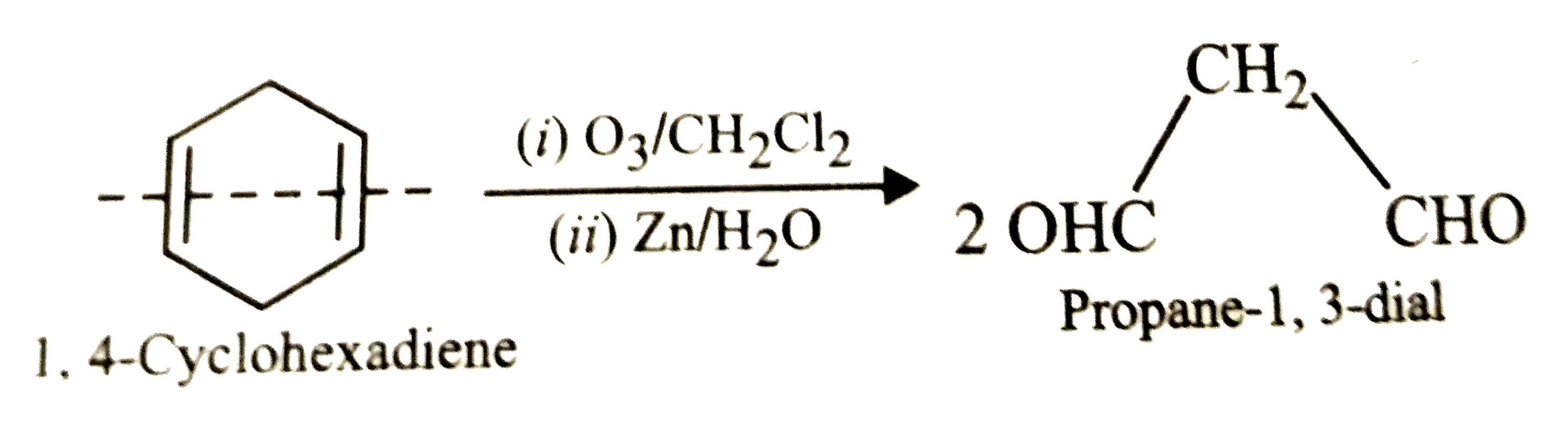
|
|
| 39. |
An alkene on ozonolysis yields only ethanal. There is an isomar of this, which on ozonolysis yields: |
|
Answer» PROPANONE and methanal |
|
| 40. |
An alkene on ozonolysis gives a mixture of ethanal and pentan-3-one. Write the structure and IUPAC name of the alkene. |
Answer» SOLUTION :The PRODUCTS of OZONOLYSIS are : 
|
|
| 41. |
An alkene is most likely to reach with |
|
Answer» A FREE radical |
|
| 42. |
An alkene gives propan-2-one and 2-methylpropanal on ozonolysis. Identify the alkene. What products will be obtained when it is treated with hot and concentrated KMnO_4 ? |
Answer» SOLUTION :The PRODUCTS of OZONOLYSIS are
|
|
| 43. |
An alkene (A) overset("Ozonolysis")to (##RES_CHM_SIPOC_E02_002_Q01.png" width="80%"> , A is |
|
Answer»
|
|
| 44. |
An alkene "A" on reaction with O_3 and Zn gives propanone and acetaldehyde in equimolar Addition of HCl to alkene "A" gives "B" as the product. The structure of product "B" is: |
|
Answer»
|
|
| 45. |
An alkene 'A' on ozonolysis gives a mixture of ethanal and pentan-3-one . Write the structures and IUPAC name of 'A'. |
Answer» Solution :WRITE the structures of the products of ozonolysis side by side with their oxygen ATOMS pointing TOWARDS each other. Remove the oxygen atoms and join the two ends by a double BOND, the STRUCTURE of the alkene 'A' is 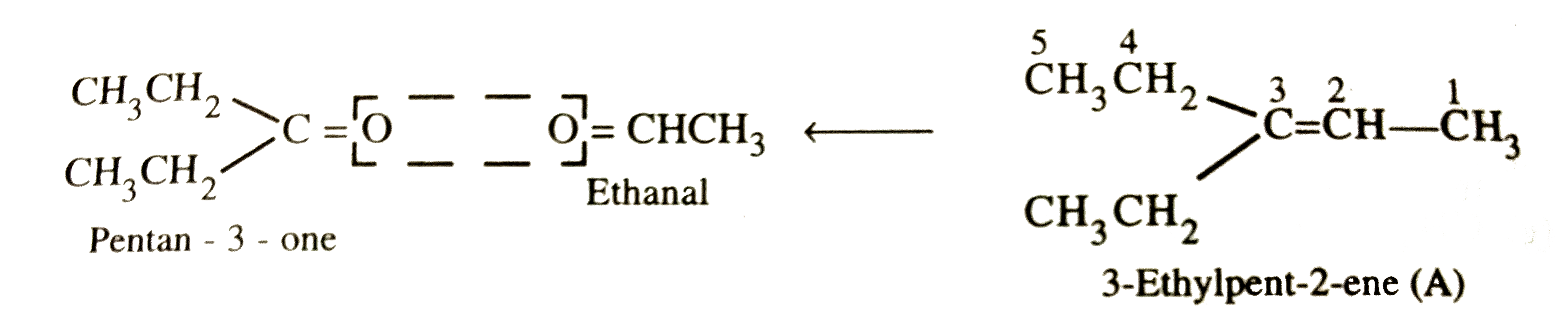
|
|
| 46. |
An alkene 'A' on ozonolysis gives a mixture of ethanal and pentan-3-one. Write structure and IUPAC name of 'A'. |
Answer» Solution : : SELECTION of structure of alkene from the ozonolysis : write the structure of ozonolysis of product. Remove oxygen from the structure Carbon CONTAINING oxygen put the double bond. Put the SUBSTITUTION of the both carbon. |
|
| 47. |
An alkene ‘A’ on ozonolysis gives a mixture of ethanal and pentan-3-one. Write structure and IUPAC name of ‘A’. |
Answer» SOLUTION :The PRODUCTS of OZONOLYSIS are The IUPAC name of the COMPOUND is 3-ethylpent-2-ene. |
|
| 48. |
An alkene 'A' contains three C-C, eight C-H, sigma-bonds , and one C-C pi-bond . 'A' on ozonolysis gives two moles of an aldehyde of molar mass 44 u write the IUPAC name of 'A' |
|
Answer» Solution :(i)An aldehyde with MOLAR mass 44 uis ethanal, `CH_3CH=O` (ii)Write two moles of ethanal SIDE by side with their oxygen ATOMS pointing towards each other. Remove the oxygen atoms and join them by a double bond, the STRUCTURE of alkene 'A' is  As required , but-2-ene has three C-C, eight C-H `sigma`-bonds and one C-C `pi`-bond. |
|
| 49. |
An alkene ‘A’ contains three C – C, eight C – H (sigma)bonds and one C – C (pi) bond. ‘A’ on ozonolysis gives two moles of an aldehyde of molar mass 44 u. Write IUPAC name of ‘A’. |
Answer» Solution : The aldehyde having MOLAR mass 44 U is ethanal, `CH_3CHO` . Since, the ALKENE A on ozonolysis gives two moles of ethanal, `(CH_3 - undersetoverset(|)(H)(C) = O)`, its structure can be obtained by removing O ATOMS from two molecules of ethanal and joining them together by a double bond. THUS, the alkene A has the following structure : As shown above, but-2-ene has three C-C, eight C-H o-bonds and one C-C `pi`- bond. As shown above, but-2-ene has three C-C, eight C-H o-bonds and one C-C `pi`- bond.
|
|
| 50. |
An alkene 'A' contains three C-C, eight C-H sigma bonds and one C-C pi-bond. 'A' on ozonolysis gives two moles of an aldehyde of molar mass 44u. Write IUPAC name of 'A'. |
|
Answer» Solution :Product is formed of molecular weight 44u ALDEHYDE. Aldehyde GROUP is CHO = 12 + 1 + 16 = 29 TOTAL weight `= 44-29 = 15 -= CH_(3)` group `therefore` Product 1 is aldehyde `CH_(3)CHO`. From 2 moler of `CH_(3)CHO`, product alkene is formed.  `underset("But-2-ene")(CH_(3)CH=CHCH_(3))`(A) Structure of but-2-ene with bonds are as follows : `Hoverset(sigma)(-)underset(H)underset(|sigma)overset(H)overset(|sigma)(C)overset(sigma)(-)overset(H)overset(|sigma)(C)underset(sigma)overset(sigma)(=)overset(H)overset(|sigma)(C)overset(sigma)(-)underset(H)underset(|sigma)overset(H)overset(|sigma)(C)overset(sigma)(-)H` In these structure these are C-C `sigma` bond. + These structure has 8 C-H `sigma`-bond. + These structure has 1 C-C `pi`-bond. All DETAILS relates with the que asked. `therefore` Main product is But-2-ene. |
|