Saved Bookmarks
This section includes 7 InterviewSolutions, each offering curated multiple-choice questions to sharpen your Current Affairs knowledge and support exam preparation. Choose a topic below to get started.
| 1. |
An alkene 'A' contains 3 C-C, 8 C-H sigma bonds and 1 C-C pi bond. 'A' on ozonolysis gives two moles of an aldehyde of molar mass 44u. Write the IUPAC name of 'A' |
|
Answer» SOLUTION :Aldehyde with MOLAR mass 44u is `CH_3-CHO` PRODUCTS of OZONOLYSIS `CH_3-CHOrarr OHC-CH_3` `therefore` The alkene is `CH_3-CH=CH-CH_3` |
|
| 2. |
An alkene (A) C_(10)H_(10) on ozonolysis gives only one product (B) C_(8)H_(8)O. Compound (B) reduction with NaOH//I_(2) yields sodium benzoate. Compound (B) reacts with KOH//NH_(2)NH_(2) yielding a hydrocarbon (C) C_(8)H_(10). Write the structures of compound (B) & (C). Based on this information two isomeric structures can be proposed for alkene (A). Write their structure and identify the isomer which on catalytic hydrogenation (H_(2)//Pd-C) gives a racemic mixture. |
|
Answer» |
|
| 3. |
An alkene 3-ethylpent-2-ene will give which of the following products on ozonolysis? |
|
Answer» `HCHO+CH_(3)CH_(2)CH_(2)CHO` 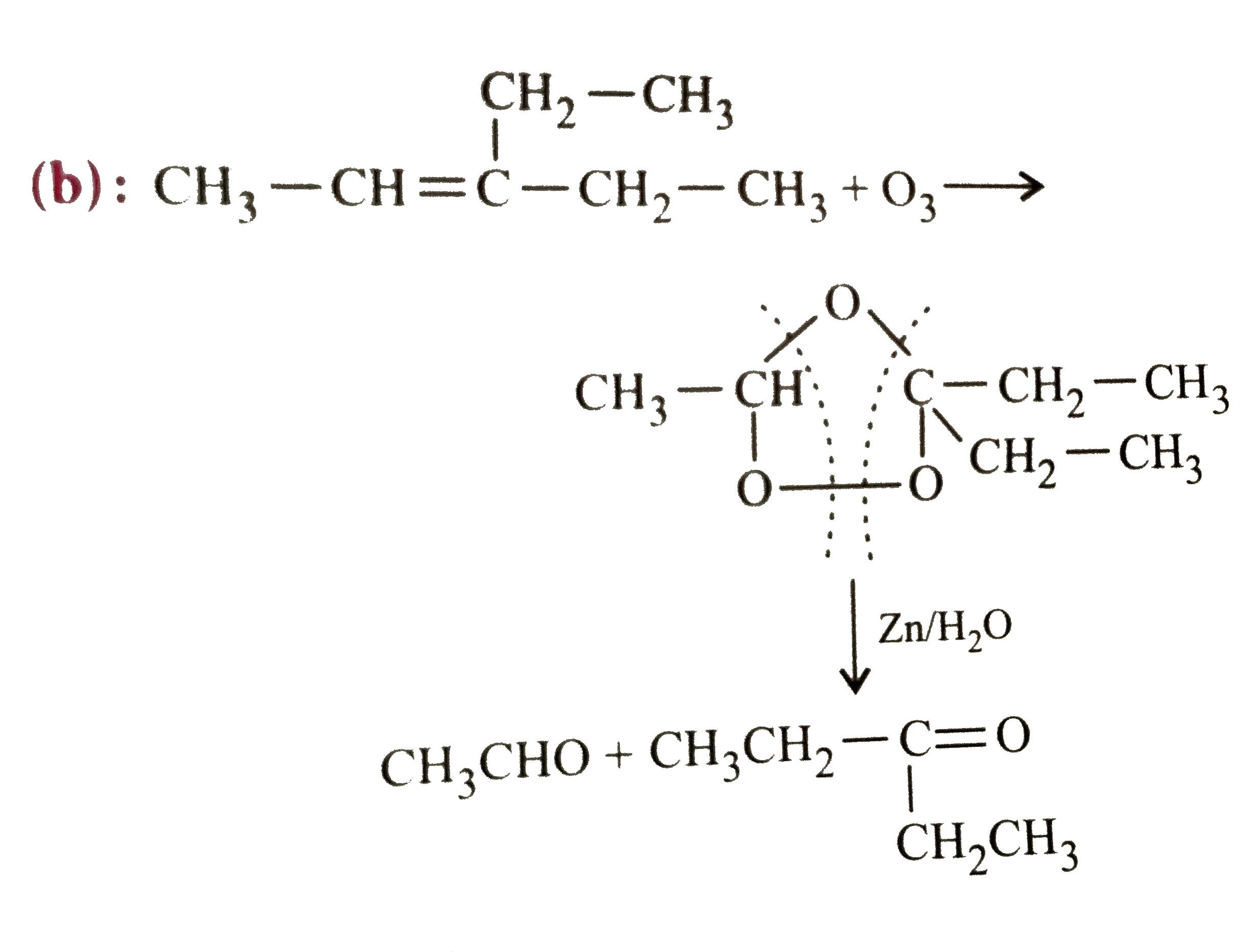
|
|
| 4. |
An alkane with mol.mass = 86 on bromination gives only two monobromo derivatives (excludingstereoisomers). The alkane is |
|
Answer» `CH_3 - UNDERSET(CH_3)underset(|)CH-CH_2-CH_2 - CH_3` |
|
| 5. |
An alkane is obtained by decarboxylation of sodium propionate .Same alkane can be prepared by |
|
Answer» Catalytic hydrogenation of propene |
|
| 6. |
An alkane is obtained by decarboxylation of sodiumpropionate same alkane can be prepared by…………… |
|
Answer» catalytic hydrogenation of propene |
|
| 7. |
An alkane has C/H ratio (by mass) of 5.1428. Its molecular formula is |
| Answer» Answer :B | |
| 8. |
An alkane has a molecular mass of 72 Give all the possible structural isomers along with their IUPAC names. |
|
Answer» Solution :The general formula of ALKANES is `C_n H_(2n+2)` `therefore` 12 x n +1 x (2n + 2) = 72 or 12n+ 2n +2 =72 or n=5 THUS, the MOLECULAR formula of the ALKANE is `C_5H_12` . For structural isomers and their IUPAC NAMES. |
|
| 9. |
An alkane C_(8)H_(18) is obtained as the only product on subjectiog a primary alkyl halide to wurtz reaction. On monobromination this alkane yieles a single isomer of a tertiary bromide . Write the structure of alkane and the tertiary bromide. |
|
Answer» Solution :From wurtz reaction of an alkyl halide gives an alkane with double the number of carbon ATOMS present in the alkyl halide . Here m Wurlz reaction of a primary alkyl halibe gives an alkane `(C_(8)H_(18))` therefore, the alkyl halide must contain four carbon atoms . Now the two possible primary alkyl halides having four corbon atoms each are I and II. (I) `CH_(3)CH_(2)CH_(2)CH_(2)-X` (II) `CH_(3)overset(CH_(3))overset(|)(CH)-CH_(2)X` Since, alkane `C_(8)H_(18)` on monobromination yields a single isomer of TERTIARY alkyl halide, therefore, the alkane must contain teriary hydrogen. This is possible only if primary alkyl halide (which UNDERGOES wurtz reaction) has a tertiary hydroen. 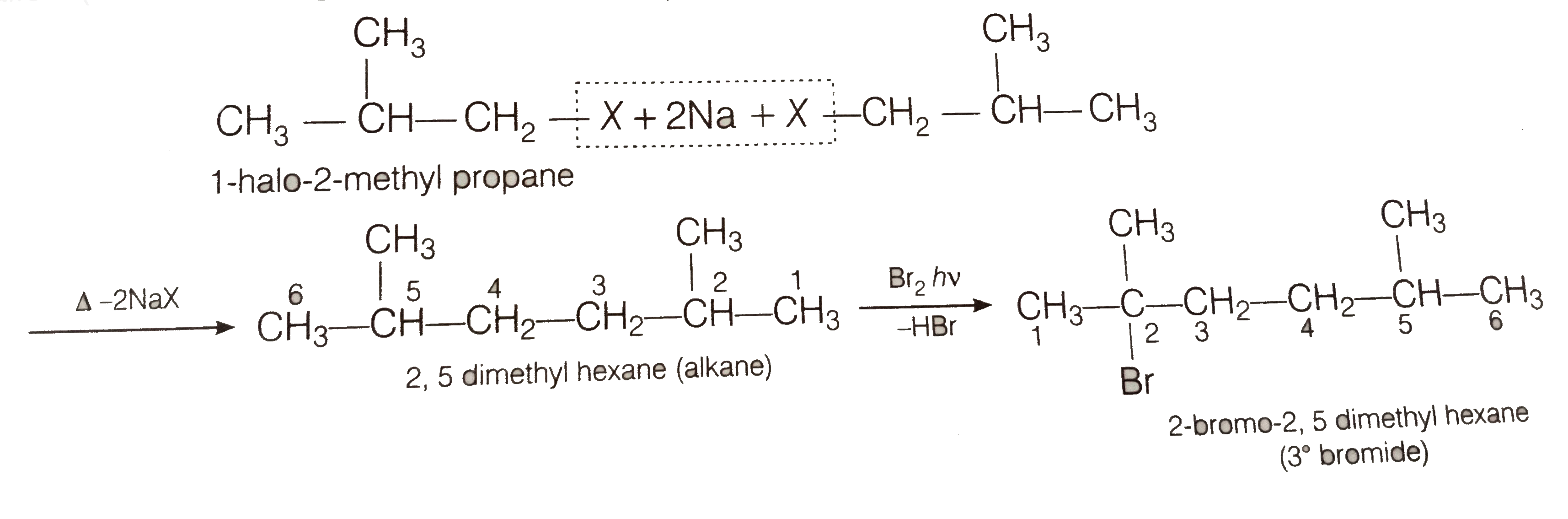
|
|
| 10. |
An alkane C_8H_18 is obtained as the only product on subjecting a primary alkyl halide to Wurtz reaction. On monobromination this alkane yields a single isomer of a tertiary bromide . Write the structures of alkane and the tertiary bromide. |
|
Answer» Solution :(i)We know that Wurtz reaction of an alkyl halide gives an alkane with DOUBLE the number of carbon ATOMS present in the alkyl halide. Since hereWurtz reaction of a primary of a primary alkyl halide gives an alkane with M.F. `C_8H_18`, therefore , the `1^@` alkyl halide MUST contain four carbon atoms. Now the two possible primary alkyl halides having four carbon atoms each are I and II. `underset"I"(CH_3CH_2CH_2CH_2-X) "" underset"II"(CH_3-oversetoverset(CH_3)|CH-CH_2X)` (ii)Since the alkane `C_8H_18` on MONOBROMINATION yields a single isomer of a tertiary alkyl halide, therefore, the alkene `C_8H_18` must contain a tertiary hydrogen. This is possible only if the starting primary alkyl halide has a tertiary hydrogen. Out of I and II , onlyprimary alkyl halide (II) has a tertiary hydrogen. In other WORDS, the starting primary alkyl halide is 1-halo-2-methylpropane (II). If this is so, then the alkene with M.F. `C_8H_18` must be 2,5-dimetylhexane (III) and the monobromoderivative must be 2-bromo-2,5-dimethylhexane (IV). 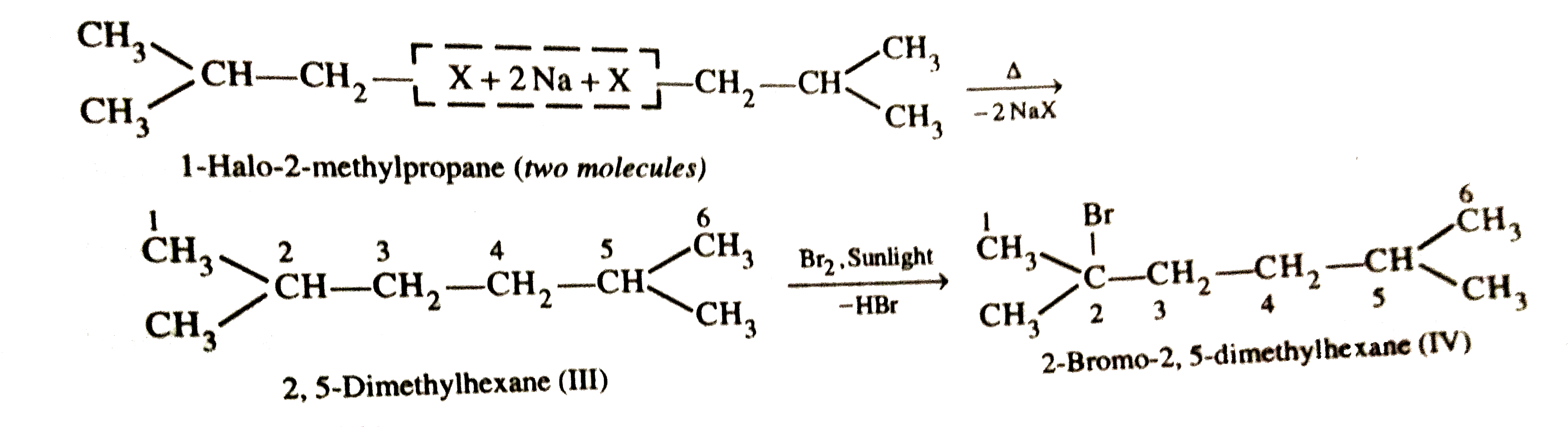
|
|
| 11. |
An alkane cannot be chlorinated by using which of the fallowing reagents ? |
|
Answer» `Cl_2`/ hv |
|
| 12. |
An alkane C_(8)H_(18) is obtained as the only product on subjecting a primary alkyl halide to Wurtz reaction. On monobromination this alkane yields a single isomer of tertiary bromide. Write the structure of alkane and the tertiary bromide. |
|
Answer» Solution :`2C_(4)H_(9)X + 2Na RARR C_(8)H_(18) + 2NaI` `C_(8)H_(16) + Br_(2) rarr` Single isomer of tertiary bromde.. `C_(4)H_(9)X` can be n-butylhalide `= CH_(3)-(CH_(2))_(2)-CH_(2)X` (it is PRIMARY halide) and `CH_(3)-CH(CH_(3))-CH_(2)X` `2CH_(3)-CH(CH_(3))-CH_(2)X + 2Na rarr 2NaX+ CH_(3) - CH(CH_(3))-CH_(2)-CH_(2)-CH(CH_(3))-CH_(3)`. This compound gives only one isomer of tertiary BROMIDE. Therefore, the name of `C_(8)H_(16)` is 2,5-dimethylhexane. `underset("2-Bromo2,5-dimethylhexane")(CH_(3)-CH(CH_(3))-CH_(2)-CH_(2))-CH(CH_(3)-CH_(3)+Br_(2) rarr HBr +CH_(3) - CBr(CH_(3)-CH_(2)-CH_(2)-CH(CH_(3))-CH_(3)` |
|
| 13. |
An alkane C_7H_16 is produced by the reaction of lithium di(3-pentyl ) cuprate with ethyl bromide. The structural formula of the product is |
|
Answer» 3-ethylpentane 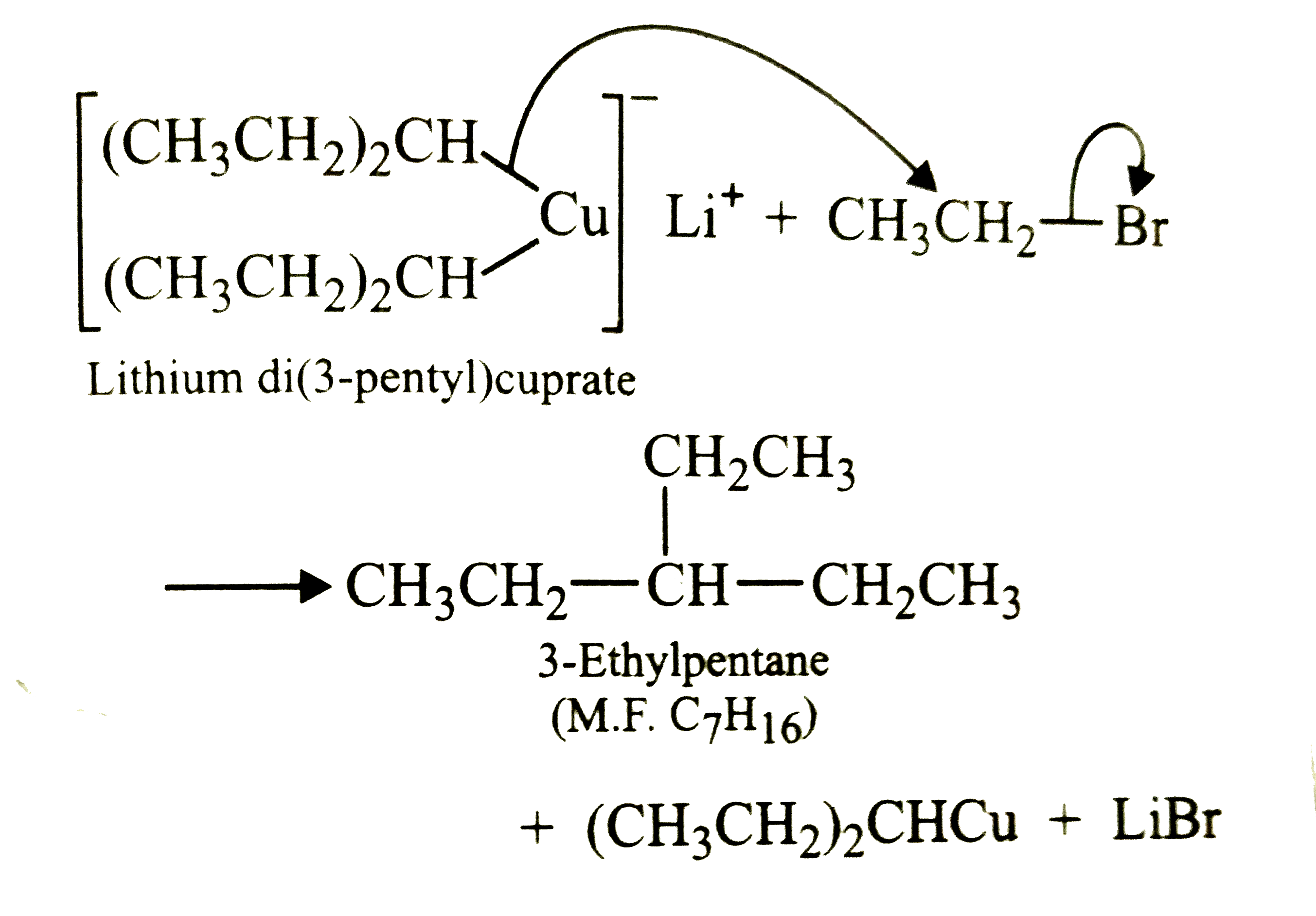
|
|
| 14. |
An alkane C_(7)H_(16) is produced by the reaction of lithium di(3-pentyl)cuprate with ethyl bromide. The name of the product is |
|
Answer» 3-methylhexane |
|
| 15. |
An alkane C_7H_(16) is produced by the reaction of lithium di (3-pentyl) cuprate with ethyl bromide.The structural formula of the product is |
|
Answer» 3-ethylpentane 
|
|
| 16. |
An alkane C_(6)H_(14) gives two monochloro derivatives on chlorination. Its possible structure is |
|
Answer» `CH_(3)CH_(2)CH_(2)CH_(2)CH_(2)CH_(3)` |
|
| 17. |
An alkaloid contains 17.28% of nitrogen and its molecular mass is 162. The number of nitrogen atoms present in one molecule of the alkaloid is |
|
Answer» five 162 g alkaloid `=(162xx17.2)/(100)=27.86g` nitrogen `therefore` No. of nitrogen ATOMS = `(27.86)/(14)~~2` |
|
| 18. |
An alkaloid contains 17.28% of nitrogen and its molecular mass is 162. The number of nitrogen atoms present in one molecule of alkaloid is: |
|
Answer» 3 |
|
| 19. |
An alkaline solution of H_(2)O_(2) converts benzene into phenol in the presence of FeSO_(4). Thus, the solution of alkaline H_(2)O_(2)+FeSO_(4) is a strong oxidising agent and is known as |
|
Answer» FENTON's REAGENT |
|
| 20. |
An alkaline earth metal (M) gives a salt chlorine, which is souble in water at room temperature. It also forms an insoluble sulphate whose mixture with a sulphide of a transtion metal is called lithopone a while pigment Metal M is |
|
Answer» Ca |
|
| 21. |
An alkali metal (x) forms a hydrated sulphate, X_2SO_4.10H_2O. Is the metal more likely to the sodium (or) postassium. |
| Answer» Solution :X forms `X_2SO_4.10H_2O`. The metal is more LIKELY be SODIUM. So X is `Na_2SO_4.10H_2O`. It is a otherwise CALLED as Glauder's salt. | |
| 22. |
An alkali metal (s) forms a hydrated sulphate, X_(2)SO_(4).10H_(2)O. Is the metal more likely to be sodium (or) potassium. |
| Answer» SOLUTION :X forms `X_(2)SO_(4).10H_(2)O`. The metal is more likely be sodium. So X is `Na_(2)SO_(4).10H_(2)O`. It is otherwise called as Glauber.s salt. | |
| 23. |
An alkalimetal (M )reactswithammoniato formamida(MNH_(2)). 2M+2NG_(3) to2MNH_(2)+H_(2) thereactiondoesNOTholdtruewhenM is_________. |
|
Answer» SODIUM |
|
| 24. |
An alkali metal hydride (NaH) reacts with diborane in 'A' to give a tetrahedral complex 'B' which is extensivelyused as reducingagentin organic synthesis. The compounds 'A' and 'B'respectivelyare |
|
Answer» `CH_(3)COCH_(3)` and `B_(3)N_(3)H_(6)` |
|
| 25. |
An alkali metal (A) belongs to period number II and group number I react with oxygen to form (B). (A) reacts with water to form (C) with liberation of hydrogen compound Identify A, B, C. |
|
Answer» Solution :An ALKALI metal (A) belongs to period number II and group number I is lithium. (ii) Lithium reacts with oxygen to form simple oxide lithium oxide (B) `4Li + O_(2) tounderset("Lithium oxide")( 2Li_(2)O)` (iii) Lithium reacts with water to form lithium hydroxide with LIBERATION of hydrogen ` 2Li + 2H_(2)O to underset("Lithium hydroxide ")(2LiOH) + H_(2)`Lithium directly react with carbon to form an ionic compound lithium carbide. ` 2Li + 2C to underset("Lithium carbide")(Li_(2)C_(2))`LithiumLi Lithium oxide` Li_(2)O` Lithium hydroxide`LiOH` Lithium carbide`Li_(2)C_(2)`(kindly insert a table) |
|
| 26. |
An alkali is titrated against an acid with methyl orange as indicator. Which of the following is a correct combination ? |
|
Answer» `{:(,"Base","Acid","END POINT",),((a),"Weak","Strong","Colourless to pink",):}` Weak base has `pH gt 7`. When methyl orange is added to weak base solution, the solution becomes yellow. When the solution is titrated with a strong acid, after the end point, solution is acidic and pH is `lt ` 3.1 . Therefore solution becomes pinkish red. |
|
| 27. |
An alekene X is obtained by dehydration of ann alcohol Y. X on ozonolysis gives two molecules of ethanal for every molecule of alkene. X and Y are |
|
Answer» X=3-hexene,Y=3-hexanol `CH_(3)-overset(H)overset(|)(C)=O+O=overset(H)overset(|)(C)-CH_(3) to underset("2-Butene")(CH_(3)CH=CHCH_(3))` 2-butene is obtained by dehydration of 2-butanol. `CH_(3)-CH_(2)-underset(OH)underset(|)(C)H-CH_(3)overset(H^(+))to CH_(3)-CH=CH-CH_(3)+H_(2)O` |
|
| 28. |
An aldehyde can not be reduced to a primary alcohol by |
|
Answer» `NaBH_(4)` |
|
| 29. |
An aldehyde (A) (C_11H_8O) , which does not undergo self aldol condensation, gives benzaldehyde and two moles of (B) on ozonolysis.Compound (B), on oxidation with silver ion, gives oxalic acid. Identify the compounds (A) and (B). |
Answer» Solution :Since, the given aldehyde does not undergo self aldol condensation, it will not CONTAIN `alpha`-HYDROGEN atom. Further it undergos ozonolysis indicating the presence of UNSATURATION probably at two places as the PRODUCTS are benzaldehyde and two MOLES of (B). So, the structure of given aldehyde `(C_11H_8O)` is. 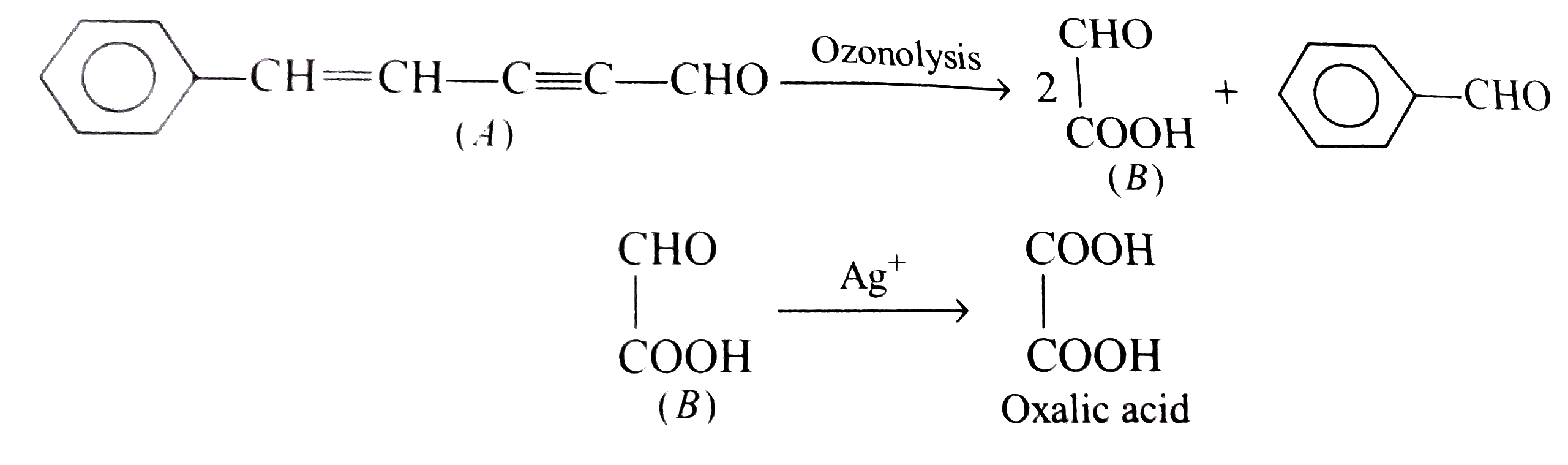
|
|
| 30. |
An alcohol produced during manufacture of soap is |
|
Answer» Ethanol |
|
| 31. |
An alcohol on vigorous oxidation is found to give ethanoic acid and propanoic acid. The alcohol may be |
|
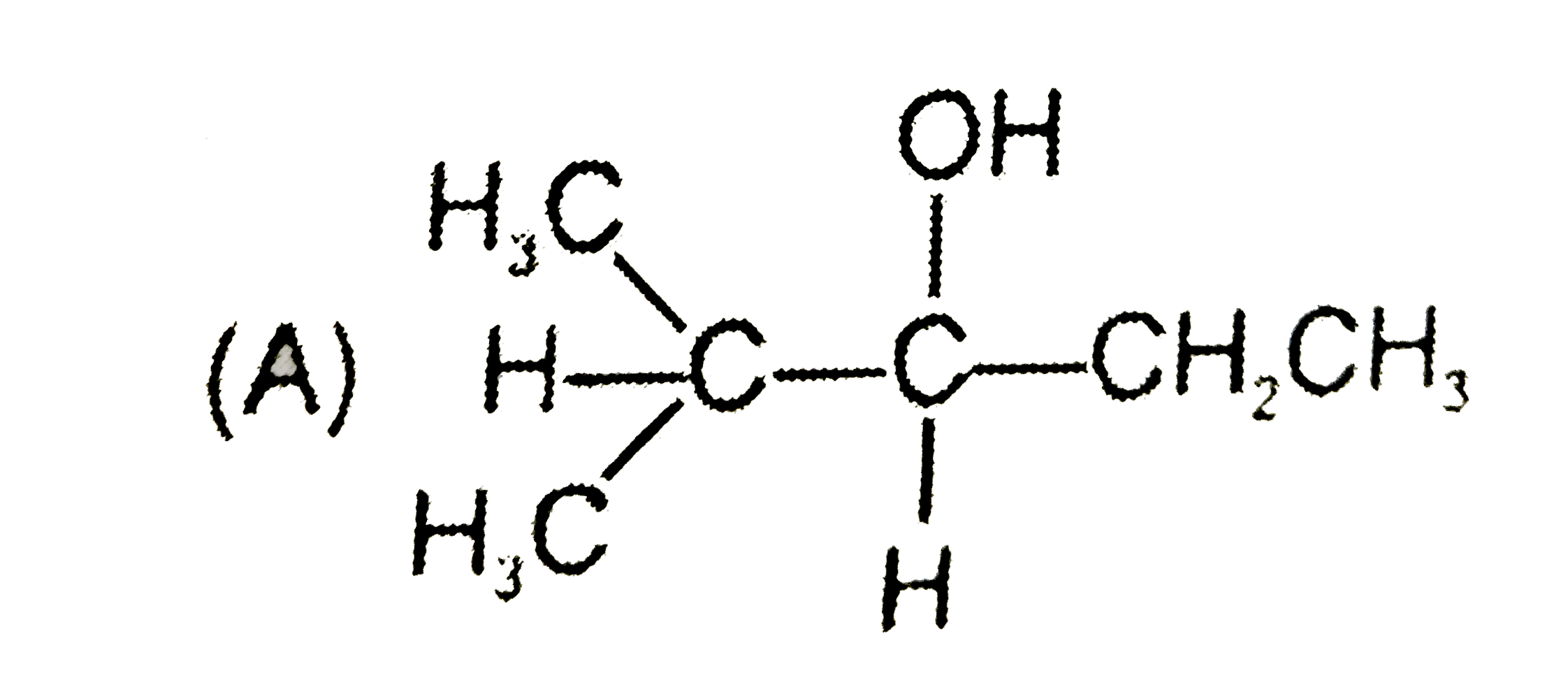
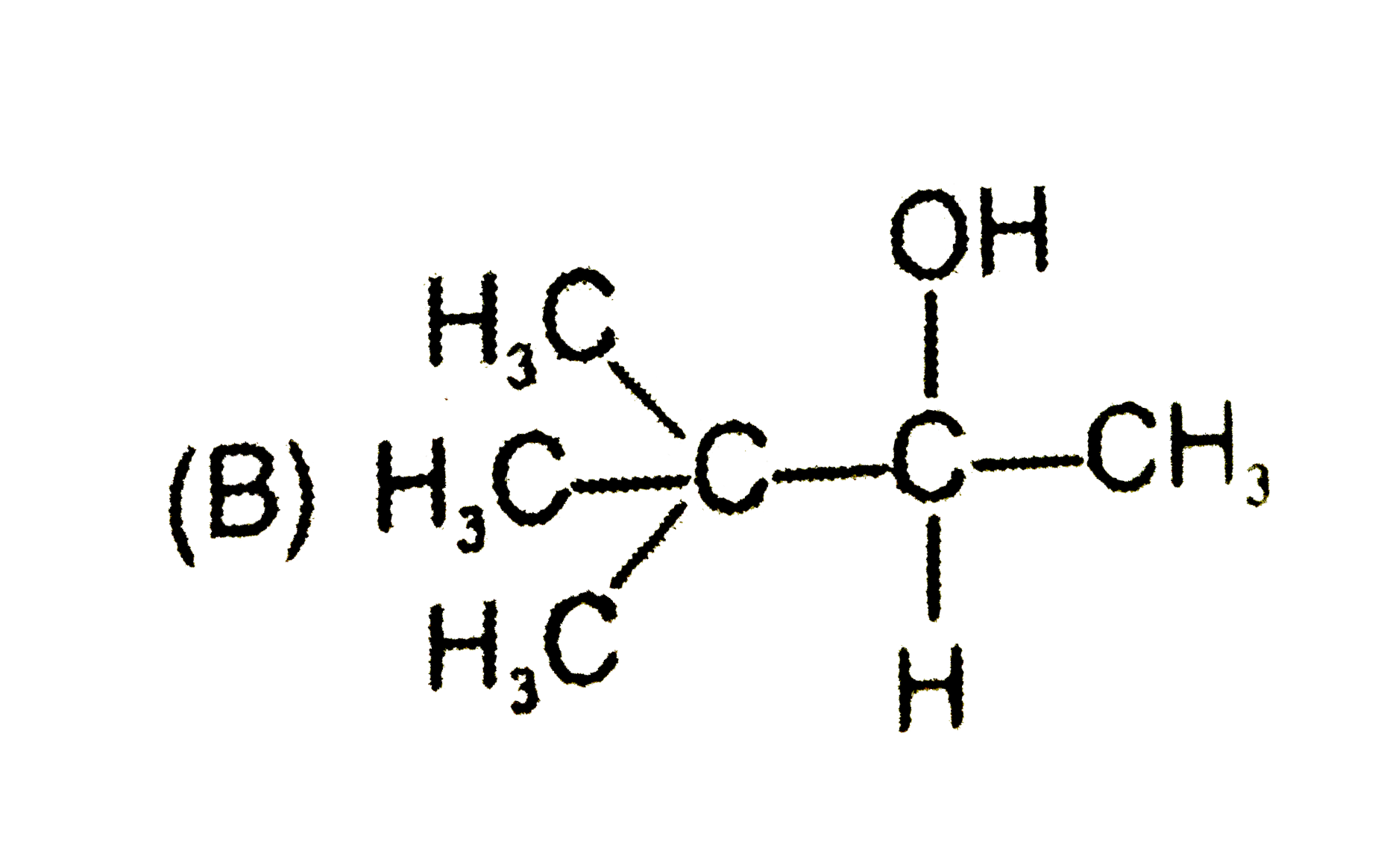
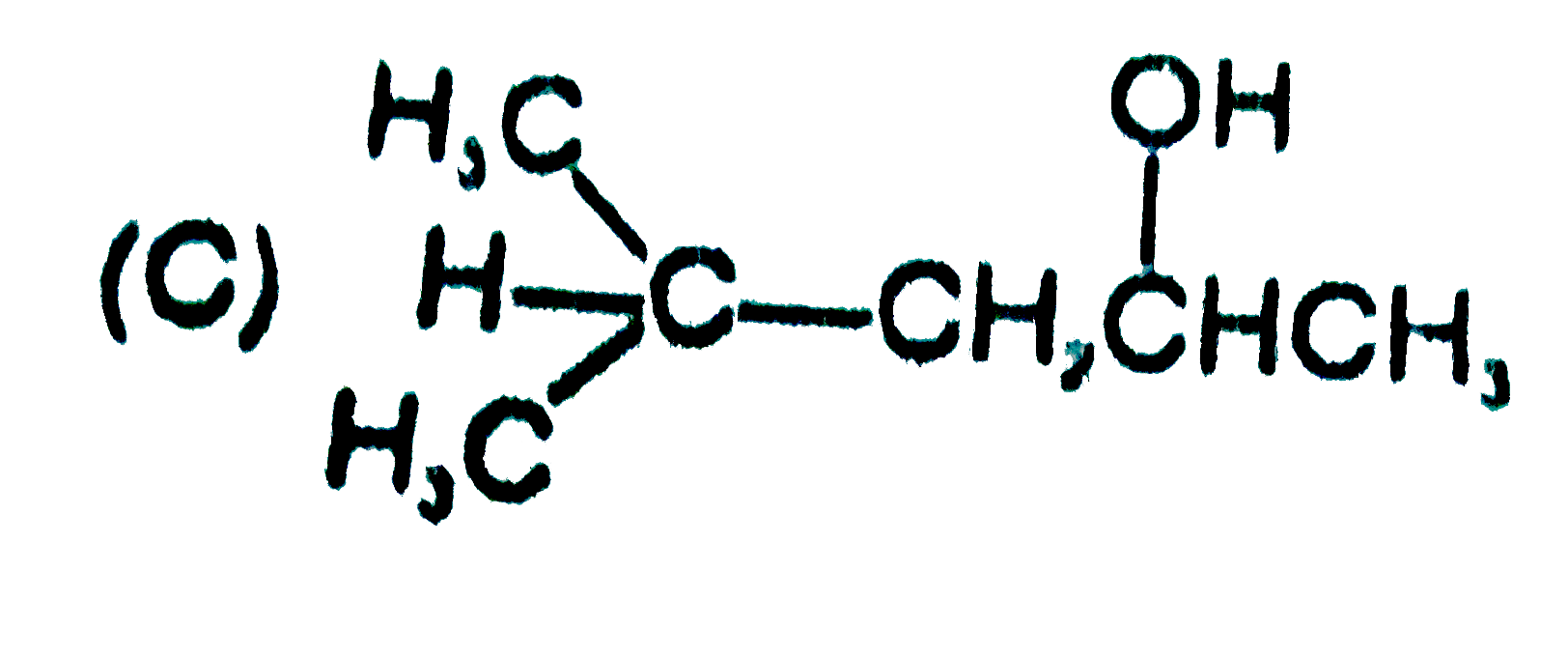
Answer» 1-Pentanol `underset("2-Pentanol")(CH_(3)-overset(OH)overset(|)(CH)-CH_(2)-CH_(2)-CH_(3)) overset([O])rarrCH_(3)-overset(O)overset(||)(C)-CH_(2)-CH_(2)-CH_(3) overset([O])rarr underset("Ethanoic ACID")(CH_(3)COOH)+underset("Propanoic acid")(CH_(3)CH_(2)COOH)` |
|
| 32. |
An alcohol on treatment with alkaline KMnO_(4) gives brown ppt. The alcohol is |
|
Answer» `(C_(2)H_(5))_(3)COH` |
|
| 33. |
An alcohol on oxidation is found to give CH_(3)COOH and CH_(3)CH_(2)COOH. The structure of the alcohol is |
|
Answer» `CH_(3)CH_(2)CH_(2)CH_(2)CH_(2)OH` `underset(A 2^(@) alcohol")(CH_(3)-CH_(2)-CH_(2)-overset(OH)overset(|)(CH)-CH_(3) overset([O])rarr)` `CH_(3)-CH_(2)-CH_(2)-overset(O)overset(||)(C)-CH_(3) overset([O])rarr CH_(3)CH_(2)COOH+CH_(3)COOH` |
|
| 34. |
An alcohol (A) on treatment with conc. H_(2)SO_(4) gave an alkene (B). The compound (B), on reacting with Br_(2) water and subsequent dehydrobomination with NaNH_(2) produced a compound (C). The compound (C) with dil. H_(2)SO_(4) in presence (D) can also be obtained by oxidation of A by acifified KMnO_(4) or from dry heating of calcium acetate. Calculate the mass of 0.1 mol of D in gms. Round off your answer to next nearest integer. |
|
Answer» |
|
| 35. |
An alcohol C_(5)H_(11)OH on dehydration gives an alkene which on oxidation yields a mixture of a ketone and an acid. The alcohol in question is |
|
Answer» `H_(3)C- UNDERSET(H)underset(|)OVERSET(OH)overset(|)(C) - underset(H)underset(|)overset(H)overset(|)(C) - underset(H)underset(|)overset(H)overset(|)(C) - CH_(3)` |
|
| 36. |
An alcohol (a) on dehydration gives (b), which on Ozonolysis gives acetone and formaldehyde. (b) decolourises alkaline KMnO_4 solution but (a) does not. (a) and (b) are respectively: |
|
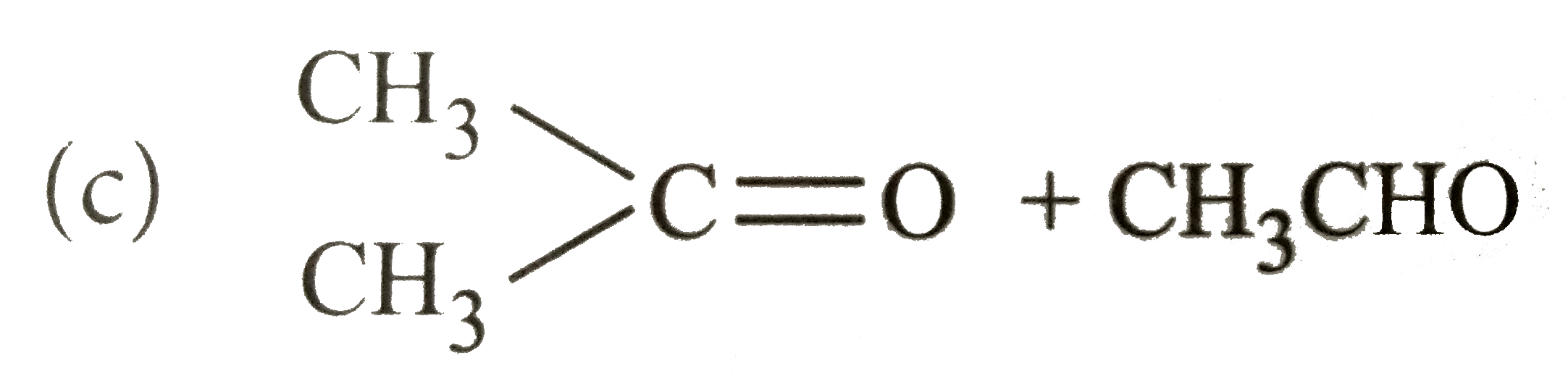
Answer» `CH_3CH_2CH_2CH_2OH and CH_3CH_2CH=CH_2` `CH_3 - underset(CH_3)underset(|)C = CH_2 overset(O_3)to underset(CH_3)underset(|)CH_3 - C = O + HCHO` |
|
| 37. |
An air bubble has a radius of 0.50 cm at the bottom of a water tank where the temperature is 280 K and the pressure is 280 kPa. When the bubble rises to the surface, the temperature changes to 300 K and pressure to 300 K and pressure to 100 kPa. Calculate the radius of the bubble at the surface |
|
Answer» SOLUTION :Volume of AIR bubble `(V_(1))` at the bottom `=(4)/(3)PI(0.50)^(3)` ltbr volume of air bubble `(V_(2))` at the top `=(4)/(3)pi(r)^(3)` Now `V_(2)=(280xxV_(1)xx300)/(280xx300)=3V_(1)` `therefore(4)/(3)pi(r)^(3)=3XX(4)/(3)pi(0.50)^(3)` or `r=(3)^(1//3)xx0.50=1.442xx0.50=0.721cm` |
|
| 38. |
The volume of an air bubblebecomes three times as it rises from the bootom of a lake to its surface. Assuming temperature to be constant and atmospheric pressure to be 75 cm of Hg and the density of water to be 1//10 of the density of the mercury, the depth of the lake is |
|
Answer» `=75+(20xx12xx2.54)/(13.6)` `( :. "DENSITY of Hg " 13.6 g cm^(-3))` =119.8 cm of Hg According to Boyle.s law `P_1 V_1 = P_2 V_2` In the PRESENT case, `P_1 119.8 " cm Hg," V_1=3 mL ,P_2=75 " cm Hg, "` `:. 119.8xx3=75xxV_2 or V_2= 4.79 mL` Hence, the valume at the surface of water is 4.79 mL. |
|
| 39. |
An adult human body contain approximately ... Mg. |
|
Answer» 25 gram |
|
| 40. |
For the adiabatic expansion of an ideal gas |
|
Answer» INCREASE in TEMPERATURE |
|
| 41. |
In an adiabatic expansion of ideal gas: |
|
Answer» Increase in temperature |
|
| 42. |
An acyclic hydrocarbon P, having molecular formula C_6H_10 , gave acetone as the only organic product through the following sequence of reactions, in which Q is an intermediate organic compound. The major product (H) in the given reaction sequence is : CH_3-CH_2-CO-CH_3overset(CN)to Gunderset("Heat")overset(95% H_2SO_4)toH |
|
Answer» `CH_3-CH=undersetunderset(CH_3)(|)C-COOH` |
|
| 43. |
An acyclic hydrocarbon P, having molecular formula C_6H_10 , gave acetone as the only organic product through the following sequence of reactions, in which Q is an intermediate organic compound. The structure of compound Q is |
|
Answer»
|
|
| 44. |
An acidic solution of methyl red has an absorbance of 0.451 at 530 nm in a 5.00 nm cell . Calculate the molarity of methyl red in this solution . [Molar absorbtivity = 1.06 xx 10^(5) L mol^(-1) cm^(-1) at 530 nm ] |
|
Answer» `2.31 XX 10^(-6)`M |
|
| 45. |
An acidic solution of hydrogen peroxide behaves as an oxidising as well as reducing agent. Illustrate it with the help of a chemical equation. |
|
Answer» Solution :The FOLLOWING chemical equation indicate the oxidising and reducing nature of `H_2O_2`. (i) `H_2O_2`, oxidises acidified KI to iodine. `2KI + H_2O_2 + H_2SO_4 toI_2+ K_2SO_4 + 2H_2O` (ii) `H_2O_2` REDUCES `KMnO_4` to `MnO_2` in ALKALINEMEDIUM. `2KMnO_4 + 3H_2O_2 to 2MnO_2 + 2KOH + 3O_2 + 2H_2O` |
|
| 46. |
An acidic indicator ionises as I_n H hArr In^(-) + H^(+). The molecular and ions of the indicator show different colours. The indicator changed it colour if its acidic of basic form completelypredominate. What is the percentage of basic form acidic indicator . (P^(ka) =6)is an aqeous NaCl soluition at 25% C |
|
Answer» `90 %` ` ([In^(-) ])/( [In^(-)][HIn]) XX 100 =(10)/(10+1)xx 100 = 90 %` |
|
| 47. |
An acidic indicator ionises asI_(n) H hArr "In"^(-) + H^(+) . The molecular and ions of the indicator show different colours. The indicator changed it colour if its acidic of basic form completely predominant. An indicator with P^(Kin) = 5 is added to a solution with p^(H) = 5 . What is the percentage of acidic form of theindicator |
|
Answer» `25 % ` |
|
| 48. |
An acidic indicator ionises asI_(n) H hArr "In"^(-) + H^(+) . The molecular and ions of the indicator show different colours. The indicator changed it colour if its acidic of basic form completely predominant. Dissociation constant of an acidic indicator is 10^(-5) . At what p^(H) 80% of the indicator exists in molecular form ? |
|
Answer» SOLUTION :` pH = p^(kln )+ log ""([In^(-) ])/( [HIn]) ` ` pH =5+ log ""(20)/( 80 ) =5- log 4 = 4.4 ` |
|
| 49. |
An acidic indicator ionises asI_(n) H hArr "In"^(-) + H^(+) . The molecular and ions of the indicator show different colours. The indicator changed it colour if its acidic of basic form completely predominant. What is the percentage of basic form acidic indicator (p^(ka) = 6) is an aqeous NaCl solution at 25^(@) C |
|
Answer» `90 %` ` ([In^(-) ])/( [In^(-)][HIn]) xx 100 =(10)/(10+1)xx 100 = 90 %` |
|
| 50. |
An acidic compound (A) , C_4H_8O_3 , loses its optical activity on strong heating yielding (B), C_4H_6O_2 , which reacts readily with KMnO_4 . (B) forms a derivative (C) with SOCI_2, which on reaction with (CH_3)_2 NH gives (D). The compound (A) on oxidation with dilute chromic acid gives an unstable compound (E) which decarboxylates readily to give (F), C_3H_6O. The compound (F) gives a hydrocarbon (G) on treatment with amalgamated Zn and HCI. Give structures of (A) to (G) with proper reasoning. |
Answer» Solution :The compound (A) is an acid and OPTICAL active.It possesses an ASYMMETRIC carbon and a carboxylic group. The structure of (A) may be, 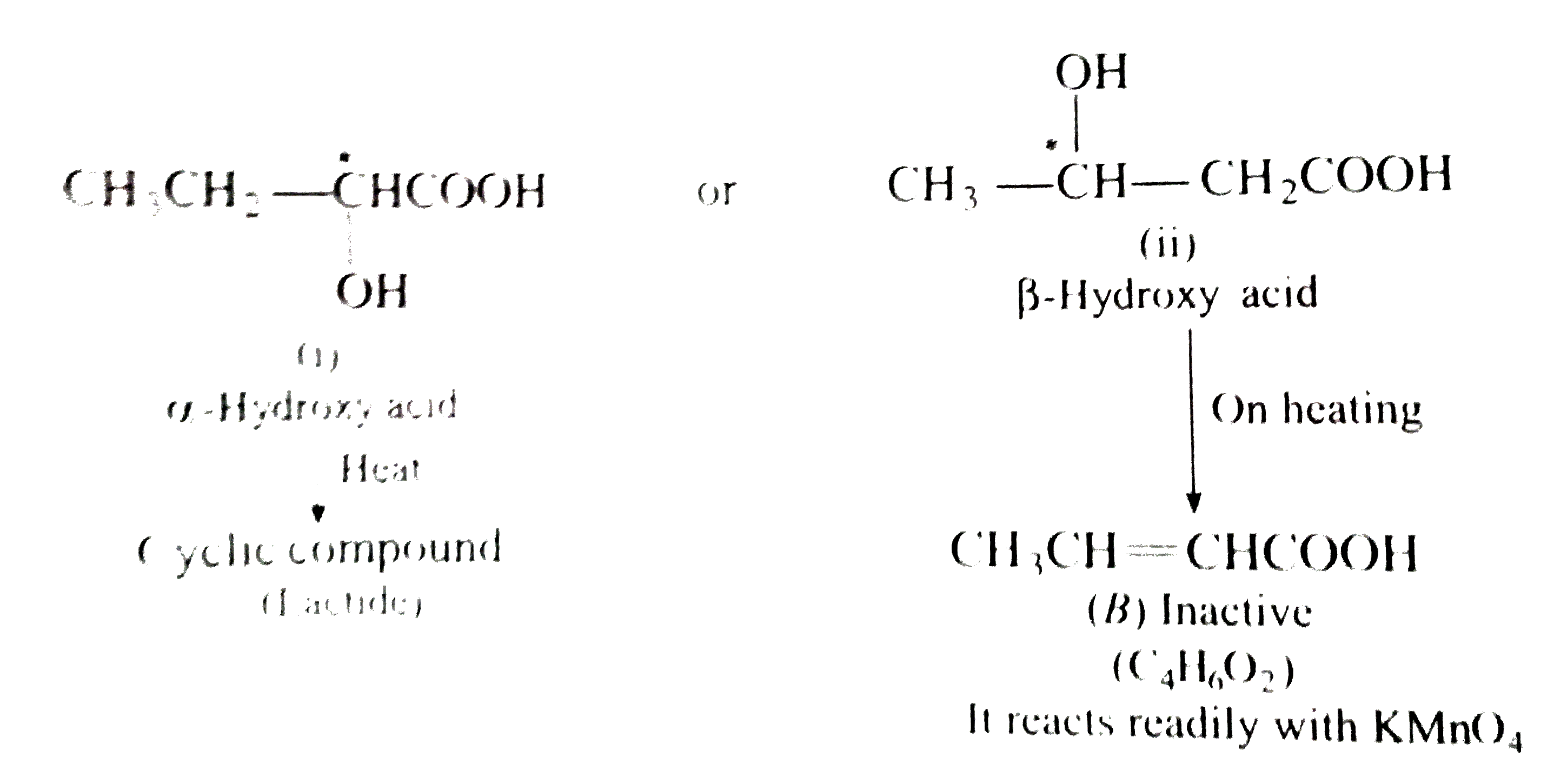 THUS,(A) is `CH_3CHOHCH_2COOH`. 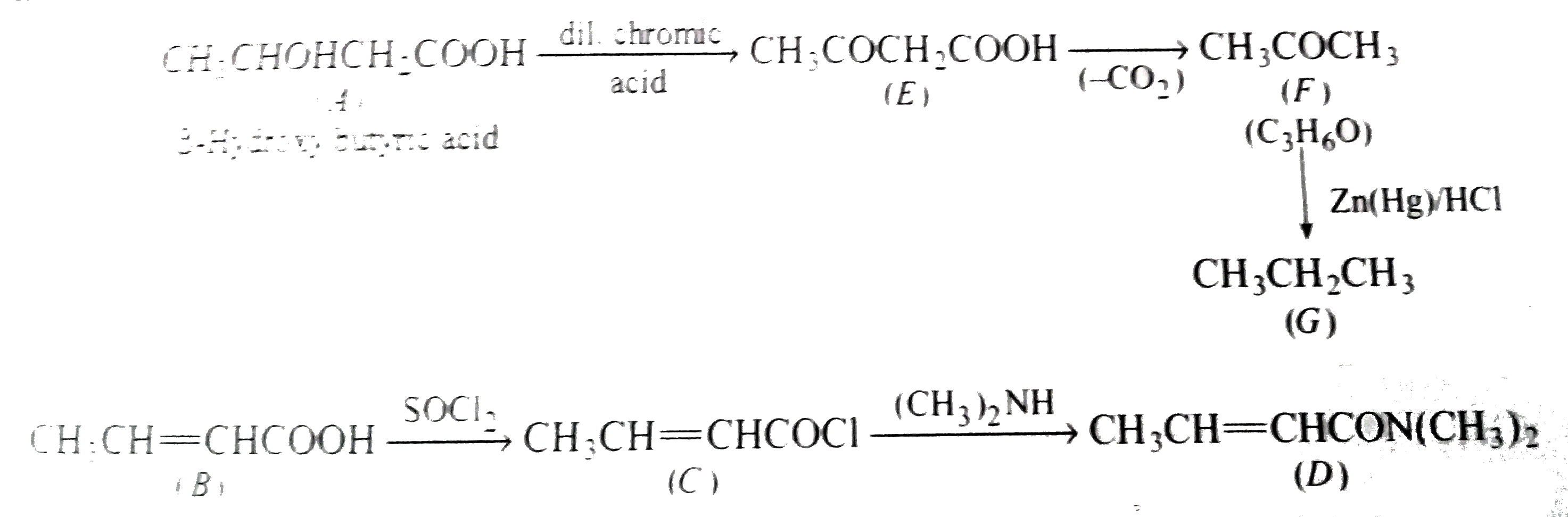 `underset((B))(CH_3CH=CHOOH)overset(SOCI_2)toCH_3CHunderset((C))(=)CHCOCIoverset((CH_3)_2NH)toCH_3CH=underset((D))(CHCON(CH_3)_2)` |
|