Saved Bookmarks
This section includes 7 InterviewSolutions, each offering curated multiple-choice questions to sharpen your Current Affairs knowledge and support exam preparation. Choose a topic below to get started.
| 2. |
But -1, 3-diene and but-1-yne have the following reactions in common. |
|
Answer» Decolourise the purple COLOUR of `KMnO_4` solution. |
|
| 3. |
Burning sensation is caused in nose and throat due to ozone and nitric oxide. |
| Answer» SOLUTION :TRUE STATEMENT | |
| 4. |
Burning of methane with oxygen from air is an example of oxidation. It is also called as "______________". |
|
Answer» BLEACHING |
|
| 5. |
Bulky t-butyl group is always on the equatorial position because of less steric strain, as the group is out of the ring plane. Write the major products and conformational structures or stereoisomers ( if any ) when (A) reacts with the following reagaents : a. O_(3)//Me_(2)Sb. D_(2)+Ptc.BD_(3)+THF and then CH_(3)COOTd.BH_(3)+THF then H_(2)O_(2)+O^(c-)H e.Hg(OAc)_(2)+THF+H_(2)Othen NaBH_(4)+O^(c-)Hf.Magnesimu perphthalate then H_(3)O(c-), H_(2)O g.OsO_(4)//aq. NaHSO_(3) , h.Br_(2),C CI_(4) , i. Br_(2), H_(2)O , j. ICI, k.Dil. H_(2)SO_(4) |
Answer» Solution : a. 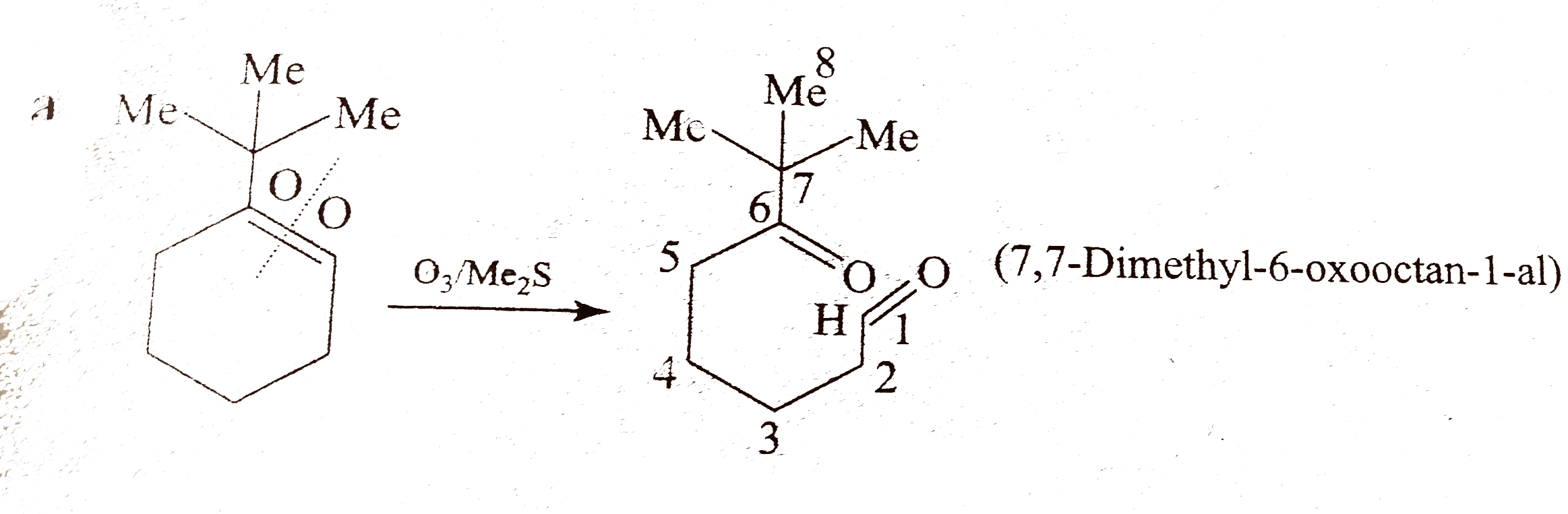 b. 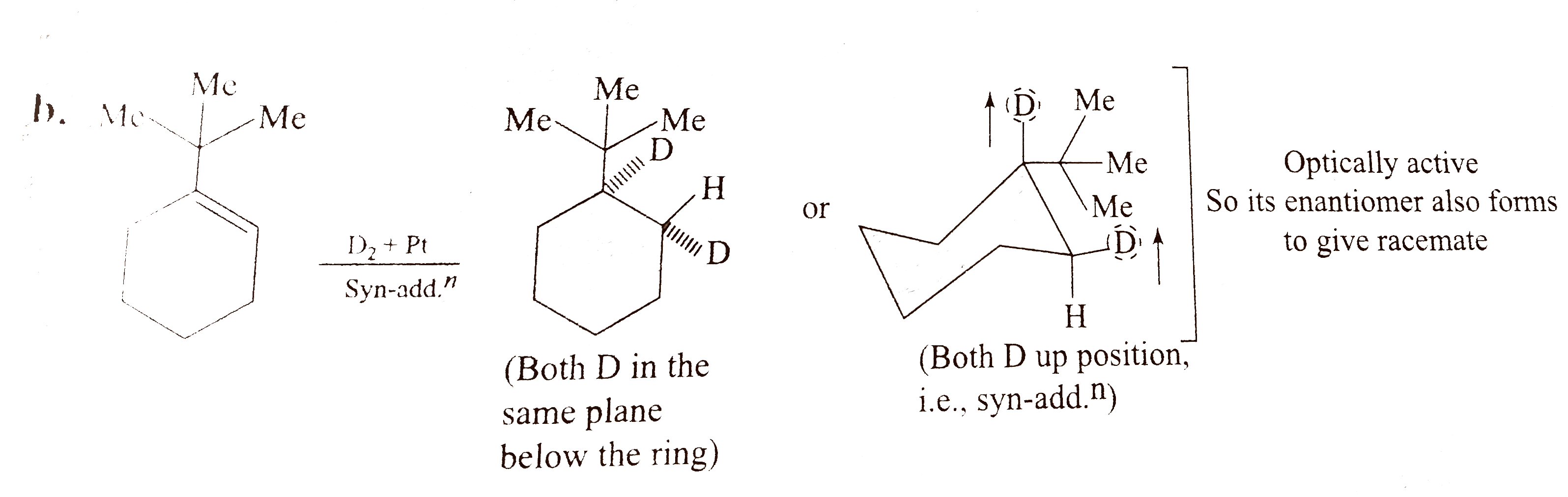 c. Syn `-` ADDITION of `D,T`, and anti - Markovnikov's addition of `D` and 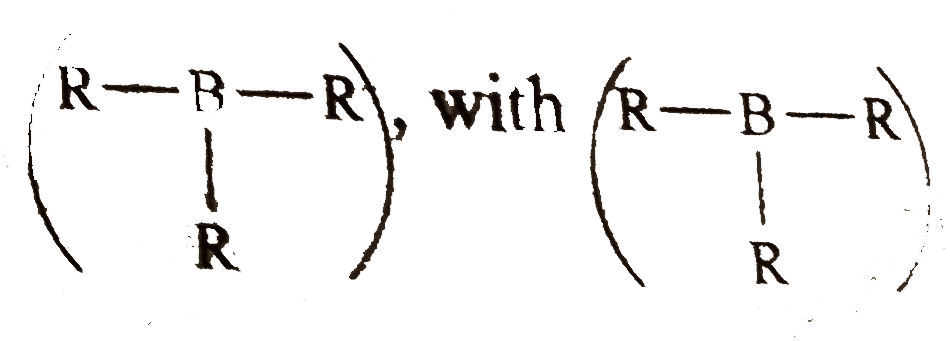 , with , with 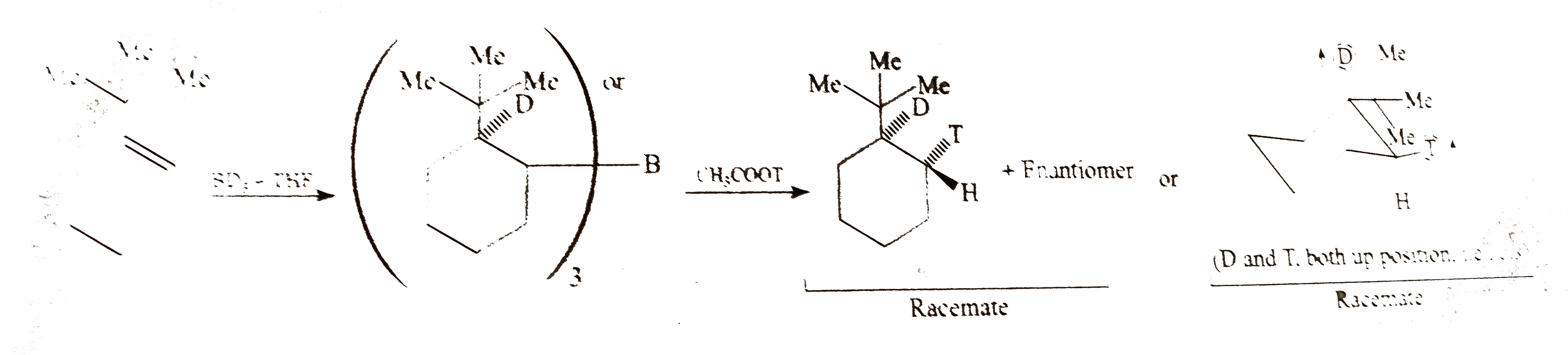 being replaced by T(D and `T` are deuteriu and tritium, ISOTOPES of H). being replaced by T(D and `T` are deuteriu and tritium, ISOTOPES of H).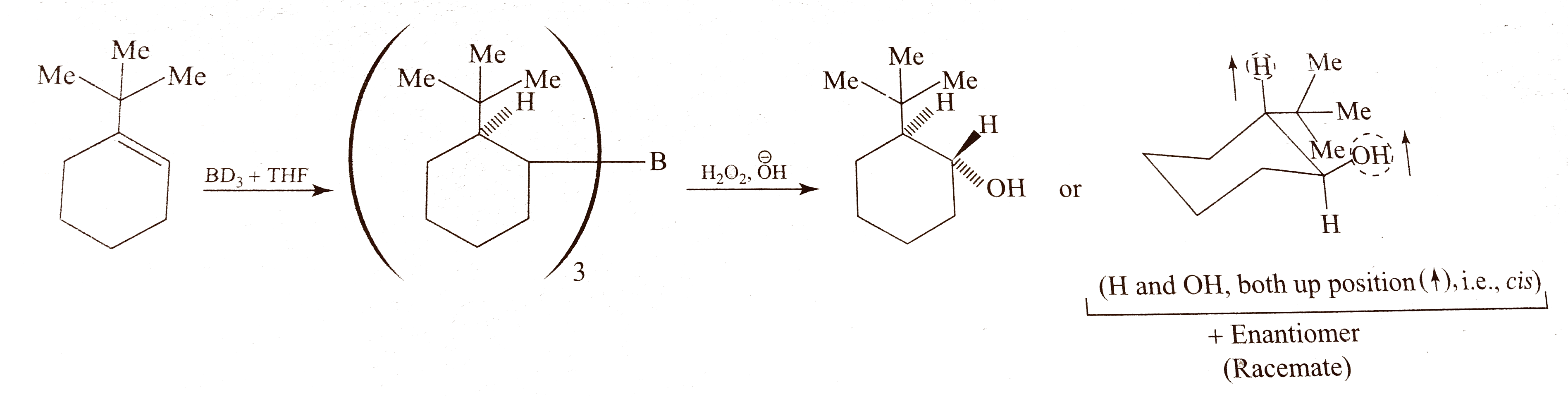 `d.` 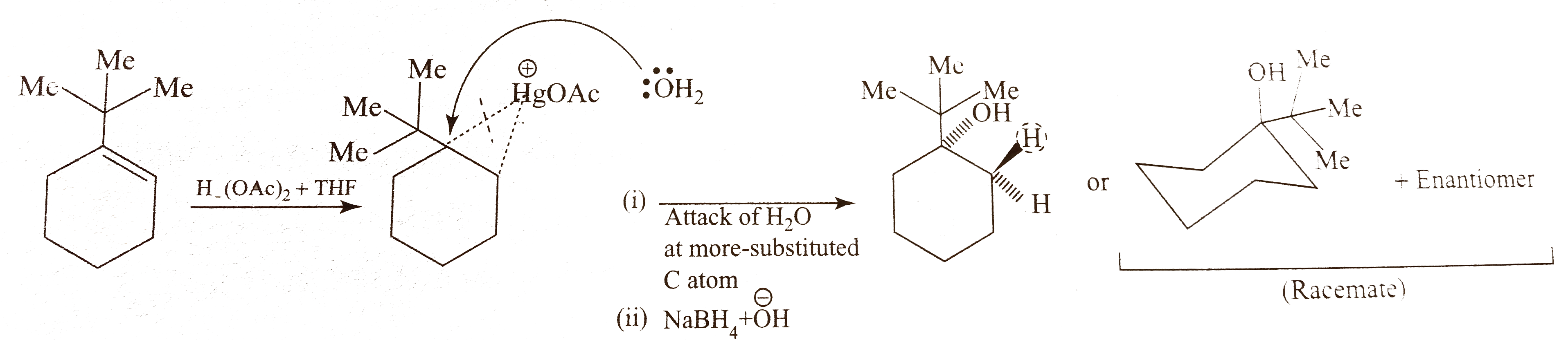 `e.` Anti`-` and Markovnikov's addition of `(-H)` and `(-OH)`. 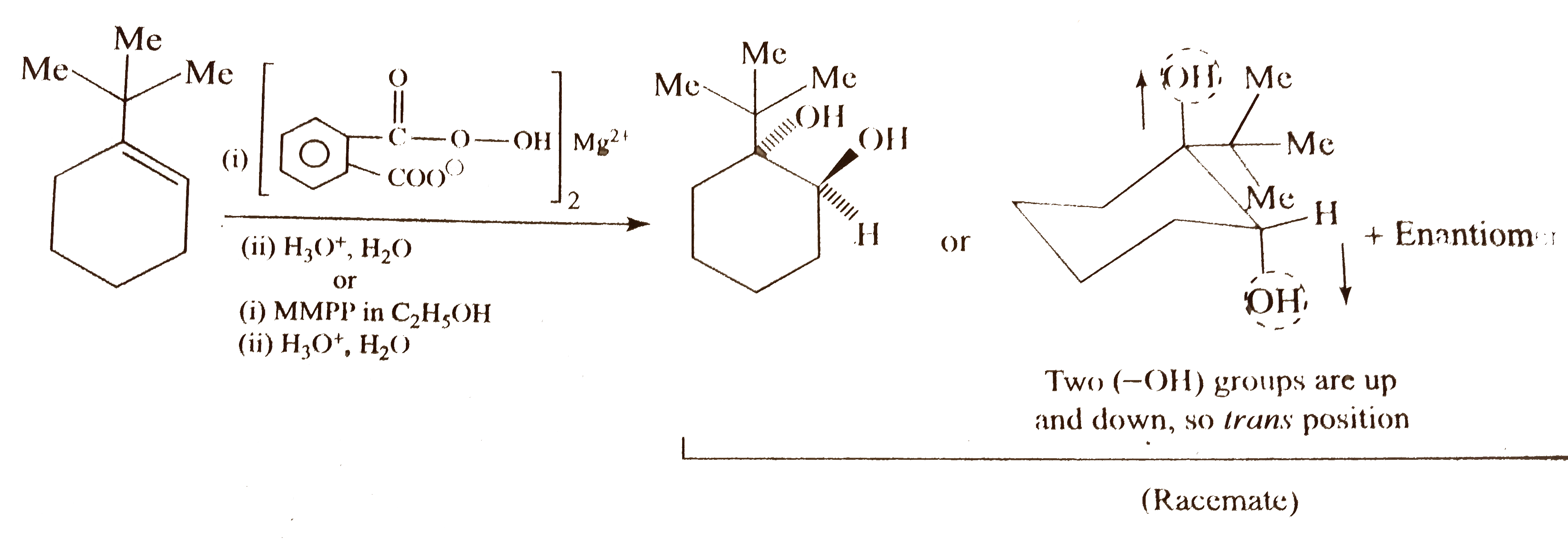 `f.` Anti`-` hydroxylation `:` 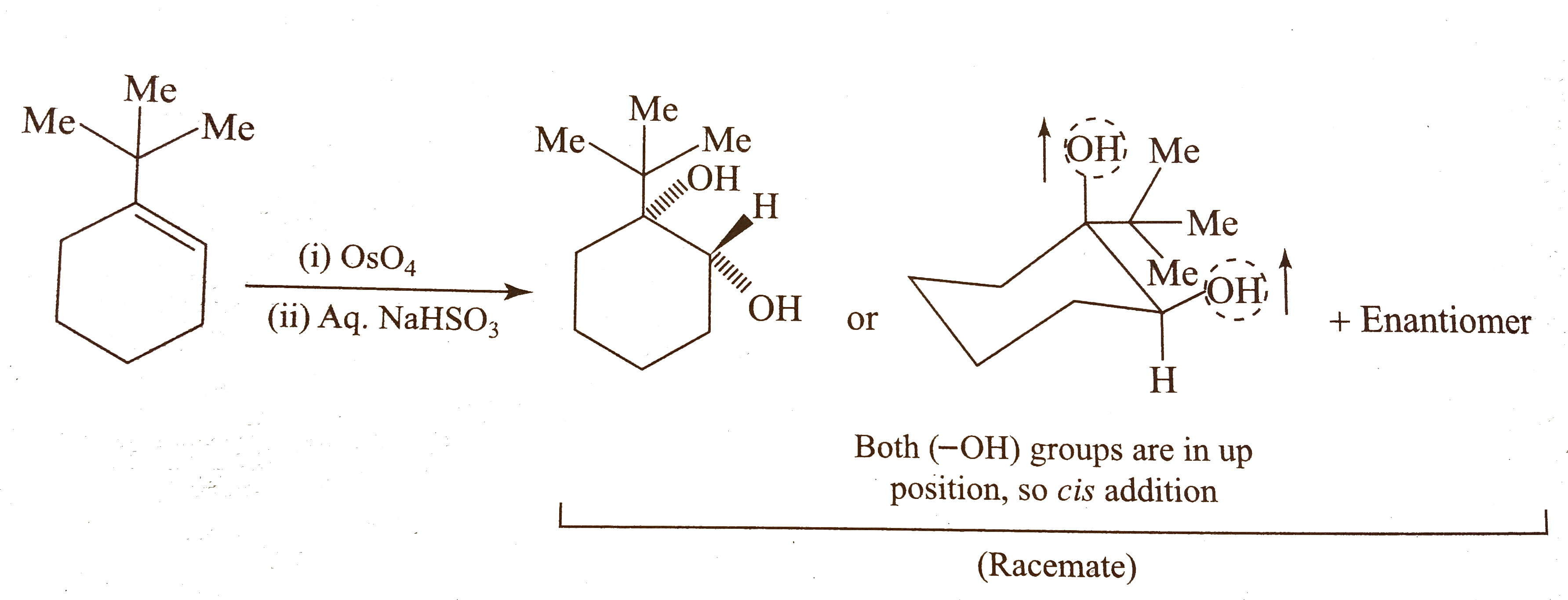 `g.` Syn `-` hydroxylation : 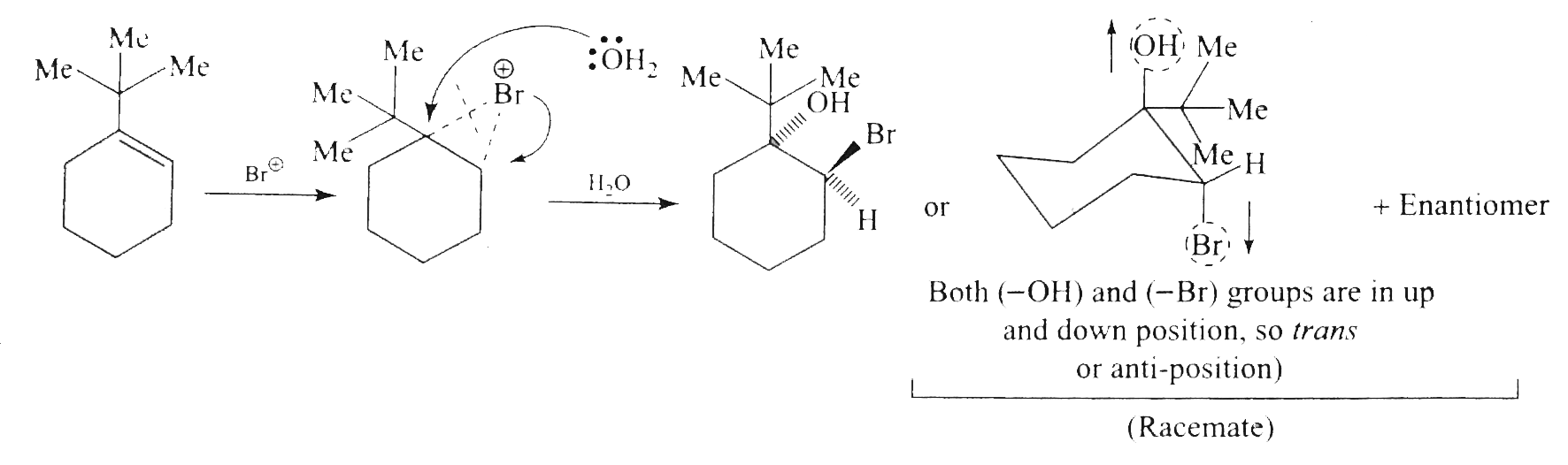 h. Anti `-` addition of `Br_(2):` 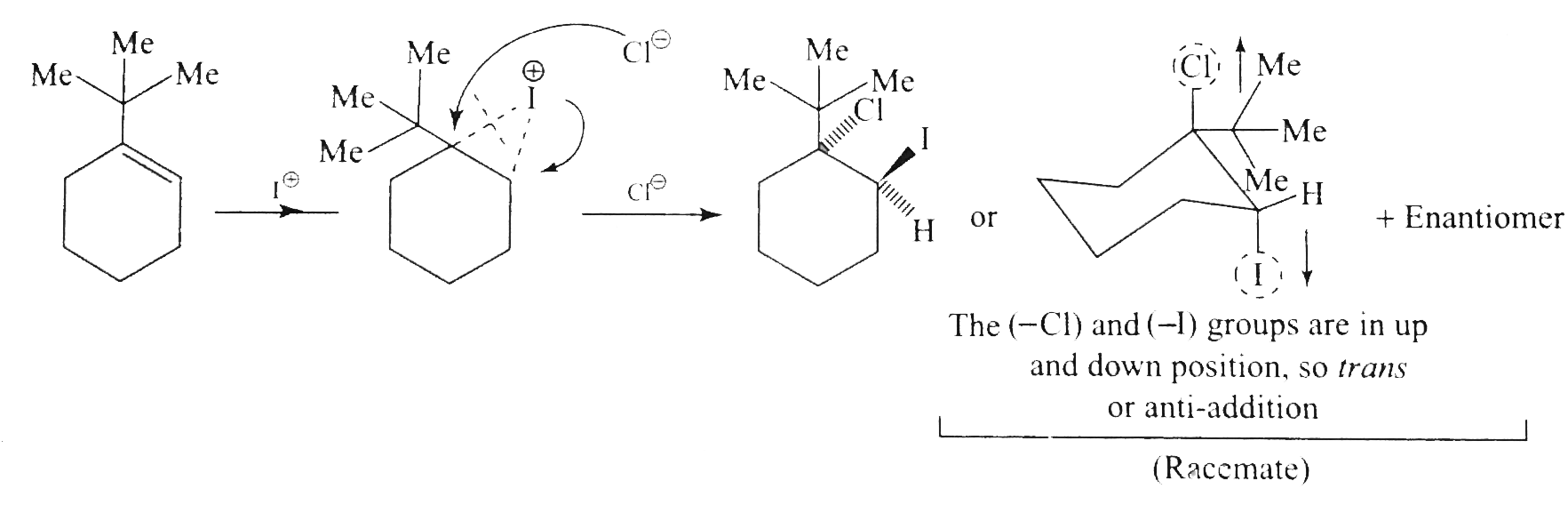 `i.` Anti`-` addition of `(-Br)` and `(-OH):` 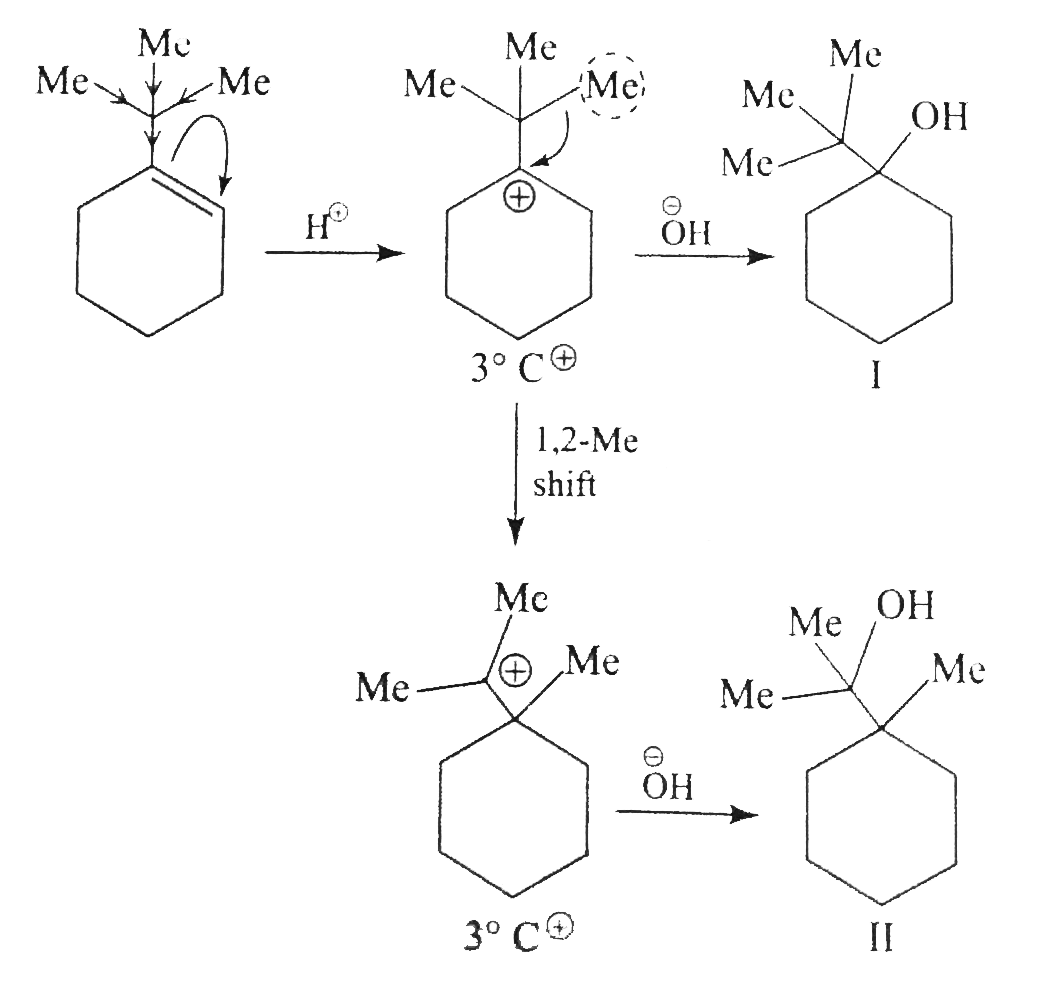 `j.` Anti `-` addition of `I^(o+)` and `CI^(o+)` with Markovnikov's RULE.  `k`. Addition of `H^(o+)` and `O^(c-)H` ACCORDING to Markovnikov's rule , with rearrangements `(` if any `)`. But `I` and `II` are the major products, since both have been formed from stable `3^(@)C^(c+)`. |
|
| 6. |
Buffer system helps to maintain blood pH between ……. |
| Answer» SOLUTION :7.26 to 7.42 | |
| 7. |
Buffer index of a buffer of 0.1 M NH_(4)OH and 0.1 M NH_(4) C lis (pK_(b) for NH_(4)OH=4.74) |
|
Answer» 0.116 Suppose 1 ML of 1 M HCl (i.e. 0.001 MOL of HCl) is added. It will convert 0.001 mol of `NH_(4)OH` into `NH_(4)Cl` Now `[NH_(4)Cl]=0.1+0.001=0.101 M ` and `[NH_(4)OH]=0.1-0.001 = 0.099 M` Now, `pOH = 4.74 + log .(0.101)/(0.099)= 4.74+ 0.0086` Thus, change in pH = 0.0086 `:.` Buffer index `=(dn)/(dpH)=(0.001)/(0.0086) = 0.116` |
|
| 8. |
Buffer is a colloidal solution of:- |
|
Answer» solid-solid |
|
| 9. |
Buffer capacity of acidic buffer solution is maximum when (1)P^(H)=P^(k)(2) [salt ]= [acid ] (3) p^(K)=7 (4) [H^(+)]=P^(k) |
|
Answer» all are CORRECT |
|
| 11. |
Buckminster Fullerene contains ……. Number of Carbon atoms. |
|
Answer» `C_70` |
|
| 12. |
Bu-C-=CHoverset(NaNH_(2))rightarrowoverset(ph-CHO)underset(H_(2)O)rightarrowoverset(MnO_(2))rightarrowX |
|
Answer»
|
|
| 13. |
Bu - C -= CH overset(NaNH_2) to A underset(H_2O)overset(Ph-CHO)to B overset(MnO_2)to C . Compound C of the reaction cannot be : |
|
Answer»

|
|
| 14. |
Brownian movement is found in |
|
Answer» COLLOIDAL solution |
|
| 15. |
Brown colouration 'D' contains: |
|
Answer» `Cu_(2)[Fe(CN)_(6)]` |
|
| 16. |
Bromoethane on treatment with alcoholic KOH gives |
|
Answer» ETHYL alcohol |
|
| 17. |
Bromocyclohexane can be converted into cyclohexene on treatment with |
|
Answer» `EtONa// ETOH , DELTA ` |
|
| 18. |
Bromocyclodecane on heating with ethanolic KOH, produces two alkenes. Write the two products also mentions the major one. |
|
Answer» |
|
| 19. |
Bromine reacts with hot aqueous alkali to give bromide and bromate. What is the change that is brought about in oxidation state |
|
Answer» `-1" to +5"` |
|
| 20. |
Bromine monochloride (BrCl) (g) hArr Br_(2) (g) + Cl_(2) (g) for which K_(c) = 32 " at " 500 K . If initially pure BrCl is present at a concentration of 3*30 xx 10^(-3) " mol " L^(-1),what is its molar concentration in the mixture at equilibrium ? |
|
Answer» Solution :` {:(,2BrCl (g),hArr,Br_(2)(g),+ ,Cl_(2)), ("Intial" ,3*30 xx 10^(-3)"mol"L^(-1) ,,,,), ("At eqm.",(3*30 xx 10^(-3) -x),,x//2,,x//2):}`<BR> ` K_(c) = ((x//2)(x//2))/(3*30xx10^(-3)-x)^(2) = 32 ("GIVEN") :. (x^(2))/(4( 3*30 xx 10^(-3)-x))=32` or` x/ (2 (3*30 xx 10^(-3))-x)=SQRT(32) = 5*60` ` x = 11*32 ( 3*30 xx10^(-3) -x) or 12*32 x = 11*32 xx 3*30 xx 10^(-3) or x = 3*0 xx 10^(-3) ` ` :."At eqm., " [BrCl] = ( 3*30 xx 10^(-3) - 3*0 xx 10^(-3))= 0*30 xx 10^(-3) = 3*0 xx 10^(-4) "mol"L^(-1)` |
|
| 21. |
Bromine monochloride, BrCl decomposes into bromine and chlorine and reaches the equilibrium : 2BrCl_((g)) hArr Br_(2(g)) + Cl_(2(g)) for which K_c = 32 at 500 K. If initially pure BrCl is present at a concentration of 3.3 xx10^(-3) "mol L"^(-1), what is its molar concentration in the mixture at equilibrium ? |
|
Answer» Solution :In starting BRCL = `3.3xx10^(-3) "MOL L"^(-1)` Suppose x mol `L^(-1)` of decompose. So, EQUILIBRIUM `[Br_2]=[Cl_2]= x/2 "mol L"^(-1)` Because , according to stoichiometry, 2 mol BrCl `to` 1 mol `Br_2` + 1 mol `Cl_2` `therefore` x mol Cl `to x/2` mol `Br_2 + x/2` mol `Cl_2` `{:("Reaction :",2BrCl_((g)) hArr , Br_(2(g)) +,Cl_(2(g))),("Initial mol L"^(-1):, 3.3xx10^(-3), 0 ,0):}` `{:("Change in reaction mol L"^(-1):, -x, +x//2,x//2),("At equilibrium mol L"^(-1) :, (3.3xx10^(-3)-x),x//2,x//2):}` According to CHEMICAL equilibrium `K_c=([Br_2][Cl_2])/([BrCl]^2)` `therefore 32.0=((x/2)(x/2))/(3.3xx10^(-3)-x)^2=x^2/(4(0.0033-x)^2)` `therefore 128=(x/"0.003-x")^2` `therefore sqrt128=x/(0.0033-x)` `therefore` 11.31 (0.0033-x)=x `therefore` 0.03732 - 11.31x=x `therefore` 12.31x =0.03732 `therefore x=0.03732/12.31`=0.0030 At equilibrium [BrCl]=`3.3xx10^(-3)-0.003` `=3.3xx10^(-3)-3.0xx10^(-3)` `=0.3xx10^(-3)=3.0xx10^(-4) "mol L"^(-1)` |
|
| 22. |
Bromine is converted to Bromate ion. The change in oxidation number of bromine is from |
|
Answer» 0 to +1 |
|
| 23. |
Bromine is added to cold dilute aqueous solution of NaOH. The mixture is boiled. Which of the following statements is not true ? |
|
Answer» During the REACTION bromine is present in four different oxidation states. `underset"Sodium hypobromide"(3NaBrO overset"300 K"to 3NaBrO)` On acidification, the final mixture gives bromine `5NaBrO+NaBrO_3 + 6HCl to 6NaCl + 3Br_2 + 3H_2O` Thus, during the reaction, bromine is present in four different oxidation states i.e., zero in `Br_2`, +1 in NaBrO, -1 in NaBr and +5 in `NaBrO_3`. The greatest difference between various oxidation states of bromine is 6 and not 5. On acidification of the final mixture, `Br_2` is formed and disproportionation of `Br_2` occurs during the reaction giving `BrO^(-), Br^(-)` and `BrO_3^-`IONS. |
|
| 24. |
Bromination of phenol gives tribromophenol while bromination of nitrobenzene gives only one bromonitrobenzene, why ? |
| Answer» SOLUTION :Because in phenol -OH GROUP is PRESENCE, which is ACTIVATOR while NITROBENZENE `-NO_(2)` group is deactivator. | |
| 25. |
Bromide is a Lowry base as well as a Lewis base. Explain. |
|
Answer» Solution :The chemical reaction involving BROMIDE ion is gives as, `Br^(-)+ H^(+) to HBr`. Bromide ion is a proton acceptor. HENCE it acts as Lowry-Bronsted base. Bromide ion is an electron pair donor. Hence it acts as LEWIS base. |
|
| 26. |
BrO_(3)^(-)+Br^(-)+H^(+)toBr_(2)+H_(2)O When this reaction is balanced completely, than mention the total charge and number of Bromine atoms on product respectively. |
Answer» Solution : (ii) Balancing change of oxidation number `BrO_(3)^(-)+5Br^(-)to1/2Br_(2)+5/2Br_(2)` `thereforeBrO_(3)^(-)+5Br^(-)to3Br_(2)` (iii) CHARGE, O and H balancing `BrO_(3)^(-)+5Br^(-)+6H^(+)=3Br_(2)+3H_(2)O` At product side : Total Charge = 0 No. of bromine ATOMS = 6 |
|
| 27. |
Bring out the main points of difference between orbital and orbital. |
Answer» SOLUTION :
|
|
| 28. |
Bring out the difference between extensive and intensive properties. |
Answer» SOLUTION :
|
|
| 29. |
Bring about the dissimilarities in mole concept and molar mass by clearly analysing them. |
Answer» SOLUTION : . .
|
|
| 31. |
Brine is electrolysed by using inert electrodes. The reaction at anode is |
|
Answer» `Cl_((aq))^(-) to 1/2 Cl_(2(G)) + e^(-) , E^@ = 1.36 V` |
|
| 32. |
Briefly give the basis for pauling's scale of electronegativity. |
Answer» Solution :The electro negativity increases across a period from left to right SINCE the atomic radius decreases in a period , the ATTRACTION between the valence ELECTRON and the nucleus increases Hence the tendency to attract shared pair of electrons increases VARIATION of electro negativity along I period Variation of electro negativity in a GROUP : The electro negativity decreases down a group As we move down a group ,the atomic radius increases and the nuclear attractive force on the valence electron decreases `(SUR_CHE_XI_V01_C03_E01_050_S02.png" width="80%"> |
|
| 33. |
Describe the measurement of Delta U by bomb calorimeter. |
|
Answer» Solution :When a reaction occurs in an aqueous solution, the reaction is siad to occur at constant pressure (ATMOSPHERIC pressure). Then the heat liberated or absorbed is the heat of reaction at constant pressure `(Delta H)` . It can be measures by using a calorimeter. Let us take the example of enthalpy of neutralisation of an acid by a base. The apparatus consists of a polythene bottle fitted with a coke carrying a thermometer and a stirrer. Let us consider the determination of enthalpy of neutalisation of hydrochloric acid by sodium hydroxide solution. PROCEDURE : (a) `50 cm^(3)` of 0.1 N HCl is taken in a breaker and kept in a water bath taken in an insulated vessel. (b) `50 cm^(3)` of 0.1 N NaoH is taken in ANOTHER beaker and kep in the same water bath. (c ) When the two solutions attains the same initial temperature as that of the water bath, the temperature is noted. Let it be `t_(1).^(@)C` HCl in the first beaker is POURED into the ploythene bottle. Immediately NaOH solution kep in the second beaker is added into the polythene bottle. THe neutralisation reaction occurs with the liberation of heat. The temperature rises. When it reaches a constant temperature, it is noted. Let it be `t_(2).^(@)C`. It is the final temperature. CALCULATION : Heat capacity of the polythene bottle is negligible and not considered. The amount of NACL formed in the reaction is negligible. Its heat capacity is also negligible. The heat liberated in the reaction is taken as completely absorbed by `100 cm^(3)` of water. Rise in temperature `= (t_(2) - t_(2))^(@)C` Mass of water = 50 + 50 = 100 g Specific heat capacity of water `= 4.184 Jg^(-1)` Heat liberated in the reaction = heat gained by water `= "mass" xx "specific heat" xx "rise in temperature"` `= 100 xx 4.184 xx (t_(2) - t_(1))` = xJ Heat liberated by the neutralisation of `50 cm^(3)` of 0.1 N HCl = x J Heat liberated by the neutralisation of `1000 cm^(3)` of 1N HCl will be `(x xx 1000 xx 1)/(50 xx 0.1) = QJ` Enthalpy of neutralisation of HCl by NaOH = -QJ. |
|
| 34. |
Briefly explain the effect of pressure on Le-Chatelier's principle. |
|
Answer» Solution :Number of GASEOUS moles decreases in the FORWARD REACTION. If the pressure is increased at EQUILIBRIUM, the system tries to reduce the pressure by reducing the number of moles in the vessel. Forward reaction is favoured. If the pressure is decreased, the system tries to increase the pressure by increasing the number of moles. The BACKWARD reaction gets favoured at low pressure. Note. If volume of the vessel is decreased, pressure increases. Forward reaction is favoured. If volume is increased, pressure decreases. Backward reaction is favoured. |
|
| 35. |
Briefly explain the effect of addition of inert gas on Le-Chatelier's principle. |
|
Answer» Solution :Case I : At constant volume : If an inert GAS like argon is added to the equilibrium mixture in a closed vessel, total pressure increases. However, total NUMBER of MOLES of gases also increases. As a result, PARTIAL pressure of any gas does not change. Equilibrium is not disturbed. Case II : At constant pressure : If an inert gas is added at constant pressure (open vessel), volume of the SYSTEM increases. System tries to increases the number of moles per unit volume, by increasing the total number of moles. As the number of moles increases in the backward reaction, equilibrium gets shifted to the left side. |
|
| 36. |
Briefly explain the account explain the account of groups and periods in long from of periodic table . |
|
Answer» Solution :Groups: VERTICAL COLUMNS from 1 to 18 groups Groups : 1 `rarr` Alkali net as Groups : 2 `rarr` Alkaline earth metals Groups :3 to 12 `rarr` Transition elements (d - block elements) Groups : 13 `rarr`Boron family, Groups : 14 `rarr` Carbon family Groups : 15 `rarr` Nitrogen family , family , Groups : 16 `rarr` Oxygen family Groups : 17 `rarr` Halogens , Group : 18 `rarr` Noble gass. Periods : Horizontal rows from 1 to 7 are PERUSES first period (IS) very short period, H and He is preset Seconds period (2s,2p) `rarr` Short period, Li to Ne is present. Third period (3s,3p) `rarr` short period , Na to Ar is present. Fourth period(4s,3d,4p) `rarr` Long period , K to Krr is present. Fifth period (5s,4f,5d,6p) `rarr` Long period RB to Xe present. Sixth period (6s, 4f,5d,4p) `rarr` Very Long period , Lanthanides are present Seventh period (7s,5f,6d) `rarr` Actinides are present . Here both sixth and seventh period are CALLED inner transition elements. |
|
| 37. |
Briefly explain London or disperison forces |
| Answer» Solution :These are intermolecular FORCE.Which EXISTS in MONOATOMIC gases like He,Ne etc and homodiatomic molecules (non-polar molecules) 1/He, `H_(2), O_(2), N_(2)` etc. This was first explained by Fritz london in 1930. According to him, in non-poar and monoatomic gases, there is symmetrical distributaion of ELECTRON cloud. Due to the movement of electrons cloud gets destarded so that a MOMENTARY dipole is produces. In this one will be more negative. therefore, two molecules attract each other and hisin London force. | |
| 38. |
Briefly explain geometrical isomerism in alkenes by considering 2- butene as an example2-butene: Geometrical isomerism: (ii) What is meant by condensed structure? Explain with an example |
|
Answer» Solution :Geometrical isomers are the stereoisomers which have different arrangement of groups atoms around a rigid framework of double bonds. This type of isomerism occurs due to restricted rotation of double bonds or about single bonds in cyclic compounds. 2. In 2-butene, the carbon-carbon double bond is sp2 hybridised. The carbon-carbon double bond consists of a s bond and a p bond. The presence of p bond lock the molecuic om POSITION. HENCE, rotation around C=C bond is not possible. 4. These two compounds are termed as geometrical isomers and are termed as cis and trans FORM. 5. The cis isomer is the one in which two similar groups are on the same side of the double bond. The trans isomer is that in which two similar groups are on the opposite side of the double bond. Hence, this type of isomerism is called cis-trans isomerismThe bond line structure can be further abbreviated by omitting all the these DASHES representing covalent bonds and by indicating the NUMBER of identical groups attached to an atom by a subscript. The resulting expression of the compound is called a condensed structural formula. e.g., 1, 3-butadiene  
|
|
| 39. |
Explain the isomerism exhibited by alkenes. |
|
Answer» Solution :2-butene: GEOMETRICAL isomerism: `CH_(3)-CH=CH-CH_(3)` (i) Geometrical isomers are the stereoisomers which have different arrangement of groups or atoms around a rigid framework of double bonds. This type of isomerism occurs due to restricted rotation of double bonds or about SINGLE bonds in cyclic compounds. (ii) In 2-butene, the carbon-carbon double BOND is `sp^(2)` hybridised. The carbon-carbon double bond consists of a `sigma` bond and a `pi` bond. The presence of `pi` bond lock the molecule in one position. Hence, rotation around C = C bond is not possible. (iii)  (iv) These TWO compounds are termed as geometrical isomers and are termed as cis and trans form. (v) The cis-isomer is the one in which two similar groups are on the same side of the double bond. The trans-isomer is that in which two similar groups are on the opposite side of the double bond. Hence, this type of isomerism is called cis-trans isomerism. |
|
| 40. |
Briefly explain about zeolites . |
|
Answer» Solution :Zeolites are alumino silicates having a three - dimensional cage like structure with a general formula `M_(x//n)^(n+) [ (AIO_(2))_(x) (SiO_(2))_(y) ] H_(2) O ` where M is a cation ion like `K^(+), Na^(+), Ca^(2+)`. These are obtained by replacing some of the silicon atoms by aluminium atoms. The aluminosilicate thus FORMED acquires negative charge and it is balanced by the cations like `Na^(+), K^(+) "or" Ca^(2+)` . Example : Feldspar - `KAISi_(3) O_(8)` and Zeolite - NAAI`(Si_(2) O_(6). H_(2)O)` |
|
| 41. |
Briefly describe the valence bond theory of covalent bond formation by taking an example of hydrogen. How can you interpret chergy changes taking place in the formation of dihydrogen ? |
|
Answer» Solution :VALENCE bond theory (VBT) was introduced by Heitler and London (1927) and developed further by Pauling and otheL VBT is based on the knowledge of atomic orbitals, electronic configurations of elements, the overlap criteri~ of atomic orbitals, the hybridization of atomic orbitals and the principles of variation and superpositfon. Consider two hydrogen atoms A and B approaching each other having nuclei `N_(A) and N_(B)` and electrons present in them are represented by `e_(A) and e_(B)`. When the two atoms are at large distance from each other, there is no interaction between them. As these two atoms approach each other, new attractive and repulsive forces begin to operate Attractive forces arise between, (i) nucleus of one atom and its own electron : i.e., `N_(A) - e_(A) and N_(B) - e_(B)` (ii) nucleus of one atom and electron of other atom : i.e.,`N_(A) - e_(B) and N_(B) - e_(A)` Similarly, repulsive forces arise between (i) electrons of two atoms like `e_(A) - e_(B)`(ii) nuclei of two atoms like `N_(A) - N_(B)` Attractive forces keep the two atoms close to each other and repulsive forces TRY to push them away. Experimentally, It is found that the magnitude of new attractive force is more than the new repulsive forces. As a result two atoms approach each other and POTENTIAL energy decreases. So, a stage is reached where the NET force of attraction balances the force of repulsion and system attain minimum energy. At this stage, two H-atoms are said to be bonded together to form a stable molecule having the bond length of 74 pm.  The energy gets released when the bond is formed between two hydrogen atoms, the hydrogen molecule is more stable than that ofisolated hydrogen atoms. The energy so released is called as bond enthalpy, which is corresponding to minimum in the curve depicted in the given figure. CONVERSELY 435.8 kJ of energy is required to dissociate one mole of `H_(2)` molecule. `H_(2(g)) = 435.8 " kJ mol"^(-1) rarr H_((g)) + H_((g))`  The potential energy curve for the formation of `H_(2)` molecule as a function of internuclear distance of the H-atoms. THe minimum in the corve corresponds to the most stable state or `H_(2)`. |
|
| 42. |
Briefly explain dipole-induced-dipole interaction with example. |
Answer» Solution :In this INTERACTION the forces of attraction between the opposite ends of NEIGHBOURING molecules takes place. If posses .. PARTIAL charges `(delta+ and delta-)` . The partial charges is less than the unit CHARGE `(1*6xx10^(-19)C)Ex` 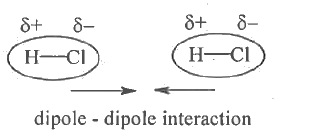
|
|
| 43. |
Bredig's arc method cannot be used to prepare colloidal solution of which of the following ? |
|
Answer» Pt |
|
| 44. |
Brakett series is produced when the electrons from outer orbits jumps to |
|
Answer» THIRD ORBIT |
|
| 45. |
Br_(2) dissolved in CS_(2) reacts with phenol at 273 K to give........as the major product |
|
Answer» o-Bromophenol 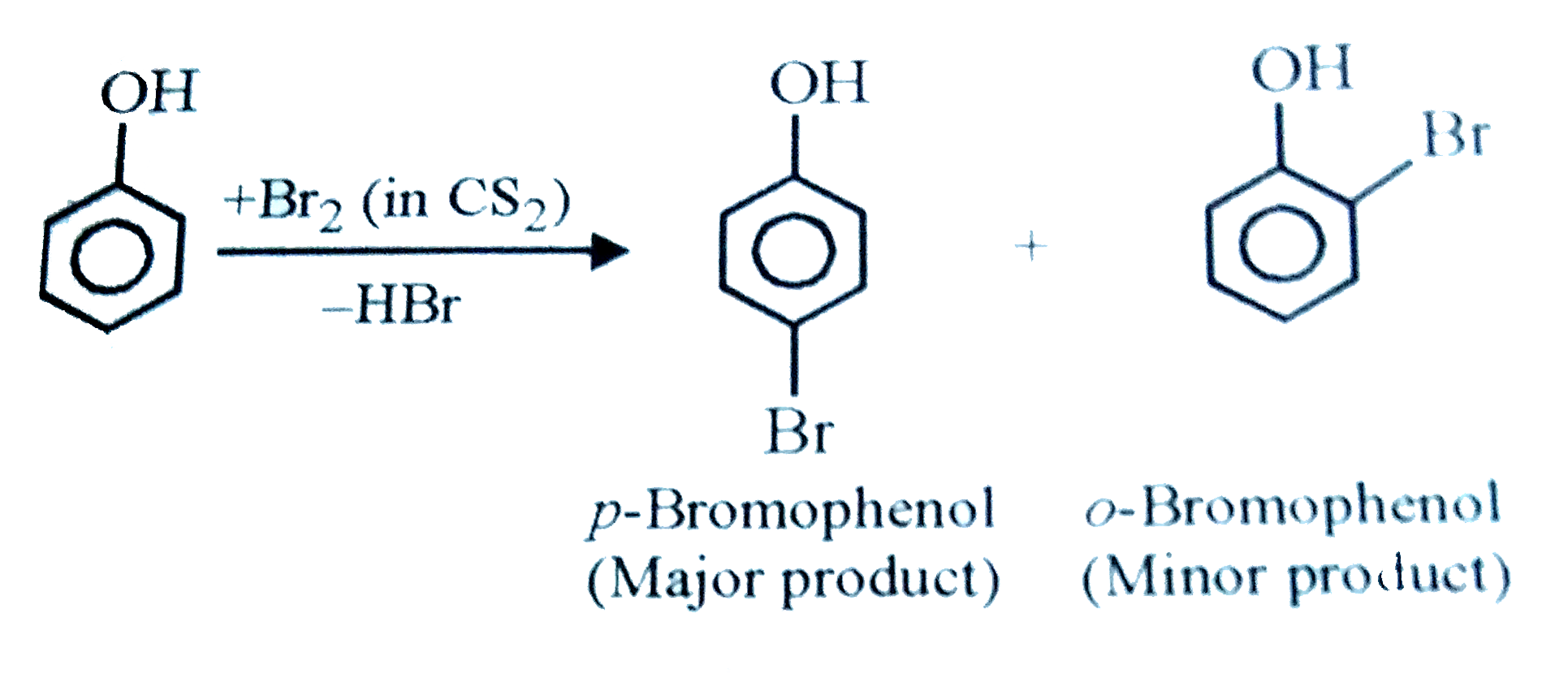
|
|
| 46. |
Br^(+), N^(+)H_(4) and N^(+)O_(2) all three possess positive charge, ………….. is notelectrophilic in nature. |
| Answer» SOLUTION :`NH_(4)^(+)` | |
| 47. |
Br^(-)ions form a close packed struture. If the radius ofBr^(-)ions is 195 pm, calculate the radius of the cation theat just fits into the tetrahedral hole. Can a cationA^(+)having a radius of 82 pm be slipped into the octahedral hole of the crystalA^(+)Br^(-) ? |
|
Answer» Solution : (i) RADIUS of the cation just FITTING into the tetrahedral hole= Radius of the tetrahedral hole `= 0.225 xx r_(Br^(-)) = 0.225 xx 195 = 43.875 ` PM (II) For the cation ` A^(+)` with radius = 82 pm. Radius ratio `= (r_(+))/(r_(-)) =(82"pm")/(195" pm") = 0.4205` As it lies in the range 0.414 - 0.732 , hence tha catio ` A^(+)`can be slipped into octahedral hole of the crystal ` A^(+)Br^(-)` |
|
| 48. |
Br^- ions form a close packed structure . If the radius of Br^- ion is 195pm, calculate the radius of the cation that just fits into the tetrahedral hole. Can a cation A^+ having a radius of 82 pm be slipped into the octahedral hole of the crystal A^+ Br^- ? |
|
Answer» Solution :(i)Radius of the cation just fitting into the tetrahedral hole=Radius of the tetrahedral hole `=0.255xxr_(Br^-)=0.225xx195`=43.875 pm (II)For the cation `A^+` with radius =82 pm Radius RATIO =`r_+/r_(-)="82pm"/"185pm"`=0.4205 As it lies in the range 0.414-0.732 , hence the cation `A^+` can be slipped into the octahedral hole of the crystal `A^+Br^(-)` Note. In case(ii), radius of octahedral void in which the cation can be fitted exactly =`0.414xxr_(Br^-) =0.414 xx195"pm"`=80.73 pm This is the minimum size of the octahedral void in which if the cation is placed, it will touch all the anions and the anions also touch each other . However , if cation bigger than the above size is slipped into the octahedral void, cation will continue to touch all the anions but anion-anion contact will VANISH. The arrangement remains octahedral upto the maximum size of the octahedral void viz . `0.732xxr_(Br^-)` Hence, in such cases , we apply radius ratio rules to FIND the range of the void, for a PARTICULAR arrangement |
|
| 49. |
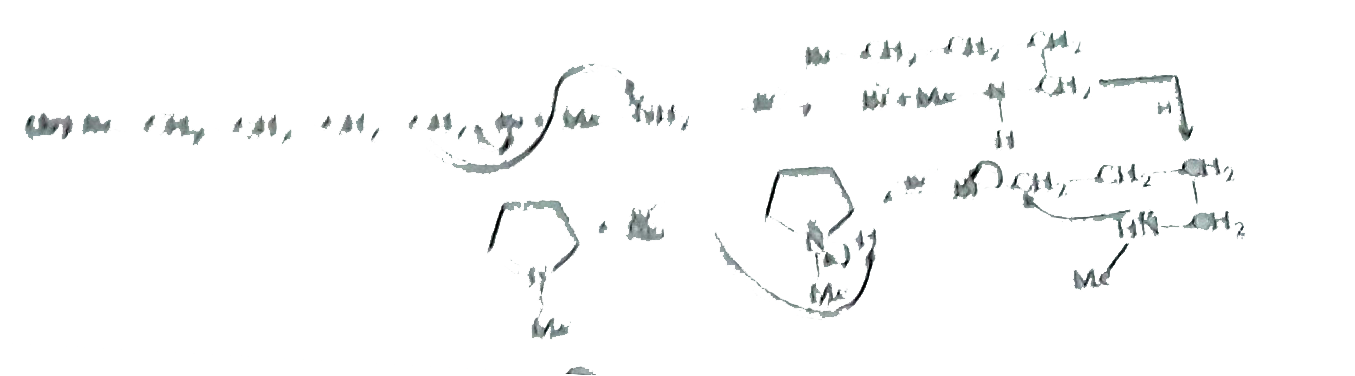
Br-CH_(2)(CH_(2))_(2)-Ch_(2)-Br+CH_(3)NH_(2)to product to the reaction is : |
|
Answer»
|
|