

Saved Bookmarks
This section includes 7 InterviewSolutions, each offering curated multiple-choice questions to sharpen your Current Affairs knowledge and support exam preparation. Choose a topic below to get started.
| 1. |
Boyle's law may be expressed as (one or more) |
|
Answer» <P>`(dP//dV)_(T)=K//V` `:.` Ratio of mean SQUARE VELOCITIES, viz, `:. "" P=K//V` or`"" (dP//dV)=-K//V^(2)`. Also `"" V prop 1//P`. |
|
| 2. |
Boyle's law for a gas of constant mass, may be expressed as |
|
Answer» <P>`((DP)/(dV))_(T) = K/V` |
|
| 3. |
Boyle temperature of vaiour gases are given below : {:("Gas",T_(B)(K),),(H_(2),117,),(He,23,),(CH_(4),498,),(O_(2),406,):} Which gas can be liquefied most easily ? |
|
Answer» `H_(2)` `= (2)/(3) ((8a)/(27 RB)) = (16)/(81) (a)/(Rb) = (16)/(81) T_(B)` Here `T_(B)` is Bolye temperature Thus, more the `T_(B)` more is the b.pt and hence easy to liquify |
|
| 4. |
Boyle, Charle.s Law indicates ? |
| Answer» SOLUTION :This LAWS indicate that system of GAS working in proper WAY for example pressure is increases when compressiblity of gas. | |
| 5. |
Boverset(alc.KOH)larrC_(2)H_(5)Clunderset(C_(2)H_(5)OH)overset(Zn-Cu)rarrA Here compounds A and B are |
|
Answer» `CH_(4),C_(2)H_(4)` |
|
| 6. |
Bouveault-Blanc reduction reaction involves : |
|
Answer» Reduction of an anhydride with `LiAlH_(4)` |
|
| 7. |
Both temporary annd permanent hardness can be removed by using |
|
Answer» `CA(OH)_(2)` |
|
| 8. |
Both temporary and permanent hardness can be removed by using |
| Answer» Answer :B | |
| 9. |
Both temperary and permanent hardness are removed on boiling water with: |
| Answer» Answer :a | |
| 10. |
Both temperary ad permanent hardness in water are removed by: |
|
Answer» BOILING |
|
| 11. |
Both methane and ethane may be obtained by suitable one step reaction from |
|
Answer» METHYL iodide |
|
| 12. |
Both lithium and magnesium displays several similar properties due to the diagonal relationship , however , the one which is incorrect is , |
|
Answer» both form nitrides |
|
| 13. |
Both lithium and magnesium display several similar properties due to the diagonal relationships, however, the one which is incorrect, is: |
|
Answer» both form NITRIDES |
|
| 14. |
Both lithium and magnesium display several similar properties due to the diagonal relationship, however the one which is incorrect is ...... |
|
Answer» both form basic carbonates. |
|
| 15. |
Both Cr_(2)O_(7)^(2-) (aq) and MnO_(4)^(-) (aq) can be used ot titrate Fe^(2+)(aq) if in a given titration 24-50 cm^(3)0.1 M Cr_(2)O_(7)^(2-) were used then what volume of 0.1 M MnO_(4)^(-) solution would have been use for the same titration ? |
|
Answer» `Cr_(2)O_(7)^(2-)+6Fe^(2+)14H^(+)rarr2Cr^(3+)+6Fe^(3)+7H_(2)O` `MnO_(4)^(-)+5Fe^(2+)+8H^(+)rarrMn^(23+)+5Fe^(3+)+4H_(2)O` Suppose `V_(2) cm^(3)"of"M_(2)F^(2+)` is titreated against 24.50 `cm^(3)` of 0.1 M `Cr_(2)O_(7)^(2-) "and" V_(1)cm^(3) of 0.1 M MnO_(4)^(-)` solution then `(24.5xx0.1)/(1)(Cr_(2)O_(7)^(2-))=(M_(2)B_(2))/(6)(Fe^(2+))` `(V_(1)xx0.1)/(1)(MnO_(4)^(-))=(M_(2)V_(2))/(5)(Fe^(2+))` Equating (i) and (II) `V_(1)=2.45xx6/5=29.4 cm^(3)` |
|
| 16. |
Both C_(2)H_(2) and CO_(3) have the same structure . Explain why. |
|
Answer» Solution :`H-C -= C-H` and O=C=O Both has, Linear - Molecular GEOMETRY Zero -DIPOLE moment sp- Hybridization of C in `C_(2)H_(2)` and `CO_(2)` Hence `C_(2)H_(2)` and `CO_(2)` have the same structure. |
|
| 17. |
Both C CI_4 and SiCI_4 has stable octets of the central atoms, but SiCl_4, is acidic. Why? |
| Answer» Solution :`C CI_4` is saturated. The central atom carbon has no VACANT d-orbitals in its valence SHELL. `SiCl_4` is a Lewis ACID. The central atom silicon has empty d-orbitals in the VALENCY shell and excitation is easy. It ACTS as Lewis acid, by expanding its octet configuration. | |
| 18. |
Both C_(2)H_(2) and CO_(2)have the same structure. Explain why. |
| Answer» Solution :`{:("Molecule","concept","GEOMETRY"),(C_(2)H_(2),"Hybridisation (SQ)","LINEAR"),(CO_(2),"VSEPR"(AB_(2)),"Linear"):}` | |
| 19. |
Both Be and Al become passive on reaction with concentrated. nitric acid due to |
|
Answer» The non-reactive nature of the metal |
|
| 20. |
Both Be and Al metals shows ...... properties. |
|
Answer» Acidic |
|
| 21. |
Both alkali metals and alkaline earth metals are s - block elements. They resemble each other respect but still there are certain dismilariaties in their properties due to number of eletrons in the valence shell different atomic radii, ionisation enthalpy, electronegativity etc. Which of the following statements are true for group ? electrons ? |
|
Answer» Lattice ENTHALPY of OXIDES, CARBONATES, fluorides from Be to Ba |
|
| 22. |
Both alkali metals and alkaline earth metals are s - block elements. They resemble each other respect but still there are certain dismilariaties in their properties due to number of eletrons in the valence shell different atomic radii, ionisation enthalpy, electronegativity etc. The correct sequence of increasing covalent character is |
|
Answer» `BeCI_(2)ltNaCIltLiCI` |
|
| 23. |
Both alkali metals and alkaline earth metals are s - block elements. They resemble each other respect but still there are certain dismilariaties in their properties due to number of eletrons in the valence shell different atomic radii, ionisation enthalpy, electronegativity etc. Which is least thermally stable ? |
|
Answer» `LiCO_(3)` |
|
| 24. |
Both alcohols and phenols contain a hydroxyl group, but phenols are more acidic than alcohols. The reason being that the phenoxide ion left after the removal of a proton is resonance stabilized while alkoxide is not. Therefore, phenols dissolve in aqueous sodium hydroxide but alcohols do not. However, both are weaker acids than carbonic acid and hence do not decompose aqueous NaHCO_(3) solution evolving CO_(2). The presence of electron-donating groups in the benzene ring decrease the acid strength while the presence of electron withdrawing groups in the benzene ring increase the acid strength of phenols. The relative strength of o-, m- and p- substituted phenols, however, depends upon a combination of inductive and resonance effects of the substituent. Alcohols are very weak acids even weaker than water. Because of the +I effect of the alkyl groups, tha acidic strength of alcohols decreases in the order : 1^(@) alcohol gt 2^(@) alcohol gt 3^(@) alcohol. The strongest acid among the following is |
|
Answer» o-Methoxy phenol |
|
| 25. |
Both alcohols and phenols contain a hydroxyl group, but phenols are more acidic than alcohols. The reason being that the phenoxide ion left after the removal of a proton is resonance stabilized while alkoxide is not. Therefore, phenols dissolve in aqueous sodium hydroxide but alcohols do not. However, both are weaker acids than carbonic acid and hence do not decompose aqueous NaHCO_(3) solution evolving CO_(2). The presence of electron-donating groups in the benzene ring decrease the acid strength while the presence of electron withdrawing groups in the benzene ring increase the acid strength of phenols. The relative strength of o-, m- and p- substituted phenols, however, depends upon a combination of inductive and resonance effects of the substituent. Alcohols are very weak acids even weaker than water. Because of the +I effect of the alkyl groups, tha acidic strength of alcohols decreases in the order : 1^(@) alcohol gt 2^(@) alcohol gt 3^(@) alcohol. The acidic strength decreases in the order |
|
Answer» p-Nitrophenol `GT` m-Nitrophenol`gt` o-Nitrophenol |
|
| 26. |
Both alcohols and phenols contain a hydroxyl group, but phenols are more acidic than alcohols. The reason being that the phenoxide ion left after the removal of a proton is resonance stabilized while alkoxide is not. Therefore, phenols dissolve in aqueous sodium hydroxide but alcohols do not. However, both are weaker acids than carbonic acid and hence do not decompose aqueous NaHCO_(3) solution evolving CO_(2). The presence of electron-donating groups in the benzene ring decrease the acid strength while the presence of electron withdrawing groups in the benzene ring increase the acid strength of phenols. The relative strength of o-, m- and p- substituted phenols, however, depends upon a combination of inductive and resonance effects of the substituent. Alcohols are very weak acids even weaker than water. Because of the +I effect of the alkyl groups, tha acidic strength of alcohols decreases in the order : 1^(@) alcohol gt 2^(@) alcohol gt 3^(@) alcohol. Which of the following is the strongest acid |
|
Answer» `FCH_(2)CH_(2)CH_(2)OH` |
|
| 27. |
Both alcohols and phenols contain a hydroxyl group, but phenols are more acidic than alcohols. The reason being that the phenoxide ion left after the removal of a proton is resonance stabilized while alkoxide is not. Therefore, phenols dissolve in aqueous sodium hydroxide but alcohols do not. However, both are weaker acids than carbonic acid and hence do not decompose aqueous NaHCO_(3) solution evolving CO_(2). The presence of electron-donating groups in the benzene ring decrease the acid strength while the presence of electron withdrawing groups in the benzene ring increase the acid strength of phenols. The relative strength of o-, m- and p- substituted phenols, however, depends upon a combination of inductive and resonance effects of the substituent. Alcohols are very weak acids even weaker than water. Because of the +I effect of the alkyl groups, tha acidic strength of alcohols decreases in the order : 1^(@) alcohol gt 2^(@) alcohol gt 3^(@) alcohol. The correct order of reactivity of 1^(@), 2^(@) and 3^(2) alcohols towards sodium metal is |
|
Answer» `1^(@) GT 2^(@) gt 3^(@)` |
|
| 28. |
Boron trihalides act as Lewis acids. Their Lewis acid strength is in the order |
|
Answer» `BF_3 GT BCl_3 gt B Br_3` |
|
| 29. |
Boron tribromide is a stronger acid than boron trifuoride. Assign reason. |
| Answer» Solution :Both of them are LEWIS acids but becaue of `p pi-p pi` BACK BONDING the elecron density on boron atom INCREASE and the Lewis acid strength of the halides . Now, 2p orbitals of boron and fluorine that are involed in back b onding have comparable energies. while p orbtials of boron and 4p orbtials of bromine differ LARGELY in energy and the b ack bonding is not so efficient. therefore, `BBr_(3)` is a stronger acid than `BF_(3)`. | |
| 30. |
Boron, the first member of group 13 (p-block) is a typical non-metal. H exists in two allotropic forms. The compounds of boron are mainly electron deficient as well as Lewis acids. For example, all the trihalides of boron (BX_(3)) are Lewis acids. The expected order of acidic strength based on the electro negativity of halogen atoms is : BF_(3)gtBC l_(3)gtBBr_(3)gtBl_(3). But theactual order is the reverse. This is explained with the help of the concept of back bonding (p pi- p pi) . Among the hydrides of boron. diborane has a bridged structure. The two types of bonds in diboran e are covalent and q |
|
Answer» IONIC |
|
| 31. |
Boron reacts with oxygen at 700^(@)C to give (A). Compound (A) reacts with carbon and dry chlorine to give (B) an carbon monoxide. (B) on reduction with LiAlH_(4) gives (C ) along with LiCl and AlCl_(3). (C ) on reaction with ammonia at 200^(@)C gives (D).Compound (D) has B in ________ hybridised state |
| Answer» SOLUTION :`4BCl_(3) +3LiAlH_(4)rarrunderset((C))(2B_2H_6)+3LiCl+3AlCl_3` | |
| 32. |
Boron reacts with oxygen at 700^(@)C to give (A). Compound (A) reacts with carbon and dry chlorine to give (B) an carbon monoxide. (B) on reduction with LiAlH_(4) gives (C ) along with LiCl and AlCl_(3). (C ) on reaction with ammonia at 200^(@)C gives (D).Compound (C ) is |
|
Answer» an ELECTRON - deficient compound |
|
| 33. |
Boron reacts with oxygen at 700^(@)C to give (A). Compound (A) reacts with carbon and dry chlorine to give (B) an carbon monoxide. (B) on reduction with LiAlH_(4) gives (C ) along with LiCl and AlCl_(3). (C ) on reaction with ammonia at 200^(@)C gives (D).In compound (B) : |
|
Answer» Boron is `sp^2`hybridised `B_(2)O_3+3C+3Cl_(2) rarrunderset((B))(2BCl_3)+3CO` |
|
| 34. |
Boron occurs in nature in the form of two isotopes having atomic masses 10 and 11. What are the percentage abundances of these isotopes in a simple a boron having average atomic mass of 10.8are : |
|
Answer» 20,80 `:.` The percentage abundance of B-11 isotope = (100-x) From the available data : `(x xx10)/(100)+((100-x)xx11)/(100)=10.8` or `10X + 1100 - 11X = 1080or x = 20` Percentage abundance of B-10 isotope = 20 % Percentage abundance of B-11 isotope = 80 %. |
|
| 35. |
Boron occurs in nature in the form of two isotopes having atomic masses 10 and 11. What are the percentage abundances of these isotopes in a simple a boron having average atomic mass of 10.8 ? |
|
Answer» `:.` The percentage abundance of B-11 isotope = (100-x) From the available DATA : `(x xx10)/(100)+((100-x)xx11)/(100)=10.8` or `10x + 1100 - 11x = 1080or x = 20` Percentage abundance of B - 10 isotope = 20 % Percentage abundance of B - 11 isotope = 80 %. |
|
| 36. |
Boron nitride which is isoclectronic and isostructural with graphite is mode of fused hexagonal rings made of boron and nitrogen atoms alternatively. The number of pi bonds in each hexagonal ring is |
|
Answer» |
|
| 37. |
Boron is unable to form BF_6^(3-)ion. Explain. |
| Answer» Solution :Due to non-availability of d-orbitals, boron is UNABLE to expand its OCTET. Therefore, the maximum COVALENCE of boron cannot EXCEED 4. | |
| 38. |
Boron is unable to formBF_(6)^(3-)ion. Explain. |
| Answer» Solution :Due to absence of d-orbitals, B at the maximumcan ammoundates 8 electrons pairs of electrons inits valencesshell. In otherwords, B can have a maximum convalency of 4. Therefore, `BF_(3)` can FORM`BF_(2)` but never `BF_(6)^(3-)`in whichthe COVALENCY of B is 6. | |
| 40. |
Boron is a |
|
Answer» metal |
|
| 41. |
Why do boron halides form addition compounds with ammonia ? |
| Answer» Solution :Boron halides act as Lewis acids and are capable of ACCEPTING a pair of ELECTRONS from AMINES (which act as Lewis BASES) to form addition compounds. | |
| 42. |
Boron forms only "………….." compoundswhile aluminium forms both "………….." and "………….."compounds. |
|
Answer» |
|
| 43. |
Boron fluoride exists as BF_(3) but boron hydride does't exist as BH_(3). Give reason. In which form does it exist ? Explain its structure. |
Answer» Solution :Due to `p pi - p pi` back bonding, the LONE pair of electrons of F is donated to the B-atom. Thus delocalisation reduces the deficiency of electrons of B thereby incresing the stability of `BF_(3)` molecule 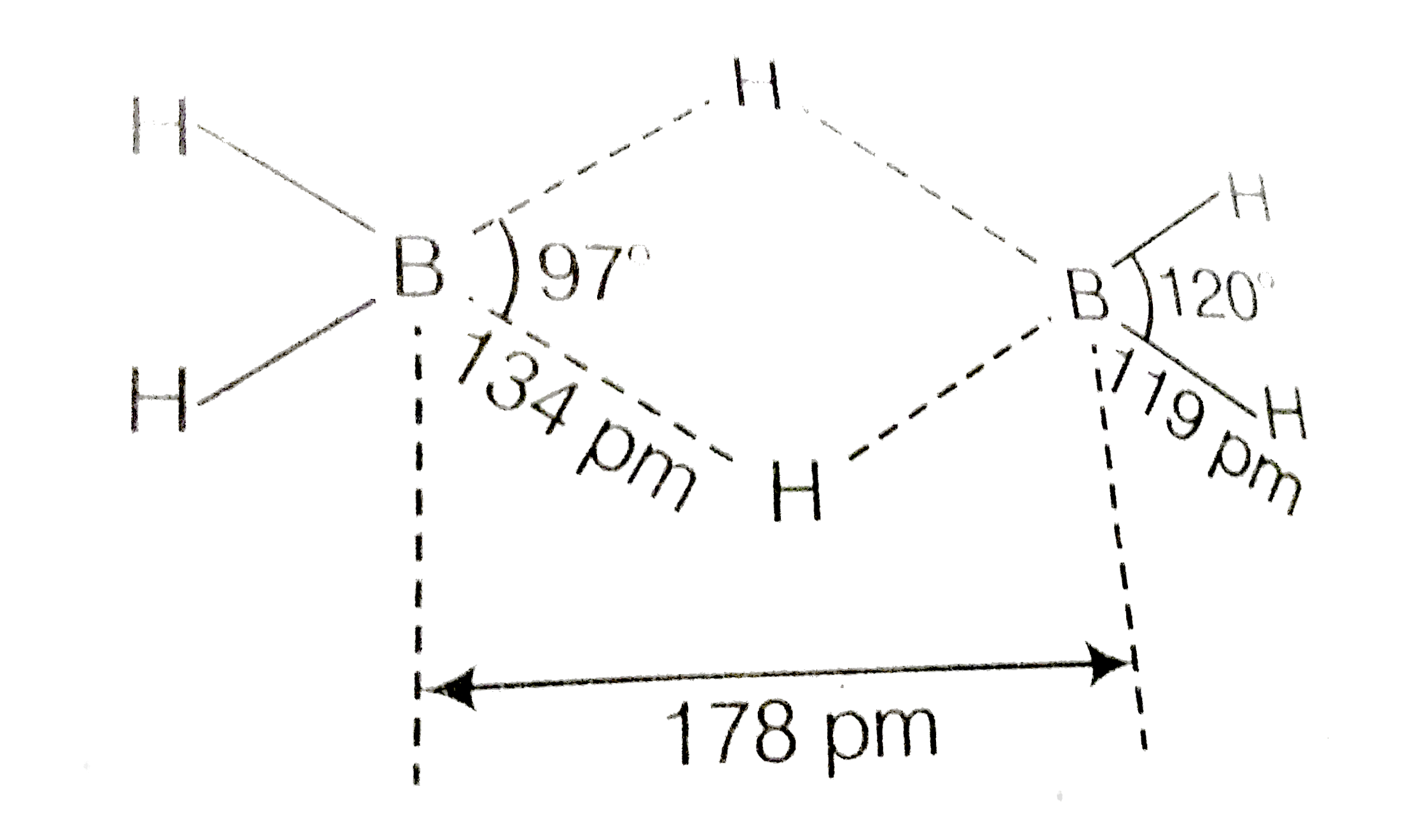 Due to absence of lone pair of electrons on H-atom, this compensation does not occur in `BH_(3)`. In other WORDS electron deficiency of B stays and hence to reduce its electron deficiency, `BH_(3)` dimerises, `BH_(3)` dimerises to form `B_(2)H_(6)` In `B_(2)H_(6)`, FOUR terminal hydrogen atoms and two boron atoms lie in one PLANE. Above and below this plane there are two BRIDGING H-atoms. The four terminal B-H bonds are regular while the two bridge (B-H-B) bonds are three centre-two electron bonds. |
|
| 44. |
Boron fluoride exists as BF_3 but boron hydride doesn't exist as BF_3. Give reason. In which form, does it exist ? Explain its structure. |
|
Answer» SOLUTION :In `BF_3`, lone pair of fluorine gives back support of electrons to boron atom by `ppi-ppi` back bonding. This delocalization of electrons reduces the DEFICIENCY of electrons and THUS reduces Lewis acidic character and increases stability of `BF_3`. In `BH_3`, there is no lone pair of electrons on H atom, therefore, `BH_3` dimerizes to give `B_2H_6`. 4 terminal H atoms and 2 boron atoms lie in one plane and above and below the plane. So there are TWO bridging H-atoms. 
|
|
| 45. |
Boron fibres are used in making light composite material for aircraft. |
| Answer» SOLUTION :TRUE STATEMENT | |
| 46. |
Boron exist in different allotropic forms .All allotropic fropm contains icosahedral units (icosahedral is a regular shape with 12 corners and 20 faces ) with boron atoms at all 12 corners and all bonds are equivalent . Calculate DeltaH (n KJ) per mole of boron atoms formating gaseous icosahedron if DeltaH_(BE)(B-B)=200KJ//mol: |
|
Answer» 1000 |
|
| 47. |
Boron does not form ionic compounds containing B^(2+) ions. Comment on the statement with suitable explanation. |
| Answer» SOLUTION :The STATEMENT is TRUE | |
| 48. |
Boron does not form [BF_6]^(3-), whereas aluminium forms [AlF_6]^(3-). Explain. |
| Answer» Solution :In the ABSENCE of vacant d-orbitals, boron cannot expand its OCTET, WHEREAS aluminium POSSESSES vacant d-orbitals and can expand its octet. | |
| 49. |
Boron does not form B^(3+) ions whereas Al forms Al^(3+) ions. This is because |
|
Answer» The SIZE of B atom is larger than that of Al |
|
| 50. |
Boron compouns act as Lewis acid because of their "………….." nature. |
|
Answer» |
|