

Saved Bookmarks
This section includes 7 InterviewSolutions, each offering curated multiple-choice questions to sharpen your Current Affairs knowledge and support exam preparation. Choose a topic below to get started.
| 1. |
Electrons will first enter into the set of quantum numbers n=5, l=0 or n=3 , l=2 |
|
Answer» n=5, l=0 HENCE, here electron will be filled in the orbital with n=3, l=2 |
|
| 2. |
Electrons of valence orbital have force of attraction is decrease because... |
|
Answer» SMALLER ATOMIC size. |
|
| 3. |
Electrons are emitted with zero velocity from a metal surface when it is exposed to radiation of wavelength 6800 Å. Calculate the threshold frequency and work function (W_(0)) of the metal. |
|
Answer» Solution :Threshold wavelength `(lambfa_(0))=6800 Å=6800xx10^(-10) m` As `c=V lambda :. v_(0)=c/lambda_(0)=(3.0xx10^(8)" ms"^(-1))/(6800xx10^(-10) m)=4.41xx10^(14) s^(-1)` Work FUNCTION `(W_(0))=hv_(0)=(6.626xx10^(-34) J s)(4.41xx10^(14) s^(-1))=2.92xx10^(-19) J` |
|
| 4. |
Electrons are emitted with zero velocity from a metal surface when it is exposed to radiation of wavelength 6800Å. Calculate threshold frequency (V_(0)) and work function (W_(0)) of metal. |
|
Answer» Solution :`"Given "= 6800Å = 6800 xx 10^(-8) cm` `= 6.8 xx10^(-5) cm` `therefore v_(0)=(c)/(lambda)=(3xx10^(10)" cm. SEC"^(-1))/(6.8xx10^(-5)cm)=0.44xx10^(15)s^(-1)` `=4.4xx10^(14)s^(-1)" (or HZ)"` `W_(0)=h lambda_(0)=6.625xx10^(-27)" erg. Sec" xx4.4xx10^(14)S^(-1)`. `29.15xx10^(-13)" erg. For 1 PHOTO ELECTRON."` |
|
| 5. |
Electronsareemittedwithzerovelocityfromametalsurfacewhenit isexposed toradiationof wavelength6800A . Calculatethresholdfrequency(V_(0))and workfunction(W_(0))of themetal. |
|
Answer» Solution :Where`lambda =6800 A = 6800 xx 10^(10) m = 6.8 xx 10^(7) m` WORKFUNCTION`(W_(0)) = hv_(0) ` but `V=(c)/(lambda)` Thresholdfrequency `(V_(0))= (W_(0))/( h) = (2.923 xx 10^(19))/(6.626 xx 10^(34)J s)` `=4.411xx 10^(14) s^(1)` `4.411 xx 10^(14) Hz` |
|
| 6. |
Electronic configurations of four elements A, B, C and D are given below: (A) 1s^(2)2s^(2)2p^(6) "" (B) 1s^(2)2s^(2)2p^(4) (C) s^(2)2s^(2)2p^(6)3s^(1) "" (D) 1s^(2)2s^(2)2p^(5) Which of the following is the correct order of increasing tendency to gain electron? |
|
Answer» `A lt C lt B lt D` (i) Noble gases do not have tendency to gain electrons since all the orbitals are fully filled. Thus, element A is lowest ELECTRON gain enthalpy. (ii) Since, element D has one electron less than the corresponding noble gas configuration and element B has 2 electron less than the corresponding noble gas configuration. Element D has highest electron gain enthalpy then the element B. (iii) As, element C has only one electron in the S-orbital and hence need one more electron to complete it octet, therefore, electron gain enthalpy of C is less than that of B. Combining all the above information, the electron gain enthalpy in increasing order for the four elements is `A lt C lt B lt D` |
|
| 7. |
Electronic transition in He ion takes from n_2 to n_1 shell such that :2n_2 + 3n_1 = 18 , 2n_2 - 3n_1 = 6 What will be the total number of photons emitted when electrons transit to n_1 shell ? |
|
Answer» 21 `n_1 = 2 ` no. of spectral lines `(4(5))/(2)` = 10 |
|
| 8. |
Electronic structure acquired by compounds of IIIA group elements in bonding is |
|
Answer» Sextet |
|
| 9. |
Electronic configurations of four elements A, B, C and D are given below |
|
Answer» `1s^(2), 2S^(2), 2p^(6)` |
|
| 10. |
Electronic configuration of species M^(2+) is 1s^(2) 2s^(2) 2p^(6) 3s^(2) 3p^(6) 3d^(6) and its atomic weight is 56. The number of neutrons in the nucleus of species M is .......... |
|
Answer» 26 Atomic number =26 Mass number =56 No. of NEUTRONS =56-26=30 |
|
| 11. |
Electronicconfigurationof someelement ofgiven in column Iand theirelectrongainenthalpies are given incolumn II. Matchthe electronicconfigurationwith electrongain enthalpy. {:(,,"Column I",,"Column II"),((i),,1s^(2)2s^(2)2p^(6),,(A)-53),((ii),,1s^(2)2s^(2)2p^(6)3s^(1),,(B )-328),((iii),,1s^(2)2s^(2)2p^(5),,(C )-141),((iv),,1s^(2) 2s^(2)2p^(4),,(D) +48):} |
|
Answer» Solution :(i) Thiselectronicconfigurationcorrespondsto noblegas, neon . Sincenoblegaseshave + ve`Delta_(eg)` H avluethereforeelectronicconfiguration(i) corresponds to element D having`Delta_(eg) H` = +48 kj `mol^(-1)`. (ii) Thiselectronicconfigurationcorresponds to thealkalimetalpotassium.Sincealkalimetalshave smallnegative `Delta_(eg)` VALUES , thereforeelectronicconfiguration(ii)corresponds to element A with `Delta_(eg) H`=- 53 kJ `mol^(-1)` (III)Thiselectronicconfigurationto thehalogen FLUORINE. Sincehalogenhave highnegative`Delta_(eg) H` valuesthereforeconfiguration (iii)corresponds to the elementB having`Delta_(eg) H` =- 32 kj `mol^(-1)` (iv)This electronicconfigurationcorrespondsto the chalcogenoxygen , Sincechalogenhave`Delta_(eg) h`valueless negativethan thosehalogensthere foreelectronicconfiguraiton(iv)corresponds to element C having`Delta_(eg) H `=- 141 kj `mol^(-1)` FROMTHE abovediscussion thecorrectmatchingis , (i) `to( D) , (ii) to(A) , (iii)to ( B)` and `(iv) to( C ) ` |
|
| 12. |
Electronic configuration of the element with atomic number 56 and mass number 138 is |
|
Answer» `[Xe]6s^(2)` |
|
| 13. |
Electronic configuration of some elements is given in Column-I and their electron gain enthalpies are given in Column-II. Match the electronic configuration with electron gain enthalpy. |
| Answer» SOLUTION :(i-D), (ii-A), (III)-B), (iv-O) | |
| 14. |
Electronic configuration of Sc^21 is |
|
Answer» `1s^22s^2 2p^6 3s^2 3p^6 4s^2 3d^1` |
|
| 15. |
Electronic configuration of multielectron atoms can be written by the use of four quantum numbers and also by following certain principles. Pauli's exclusion principle suggests that maximum capacity of an atomic orbital is two. Auf bau principle suggests that the lower energy orbitals are filled first and hence stability can be attained. Hunds rule of maximum multiplicity suggests that pairing occurs with one electron. The arrangement of electrons in the space around the nucleus can be understood only after writing the electronic configuration. Thus writing electronic configuration is more important in the structure of an atom. Auf-bau principle is first violated for the element with atomic numbers |
|
Answer» 21 |
|
| 16. |
Electronic configuration of multielectron atoms can be written by the use of four quantum numbers and also by following certain principles. Pauli's exclusio principle suggests that maximum capacity of an atomic orbital is two. Auf bau principle suggests that the lower energy orbitals are filled first and hence stability can be attained. Hunds rule of maximum multiplicity suggests that pairing occurs with one electron. The arrangement of electrons in the space around the nucleus can be understood only after writing the electronic configuration. Thus writing electronic configuration is more important in the structure of an atom. Applying Hunds rule of maximum multiplicity, the maximum number of electrons that can posses spin quantum number +1/2 in 4p orbitals is |
|
Answer» 1 |
|
| 17. |
Electronicconfigurationof most electronegative element is |
|
Answer» `1 s^(2)2 s^(2)2 p^(6)3 s^(1)` |
|
| 18. |
Electronic configuration of an element is 1s^(2) 2s^(2) 2p^(6) 3s^(2) 3p^(5) than whatis atomic number of element which is situated bottom of this elements group ? |
|
Answer» 49 |
|
| 19. |
Electronic configuration of C is |
|
Answer» `1s^2, 2s^2 2p^2` |
|
| 20. |
Electronic configuration of an elem ent of the m odern periodic table i s ............ Is^(2) 2s^(2) 2p^(6) 3s^(2) 3p^(4) What will be atomic number of the element immediately below it, in the same group ? |
|
Answer» 18 |
|
| 21. |
Electronic configuration of an element is 1s^22s^2 2p^6 3s^2 3p^6 3d^5 4s^1. It belongs to |
|
Answer» s-block |
|
| 22. |
Electronicconfiguationof four elements B, C and Dare givenbelow : A. 1s^(2)2s^(2)2p^(6)B. 1s^(2)2s^(2) 2p^(4) C. 1s^(2)2s^(2)2p^(6)3s^(1)D.1 s^(2)2s^(2)2p^(5) whichof the followingis thecorrectorderincreasingtendencyto gainelectron : |
|
Answer» `A lt C lt B lt D` (i) Noblegases have no tendencyto gain electronssince alltheirorbitalsare completely FILLED. Thuselement A hashte leastelectron gainenthalpy. Nowsinceelement D hasone electron lessand elementBhastwoelectrons LESSTHAN thecorrespondingnoblegasconfigurationthereforeelementD hasthe highestelectrongainenthalpyfollowedby ELEMENT B. (iii) SinceelementC hasoneelectron in thes-orbitaland henceneedsone moreelectron to complete it thereforeelectrongainenthalpy of C islessthan that of elementB. Combing all the factsgivenabovetheelectron gain enthalpy of thefour elementsincreasesin theorder `: A lt C lt b lt D,` i.e.,option (a) is correct . |
|
| 23. |
Why the bond dissociation enthalpy of F_2 is less than that of Cl_2. |
| Answer» Solution :B and F atoms are elements of the samme period (second period), having comparable sizes. In `BF_(3)`, the octet of B-atom is not filled up. To fullfill the octet, B-atom participates in the resonance (`pi`-back bonding) with the f-atoms. This resonance involving orbitals of comparable sizes (2p-2p overlap) is very effective. as a RESULT, electron density on B-atom increases, and tendencyy of `BF_(3)` to behave as a lewis acid decreases. on the other hand, Br is an ELEMENT of fourth period. in `B Br_(3)`, effective `pi`-back bonding involving orbitals of dissimilar sizes (2p-4p overlap) does not take place. hence, the electron density on B does not INCREASE and therefore, `B Br_(3)` behaves as a stronger Lewis acid than `BF_(3)`. | |
| 24. |
Electronegativity of which element is one ? |
|
Answer» H |
|
| 25. |
Electronegativity on Mulliken scale is limited to |
|
Answer» MONOVALENT atoms |
|
| 26. |
Electronegativity of thefollowingelementsincreasesin theorder |
|
Answer» `C lt N lt SI lt P` |
|
| 27. |
Electronegativity of carbon atoms depends upon their state of hybridisation. In which of the following compounds, the carbon marked with asterisk is most electronegative ? |
|
Answer» `CH_(3)-CH_(2)-.^(**)CH_(2)-CH_(3)` |
|
| 28. |
Electronegativity of carbon atoms depends upon their state of hybridisation. In which of the following compounds, the carbon marked with asterisk is most electronegative? |
|
Answer» `CH_(3)-CH_(2) - ""^(**)C H_(2)-CH_(3)` (A)`CH_(3)- CH_(2) - underset(underset(underset(sp^(3)"carbon")(uarr))(-))(""^(**)C)H_(2)-CH_(3)` (B) `CH_(3) - underset(underset(underset(sp^(2)"carbon")(uarr))(-))(""^(**)C)H= CH-CH_(3)` (D) `CH_(3)-CH_(2)-CH= underset(underset(underset(sp^(2)"carbon")(uarr))(-))(""^(**)C)H_(2)`  but electronegativity `prop` % of s-orbital. `THEREFORE` sp carbon is MAXIMUM electronegative. |
|
| 29. |
Electronegativity of aluminium is 1.5. Electro negativity of thallium is |
|
Answer» 1.5 |
|
| 30. |
Electronegativity of an element is the average of its ionisation energy and electron affinity according to |
|
Answer» Pauling |
|
| 31. |
Electronegativity is the ability of an atom to attract a shared pair of electrons. Name a numerical scale of electronegativity of elements |
| Answer» SOLUTION :PAULING SCALE | |
| 33. |
Electronegativity is ........ |
|
Answer» ELECTRON gain tendency of METAL |
|
| 34. |
Electronegativity is a measure of the capacity of an atom to |
|
Answer» ATTRACT ELECTRONS |
|
| 35. |
Electron withdrawing and electron donating inductive effect. -CH_(3), -Cl, -NO_(2) (CH_(3))_(3)C-, -OC_(6)H_(5), -C_(6)H_(5), -OH, -NH_(2), CH_(3)CH_(2)- |
|
Answer» Solution :Electron withdrawing inductive EFFECT (+I): `-CH_(3), (CH_(3))_(3)C-, CH_(3)CH_(2)-` Electron donating inductive effect (-I): `-CL, -NO_(2), -OC_(6)H_(5), -C_(6)H_(5), -OH, -NH_(2)` |
|
| 36. |
Electron sp^(3) d^(2) hybridization by suitable example. OR Explain geometry of SF_(6). |
Answer» Solution :Electron configuration of sulphur : S (Z= 16) has `bar(e)` configuration [Ne] `3s^(2) 3p^(4)` . In exited state it has six half filled orbitals are three 3s, TWO 3p and one 3d orbital. `sp^(3) d^(2)` hybridization of orbitals: These six half filled orbitals have less difference in their energies so overlap with each other and form six `sp^(3)d^(2)`, size and SYMMETRY. These `sp^(3) d^(2)`orbitals are arrange in octahedral shape at `90^(@)` angle.  Bond fornmation in `SF_(6)` :  FLUORINE has one half filled 2p orbital which axially overlap with six half filled`sp^(3) d^(2)` orbital & form six S - F sigma bond. FLUORINE has one half filled 2p orbital which axially overlap with six half filled`sp^(3) d^(2)` orbital & form six S - F sigma bond. Shape : Like six `sp^(3) d^(2)` orbitals all the six bonds are arrange in octahedral shape. All F are at six carbon of octahedron os `SF_(6)` has regular octahedral geometry.  Bond angle and bond length : All F - S - F bond angle is `90^(@)` all S -F bond length is also same. |
|
| 37. |
Electron was discovered by |
|
Answer» Chadwick |
|
| 38. |
Electron is a particle having a |
|
Answer» negative CHARGE of one unit and zero mass |
|
| 39. |
Electron gain enthalpy usually becomeslessnegativefrom top tobottom in a group. Is there any exception to thisgeneralization ? Comment. |
| Answer» SOLUTION :The `Delta_(eg)H` of N ispositivewhilethe `Delta_(eg)H` of other elements of group 15 becomes moreand more NEGATIVE down the group from P to Bi. | |
| 40. |
Electron gain enthalpy is F is less negative than Cl Why ? |
|
Answer» Solution :When an electron is added to F, the added electron to the L shell (n=2). As the .L. shell possess smaller region of space, the added electron feels significant repulsion from the other ELECTRONS present in this level. E.A of F = -328 KJ `MOL e^(-1)` E.A of CI=-349 KJ `mol e^(-1)` |
|
| 41. |
Electron gain enthalpy of F atom is 333 kJ/mole and dissociation energy of F_(2) is 158.8 kJ /mole . The energy released during the formation of 2g of F^(-) ions form 2g of F_(2). |
|
Answer» `26.69` J |
|
| 42. |
Identify the largest and smallest species from those given below : O^(2-), F^-, Na^+ ,Mg^(2+) |
|
Answer» SOLUTION :LARGEST SPECIES : `O^(2-)` Smallest species : `MG^(2+)` |
|
| 43. |
Electron gain enthalphy is the amount of energy involved when an isolated gaseous atom accepts an electron to form a monovalent anion the value of the electron gain enthalpy of halogens are given below: F : -328KJmol^(-1) Cl - 349 KJ mol^(-1) Br : -325 KJ mol^(-1) I : -295 KJ mol^(-1)Chlorine has more negative electron gain enthalpy than fluorine. why ? |
| Answer» Solution :Fluorine atom is SMALLER in size than chlorine atom. In fluorine atom, added ELECTRON GOES to the RELATIVITY smaller 2p ORBITAL | |
| 44. |
Electron gain enthalphy is the amount of energy involved when an isolated gaseous atom accepts an electron to form a monovalent anion the value of the electron gain enthalpy of halogens are given below: F : -328KJmol^(-1) Cl - 349 KJ mol^(-1) Br : -325 KJ mol^(-1) I : -295 KJ mol^(-1) Why the negative electron gain enthalpy decreases from chlorine iodine? |
| Answer» Solution :ELECTRON gain enthalpy becomes less negative from chlorine to iodine because of the INCREASE in size. As atomic size increase, the ADDED electron is less attracted by the NUCLEUS and so the energy released will be less. | |
| 45. |
Electron falls from 7^"th" energy level and lower energy levels to produce bands in the Paschen series. The total number of bands obtained will be |
|
Answer» |
|
| 46. |
Electron density in the yz plane of 3d_(x^2-y^2) orbtial is |
|
Answer» ZERO |
|
| 47. |
Electron displacement occuring in saturated compounds along chain is termed as .......... |
| Answer» SOLUTION :INDUCTIVE EFFECT | |
| 48. |
Electron density in the yz plan of 3d_xy orbital is…………. |
|
Answer» ZERO 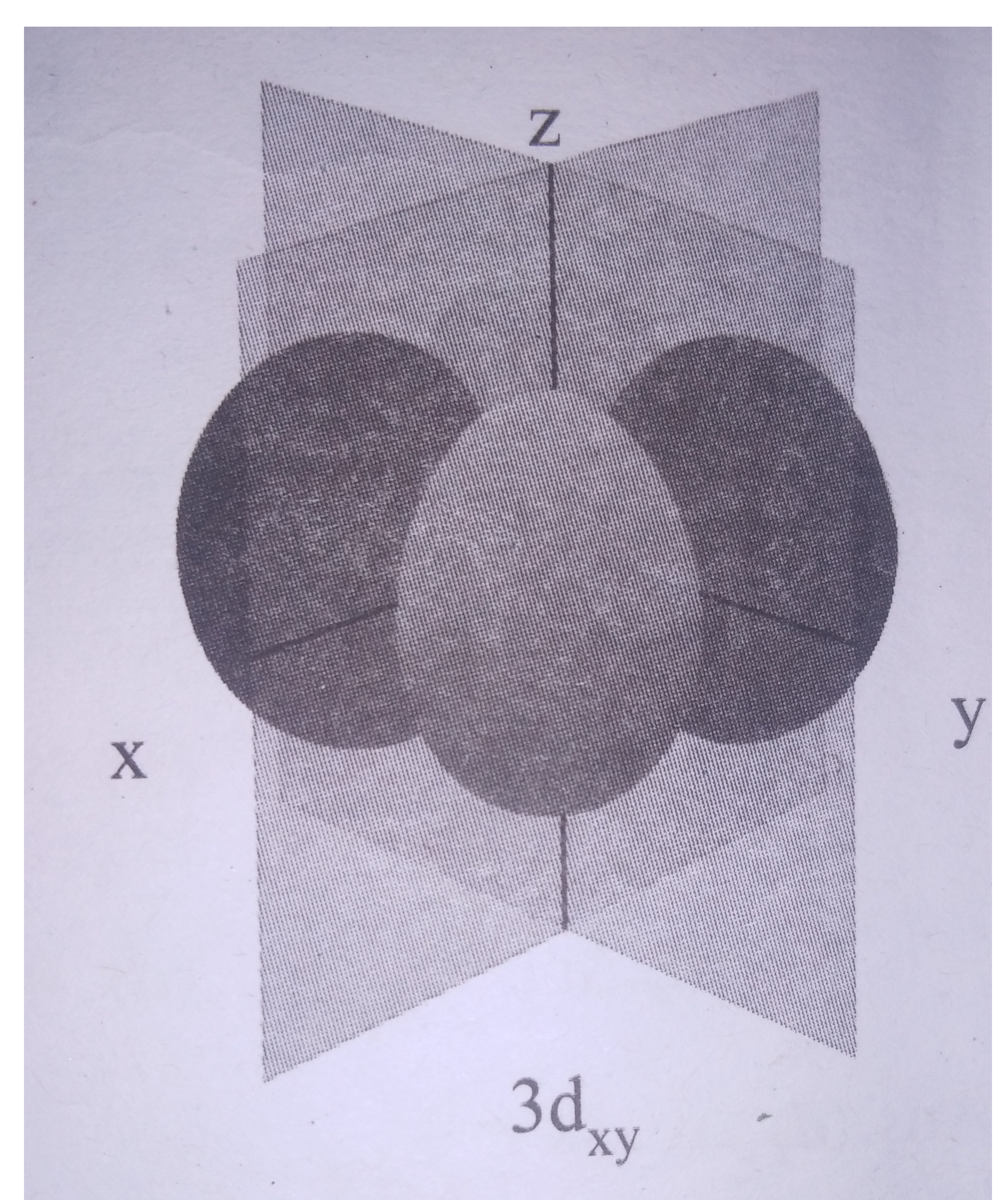 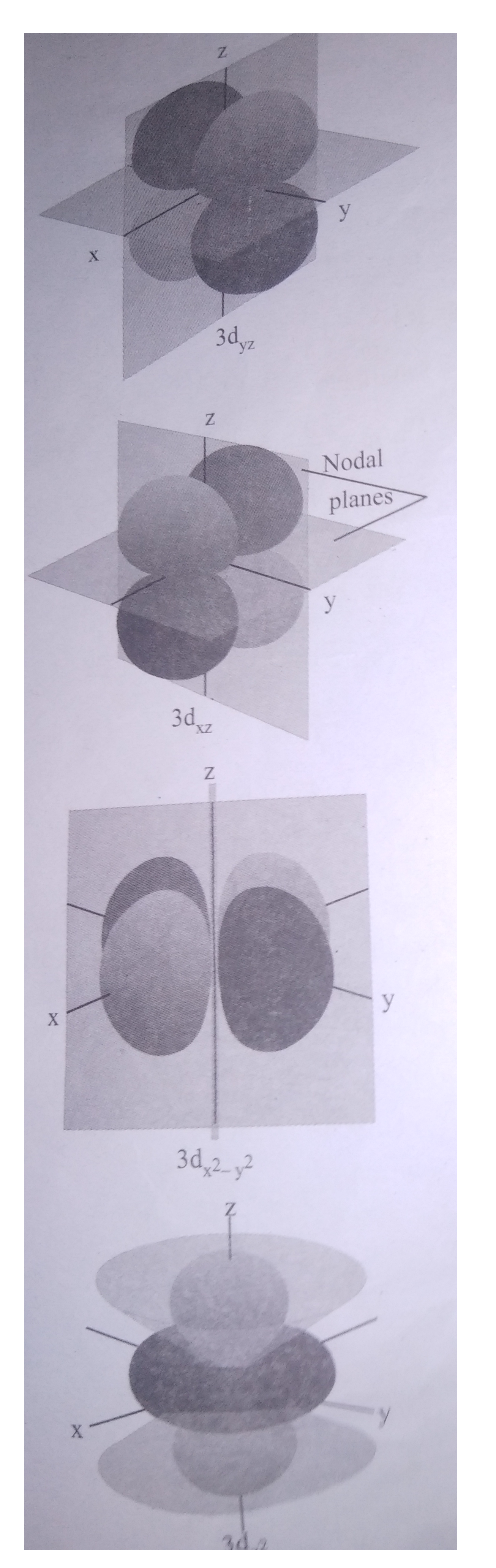
|
|