Saved Bookmarks
This section includes 7 InterviewSolutions, each offering curated multiple-choice questions to sharpen your Current Affairs knowledge and support exam preparation. Choose a topic below to get started.
| 1. |
In acid medium, both KMnO_(4) " and " K_(2)Cr_(2)O_(7) act as oxidising agents. Which among the following is correct about the oxidising behaviou ? |
|
Answer» `KMnO_(4) GT K_(2)Cr_(2)O_(7)` Change in oxidation number=10 `K_(2)overset(+12)(Cr_(2)O_(7))+4H_(2)SO_(4)to K_(2)SO_(4)+overset(+6)(Cr_(2))(SO_(4))_(3)+4H_(2)O+3[O]` Change in oxidation number = 6 |
|
| 2. |
In acetylene molecule between the carbon atoms there are ……………. sigma and ………………….. pi bonds. |
| Answer» SOLUTION :ONE, TWO | |
| 3. |
In acetylene molecule between the carbon atoms there are |
|
Answer» three SIGMA bonds |
|
| 4. |
In above problem -26, why the IUPAC name 4-isopropyl-5-secondary butyldecane is wrong? |
| Answer» Solution :In nomenclature, secondary PREFIX of ALKYL group is not consider in alphabetical order so, first letter B of BUTYL is consider. B of butyl is prior to the ISOPROPYL (I) So, In this name first secondary butyl is required there after iso propyl is placed. So this GIVEN name is wrong. | |
| 5. |
In ABAB.... Arrangement if an atom is placed in A layer then calculate the number of atoms touching in its adjacent B layer ? |
|
Answer» |
|
| 6. |
In a Victor Meyer's determination, the following observations have been made: Mass of compound = 0.17g Volume of air collected = 34.2 mL Temperature = 15^(@)C Atmospheric pressure = 750 mm Vapour pressure of water at 15^(@)C = 13mm Calculate the vapour density and molecular mass of the compound. |
|
Answer» SOLUTION :Given `{:(V_(1)=34.2mL,V_(2)=?),(P_(1)=(750-13)=737mm,P_(2)=760mm),(T_(1)=(15+273)=288K,T_(2)=273K):}}NTP "conditions"` By gas equation, `V_(2)=(737 xx 34.2)/(288) xx (273)/(760) = 31.4376 mL` Vapour density `=(W)/(V_(2) xx 0.00009) = (0.17)/(31.4376 xx 0.00009) = 60.08` Mol.mass `= 2XX` Vapour density` = 2xx 60.08 = 120.16` |
|
| 7. |
In a vessel, two equilibrium are simultanceously established at the same temperature as follows: N_(2)(g)+3H_(2)(g)hArr2 NH_(3)(g).... (1) N_(2)g)+2H_(2)(g)hARrN_(2)H_(4)(g) ....(2) Initially the vessel contains N_(2) "and" H_(2) in the molar ratio of 9:13. The equilibrium pressure is 7P_(0), in wich pressure due to ammonia is P_(o) and due to hydrogen is 2P_(0). Find the values of equilibrium constats (K_(p)'S) for both the reactions |
|
Answer» |
|
| 8. |
In a Victor Meyer's determination of molecular mass, 0.1015 g of an organic substance displaced 27.96 mL of air at 15°C and 766 mm pressure. Calculate the molecular mass of the substance (Aqueous tension at 15°C = 16 mm). |
|
Answer» Solution :In the present case, mass of the substance = 0.1015 g Volume of moist air = 27.96 mL Room temperature = 273 + 15 = 288 K Barometric pressure = 766 MM `P_(1) = 766-16 = 750 mm, P_(2) = 760 mm` `V_(1) = 27.96 mL, V_(2)`= ? `T_(1) = 288 K, T_(2) = 273 K` According to the gas equation, `(P_(1)V_(1))/T_(1) = (P_(2)V_(2))/T_(2)` `V_(2) = (P_(1)V_(1))/T_(1) xx T_(2)/P_(2) = (750 xx 27.96)/288 xx 273/760 = 26.16 mL` Thus, 0.1015 g of the given compound displaces 26.16 mL of dry air at S.T.R This is equal to the volume of vapour formed. `THEREFORE 26.16` mL of vapour at S.T.R weigh = 0.1015 g Hence, the MOLECULAR mass of the given substance is 86.9 |
|
| 9. |
In a Victor Meyer's determination of molecular mass, 0.15 g of a volatile substance displaced 31.64 mL of air at 25°C and 755 mm pressure. Calculate the molecular mass of the substance. |
|
Answer» |
|
| 10. |
In a Victor Meyer's determination, 0.23 g of a volatile substance displaced air which measured 112 mL at S.T.P. Calculate the vapour density and molecular weight of the substance (1 litre of H_2 at S.T.P. weighs 0.09 g). |
|
Answer» `V.D. =(" WEIGHT of a definite volume of gas at S.T.P.")/("Weight of the same volume of" H_2 "at S.T.P.")` In the present case, 112 mL of the vapour of the given substance weighs 0.23 g. The weight of similar volume (112 mL) of H2 at S.T.P. will be `=(0.09)/1000 xx 112 = 0.01008 g` `:." The V.D. of the given substance " (0.23)/(0.01008)= 22.82` The molecular weight is related to V.D. as Molecular weight `= 2 xx V.D`. Hence, the molecular weight of the given substance `= 2 xx 22.82 = 45.64` |
|
| 11. |
The uncertainty in the position of an electron moving with a velocity of 1x10^4ms^-1 (accurate up to 0.011%) will be |
|
Answer» `3.7xx10^(4)CM*s^(-1)` |
|
| 12. |
In a titration to 5OmL of 0.2M acetic acid (K_(a), = 1.8 xx10^(-5) ), 0.2M of V' mlL of NaOH is added to get a resultant solution of pH=4.74 if V =x^(2)?, what is x? |
|
Answer» To GET this, `V_(NAOH),` MUST be 25 ml |
|
| 13. |
In a tetragonal crystal |
|
Answer» a=B=C,`alpha=beta=90^@ NE GAMMA` |
|
| 14. |
In a solution the concentration of CaCl_(2) is 5M & that of MgCl_(2) is 5 m. The specific gravity of solution is 1.05, calculate the concentration of Cl^(-) in the solution in terms of Molarity. |
|
Answer» `wt`. Of `("solvant" + MgCl_(2))=1050-555=495g` `MgCl_(2)rarr5m` `1000G` solvant`rarr 5` MOL of `MgCl_(2)` `=5xx95=475gMgCl_(2)` `i.e., 1475 ("solvant" + MgCl_(2))rarr 475g MgCl_(2)` `495("solvant"+ MgCl_(2)) rarr(475)/(1475)xx495` `=159.4g MgCl_(2)` MOLES of `MgCl_(2)=(159.4)/(95)=1.678` TOTAL moles of `Cl^(-)` `=(5+1.678)xx2=13.356` volume of solution `1L` Molarity of`Cl^(-) = 13.356 M` |
|
| 15. |
In a solid S^(2-) ions are packed in fcc lattice. Zn^(2+) occupy half of the tetrahedral voids in an alternating arrangement. Now if a plane is cut (as shown) then the cross -section would be |
|
Answer»
`rarr ZN^(+2)` ion ocupy ALTERNATE four TETRAHEDRAL void i.e. 
|
|
| 16. |
In a solid, oxide ions are arranged in ccp. One -sixth of the tetrahedral voids are occupied by the cations A while one -third of the octahdral voids are occupied by the cations B. what is the formula of the compound ? |
|
Answer» Ratio` A : B : O^(2-)- n/3 : n/3: n = 1:1 : 3 ` i.e, formula is ` ABO_(3)` |
|
| 17. |
In a solidlattice, the cation has left a lattice site and is located on interstitial position. The lattice defect is |
|
Answer» F centres |
|
| 18. |
In a solid, oxide ions are arranged in ccp. One-sixth of the tetrahedral voids are occupied by the cations A while one-third of the octahedral voids are occupied by the cations B. What is the formula of the compound? |
|
Answer» `THEREFORE` A:B:`O^(2-)=n/3:n/3:n=1:1:3` , i.e., FORMULA is `ABO_3` |
|
| 19. |
In a solid lattice, the cation has left a lattice site and is located at an interstitial position. The lattice defect is |
|
Answer» n-type |
|
| 20. |
In a solid lattice, cation is absent from lattice site and present at an interstitial posiotion, the lattice defect is |
|
Answer» Schottky |
|
| 21. |
In a solid 'AB'havingNaCl structure , 'A' atoms occupy the corners of the cubic unit cell. If all the face-centred atoms along one of the axes are removed, then the resultant stoichiometry of the solid is |
|
Answer» `AB_(2)` 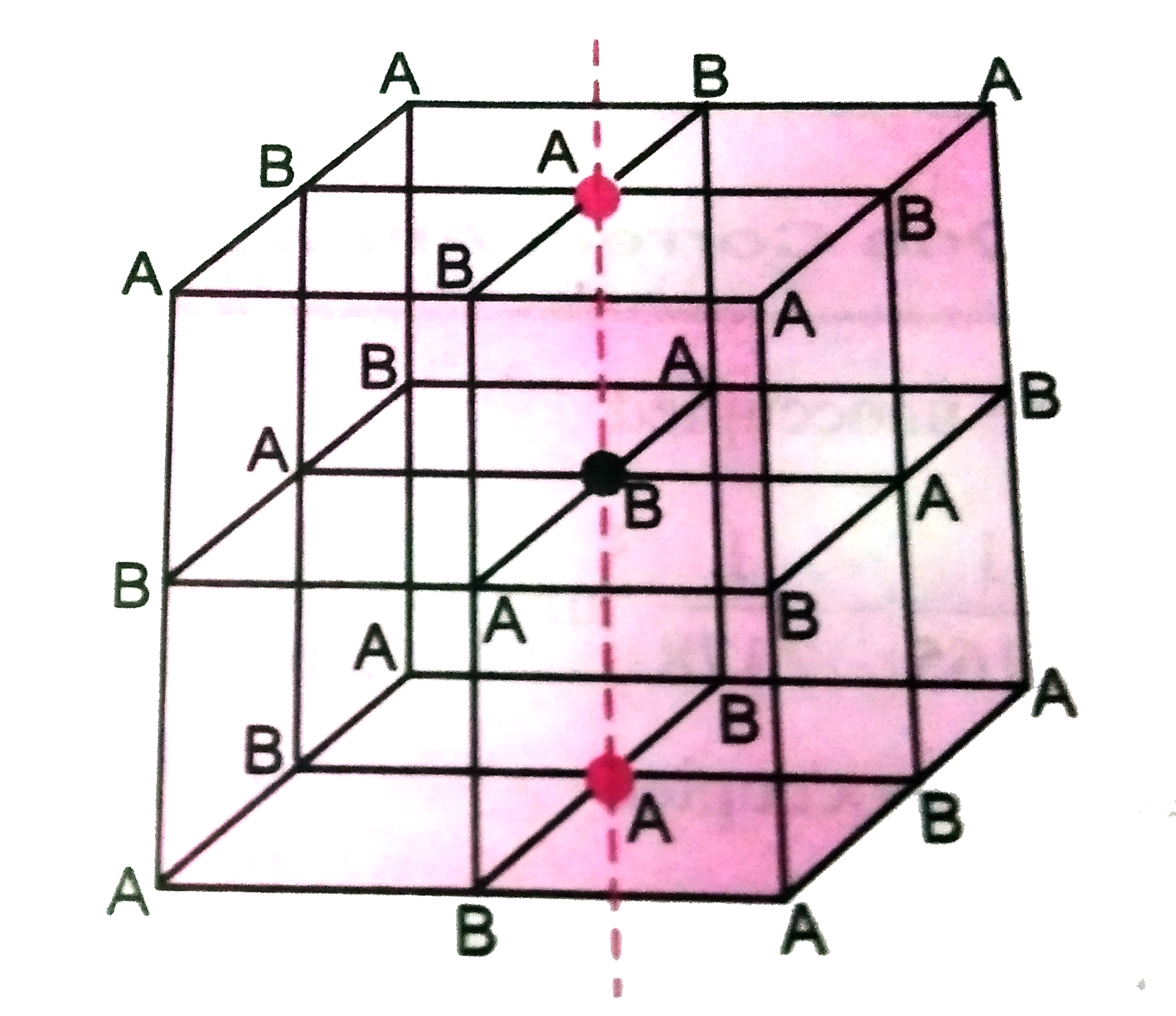 Now, no , of atoms per unit cell `= 8 xx 1/8 + 4 xx 1/2 = 3 ` No. of B atoms per unit cell ` 12 xx 1/4+ 1 = 4` HENCE, the resultant stoichimetry is ` A_(3)B_(4)` |
|
| 22. |
In a solid 'AB' having NaCl structure atoms occupy the corners of the cube unit cell. If all the face centred atoms along one of the axis are removed then the resultant stoichiometryof the solid is |
|
Answer» `AB_(2)` Contribution of two FECE centred `B^(-)`ions `=2times1//2=1` In the resultant unit cell, `THEREFORE "No.of " A^(+)` ions present per unit cell =4 `therefore"No. of "B^(-)`ions present per unit cell =4-1=3resultant. `therefore"Stoichiometry"=A_(4)B_(3)` |
|
| 23. |
In a solid 'AB' having NaCl structure , 'A' atoms occupy the corners of the cubic unit cell. If cell the face-centred atoms along one of the axes are removed , then the resultant stoichiometry of the solid is |
|
Answer» `AB_2` 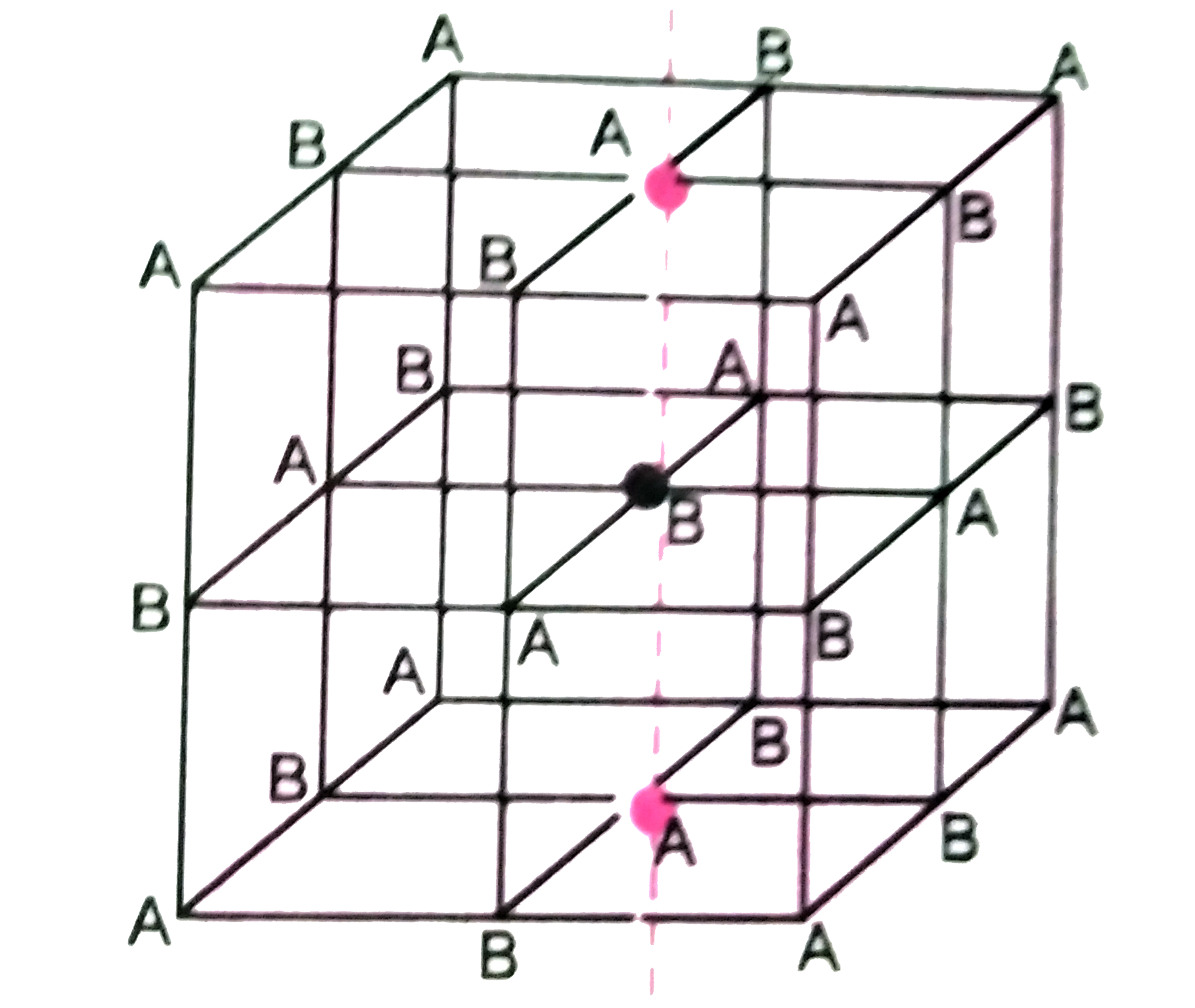 Now, no of A atoms per unit cell `{:(=8xx1/8,4xx1/2,=3),("(Corners)","(face-centred)",):}` No.of B atoms per unit cell `{:(=12xx1/4,1,=4),("(edge centred)","(body-centred)",):}` HENCE, the resultant stoichoimetry is `A_3B_4` |
|
| 24. |
In a solid .AB. hasving the NaCl structure, .A. atoms occupy the corners of the cubic unit cell. If the face - centrad atoms along one of the axis are removed, then the resultant stoichiometry of ther solid is |
|
Answer» `AB_(2)` (i) Effective number of `A^(-)` or `Cl^(-)` (normally) `= (8xx(1)/(8))+(6xx(1)/(2))=4` From corners and faces (all face centered) Effective number of `A^(-)` after removing ATOMS along one AXES. `= (8xx(1)/(8))+(4xx(1)/(2))=3` (III) Effective number of `B^(+)` or `Na^(+)` `= underset("From edge centres")((12xx(1)/(4)))+underset("From body CENTRE")(1)` = 4 `therefore` Formula is `A_(3)B_(4)` |
|
| 25. |
In a sodium atom(atomic number=11 and mass number=23) and the number of neutrons………….. |
| Answer» SOLUTION :GREATER than the NUMBER of PROTONS | |
| 26. |
In a S_(N)2 substitution reaction of the type R-Br+Cl^(-) overset(DMF)to R-Cl+Br^(-), which of the following has the highest reactivity rate? |
|
Answer» `CH_(3)-underset(CH_(3))underset(|)CH-CH_(2)Br` |
|
| 27. |
In a simple cubic cell, each point on a corner is shared by |
| Answer» Answer :C | |
| 28. |
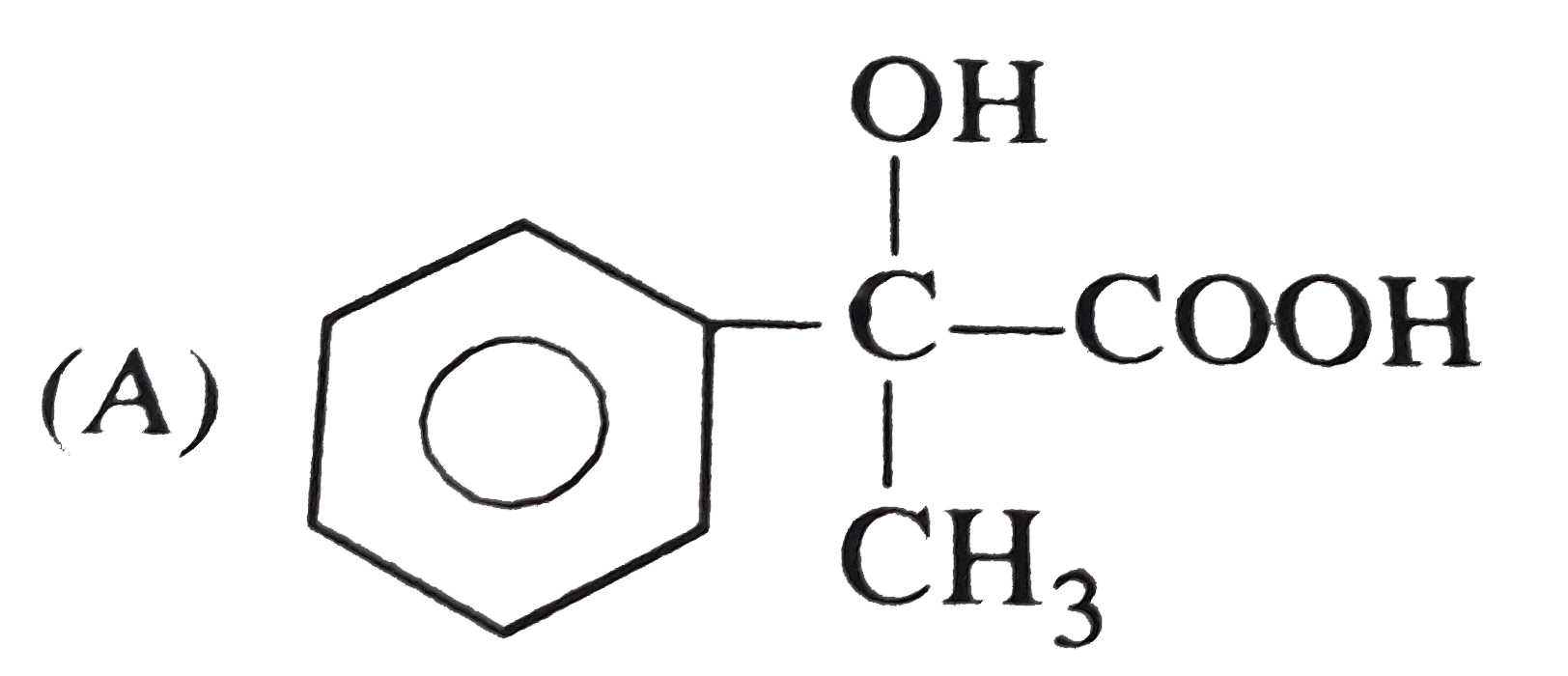
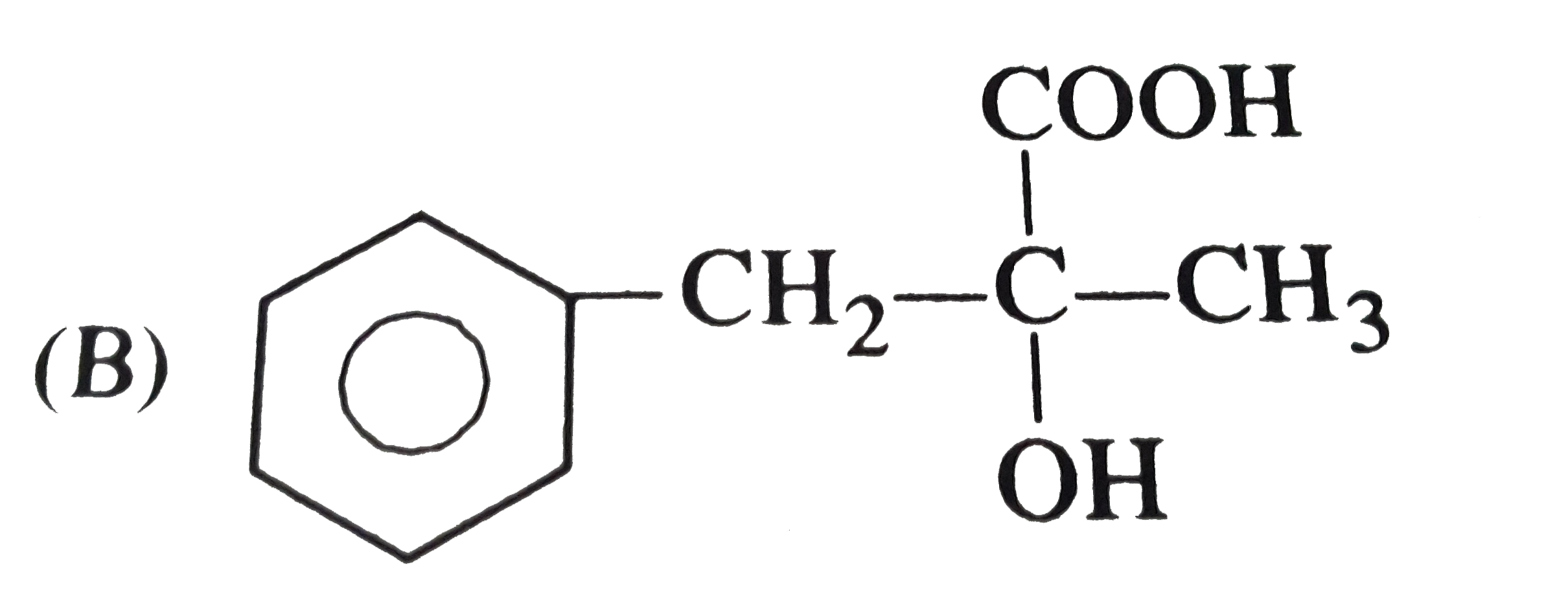
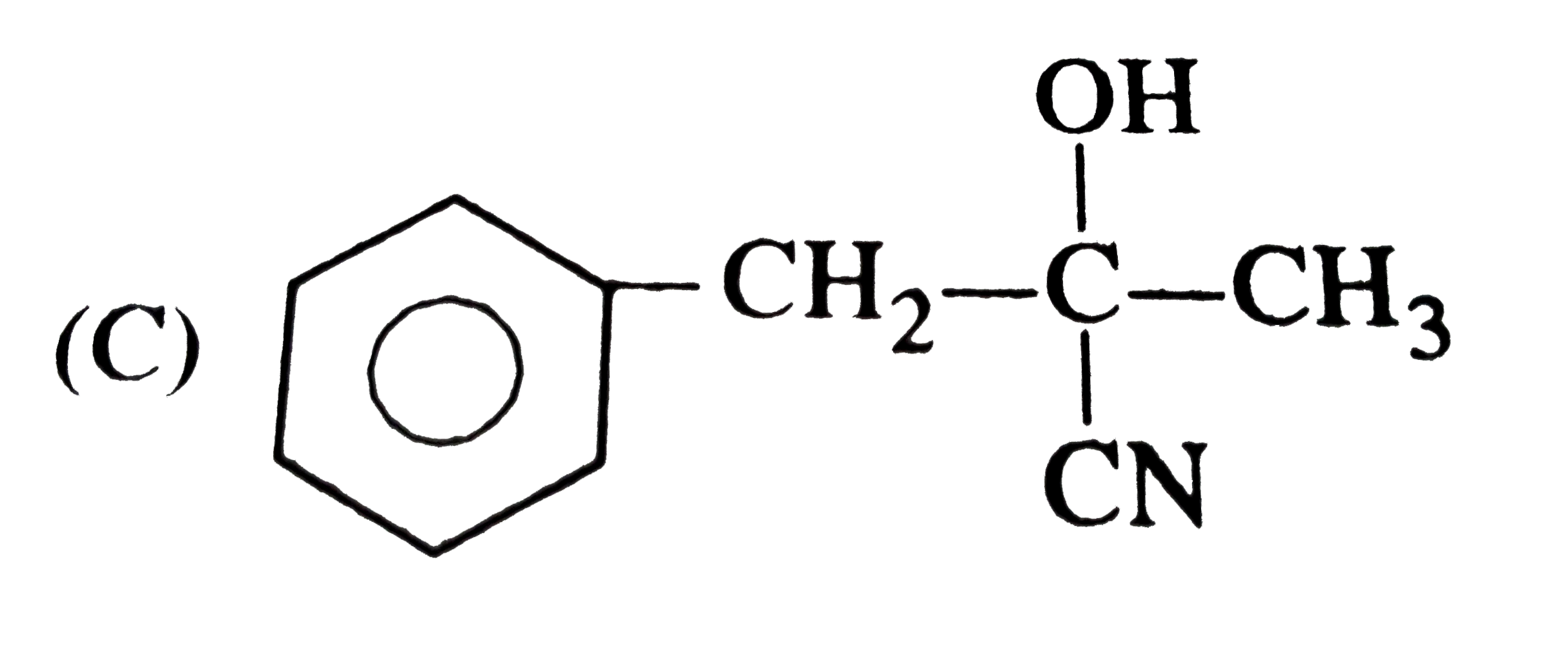
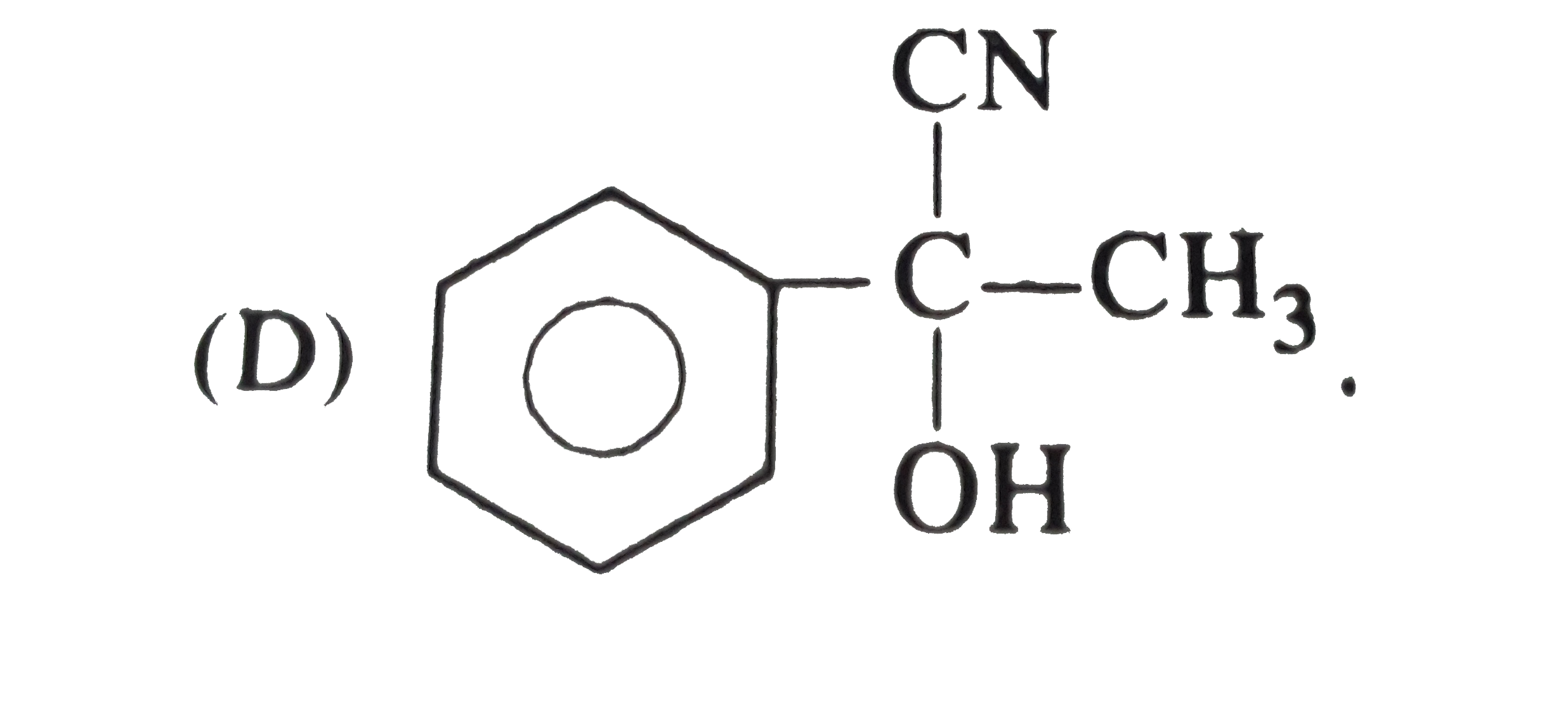
In a set of reactions acetic acid yielded a product S CH_(3)COOH overset(SOCl_(2))rarrP underset("Anhy." AlCl_(3))overset("Benzene")rarr Q overset(HCN)rarrR overset(H_(2)O //H^(+))rarrS The structure of S would be : |
|
Answer»
|
|
| 29. |
In a saturated solution of the sparingly soluble strong electrolyte AgIO_(3) (Molecular mass = 283), the equilibrium which sets in is AgIO_(3) (s) hArr Ag^(+) (aq) +IO_(3)^(-) (aq) If the solubility product constant K_(sp) of AgIO_(3) at a given temperature is 1.0xx10^(-8), what is the mass of AgIO_(3) contained in 100 ml of its saturated solution ? |
|
Answer» `1.0xx10^(-4)g` `K_(sp)=S^(2) or S=sqrt(K_(sp))=sqrt(10^(-8))=10^(-4) "mol" L^(-1)` `=10^(-4)xx283 gL^(-1) = 2.83 xx 10^(-2) g L ^(-1)` Thus, 1000 mL of the saturated solution will contain `AgIO_(3)=2.83xx10^(-2)g` `:.100 ` m L of the saturated solution will contain `AgIO_(3)=2.83xx10^(-3)g`. |
|
| 30. |
In a series in the line spectrum of hydrogen, the wavelength of radiation is 6,563Å. The name of the series and the orbits in which electron transition takes place are |
|
Answer» Balmer series, 3rd to 2ND ORBIT |
|
| 31. |
In a series in the line spectrum of hydrogen the wavelength of radiation is 6,563Å. The name of the series and the orbits in which electron transition takes place are |
|
Answer» Balmer SERIES , `3^(RD) ` to `2^(ND)` orbit |
|
| 32. |
In a saturated solution of the sparingly soluble strong electrolyte AgIO_3 (molecular mass = 283), the equilibrium which sets in is AgIO_(3(s)) hArr Ag_((aq))^(+) + IO_(3(aq))^(-) If the solubillity product constant K_(sp) of AglO_3 at a given temperature is 1.0xx 10^(-8), what is the mass of AgIO_3 contained in 100 ml of its saturated solution? |
|
Answer» `1.0xx10^(-4)` g `K_(sp)=S^2` `S^2=1.0xx10^(-8)` `S=1.0xx10^(-4)` mol/lit `=(1.0xx10^(-4) xx 283)/1000` gm/ml `=(1.0xx10^(-4)xx283xx100)/1000`gm/100 ml `=28.3xx10^(-4)` gm/100ml `=2.83xx10^(-3)` gm/100 ml |
|
| 33. |
In NaCl is doped with 1 xx 10^(-3) mol percent of SrCl_(2) , what is the concentration of cation vacancies ? |
|
Answer»
|
|
| 34. |
In a saturated solution of AgCl, NaCl is added gradually. The concentration of Ag^(+)is plotted against the concentration of Cl^(-). The graph appears as : |
|
Answer»
|
|
| 35. |
In a saturated aqueous solution of AgBr , conc, of Ag^(+) ion is 10^(-6) mol/lit. if K_(sp) for Ag Br is 1 xx 10^(-12) , then concentration of Br^(-) in the solution is |
|
Answer» `1 xx 10^(-6)` mol/lit |
|
| 36. |
In a sample of sodium carbonate, some sodium sulphate is mixed. 2.50 g of this sample is dissolved and the volume made up to 500 mL . 25 mL of this solution neutralises 20 mL of N//10 in the sample. |
|
Answer» |
|
| 37. |
In a sample of excited hydrogen atoms electrons make transition from n = 2 to n = 1. Emitted photons striķe on a metal of work function (phi) 4.2 eV. Calcualte the wavelength (in A^@) associated with ejected electrons having maximum kinetic energy. |
|
Answer» = hcR (3/4) K.E. hcR (3/4) - 4.2 EV On SOLVING `lambda = 5A^0` |
|
| 38. |
In a reversible reaction, two substances are in equilibrium . If the concentration of each one is doubed , the equilibrium constant will be. |
|
Answer» REDUCED to HALF its ORIGINAL value |
|
| 39. |
In a reversible reaction, the forward reaction was 3 times faster than that of reverse reaction. The reaction quotient is..... |
|
Answer» |
|
| 40. |
In a reversible reaction the rate constants of the forward and the backward reactions are 4.8xx10^(-5)s^(-1)and1.2xx10^(-4)s^(-1) respectively. Calculate the equilibrium constant. |
| Answer» SOLUTION :`K=k_(1)/k_(2)=(4.8xx10^(-5))/(1.2xx10^(-4))=0.4` | |
| 41. |
In a reversible reaction K_(c) gt K_(p) and DeltaH = + 40 K. Cal. The product will be obtained in less amount on |
|
Answer» INCREASING both pressure & temperature `:.` backward REACTION favoured by low T & low P |
|
| 42. |
In a reversible reaction, if the concentration of reactants are double, the equilibrium constant K will be x times the initial equilibrium constant. x will be equal to |
|
Answer» |
|
| 43. |
In a reversible reaction at equilibrium the net heat change of the reaction is : |
|
Answer» POSITIVE |
|
| 44. |
In a reversible process, the change in entropy of the universe is_______ |
| Answer» ANSWER :d | |
| 45. |
In a reversible process, the change in entropy of the universe is |
| Answer» SOLUTION :EQUAL to ZERO | |
| 46. |
In a reversible process, the change in entropy of the universe is ____ |
| Answer» ANSWER :D | |
| 47. |
In a regular B_(12) icosahedran : (a) How many boron atoms are equidistant from a given boron atom ? (b) How many edges are there ? ( c) How many valence electrons are there ? (d) Can each edge line represent pair bond ? ( e) Explain the type of bonding involved in elemental boron ? |
|
Answer» Solution :In a regular `B_(12)` icosahedran : (a) Five boron atoms are equidistant from a given boron atom. (b) There are `30` edges, i.e. `5` from the TOP B-atom, `5` around the upper pentagon, `10` from the upper pentagon to the low, `5` around the lower pentagon and `5` to the bottom boron atom. ( c) Valence shell electronic configuration of `B` is `2 s^(2) 2p^(1)`, so each boron atom has `3` valence electrons. Total number of valence electrons in `B_(12)` icosahedra `= 3 xx 12 = 36` electrons. (d) No, there are `30` edges in `B_(12)` icosahedra, so the total electron should be `30 xx 2 = 60` electrons. SINCE there are not `60` electrons. hence each EDGE line cannot represent an electron pair. ( e) There MUST be some `(3c, 2e)` bridge bonding, just as in diborane. |
|
| 48. |
In a Regnault's experiment, the mass of a definite volume of a gas was found to be 4.6420 g, whereas the mass of the same volume of hydrogen at the same temperature and pressure was found to be 0.2902 g. Calculate the vapour density and molecular mass of the gas. |
|
Answer» SOLUTION :Mass of the GAS =4.6420 g Mass of the same volume of `H_(2) = 0.2902` `therefore V.D = ("Mass of the gas")/("Mass of the same volume of HYDROGEN")` `=4.6420/0.2902 = 15.9959` `therefore` MOLECULAR mass `=2 xx V.D. = 2 xx 15.9959` = 31.99 |
|
| 49. |
In a traction x+y + z_(2)to xyz_(2), Identity the limiting reagent If tiny, in the following traction mixtures. (a) (A)200 atoms of x+ 200 atoms of y+ 50 molecules of z_(2) (b) 1 mol of x+1 mol of y +3 3 mol ofz_(2) (c) 50 atoms of x + 25 atoms of y + 50 molecules of z_(2) (d) 2.5 mol of x + 5 mol of y + 5 mol of z_(2) |
Answer» SOLUTION :REACTION : `x+y+z_2 to xyz_2`  . .
|
|