Saved Bookmarks
This section includes 7 InterviewSolutions, each offering curated multiple-choice questions to sharpen your Current Affairs knowledge and support exam preparation. Choose a topic below to get started.
| 1. |
In a reaction excess of H_(2)O_(2) is added to 0.1 mole of acidified KMnO_(4) solution. Then the S.T.P volume of O_(2) liberated is |
|
Answer» `5.6 LIT.` |
|
| 2. |
In a reaction excess of H_(2)O is added to 0.1 mole of acidified KMnO_(4) solution. Then the S.T.P volume of O_(2) liberated is |
|
Answer» 5.6 lit. 2 moles `KMnO_(4) rarr 5 times 22.4 L` 0.1 mole `KMnO_(4) rarr ?=5.60L` |
|
| 3. |
In a reaction container, 100g of hydrogen and 100 g of Cl_2 are mixed for the formation of HCl gas. What is the limiting reagent and how much HCl is formed in the reaction ? |
|
Answer» `H_2` is limiting reagent and 36.5 G of HCl are FORMED. 2g of `H_2` reacts with 71 g of `Cl_2` 100 g of `H_2` reacts with `71/2xx100=3550g " of " Cl_2` Hence, `Cl_2` isthe limiting reagent. 71g of `Cl_2` produces 73 g of HCl 100G of `Cl_2` will produce `73/71xx100=102.8g` of HCl |
|
| 4. |
In a reaction CH_(2)=CH_(2)underset("acid")overset("Hypochlorous")rarrMoverset(R)rarrunderset(CH_(2)OH)underset("|")(CH_(2)OH) Here, M = Molecule, R = Reagent, M and R are respectively |
|
Answer» `CH_(3)CH_(2)CL and NaOH` |
|
| 5. |
In a reaction between zinc and iodine in which zinc iodide is formed, what is being oxidised ? |
|
Answer» ZINC ions |
|
| 6. |
In a reaction between H_(2) and I_(2) ata certain temperature, the amounts of H_(2), I_(2) and HI at equilibrium constant f werefound to be0.45 mole, 0.39 mole and 3.0 moles respectively. Calculate the equilibrium constant for the reaction at the given temperature. |
|
Answer» Solution :THR reaction between `H_(2) and I_(2)` may be represented as : `H_(2) + I_(2) HARR 2 HI` Amounts of `H_(2), I_(2) and HI` at equilibriumare given to be `H_(2) = 0.45 " MOLE " , I_(2) = 0.39 " mole" and HI= 3.0 " mole"` Suppose the volume of the vessel ( i.e., reaction mixture) = V litres. Then the molar concentrations at equilibrium will be `[H_(2)] = (0.45)/V molL^(-1), [I_(2)]= (0.39)/V mol L^(-1) and [ HI] = (3.0)/V mol L^(-1)` Applying the LAW of chemical equilibrium to the above reaction, we get `K_(c) = [HI]^(2) /([H_(2)][I_(2)])=(3.0//V)^(2)/(0.45 xx 0.39) = 51.28` |
|
| 7. |
In a reaction between zinc and iodine, in which zinc iodide is formed, what is being oxidised |
|
Answer» ZINC ions |
|
| 8. |
In a reaction at equilibrium, X moles of the reactant A decomposes to give 1 mole each of C and D. It has been found that the fraction of A decomposed at equilibrium is independent of initial concentration of A. Calculate X. |
|
Answer» `:. K_(c)=(a^(2)alpha^(2))/(V^(2).x^(2)[(a(1-alpha))/V]^(x))=(a^(2).alpha^(2-x))/(x^(2)(1-alpha)^(x).V^(2-x))` since `alpha` is independent of a `:. 2-x=0, x=2` |
|
| 9. |
In a reaction at equilibrium, x' mole of the reactant 'A' decompose to give I mole of C and D. It has been found that the fraction of A decomposed at equilibrium is independent of intial concentration of A. Find the value of x. |
|
Answer» `a(1-alpha), (a alpha)/(x), (a alpha)/(x)` `K_(c)=(a^(2)alpha^(2))/(V^(2)x^(2)[(a(1-alpha))/(V)]^(x))=(alpha^(2)a^(2-x))/(x^(2)(1-alpha)x 2-x)` `alpha` INDEPENDENT of a =2-x=0 `IMPLIES` x=2 |
|
| 10. |
In a reaction A+B_2rarrAB_2. identify the limiting reagent in the reaction mixture containing 5 mole of A and 2.5 mole of B. |
| Answer» SOLUTION :B is the LIMITING REAGENT | |
| 11. |
In a reaction A +B_(2) rarr AB_(2) identify the limiting reagent, if any, in the following reaction mixture. (i) 300 atoms of A + 200 molecules of B (ii) 2 mol A + 3 mol B (iii) 100 atoms of A + 100 molecules of B (iv) 5 mol A + 2.5 mol A (v) 2.5 mol A + 5 mol B |
|
Answer» (i) Accroding to above reaction, ONE atom of A react with one molecules of B. So, 200 ATOMS of a react with 200 molecules of B. So, B is a limiting reagent and A is excess reagent is remain. (II) According of above, one mole of A react with one mole of B. So, 2 mol of A react with 2 mole of B. So, A is limiting reagent. (iii) No lomiting reagent. (iv) 2.5 mol of B is consumed to react with 2.5 mol of A atom. So, B is limiting reagent. (v) 2.5 mol of A is consumed to react with 2.5 mol of B atom. So, A is limiting reagent. |
|
| 12. |
In a reaction A+B_(2) rarr AB_(2) Identify the limiting reagent, if any, in the following reaction mixtures. a. 300 "atoms" of A+ 200 molecules of B b. 2 mol A+3 mol B c. 100 "atoms" of A+100 molecules of B d. 5 mol A+2.5 mol B e. 2.5 mol A + 5 mol B |
|
Answer» Solution :(i) According to the GIVEN reaction `A + B_(2) to AB_(2)`, one atom of A reacts with one molecule of B. 300 atoms of A will require 300 molecules of B for COMPLETE reaction. Since, the molecules of B present are only 200, it is short of 100 molecules. Thus, A is in excess. Therefore, B is the limiting reagent. (ii) 1 mol of 4 reacts with 1 mol of B. `therefore` 2 mol of A will react with 2 mol of B. Since, 3 mol of B are present, it is in excess. Thus, A is the limiting reagent. (iii) 100 atoms of A will completely react with 100 molecules of B. Thus, both will get consumed . HENCE, there is no limiting reagent in this CASE. (IV) 2.5 mol of B will react with 2.5 mol of A. Thus, A will be left in excess. Therefore, B is the limiting reagent. (v) 2.5 mol of A will react with 2.5 mol of B. Thus, B will be left in excess. Therefore, A is the limiting reagent. |
|
| 13. |
In a reaction , A+ 2 B hArr 2 C, 2.0mole of 'A' 3.0 mole of 'B' and 2.0 mole of 'C' are placed in a 2.0 L flask and the equilibrium concentration of 'C' is 0.5 mole/L. The equilibrium constant (K) for the reaction is |
|
Answer» `0.073` `K= (0.5)^(2)/(1.25 xx (2.0)^(2)) = 0.05` Note that 0.5 mol `L^(-1)` of C has decomposed to produce 0.25 mol of A and .5 mol of B. |
|
| 14. |
In a quality control analysis for sulphur impurity 5.6g steel sample was burnt in a stream of oxygen and sulphur was converted into SO_(2) gas. The SO_(2) was then oxidized to sulphate by using H_(2)O_(2) solution to which has been added 30 mL of 0.04M NaOH. The equation ofthe reaction is: SO_(2(g)) +H_(2)O_((aq.))+2OH_((aq.))^(-)to SO_(4(aq.))^(2-) +2H_(2)O_((l)) 22.48mL of 0.024M HCI was required to neutralize the base remaining after oxidation reaction. Calculate % sulphur in given sample. |
|
Answer» |
|
| 15. |
In a quality control analysis for sulphur impurity 0.56g steel sample was burnt in a stream of oxygen and sulpphur was converted into SO_(2) gas. The SO_(2) was then oxidized to sulphate by using H_(2)O_(2) solution to which had been added 30mL of 0.04M NaOH. the equation for reaction is: SO_(2(g)) +H_(2)O_(2(aq)) +2OH_((aq))^(-) rarr SO_(4(aq))^(-2) +2H_(2)O_((1)) 22.48 mL of 0.024M HCI was required to neutralize the base remaining after oxidation reaction. Calculate % of sulphur in given sample. |
|
Answer» `3.6%` Meq. Of alkali left `=22.48 xx 0.024 = 0.54` `:.` Meq. of alkali for `SO_(2)` and `H_(2)O_(2) = 1.2 - 0.54 = 0.66 =` M.eqts of alkali 1 moles of alkai `-=1` moles of `SO_(2)` `:.` WEIGHT of `S = (0.66)/(2) xx (32)/(1000) = 0.0105g` `:. %` of `S = (0.0105)/(0.56) xx 100 = 1.875%` |
|
| 16. |
In a process, a system loses 125 J of heat when 400 J of work was done on the system. Calculate the change in internal energy. |
|
Answer» SOLUTION :`Q = - 125J, W = +400` `:. DELTAE= -125 + 400 = +275 J`. |
|
| 17. |
In a process, 701J of heatis absorbed by a system and 394 J of work is done by the system. What is the change in internal energy of the process ? |
|
Answer» Solution :`q=+ 701 J ,w = - 394 J , DeltaU =?` By firstlaw of THERMODYNAMICS `Delta U =q +w = + 701 J + ( -394J) = + 307 J` i.e., internal energy of the system increases by 307J |
|
| 18. |
In a process, 701 J of heat is absorbed by a system and 394 J of work is done by the system.What is the change in internal energy for the process? |
|
Answer» Solution :Heat ABSORBED by the system = 701 J or q = 701 J Work done by the system = 394 J or w = -394 J According to first LAW of THERMODYNAMICS `DeltaU = q + w` `DeltaU = 701 -394 = 307 J`. |
|
| 19. |
In a process, 701 J of heat is absorbed by a system and 394 J of work is done by the system. What is the change in internal energy for the process? |
|
Answer» Solution :Since HEAT is absorbed, it is GIVEN POSITIVE sign,i.e. q=701J Since WORK is done by the system, it is given negative sign i.e. w=-394J `therefore DeltaU=q+w=701-394=+307 J` |
|
| 20. |
In a process, 701 J of heat is absorbed by a system and 394 J of work is done by the system. What is the change in internal energy for the process ? |
|
Answer» Solution :As per the FIRST law of thermodynamics `Delta U= Q+w` `= 701 + (-394)` `= 307` J Where `q= +701` J `w=-394` J `Delta U = (?)` |
|
| 21. |
In a process 701 J of heat is absorbed by a system and 394 J of work is done by the system. What is the change in internal energy for the process? |
| Answer» SOLUTION :`-307 J` | |
| 22. |
In a process, 646 g of ammonia is allowed to react with 1.144 kg of CO_(2) to form urea.(i) If the entire quantity of all the reactants is not consumed in the reaction which is the limiting reagent ?(ii) Calculate the quantity of urea formed and unreacted quantity of the excess reagent. The balanced equation isunderset (H_(2)NCONH_(2) + H_(2)O)(2NH_(3) + CO_(2)) |
|
Answer» Solution :(i) The entire quantity of ammonia is CONSUMED in the reaction. So ammonia is the limiting reagent. Som,e quantity of `CO_(2)` remains unreacted, so `CO_(2)` is the excess reagent. (ii) Quantity of urea FORMED = number of moles of urea formed x MOLAR mass of urea = 19 moles `xx 60 g mol^(-1)` = 1140 g = 1.14kg Excess reagent leftover at the end of the reaction is carbon dioxide. Amount of carbon dioxide leftover = number of moles of CO, LEFT over x molar mass of `CO_(2)` = `7 "moles" xx 44 g mol^(-1)` = 308 g. 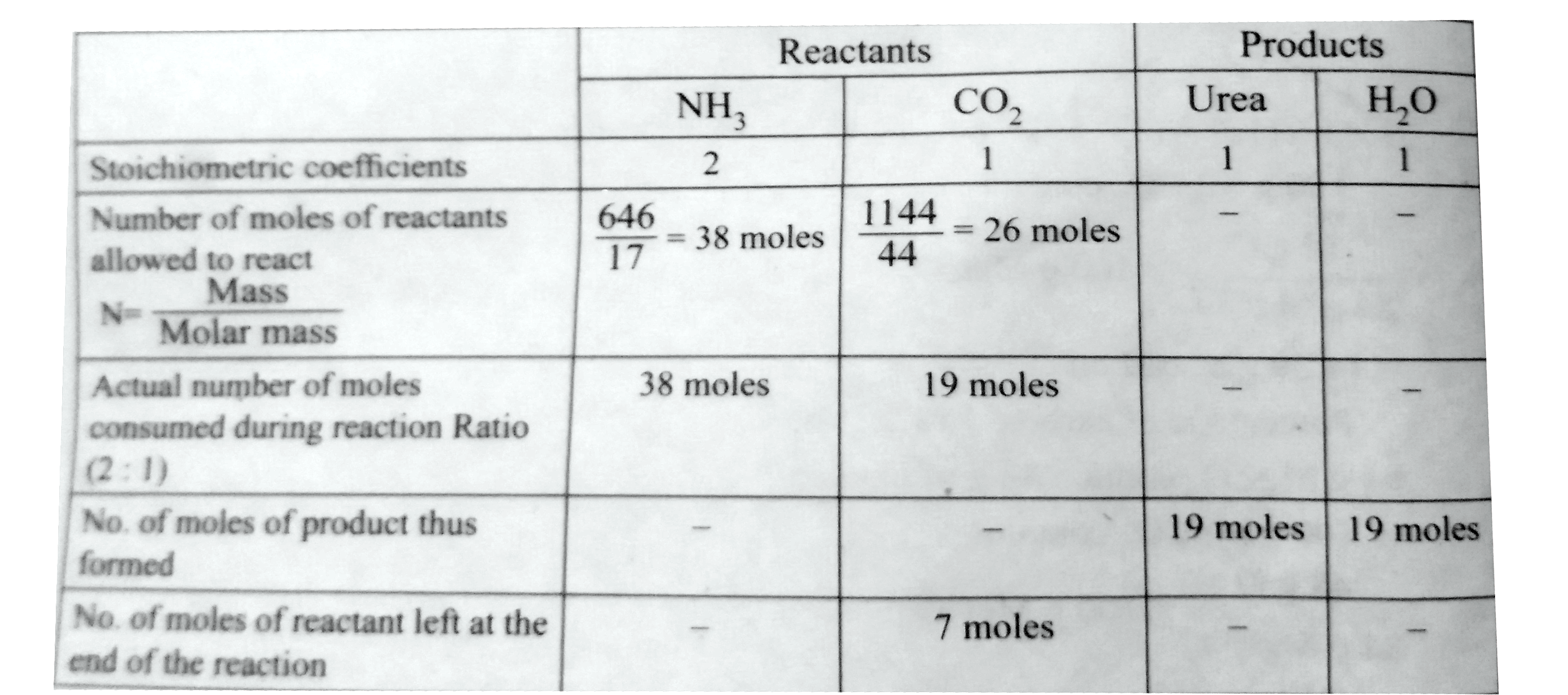
|
|
| 23. |
In a photovoltaic cell, the material that converts sunlight into electricity is __________ |
|
Answer» |
|
| 24. |
In a photoelectric experiment, kinetic energy of photoelectrons was plotted aganist the frequency of incident radiation (v), as the shown in figure. Which of the following statements is correct? |
|
Answer» The threshold frequency is `v_(1)` |
|
| 25. |
In a photoelectriceffect setup, a point source light of power ((p)/(4piR^(2))) =3.2xx10^(-3)W emitsmonoenergetic photons of enegry5.0 EV.Then photons falling on a metallic sphere of radius r=6 mm and of work function 3.0 eV at distance of 0.6 mm. The efficiency of photo- electron emissionis on for every 10^(5)incident photons.Assume that the sphere is located and initially neuttral and that photoelectron are instantly swept away after emission. [Given hc=1240 eV-nm] Find the ratio of the wavelenght of incident light to the De-Brogli wavelenght of the fastest photoelectron emitted |
|
Answer» `23.6` `lambda_(1)=(h)/sqrt(2m_(e) KE)=sqrt((150)/(2))` `lambda_(1)=8.66=0.866 nm` `lambda_(1)/lambda_(1)=(248)/(0.866)=286.374` |
|
| 26. |
In a photoelectriceffect setup, a point source light of power ((p)/(4piR^(2))) =3.2xx10^(-3)W emitsmonoenergetic photons of enegry5.0 EV.Then photons falling on a metallic sphere of radius r=6 mm and of work function 3.0 eV at distance of 0.6 mm. The efficiency of photo- electron emissionis on for every 10^(5)incident photons.Assume that the sphere is located and initially neuttral and that photoelectron are instantly swept away after emission. [Given hc=1240 eV-nm] Calculate the number of photoelectron emitted second. |
|
Answer» `10^(10)` `nxx5xx1.6xx10^(-19)`=`3.2xx10^(-3)` `rArr=(3.2xx10^(-3))/(5xx1.6xx10^(-19))=4xx10^(15)` photons /second. number of photons falling per second on metallic sphere ='n' `n=nxx(pir)/(4piR^(2))""r=6mn=0.006mn,""R=0.6 m` `rArrn4xx10^(15)xx(0.006xx0.006)/(4xx0.6xx0.6)`photons /sec. `=10^(11)` photons /sec `therefore`number of photons electronnemitted /sec. `=(10^(11))/(10^(5))=10^(6)` |
|
| 27. |
In a photoelectriceffect setup, a point source light of power ((p)/(4piR^(2))) =3.2xx10^(-3)W emitsmonoenergetic photons of enegry5.0 EV.Then photons falling on a metallic sphere of radius r=6 mm and of work function 3.0 eV at distance of 0.6 mm. The efficiency of photo- electron emissionis on for every 10^(5)incident photons.Assume that the sphere is located and initially neuttral and that photoelectron are instantly swept away after emission. [Given hc=1240 eV-nm]Calculate the accumulated charge oan the metallic sphere in one sec. |
| Answer» Solution :Acumulated chager `=1.6xx10^(-19)xx10^(6)=1.6xx10^(-13) C`. | |
| 28. |
In a permutit, the calcium and magnesium ions of hard water are exchanged by |
|
Answer» `CO^(2-)` and `HCO_(3)^(-)` ions of permutit |
|
| 29. |
In aperiodictable thebasiccharacterof oxides |
|
Answer» increasesfrom left torightand decreasesfromtop tobottom |
|
| 30. |
In a period of representative elements, the decrease in ionic radius when compared with the corresponding decrease in atomic radius |
|
Answer» is equal |
|
| 31. |
In a period from left to right, electron affinity |
|
Answer» INCREASES |
|
| 32. |
In a period from left to right A) nuclear charge increases B) effective nuclear charge increases C) atomic size decreases D) Ionisation potential increases Correct among the above are |
| Answer» ANSWER :D | |
| 33. |
In a period, elements are arranged in strict sequence of |
|
Answer» Decreasing charges in the NUCLEUS |
|
| 34. |
In a period electronegativity is highest for |
| Answer» Answer :B | |
| 35. |
In a NaCl crystal, cations and anions are held together by |
|
Answer» ELECTRONS |
|
| 36. |
In a multi-electron alom, which of the following orbitals described by the three quantum members will have the same energy in the absence of magnetic and electric fields ? |
|
Answer» (D) and (E) |
|
| 37. |
In a moleculte A - B, electronegativities of atom A and B are 2.0 and 4.0 respectively. Calculate the percent ionic character of A- B bondusing (i) Pauling equation (ii) Hannay and Smith equation. |
|
Answer» Solution : (i) ACCORDING to PAULING equation % ioniccharacter = `18 (chi _(A) - chi_(B))^(1-4) = 18 (4 - 2)^(1-4) = 18 xx 2 ^(1-4) = x (say)` ` long x = LOG 18 + 1.4 log 2 = 1.2553 + 1.4 xx 0.3010 = 1.6767` x = ANTILOG 1 .` 6767 = 47. 50 %` (ii) According to Smith and Hannay equation ` %` ionic character = `16 (chi _(A) - chi_(B)) + 3.5 (chi_(A) - chi_(B))^(2) = 16 xx 2 + 3.5 xx 2^(2)` ` = 32 + 14 = 46 %` |
|
| 38. |
In a molecule, central atom 'A' hassp^(3) dhybridisationand is surrounded by some sigmabond pairs and some lone pairs . For this molecule, three structures are possible . In each structure electron pair repulasion at90^(@)are given below : Structure 1 : lone pair -lone pair = 0, lone pair-bond pair = 6, bond pair- bond pair = 0 Structure 1 : lone pair -lone pair = 1, lone pair-bond pair = 3, bond pair- bond pair = 2 Structure 1 : lone pair -lone pair = 0, lone pair-bond pair = 4, bond pair- bond pair = 2which of these structures has maximum stabililty and why ? |
|
Answer» Solution :`CIF_(3)`molecule and explanaion and explanaion in the footnote on. COMPARED with structure 1, structure 3 has less LP - lp repulsions. Compared with structure 2, structure 3 has no lp - lp repulsions. Thus , structure 3 has less repulsions than structure 1 and structure 2 and hence is most stable . |
|
| 39. |
In a molecule of diborane how many atoms are present in a plane? |
| Answer» Solution :In diborane molecule TWO coplanar `BH_2` groups are present. Thus in a molecule of diborane, a maximum of SIX ATOMS are present in a PLANE. | |
| 40. |
In a mixture of N_2 and CO_2 gases, the partial pressure of CO_(2)is 1.25 atm. The total pressure of the mixture is 5 atm. The mole fraction of N_(2)in the mixture is |
|
Answer» <P>0.82 |
|
| 41. |
In a mixture of a wead and its salt, the ratio of the concentration of acid to salt is increased ten-fold. The pH of the solution |
|
Answer» DECREASES by ONE |
|
| 42. |
In a measurement of quantum efficiency of photosynthesis in gree plants , it was found that 8 quanta of red light of 6850 Å were neededto evolve 1 moleculeof CO_(2). The average energy storage in the photosynthesis process is 112 kcal // mol O_(2) evolved. Calculatethe percent efficiency of energy conversion in this experiment. |
|
Answer» Solution :`E = ( hc)/( lambda)= ((6.63 xx 10^(-34)JS) ( 3 xx 10^(8)ms^(-1)))/( ( 6850xx 10^(-10)m)) = 2.90 xx 10^(-19)J` `:. `Energy of 8 quanta `= 8 xx 2.90 xx 10^(-9) J = 2.32 xx10^(-18) J` Energy storedper molecule `=( 112 xx 4.184 xx 10^(3)J mol^(-1))/(6.02 xx 10^(23)mol^(-1)) = 7.78 xx10^(-19)J` `:. %` efficiency of energy CONVERSION`= ("Energy stored per molecule") /( "Energy needed per molecule ") xx 100` `= ( 7.78 xx 10^(-19))/( 2.32 xx 10^(-18)) xx 100 = 33.5%` |
|
| 43. |
Uncertainity in position of a minute particle of mass 25 g in space is 10^(-5)m. What is the uncertainity in its velocity (in ms^(-1)) ? (h = 6.6 xx 10^(-34) Js) |
|
Answer» 23.5 Total energy of 10 quanta `implies10 xx 2.9 xx 10^(-19) J` Energy stored for process `=(112 xx 4.18 xx 10^3)/(6xx10^(23)) = 7.80xx 10^(-19) J` % efficiency `=(7.80xx 10^(-19))/(29 xx 10^(-19)) xx 100 implies26.9 %` |
|
| 44. |
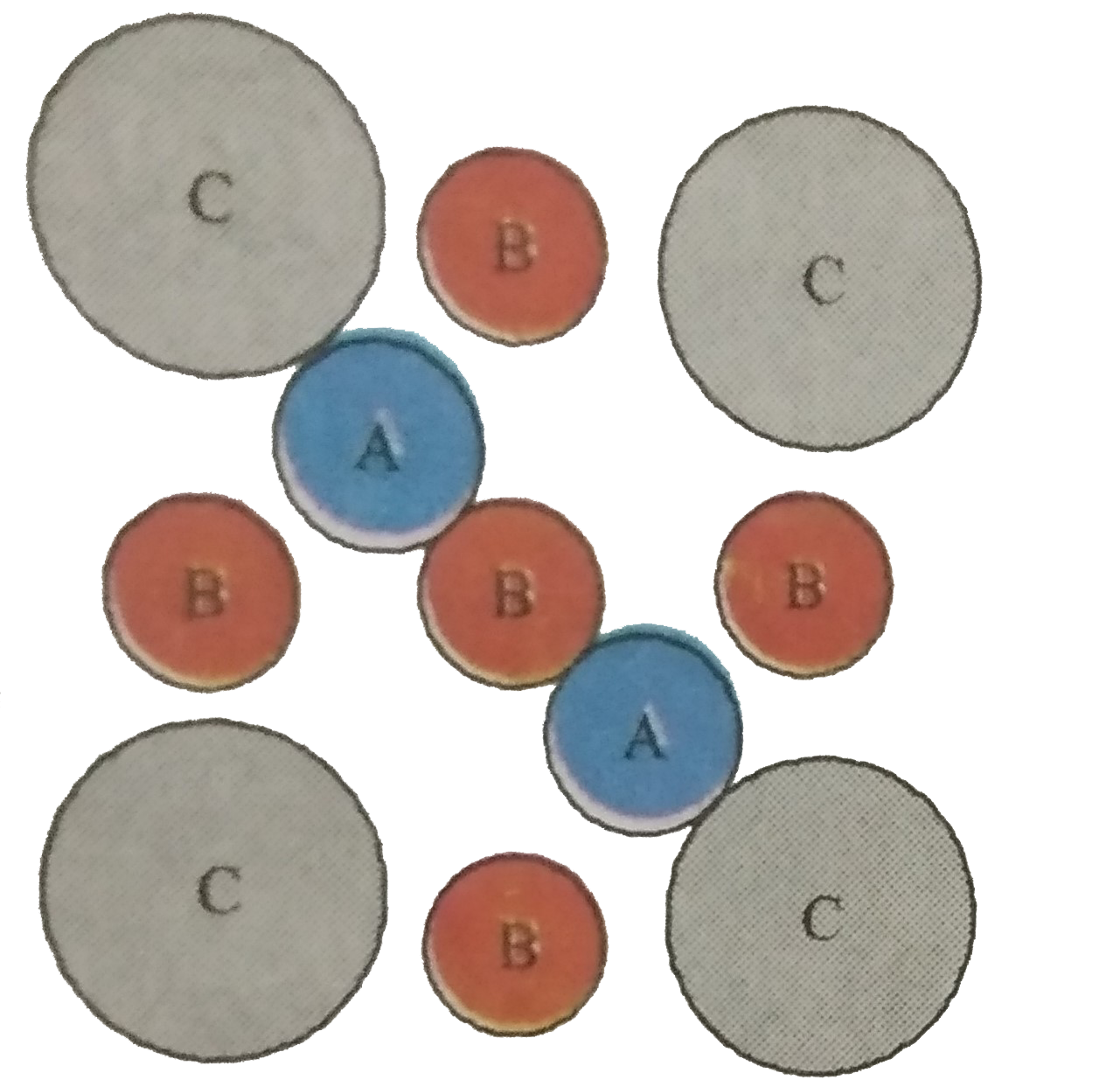
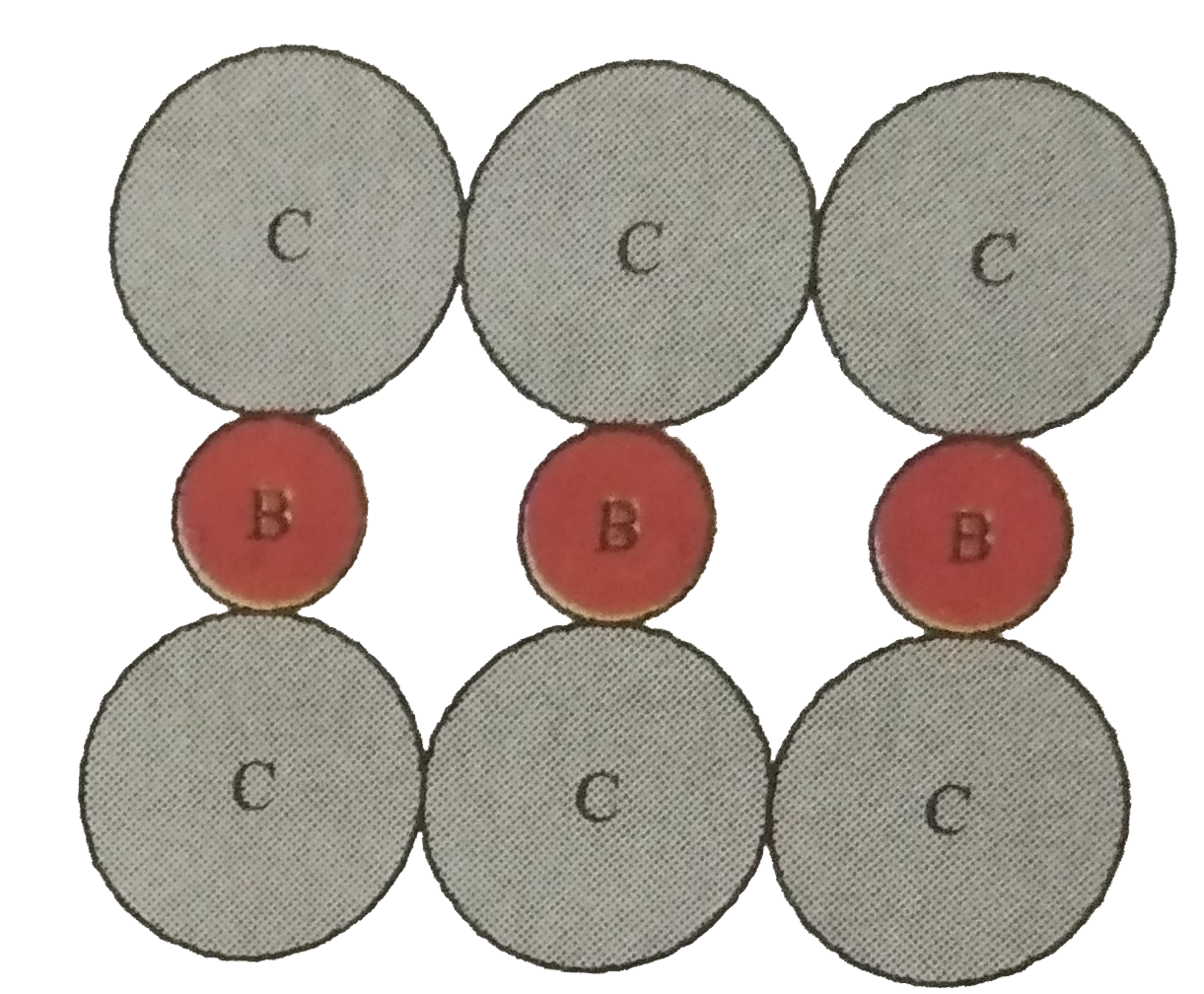
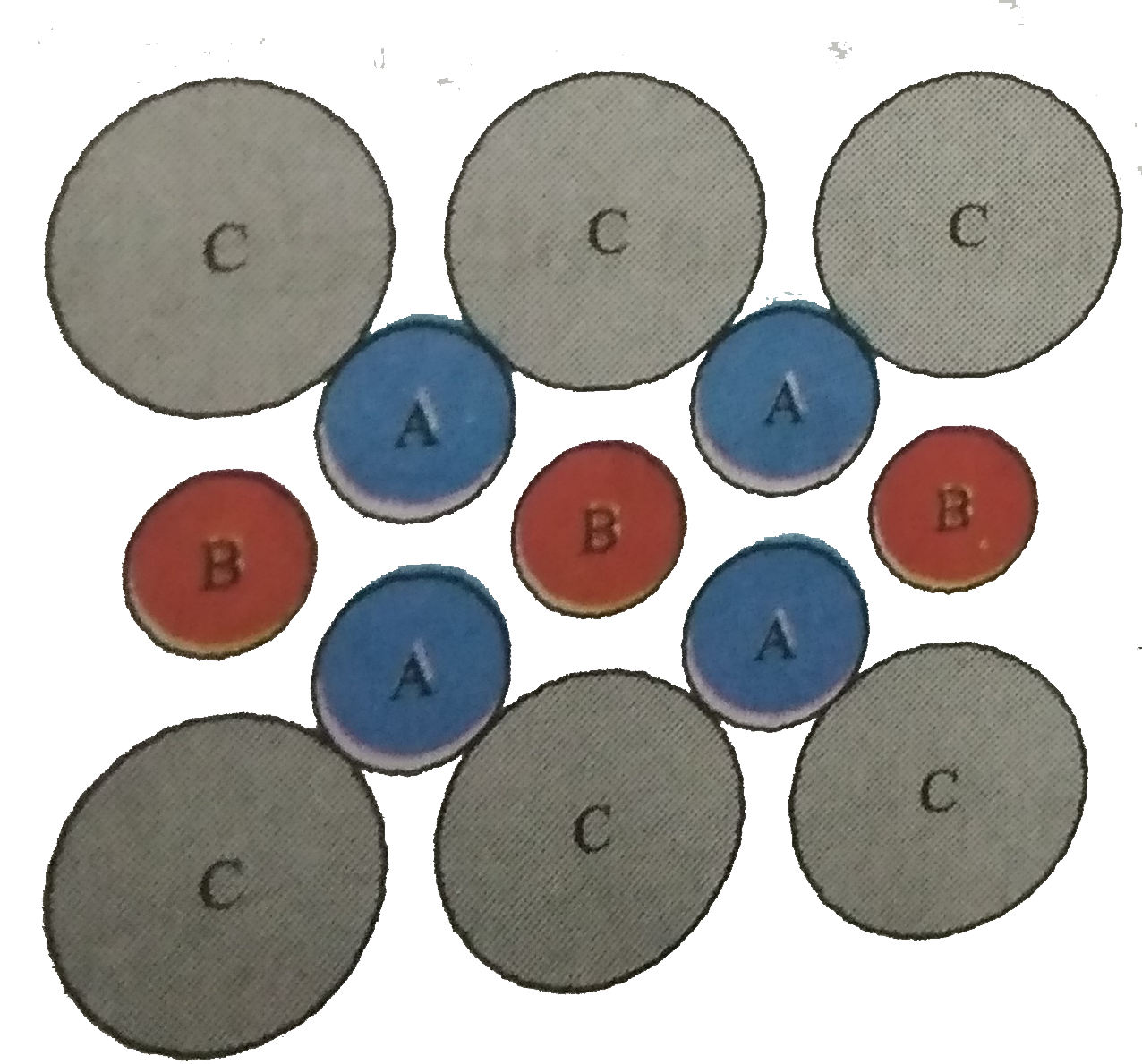
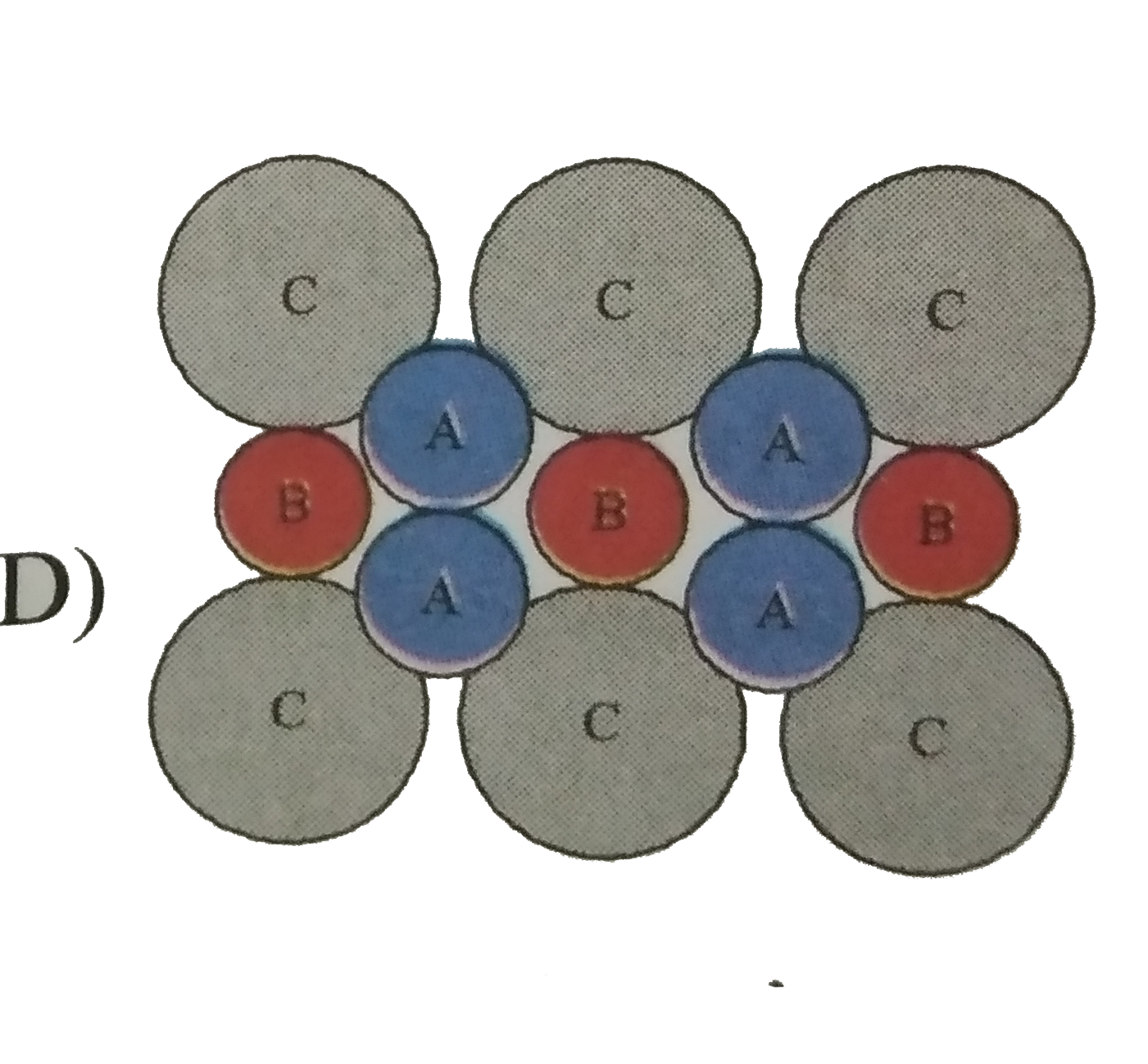
In a hypothetical solid , C atoms are found to form cubical close - packed lattice . A atoms occupy all tetrahedral voids and B atoms occupy all octahedral voids . A and B atoms are of appropriate size , so that there is no distortion in the ccp lattice of C atoms .Now if a plane as shown in the above figure is cut , then the cross section of this plane will look like |
|
Answer»
Fig. (a) is not possible, four atom marked C. Fig (b) isnot possible , atoms A in TVs are not shown in figure. Fig (c) is possible , since atoms A in TVs are not TOUCHING each other. Fig (d) is not possible , since atoms A in TVs are touching each other. |
|
| 45. |
In a hydrogen molecules, the attractive and repulsive force between the atoms are balanced at _________. |
|
Answer» 77.4 pm |
|
| 46. |
In a hydrogen like atom, electron is in 2^(nd) excited state, the binding energy of fourth state of this atom is 13.6 eV, then |
|
Answer» A 25 eV photon can set FREE the electron from the second excited state of this SAMPLE. `=13.6 (z^2)/(n^2) implies13.6 (z^2)/(4^2) = 13.6 impliesz= 4` Sample is `Be^(3+) therefore` energy of electron in `3^(rd)` state Therefore 25 eV photon will cause ionization |
|
| 47. |
In a hydrogen like sample two different types of photons a and B are produced by electronic transition. Photon B has its wavelength in infrared region if photon A has more energy than B, then the prohon a may belong to the region |
|
Answer» Ultraviolet |
|
| 48. |
In a hydrogen like ion, nucleus has a positive charge Ze Bohr.s quantization rule is, the angular momentum of an electron about the nucleus l = (nh)/(2pi), where n is a positive integer If electron goes from ground state to 1^(st) excited state then change in energy of the hydrogen like ion is |
|
Answer» `(3)/(32) = (m_(e)x^(2)e^(4))/(in_(0)^(2)h^(2))` |
|
| 49. |
In a hydrogen atom.the energy of an electron in first Bohr's orbit is 13.12xx10^(5)J mol^(-1).What is th energy required for its excitation to Bohr's second orbit? |
|
Answer» Solution :`E_n=-(2pi^(2)m_e^(4))/(n^(2)h^(2)` When`n=1,E_1=-(2pi^(2)m_e^(4))/((1)^(2)h^(2))=-13.12xx10^(5)J MOL^(-1)` When`n=2,E_2=-(2pi^(2)m_(E)^(4))/((2)^(2h^(2)))=-(13.12xx10^(5))/(4)J mol^(-1)`= =`3.28xx10^(5)J mol^(-1)` The energy required for the excitation is: `/_\E=E_2-E_1=(-3.28xx10^(5))-(-13.12xx10^(5))=9.84xx10^(5)Jmol^(-1)` |
|
| 50. |
In a hydrogen atom, an electron jumps from third orbit to the first orbit. Find out the frequency and wavelength of the spectral line. Given R=1.097xx 10^(7) m^(-1) |
|
Answer» Solution :`1/lamda=barv=R[1/(n_(1)^(2))-1/(n_(2)^(2))]` `n_(1)=1,n_(2)=3` `1/lamda=1.097xx10^(7)m^(-1)[1-1/9]=0.9749xx10^(7)m^(-1)` `=1/(0.9747xx10^(7)m^(-1))=1.0254xx10^(-7)m=1025.4xx10^(-10)m=1025.4` Å `v=c/lamda=(3.0xx10^(8)ms^(-1))/(1.0254xx10^(-7)m)=2.9257xx10^(15)s^(-1)` Wavelength of the SPECTRAL line = 1025.4 Å Frequency of the spectral line `=2.9257xx10^(15)s^(-1)` |
|