Saved Bookmarks
This section includes 7 InterviewSolutions, each offering curated multiple-choice questions to sharpen your Current Affairs knowledge and support exam preparation. Choose a topic below to get started.
| 2. |
What are methanides and acetylides ? Give examples |
|
Answer» Solution :Cabides which give METHANE on hydrolysisare calledmethanides EG , `Be_(2)C , Al_(4)C_(3)` Cardies which give acetylene on hydrolysis are called acetylides . Eg . `CaC_(2)`. |
|
| 3. |
Which one of the following arrangements of molecules is correct on the basis of their dipole moments ? |
|
Answer» `BF_(3) GT NF_(3) NH_(3)` `mu (BF_(3)) = 0` |
|
| 4. |
Write the complete chemical equation for the following . Hydrolysis of alkyl halide |
| Answer» SOLUTION :`underset (" METHYL BROMIDE ")(CH_(3) BR) overset (aq . KOH )(to) underset (" Methyl bromide ")(CH_(3)OH )+ KBr ` | |
| 5. |
Which of the following represents a homologous series ? |
|
Answer» ETHANE, ethylene, ethyne |
|
| 6. |
Which one of the following statements is WRONG for gases ? |
|
Answer» GASES do not have a definite shape and volume. |
|
| 7. |
Which of the following is used as black pigment in black ink ? |
|
Answer» Coke |
|
| 8. |
The total number of reagents that are used to distinguish between sulphide and bisulphie acidic radical are: Litmus paper, AgNO_(3),Pb(OAc)_(2),CaCI_(2),SrCI_(2),BaCI_(2),(K_(2)Cr_(2)O_(7)+H_(2)SO_(4)),(KMnO_(4)+H_(2)SO_(4)) |
|
Answer» |
|
| 9. |
Which of the following compound is more covalent in nature ? |
|
Answer» LiF |
|
| 10. |
What is the difference between distillation, distillation under reduced pressure and steam distillation? |
Answer» SOLUTION :
|
|
| 11. |
Which of the following has vacant orbitals, that can accept a lone pair of electron? |
|
Answer» ELECTROPHILES |
|
| 12. |
Which one of the following will have the largest number of atoms? (i) 1 g Au (s) (ii) 1 g Na (s) (iii) 1 g Li (s) (iv) 1 g of Cl2(g) |
|
Answer» Solution :(i) `1g AU = 1/197 "mole" = 1/197 xx 6.022 xx 10^(23) = 3.057 xx 10^(21)` atoms (II) `1 G Na = 1/23 "mole" =1/23 xx 6.022 xx 10^(23) = 2.618 xx 10^(22)` atoms (iii) `1g of Li =1/7 "mole" =1/7 xx 6.022 xx 10^(23) = 8.0603 xx 10^(22)` atoms (iv) `1g Cl_(2) = 1/71 "mole" =1/71 xx 6.022 xx 10^(23)` MOLECULES = `1/71 xx 6.022 xx 10^(23) xx 2` atoms `=1.696 xx 10^(22)` atoms. Hence, 1 g Li will contain the largest number of atoms. |
|
| 13. |
Which of the following orbitals are possible? |
|
Answer» Solution :1p is not possible because if `n=1` then `l=0` only and for p, `l=1` 2s is possible because if `n=2` then `1=0`, 1 and for s, `1=0` 2p is possible because if `n=2` then `1=0`, 1 and for p, `1=l` 3f is not possible because if `n=3` then `1=0`, 1 and 2 for f, `1=3`. |
|
| 14. |
The Simple Aromatic Hydrocarbon compound (A)reacts with Bromine to give (B) . Compound (A) reacts with Raney Ni and gives (C) . Identify (A), (B) and (C) . |
|
Answer» Solution :`underset((A))(C_(6)H_(6))+Br_(2)OVERSET(FeBr_(3))to underset((B))(C_(6)H_(12))+Br` `C_(6)H_(6)+3H_(2)overset("Rancy Ni")toC_(6)H_(12) + HBR` A - BENZENE, B - Bromo benzene, c - Cyclohexanc |
|
| 15. |
Which of the following statements is true |
|
Answer» Electron DONATING groups stabilize a positively charged species `CH_3^(Ɵ) CH_3CH_2^(Ɵ) gt (CH_3)_2 CH^(Ɵ) gt (CH_3)_3C^(Ɵ)` |
|
| 16. |
When does a non-ideal solution is said to show a negative deviation? |
| Answer» Solution :The escaping tendency of A and B will be lower when compared with an IDEAL solution formed by A and B.Hence ,the vapour pressure of such solution will belower than the sum of the vapour pressure of A and B . This type of deviation is called NEGATIVE deviation . For. the negative deviation ` P_A lt P_A^(@) X_A and P_B lt P_B^(@) X_B ` | |
| 18. |
Write physical properties of Hydrogen peroxide. |
|
Answer» Solution :In the pure state `H_2O_2` is an almost colourless (very pale blue) liquid. `H_2O_2` is MISCIBLE with water in all proportions and forms a HYDRATE `H_2O_2. H_2O`(mp 221K). A 30% solution of `H_2O_2` is marketed as .100 volume. hydrogen PEROXIDE. It means that one millilitre of 30% `H_2O_2` solution will GIVE 100 mL of oxygen at STP. Commercially marketed sample is 10 V, which means that the sample contains 3% `H_2O_2`. 
|
|
| 19. |
Which of the following oxides is the most basic in nature? |
|
Answer» `Na_2O` |
|
| 20. |
When propanamide reacts with Br_(2) and NaOH then which of the following compounds is formed ? |
|
Answer» Ethyl alcohol |
|
| 21. |
The value of 'n' in the molecular formula Be_(n) Al_(2)Si_(6)O_(18)is |
|
Answer» |
|
| 22. |
What is the maximumnumber ofemissionlineswhen theexcitedelectronof a H atominn=16dropsto thegroundstate ? |
|
Answer» Solution :Numberof emissionlines `=(n(n-1))/( 2 )` `=(6(6-1))/(2) =15` followingtransitionare occur : (i) n=6 to n=1 `6 to 5, 6 to4,6 to3,6 to 2,6 to 1` (ii)5 to4 ,5 to 3,5 to 2,5 to 1 so (iii) n=4ton= 1 so `n_(4) to n_(3)n_(4)to n_(2)n_(4) to n_(1)` (IV)n=3ton=1so `n_(3)to n_(2) ` and`n_(3)to n_(1) so` (v ) `n_(2) to ` n=1 so ONE Total5 + 5+3 +2 +1=15transitionso 15 emissionlinesobtain |
|
| 23. |
Which of the following acids can produce three series of salts ? |
|
Answer» OXALIC ACID |
|
| 24. |
What happens to the position and momentum of an electron if a photon of a short wavelength hits the electron? |
| Answer» SOLUTION :The UNCERTAINTY in position decreases but the uncertainty in velocity or momentum increases. | |
| 25. |
Which of the following carbo-cation is the most stable? |
|
Answer» `H- UNDERSET(underset(H)(|))overset(overset(H)(|))(C^(+))` |
|
| 27. |
What is the percentage of nitrogen in an organic compound 0.14 g of which gave by Dumas method 82.1 c.c. Of nitrogen collected over water at 27^(@)C and at a barometric pressure of 774.5 mm ? ("aqueous tension of water at" 27^(@)C"is"14.5 mm) |
|
Answer» `m_(N_(2))=0.0946gm` `% N_(2)=(0.0946)/(0.14)xx100=66.7%` |
|
| 28. |
Two half cells are AI^(3+)(aq)/AI and Mg^(2+)(aq)/M The reduction potential of these half cells are -1.66 V and -2.36 V respectively calculate the cell potential write the cell reaction also |
|
Answer» `3Mg+2AI^(3+)rarr3Mg^(2+)+2AI"and"E_("cell")^(@)=E_(AI)^(@),AI-E_(Mg)^(2+),Mg^(@)=-1.66-(-2.36)=+0.70V` |
|
| 29. |
The second ionisation enthalpy of Mg is sufficiently high while the second electron affinity or electron gain enthalpy of oxygen is low (actually this value is positive), yet Mg^(2+) and O^(2-) ions form ionic compound, MgO. Explain with reasons. |
| Answer» Solution :The sufficiently high second ionisation enthalpy of Mg indicates that a large amount of ENERGY is required to remove second electron from the Mg-atom. i.e, to CONVERT `Mg^(+)` to `Mg^(2+)` ion. The second electron gain enthalpy of oxygenn is positive indicating that the energy should be supplied to convert O-atom into `O^(2-)` ion. since, both the processes are endothermic, MGO is not expected to be produced through the formation of ionic bond. but actually, it is produced and this is because of its high lattice energy (mainly due to comparable sizes of `Mg^(2+) and O^(2-)` IONS.) | |
| 30. |
How many water molecules present in CuSO_(4).5H_(2)O are hydrogen bonded? |
|
Answer» ELECTROVALENT and COVALENT |
|
| 31. |
Which of the following redox reaction is oxidation and which is reduction? Sn^(4+)2e^(-) to Sn^(2+) |
| Answer» SOLUTION :REDUCTION | |
| 32. |
What are the scope of thermodynamics? |
|
Answer» SOLUTION :Thescopeof THERMODYNAMICS ITO derivefeasibilityof agivenprocess . II .It alsohelpsin predictinghowfara PHYSICAL(or )chemicalchangecan preoceduntiltheequilibriumconditionsareestablished . |
|
| 33. |
Which of the following electronic configuration is not possible |
|
Answer» `4d^(8)` Thus if n = 3 then f is not POSSIBLE i.e `3f^(14)` arrangement is not allowed. While (A) `4d^(8) 3s^(1)` and `2p^(6)`configuration are permitted |
|
| 34. |
Why beryllium has distinctive character? |
| Answer» Solution :The distinctive character of beryllium is MAINLY due to its small size, HIGH ELECTRONEGATIVITY and high polarizing POWER, when compared to other elements in the same BLOCK | |
| 35. |
Which of the following is wrong? |
|
Answer» Cathode rays have constant e/m ratio. |
|
| 36. |
which one of the following on oxidation gives H_(2)O_(2)? |
|
Answer» 2-Ethylanthraquinol |
|
| 37. |
Whichof thefollowingisINCORRECTaboutcalciumcarbonate? |
|
Answer» Itoccursin severalformslikechalk, LIMESTONE, calcites, etc. |
|
| 38. |
Which of the following is an example for heterogeneous catalysis reaction ? |
|
Answer» `2SO_(2)(g)+O_(2)(g) overset(NO(g))rarr2SO_(3)(g)` |
|
| 39. |
Which alkali metals are useful as electrodes in photoelectric cell ? |
| Answer» Solution : Caesium and POTASSIUM USEFUL as ELECTRODES in photoelectric cells. | |
| 40. |
When would the be Broglie wavelength of a moving electron become equal to that of a moving proton? Mass of electron = 9.1095 xx 10^(-31)kg and mass of proton = 1.6725 xx 10^(-27) kg |
|
Answer» Solution :`lamda_(e) = (h)/(m_(e) v_(e)) , LAMDA _(p) = (h)/(m_(p) v_(p))` When `lamda_(e) = lamda_(p), m_(e) v_(e) = m_(p) v_(p) or (v_(e))/(v_(p)) = (m_(p))/(m_(e)) = (1.6725 XX 10^(-27) kg)/(9.1095 xx 10^(-31)kg) = 1836`, i.e., `v_(e) = 1836 xx v_(p)` |
|
| 41. |
What is the mass of precipitate formed when 50 ml of 8.5% solution of AgNO_(3) is mixed with 100 ml of 1.865% potassium chloride solution? |
|
Answer» 3.59g 50 mL of 8.5% solution CONTAINS 4.25 g of `AgNO_(3)` No. of moles of `AgNO_3` present in 50 mL of 8.5% `AgNO_3` solution = Mass / Molar mass = 4.25 / 170 = 0.025 moles Similarly, No of moles of KCI present in 100 mL of 1.865% KCI solution = 1.865/74.5 = 0.025 moles So total amount of AgCI formed is 0.025 moles (based on the stoichiometry) Amount of AgCI present in 0.025 moles of AgCI = no. of moles `xx` molar mass = `0.025 xx 143.5 = 3.59 g` |
|
| 42. |
What is the self linking property of an atom known as? |
|
Answer» |
|
| 43. |
What is the formula to find percentage mass of N in NH_(3)? |
|
Answer» `(7xx100)/(14)` |
|
| 44. |
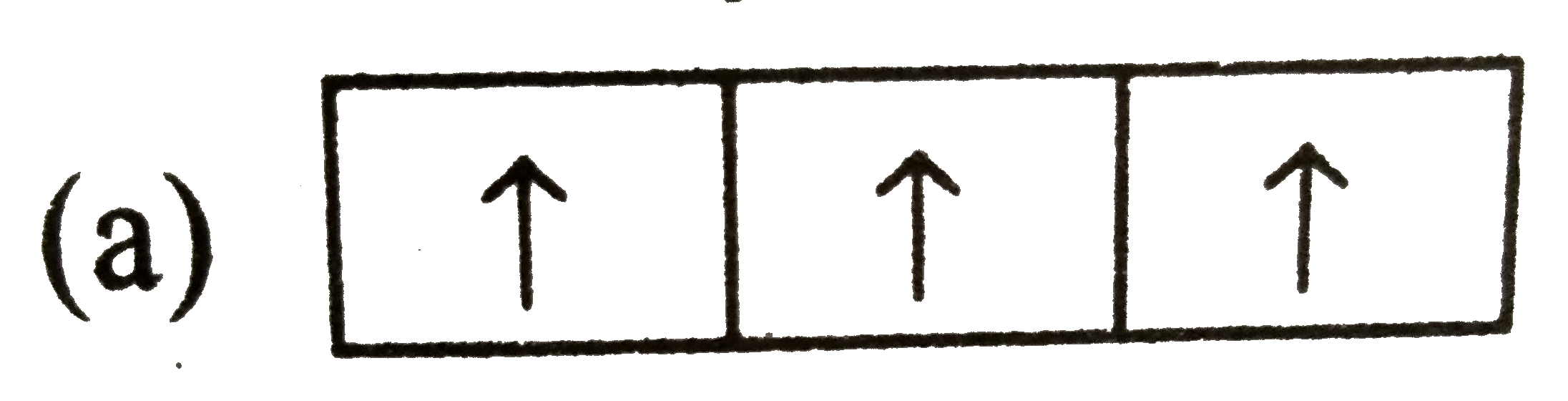
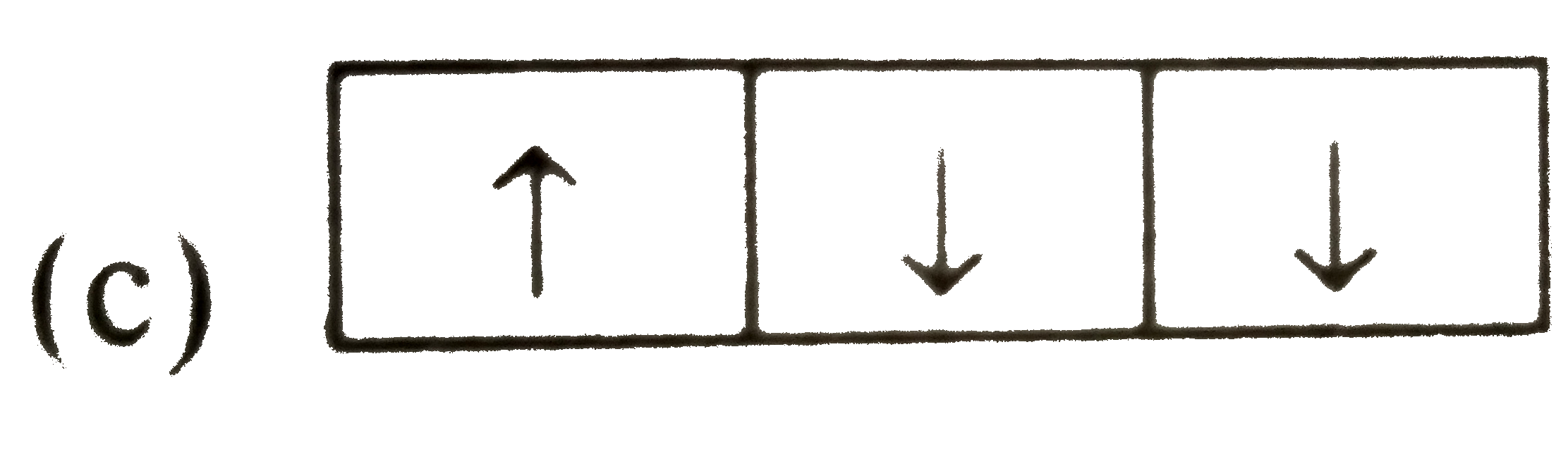
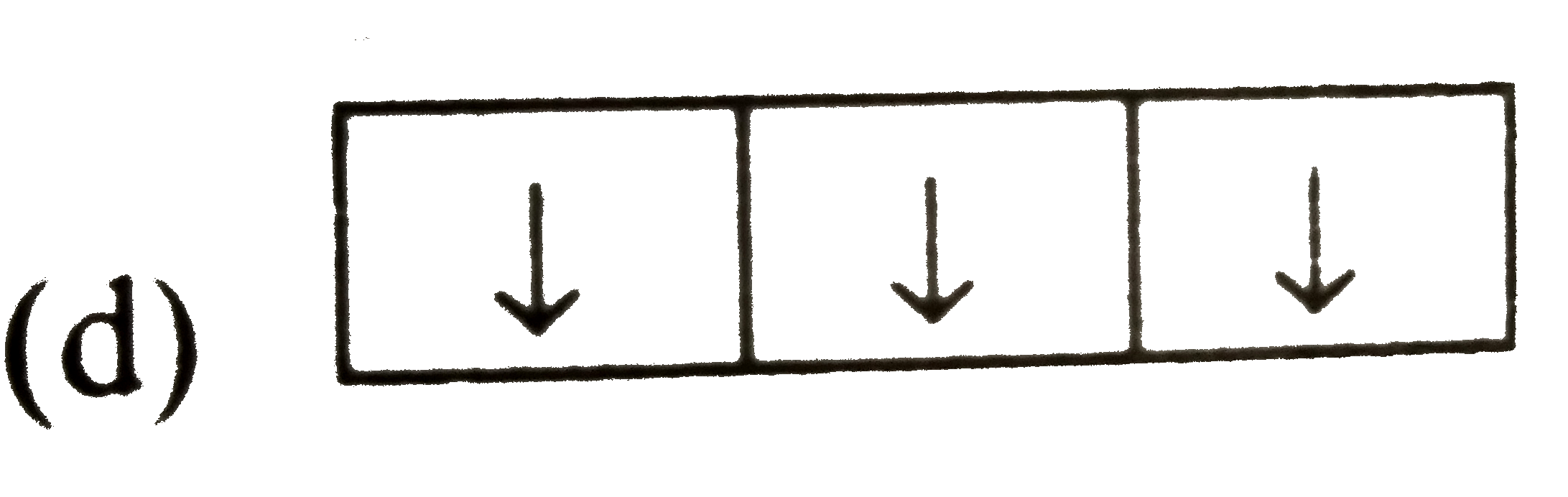
Which of the following electronic configurations has zero spin multiplicity? |
|
Answer»
|
|
| 45. |
The solubilities of carbonates decrease down the magnesium group due to decrease in.... |
|
Answer» LATTICE ENERGIES of solids. |
|
| 46. |
Which of the following is/are correct about the solubility? |
|
Answer» Solubility of `CaF_2 ` is more in buffer solution of pH = 3 than in PURE water (b) ` S^(2-)` reacts with ` H^(+) ` ( c )` Zns hArr 2n^(+2) + S^(2-), KsP ` ` (H_2S hArr 2H^(+)+S^(2-) ,Ka)/( Zns +2H^(+)hArr Zn^(+2)+H_2S, K =(Ksp)/(Ka))` |
|
| 47. |
Which of the following metal pairs liberate H_(2) with NaOH |
|
Answer» `Zn,AL` |
|
| 48. |
Which alkali metal reacts with nitrogen to form nitride? |
|
Answer» Li |
|
| 49. |
What is wedge formula? Explain with suitable example. |
|
Answer» Solution :(i) The simplest convention is solid and dashed wedge formula in which 3-D image of a molecule can be perceived from TWO dimensional PICTURE. (ii) In this representation, a tetrahedral molecule with four atoms or groups a, b, c and d BONDED to it can be represented by wedge formula as FOLLOWS. (iii) A solid wedge  or a heavy line is used to indicate a BOND projecting above the plane of the paper and dashed wedge or a heavy line is used to indicate a BOND projecting above the plane of the paper and dashed wedge  or a dashed line is used to depict the bond below the plane. The bonds lying in the plane of the paper are shown by normal lines. or a dashed line is used to depict the bond below the plane. The bonds lying in the plane of the paper are shown by normal lines. 
|
|