

Saved Bookmarks
This section includes 7 InterviewSolutions, each offering curated multiple-choice questions to sharpen your Current Affairs knowledge and support exam preparation. Choose a topic below to get started.
| 1. |
Acetone (CH_(3)COCH_(3)) and propanal (CH_(3)CH_(2)CHO) are |
|
Answer» FUNCTIONAL ISOMERS |
|
| 2. |
Acetone and water is purified by ______ methods. |
|
Answer» CRYSTALLIZATION |
|
| 3. |
Acetone and propen-2-ol are |
|
Answer» enantiomers |
|
| 4. |
Acetone and prop-1-in-2-ol are example of which type of isomerism? |
|
Answer» Position isomerism |
|
| 5. |
Acetoacetic ester behaves as |
|
Answer» An unsaturated hydroxy compound |
|
| 6. |
Acetic anhydride is used for the detection and estimation of |
|
Answer» `-OH` group |
|
| 7. |
Acetic anhydride is prepared in the laboratory by heating sodium acetate with |
|
Answer» ethyl chloride |
|
| 8. |
Acetic anhydride is obtained by the reaction of |
|
Answer» sodium and ACETIC acid |
|
| 9. |
Acetic acid when treated with NH_(3) forms ammonium acetate which on heating gives |
|
Answer» METHYL cyanide |
|
| 10. |
Acetic acid reacts with PCl_(5) to form |
|
Answer» `CH_(2)ClCOOH` |
|
| 11. |
Acetic acid is weaker acid than formic acid. This is explained by |
|
Answer» Mesomeric effect |
|
| 12. |
Acetic acid is found to have molar mass as 120 g mol ^(-1). Prove it. |
|
Answer» SOLUTION :(i) In certain SOLVENT, solute molecules associate to from a dimer. This reduces the total number of molecules formed in solution and as a RESULT the calculated molar mass will be higher than the actual molar mass. (ii) ACETIC ACID in benzene exist as a dimer 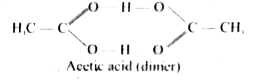 (iii) The molar mass of acetic acid calculate using colligative properties is found to be around 120 g `mol^(-1)` is two times of the actual molar mass `60 g mol ^(-1)` |
|
| 13. |
Acetic acid is added to the solution of sodium carbonate the gas evolved does not turn purple colour of KMnO_(4) but turns lime water milky forming a compound (M) which becomes soluble by passing the same gas in excess forming another compound (N). But same obserbation is not obtained with boric acid. The correct order of increasing acidity is: |
|
Answer» Boric acid `lt` ACETIC acid `lt` Carbonic acid |
|
| 14. |
Acetic acid is added to the solution of sodium carbonate the gas evolved does not turn purple colour of KMnO_(4) but turns lime water milky forming a compound (M) which becomes soluble by passing the same gas in excess forming another compound (N). But same obserbation is not obtained with boric acid. The compound formed in the above sequence (M) and (N) are respectively. |
|
Answer» water SOLUBLE `CaCO_(3)` and water soluble `Ca(HCO_(3))_(2)` |
|
| 15. |
Acetic acid is added to the solution of sodium carbonate the gas evolved does not turn purple colour of KMnO_(4) but turns lime water milky forming a compound (M) which becomes soluble by passing the same gas in excess forming another compound (N). But same obserbation is not obtained with boric acid. Purple colour of KMnO_(4) has not changed because: |
|
Answer» the gas has no oxidising property since central atom is in minimum oxidation state |
|
| 16. |
Acetic acid has a dissociation constant of 1.8xx10^(-5), Calculate the pH values of the decinormal solution of Acetic acid. |
|
Answer» SOLUTION :`[H^(+)]=SQRT(K_(a).C)""C=0.1M` `sqrt(1.8xx10^(-1)xx10^(-1))=1.34xx10^(-3)` `pH=-log[H^(+)]=-log01.34xx10^(-1)=2.872` |
|
| 17. |
Acetic acid has a dissociationconstant of 1.8xx10^(-5). Calculate the pH value of the decinormal solution of acetic acid. |
|
Answer» |
|
| 18. |
Acetic acid exist as a dimer in benzene due to |
|
Answer» CONDENSATION reaction |
|
| 19. |
Acetic acid exist as a __________ |
|
Answer» monomer |
|
| 20. |
Acetic acid dissociates as CH_(3) "COOH" hArr CH_(3) "COO"^(-) + H^(+).If a little amount of sodium acetate is added to its aqueous solution |
|
Answer» The acid DISSOCIATES further `:.` BACKWARD reaction FAVOURED |
|
| 21. |
Acetic acid and glucose have same |
|
Answer» emperical formula |
|
| 22. |
Acetamide is amhoteric in nature. Hence it can react with limited amount of |
| Answer» Solution :FACTUAL QUESTION | |
| 23. |
Acetamide is |
|
Answer» HIGHLY acidic `underset(("Base"))(CH_(3) - overset(O)overset(||)(C)) - NH_(2) + HCl rarr CH_(3) - overset(O)overset(||)(C) - overset(+)(N)H_(3) overset(-)(Cl` |
|
| 24. |
Acetamide and NaOBr//OH^(-) produce |
|
Answer» Ethanamine<BR>Methanamine `CH_(3) - OVERSET(O)overset(||)(C) - NH_(2) + Br_(2) + 4 NAOH rarr CH_(3) NH_(2) + Na_(2)CO_(3) + 2NaBr + H_(2)O` |
|
| 25. |
Acetaldehyde is polar and benzene is non-polar. But benzene boils at higher temperature. Why? |
|
Answer» Solution :Acetaldehyde is polar and has dipole-dipole ATTRACTIONS between its molecules. However, benzene molecules has dispersion of PI electron cloud. HENCE molecules of benzene are more associated. Because of the dispersed picloud, BENZEE is less volatile and has higher BOILING point compared to acetaldehyde |
|
| 26. |
Acetaldehyde and propyne can be distinguish by (i) Tollen's reagent(ii) I_(2)//NaOH(iii) Lucas reagent(iv) neutral FeCl_(3) |
|
Answer» (i) ,(II)& (iii) |
|
| 27. |
Accroding to Bohr's theory angular momentum of an electron in 6^(th) orbit is |
| Answer» Answer :C | |
| 28. |
Account for the foolowing: (a) Aluminium is not prepared by carrying out the electrolysis of moltent alumina (Al_(2)O_(3)). (b) Aluminium is preferred in electrical cables though it is relatively less conducting than copper. (iii) Aluminium dissolves in both acidic and basic solutions. |
|
Answer» Solution :(a) Alumina `(Al_(2)O_(3))` is a poor CONDUCTOR of ELECTRICITY and, therefore, the process of electrolysis is not very successful. MOREOVER, the melting point of alumina is also very high (2323K) and it is very difficult to attain and maintain this temperature. Alumina is genrally mixed with cryolite `(Na_(3)AIF_(6))` which lowers the melting point to maintain this temperature. Alumina is generally mixed with cryolite `(Na_(3)AIF_(6))` which lowers the meltingpoint to about 1173k and also converts aluminium oxide to aluminium FLUORIDE `(AIF_(3))` which is quite conducting. (b) Although aluminium is less conducting than copper it is STILL preferred in the electric cables because it is cheaper than copper. (c) Aluminium is weakly electrospostive in nature. it, therefore, reacts with both acids and bases `2Al+6HCLrar2AlCl_(3)+3H_(2)` `2Al+2NaOH+2H_(2)Orarr2NaAlO_(2)+3H_(2)` Sod. metaaluminate |
|
| 29. |
Account for the following:The experimentally determined N_F bond length inNF_(3)is greater than the sum of the sigle covalent radii of N andF. |
|
Answer» SOLUTION :This is because both N and F aresmall and hence have high ELECTRON density . So they repal the bond PAIRS thereby making the N-F bond length LARGER. |
|
| 30. |
Account for the following: t-butyl chloride reacts with aqueous KOH by S_(N)1 mechanism while n-butyl chloride reacts with S_(N^(2)) mechanism. |
| Answer» Solution :This is because rate of `S_(N(2))` REACTION is directly proportional to delta INVERSELY proportional to steric crowding. Ter-buty & chloride has vast steric crowding. Ter-buty & chloride has vast steric crowding and THUS it is more stable. For `S_(N^(1))` reaction rather then `S_(N^(2))` reaction. | |
| 31. |
Account for the following : PCl_(5) is more covalent than PCl_(3). |
| Answer» Solution :The OXIDATION state of P in `PCl_(5)` is +5 and that in `PCl_(3)` is +3. Since ELEMENTS in the +5 oxidation state have less TENDENCY to LOSE electrons than in the +3 oxidation state, therefore, P in the +5 oxidation state has more tendency to share its electrons with Cl than in the +3 oxidation state. THUS, `PCl_(5)` is more covalent than `PCl_(3)`. | |
| 32. |
Account for the following: p-dichloro benzene has higer melting point than those of o-and m-dichloro benzene. |
| Answer» Solution :p-dichloro benzene is more symmetrical than O and m isomers and so FITS perfectly in crystal lattice. THEREFORE more ENERGY is required to BREAK the crystal lattice of p-dichlorobenzens and so has higher MELTING point. | |
| 33. |
Account for the following observations : Though fluorine is more electronegative than chlorine yet BF_3 is a weaker Lewis acid than Cl_3. |
|
Answer» Solution :In `BF_3`, boron has a VACANT 2P orbital and fluorine has one of the 2p orbital completely FILLED and unutilized. Both have same energy and can OVERLAP effectively to give `ppi-ppi` bond. While such type of bonding is not possible in `BCl_3` as there is no effective overlapping between the 2p-orbital of boron and 3p-orbital of chlorine. Therefore electron deficiency of B is higher than that of `BF_3`. Therefore `BF_3` is weaker Lewis ACID. 
|
|
| 34. |
Account for the following observations : The +1 oxidation state of thallium is more stable than its +3 state. |
| Answer» Solution :`Tl^+`is more table than `Tl^(+3)`DUE to INERT PAIR EFFECT. | |
| 35. |
Account for the following observations : PbO_2is a stronger oxidizing agent than SnO_2. |
| Answer» Solution :In `PbO_2` and `SnO_2` both lead and the tin are present in +4 oxidation STATE but due to stronger inert pair effect, `Pb^(+2)` ion is more stable than `SN^(+2)` ion. So `PbO_4` is stronger OXIDISING AGENT. | |
| 36. |
Account for the following observations : (i) AlCl_(3) is a lewis acid. (ii) Though fluorine is more electronegative than chlorine yet BF_(3) is a weaker Lewis acid than BCl_(3). (iii) PbO_(2)is stronger oxidising agent than SnO_(2).(iv) The +1 oxidation state of thallium is more stable than its +3 state. |
|
Answer» Solution :(i) The `Al` atoms in `AlCl_(3)`, has only six electron in tis valence shell and hence can accept apair of its octet. Therefore, it actsas a Lewis acid. (II) The B atom in `BF_(3)` or has only six electronsin the valene shell and hence can accept a pair of electrons to COMPLETE its octet. Therefore,both `BF_(3)` and`BCl_(3)` act asLewis acids.But in `BF_(3)`,the SIZE of empty 2p-orbital on Band 2p-orbital on F containingthe lone pair of electronsof F is donated to the empty 2p-orbital to a considerable EXTENT and hence electrondeficiency of B decreases. In contrast,in `BCl_(3)`, the size of `3p`-orbital of Cl containing the lone pair .  of electron is muchbigger than the empty 2p-orbital of B and hence donation of lone pairof electron of Cl to B does notoccur to any significantextent. Thereforeelectron deficiency of B is much higherin `BCl_(3)` than thatis `BF_(3)`and hence `BCl_(3)` is a stronger LEWISACID than `BF_(3)`. (iii) N/A, (iv) N/A |
|
| 37. |
Account for the following observation: (i) AlCl_(3) is Lewis acid (ii) Though fluorine is more electronegative than chlorine yet BF_(3) is a weaker Lewis acid than BCl_(3) (iii) PbO_(2) is a stronger oxidising agent thatn SnO_(2) (iv) The +1 oxidation state of thallium is more stable than its +3state. |
|
Answer» Solution :(i) `AlCl_(3)` is a Lewis acid because the central Al ATOM has a sextel of electrons after SHARING. It is electron deficient and `AlCl_(3)` BEHAVES as a Lewis acid. (ii) For answer, consult SECTION 11.12. (iii) +2 oxidation state of Pb in `PbO_(2)` is more stable than +2 oxidatin state of Sn in `SnO_(2)` due to greater INERT pair effect. This means that `PbO_(2)` is a stronger oxidising agent than `SnO_(2)` and changes to +2oxidisionstate more easily. (iv) For answer, consult section 11.2. |
|
| 38. |
Account for the following observations : AlCl_3 is a Lewis acid. |
| Answer» Solution :In `AlCl_3`, the OCTET of Al is incomplete as it has 6 electrons and accepts pair of electrons. ELECTRON accepters are Lewis ACIDS. | |
| 39. |
Account for the following observations (a) AlCl_(3) is a Lewis acid (b) Though fluorine is more electronegative than chlorine yet BF_(3) is a weaker Lewis acid than CI_(3) (c) PbO_(2) is a stronger oxidising agent than SnO_(2) (d) The +1 oxidation state of thallium is more stable than its +3 state. |
|
Answer» Solution :(a) In `AlCl_(3),Al` has only six electron in its valence shell. It is an electron deficient SPECIES. Therefore, it acts as a Lewis acid (electron ACCEPTOR) (b) In `BF_(3)` boron has a vacant 2p-orbital and fluorine has one 2p-completely filled unutilised orbital. Both of these ORBITALS belong to same energy level therefore, they can overlap efficitively and form `p pi - p pi` bond. This type of bond formation is known as back bonding. While back bonding is not possible in `BCl_(3)`, because there is no EFFECTIVE overlapping between 2p-orbital of boron and 3p-orbital of chlorine. Therefore, electron deficiency of B is higher in `BCl_(3)` than that of `BF_(3)`. That's why `BF_(3)` is a weaker Lewis acid than `BCl_(3)` 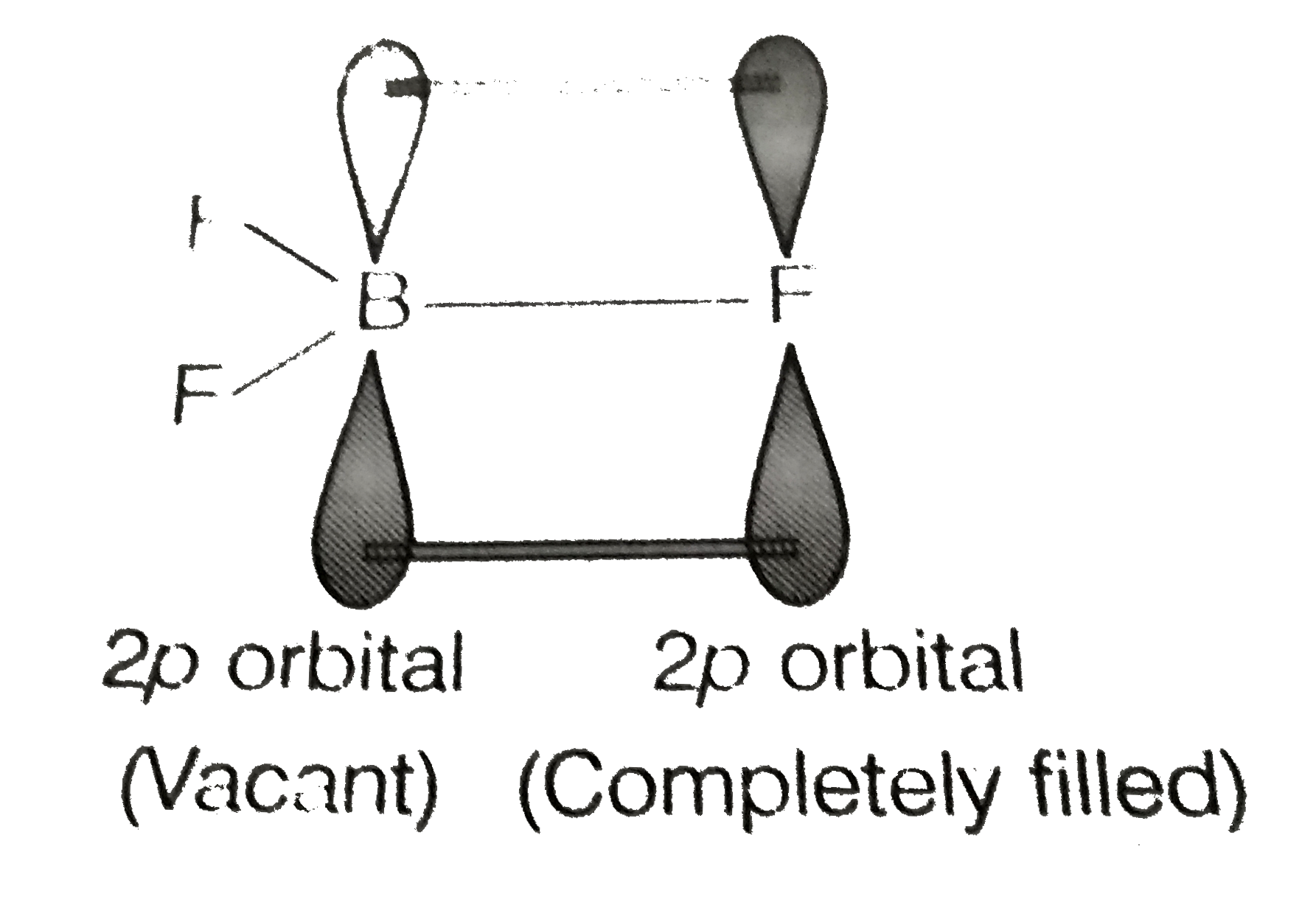 (c) In `PbO_(2) and SnO_(2)`, both lead and tin are present in +4 oxidation state. But due to stronger inert pair effect, `Pb^(2+)` ion is more stable than `Sn^(2+)` ion. In other words, `Pb^(4+)` ions i.e., `PbO_(4)` is more easily reduced to `Pb^(2+)` ions than `Sn^(4+)` ions reduced to `Sn^(2+)` ions. Thus, `PbO_(2)` acts as a stronger OXIDISING agent than `SnO_(2)` (d) `Tl^(+)` is more stable than `Tl^(3+)` because of inert pair effect. |
|
| 40. |
Account for the following (i) t-butyl chloride reacts with aqueous KOH by S_(N^1) mechanism while n-butyl chloride reacts with S_(N^2)mechanism. (ii) p-dichlorobenzene has higher melting point than those of o-and m - dichlorobenzene. |
|
Answer» Solution :(i) In t-butyl chloride, there is more STERIC hindr ance and it involves formation of a stable tertiary CARBOCATION. Therefore it reacts with KOH by`S_(N^1)`- mechanism rather than `S_(N^2)`-mechanism because `S_(N^1)`-mechanism is favourable in case of steric crowding and is directly proportional to partial positive charge on carbon atom. In n-butyl chloride, there is least steric hindrance and involves formation of less stable primary carbocation. Thus it takes place in one step and is favoured by `S_(N^2)`-mechanism. (ii) Melting point ofp- dichlorobenzene is HIGHER than that of ortho and meta-dichlorobenzene. This is due to the FACT that is has a symmetrical structure and therefore, its molecules can easily pack closely in the crystal lattice. p-dichlorobenzene being more symmetrical fits closely in the crystal lattice and has stronger intermolecular ATTRACTION than o & m isomers. So p-isomer has high melting point than the corresponding o & m-isomers. |
|
| 41. |
Account for the following: (i) PbX_(2) is more stable than PbX_(4) (X = Cl, Br) (ii) PbCl_(4) is more stable than SnCl_(4) but PbCl_(2) is more stable than SnCl_(2), (iii) PbCl_(4) is less stablethan SnCl_(4) ? |
| Answer» Solution :(i) DUE to inert pair effect, the +2 OXIDATIONSTATE of Pb is more stablethan `+4`. Hence, `PbX_(2)` is more stable than `PbX_(4)`. (ii) STABILITY of `+4` oxidationstate decreases down the groupwhile that of `+2`oxidationstate increases due to inert pair effect. (iii) Same as (ii). | |
| 42. |
Account for the following : (i) Be(OH)_(2) is insoluble but Ba(OH)_(2) is fairly soluble in water . (ii) Be(OH)_(2) is amphoteric while Mg(OH)_(2) is basic . |
|
Answer» Solution :(i) Be has small size , HIGH ionization enthalpy and comparatively high electronegativity . Therefore , `Be(OH)_(2)` is essentially covalent and hence is insoluble in water . However , as we MOVE down the group from Be to Ba , the atomic size increases , ionization enthalpy and electronegativity decrease . therefore , ionic characters of their hydroxides increases down the group . Further , it has been found that with increase in size the lattice down the group from Be to Ba . In other words , `Be(OH)_(2)` is insoluble but `Ba(OH)_(2)` is FAIRLY soluble in water . (ii) Because of HIGHER sum of `Delta_(i)H_(1) + Delta_(i) H_(2)` of Be than that of Mg , the M-OH bond can break less easily in `Be(OH)_(2)` than in `Mg(OH)_(2)` . In other words , `Be(OH)_(2)` acts as a weak base even weaker than `Mg(OH)_(2)` . Further because of smaller size and higher electronegativity than that of Mg , `Be(OH)_(2)` can accept `OH^(-)` ions from alkalies to form beryllate ion but Mg`(OH)_(2)` does not . `Be(OH)_(2) + 2OH^(-) to Be(OH)_(4)^(2-) to underset("Beryllate ion")(BeO_(2)^(2-) ) + 2H_(2)O` `Mg(OH)_(2) + 2OH^(-) cancelto Mg(OH)_(4)^(2-)` Thus , `Be(OH)_(2)` acts as a weak acid but `Mg(OH)_(2)` does not . Combining both the facts , we conclude that the `Be(OH)_(2)` is amphoteric but `Mg(OH)_(2)` is basic . |
|
| 43. |
Account for the following: (i) water is a liquid while H_(2)S is a gas (ii) NH_(3) has higher boiling point than PH_(3). |
|
Answer» Solution :(i) In case of WATER, hydrogen bonding causes association of the `H_(2)O` molecules. There is no such hydrogen bonding in `H_(2)S,`that is why it is a GAS. (ii) There is hydrogen bonding in `NH_(3)` but not in `PH_(3).` |
|
| 44. |
Account for the following : BiH_(3) is the strongest reducing agent in Group 15 element hydrides. |
| Answer» Solution :As we move down the GROUP from N to Bi, the size of the element increases. As a result, bond LENGTH increases and bond strength decrease from N to Bi. In other words, Bi-H bond is the weakest and hence decomposes, on heating, to liberate `H_(2)` most readily. Thus, `BiH_(3)` is the strongest reducing agent in group 15 element hydrides. | |
| 45. |
Account for the decrease in first ionization energy between phosphorous and sulphur. |
| Answer» Solution :PHOSPHOROUS has a stable HALF filled CONFIGURATION, so its first ionization energy is HIGHER than sulphur. This SORT of trend is also observed between nitrogen and oxygen where the former has higher first ionization energy. | |
| 46. |
Account for following: (a) Use of DDT was banned in United States in 1973. (b) Benzylic halides show high reactivity towards S_(N)1 reaction. |
|
Answer» SOLUTION :(a) Because of chemical stability of DDT and its fat stability, it is not metabolised very RAPIDLY by animals. Rather it gets deposited and stored in fatty tissues. This raised alarming danger due to its toxic effects. Therefore, its use has been banned in U.S.A. (b) BENZYLIC halides show high reactivity towards `S_(N)1` reactions because benzyl carbocation formed is HIGHLY stable through resonance. |
|
| 47. |
Accound for the following with ittle or no PhCH_(2)(Br)CH_(3))_(2) formed. |
Answer» Solution :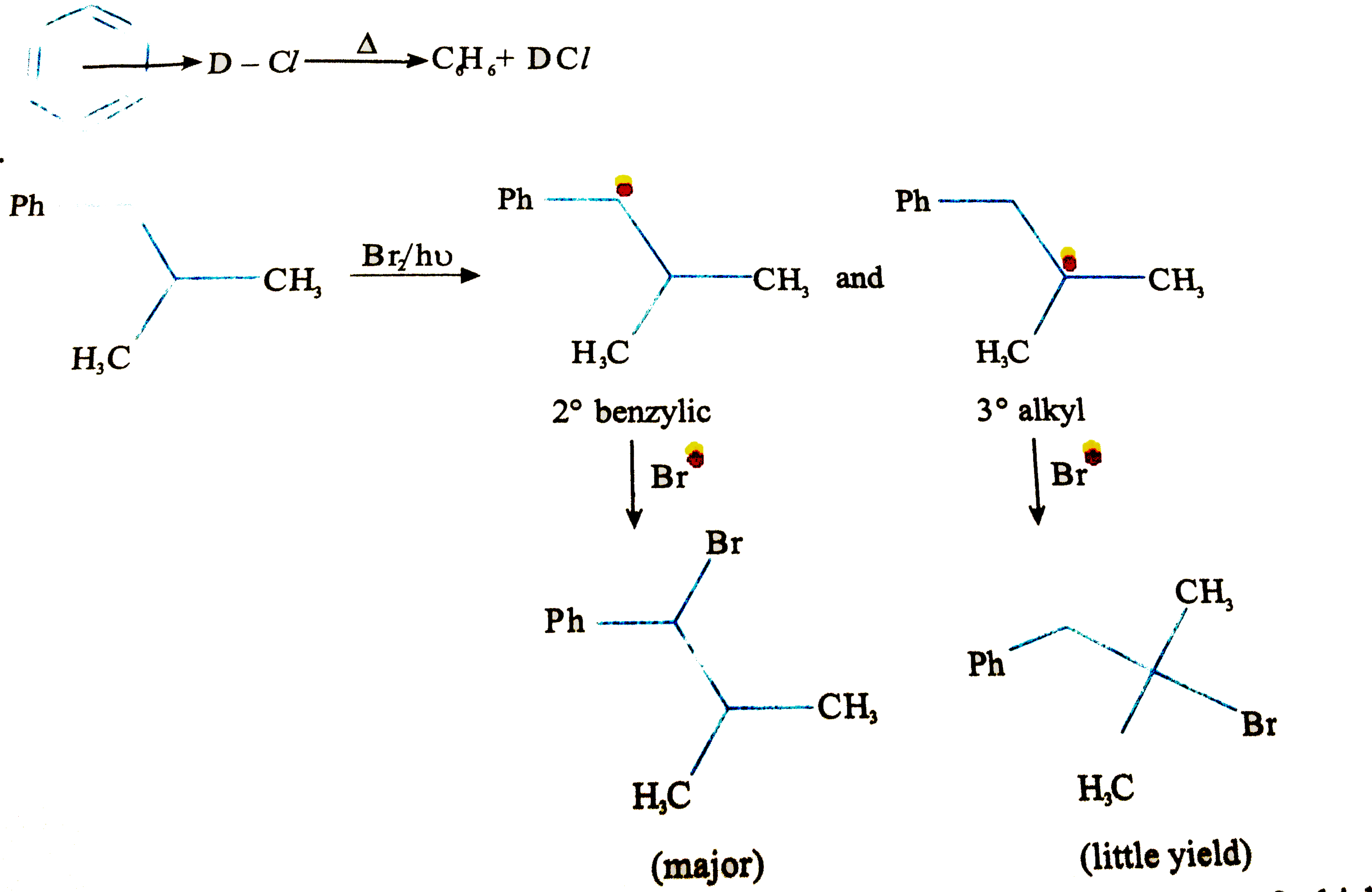 This REACTION proceeds VIA free radical mechanism forming 2 free RADICALS, of which `2^(@)` benzylic free radical is stabilized more by resonance of phenyl ring and with HYPERCONJUGATION of `-CH_(3)` group, thus resulting in the formation of `PhCH(Br)CH(CH_(3))_(2)` as the major product. |
|
| 48. |
According to whom chemistry is the science of 100 elements ? |
|
Answer» Lavoisier |
|
| 49. |
According to which theory, NH_3 is not a base ? |
|
Answer» Lewis |
|