

Saved Bookmarks
This section includes 7 InterviewSolutions, each offering curated multiple-choice questions to sharpen your Current Affairs knowledge and support exam preparation. Choose a topic below to get started.
| 1. |
Give reasons: (i) PbCl_(4) exists but PbI_(4) does not, (ii) SnCl_(2) is solid at room temperature while SnCl_(4) is liquid. (iii) FeI_(3) cannot be prepared. |
|
Answer» Solution :(i) N/A (II) `Sn^(4+) `having a higher positive charge than `Sn^(2+)` has a greater polarising POWER than `Sn^(2+)` hence the covalency of the corresponding chlorides increases from `SnCl_(2)` to `SnCl_(4)`, which ULTIMATELY RESULTS in decreases in the melting point from `SnCl_(2)` to `SnCl_(4) ` therefore `SnCl_(4)` is a liquid while `SnCl_(2)` in a solid at room temperature. (iii) N/A. |
|
| 2. |
Give reasons. (i) Lakes freeze from top towards bottom (ii) Ice floats on water. |
|
Answer» Solution :(i) During winter, the temperature of lake water KEEPS on decreasing. Since, water is heavier, THEREFORE, of keeps on going into the interior of the lake while warm water from inside the lake keeps on COMING to the surface of the lake. This process CONTINUES till the temperature of entire water of TWO lakes becomes 277 K Therefore, any further decrease in the temperature of the surface water will less its density. (ii) Density of ice is less than that of liquid water, so it floats over water. |
|
| 3. |
Give reasons: (i) IE_(1) of sodium is lower than that of magnesium whereas IE_(2) of sodium is higher than that of magnesium. (ii) Noble gases have positive value of electron gain enthalpy. |
|
Answer» Solution :(i) The effective nuclear charge of MAGNESIUM is higher than that of sodium. For these reasons, the energy required to REMOVE an electron from magnesium is more than the energy required in sodium. Hence, the first ionization enthalpy of sodium is lower than that of magnesium (ii) Noble gases have completely filled electronic CONFIGURATION and they are more stable. So in Noble gases addition of electron is not possible. Electron gain enthalpy is always the amount of energy released (-ve SIGN) when an electron is added to an atom. But in noble gases, if an electron is added, they have positive VALUE of electron gain enthalpy. |
|
| 4. |
Give reasons : (i) Conc. HNO_(3) can be transported in aluminium container. (ii) A mixtureof dilute NaOH and aluminium pieces is used to open drain. (iii) Graphite is used as lubricant. (iv) Diamond is used as an abrasive. (v) Aluminium alloys are used to make aircraft body. (vi) Aluminium utensils should not be kept in water overnight. (vii)aluminium wire is used to make transmission cables. |
|
Answer» Solution :(i) Al reacts with conc.`HNO_(3)` to form a very thin film of aluminium oxideon its surfacewhich protects it from furtheraction. `2Al (s) + 6 HNO_(3) (conc.) rarr underset("Alumina")(Al_(2)O_(3)(s)) + 6NO_(2) (g) + 3H_(2)O (l)` thus,Al becomes passive and hence aluminium containerscan be used to transportconc. `HNO_(3)` . (ii) `NaOH`reacts with Al to evolvedihydrogen gas. The pressure of the gas thusproduced can be used to OPEN cloggeddrains . `2Al(s) + 2NaOH (aq) + 2H_(2)O(l) rarr 2NaAlO_(2) (aq) + 3H_(2)(g)` (iii) Graphite has layered structure in which thedifferent layers are held together by WEAK can der Waaks forcesand hence can be madeto slipover one another. Therefore, graphite acts as a lubricant. (IV) Diamond is very hard and hence can be used as an abrassive. (v) Aluminium alloyssuch as duralumin is light, tough and resistantto corrosion and hence isused to make aircraft body. (vi) Al reactswith `H_(2)O`and dissolved`O_(2)` to form a thi film of alumioniumoxide. `2Al (s) + O_(2) (g) + H_(2)O (l) rarr Al_(2)O_(3)(s) + H_(2) (g)` A very very smallamount of `Al_(2)O_(3)` may dissolve to give a few ppm of `Al^(3+)` ions in the solution. SINCE `Al^(3+)` ions are injurious to health,therefore, drinking water should not be kept in aluminiumutensile overnight. (vii) On weightto weightbasis, aluminium conducts twice as Cu. Therefore, it is used in trasmission cables. |
|
| 5. |
Give reasons (i) Con.HNO_3 can be transported in Al containers |
|
Answer» |
|
| 6. |
Give reasons Graphite is used as lubricant. |
| Answer» Solution :Graphite has a layered STRUCTURE and differentlayers of graphite are bonded to each other byweak van der WAALS. forces. These layers can slide over each other. Graphite is SOFT and slippery. Therefore, graphite can be USED as a lubricant. | |
| 7. |
Give reasons Graphite is used as lubricant. |
| Answer» Solution :Graphite has a LAYERED structure in which huge sheets CONSISTING of hexagonal rings are held together by WEAK van der WAALS. forces. These sheets are not firmly attached and slide over ONE another. This is why graphite is soft and used as a lubricant. | |
| 8. |
Give reasons for the least reactivity of nitrogen molecule. |
| Answer» Solution :Due to PRESENCE of a triple bond between the TWO N-atoms, the bond DISSOCIATION enthalpy `(941.4kJmol^(-1))` is very HIGH. Hence, `N_(2)` is LEAST reactive. | |
| 9. |
Give reasons for the following : Water molecule has bent structure where as CO_(2) has linear structure. |
Answer» Solution :Oxygen atom is `H_(2)O" is " sp^(3)` hybridised with two lonepairs. Due to greater repulsive force between lone - pair - lone -pair , the bond angle is REDUCED from `109.5^(@) " to " 104.5^(@)` and hence `H_(2)O` molecule acquires a BENT structure.  In `CO_(2)` molecule, carbon atom is sp- hybridised . There is nofree electron in `CO_(2)` molecule. The two sp hybrid orbitals are oriented in opposite DIRECTION forming an angle of `180^(@)`. Hence `H_(2)O` has a bent structure and `CO_(2)` has `Ounderset(O^(-))overset(pi" ") = C underset(O^(-))overset(pi" ") = O` linear structure. |
|
| 10. |
Give reasons for the following : tert-Butylbenzene does not give benzoic acid on oxidation with acidic KMnO_4 |
Answer» Solution :Alkylbenzenes in which the alkyl groups contain one or more `alpha`-hydrogens or BENZYLIC hydrogens on VIGOROUS oxidation with ACIDIC `KMnO_4` ultimately give the CORRESPONDING benzoic acids irrespective of the length of the CARBON chain. For example,  tert-Butylbenzene , on the other hand, does not contain any `alpha`-hydrogen or benzylic hydrogen and hence does not undergo oxidation easily to give benzoic acid 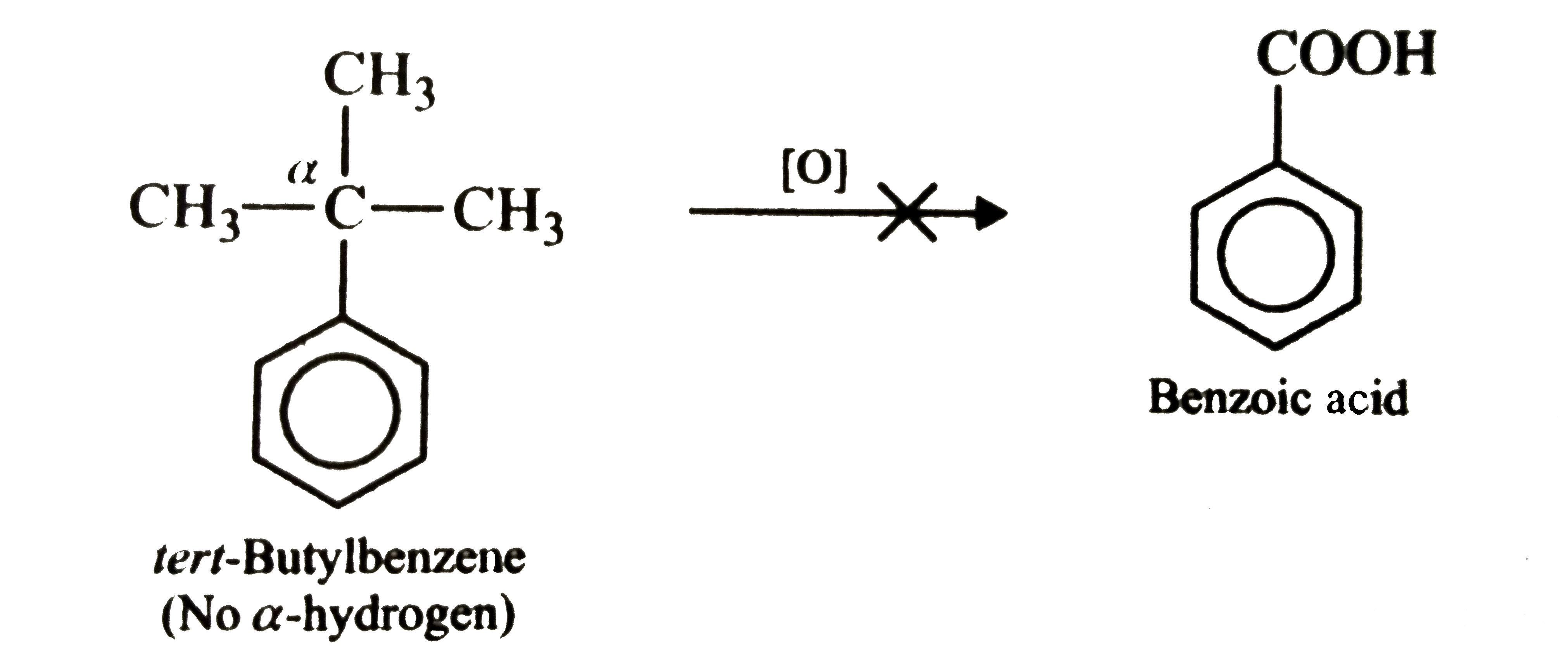
|
|
| 11. |
Give reasons for the following in one or two sentences only: BeCl_(2) can be easily hydrolysed'. |
| Answer» Solution :Beryllium ion is very SMALL in SIZE,and so it has a very high polarising power (Fajans'rules). Also, vacant `p-`ORBITALS are available. So,, beryllium chloride is READILY hydrolysed. | |
| 12. |
Give reasons for the following : (i)Covalent bonds are directional bonds while ionic bonds are non-directional. (ii) Water molecule has bent structrue whereas carbon dioxide molecule is linear. (iii) Ethyne molecule is linear. |
|
Answer» Solution :(i) In covalent bond, the shared pair of electrons is LOCALIZED between the two atoms and this gives a directional character . In ionic bonds, an ion is surrounededby oppositely charged ions in any direction and the oppositely charged ions are held together by electrostatic forces. Hence, they are non-directional. (ii) In `H_(2)O,""_(8)O= 1s^(2) underbrace(2s^(2) 2p_(x)^(2) 2p_(y)^(1) 2p_(z)^(1)) `O-atom is `sp^(3) ` hybridized . Two hybrid orbitals are half-filled and two are occupied by lone PAIRS of electrons . Half-filled orbitals overlap with half-filled orbitals of H-atoms Hence, it has a bent structure. 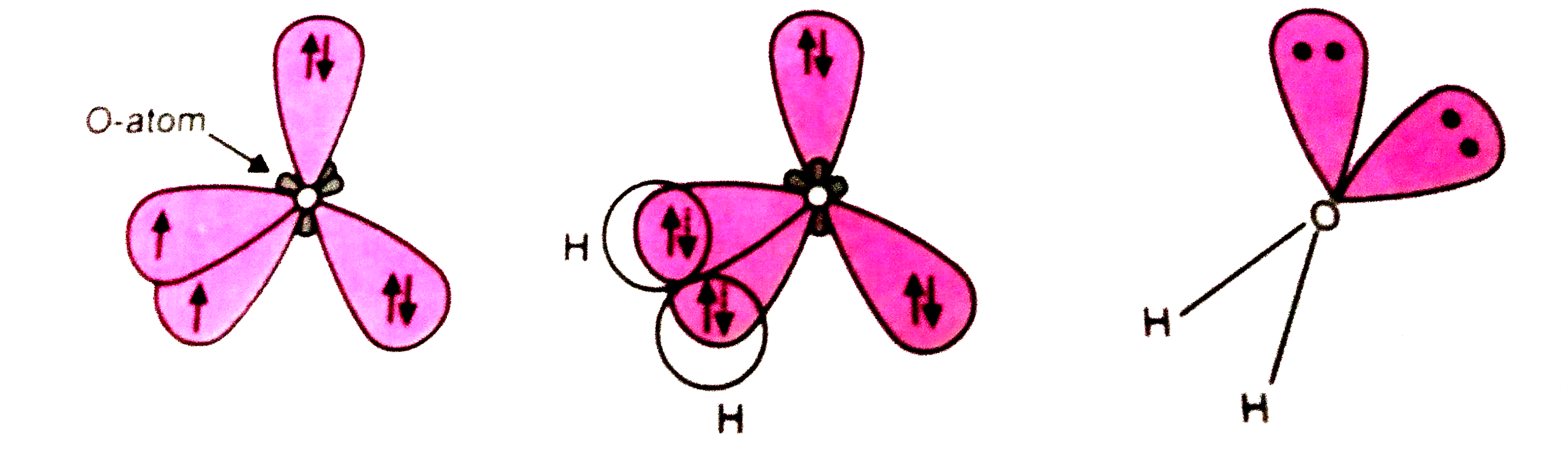 In`CO_(2), ""_(6)C = 1s^(2) underbrace(2s^(1) 2p_(x)^(1)) 2p_(y)^(1) 2p_(z)^(1)`(excited state ) and `._(8)O = 1s^(2) 2s^(2) 2p_(x)^(2) 2p_(x)^(2)2p_(y)^(1) 2p_(z)^(1)` C is sp hybridized forming two sp hybrid orbitals nad two half-filled 2P orbitals are left umhybridized . The overlappings take place as follows : 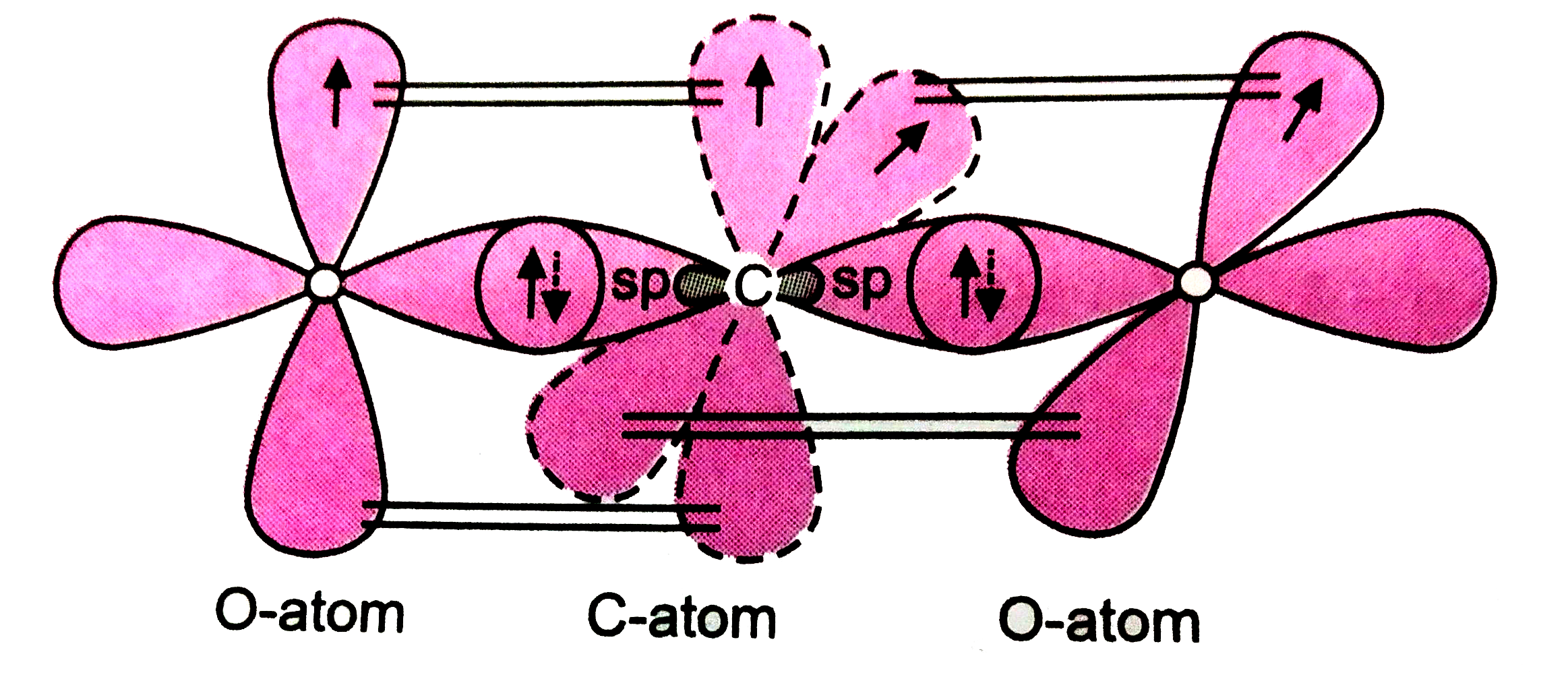 . .
|
|
| 13. |
Give reasons for the following : (i) The size of weather balloon becomes larger and larger as it ascends into higher altitudes. (ii) Tyres of automobiles are inflated to lesser pressure in summer than in winter. |
|
Answer» Solution :(i) As we go to higher ALTITUDES, the ATMOSPHERIC pressure decreases. Thus, the pressure outside the balloon decreases. To regain equilibrium with the external pressure, the gas inside expands to decrease its pressure. Hence, the size of the balloon increases. (ii) In summer, due to higher temperature, the average kinetic energy of the air molecules inside the typre increases, i.e., molecules start moving faster. Hence, the pressure on the walls of teh tube increases. If pressure inside is not kept LOW at the time of INFLATION, at higher temperature, teh pressure may become so high that the tyre may burst. |
|
| 14. |
Give reasons for the following : (i) NO (Nitric oxide) is paramagnetic in the gaseous state but diamagnetic in the liquid and solid states. Why ? (ii) Nitric oxide becomes brown when released in air. |
|
Answer» Solution :(i) NO has an ODD number of electrons (7+8=15 electrons) and hence is paramagetic in the gaseous STATE. But in liquid and solid STATES, it exists as a dimer (Table 11.14, page 11//19) and hence is diamagnetic in these states. (ii) Nitric oxide has ONE unpaired electron and hence is very REACTIVE. As a result, it readily combies with `O_(2)` of the air to form nitrogen dioxide `(NO_(2))` which has brown colour. `underset("Colourles")(2NO)+O_(2)tounderset("Brown")(2NO_(2))` |
|
| 15. |
Give reasons for the following : (i) Magnesium is not precipitated from a solution of its salt by NH_(4)OH in the presence of NH_(4)Cl. (ii) Ammonium chloride is acidic in liquid ammonia solvent |
|
Answer» Solution :(i) The solubility PRODUCT of `Mg(OH)_(2)` is high. Presence of `NH_(4)Cl` suppresses the DISSOCIATION of `NH_(4)OH` due to common ion EFFECT thus giving low giving low concentration of `[OH^(-)]` . The IONIC product, therefore, cannotexceed the solubility product. (ii) In solution of `NH_(4)Cl` in liquid `NH_(3)`, the following reaction takes place : `NH_(4)^(+) + NH_(3) hArr NH_(3)+NH_(4)^(+)` Thus, `NH_(4)Cl` gives proton. Hence, it is acidic. |
|
| 16. |
Give reasons for the following : (i) MgCl_(2) is more covalent than NaCl (ii) CuCl is more covalent than NaCl. |
|
Answer» Solution :(i) Due to higher charge , `Mg^(2)` is more polarising than `Na^(+)` and hence `MgCl_(2)` is more covalent than NaCl. (ii) Due to PSEUDO INERT gas configuration , `CU^(+)` is more polarising than `Na^(+)` and hence CUCL is more covalent than NaCl . |
|
| 17. |
Give reasons for the following : (i) LiCl is more covalent that KCl . (ii) LiI has lower melting point than LiF. |
|
Answer» SOLUTION :(i) Due to SMALLER SIZE , `Li^(+)` is more polarising than `Na^(+)` and hence LiCl is more covalent than NACL . (ii) Due toi bigger size , `I^(-)` is more polarizable than `F^(-)` and hence LII is more covalent than LiF . |
|
| 18. |
Give reasons for the following: (i) Ethyl iodide undergoes S_(N^2) reactions faster than etheyl bromide. (ii) (pm) 2 - Butanol is optically inactive. (iii) C - Xbond lengthin halobenzene is smaller than C -X bond length inCH_3-X. |
|
Answer» Solution :(i) Because in ethyl iodide, `(I^(-))` being the best leaving group among all the halide ions. RATE of `S_(N^2)` REACTION `prop` ability of leaving group. (ii) `(pm)` 2 -butanol is a recemicmixture which is optically inactive DUE to the EXTERNAL compensation. (iii) Due to resonance in halobenzene, it has a SMALLER bond length value as compared to `CH_3-X`. |
|
| 19. |
Give reasons for the following : (i) "CCl"_(4) is immiscible in water , whereas SiCl_(4) is easily hydrolysed. (ii) Carbons has a strongtendency for catenation comparedto silicon. |
|
Answer» Solution :(i) `"CCl"_(4)` isa covalent compoundwhile `H_(2)O`is a polar compound. Thereforeit isinsolublein water alternatively, `"CCl"_(4)`is insolublein water becausecarbon does nothave d-orbitals to accommodatethe electrons DONATED by oxygenatom of watermolecules. As a RESULT, thereis no interactionbetween `"CCl"_(4)` and watermolecules and hence`"CCl"_(4)`is insolublein water. On the otherhand, `SiCl_(4)`has d-orbitalsto accomendatethe lone pair of electronsdonated by oxygen ATOM ofwater molecules. As a result, there is a strong intereaction between `SiCl_(4)` and watermolecules . Consequently, `SiCl_(4)`undergoeshydrolysisby waterto form silicic acid. `"CCl"_(4) +H_(2)O rarr "No reaction", SiCl_(4)+4H_(2)Orarr underset("Silicate acid")(Si(OH)_(4))+4HCl` (ii) The bond dissociation energydecreasesrapidlyas the atomic size increases. Since the atomic size carbon is much smaller (77 pm)as comparedto that of silicon (118 pm), therefore , carbon -carbon bond dissociationenergy ismuch higher`(348 kj mol^(-1))`than than that ofsilicon-siliconbond `(297 kJ mol^(-1))`. Becauseof much STRONGER C-Cbonds as copared to Si-Si bonds, carbon hasa much higher tendencyfor catenation than silicon. |
|
| 20. |
Give reasons for the following : (i) Be(OH)_(2) dissolves in NaOH but Mg(OH)_(2) does not . (ii) Magnesium oxide is used as a refractors material , (iii) During electrolysis of molten sodium chlorides , calcium chloride and potassium fluoride are added . |
|
Answer» Solution :(i) `Be(OH)_(2)` is amphoteric and hence it dissolves in NaOH forming sodium beryllate `Be(OH)_(2) + 2NaOH to Na_(2)BeO_(2) + 2H_(2)O` `Mg(OH)_(2)` on the other hand , basic does not dissolve in NaOH. (ii) MgO has high lattice energy due to GREATER CHARGE and smaller ionic size of `Mg^(2+)` and `O^(2-)` ions . As a result , it has a very high melting point and hence is used as a refractory material . (III) Pure sodium chloride metals at 1084 K . The cost of electricity to attain and maintain this temperature is very high . Furthermore , `Cl_(2)` gas evolved during electrolysis has CORROSIVE action on the cell at high TEMPERATURES . Therefore , to lower the fusion temperature to 850-875 K , some `CaCl_(2)` and KF are added to molten NaCl. |
|
| 21. |
Give reasons for the following : Ethyne molecule is linear. |
|
Answer» Solution :ETHYNE MOLECULE is linear because both the carbon atoms in it are sp hybridized having two unhybridised orbitals (2px and2py). The two sphybrid orbitals of both the carbon atoms are oriented in opposite direction forming an angleof `180^(@)`. `H - C UNDERSET(2PI" bonds")overset(O^(-)) =C - H` |
|
| 22. |
Give reasons for the following : Covalent bonds are directional while ionic bonds are non -directional . |
|
Answer» Solution :In covalent bonds , the shared pair of ELECTRONS are LOCALIZED bonds between two atoms and also covalent bonds are formed by overlap of half covalent bonds are formed by the orbitals are DIRECTIONAL in nature, covalent bonds are also directional. In ionic bonds, only a network of cations are anions are TIGHTLY held together by electrostatic forces. The electrostatic field of an ion is non-directional , hence ionic COMPOUNDS are also non-directional. |
|
| 23. |
Give reasons for the following : CH_2=CH^- is more basic than HC-=C^- |
| Answer» Solution :`CH_2=CH^-` is the CONJUGATE BASE of the ACID `H_2C=CH_2` and `HC-=C^-` is the conjugate base of the acid `HC-=CH` . We know that stronger the acid , WEAKER is the conjugate base. Since , `HC-=CH` is a stronger acid than `CH_2=CH_2` , therefore , `CH_2=CH^-` is a stronger base than `HC-=C^-` | |
| 24. |
Give reasons for the following: Carbon has a strong tendency for catenation compared to silicon. |
|
Answer» Solution :Carbon atoms have the tendency to link with one another through covalent bonds to form CHAINS and rings. This property is called catenation. This is because C-C bonds are very strong. Down the GROUP the size INCREASES and electronegativity decreases, and, there by, tendency to show catenation decreases. This can be clearly seen from bond enthalpies values. The order of catenation is `C gt gt Si gt Ge SN`. Lead does not show catenation. |
|
| 25. |
Give reasons for the following: C Cl_4is immiscible in water, whereas SiCl_4 is easily hydrolyzed. |
|
Answer» SOLUTION :`C Cl_4` is a covalent compound and cannot FORM H-bond with polar `H_2O` and C does not have d-orbital to accommodate the LONE pair of electrons from oxygen ATOM of water molecule. Other tetrachlorides are easily hydrolyzed by water because the central atom can accommodate the lone pair of electrons from oxygen atom of water molecule in d-orbital. Hydrolysis can be understood by taking the example of `SiCl_4`. It undergoes hydrolysis by initially ACCEPTING lone pair of electrons from water molecule in d orbitals of Si, finally leading to the formation of `Si(OH)_4` as shown : `SiCl_4 + 4H_2O to underset"Silicic acid"(Si(OH)_4)+ 4HCl` 
|
|
| 26. |
Give reasons for the following: a. Anhydrous calcium sulphate (anhydrite) cannot be used as plaster of Paris. B. Limewater turns milky on passing CO_(2) through it, but milkiness disappears on passing excess of CO_(2). C. The reacton between marble and dil H_(2)SO_(4) is not used to prepare CO_(2). d. In the manufacture of Mg by carbon reduction of MgO, the product is cooled in the stream of an inert gas. e. magnesium metal burns in air to give a white ash. when this ash is treated with water, the odour of ammonia can be detected. |
|
Answer» Solution :(a). Anhydrous calcium sulphate in presence of water does not set like plaster of paris. However, it directly changes to gypsum. `CaSO_(4)+2H_(2)Orarrunderset("Gypsum")(CaSO_(4).2H_(2)O` (b). Limewater, `CA(OH)_(2)`. Reacts with `CO_(2)` to form white ppt. of `CaCO_(3)`, which gives milkiness to the solution, But on excess passage of `CO_(2)` through limewater, `CaCO_(3)`. formed initially further reacts with `CO_(2)` to form calcium bicarbonate, `Ca(HCO_(3))_(2)`. which is soluble and hence the milkiness disappears. `underset("Limewater") +CO_(2) rarr underset(("Milkiness")darr+H_(2)O` `CaCO_(3)+H_(2)O+underset(("excess"))(CO_(2))rarrunderset(("Soluble"))(Ca(HCO_(3))_(2))` (C ). Marble, `CaCO_(3)`, reacts with dil `H_(2)SO_(4)` to form `CaSO_(4)`. This `CaSO_(4)` forms a layer on the surface of marble, preventing any further reaction with dil `H_(2)SO_(4)`. Hence, EVOLUTION of `CO_(2)` ceases after sometime and hence marble cannot be used as a source of `CO_(2)`. `CaCO_(2)+H_(2)SO_(4)rarrCaSO_(4)darr+H_(2)O+CO_(2)uarr` (d).  Reducing of `MgO` by `C` to give `Mg` metal and `CO` is a reversible process. In order to prevent the backward reaction or to make the reaction proceed in FORWARD direction, the temperature of the products is reduced in a stream of an inert gas. (e). Magnesium metal on burning in air reacts with `O_(2)` and `N_(2)` to give `2Mg+O_(2)rarrunderset("Magnesium oxide")(MgO)` `3Mg+N_(2)rarrunderset("Magnesium nitride")(Mg_(3)N_(2))` White ash produced is a mixture of `MgO` and `Mg_(3)N_(2)`.On treatment with water, `Mg_(3)N_(2)` is hydrolysed, ammonia is produced. `Mg_(3)N_(2)+6H_(2)Orarr3Mg(OH)_(2)+2NH_(3)uarr` |
|
| 27. |
Give reasons for the following: |
|
Answer» `BeO` is used as a refractory material. (b).Beryllium halides are electron-deficient compounds since they only four electrons in the valence shell. to complete their octet, they undergo polymerisation. (C ). `Be(OH)_(2)` being amphoteric dissolves in `NaOH` forming sodium beryllate. `Be(OH)_(2)+2NaOHrarrNa_(2)BeO_(2)+2H_(2)O` Whereas `Ca(OH)_(2)` being basic, does not dissolve in `NaOH`. (d). `Mg_(3)N_(2)` is a salt of strong base `[Mg(OH)_(2)]` and a weak acid `(NH_(3))` and hence on hydrolysis gives `NH_(3)`. `Mg_(3)N_(2)+6H_(2)Orarr3Mg(OH)_(2)+2NH_(3)` `MgCl_(2)` is a salt of strong base, `Mg(OH)_(2)`, and strong acid, `HCl`, and hence does not hydrolyse. |
|
| 28. |
Givereasons for the failureof the Bohr model |
|
Answer» Solution :in bohr modeland electronregarded as acharged particlebut thewavecharacterof the electronis notconsidered. in bohr.smodelmovingin welldefinedcircularorbitsit completely be definedonly if boththeknownexactly at thesametime. THISIS notpossibleaccordingto theHeisenberguncertainty PRINCIPLE Bohrmodelof the hydrogenatomthereforenot onlyignoresdualbehaviourof matterbut alsocontradictsHeisenberguncertaintyprincipleThereforetherewas nopointin extendingBohrmodelto otheratoms. |
|
| 29. |
give reasons for following in one or two sentence: "Nitrobenzene does not undergo Friedal Craft's reaction". |
|
Answer» Solution :In nitrobenzene, `-NO_(2)` group is ATTACHED with carbon of BENZENE ring, such group deactivates the benzene ring to such an extent that ALKYLATION or acylation does not take place. Stable carbonium ion (it is ACTIVE species of this REACTION) |
|
| 30. |
Give reasons for polarity of C-X bond in haloalkanes. |
|
Answer» Solution :(i) Carbon HALOGEN bond is a polar bond as halogens are more eiectronegative than carbon. (ii) The carbon atom exhibits a partial positive change `(delta^(-))` and halogen atom acquires a partial NEGATIVE change. `(delta^(-))` (iii) `OVERSET(delta)(-)UNDERSET(|)overset(|)C-overset(delta)(X^(-))` |
|
| 31. |
Give reasons Diamond is used as an abrasive. |
| Answer» Solution :The diamond has a three DIMENSIONAL NETWORK STRUCTURE in which `sp^3` hybridised carbon atoms are linked together by strong COVALENT bonds. The network is very hard. This is why diamond is extremely hard and is used as an ABRASIVE. | |
| 32. |
Give reasons Diamond is used as an abrasive. |
|
Answer» SOLUTION :In diamond, carbon is `sp^3` hybridised. Each carbon atom is bonded to four other carbon atoms with the HELP of strong covalent bonds. These covalent bonds are present throughout the surface, giving it a very rigid 3-D STRUCTURE. It is very difficult to break this extended covalent bonding and for this reason, diamond is the hardest SUBSTANCE known. Thus, it is USED as an abrasive and for cutting tools. |
|
| 33. |
Explain why : Conc. nitric acid can be stored in aluminium containers. |
|
Answer» Solution :Aluminium reacts with conc. `HNO_3` to FORM a very thin layer of aluminium oxide on its SURFACE which prevents it to react further with conc. HNO3. In other words, aluminium becomes passive by the action of conc. `HNO_3` `2AL(s)+ underset("(conc.)")(6HNO_3) to underset("Alumina")(Al_2 O_3 (s)) + 6 NO_2 (g) + 3H_2 O (L)` HENCE, aluminium containers can be used to transport conc. nitric acid. |
|
| 34. |
Give reasonsConc. HNO_3 can be transported in aluminium container. |
|
Answer» Solution :Concentrated `HNO_3` can be stored and transported in aluminium containers as it reacts with aluminium to FORM a thin protective OXIDE LAYER on the aluminium SURFACE. This oxide layer renders aluminium passive. `2Al_((s)) + 6HNO_(3(Conc.)) to Al_2O_(3(s)) + 6NO_(2(g)) + 3H_2O_((l))` |
|
| 35. |
Give reasons: Boron is used as control rods in nuclear reactosrs. |
| Answer» SOLUTION :Because it ABSORBS NEUTRONS. | |
| 36. |
Give reasons for the following: Aluminium is used in transmission wires. |
| Answer» SOLUTION : Aluminium is a good conductor of ELECTRICITY and on weight to weight basis, it conducts twice as MUCH current as conducted by Cu. Aluminium wires are lighter and cheaper. THEREFORE, aluminium wire is used to make transmission cables. | |
| 37. |
Give reasons Aluminium wire is used to make transmission cables. |
| Answer» SOLUTION :Silver, copper and aluminium are AMONG the best conductors of electricity. Silver is an expensive metal and silver WIRES are very expensive. Copper is QUITE expensive and is also very heavy. Aluminium is a very ductile metal. Thus, aluminium is USED in making wires for electrical conduction. | |
| 38. |
Give reasons Aluminium utensils should not be kept in water overnight. |
|
Answer» Solution :The oxygen present in WATER reacts with ALUMINIUM to form a thin layer of aluminium OXIDE. This layer prevents aluminium from further reaction. However, when water is KEPT in an aluminium vessel for long periods of time, some amount of aluminiumoxide may dissolve in water. As aluminium IONS are harmful, water should not be stored in aluminium vessels overnight. `2Al+O_(2(g)) + H_2O_((l)) to Al_2O_(3(s)) + H_(2(g))` |
|
| 39. |
Give reasons Aluminium utensils should not be kept in water overnight. |
|
Answer» Solution :Aluminium reacts with water and dissolved oxygen to FORM a THIN film of aluminium OXIDE on its surface. `2AL(s) + O_2 (g) + H_2 O (l) to Al_2 O_3 (s) + H_2(g)` Some of the `Al^(3+)` ions from the layer may dissolve in water to form a solution containing a few ppm of `Al^(3+)` ions. `Al^(3+)` ions are toxic and their presence in drinking water or FOOD stuffs is undesirable. Therefore, aluminium utensils should not be kept in water overnight. |
|
| 40. |
Give reasons Aluminium alloys are used to make aircraft body. |
| Answer» SOLUTION :Aluminium ALLOYS are light, tough and resistant to CORROSION. Therefore, they are used to make aircraft body. | |
| 41. |
Give reasons Aluminium alloys are used to make aircraft body. |
| Answer» Solution :Aluminium has a high tensile STRENGTH and is very LIGHT in weight. It can also be alloyed with various metals such as Cu, Mn, MG, Si and Zn. It is very malleable and ductile. Therefore, it is used in making aircraft BODIES. | |
| 42. |
Give reasons :(a) Neither q nor wis a state function butq+w is a state function. (b) The dissociation of ammoniumchloride in water is endothermic still it dissolved in water. (c ) A real crystal has more entropythan an idealcrystal. |
|
Answer» Solution :(a) `q+w = DeltaU` . As `DeltaU` is a STATE FUNCTION,hence`q+w` is a state function. (b) On dissolution,entropy increases , i.e.,`DeltaS` is`+ve` . Though `DeltaH` is`+ve` but if `T DeltaSgt DeltaH ` , then according to the equation ,`DeltaG = DeltaH -T DeltaS , DeltaG` will be -ve. Hence,the process is spontaneous. (C ) A REAL crystal has some disorderdue to presence of DEFECTS whereas ideal crystalhas no disorder. Hence, a real crystal has more entropy than ideal crystal. |
|
| 43. |
Give reasons A mixture of dilute NaOH and aluminium pieces is used to open drain. |
|
Answer» SOLUTION :Aluminium reacts with dilute NaOH to evolve dihydrogen gas. `H_2` gas thus evolved under pressure can be used to OPEN CLOGGED drains . `2Al(s) + 2NaOH(aq) + 6H_2 O (l) to 2NA^+ [Al(OH)_4]^(-) (aq) + 3H_2 (g)` |
|
| 44. |
Give reasons A mixture of dilute NaOH and aluminium pieces is used to open blocked drain. |
|
Answer» Solution :Sodium HYDROXIDE and aluminium react to FORM sodium tetra hydroxoaluminate(III) and hydrogen gas. The pressure of the produced hydrogen gas is used to open blocked drains. `2Al_((s)) + 2NaOH + 2H_2O_((L)) to 2NaAlO_(2(aq)) + 3H_(2(g))` |
|
| 45. |
Give reasons: a. Conc HNO_(3) can be transported in aluminium containers. b. A mixture of dil NaOH and aluminium pieces is used to open drain. ltBrgt c. Graphite is used as lubricant. d. Diamond is used as an abrasive. e. Aluminium alloys are used to make aircraft body. f. Aluminium utensils should not be kept in water overnight. g. Aluminium wire is used to make transmission cables. |
|
Answer» Solution :a.Aluminium REACTS with conc.`HNO_(3)` to form a very fine layer of aluminium oxide, `Al_(2)O_(3)`, on its surface. This renders aluminium passive and protects it from further action. `2Al_((s))+underset("conc.")(6HNO_(3))tounderset("Alumina")(Al_(2)O_(3(s)))+6NO_(2(g))+3H_(2)O_((L))` Since alumiuium has BECOME passive, it can be used to transport conc.`HNO_(3)`. b. `NaOH` reacts with `Al` to evolve hydrogen gas. The presence of the gas thus produced can be used to open clogged drains. `2Al_((s))+2NaOH_((aq))+2H_(2)O_((l))to 2NaAlO_(2(aq))+3H_(2)uarr_((g))` c. Graphite has a layer-like structure is which different layers are stacked on one another and held together by weak van der Walls forces of attraction.These weak forces can be easily overcome.Thus,graphite acts as a lubricant. d. Diamond is very hard and hence can be used as an abrasive. e. Alumina alloys are light, tough and resistant to CORROSION and hence are used to make aircraft body. f. Aluminium reacts with water and dissolved `O_(2)` to form a thin layer of `Al_(2)O_(3)`. `2Al_((s))+O_(2(g)+H_(2)O_((l))to Al_(2)O_(3(s))+H_(2)uarr_((g))` A very small amount of `Al_(2)O_(3)` may dissolve to give a few ppm of `Al^(3+)` ions in the solution. Since `Al^(3+)` ions are carcinogenic in nature and hence injurious to health. For the reason,drinking water should not be STORED in aluminium utensils overnight. g. On weight-to-weight basis,aluminium conducts twice as copper,therefore, it is used in transmission cables. |
|
| 46. |
Give reason : "Why the pH of a buffer solution does not change on dilution ? |
| Answer» Solution :The pH of buffer solution DEPENDS on ratio of concentration of salt and acid. Which will not CHANGE on DILUTION. So pH will not change. | |
| 47. |
Give reason why sodium bicarbonate is used in bakeries. |
| Answer» Solution :Sodium bicarbonate is called as baking soda. Because it decomposes on HEATING bubbles of carbon dioxide, LEAVING HOLES in CAKES or pastries and making them light and fiuffy | |
| 48. |
Give reason why H_(2), ions are more stable than H_(2)though have the same bond order. |
| Answer» SOLUTION :bond DISSOCIATION ENERGY of `H_(2)^(+)` is LESS than `H_(2)` | |
| 49. |
Give reason why aquatic species are less sustained in hot water ? |
| Answer» Solution :The will be DECREASE in solubility of gases in solution with INCREASE in temperature. During SUMMER, in hot water rivers, due to high temperature, the availability of dissolved oxygen DECREASES. So the AQUATIC species are less sustaned in hot water. | |