

Saved Bookmarks
This section includes 7 InterviewSolutions, each offering curated multiple-choice questions to sharpen your Current Affairs knowledge and support exam preparation. Choose a topic below to get started.
| 1. |
Ice crystallises in a hexagonal lattice having a volume of the unit cell as 132xx10^(-24) cm^3. If density of ice at the given temperature is 0.92 g cm^(-3), then number of H_2O molecules per unit cell is |
|
Answer» 1 `0.92xx(Zxx18)/((132xx10^(-24))(6.02xx10^23))` `=(Zxx18)/(132xx6.02xx10^(-1))` or `Z=(0.92xx132xx6.02xx10^(-1))/18=4.06` |
|
| 2. |
Ice crystallises in a hexagonal lattice having a volume of the unit cell as132 xx 10^(-24) cm^(3) . If density of ice at the given temperature is 0.92 g cm^(-3), the number ofH_(2)O molecules per unit cell is |
|
Answer» <P>1 ` 0.92= ( Z xx 18)/((132 xx 10^(-24))( 6.02 xx 10^(23))) ` ` ( Z xx 18) /(132 xx 6.02 xx 10^(-1))` `or Z = ( 0.92 xx 132 xx 6.02 xx 10^(-1))/18= 4.06` |
|
| 3. |
Ice and water are placed in a closed container at a pressure of 1 atm and 273.15 K temperature. If pressure of the system is increased by 2 atm keeping temperature constant the correct observation would be |
|
Answer» The amount of ice INCREASES |
|
| 4. |
Ibuprofen contains : |
|
Answer» only S-enantiomer |
|
| 5. |
I_(2(aq)) + I_((aq))^(-) hArr I_(3(aq))^(-).We started with I mole of I_(2)and 0.5 mole of l^(-) in one litre flask. After equilibrium is reached, excess of AgNO_(2) gave 0.25 mole of yellow precipitate. Equilibrium constant is |
|
Answer» 1.33 At equilibrium `(0.5-alpha)` mole of `I^(-)` reacts with `AgNO_(3)` to GAVE 0.25 mole of AGI `:. 0.5 - alpha=0.25, alpha=0.25` `K_(c)=([I_(3)^(-)])/([I_(2)](I^(-)))=(2)/((1-alpha)(0.5-alpha))=(0.25)/(0.75 XX 0.25)=(4)/(3)=1.33` |
|
| 6. |
I_(2) and Br_(2) are added to a solution containing Br^(-) and T^(-) ions what reaction will occur if I_(2)+2 e^(-)rarr2I^(-),E^(@)=+0.54 V and Br_(2)+2e^(-)rarrBr^(-),E^(2)=+1.09 V? |
|
Answer» Solution :Since `E^(@)` of `Br_(2)` is higher than that of `I_(2)` THEREFORE `Br_(2)` has higher tendency to ACCEPT electrons that `I_(2)` converserly `I^(-)` IONS has a higher tendency to lose electrons than `Br^(-)` ion therefore the following reaction will occur `2I rarr_(2)^(@)+2e^(-)` `Br_(2)+2e^(-)rarr2Br^(-)` `2I^(-)+Br_(2)rarrI_(2)+2Br^(-)` In other words `I^(-)` ion will be oxidised to `I_(2)` while `Br_(2)` will be reduced to `Br^(-)` ions |
|
| 7. |
I_(2)+2S_(2)O_(3)^(2-)to2I^(-)+S_(4)O_(6)^(2-) How many number of electron loss by 2 mole of S_(2)O_(3)^(2-) in given redox reaction ? |
|
Answer» 2.5 `underset((0))(I_(2))+underset((+8))(2S_(2)O_(3)^(2-))tounderset((-2))(2I^(-))+underset((+10))(S_(4)O_(6)^(2-))` `THEREFORE" "underset((+8))(2S_(2)O_(3)^(-2))tounderset((+10))(S_(4)O_(6)^(-2))""therefore2bare` |
|
| 8. |
(i)1/2N_(2(g))+ 3/2H_(2(g)) hArr NH_(3(g)), At 298 K is DeltaG^ө=-16.5 "kJ mol"^(-1), So find K_p. (ii)At 298 K is N_(2(g)) + 3H_(2(g)) hArr 2NH_(3(g)) , Calculate K_p and DeltaG^ө. |
| Answer» SOLUTION :(i)779.4 = `K_p` , (II)`K_p= 6.07xx10^5` and `DeltaG^ө=-33 "KJ MOL"^(-1)` | |
| 9. |
I_1of an element X is 899 kJ "mole"^(-1) and that of another element Y is 801kJ mole-1. Then X and Y may be |
| Answer» Answer :B | |
| 10. |
I_1, I_2, I_3, of an element are 176, 346 and 1850K.cals respectively. The molecular formula of its phosphate is |
|
Answer» `M_3PO_4` |
|
| 11. |
(i) Write the symbols of one transition and inner-tranisatio element. (ii) Indicate as directred: (a) which has the highest ionic radius? Al^(3+),Mg^(2+),O^(2-),F^(-). (b) which has the lowest electronegativity? H, Na, Si, Cl. (c) which has highest ionisation energy N, O, Ar, P. |
|
Answer» Solution :(i) SYMBOL of one transition element-Fe. Symbol of one INNER transition element-Ce (II) (a) Ionic radius is higher for `O^(2-)` for the GIVEN case. (B) Electronegativity is lowest for Na for the given case. (c) Ionisation energy is higher for Ar for the given case. |
|
| 12. |
(i) Write the resonance structures for ozone molecule and N_(2)O? (ii) Draw MO diagram of CO and calculate its bond order. |
Answer» Solution :(i) • Ozone molecule,`O_(3)`  • Nitrous oxide, `N_(2)O` • Nitrous oxide, `N_(2)O`  (ii)  1. Electronic configuration of Catom: `1S^(2)2S^(2)2p^(2)` 1. Electronic configuration of Catom: `1S^(2)2S^(2)2p^(2)`Electronic configuration of O atom: `1s^(2)2s^(2)2p^(4)` 2. Electronic configuration of CO molecule is: `sigma1s^(2) sigma^(**)1s^(2) sigma2s^(2) sigma^(**)2s^(2) pi2p_(y)^(2) pi2p_(z)^(2) sigma2p_(X)^(2)` 3. Bond ORDER `(N_(b)-N_(a))/(2)=(10-4)/(2)=3` 4. Molecule has no unpaired electron, hence it is diamagnetic. |
|
| 13. |
(i) Write the steps to be followed for writing empirical formula.(ii) What do you understand by the terms empirical formula and molecular formula? |
|
Answer» Solution :(i) Empirical formula shows the ratio of number of atoms of different elements in ONE MOLECULE of the compound. Steps for finding the Empirical formula: The percentage of the elements in the compound is determined by suitable METHODS and from the data collected, the empirical formula is determined by the following steps. 1. Divide the percentage of each element by its atomic mass. This will give the relative number of atoms of various elements present in the compound. 2. Divide the atom value obtained in the above step by the smallest of them so as to get a simple ratio of atoms of various elements. 3. Multiply the figures so obtained, by a suitable integer if necessary in order to OBTAIN whole number ratio. 4. Finally write down the symbols of the various elements side by side and put the above numbers as the subscripts to the lower right HAND of each symbol. This will represent the empirical formula of the compound. 5. Percentage of Oxygen = 100 -Sum of the percentage masses of all the given elements. (ii) 
|
|
| 14. |
(i) Write the name of the element which is diagonally related to the element beryllium. (ii) Three element A, B and C have atomic numbers 11, 14 and 17 respectively. State the blocks in periodic table in which elements A and C belong to. Write the formulas of the compound formed between B and C and A and C. state the nature of the bonds. |
|
Answer» Solution :(i) Aluminium (Al). (ii) `""_(A):1s^(2)2s^(2)2P^(6)3s^(1),""_(14)B:1s^(2)2s^(2)2p^(6)3s^(2)3p^(2)` `""_(17)C:1s^(2)2s^(2)2p^(6)3s^(2)3p^(5)` From the electronic configuration it is EVIDENT that Ais s-block element whereas C is p-block element. the compound formed between B and C has the formula `BC_(4)` and the nature of bond is covalent. compound formed by COMBINATION of A and C is AC (electrovalent). |
|
| 15. |
(i) write the electronic configurations of the following ions : (a) H^(+) (b) Na^(+) (c) O^(2-) (d) F^(-) ltbr. (ii) What are the atomic number of elements whose outermost electrons are represented by (a) 3s^(1) (b) 2p^(3) and (c) 3 d^(6) ? |
|
Answer» Solution :(i) (a) `._(1)H=1 s^(1) :. H^(+)=1 s^(0)""`(b) `._(11)Na=1 s^(2) 2s^(2) 2p^(6) 3s^(1) :. Na^(+)=1s^(2) 2s^(2) 2p^(6)` (C) `._(8)O=1 s^(2) 2s^(2) 2p^(4) :. O^(2-)=1 s^(2) 2s^(2) 2p^(6)""`(d) `._(9)F=1 s^(2) 2s^(2) 2p^(5) :. F^(-) =1 s^(2) 2s^(2) 2p^(6)` (ii) (a) `1s^(2) 2s^(2) 2p^(6) 3s^(1) (Z=11)""`(b) `1s^(2) 2s^(2) 2p^(3) (Z=7)` (c) `1s^(2) 2s^(2) 2p^(6) 3s^(2) 3p^(6) 4S^(2) 3d^(6) (Z=26)`. |
|
| 16. |
(i) Write the important common features of group 2 elements? (ii) What is meant by retrograde solubility? |
|
Answer» SOLUTION : (i)• Group 2 elements except beryllium are commonly known as alkaline EARTH metals because their oxides and hydroxides are alkaline in nature and these metal oxides are found in the Earth.s crust. • Many alkaline earth metals are used in creating colours and used in fireworks. • Their general electronic configuration is ns? • Atomic and ionic RADII of alkaline earth metals are smaller than alkali metals, on movin down the group, the radii increases. . These elements exhibit +2 oxidation state in their compounds. • Alkaline earth metals have higher ionization enthalpy values than alkali metals and they are less electropositive than alkali metals. • Hydration enthalpies of alkaline earth metals decreases as we go down the group. . Electronegativity values of alkaline earth metals decrease down the group. • Alkaline earth metal salts moistened with concentrated hydrochloric acid gave a characteristic coloured flame, when heated on a platinum wire in a flame. (ii) Gypsum is a SOFT mineral and it is less soluble in water as the temperature increases. This is known as RETROGRADE solubility, which is a distinguishing characteristic of gypsum. |
|
| 17. |
(i) Write a chemical reaction useful to prepare the following: 1. Freon-12 from carbon tetrachloride. 2. Carbon tetrachloride from carbon disulphide. (ii) What are ambident nucleophiles? Explain with an example. |
|
Answer» Solution :(a) (i) 1. Freon-12 from carbon tetrachloride: Freon-12 is prepared by the action of hydrogen fluoride on carbon tetrachloride in the presence of catalytic amount of antimony PENTACHLORIDE. This REACTION is called ..Swarts reaction." `underset("Carbon tetrachloride")(C Cl_(4)) + 2HF overset(SbCl_(5)rarr underset("Freon-12")(C Cl_(2) F_(2)) + 2HCl` 2. Carbon tetrachloride from carbon disulphide: Carbon disulphide reacts with chlorine gas in the presence of anhydrous `AlCl_(3)` as catalyst to given carbon tetrachloride. `underset("carbon disulphide")(CS_(2)) + 3Cl_(2) underset(AlCl_(3))overset("Anhydrous")rarr underset("Carbon tetrachloride")(C Cl_(4)) + S_(2)Cl_(2)` (II) Nucleophiles which can attack through two different sites are called ambident nucleophiles. For example, cyanide group in a resonance hydrid of two CONTRIBUTING structures and therefore it can act as a nucleophile in two different ways: `""^(ө)C= N HARR : C = N^(ө)` It can attack through carbon to form cyanides and through nitrogen to form isocyanides or carbylamines. |
|
| 18. |
(i) Write about hydrosphere (or) Why Earth is called as Blue planet? (ii) Even through the use of pesticides increase the crop production, they adversely affect the living organisms. Explain the function and the adverse effects of the pesticides. |
|
Answer» Solution :(b) (i) 1. Hydrosphere include all TYPES of water sources like oceans, seas, rivers, lakes, streams, underground water, polar ice-caps, clouds etc. 2. It covers about 74% of the earth.s surface. Hence earth is called as Blue planet. (ii) Pesticides are the CHEMICALS that are used to kill or stop the growth of unwanted organims. But these pesticides can effect the health of human beings. Pesticides are CLASSIFIED as (a) insecticides, (b) Fungicides and (c) Herbicides. 1. Insecticides: Insecticides like DDT, BHC, Aldrin can STAY in soil for a long period of time and are absorbed by soil. They contaminate root crops like carrot, radish. 2. Fungicides: Organomercury compounds dissociate in soil to produce mercury which is highly toxic. 3. Herbicides: They are used to control unwanted plants and are also known as weed KILLERS. Eg., Sodium chlorate, sodium nitrate. They are toxic to mammals. |
|
| 19. |
(i) Why standard entropy of an elementary substance is not zero whereas standard enthalpy of formation is takes as zero ? (ii) Derive the relationship between standard free energy (delta G^(@)) and equilibrium constant (K_(eq)). |
|
Answer» SOLUTION :(a) (i) A substance has a perfectly ORDERED arrangement only at absoulte zero. Hence, entropy is zero only at absolute zero. Enthalpy of formation is the heat change involved in the formation of one mole of the substance from its elements. An element formed from its constituents means no heat change. (ii) 1. In a reversible process, system is at all times in perfect EQUILIBRIUM with its surrounding. 2. A reversible chemical reaction can proceed in either direction simulaneously, so that a dynamic equilibrium is set up. 3. This means that the reactions in both the directions should proceed with decrease in free energy, which is impossible. 4. It is possible only if at equilibrium, the free energy of a system is minimum 5. Lets consider a general equilibrium reaction, `A + B hArr C + D` The free energy change of the above reaction in any state `(Delta G)` is related to the standard free energy change of the reaction `(Delta G^(0))` according to the following equation. `Delta G= Delta G^(0) + RT In Q`...(1) where Q is reaction quotient and is defined as the ratio of concentration of the products to the concentration of the reactants under non-equilibrium conditions. 6. When equilibrium is attined, there is no further free energy change i.e., `Delta G=0 and Q` `Delta G^(0) = -RT In K_(eq)`....(2) This equation is known as Van.t Hoff equation. `Delta G^(0) = 2.303 RT LOG K_(eq)`....(3) We also know that, `DeltaG^(0) = Delta H^(0) - T Delta S^(0) = -RT In K_(eq)` ....(4) |
|
| 20. |
(i) Why hydrogen peroxide is stored in plastic containers, so in class container (ii) Give the general electronic condition of ladies and actinides. |
|
Answer» Solution : (i) The AQUEOUS solution of hydrogen peroxide is spontaneously disproportionate to give oxygen. The reaction is slow but it is explosive when it is catalyzed by metal or alkali dissolved from glass. For this reason, its solution are stored in plastic bottles. `H_(2)O_(2(aq)) rarr H_(2)O_(1) + 1//2 O_(2(g))` 1. The electronic configuration of lanthanides is `4f^(1-14)5d^(10-1) 6s^(2)` 2. The electroniconfiguration of actinides is `5f^(1-14) 6D^(10-1)7s^2` |
|
| 21. |
(i) Why does nitrogen have a higher ionisation enthalpy than that of oxygen? (ii) Arrange the following in increasing order of acidity: NO_(2),Al_(2)O_(3),SiO_(2):ClO_(2). |
|
Answer» Solution :(i) N/A (II) `Al_(2)O_(3) lt SiO_(2) lt NO_(2) lt ClO_(2)`. |
|
| 22. |
(i) why does the PCl_(5) exist but NCl_(5) does not? (ii) why does BaSO_(4) not soluble in water? |
|
Answer» Solution :(i) . (II) For a compound to be soluble in `H_(2)O`, its lattice enthalpy should be low compare to its hybration enthalpy. Since, both `BA^(2+)` and `SO_(4)^(2-)` are LARGE I size, they stabilises each other to form a STRONG lattice. This leads to the insolubility of `BaSO_(4)` in water. |
|
| 23. |
(i) Why deep-sea divers use air diluted with helium gas in their air tanks? (ii) What is molal depression constant? Does it depend on nature of the solute. |
|
Answer» Solution :(i) 1. Deep-sea divers carry a compressed air tank for breathing at high pressure under water. This air tank contains nitrogen and oxygen which are not very soluble in blood and other body fluids at normal pressure. 2. As the pressure at the depth is far greater than the SURFACE atmospheric pressure, more nitrogen dissolves in the blood when the diver breathes from tank. 3. When the divers ascends to the surface, the pressure decreases, the dissolved nitrogen comes out of the blood quickly forming bubbles in the blood STREAM. These bubbles restrict blood flow, affect the transmission of nerve impulses and can even burst the CAPILLARIES or block them. This condition is called "the BENDS" which are PAINFUL and dangerous to life. 4. To avoid such dangerous condition they use air diluted with helium gas (11.7 % helium, 56.2% nitrogen and 32.1% oxygen) of lower solubility of helium in the blood than nitrogen. (ii) `K_(f)` - molar freezing point depression constant (or) cryoscopic constant. `DeltaT_(f)= K_(f).m`, where `DeltaT_(f)` - depression in freezing point, m = molality of the solution `K_(f)` =cryoscopic constant If m=1, `DeltaT_(f)=K_(f)` i.c., cryoscopic constant is equal to the depression in freezing point for 1 molal solutic cryoscopic constant depends on the molar concentration of the solute particles. K. directly proportional to the molal concentration of the solute particles. `DeltaT_(f)= K_(f)xx(W_(B)xx1000)/(M_(B)xxW_(A))` `W_(B)` = mass of the solute, `W_(A)` =mass of solvent, `M_(B)` =molecular mass of the solute. |
|
| 24. |
(i) Why blue colour appears during the dissolution of alkali metals in liquid ammonia? (ii) What is Boyle's temperature? What happens to real gases above and below the Boyle's temperature? |
|
Answer» Solution :`M+(x +y)NH_3 rarr [M(NH_3)_x]^+ + [e(NH_3)_y]^-` The blue colour of the solution is due to the ammoniated electron which absorbs energy in the visible region of light and thus imparts blue colour to the solution. The solutions are paramagnetic and on standing slowly liberate hydrogen resulting in the formation of amide. In concentrated solution, the blue colour changes to bronze colour and become diamagnetic (ii) 1. Over a range of low pressures, the REAL gases can behave ideally at a particular TEMPERATURE called as Boyle temperature or Boyle point. 2. The Boyle point varies with the nature of the gas. 3. Above the Boyle point, the compression point `Z gt1` for real gases i.e. real ases show positive deviation 4. Below the Boyle point, the real gases first show a decrease for Z, reaches a minimum and then increase with increase in PRESSURE. So, it is CLEAR that at low pressure and at high temperature, the real gases behave as ideal gases. 5. Hence `Z = (PV_("real"))/(nRT)` ` PV_("ideal")=(nRT)/(P)` So, `Z = (V_"real")/(V_"ideal")` |
|
| 25. |
(i) Why alkali metals have high chemical reactivity? How this changes along the group? (ii) Distinguish between alkali metals and alkaline earth metals. |
|
Answer» Solution :(a) (i) Alkali metals exhibit high chemical reactivity because of their LOW ionization enthalpy and their larger size. The reactvity of alkali metals increases from Li to Cs, since the value of ionization energy decreases down the group (Li to Cs). All the alkali metals are HIGHLY reactive towards the more electronegative elements such as OXYGEN and HALOGENS. (ii)  
|
|
| 26. |
(i) When the driver of an automobile applies brake, the passengers are pushed toward the front of the car but a helium ballon is pushed toward back of the car. Upon forward acceleration the passengers are pushed toward the front of the car. Why ? (ii) Critical temperature of H_(2)O,NH_(3) and CO_(2) are 647.4, 405.5 and 3.4.2 K respectively. When we start cooling from a temperature of 700 K which will liquefy first and which will liquefy finally ? |
|
Answer» Solution :(i) 1. When the driver of an automobile applies brake, the passengers are pushed toward the front of the car due to inertia of the body, but a helium ballon pushed toward back of the car. Helium ballon responds to the air around it. Helium molecules are lighter than air of our atmosphere, and so they move toward back by gravity as a result of the accelerating frame. 2. Upon forward acceleration, the passengers are pushed toward the front of the car because the body in motion tends to stay i motion until acted upon by an OUTSIDE force. Helium ballon is going to move OPPOSITE to this pseudo gravitational force. (ii) CRITICAL TEMPERATURE of a GAS is defined as the temperature above which it cannot be liquefied even high pressures. `:.` When cooling start from 700 K, `H_(2)O` will liquefied first, then followed by ammonia and finally carbon dioxide will liquefied. |
|
| 27. |
(i) What is the mass of sodium bromate and molarity of the solution necessary to prepare 85.4 mL of 0.672 N solution when the half reaction is , BrO_(3)^(-) +6H^(+)+6e^(-) to Br^(-)+3H_(2)O (ii) What would be the mass as well as molartiy if the half cell reaction is, 2BrO_(3)^(-)+12H^(+)+10e^(-) to Br_(2)+6H_(2)O |
|
Answer» Solution :(i) Molecular mass of `NaBrO_(3)=23+80+(3xx16)=151` Each BROMATE ion takes-up 6 electrons, THEREFORE, Eq. mass of `NaBrO_(3)=("Mol.mass")/(6)=(151)/(6)` Amonut of `NaBrO_(3)` in 85.5 mL 0.672 N solution `=(0.672)/(1000)xx(151)/(6)xx85.5=1.446 g` `"Molarity"=("NORMALITY")/(n)=(0.672)/(6)=0.112 M` (ii) Each bromate ion takes-up 5 electrons, therefore, Eq. mass of `NaBrO_(3)=("Mol. mass")/(5)=(151)/(5)` Amount of `NaBrO_(3)` in 85.5 mL 0.672 N solution `=(151)/(5)xx(0.672)/(1000)xx85.5` =1.7352 g `"Molarity"=("Normality")/(n)=(0.672)/(5)=0.1344 M` |
|
| 28. |
(i) What is the weight of sodium bromate and molarity of solution necessary to prepare 85.5 mL of 0.672 N solution when the half-cell reaction is BrO_(3)^(-) + 6H^(+) +6e to Br^(-) + 3H_(2) O? (ii) What would be the weight as well as molarity if the cell reaction is 2BrO_(3)^(-) + 12H^(+) + 10e to Br_(2) + 6H_(2) O? |
| Answer» SOLUTION :(i) 1.4479 G, 0.112 M (II) 1.7236 g, 0.134 M | |
| 29. |
(i) What is the oxidation state of TI in the compound TlI_(3)? (ii) Which is stronger oxidising agent between CO_(2) and PbO_(2) and why? |
|
Answer» SOLUTION :(i) +1 (ii) `PbO_(2)`. Due to the inert pair effect, PB is very unstable in +4 oxidaition STATE. Thus `Pb^(4+)` can be easily reduced to `Pb^(2+)`. |
|
| 30. |
(i) What isthe energyof electronfor hydrogenin J// atomand 1//mole ? (ii)Calculatethe energyof thiselectronpermolefor firsttransition. |
| Answer» Solution :`(i) -2.18 xx 10^(18) J atom^(1) ` and `-1.31 18 xx 10^(8) J mol^(-1)=-1311 .8 kJ mol^(1)(ii)n_(1) ton_(2)`transitiontakeplace`9.84xx 10^(5) J mol^(1) = 984 kJmol^(1)(iii) n_(1)n_(PROP) ` transitiontakeplace | |
| 31. |
(i) What is the difference between molecular mass and molar mass ? Calculate the molecular mass and molar mass for carbon monoxide. (ii) What are competitive electron transfer reaction ? Give example. |
|
Answer» Solution :(i) MOLECULAR mass : 1. RELATIVE molecular mass is defined as the RATIO of the mass of the molecule to the unified atomic mass unit. 2. It can be calculated by addingg the relative atomic masses of its constituent atoms. 3. For carbon monoxide (CO) Molecular mass = Atomic mass of carbon + Atomic mass of oxygen `12+16=28u` Molar mass : 1. It is defined s the mass of one mole of a substance . 2. The molar mass of a compound is equal to the sum of the relative atomic masses of its constituent expressed in `"g mol"^(-1)`. For carbon monoxide (CO) `12+16=28"g mol"^(-1)`. Both molecular mass and molar mass are numerically same but the units are different. (ii) These are the reactions in which redox reaction TAKE place in different vessels and it is an indirect redox reaction. There is a competition for the release of electrons among different metals. Example : Zn releases electrons to Cu and Cu releases electrons to Silver and on. `Zn_((s))+Cu^(2+)toZn_((aq))^(2+)+Cu_((s))""` (Here Zn - oxidised, `Cu^(2+)` - reduced) `Cu_((s))+2Ag^(+)toCu_((aq))^(2+)+2Ag_((s))""` (Here Cu - oxidised , `Ag^(+)` - reduced) |
|
| 32. |
(i) What is the effect of added inert gason the reaction at equilibrium. (ii) Explain the equilibrium constants for heterogenous equilibrium. |
|
Answer» SOLUTION :(i) When an inert gas (i.e., a gas which does not react with any other species involved in equilibrium) is added to an equilibrium system at constannt volume, the total number of moles of gases present in the container increases, that is, the total pressure of gases increases, the partial pressure of the reactants and the products are unchanged. Hence at constant volume, addition of inert gas has no effect on equilibrium. (ii) Equilibrium constants for heterogeneous equilibrium: Consider the following heterogeneous equilibrium. `CaCO_(3)(s) hArrCaO(s)+CO_(2)(g)` The equilibrium constant for the above reaction can be written as `K_(c)=([CaO(s)][CO_(2)(g)])/(CaCO_(3)(s))` A pure solid always has the same concentration at a given temperature, as it does not expand to fill its container. IE.., it has same number of moles `L-1` of its volume. therefore, the concentration of a pure solid is a constant. the above expression can be MODIFIED as follows `K_(c)=[CO_(2)(g)]` (or) `K_(p)=p_(CO_(2))` The equilibrium constant for the above reaction depends only the concentration of carbon dioxide and not the calcium carbonate or calcium oxide. similarly, the ACTIVE mass (concentration) of the pure liquid does not change at a given temperature. consequently, the concentration terms of pure liquids can also be excluded from the expression of the equilibrium constant. For example, `CO_(2)(g)+H_(2)O(l)hArr H^(+)(AQ)+HCO_(3)^(-)(aq)`. Since, `H_(2)O(l)` is a pure liquid the `K_(c)` can be expressed as `K_(c)=([H^(+)(aq)][HCO_(3)^(-)(aq)])/([CO_(2)(g)])`. |
|
| 33. |
Calculatethe grammolecularmass of thefollowing NH_(3) |
|
Answer» Solution :(i) Osmotic pressure: It is the pressure of the solution column that can prevent the entry of solvent molecules throgh a semi-permeable membrane, when the solution and the solvent are separted by the same. It is denoted by `pi.` Its unit is mm Hg or atmosphere. We KNOW that, `pi= CRT` where `pi` is the osmotic pressure and R is the gas constant `jjpi = (n _(2))/(V) RT` where V is volume of solution per litre containing `n _(2)` moles of solute. `piV= (W_(2))/(M _(2)) RT` `M _(2) =(W_(2) RT)/(piV)` By the above relation molar mass of solute can be calculated. (ii) The osmotic pressure method has the ADVANTAGE over other methods as pressure measurement is around the room temperature and molarity of the solution is USED instead or molality. The technique of osmotic pressure for determination of molar mass of solutes is particularly useful for biomolecules as they are GENERALLY not stable at higher temperature and polymers have poor solubility. |
|
| 34. |
(i) What is sublimation? (ii) Define molar heat of sublimation. |
|
Answer» Solution :(i)SUBLIMATION is a process when a SOLID changes directly into gaseous state without changing into LIQUID state (ii) MOLAR heat of sublimation is DEFINED as the change in enthalpy when one mole of a solid is directly converted into the gaseous state at its sublimation temperature. |
|
| 35. |
(i) What is meant by the term 'coordination number ?(ii)what is the corrdination number of atoms (a)in a cubic close packed structure ?(b)ina body-centred cubic structure ? |
|
Answer» Solution :The coordination NUMBER of a constituent particle ( ATOM, ion or molecule) , in a crystal is the number of constituent particles which are the IMMEDIATE neighbours of that particle in the crystal. In ionic crystals, coordiantion number of an ion in the crystal is the number of oppositely CHARGED ions surrounding that particular ion. (ii) (a) 12 (b) 8 |
|
| 36. |
(i) What is meant by covalent bond? (ii) Explain the covalent bonding in H_(2), O_(2), N_(2). |
|
Answer» Solution :(i) Mutual sharing of one or more pair of electrons between two combining atoms results in the FORMATION of a chemical bond called a covalent bond. (ii)two atoms share just one pair of ELECTRON, a single covalent bond is formed as in the CASE of hydrogen molecule (iii) If two or THREE electron PAIRS are shared between the two combining atoms, then the covalent bond is called double bond and triple bond respectively, as in the case of `O_(2) and N_(2)` molecules respectively. 
|
|
| 37. |
(i) What is lattice energy? (ii) Write down the Born-Haber cycle for the formation of CaCl_(2). |
|
Answer» Solution :(i) Lattice ENERGY is defined as the AMOUNT of energy required to completely separate one MOLE of a solid ionic COMPOUND into gaseous constituent. (ii) Born-Haber cycle for the formation of `CaCl_(2)`. 
|
|
| 38. |
(i) What is he effect of temperature on (a) density, (b) surface tension , (c) visocity and (d) vapour pressure of a liquid ? (ii) What is the effect of pressure on (a) volume, (b) boiling point and (c) viscosity of a liquid ? |
|
Answer» SOLUTION :(i) (a) Density DECREASES (b) surface tension decreases (c) Viscosity decreases (d) Vapour pressure INCREASES with rise in TEMPERATURE. (ii) (a) Volume decreases (b) B. pt increases (c) Viscosity increases with INCREASE in pressure. |
|
| 39. |
(i) What is green chemistry? (ii) Differentiate - BOD and COD. |
|
Answer» Solution :(i) . Green chemistry is a chemical philosophy ENCOURAGING the design of products and processes that reduces or eliminates the use and generation of hazardous substances. • Efforts to control environmental pollution resulted in DEVELOPMENT of SCIENCE for the synthesis of chemicals favourable to environment. • Green chemistry means science of ENVIRONMENTALLY favourable chemical synthesis. 
|
|
| 40. |
(i) What is enzymatic browning? (ii) How will you convert nitrile into primary amine? |
|
Answer» Solution :(i) 1. Apples contains an enzyme CALLED polyphenol oxidase (PPO) ALSO known as tyrosinase. 2. Cutting an apple exposes its cells to the atmospheric oxygen and oxidizes the PHENOLIC compounds present in apples. This is called the "enzymatic browning" that turns a cut apple brown. 3. In addition to apples, enzymatic browning is also evident in BANANAS, pears, avocados and even potatoes. (ii) Converting nitrile into PRIMARY amine: `underset(("nitrile"))(R-CN)overset(LiAlH_(4))tounderset((1^(@)-"amine"))(R-NH_(2)` |
|
| 41. |
(i) What is common between d_9xy) and d_(x^(2) - y^(2)) orbitals ? (ii) What is the difference between them ? (iii) What is the angle between the lobes of the above two orbitals ? |
|
Answer» Solution :(i) Both have IDENTICAL shape, consisting of four lobes. (II) Lobes of `d_(x^(2) - y^(2))` lie ALONG the x and y-axes while those of `d_(xy)` lie between x and y-axes (iii) `45^(@)` 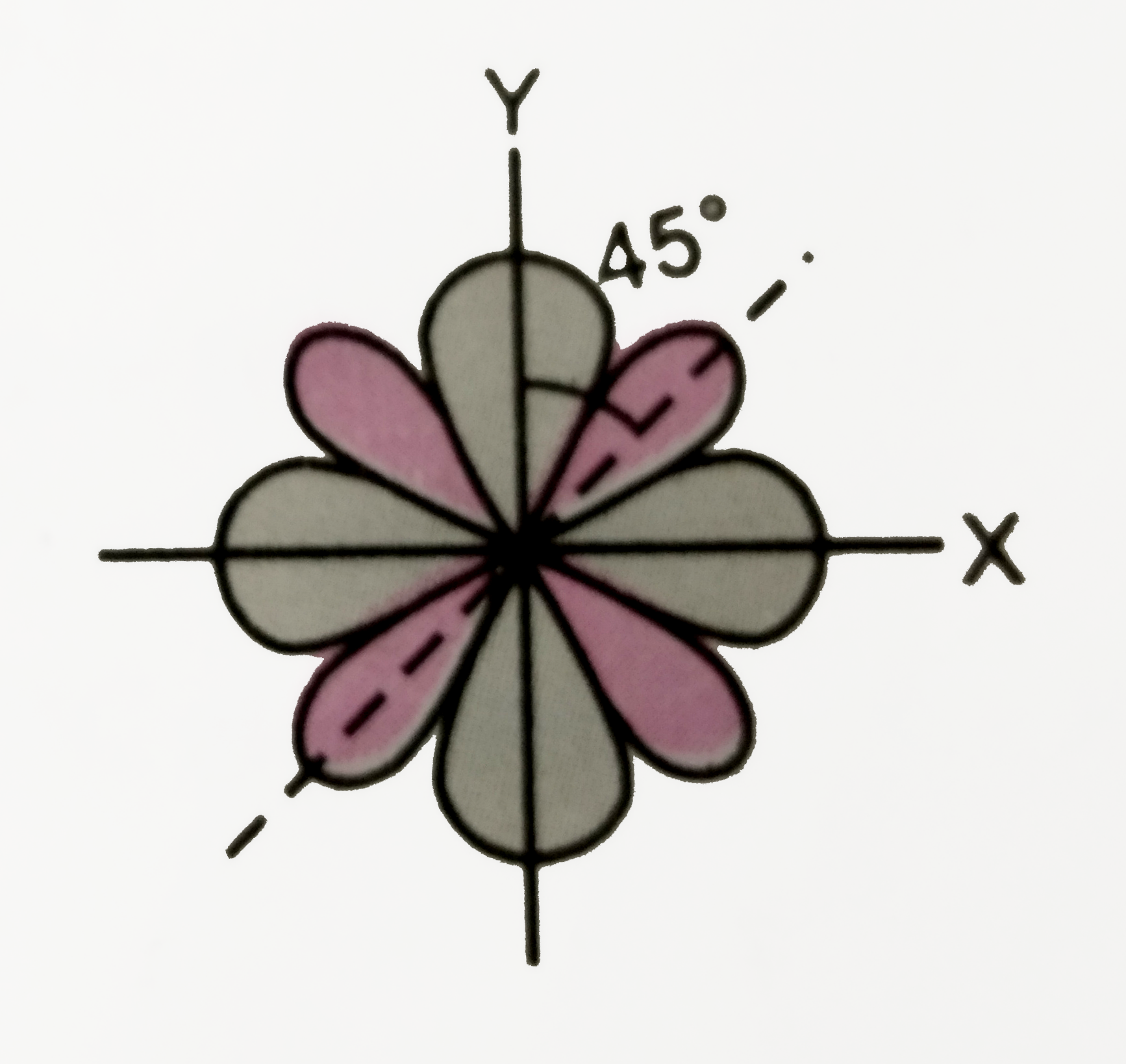
|
|
| 42. |
(i) What is dipole moment? (ii) Describe Fajan's rule. |
|
Answer» Solution :(i) 1. The polarity of a covalent bond can be measured in terms of dipole moment which is defined as: `m=qxx2d`, where m is the dipole moment, is the charge, 2d is the distance between the two charges. 2. The dipole moment is a vector quantity and the direction of the dipole moment points from the negative charge to positive charge. 3. The unit of dipole moment is Coulomb metre (C m). It is usually expressed in Debye unit (D). 4.1 Debye = `3.336xx10^(-30)Cm` (ii) 1. The ability of a cation to polarise an ANION is called its polarising ability and the tendency of an anion to get polarised is called its polarisibility. The extent of POLARISATION in an ionic compound is given by the Fajans rule. 2. To show greater covalent character, both the cation and anion should have high charge on them. HIGHER the positive charge on the cation greater will be the attraction on the electron anton. Similarly higher the magnitude of negative charge on anion, greater is its polarisability. For example, `Na^(+) 4. Cation having ns.npönd configuration shows greater polarising POWER than the cations with ns.np configuration. e.g., CUCL is more covalent than NaCl. |
|
| 43. |
(i) What is an ionic bond? (ii) Explain about the formation of ionic bond with a suitable example. |
|
Answer» Solution :(i) The complete transter oI electrons leads to the formation of a cation and an anion. Both these ions are HELD together by electrostatie attractive forces which is known as ioniç bond. (ii) KC1: Potassium chloride Electronic contiguration of `K = [Ar] 4s` Electronic contiguration of `CL = [Ne] 3s^(2)" "3p^(5)` (iii) Potassium has 1 ELECTRON in its valence shell and chlorine has 7 electrons in its valence shell. (iv) By losing one electron potassium attains the nearest inert gas configuralion ot Argon and becomes a unipositive cation `(K^(+))`and chlorine accepts this electron to become uninegative Chioride ION `(Cl^(-))` to attain the stable configuration of nearest noble gas, Argon. (v) ese two ions combine to form an ionic crystal in which they are held together by electrostatic attractive forces. (vi) ring the formation of one mole of potassium chloride crystal from its consTuent ions 16 KJ of energy is released. This favours the formation of KCI and its stabilisation. |
|
| 44. |
(i) What is a pi-bond? (ii)Discuss the formation of N_(2) molecule using MO theory. |
|
Answer» Solution :(i) PI-Bond: When two atomic orbitals overlap sideways, the resultaint covalet bond is called a pi `(pi)` bond. (ii) Formationof N, molecule using MO theory: 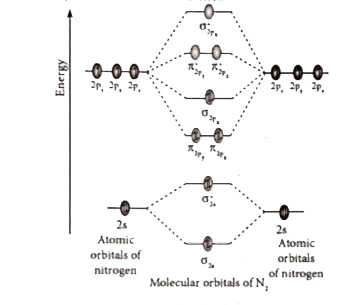 1. Electronic configuration of N atom `1S^(2)2s^(2)2P^(3)` . 2. Electronic confifuration of `N_(2)` molecule is `SIGMA1S^(2)sigmaast1s^(2)sigma2s^(2)sigmaast2s^(2)pi2p_(y)^(2)pi2p_(z)^(2)sigma2p_(x)^(2)` 3. Bond order `(N_(b)-(N_(a)))/(2) (10-4)/(2)=3` 4. Molecule has no unpaired ELECTRONES hence, it is diamagnetic. |
|
| 45. |
(i) What are spontaneous reaction? (ii) Prove that for an ideal gas C_(P) is greater than C_(V) |
|
Answer» Solution :(i). A reaction that does occur under the given set of conditions is called a spontaneous reaction. The expansion of a gas into a evauated bulb is a spontaneous process, the reverse process that is gathering of all molecules into one bulb is not spontaneous, This example shows that processes the occur spontaneously in one DIRECTION cannot take place in opposite direction spontaneously. Increase in randomness favours a spontaneous change. If enthalpy change of a process is negative, then the process is EXOTHERMIC and occurs sponteneously. Therefor `DeltaH` should be negative if entropy change of a process is positive, then the process occurs spontaneously, therefore `DeltaS` should be positive. If free energy of a process is negative, then the process occurs sponraneously, `therefore DeltaG` should be negative. For a spontaneous, irreversible process, `DeltaHit0,gt0,DeltaGit0.DeltaH=-ve, DeltaS=+ve and Delta=-ve` . (ii) 1. It is CLEAR that two heat capacities are not EQUAL and `C_(P)` greater than `C_(V)` by a factor which is related to the work done. 2. At a constant pressure, a part of a heat absorbed by the system is used up in increasing the internal energy of the system and the other for doing work by the system. 3. At constant volume the whole of heat absorbed is utlized in increasing the tempreture of the system as there is no work done by the system. Thus `C_(P)` is greater than `C_(V)` `C_(P)=(dH)/(dT), C_(V)=(dU)/(dT)` 4. By defination`H=U+PV` for 1 mole of an ideal gas H=U+RT By diffeentiating this question with repect to tempretureT, we get `(dH)/(dT)=(dU)/(dT)+R C_(P)=C_(V)+R,C_(P)-C_(V)=R` Thus for an ideal gas `C_(P)` is greater than `C_(V)` by the gas constant R. |
|
| 46. |
(i) The volume of N_(2) is measured by nitrometer. (ii) The weight of N_(2) is measured by nitrometer. (iii) The weight of NH_(3) is measured by nitrometer. (iv) The volume of NH_(3) is measured by nitrometer. |
| Answer» SOLUTION :(i-T), (ii-F), (iii-F), (iv-F) | |
| 47. |
(i) There are huge no. of organic compound because carbon atom is very small. (ii) No. of organic compound are huge because of catanation. (iii) Organic compound are in huge no. because of valency. |
| Answer» SOLUTION :`(i-F), (ii-T), (iii-F)` | |
| 48. |
(i) The stabilization of a half filled d-orbital is more pronounced than that of the p-orbital why? (ii) What are degenerate orbitals? |
|
Answer» Solution :(i) The exactly HALF filled ORBITALS have greater stability. The REASON for their stability are 1. SYMMETRY 2. exchange energy. 1. Symmetry: The half filled orbitals are more symmetrical than partially filled orbitals and this symmetry leads to greater stability. 2. Exchange energy: The electrons with same spin in the different orbitals of the same subshell can exchange their position. each such echange release energy and this is known as exchange energy. greater the number of exchanges, greater tha exchange energy and hence greater the stability. In d-orbital, 10 exchanges are possible but in p-orbital 6 exchanges are possible. So, d-orbital with 5 UNPAIRED electrons (10 exchanges)n i.e., half filled in more stable than p-orbital with 3 unpaired electrons (6 exchanges). (ii) Three different orientations in space that are possible for a p-orbital. all the three p-orbitals, namely `p_(x),p_(y)` and `p_(z)` have same energies and are called degenerate orbitals. * In the presence of magnetic or electric field, the degeneracy is lost. |
|
| 49. |
(i) The volatile liquid is purify by the fractional distillation and simple distillation. (ii) Two liiquids are separated by fractional distillation. (iii) The difference of low boiling point containing liquids are separated by fractional distillation. (iv) The difference of high boiling point containing liquids are separated by fractional distillation |
| Answer» SOLUTION :(i-F), (ii-F/T), (iii-T), (iv-F) | |
| 50. |
(i) The stability of carbocation is explain by delocalised structure of hyperconjugation. (ii) The stability of carbocation is explain by drawing the resonance structure. (iii) Hyperconjugation effect is (+) or (-) (iv) Mesomeric effect is (+) or (-) |
| Answer» SOLUTION :`(i-T), (ii-F), (iii-F), (iv-T)` | |