

Saved Bookmarks
This section includes 7 InterviewSolutions, each offering curated multiple-choice questions to sharpen your Current Affairs knowledge and support exam preparation. Choose a topic below to get started.
| 1. |
If two elements can combine to form more than one compound, the masses of one element that combine with a fixed mass of the other element, are in whole number ratio. (a) Is this statement true ? (b) If yes, according to which law ? (C) Give one example related to this law. |
|
Answer» Solution :(a) Yes, the given statement is TRUE. (b) According to the law of multiple proportions (c) `{:(H_(2),+,O,rarr,H_(2)O,,,H_(2),+,O_(2),rarr,H_(2)O_(2)),(2g,,16g,,18g,,,2g,,32G,,34g):}` Here, the masses of OXYGEN which combine with fixed MASS of hydrogen are in the simple ratio i.e., `16:32` or `1:2`. |
|
| 2. |
If two compounds have same empirical formula but different molecular formula then..... |
|
Answer» percentage PROPORTION of elements is DIFF. |
|
| 3. |
If travelling at same speeds, which of the following matter waves have the shortest wavelength ? |
|
Answer» Electron h is CONSTANT. So, GREATER the mass of matter waves, lesser is wavelength and vice-versa. In these matter waves, alpha particle `(He^(2+))` has higher mass, therefore, shortest wavelength. |
|
| 4. |
If travelling at same speeds, which of the following matter waves have the shortest wavelength? |
|
Answer» Electron |
|
| 5. |
If three elements P, Q and R crystallize in a cubic solid lattice with P atoms at the corners, Q atoms at the cube centre and R atoms at the centre of the faces of the cube, then write the formula of the compound. |
|
Answer» Hence, the formula is `PQR_3` |
|
| 6. |
If three element, P , Q and R crystallize in a cubic solid lattice with P atoms at he corners, Q atoms at the cube centre and R atoms of the faces of the cube, then write the formula of the compound. |
|
Answer» SOLUTION :Atoms P PER formula CELL =` 8 xx 1//8 =1 ` , Atoms Q per unit cell =1 , Atoms R per UNITCELL =1 , Atoms R per unit cell = ` 6 xx 1//2 =3` Hence the formula is ` PQR_(3)` |
|
| 7. |
If three electrons are lost by Mn^(3+), its final oxidation state would be |
| Answer» Answer :B | |
| 8. |
If this is passed in solution of 0.1 M Zn^(2+) and 0.01 M Cu^(2+) and concentration of S^(2-) made 8.1xx10^(-31) M . Precipitation of ZnS and CuS will take place ? K_(sp) of ZnS=3.0xx10^(-23) & K_(sp) of CuS=8.0xx10^(-34) . |
| Answer» SOLUTION :PRECIPITATION of CUS TAKE PLACE | |
| 9. |
If thermal energy predominates over intermolecular forces, then the substance changes from……..to…….. |
|
Answer» GAS to LIQUID |
|
| 10. |
If thermal energy predominates over intermolecular forces, then the substance changes from __to__ |
|
Answer» GAS to LIQUID |
|
| 11. |
If there is no change in concentration, why is the equilibrium state considered dynamic? |
| Answer» Solution :Chemical reactions which are reversible do not cease, when equilibrium is ATTAINED. At equilibrium the FORWARD and the BACKWARD reactions are proceeding at the same RATE and no macroscopic change is observed. So chemical equilibrium is in a STATE of dynamic equilibrium. | |
| 12. |
If there is no change in concentration why is the equilibrium state considered dynamic? |
| Answer» Solution :At chemical equilibrium the RATE of two opposing reactions are EQUAL and the concentration of reactants and products do not CHANGE with time. This condition is not STATIC and is DYNAMICS because both the forward and reverse reactions are still occurring with the same rate and macroscopic change is observed. So chemical equilibrium is in a state of dynamic equilibrium. | |
| 13. |
If there is no change in concentration, why is the equilibrium state considered dynamic ? |
| Answer» Solution :At chemical equilibrium the rate of two OPPOSING reactions are equal and the concentrationof reactants and PRODUCTS do not change with time. This CONDITION is not static and is dynamic, because both the forward and REVERSE reactions are still OCCURRING with the same rate and no macroscopic change is observed. So chemical equilibrium is in a state of dynamic equilibrium. | |
| 14. |
If there is a large energy gap between the filled valence band and empty conduction band, the substance acts as _______ |
|
Answer» |
|
| 15. |
If there be a compoud of the formula CH_(3)C(OH)_(3) which one of the following compounds would be obtained from it without reaction with any reagent |
|
Answer» `CH_(3)OH` 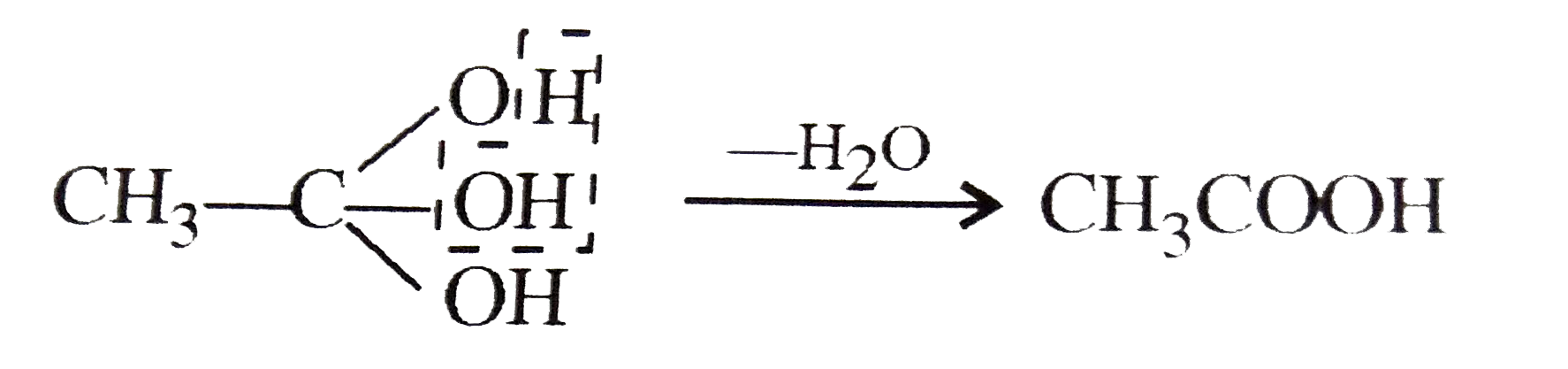
|
|
| 16. |
If there are three possible values (-1//2,0,+1//2) for the spin quantum, then electronic configuration of K (19) will be: |
|
Answer» `1S^(3),3s^(3)2p^(9),3s^(2)3p^(1)` |
|
| 17. |
If there are only two H-atoms each is in 3rd excited state then: |
|
Answer» maximum number of DIFFERENT PHOTONS emitted is 4 |
|
| 18. |
If there are 13 electrons in M shell and 1 electron in N shell th en the num ber of unpaired electrons in such atom will be..... |
|
Answer» 5  `therefore`Six unpaired electrons are p RESEN t in this |
|
| 19. |
If the weight of 5.6 lit of a gas at NTP is 11g, the gas may be (at.wt of P = 31, N = 14,0 = 16 and Cl = 35.5) |
|
Answer» `PH_3` |
|
| 20. |
If the wavelength of an electromagnetic radiation is 2000 A. what is its energy in ergs? |
|
Answer» `9.94xx10^(-12)` |
|
| 21. |
If the wavelength of the electron is numerically equal to the distance travelled by it in one second, then |
|
Answer» |
|
| 22. |
If thewavelengthanddistancetravelbyelectronin 1 sec . Issame thancalculatethe itsvelocity . |
| Answer» SOLUTION :`2.7 XX 10^(2) MS^(-1)` | |
| 23. |
If the volume of the racion flask is reduced to half of its initial value and temperature is kept constant the in which of the following cases the position of equilibrium will shift? |
|
Answer» `CO(g)+H_(2)O(g)hArrCO(2)(g)+H_(2)(g)` |
|
| 24. |
IF the volume of each molecule is 3.4 xx 10^(-24) cc, calculate the vacant space of 8 g of oxygen gas at 27^(@)C and one atmosphere pressure. |
| Answer» SOLUTION :`5.65 LIT | |
| 25. |
If the volume of a fixed mass of a gas is reduced to half at constant temperature, the gas pressure _________ |
|
Answer» REMAINS CONSTANT |
|
| 26. |
If the velocity of the electron in Bohr's first orbit is 2.19 xx 10^(6) m s^(-1), calculate the de Broglie wavelength associated with it. |
| Answer» SOLUTION :`lamda = (H)/(MV) = (6.626 XX 10^(-34) kg m^(2) s^(-1))/((9.11 xx 10^(-31) kg) (2.19 xx 10^(6) ms^(-1))) = 3.32 xx 10^(-10) m = 332` pm | |
| 27. |
If the values of Delta_(f) H^(@) for H_(2) O_(2) and H_(2) O are -188 and -286 "kJ mol"^(-1), then the value of Delta H^(@) = …. kJ for the following reaction - 2H_(2) O_(2(l)) to 2H_(2)O_((l)) + O_(2(g)) |
| Answer» ANSWER :B | |
| 28. |
If the value of principal quantum number is 3, the total possible values for magnetic quantum number will be |
|
Answer» 5 |
|
| 29. |
If the value of equilibrium constant for a particular reaction is 1.6 xx 10^(12) , then at equilibrium , the system willcontain |
|
Answer» mostly products |
|
| 30. |
if the value of azimuthal quantum number is 3, the possible values of the magnetic quantum number would be |
|
Answer» 0,1,2,3 |
|
| 31. |
If the value of Avogadro's number is changed to 1.0 xx 10^20, what would be the molecular mass of nitrogen gas ? |
|
Answer» |
|
| 32. |
If the value of Avogadro number is 6.023 xx 10^23 "mol"^(-1)and the value of Boltzmann constant is 1.380 xx 10^(-23) JK^(-1), then the number of significant digits in the calculated value of the universal gas constant is [Hint: Since k and N, both have four significant figures, the value of R is also rounded off up to four significant figures.] |
|
Answer» |
|
| 33. |
If the universal gas constant is 8.3 joule mol^(-1) K^(-1) and the Avogadro's number is 6 xx 10^(23). The mean kinetic energy of the oxygen molecules at 327^(@)C will be : |
|
Answer» `415 XX 10^(23)` joule |
|
| 34. |
If the value of an equilibrium constant for a particular reaction is 1.6 xx 10^12, then at equilibrium the system will contain: |
|
Answer» all reactants. `K=1.6xx10^12` The value of K is very high so the SYSTEM will contain mostly products at equilibrium. |
|
| 35. |
If the unit cell of a mineral has a cubic close packed (ccp) array of oxygen atoms with m fraction of octahedral holes occupied by magnesium ions , m and n, respectively are |
|
Answer» `1/2,1/8` `therefore` No. of octahedral voids = 4 and No. of tetrahedral voids=8 As m fraction of octahedral voids is occupied by `Al^(3+)` ions, therefore , `Al^(3+)` ions present =4 m . Similarly, `Mg^(2+)` ions =8 n. Hence, formula of the MINERAL is `Al_(4m) Mg_(8n)O_4`. As TOTAL charge on the COMPOUND is zero, hence 4 m (+3)+8 n(+2)+4 (-2)=0 or 12 m +16 n -8 =0 Substituting the GIVEN values of m and n , equation is satisfied only when `m=1/2` and `n=1/8` (as `12 xx1/2+16xx1/8-8=0`) |
|
| 36. |
If the unit cell of a minearl has a cubic close packed (ccp) array of oxygen atoms with m fraction of octahderal holes occupied by aluminium ions and n fraction of tetrahdral holes occupied by magnesium ions, m and n, respectively are |
|
Answer» `1/2 , 1/8` No.of octahedral voids = 4 and No. of tetrahedral voids = 8. As m fraction of octahedral voids is occupied by `Al^(3+)`ions. Therefore, `Al^(3+)`ions present = 4 m. similarly, ` Mg^(2+)`ions= 8 N. Hence, formula of the MINERAL is ` Al_(4m) Mg_(8n)O_(4)` . As total charge on the compound is zero, hence. 4 m ( +3)+ 8 n ( +2) + 4( -2) =0 or 12 m+ 16 n -8 =0 Substituting the given values of m and n m, EQUATION is satisfied only when ` m = 1/2 and n = 1/8` ` ( as 12 xx 1/2 + 16 xx 1/8 -8 =0 )` |
|
| 37. |
If the uncertainity in velocity of a moving object is 1.0 xx 10^(-6) ms^(-1) and the uncertainty in its position is 58m, the mass of this object is approximately equal to that of (h = 6.626 xx10^(-34) Js) |
|
Answer» Helium |
|
| 38. |
If the system does not lose heat or does not receive heat, then the process is called ......... . |
|
Answer» ISOBARIC process |
|
| 39. |
If the subsidiary quantum number of a subenergy level is 4, the maximum and minimum values of the spin multiplicities are : |
|
Answer» 9,1 |
|
| 40. |
If the starting material for the manufactureof silicons is RSiCl_(3), write the structure of the productformed . |
Answer» SOLUTION :HYDROLYSIS of alkyltrichlorosilanes GIVES cross-linked SILICONS. 
|
|
| 41. |
if the starting material is labelled with deuterium as indicated, predict how many total deuterium atoms will be present in the major elimination product ? |
| Answer» | |
| 42. |
If the starting material for the manufacture of silicones is RSiCl_(3), write the structure of the product formed. |
Answer» Solution : If the STARTING MATERIAL is `RSiCl_3`, a cross-linked silicone is OBTAINED as SHOWN below. 
|
|
| 43. |
If the starting material for the manufacture of silicones is RSiCl_3, write the structure of the product formed. |
Answer» SOLUTION :
|
|
| 44. |
If the standard molar enthalpy of formation of SO _(2 (g)) and SO _(3(g)) is - 296 . 82 kJ mol ^(-1) and -395 . 72 kJ mol ^(-1) respectively, then enthalpy change for thereaction in kJ mol ^(-1) ,SO _(2 (g)) + (1)/(2) O _(2 (g)) to SO _(3(g)) , is |
|
Answer» `-296.82` |
|
| 45. |
If the standard molar enthalpy of formation of CaO_((s)), CO_(2(s)) and CaCO_(3(s)) is -635, -393 and -1207kJ "mol"^(-1) respectively, the Delta_r H^(o.) in kJ mol^(-1) for the reaction CaCO_(3(s)) rarr CaO_((s)) + CO_(2(g)) is |
| Answer» ANSWER :D | |
| 46. |
If the speed of light is 3.0xx10^(8) ms^(-1), calculate the distance covered by light in 2.00 ns. |
|
Answer» Distance `= "speed " xx "TIME"` `=3XX10^(8) ms^(-1) xx 2.0 xx 10^(-9)s`. `=6.0xx10^(-1) m = 0.6 m` |
|
| 47. |
If the speed of light is 3.0 xx 108 m s^(–1), calculate the distance covered by light in 2.00 ns. |
|
Answer» Solution :Distance COVERED = speed `XX` time `=3.0 xx 10^(8) MS^(-1)xx 2.00 s` `=3.0 xx 10^(80) ms^(-1) xx 2.00 ns xx (10^(-9) s)/(1 ns)=6.00 xx 10^(-1) m = 0.600 m` |
|
| 48. |
If the solubility product of silver chloride is 1.8xx10^(-10). What is the solubility of silver ion if concentration of Cl^(-) is 0.01 molar. |
|
Answer» Solution :`K_(sp)=[Ag^(+)][CL^(-)]""1.8xx10^(-10)=[Ag^(+)]0.01` `[Ag^(+)]=(1.8xx10^(-10))/(0.01)=180xx10^(-10)=1.8xx10^(-8)"MOL"//dm^(3)` |
|
| 49. |
If the solubilityproduct of MOH is 1xx 10^(-10)mol^(2)dm ^(-2)Then the P^(H)of its aqueous solutions will be |
|
Answer» 12 ` therefore pH = 9` |
|
| 50. |
If the solubility of zirconium phosphate is x, what is its solubility product? What are the units of solubility product of Zr_3 (PO_4 )_4? |
|
Answer» Solution :Zirconium phosphate DISSOCIATES in aqueous solutions as `Zr_3 (PO_4)_4 hArr+3Zr^(4+)+ 4PO_(4)^(3-)` If x is the solubility, `[Zr^(4+)] =3S and [PO_(4)^(3-) ] = 4S` The solubility product `K_(sp)` is `Kp_(sp)= [Zr^(4+)] [PO_(4)^(3-) ]^4 =(3s)^2 (4s)^4 = 6912 s^7` The units of solubility product are : `mol^7L^(-7)` |
|