

Saved Bookmarks
This section includes 7 InterviewSolutions, each offering curated multiple-choice questions to sharpen your Current Affairs knowledge and support exam preparation. Choose a topic below to get started.
| 1. |
If Z is a compressibility factor, van der Waals equation at low pressure can be written as |
|
Answer» `Z=1+(Pb)/(RT)` `(P+(a)/(V^(2)))(V-b)=RT` At low PRESSURE, V is LARGE and therefore, b can be neglected in comparison to V so that `V-b~-V`. HENCE, `(P+(a)/(V^(2)))V=RT` or `PV+(a)/(V)=RT" or " PV=RT-(a)/(V)` or `(PV)/(RT)=1-(a)/(VRT)" or " Z=1-(a)/(VRT)` |
|
| 2. |
If Z is a compressibility factor, van der Waals equation at low pressure can be written as: |
|
Answer» `Z=1+(RT)/(PB)` |
|
| 3. |
If you have saturated solution of CaF_2then : |
|
Answer» ` [CA^(2+) ] =sqrt(K_(sp))` |
|
| 4. |
If you have a saturated solution of CaF_(2), then |
|
Answer» `[CA^(2+)] = (k_(SP)//4)^(1//3)` |
|
| 5. |
If (x/m) is the mass of the adsorbate adsorbed per unit mass of adsorbent, p is pressure of the adsorbate gas and a and b are constant, which of the following represent Langmuir adsorption isotherm ? |
|
Answer» <P>`LOG(x)/(m)=log((a)/(b))+(1)/(a) log p` |
|
| 6. |
If x' litres of O_(2) is released at STP from one litre of H_(2)O_(2) solution due to decomposition of H_(2)O_(2) then we lable such solution as 'x volume H_(2)O_(2) 2H_(2)O_(2) to 2H_(2)O+O_(2) 30% (w/v) H_(2)O_(2) is called perhydrol. How much volume of 224 volumes H_(2)O_(2)can completely reduce 10 ml of 0.1M KMnO, Into |
|
Answer» 25 ml `:. M=4N=22.4 vol =6.8 %w//v` `0.4xx0.5 ( :. 0.1 MkMnO_(4)-=0.5 KMnO_(4))` `V=12.5 ml` |
|
| 7. |
If x' litres of O_(2) is released at STP from one litre of H_(2)O_(2) solution due to decomposition of H_(2)O_(2) then we lable such solution as 'x volume H_(2)O_(2) 2H_(2)O_(2) to 2H_(2)O+O_(2) 30% (w/v) H_(2)O_(2) is called perhydrol. How much volume of 11.2 volumes H_(2)O_(2) is required to completely oxidise one mole of lead sulphite into lead sulphite? |
|
Answer» 2 Its 1mole z 4 MOLE `22.4 VOL H_(2)O_(2)=2M H_(2)O` `11.2 vol H_(2)O_(2)=1M H_(2)O_(2)=1` melt LT |
|
| 8. |
If X is the total number of collisions which a gas molecules registers with others per unit time under particular conditions, then the collision frequency of the gas containing 'N' molecules per unit volume is |
| Answer» ANSWER :D | |
| 9. |
If x is the fraction of PCl_5 dissociated at equilibrium in the reaction, PCl_5 hArr PCl_3 + Cl_2 then starting with 0.5 mole of PCl_5, the total number of moles of reactants and products at equilibriumis ………………………… . |
|
Answer» `0.5 - X` 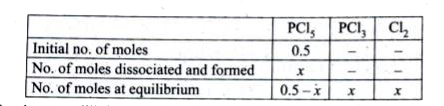 TOTAL no. of MOLES at equilibrium `= 0.5 - x + x + x= 0.5 + x` |
|
| 10. |
If x is the fraction of PCl_(5) dissociated at equilibrium in the reaction PCl_(5)hArrPCl_(3)+Cl_(2) then starting with 0.5 mole of PCl_(5), the total number of moles of reactants and products at equilibrium is |
|
Answer» `0.5-x` |
|
| 11. |
If x is the fraction of PC l_(5) dissociated at equilibrium in the reaction, PC l_(5) hArr PCl_(3)+Cl_(2) then starting with 0.5 mole of PC l_(5), the total number of moles of reactants and product at equilibrium is___ |
|
Answer» `0.5-x`  TOTAL no, of MOLES at EQUILIBRIUM`=0.5-x+x+x=0.5+x` |
|
| 12. |
If x g is the mass of NaHC_(2)O_(4) required to neutralize 100 ml of 0.2 M NaOH and y g that requiredto reduce 100 ml of 0.02 M KMnO_(4)in acidic medium then |
|
Answer» `x=y` EQ. of `NaHCl_(2)O_(4)` = Eq. of NaOH `(x)/(M)=(100xx0.2xx1)/(1000)...(1)` `NaHCl_(2)O_(4)` Vs `KMnO_(4)` is redox titration Eq. `NaHC_(2)O_(4)` = Eq. of `KMnO_(4)` `(y)/(M//2)=(100xx0.02xx5)/(1000)....(2)` from Eq. (1) % (2) = 1 `x=4y` |
|
| 13. |
if we take ethylidene chloride and isopropylidene chloride with zinc dust then product will be - |
|
Answer» 2-butene |
|
| 14. |
If we take 44 g of CO_(2) and 14 g of N_(2). What will be the mole fraction of CO_(2) in the mixture? |
|
Answer» `1/5` Number of moles of `N_(2)=(14)/28)=0.5` `therefore` Mole of fraction of `CO_(2)=(1)/(1+0.5)=(1)/(1.5)or= (2)/(3)` |
|
| 15. |
If we take 2.2 g of CO_2, 6.02 xx 10^21 atoms of nitrogen and 0.03 gram atom of oxygen, then the molar ratio of C,N and O atom will be |
|
Answer» `1:2:5` Moles of N `= (6.02xx10^(21))/(6.02xx10^(23))=0.01` Moles of O = 0.03 MOLAR ratio `CO_2 :N: O` is 0.05 : 0.01 : 0.03 is 5 : 1 : 3 |
|
| 16. |
If we rotate the structure (hcp) about an axis perependicular to the layers and passing through one sphere, we encounter the same structure'n' times in the course of a complete revolution then 'n' is |
|
Answer» |
|
| 17. |
If we subject gypsum to flame test ,We will gett a flame having a _____Colour. |
|
Answer» Briock red |
|
| 18. |
If we mix H_(2) and O_(2), they do not combine to form H_(2)O, is the reaction spontaneous or non-spontaneous? Give reason. |
| Answer» Solution :Reaction is spontaneous because it TAKES PLACE when intiated by an electric SPARK. | |
| 19. |
If we know the equilibrium constant for a particular reaction, we can calculate the concentration in the equilibrium mixture from the initial concentrations.Generally only the initial concentration of reactions are given. In a study of equilibrium H_(2)(g)+I_(2)(g)hArr2HI(g) 1 mole of H_(2) and 3 mol of I_(2) gave rise at equilibrium to x mol of HI, Further addition of 2 mol of H_(2) gave an additional x mol of HI. What is x ? |
|
Answer» 0.5 |
|
| 20. |
If we know the equilibrium constant for a particular reaction, we can calculate the concentration in the equilibrium mixture from the initial concentrations.Generally only the initial concentration of reactions are given. In above problem, what is K_(p) of the reaction? |
|
Answer» 1 |
|
| 21. |
If we consider that 1/6, in place of 1/12 mass of carbon atom is taken to be the relative atomic mass unit, the mass of one mole of a substance will:a.be a function of the molecular mass of the substanceb.remain unchangedc.increase two foldd.decrease twice. |
|
Answer» be a function of the molecular MASS of the substance |
|
| 22. |
If we consider that 1/6 in place of 1/2 men of caron is taken is taken to be the relation atomic mass orbit, the mass of the mole of substance will |
|
Answer» increase two fold |
|
| 23. |
If we assume 1//24 th part of mass of carbon instead of 1//12 th part of it as 1 amu, mass of 1 mole of a substance will |
|
Answer» Remain unchanged |
|
| 24. |
If wavelength of neutron beam used in neutron microscope is 800 pm, calculate the velocity associated with the neutron (Mass of neutron 1.675xx10^(-27)kg) |
| Answer» Solution :`lambda=h/(mv)orv=h/(mlambda)=(6.626xx10^(-34))/(1.675xx10^(-27)xx800xx10^(-12)m)=494ms^(-1)` | |
| 25. |
If water vapour is assumed to be a perfect gas, molar enthalpy change for vapourisation of 1 mol of water at 1 bar and 100°C is 41 kJ "mol"^(-1). Calculate the internal energy change, when (i) 1 mol of water is vaporised at 1 bar pressure and 100°C. (ii) 1 mol of water is converted into ice. |
|
Answer» Solution :(i) The change `H_(2) O_((l)) to H_(2) O_((G))` `DeltaH= Delta U + Deltan_(g) RT` OR `Delta U = Delta H - Deltan_(g) RT`, substituting the VALUES we gat. `Delta U = 41.00 "kJ mol"^(-1) - 1xx 8.3 "J mol"^(-1) K^(-1) xx 373 K` `= 41.00 "kJ mol"^(-1) -3.096 "kJ mol"^(-1)` `= 37.904 "kJ mol"^(-1)` (ii) The change `H_(2) O_((l)) to H_(2) O_((s))` There is negligible change in volume So, we can PUT `pDelta V=Deltan_(g) RT~~0` in this CASE, `Delta H ~=Delta U` So, `Delta U = 41.00 "kJ mol"^(-1)` |
|
| 26. |
If water vapour is assumed to be perfect gas, molar enthalpy change at 1 bar and 100^(@)C is 41 kJ mol^(-1). Calculate the internal energy change when (i) 1 mol of water is vaporised at 1 bar pressure and 100^(@)C. (ii) 1 mol of water is converted into ice. |
|
Answer» SOLUTION :(i) For vaporisation of water, the change is `: H_(2)O (l ) rarr H_(2)O(g)` `Delta n_(g) = 1 -0=1` ` Delta H = Delta U + Delta n_(g) RT` or `Delta U = Delta H - Delta n_(g) RT = 41.00 kJ mol^(-1) - ( 1 mol) xx ( 8.314 xx 10^(-3)kJ K^(-1) mol^(-1)) ( 373 K) ` `= 41.00 - 3.10 k J mol^(-1) = 37.90 kJ mol^(-1)` (ii) For conversion of water into ice, the change is`H_(2)O(l) rarr H_(2)O(s)` In this case, the volume change in negligible. Hence, `Delta H =Delta U = 41.00 kJ mol^(-1)` |
|
| 27. |
If water kept in an insultated vesselat - 10^(@)C suddenly freezes, the entropy change of the system |
|
Answer» decreases |
|
| 28. |
If w_(1), w_(2), w_(3) and w_(4) for an ideal gas are magnitude of work done in isothermal, adiabatic, isobaric and isochoric reversible expansion processes, the correct order will be : |
|
Answer» `w_(1) gt w_(2) gt w_(3) gt w_(4)` 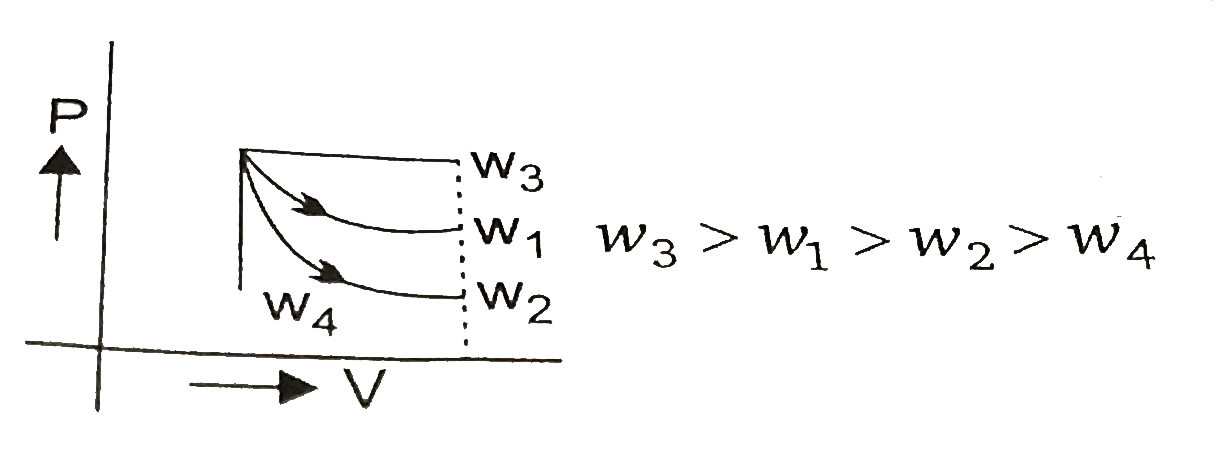
|
|
| 29. |
If w_1, w_2, w_3, and we are work done in isothermal adiabatic, isobaric and isochoric reversible processes, then the correct sequence (for expansion) would be |
|
Answer» `w_1 GT w_2 gt w_3 gt w_4` |
|
| 30. |
If W_1 and W_2 are the weights of two reactants in any reaction, having their equivalent weights E_1 and E_2 respectively, which of the following equations represents the law of equivalence correctly? (a) W_1 E_1 = W_2 E_2 (b) W_1 E_2 = W_2 E_1 ( c ) W_1 W_2 = E_1 E_2 |
|
Answer» SOLUTION :The ANSWER is (B), because NUMBER of EQUIVALENTS `= W_1 // E_1 = W_2 // E_2`. |
|
| 31. |
If volume of the gas is very large, then the second virial coefficient B in virial equation is |
|
Answer» `(b+(a)/(RT))` `PV+(a)/(V)-(ab)/(V^(2))-Pb=RT` If V is very large, `(ab)/(V^(2))` can be neglected. HENCE, `PV+(a)/(V)-Pb=RT` or `PV=RT+Pb=(a)/(V)=RT+(RT)/(V)b-(a)/(V)` `=RT[1+(1)/(V)(b-(a)/(RT))]` COMPARING with the virial EQUATION `PV=RT[1+(1)/(B)+...]` `B=b-(a)/(RT)` |
|
| 32. |
If volume of N_(2) gas at STP is 204.75 mL then calculate volume of gas at 1.5 bar pressure at 127^(@)C temperature. |
|
Answer» |
|
| 33. |
Ifvant Hoff factor , i = 1 ,then |
|
Answer» It is dissociation |
|
| 34. |
If van der Waal's parameters for gases P,Q,R and S are given as |
|
Answer» P |
|
| 35. |
If volume occupied by CO_2 molecules is negligible, then the pressure exerted by one mole of CO_2 gas in terms of temperature (T), assuming V to be single valued, is |
|
Answer» `P = (RT)/(4a)` `implies (P + (an^2)/(V^2)) V = NRT` `PV^2 + an^2 - nRT V = 0` single value `implies ` determinant = 0 `(RT)^2 - 4Pa = 0 implies P = (R^2 T^2)/(4a)`. |
|
| 36. |
If values of DeltaH_f^@of ICl_((g)), Cl_((g)) and I_((g)) are respectively 17.57, 121.34, 106.96 J mol^(-1). The value of I - Cl (bond energy) in J mol^(-1) is: |
|
Answer» 17.57 |
|
| 37. |
If value of R = 8.314 then, Given its unit. |
| Answer» SOLUTION :`8.314 J K^(-1)MOL^(-1)` are 8.314 Pa `m^(-3)K^(-1)mol^(-1)` | |
| 38. |
If v_(0) is the velocity of electron in the first orbit of hydrogen atom, then the velocity of electron in the first orbit of Li^(2+) ion will be..... |
|
Answer» `v_(0)` |
|
| 39. |
If V is the observed molar volume of real gas and V_(id) is the molar volume of an ideal gas then Z is |
|
Answer» `V V_(id)` |
|
| 40. |
If uncertainty in velocity is6.62xx10^(-2)m//sec . For a particle of mass of (0.05)/pigm. Its uncertinty in position may be |
|
Answer» `0.5xx10^(-14)` `Delta"x"ge (10^(-19))/(0.2)""rArrDelta"x"ge0.5xx10^(-18)` |
|
| 41. |
The product of uncertainty in the position and uncertainty in velocity of a particle is 5.79 xx 10^(-5)m^2 s^(-1). If uncertainty in the position is 1 nm , what is the uncertainty in the measurement of its velocity in m s^(-1) ? |
|
Answer» `m Delta v = (h)/(Delta lambda) , Delta lambda = 25 = xtherefore x/5 = 5 ` |
|
| 42. |
Ifuncertainty in position and velocity are equal then uncertainty in momentum will be: |
|
Answer» `1/2 sqrt((mh)/(pi))` `(Deltav)^2 = (Deltax)^2 = (h)/(4pi m), mDelta v =sqrt((mh)/(rpi))` |
|
| 43. |
If uncertainty in position and momentum are qual, that minimum uncertainty in velocity is |
|
Answer» `1/m SQRT(H/pi)` `Deltap.Deltap ge h/pi` `Deltap^2 ge h/(4pi)` `m^2(Delta V)^2 ge h/(4pi)` `(Delta V) ge sqrt((h)/(4pi m^2))` `Delta V ge 1/(2m) sqrt(h/pi)` |
|
| 44. |
If uncertainty in position and momentum are equal,then minimum uncertainty in velocity is…………….. |
|
Answer» `1/(m)SQRT(h/pi)` `/_\p./_\pgeh/(4pi)` `/_\P^2geh/(4pi)` `m^2(/_\V)^2geh/(4pi)` `(/_\v)gesqrt(4/(4pim^2))` `/_\GE1/(2m)sqrt(4/(pi)` |
|
| 45. |
If uncertainties in the measurement of position and momentum of an electron are found to be equal in magnitude, what is the uncertainty in the measurement of velocity of the electron ? Comment on the result obtained |
|
Answer» Solution :`Deltax xx Delta p = (h)/(4pi)`. As `Delta X = Deltap :. (Deltap)^(2) = (h)/(4pi) or Deltap = sqrt((h)/(4pi)) or m xx Deltav = sqrt((h)/(4pi))` or `Delta v = (1)/(m) sqrt((h)/(4pi)) =(1)/(9.11 xx 10^(-31)) xx sqrt((6.626 xx 10^(-34))/(4 xx 3.14)) = (0.726 xx 10^(-17))/(9.11 xx 10^(-31)) = 7.98 xx 10^(12) ms^(-1)` THUS, uncertainty in velocity is GREATER than the velocity of light which is impossible. Thus, the two uncertainties cannot be EQUAL in magnitude. |
|
| 46. |
if uncertaintyin position and momentum are equalthenuncertaintyin velocityis |
|
Answer» `(1)/(2M) SQRT((H)/( pi))` |
|
| 47. |
If uncertainty in momentum of electron is three times the uncertainty in position, then uncertainty in velocity of electron would be: |
|
Answer» `(1)/(4m)sqrt((h)/(3pi))` `therefore(Deltap)/(3)*Deltap GE (h)/(4pi)","Deltap=sqrt((3h)/(4pi))` `mDeltav=sqrt((3h)/(4pi))","DELTAV=(1)/(2m)sqrt((3h)/(pi))` |
|
| 48. |
If two gases A and B and temperatures T_(A) and T_(B) respectively have identical Maxwellian plots, then which of the following statements is true? |
|
Answer» `T_(B)=T_(A)` |
|
| 49. |
If two gases have same value of a but different values of b(a and b are van der Waal's constant) which of the following statement is wrong? |
|
Answer» The gas having smaller value of B has LARGER copressibility |
|