Saved Bookmarks
This section includes 7 InterviewSolutions, each offering curated multiple-choice questions to sharpen your Current Affairs knowledge and support exam preparation. Choose a topic below to get started.
| 1. |
It is tempting to think that all possible transitions are permissible, and that an atomic spectrum arises from the transition of the electron from any initial orbital to any other orbital. However, this is not so, because a photon has an intrinsic spin angular momentum of sqrt2 (h)/(2pi) corresponding to S = 1 although it has no charge and no rest mass. On the other hand, an electron has got two types of angular momentum :Orbital angular momentum, L=sqrt(l(l+1))h/(2pi) and spin angular momentum, arising from orbital motion and spin motion of electron respectively. The change in angular momentum of the electron during any electronic transition mush compensate for the angular momentum carries away by the photon. to satisfy this condition the difference between the azimuthal quantum numbers of the orbital within which transition takes place must differ by one. Thus, an electron in a d-orbital (1 = 2) cannot make a transition into an s = orbital (I = 0) because the photon cannot carry away enough angular momentum. An electron as is well known, possess four quantum numbers n, I, m and s. Out of these four I determines the magnitude of orbital angular momentum (mentioned above) while (2n m determines its z-components asm((h)/(2pi)) the permissible values of only integers right from -1 to + l. While those for I are also integers starting from 0 to (n − 1). The values of I denotes the sub shell. For I = 0, 1, 2, 3, 4,..... the sub-shells are denoted by the symbols s, p, d, f, g, .... respectively The spin-only magnetic moment of free ion is sqrt(8)B.M. The spin angular momentum of electron will be |
|
Answer» `sqrt2 (H)/(2PI)` No. of unpaired electrons = 2 `s= 1/2 + 1/2 =1` `L_s = sqrt(s(s+1)) h/(2pi) = sqrt2 (h)/(2pi)` |
|
| 2. |
It is tempting to think that all possible transitions are permissible, and that an atomic spectrum arises from the transition of the electron from any initial orbital to any other orbital. However, this is not so, because a photon has an intrinsic spin angular momentum of sqrt2 (h)/(2pi) corresponding to S = 1 although it has no charge and no rest mass. On the other hand, an electron has got two types of angular momentum :Orbital angular momentum, L=sqrt(l(l+1))h/(2pi) and spin angular momentum, arising from orbital motion and spin motion of electron respectively. The change in angular momentum of the electron during any electronic transition must compensate for the angular momentum carries away by the photon. to satisfy this condition the difference between the azimuthal quantum numbers of the orbital within which transition takes place must differ by one. Thus, an electron in a d-orbital (1 = 2) cannot make a transition into an s = orbital (I = 0) because the photon cannot carry away enough angular momentum. An electron as is well known, possess four quantum numbers n, I, m and s. Out of these four I determines the magnitude of orbital angular momentum (mentioned above) while (2n m determines its z-components asm((h)/(2pi)) the permissible values of only integers right from -1 to + l. While those for I are also integers starting from 0 to (n − 1). The values of I denotes the sub shell. For I = 0, 1, 2, 3, 4,..... the sub-shells are denoted by the symbols s, p, d, f, g, .... respectively The orbital angular momentum of an electron in p-orbital makes an angle of 45^@ from Z-axis. Hence Z-component of orbital angular momentum of election is : |
|
Answer» `H/pi` `m = sqrt(1(2)) cos 45^@` Z- component of O.A.M = `h/(2pi)` |
|
| 3. |
It is tempting to think that all possible transitions are permissible, and that an atomic spectrum arises from the transition of the electron from any initial orbital to any other orbital. However, this is not so, because a photon has an intrinsic spin angular momentum of sqrt2 (h)/(2pi) corresponding to S = 1 although it has no charge and no rest mass. On the other hand, an electron has got two types of angular momentum :Orbital angular momentum, L=sqrt(l(l+1))h/(2pi) and spin angular momentum, arising from orbital motion and spin motion of electron respectively. The change in angular momentum of the electron during any electronic transition must compensate for the angular momentum carries away by the photon. to satisfy this condition the difference between the azimuthal quantum numbers of the orbital within which transition takes place must differ by one. Thus, an electron in a d-orbital (1 = 2) cannot make a transition into an s = orbital (I = 0) because the photon cannot carry away enough angular momentum. An electron as is well known, possess four quantum numbers n, I, m and s. Out of these four I determines the magnitude of orbital angular momentum (mentioned above) while (2n m determines its z-components asm((h)/(2pi)) he permissible values of only integers right from -1 to + l. While those for I are also integers starting from 0 to (n − 1). The values of I denotes the sub shell. For I = 0, 1, 2, 3, 4,..... the sub-shells are denoted by the symbols s, p, d, f, g, .... respectively The maximum orbital angular momentum of an electron with n= 5 is |
|
Answer» `sqrt(16) h/(2PI)` `=sqrt(l(l+1)) h/(2pi)` n=5 , so l=0,1,2,3,4 for maximum |
|
| 4. |
It is required to raise the temperature of water of a swimming pool from 20^(@)C to 25^(@)C . The pool holds 10^(5) L of water. How much energ in joules will be required ? Given that the specific heat of water is 4.184 JK^(-1) g^(-1) |
|
Answer» |
|
| 5. |
It is planned to carry the reaction CaCO_(3)(s) hArr CaO (s) +CO_(2)(g) at 1273K and 1 bar (a) Is this reaction spontaneous at this temperature and pressure ? (b) Calculate the value of (i) K_(p) at 1273 K for the reaction and (ii) partial pressure of CO_(2) at equilibrium Given Delta_(f) H^(@) values (kJ mol^(-1)): CaCO_(3)(s) =-1206.9, CaO(s)= - 635.1, CO_(2)(g) = - 393.5 S^(@)value (JK^(-1) mol^(-1)) CaCO_(3)(s) =92.9, CaO(s) = 39.8, CO_(2)(g) = 213.7. |
|
Answer» SOLUTION :(a) `Delta_(r) H^(@) = Delta_(f) H^(@) ( CaO) +Delta_(f)H^(@) ( CO_(2))]-[Delta_(f)H^(@) ( CaCO_(3))]` `= [ - 635.1 + ( -393.5) ] -( - 1206.9 )= + 178.3 kJ MOL^(-1)` `Delta_(r)S^(@) = [S^(@) ( CaO) + S^(@) ( CO_(2)) ] - [S^(@)(CaCO_(3))]` `= ( 39.8 +213 .7)- 92.9= + 160.6 JK^(-1) mol^(-1)` `Delta_(r)G^(@) =Delta_(r)H^(@) - T Delta_(r)S^(@)` `= 178300 Jmol^(-1) - 1273 K xx 160.6 JK^(-1) mol^(-1)` `= - 26143.8 J mol^(-1) = 26144 mol^(-1) = 26.1 kJ mol^(-1)` As`Delta_(r) G^(@)` is negative, hence the reaction is spontaneous (b)(i)`DeltaG^(@) = - 2.303 RT log K_(p)` or `log K_(p) = ( - 26144 J mol^(-1))/( 2.303 xx 8.314 JK^(-1) xx 1273 K )` `= 1.0726` `K_(p) =` Antilog `1.0726 = 11.82` Applying LAW of chemical equilibrium `K_(p) = p_(CO_(2)) = 11.82` BAR |
|
| 6. |
It is not possible to measure the atomic radius precisely since the electron cloud surrounding the atom doesnot have sharp boundary. One practical approach to estimate the size of an atom of a non-metallic element is to measure the distance between two atoms when they are bound together by a single bond in a covalent molecule and then dividing by two. For metals we define the term "metallic radius" which is taken as half the internuclear distance separating the metal cores in the metallic crystal. The vander Waal's radius represents the overall size of the atoms which includes its valence shell in a nonbonded situation. It is the half of the distance between two similar atoms in separate molecules in a solid. The atomic radius decreases across a period and increases down the group. Same trends are observed in case of ionic radius. Ionic radius of the species having same number of electrons depends on the number of protons in their nuclei. Which one among the following sets of ions represents the collection of isoelectronic species? |
|
Answer» `S^(2-) , Cl^(-) , K^(+) , CA^(2+) , Sc^(3+)` |
|
| 7. |
It is not possible to measure the atomic radius precisely since the electron cloud surrounding the atom doesnot have sharp boundary. One practical approach to estimate the size of an atom of a non-metallic element is to measure the distance between two atoms when they are bound together by a single bond in a covalent molecule and then dividing by two. For metals we define the term "metallic radius" which is taken as half the internuclear distance separating the metal cores in the metallic crystal. The vander Waal's radius represents the overall size of the atoms which includes its valence shell in a nonbonded situation. It is the half of the distance between two similar atoms in separate molecules in a solid. The atomic radius decreases across a period and increases down the group. Same trends are observed in case of ionic radius. Ionic radius of the species having same number of electrons depends on the number of protons in their nuclei. Which of the following statement is correct? |
|
Answer» Metallic radius REFER to metals only and is greater than covalent radius |
|
| 8. |
It is not possible to measure the atomic radius precisely since the electron cloud surrounding the atom doesnot have sharp boundary. One practical approach to estimate the size of an atom of a non-metallic element is to measure the distance between two atoms when they are bound together by a single bond in a covalent molecule and then dividing by two. For metals we define the term "metallic radius" which is taken as half the internuclear distance separating the metal cores in the metallic crystal. The vander Waal's radius represents the overall size of the atoms which includes its valence shell in a nonbonded situation. It is the half of the distance between two similar atoms in separate molecules in a solid. The atomic radius decreases across a period and increases down the group. Same trends are observed in case of ionic radius. Ionic radius of the species having same number of electrons depends on the number of protons in their nuclei. Atomic radii of the noble gases are larger than the precedent elements of the same periods because |
|
Answer» ATOMIC radius of a NOBLE gas is expressed as VANDER Waal's radius |
|
| 9. |
It is not possible to measure the atomic radius precisely since the electron cloud surrounding the atom doesnot have sharp boundary. One practical approach to estimate the size of an atom of a non-metallic element is to measure the distance between two atoms when they are bound together by a single bond in a covalent molecule and then dividing by two. For metals we define the term "metallic radius" which is taken as half the internuclear distance separating the metal cores in the metallic crystal. The vander Waal's radius represents the overall size of the atoms which includes its valence shell in a nonbonded situation. It is the half of the distance between two similar atoms in separate molecules in a solid. The atomic radius decreases across a period and increases down the group. Same trends are observed in case of ionic radius. Ionic radius of the species having same number of electrons depends on the number of protons in their nuclei. The correct order of radii is |
|
Answer» `Na lt Li lt K` |
|
| 10. |
It is not possible to measure the atomic radius precisely since the electron cloud surrounding the atom doesnot have sharp boundary. One practical approach to estimate the size of an atom of a non-metallic element is to measure the distance between two atoms when they are bound together by a single bond in a covalent molecule and then dividing by two. For metals we define the term "metallic radius" which is taken as half the internuclear distance separating the metal cores in the metallic crystal. The vander Waal's radius represents the overall size of the atoms which includes its valence shell in a nonbonded situation. It is the half of the distance between two similar atoms in separate molecules in a solid. The atomic radius decreases across a period and increases down the group. Same trends are observed in case of ionic radius. Ionic radius of the species having same number of electrons depends on the number of protons in their nuclei. The size of iso electronic species -F^(-) , Na^(+) and Mg^(2+) is effected by |
|
Answer» NUCLEAR charge |
|
| 11. |
It is not possible to determine precisely both the position and the momentum or velocity) of a small moving particle (e.g. electron , proton, etc) The uncertainity in position and velocity of a particle are 10^(-10)m and 5.27 xx 10^(-24) ms^(-1) respectively, Calculate the mass of the particle. (h = 6.625 xx 10^(-34)J-s) |
|
Answer» Solution :According to Heisenberg.s uncertainityprinciple , `Deltax . M Delta upsilon impliesm =(h)/(4 pi Delta X . Delta upsilon)` `=(6.625 xx 10^(-34))/(4xx 3.143 xx 10^(-10) xx 5.27 xx 10^(-24)) = 0.099 kg ` |
|
| 12. |
It is not possible to determine precisely both the position and the momentum or velocity) of a small moving particle (e.g. electron , proton, etc) Calculate the uncertainity in velocity of a cricket ball of mass 150 g if the uncertainity in its position is of the order of 1 Å (h = 6.6 xx 10^(-34) kgm^(2)s^(-1)) |
|
Answer» `3.8 xx 10^(-25) MS^(-1)` |
|
| 13. |
It is not possible to determine precisely both the position and the momentum or velocity) of a small moving particle (e.g. electron , proton, etc) The above statements is known as : |
|
Answer» de-Broglie.s principle |
|
| 14. |
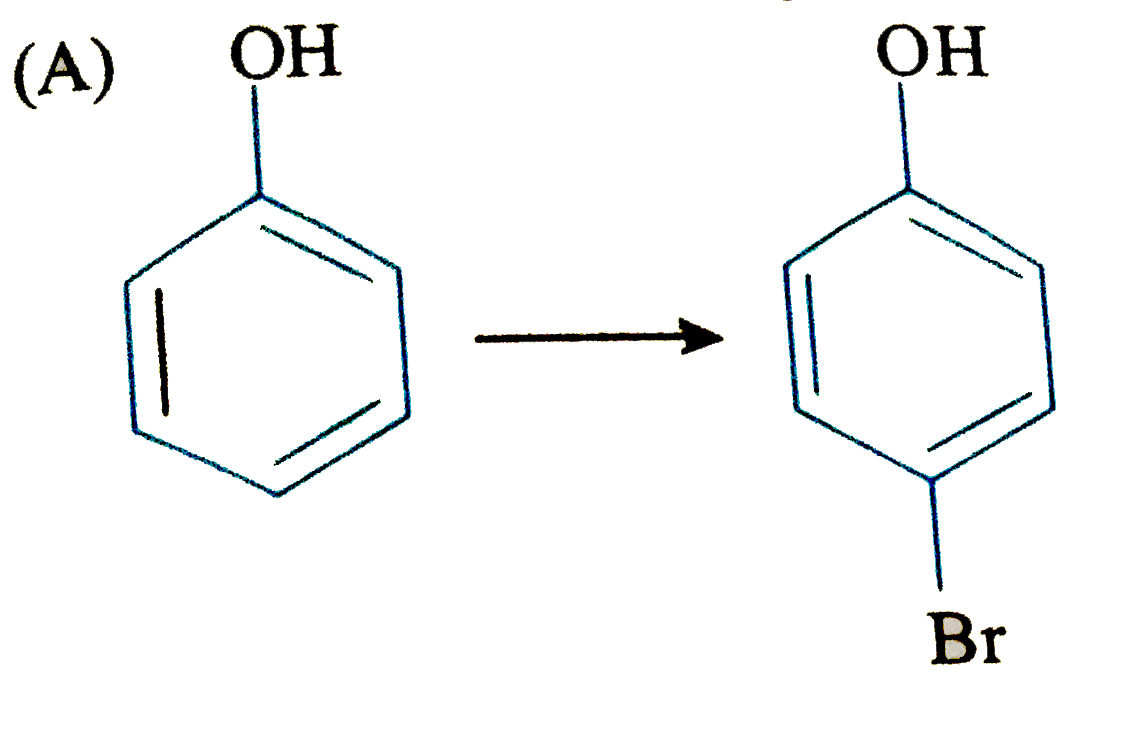
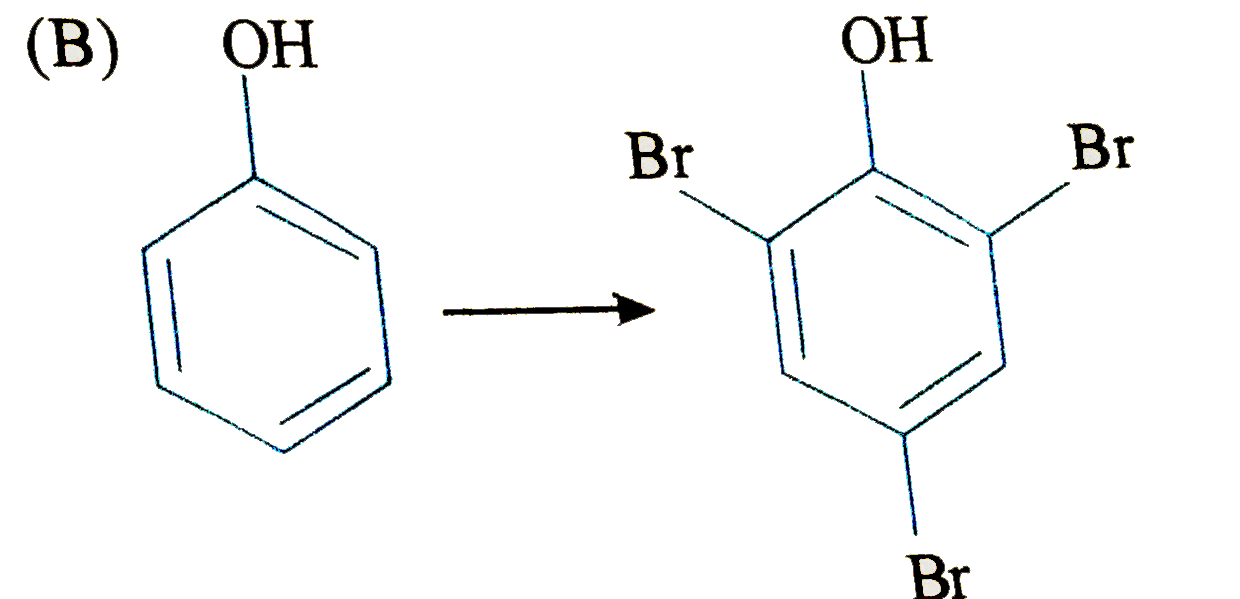
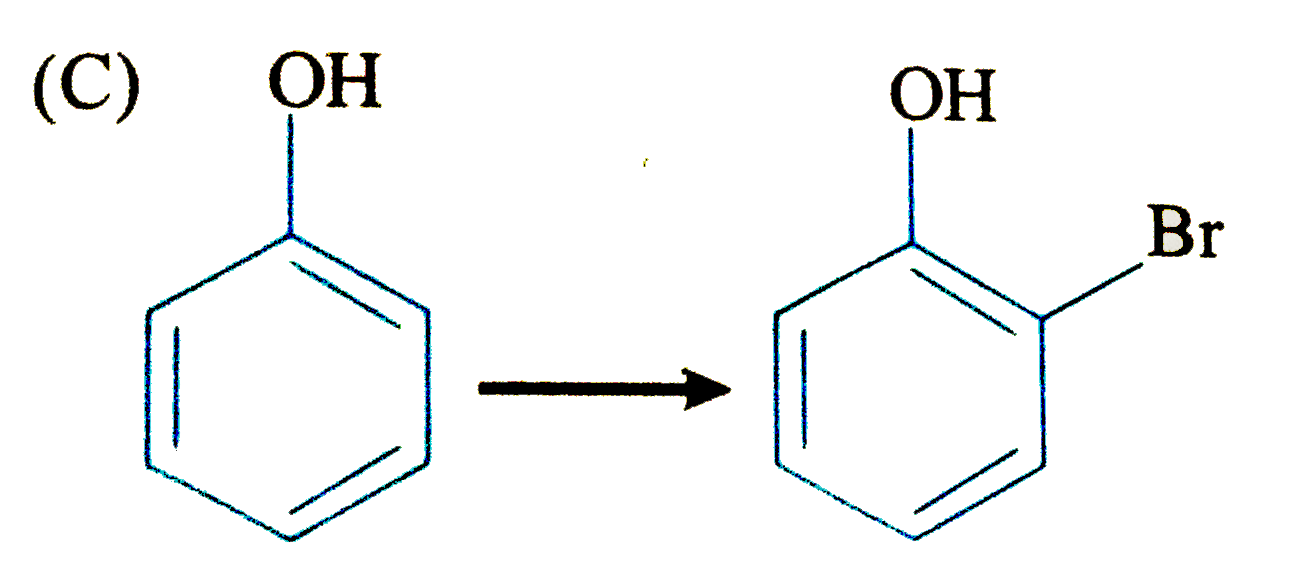
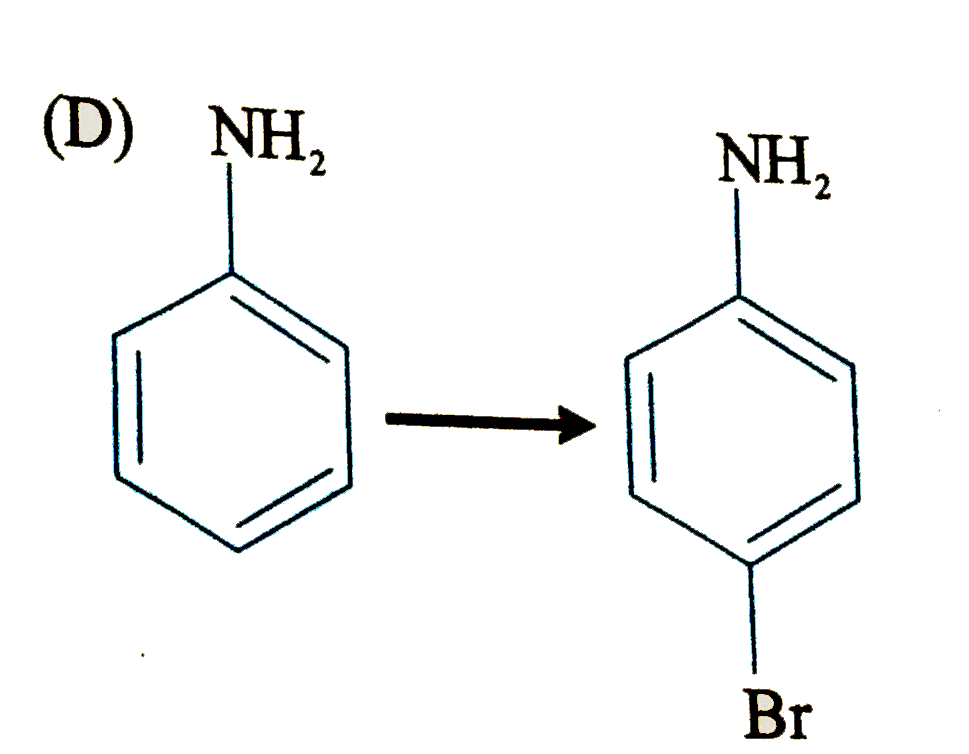
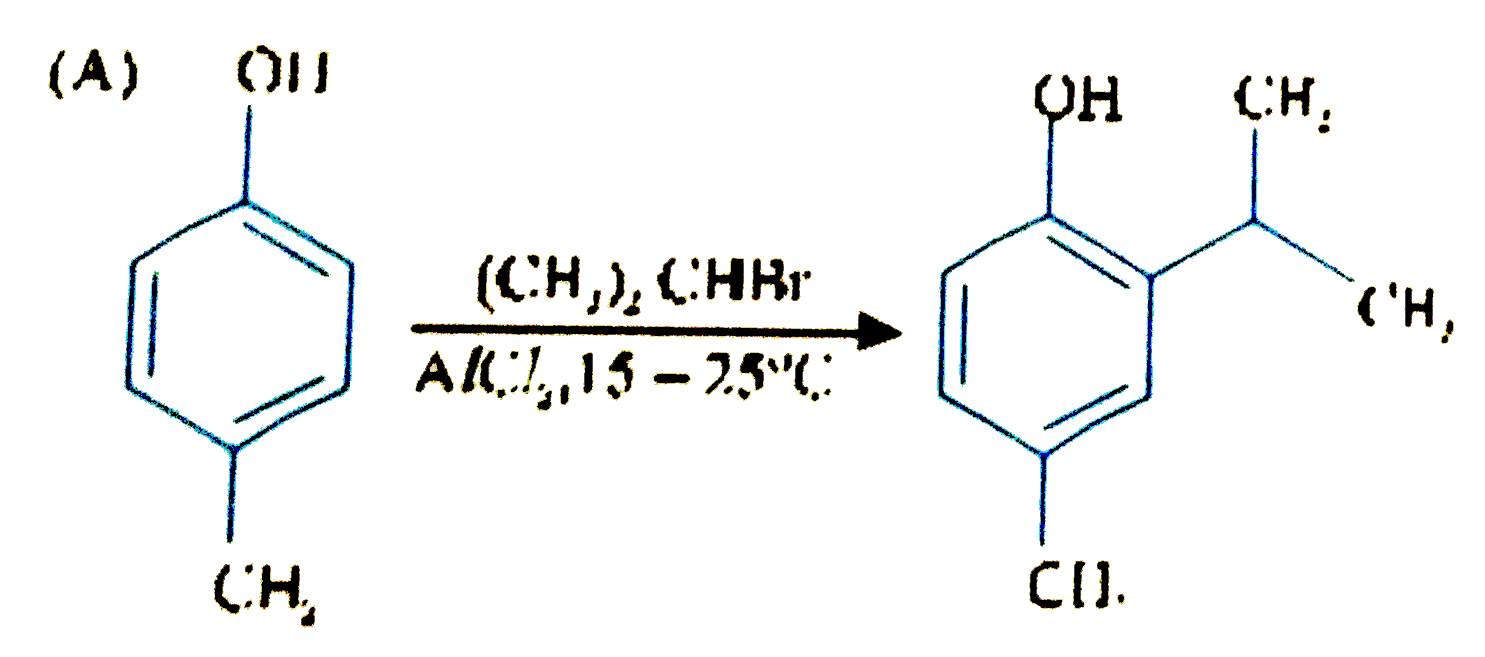
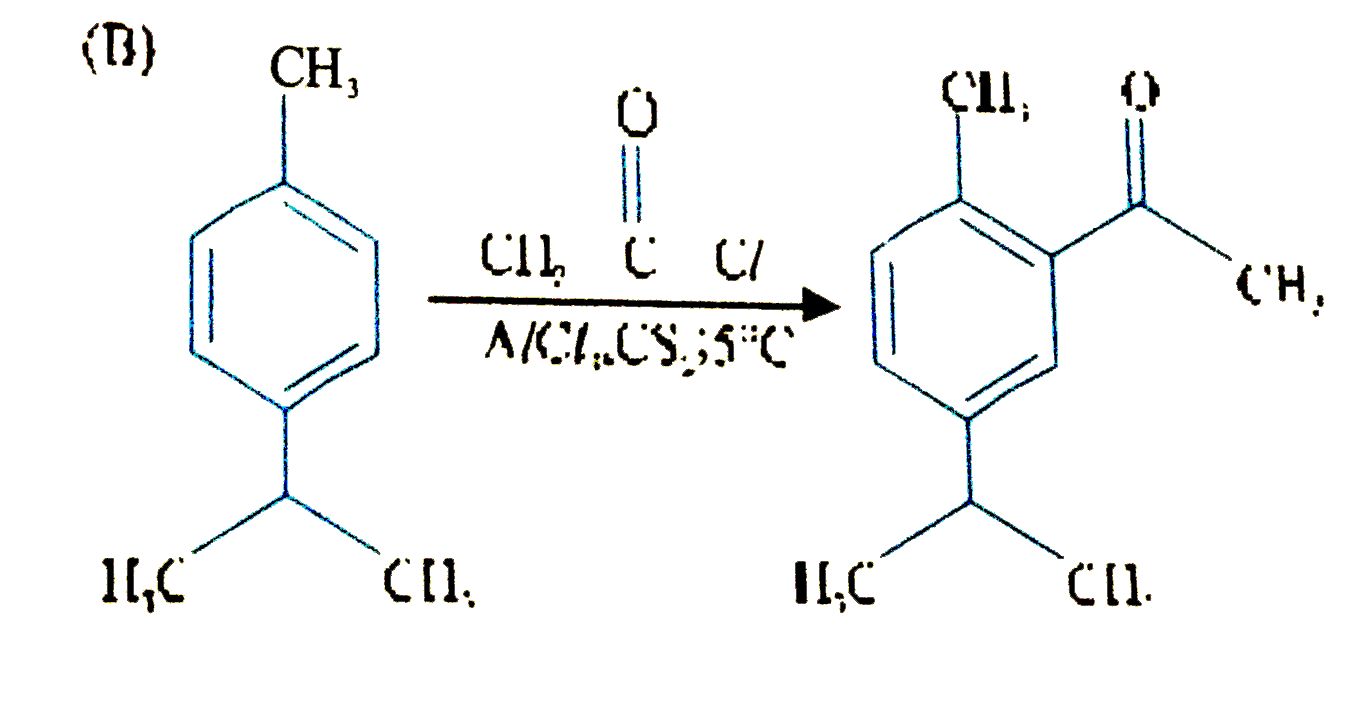
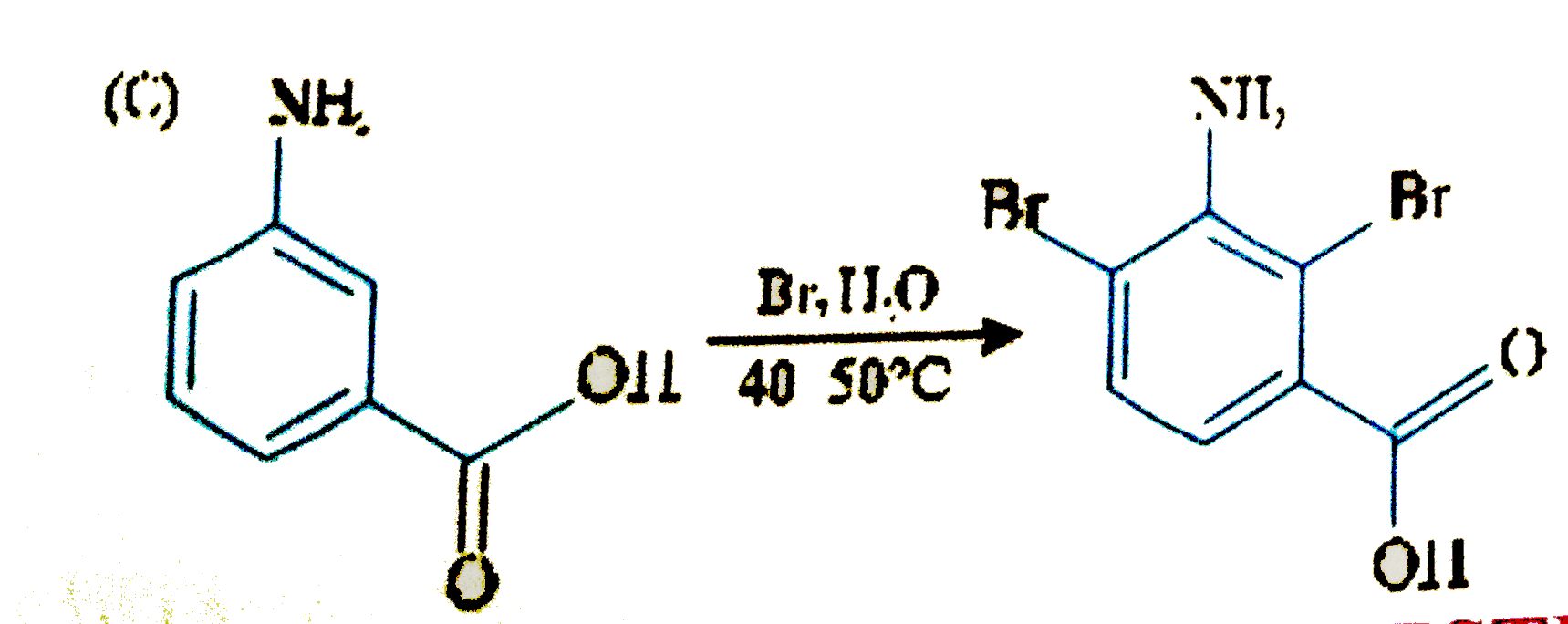
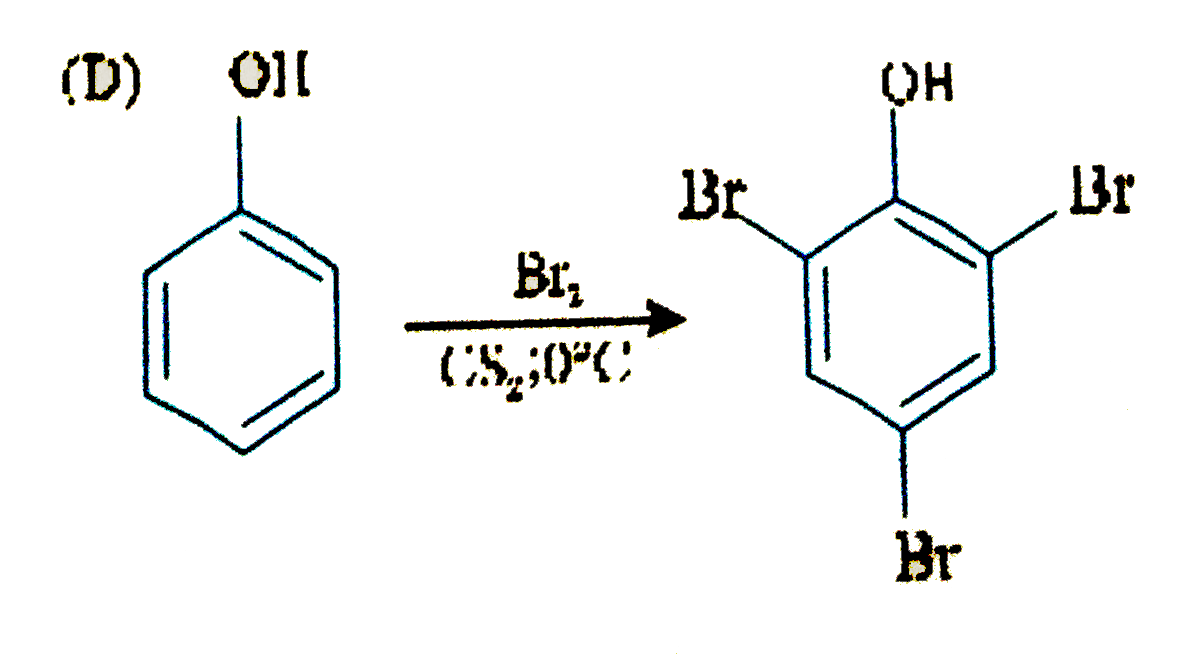
It is not always easy to predict the position of attack on multiple substituted benzene. If the benzene ring bears different ortho/para directing group at the 1 and 4 position, the position, the position of further substitution is not immediately clear. sometimes steric effect determine the outcome. in other cases, electronic factors determine the outcome, and further reaction will be at the position activated by the more strongly activating group. Some substituents are so strongly activating that no catalyst is needed to restrict the reaction to mono-substitution. It is possible to reduce the activity of such groups (by side chain reaction) so that the reaction can be stopped after mono substitution then and again by a side cahin reaction the original group is restored. effective use can sometimes be made of removable blocking groups on the ring. Q. Which of the following synthesis could not be done without involving blocking position on the ring? |
|
Answer»
|
|
| 15. |
It is not always easy to predict the position of attack on multiple substituted benzene. If the benzene ring bears different ortho/para directing group at the 1 and 4 position, the position, the position of further substitution is not immediately clear. sometimes steric effect determine the outcome. in other cases, electronic factors determine the outcome, and further reaction will be at the position activated by the more strongly activating group. Some substituents are so strongly activating that no catalyst is needed to restrict the reaction to mono-substitution. It is possible to reduce the activity of such groups (by side chain reaction) so that the reaction can be stopped after mono substitution then and again by a side cahin reaction the original group is restored. effective use can sometimes be made of removable blocking groups on the ring. Q. Which of the following is the correct major product? |
|
Answer»
|
|
| 16. |
It is not advisable to use sulphuric acid in place of acetic acid for acidification while testing sulphur by lead acetate test. Assign reason. |
|
Answer» SOLUTION :Lead acetate will REACT with sulphuric acid to give white precipitate of lead SULPHATE. This will interfere with the detection of the TEST for sulphur. `underset("Lead acetate")((CH_(3)COO)_(2))Pb+H_(2)SO_(4) rarr underset("(White ppt.)")(PbSO_(4))+2 CH_(3)COOH` Acetic acid `(CH_(3)COOH)` will not interfere in the detection of sulphur. |
|
| 17. |
It is not advisable to bleach paper by using Chlorine because .......... |
|
Answer» It reacts with lignin to FORM DIOXIN which is a carcinogenic compound. |
|
| 18. |
It is necessary to add gypsum in the final stages of preparation of cement . Explain why ? |
| Answer» Solution :Gypsum `(CaSO_(4). 2H_(2)O)` is added in the FINAL stages of preparation of cement since when `H_(2)O` is added to cement it slows down the process of setting of cement so that it GETS sufficiently hardened thereby imparting greater strength toit . | |
| 19. |
It is given that E=(2.859)/lambda cal//mol The energy associated with radiation of wavelength 4xx10^(-5) m will be |
|
Answer» `71.5 kcal//mol` `lambda=4XX10^(-7)` `E=(2.859 cal//mol)/(4xx10^(-5)m)=71.5kcal//mol` |
|
| 20. |
It is generally true that alkanes with even number of carbon atoms can be prepared in good yield by Wurtz reaction. But both butane and isobutane contain four carbon atoms each but butane can be prepared in good yield by Wurtz reaction but not isobutane. Why so ? Explain. |
|
Answer» Solution :n-Butane is a symmetrical molecule and hence a pure sample of n-butane is obtained when ethyl iodide is heated with Na metal in dry ether. `underset"Ethyl iodide "(CH_3CH_2I)+ 2Na + ICH_2CH_3 underset"Heat"overset"Dry ether"to underset"n-Butane"(CH_3CH_2CH_2CH_3)+ 2NaI` But isobutane is an unsymmetrical molecule. To prepare isobutane we need two alkyl halides,i.e., methyl iodide and ISOPROPYL iodide. Whenever a mixture of two alkyl halides is heated with Na metal , actually three alkanes are FORMED . This is DUE to the reason that two alkyl halides in addition to reacting with each other also REACT amongst themselves giving a mixture of three alkanes as shown below : `underset"Isopropyl iodide "(CH_3-oversetoverset(CH_3)|CH-I)+2Na+underset"Methyl idodide"(I-CH_3) underset"Heat"overset"Dry ether"to underset"Isobutane"(CH_3-oversetoverset(CH_3)|CH-CH_3+2NaI` `underset"Isopropyl iodide "(CH_3-oversetoverset(CH_3)|CH-I)+2Na+I-oversetoverset(CH_3)|CH-CH_3 underset"Heat"overset"Dry ether"to underset"2,3-Dimethylbutane"(CH_3-oversetoverset(CH_3)|CH-oversetoverset(CH_3)|CH-CH_3)+2NaI` `underset"Methyl iodide"(CH_3-I)+2Na+I-CH_3 underset"Heat"overset"Dry ether "to underset"Ethane"(CH_3-CH_3)+2NaI` Since a mixture of three alkanes is formed which is difficult to separate, therefore, a pure sample of isobutane cannot be prepared by Wurtz reaction . |
|
| 21. |
It is found that V forms a double salt, isomorphous will Mohr.s salt. The oxidation number of V in this compound is |
|
Answer» `+3` |
|
| 22. |
It is found that in 11.2 litres of any gaseous compound of phosphorus at NTP, there is never less than 15.5 g of P. Also, this volume of the vapour of phosphorus itself at NTP weighs 62 g. What should be the atomic weight and molecular weight of phosphorus? |
| Answer» Solution :SINCE 1 MOLE of any phosphorus compound contains at least 1 mole of P atoms, and ALSO `22.4` litres (at NTP) of the gaseous compound contains 31 g of phosphorus, therefore, 1 mole of phosphorus WEIGHS 31 g, i.e., 31 is the atomic WEIGHT of phosphorus. Similarly, the molecular weight of phosphorus is 124 as 1 mole of its vapour weighs 124 g. | |
| 23. |
It is expected that time is not far off when coastal land will be flooded . Why ? |
| Answer» Solution :Due to greenhouse effect, temperature of the EARTH's SURFACE is expected to RISE. This will result into melting of glaciers and polar ice caps. As a result, LEVEL of sea water will rise causing floods in the coastal land. | |
| 24. |
It is desired to oxide totally 1.6g of methane using oxygen at STP. What is the minimum volume of 5.6 vol hydrogen peroxide to be decomposed in order to get the oxygen required? |
|
Answer» |
|
| 25. |
It is desired to reduce the volume of 1000 cm of a gas by25%. To what temperature the gas be cooled if the initial temperature is 125^@C and the pressure remains constant ? |
|
Answer» SOLUTION :Given that `V_1 = 1000 cm^3, V_2 = 1000 - (1000 xx 25)/100= 750 cm^3` `T_1 = 125 + 273 = 398 K, "" T_2` = ? Since pressure remains CONSTANT, therefore, according to Charles. LAW, we have `V_1/T_1 = V_2/T_2` or `T_2= (V_2 T_1)/V_1 =(750 xx 398)/(1000) = 298K` Hence, the given gas should be cooled to `298 - 273 = 25^@C`to reduce its volume by `25%`. |
|
| 26. |
It is desired to increases the value of 80 cm^(3) of gas by 20% without changing the pressure to what temperature the gas be heated if its initial temperature is 25^(@)C? |
|
Answer» Solution :The desired increases in the volume of gas `=20%` of 80 `cm^(3)=(80)/(100)xx20=16 cm^(3)` Thus, the FINAL volume of the gas `=80+16=96 cm^(3)` Now, `v_(1)=80 cm^(3) "" v_(2) =96 cm^(3)` `T_(1), 25^(@)C=298 K "" T_(2) ?` Applying Charle.s law, `(V_(1))/(T_(1))=(V_(2))/(T_(2)):.T_(2) =(V_(2)T_(1))/(V_(1))` `:. T_(2)=(96 cm^(3)xx298K)/(80 cm^(3))=357*6 K=357*6-273=84*6^(@)C :. T_(2)=84*6^(@)C` |
|
| 27. |
It is customary to indicate the strength of a sample of H_2O_2under specification of volume. The strength of H_2O_2solution can also be in %(w/v) or molarity or normality. 10 vol H_2O_2 solution means Iml of H_2O_2solution decomposes to give 10ml of O_2gas at STP. 1 lit of H_2O_2solution decomposes to give 10 lit of O_2gas at STP.The volume strength of 15%(w/v) solution of hydrogen peroxide is |
|
Answer» 50 |
|
| 28. |
It is customary to indicate the strength of a sample of H_(2)O_(2) under specification of volume. The strength of H_(2)O_(2)solution can also be in %(w/v) or molarity or normality,"10 Vol H_(2)O_(2)solution means I ml ofH_(2)O_(2) solution decomposes to give 10 ml of O_(2) gas at STP. 1 lit of H_(2)O_(2)solution decomposes to give 10 lit of O_(2)gas at STR. The volume of ''20 V H_(2)O_(2) solution required to prepares is 5 litres of oxygen at STP is |
| Answer» Solution :`X XX 20=5000 , x=250 ml` | |
| 29. |
It is customary to indicate the strength of a sample of H_(2)O_(2) under specification of volume. The strength of H_(2)O_(2)solution can also be in %(w/v) or molarity or normality,"10 Vol H_(2)O_(2)solution means I ml ofH_(2)O_(2) solution decomposes to give 10 ml of O_(2) gas at STP. 1 lit of H_(2)O_(2)solution decomposes to give 10 lit of O_(2)gas at STR. ''30 vol hydrogen peroxide means |
|
Answer» 30% `H_2O_2` solution |
|
| 30. |
It is customary to indicate the strength of a sample of H_(2)O_(2) under specification of volume. The strength of H_(2)O_(2)solution can also be in %(w/v) or molarity or normality,"10 Vol H_(2)O_(2)solution means I ml ofH_(2)O_(2) solution decomposes to give 10 ml of O_(2) gas at STP. 1 lit of H_(2)O_(2)solution decomposes to give 10 lit of O_(2)gas at STR. The mass of H_(2)O_(2) set in 600ml of to volume lydrogen peroxide solution is |
|
Answer» 3.4g `0.893 = (WT)/(34) XX 1000/600 .Wt=18.28 M` |
|
| 31. |
It is customary to indicate the strength of a sample of H_2O_2under specification of volume. The strength of H_2O_2solution can also be in %(w/v) or molarity or normality. 10 vol H_2O_2 solution means Iml of H_2O_2solution decomposes to give 10ml of O_2gas at STP. 1 lit of H_2O_2solution decomposes to give 10 lit of O_2gas at STP.The volume of 20V-H_2O_2solution, required to prepare 5 litres of oxygen at S.T.P is |
| Answer» Solution :`X xx20 = 5000, x = 250 ml` | |
| 32. |
It is correct to say that hydrogen can behave as metal? State the condition under which such behaviour is possible. |
| Answer» Solution :Metals are electropositive elements and when their compounds with non-metals (e.g. NaCl) are electrolysed these aredischarged at cathode. HYDROGEN can also behave similarly when combinedwith a highly electronegative element LIKE CHLORINE (e.g.HCl). When the ELECTROLYSIS of the molten acid is carried, hydrogen is also evolved at the cathode. | |
| 33. |
It is believed that atoms combine with each other such that outrtmostshell acquires stable configuration of 8 electrons .Ifstability were attained with 6 electrons rather than 8, what would be the formula of the stable fluoride ion ? |
|
Answer» `F^(-)` 6-electrons in the outermost SHELL, it should lose ONE electrons and hence from `F^(+)` |
|
| 34. |
It is becauseof inability of ns^(2)electrons of the valence shell to participate inbonding that |
|
Answer» `Sn^(2+)` is oxidising while`Pb^(4+)` is REDUCING `underset(" Less stable ")(Sn^(2+))rarr underset(" More stable ")(Sn^(4+)) + 2e^(-)` In contrast, +2 oxidationstate of Pb is more STABLETHAN its +4 oxidationstate,therefore `Pb^(4+)`acceptstwo electrons andthus actsas an oxidising agent. `underset(" Less stable ")(Pb^(4+)) + 2e^(-) rarr underset(" More stable ")(Pb^(2+))` Thus, option (d) is CORRECT. |
|
| 35. |
It is because of inability of ns^2 electrons of the valence shell to participate in bonding that |
|
Answer» `SN^(4+)` is REDUCING while `PB^(4+)` is oxidising |
|
| 36. |
It has been found that the pH of a 0.01 M solution of an organic acid is 4.15. Calculate the concentration of the anion, the ionization constant of the acid and its pK_(a). |
|
Answer» Solution :`HA hArr H^(+) + A^(-)` `pH = - log [H^(+)] or log [H^(+)]= - pH = - 4.15 = BAR(5) . 85` `:. [H^(+)]=7.08 XX 10^(-5)M = 7.08xx10^(-5)M` `[A^(-)]=[H^(+)]=7.08xx10^(-5)M` `K_(a)=([H^(=)][A^(-)])/([HA])=((7.08xx10^(-5))(7.08xx10^(-5)))/(10^(-2))=5.0 xx10^(-7)` `pK_(a)=-log K_(a) = - log (5.0xx10^(-7))= 7-0.699=6.301` |
|
| 37. |
It has been found that the pH of a 0.01 M solution of an organic acid is 4.15. Calculate the concentrationof the anion, the ionizationconstant of the acid and its pK_a. |
|
Answer» Solution :Calculationof `H^+` :pH=-LOG `[H^+]`= -4.15 = `bar5.85` `therefore [H^+]`= Antilog `(bar5.85)=7.079xx10^(-5)` Calculation of ionization constant `K_a` : `{:("WEAK acid :",HA hArr, H^(+)+,A^-),("Initial M:",0.01,0,0),("EQUILIBRIUM M:",(0.01-x), x,x):}` So, `[H^+]=[A^-]=7.079xx10^(-5)=x` [HA]=(0.01 -x) `APPROX` 0.01 (because `0.01 GT gt gt x`) `K_a` `=([H^+][A^-])/([HA])` `=((7.079xx10^(-5))(7.079xx10^(-5)))/0.01` `=5.011xx10^(-7)` Calculation of `pK_a` : `pK_a=-log K_a` `=-log (5.011xx10^(-7))` =-(0.6999-7)=-(-6.30)=+6.30 |
|
| 38. |
It has been found that 0.290 g of an organic compound containing C, H and O on complete combustion yielded 0.66 g of CO_2 and 0.27 g of H_2O. The vapour density of the compound is found to be 29.0. Determine the molecular formula of the compound. |
|
Answer» Solution :Calculation of percentage of carbon : The gram molecular mass of `CO_(2)` `=12.01 + (2 XX 16.0) = 44.01 g` This means that 44.01 g of `CO_2` contain 12.01 g of carbon. `therefore` The mass of carbon present in 0.66 g of `CO_(2) = 12.01/44.01 xx 0.66 = 0.18 g` This much carbon comes from 0.290 g of the given COMPOUND. `therefore`Percentage of carbon in the given compound `=(0.18)/0.290 xx 100 = 62.1` Calculation of percentage of hydrogen: The gram molecular mass of `H_(2)O` `=(2 xx 1.008) + 16.0 = 18.0 g` This means that 18.0 g of WATER contain = `2 xx 1.008 = 2.016` g of hydrogen. `therefore`The mass of hydrogen present in 0.27 g of `H_(2)O` `=(2.016)/18.0 xx 0.27 = 0.03 g` This much hydrogen comes from 0.290 g of the compound. `therefore`Percentage of hydrogen in the given compound `=0.03/0.290 xx 100 = 10.34` Calculation of percentage of oxygen : Percentage of oxygen = `100 -(62.1 + 10.34) = 27.56` Calculation of empirical FORMULA:  `therefore` The empirical formula of the given compound is `C_3H_6O` Calculation of molecular formula : The empirical formula mass `=(3 xx 12.01) + 6 xx 1.008 + 16.0` = 58.0 amu Molecular mass = `2 xx` VAPOUR density `=2 xx 29.0 = 58.0 amu` `therefore n =("Molecular mass")/("Empirical formula mass") = 58.0/58.0 = 1` `therefore` Molecular formula = `1 xx` Empirical formula `=1 xx C_(3)H_(6)O = C_(3)H_(6)O` Hence, the molecular formula of the given compound is `C_(3)H_(6)O`. |
|
| 39. |
It has been estimated that 93% of all atoms in the entire universe are hydrogen and that the vast majority of those remaining are helium. Based on only these two elements, estimate the mass percentage composition of the universe. |
|
Answer» Solution :Given that out of 100 atoms of H and He, 93 atoms are of H and 7 atoms are of He, that is, the number of MOLES of H and He atoms, out of 100 moles, are 93 and 7 respectively. Mass of H `=93 xx 1 = 93 g` Mass of He `=7 xx 4 = 28 g` `therefore` mass PERCENTAGE of H `=93/(93 + 28) xx 100 = 76.86%` `therefore` mass percentage of He `=23.14%` |
|
| 40. |
(i)State the law of mass action. (ii) Deduce the vant equation. |
|
Answer» Solution :(i) The law state that .At any instant ,the RATE of chemical recation at a given temp is DIRECTLY proportional to the active masses of the reactants at the instant. (ii) Vant Hoff EQUATION, This equation gives the quantitative temp depends of EQUILBRIUM constant K. The relation between standard free energy change `DeltaG^(@)` and equilbrium constant is `DeltaG^(@)=-RTInK` We know rhat, `DeltaG^(@)=DeltaH^(@)-TDeltaS^(@)` Substituting (1) in equation (2) 1-RTInK`=DeltaH^(@)-TDeltaS^(@)` Rearranging, `InK=(-DeltaH^(@))/(RT)+(DeltaS^(@))/(R)` Diffrentiating equation (3) with respect to Temp `(d(InK))/(dT)=(DeltaH^(@))/(RT^(@))` Equation (4) is known as defferential form of van.t Hoff equation on intergrating the equation 4, between `T_(1) and T_(2)` with their resoective equilibrium constant `K_(1) and K_(2)` `int_(K_(1))^(K_(2))d(InK)=(DeltaH(@))/(R)int_(T_(1))^(T_(2))(dT)/(T^(2))` `[InK]_(K_(1))^(K_(2))=(DeltaH(@))/(R)[-(1)/(T)]_(T_(1))^(T_(2))` `InK_(2)-InK_(1)=(DeltaH(@))/(R)[-(1)/(T_(2))+(1)/(T_(1))]` In`(K_(2))/(K_(1))=(DeltaH(@))/(R)[(T_(2)-T_(1))/(T_(2)T_(1))]` Log`(K_(2))/(K_(1))=(DeltaH(@))/(2.303R)[(T_(2)-T_(1))/(T_(2)T_(1))]` Equation (5) is known as integrated form of van.t Hpff equation. |
|
| 41. |
Isotopes have |
|
Answer» same NUMBER of protons |
|
| 42. |
Isotopes are the atoms of same element, they have same atomic number but different mass number. Isotopes have different number of neutrons in their nucleus. If an element exists in two isotopes having atomic masses .a. and .b. in the ratio m : n, then average atomic mass will be mxa+nxb/m+n Different isotopes of same element have same position in the periodic table. The elements which have single isotope are called monoistropic elements. Greater is the percentage composition of an isotope, more will be its abundance in nature. Atomic mass of boron is 10.81. It has two isotopes namely ""_(5)B^(11)and""_(5)B^(x) with their relative abundance of 80% and 20% respectively. The value of x is |
|
Answer» `10.05` `IMPLIES x=(10.81-8.8)/(0.2)=10.05` |
|
| 43. |
Isotopes are the atoms of same element, they have same atomic number but different mass number. Isotopes have different number of neutrons in their nucleus. If an element exists in two isotopes having atomic masses .a. and .b. in the ratio m : n, then average atomic mass will be mxa+nxb//m+n Different isotopes of same element have same position in the periodic table. The elements which have single isotope are called monoistropic elements. Greater is the percentage composition of an isotope, more will be its abundance in nature. The isotopes of chlorine with mass number 35 and 37 exist in the ratio (if its average atomic mass is 35.5) |
|
Answer» `1:1` |
|
| 44. |
Isotopes are identified by: |
|
Answer» Postiive RAY analysis |
|
| 45. |
Isotherms of carbon dioxide gas are shown in Fig. Mark a path for changing gas into liquid such that only one phase (i.e., either a gas or a liquid) exists at any time during the change. Explain how the temperature, volume and pressure should be change to carry out the change. |
Answer» SOLUTION :It is possible to change a gas into a liquid or a liquid into a gas by a process such that there is a single phase present always. e.g., In figure given above, we can move from A to vertically by increasing the temperature, then we can reach the point by compressing the gas at constant temperature along the isotherm (isotherm at `31.1^(@)C`). The pressure will increase. Now, we can move vertically down D by lowering TEMP. As we cross the H point, we get liquid on critical isotheron. Thus, at no stage during the process, we can through two - phase region. These process is carried out at the TC, in which SUBSTANCE always remains in single phase. This is called continuity of state between the gaseous and the liquid state. |
|
| 46. |
Isotone differ in terms of ....and .....but have identical..... |
| Answer» SOLUTION :ATOMIC NUMBER, MASS number, number of NEUTRONS | |
| 47. |
Isotone of ._(32)^(76) Geis : …… |
|
Answer» `._(32)^(37) Ge` |
|
| 48. |
Isostructural species are those which have thesame shape and hybridization. Among the givenspecies, identify the isostructural pairs . |
|
Answer» `[NF_(3) and BF_(3)]` `BF_(4)^(-) and NH_(4)^(-)` ion both are tetrahedral `BCl_(3) ` is triangular planar whereas `BrCl_(3)`is pyramidal `NH_(3)` is pyramidal whereas `NO_(3)^(-)` triangular planar. |
|
| 49. |
Isopropyl bromide on Wurtz reaction gives |
|
Answer» HEXANE |
|