

Saved Bookmarks
This section includes 7 InterviewSolutions, each offering curated multiple-choice questions to sharpen your Current Affairs knowledge and support exam preparation. Choose a topic below to get started.
| 1. |
Match the colour of precipitate/residue in column-I with the reagent(s) listed in column-II. |
|
Answer» |
|
| 2. |
Match the colour of ppt. listed in column-I with the reagent(s) is column-II. |
|
Answer» |
|
| 3. |
Match the colomn I with column II and mark the appropriate choice. {:("Column I","Column II"),((A)"Used as lubricant",(i)"Carbon dioxide"),((B) "Oxide with three dimensional structure",(ii) "Grapite"),((C )"Used in solar cells",(iii) "Siica"),((D) "Anhydride of carbonic acid",(iv) "Silicon"):} |
|
Answer» (A) `to` (iv), (B) `to` (iii), (C ) `to` (II), (D) `to` (i) |
|
| 4. |
Match the chemical properties with the compounds: |
|
Answer» |
|
| 5. |
Match the bond enthalpies given in column II with the molecules given in column I and mark the appropriate choice. {:(,"Column I",,"Column II "),((A),"Hydrogen "(H_(2)),(i),498.0 " kJ mol"^(-1)),((B),"Oxygen"(O_(2)),(ii),946.0" kJ mol"^(-1)),((C),"Nitrogen"(N_(2)),(iii),435.8 " kJ mol"^(-1)):} |
|
Answer» `(A)to(i), (B)to(ii), (C) to (III)` Hence, SINGLE bond enthalpy ` lt` double bond enthalpy ` lt` triple bond enthalpy `H - H lt O = O lt N -= N` |
|
| 6. |
Match the acids given in Column I with their correct IUPAC names given in Column II |
Answer» 
|
|
| 7. |
Match the average fundamental compounds with their proper percentage presentin Portland cement. |
|
Answer» 1-d, 2-C, 3-b |
|
| 8. |
Match the activity given in Column-I with the type of pollution created by it given in Column II. |
|
Answer» (B) May cause nerve disease in human. (C) Water pollution. (D) Photochemical smog, damage to plant life, corrosion to building MATERIAL, induce breathing problems, water pollution. (E) Damaging OZONE layer. |
|
| 9. |
Match th r following columns : |
|
Answer» |
|
| 10. |
Match (##SUR_CHE_XI_V02_C09_E02_057_Q01.png" width="80%"> |
|
Answer» `{:(A,B,C),(1,2,3):}` |
|
| 11. |
Match (##SUR_CHE_XI_V02_C09_E02_056_Q01.png" width="80%"> |
|
Answer» `{:(A,B,C,D),(1,2,3,4):}` |
|
| 12. |
Match standard free energy of the reaction with thecorresponding equilibrium constant {:((i) ,DeltaG^(Θ)gt0,,(a),K gt 1),((ii),DeltaG^(Θ) lt 0,,(b) ,K=1),((iii),DeltaG^(Θ) = 0 ,,(c),K=0),(,,,(d),K lt 1),(,,,,):} |
|
Answer» (i) If `DeltaG^(@) GT 0`, i.e., `Delta^(@)` is +ve, then ln K is -ve, i.e., `K lt 1` . HENCE, (i)-(d). (ii) If `DeltaG^(@) lt 0`, i.e., `DeltaG^(@)` is -ve, then ln K is +ve, i.e., `K gt 1`. Hence, (ii) -(a). (iii) If `DeltaG^(@)= 0`, lnK = 1 , i.e., K = 1. Hence, (iii)-(b). |
|
| 13. |
Match (##SUR_CHE_XI_V02_C09_E02_055_Q01.png" width="80%"> |
|
Answer» `{:(A,B,C,D),(1,2,3,4):}` |
|
| 14. |
Match standard free energy of the reaction with the corresponding equilibrium constant |
|
Answer» (A)If `DeltaG^ө gt 0`, i.e., `DeltaG^ө` is POSITIVE , then ln K is negative i.e., `K lt 1` (B) If `DeltaG^ө lt 0`, i.e., `DeltaG^ө` is negative then ln K is positive i.e., `K gt 1` (C) if`DeltaG^ө`=0, ln K=0, i.e., K=1 |
|
| 15. |
Match species given in Column I with electronic configuration given in Column II {:("Column I","Column II"),((i) Cr,(a) [Ar] 3d^(8) 4s^(0)),((ii) Fe^(2+),(b) [Ar] 3d^(10) 4s^(1)),((iii) Ni^(2+),(c) [Ar] 3d^(6) 4s^(0)),((iv)Cu,(d) [Ar] 3d^(5) 4s^(1)),(,(e) [Ar] 3d^(6) 4s^(2)):} |
|
Answer» |
|
| 16. |
Match species given in Column-I with the electronic configuration given in Column-II |
|
Answer» Both A and R are TRUE and R is the CORRECT EXPLANATION of A. |
|
| 17. |
Match Section - I with Section - II and select proper option : |
|
Answer» IR, 2S, 3P, 4T |
|
| 22. |
Match list I with list II. Choose the correct matching codes from the choices given. {:(,"List I",,"List II"),(,"(Hydride)",,"(Type of hydride)"),(A.,BeH_(2),1.,"complex"),(B.,AsH_(3),2.,"Lewis acid"),(C.,B_(2)H_(6),3.,"Interstitial"),(D.,LaH_(3),4.,"Covalent"),(E.,LiAlH_(4),5.,"Intermediate"):} |
|
Answer» A-6, B-2, C-4, D-5, E-1 Complex : Addition compounds which do not give all their constituent ions when dissolved in water. Here, the individual properties of ions are e.g., `[Cu(NH_(3))_(4)]SO_(4), LiAlH_(4)`. Lewis acid : Electron DEFICIENT species which gain electrons while forming a bond with Lewis bases. 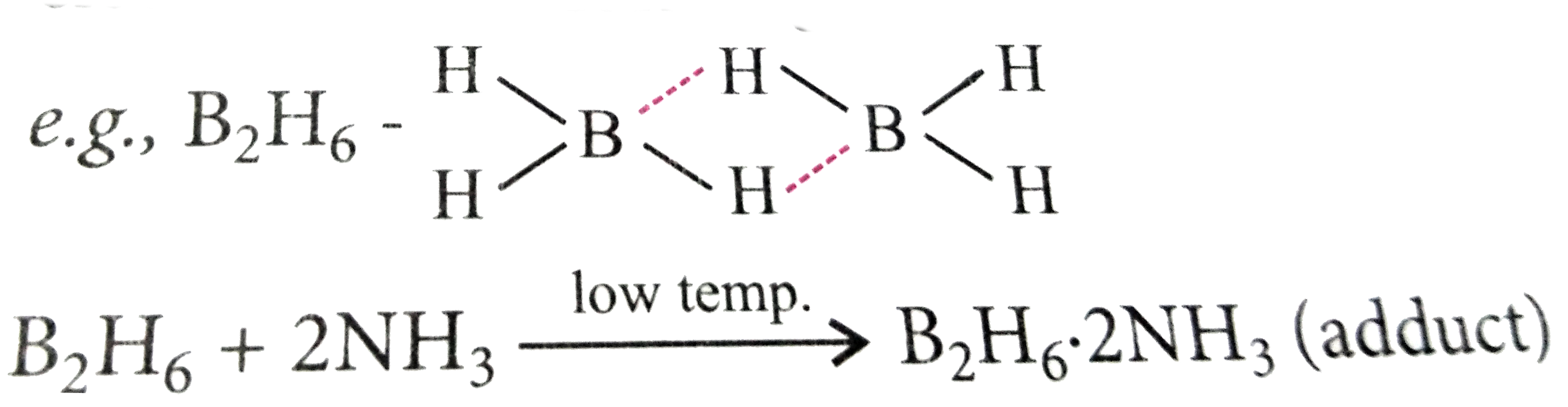 `B_(2)H_(6)+2NH_(3)overset("low temp.")rarr B_(2)H_(6).2NH_(3)` (adduct) Interstitial metallic hydrides : Many f-block hydrides are non-stoichimetric, e.g., `LaH_(n), TiH_(n)`, ETC. where the chemical composition is variable e.g., `LaH_(2.87), YbH_(2.5)`, etc. Such compounds are called interstitial compounds. `BeH_(2)` : Intermediate hydride and polymeric in nature. `AsH_(3)` : Covalent. |
|
| 23. |
Match List-I with List-II and select the correct answer using the codes given below the lists: {:(,"List-I (Compound)",,"List-II"),((a),B_(4)C,(1),"Propyne preparation"),((b),Al_(4)C_(3),(2),"Abrasive"),((c),Mg_(2)C_(3),(3),"Methane preparation"),((d),WC,(4),"Interstitial carbides"):} |
|
Answer» |
|
| 24. |
Match List-I with List-II and select the correct answer using the codes given below the litsts. |
|
Answer» `{:(A,B,C,D),(3,1,4,2):}` |
|
| 25. |
Match list I with list II and select the correct answer using the codes given below the lists: |
|
Answer» `{:(A,B,C,D),(I,II,IV,V):}` |
|
| 26. |
Match List I with ListII and select the correct answer using the codes given below the lists: |
|
Answer» (I-c), (II-a), (III-d), (IV-b) Electrolytic reduction is used for the extraction of Al. ZONE refining is used to get ultrapure GE. |
|
| 27. |
Match list I with list II and select the correct answer using the codes given below the lists : |
|
Answer» `{:(A,B,C,D),(IV,III,I,II):}` |
|
| 28. |
Match List-I with List-II and select the correct answer from the codes given belows the lists. |
|
Answer» |
|
| 29. |
Match list I with list II and choose the correct answer from the codes Code |
|
Answer» `{:(a,B,C,d,),(I,II,III,IV,):}` 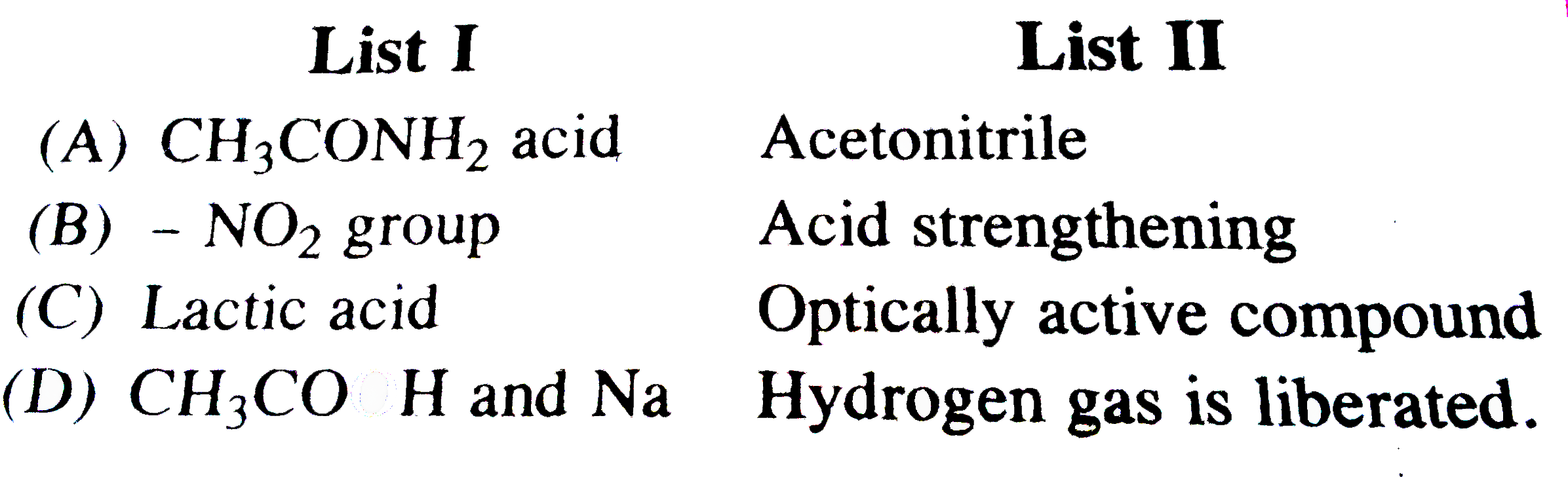
|
|
| 30. |
Match List I (substance) with List II (processes) employed in the manufacture of the substance and select the correct option. {:("List - I (Substances)","List - II (Processes)"),("A) Sulphuric acid","i) Haber's process"),("B) Steel","ii) Bessemer's process"),("C) Sodium hydroxide","iii) Leblanc process"),("D) Ammonia","iv) Contact process"):} |
|
Answer» `(A-i),(B-iv),(C-ii),(D-iii)` |
|
| 31. |
Match List I (Reaction) with List II (Type of reaction ) and select the correct answer using the code given below the lists : |
|
Answer» <P>`{:(P,Q,R,S),(1,3,4,2):}` |
|
| 32. |
Match List I (Reaction) with List II (Type of reaction ) and select the correct answer using the code given below the lists : |
|
Answer» <P>`{:(P,Q,R,S),(4,2,1,3):}` |
|
| 33. |
Match list I (reaction) with list II (Reagent) and select the correct answer using the codes given below : |
|
Answer» <P> III. `ALPHA `-HALO ester+ ` Zn to` Reformatskyiv .hydrozoicacid Schmidt reaction |
|
| 34. |
Match List I (Reaction ) with List II (Type of reaction ) and select the correct answer using the code given below the lists : |
|
Answer» <P>`{:(P,Q,R,S),(2,1,3,4):}` |
|
| 35. |
Match List I (Molecules) with List II (Bond order)and select the correctanswer using the codes. |
|
Answer» I - B, II - C, III - A, IV - E Bond order of `Li_2 = 1, N_2 = 3, Be_2 = 0, O_2 = 2` |
|
| 37. |
Match List-I, II and III. Find the correct answer from the code given below: |
|
Answer» 1-S-T, 2-P-U, 3-Q-W |
|
| 38. |
Match List-I (Compounds) with List-II (% meta electrophilic substitution product ) and select the correct answer using the code given below the lists : |
|
Answer» <P>`{:(P,Q,R,S),(1,3,2,4):}` |
|
| 39. |
Match List-1 (ion/radical) with List-II (stabilisation) and select the correct answer using the codes given below the lists {:("List-I", "List-II"), ("A) "C(CH_(3))_(3)" (Free radical)", "1) Inductive effect"), ("B) "PHO^(-), "2) Hyperconjugation"), ("C) "^(+)CH_(2)C(CH_(3))_(3), "3) Resonance"):} |
|
Answer» A-1, B-2, C-3 |
|
| 40. |
Match each of the following quantum number values with the proper letter designation (K,L.M,N,s,p,d,f): |
|
Answer» `n=1` |
|
| 41. |
Match each of the following compound in column-I with the characteristic reaction in column-II |
|
Answer» |
|
| 42. |
Match each of the following isomer with the correct boiling point and melting point. Explain your choice Compounds: 2,2,3,4-tetramethyl butane and n-octane Boiling point: 106.5^(@),125.7^(@)C Melting piont: -56.8^(@)C,+100.7^(@)C |
|
Answer» `M.P.to` More COMPACT PACKING more M.P. |
|
| 43. |
Match each of the compounds in Column I with its characteristic reaction (s) in Column-II |
|
Answer» <P> |
|
| 44. |
Match each List-I with List-II and select the correct answer using the code given below the lists. |
|
Answer» <P>`{:(P,Q,R,S),(3,1,2,4):}` |
|
| 45. |
Match compounds of coloumn-I with their uses given in coloumn-II, and select the correct option. |
|
Answer» `(i) to s, (ii) to p, (iii) to Q, (iv) to r` (ii) `NAOH to (p)` in the preparation of FLATS and oil (iii) `Ca(OH)_(2) to (q)` In the PURIFICATION of fats and oil. (iv) `NaHCO_(3) to (r )` as a fire extinguisher |
|
| 47. |
Match Column-I with List-II and select the correct answers: {:("Column-I ","Column-II "),("A) Critical temperature ","P) "a/(ab) ),("B) Boyle temperature ","Q) "(2a)/(Rb) ),("C) Inversion temperature ","R) " (T)/(T_c) ),("D) Reduced temperature","S) " (8a)/(27 Rb)):} |
|
Answer» |
|
| 48. |
Match column I withColumn II for the oxidation states of the central atoms {:(,"Column I","Column II"), ((i),Cr_(2)O(7)^(2-),(a)+3), ((ii),MnO_(4)^(-),(b)+4),((iii),VO_(3)^(-),(c)+5),((iv),FeF_(6)^(3-),(d)+6),(,,(e)+7):} |
|
Answer» Solution :(i) O.N of Cr in `Cr_(2)O__(7)^(21-)=+6` (ii) O.N Of Mn `MnO_(4)^(-)=+7` (iii) O.N of V in `O_(3)^(-)=x+3(-2)=-1 or x=+5` (IV) O.N of F in `FeF_(6)^(3-)=x+6(-1)=-3 or x=+3` THUS correct matching is `(i) rarr(d),(ii)rarr(e ),(iii)rarr(c ),(iv)rarr(a)` |
|
| 49. |
Match column I with column II {:("Column I",,"Column II"),("Compounds",,"Number of optically active isomer"),("(A) Unsymmetrical compound with 'n' chiral carbon",,"(P) " 2^(n-1)),("(B) Symmetrical molecule with 'n' chiral carbon when n is even",,"(Q) " 2^(n-1)-2^(n-1//2)),("(C) Symmetrical molecule with 'n' chiral carbon when n odd",,"(R) " 2^(n)):} |
|
Answer» <P> |
|
| 50. |
Match Column I with Column II. {:(,"Column I ",,,"Column II"),((i) ,"Equilibrium",,(a),Delta Ggt 0 ","K lt 1),((ii),"Spontaneous reaction",,(b),DeltaG=0),((iii),"Non-spontaneous reaction",,(c),Delta G ^(Θ)=0),(,,,(d),DeltaG lt 0 "," K gt 1):} |
|
Answer» (II) For spontaneous reaction, `Delta G lt 0 (-ve), K gt 1`. Hence (ii)-(d). (iii) For non-spontaneous reaction, `Delta G gt 0 (+ve), K lt 1`. Hence (iii) - (a). |
|

