

Saved Bookmarks
This section includes 7 InterviewSolutions, each offering curated multiple-choice questions to sharpen your Current Affairs knowledge and support exam preparation. Choose a topic below to get started.
| 1. |
Velocity of helium atom at 300K is 2.40 xx 10^2 meter per second. What is its wavelength? (He = 4) |
|
Answer» 0.416 nm |
|
| 2. |
What is a pi bond ? |
| Answer» SOLUTION :PI-bond: When two ATOMIC ORBITALS overlap SIDEWAYS, the resultant covalent bond is called a pi `(pi)` bond. | |
| 3. |
What is the ratio of the volumes occupied by 1 mole of O_(2)and 1 mole of O_(3)in identical conditions? |
|
Answer» |
|
| 4. |
What is the product when one mole of Pent-1-yne treated with two moles of HCl ? |
|
Answer» 1,2-Dichloropentane |
|
| 5. |
Which statments (s) about oxidatien number is are correct? |
|
Answer» The OXIDATION number is the number of electrons LOST (+ve) or gained (-ve) by an atom during the formation of IONIC compounds |
|
| 6. |
To prepare p-bromonitrobenzene, the benzene is first subjected to ___ and then ___ |
|
Answer» |
|
| 7. |
What are the numberof bond pairsand lone pairs of electrons on N - atom in NO_(3)^(-) ? |
|
Answer» Solution :No. of valence electrons in N-atom ` = 5 + 1` (negative charge ) = 6 One O-atom FORMS a double BOND. Other two O-atoms shared with two electrons of N-atom. ` :. ` No. of bond pairs = 4 No of LONE pairs = No. of valence electron - Bonding pairs ` = 4 - 4 = 0 ` ` :. ` No. of lone pairs = 0 |
|
| 8. |
Which statement is false ? |
|
Answer» Water gas is a MIXTURE of hydrogen and carbon monoxide |
|
| 9. |
Which is false statement with respect to benzene ? |
|
Answer» It has TWO TYPES of C-C bond lengths |
|
| 10. |
The simulaneous solubility of AgCN (Ksp = 2.5 xx 10^(-16)) and AgCl (Ksp = 1.6 xx 10^(-10)) in 1.0 M NH_(3(aq)) are respectively (K_(f)[Ag(NH_(3))_(2)]^(+) = 10^(7)) |
|
Answer» `0.037, 5.78 xx 10^(-8)` `K_(1) = 1.6 xx 10^(-10) xx 10^(7)` `= 1.6 xx 10^(-3)` `= ([Ag(NH_(3))_(2)]^(+)[Cl^(-)])/([NH_(3)]^(2))` `AgCH_((s))+2NH_(3(aq)) hArr[Ag(NH_(3))_(2)]_((aq))^(+) + CN_(aq)^(o.)` `K_(2) = 2.5 x 10^(-16) xx 10^(7) = 2.5 xx 10^(-9)` `= ([Ag(NH_(3))_(2)]^(+)[CN^(-)])/([NH_(3)]^(2))` `([Cl^(-)])/([CN^(-)]) = (1.6 xx 10^(-3))/(2.5 xx 10^(-9)) = 6.4 xx 10^(5)` `K_(1) = (x^(2))/((1-2x)^(2))` `(x)/(1-2x) = 0.04` `x = 0.037` `[CN^(-)] = (0.037)/(6.4 xx 10^(5)) = 5.78 xx 10^(-8) M` |
|
| 11. |
Which of the following substances does not produce ammonia on reaction with water ? |
| Answer» Solution :`Ca(CN)_(2)` does not react with water. | |
| 12. |
Which hydroxides of group 13 are amphoteric in nature ? |
| Answer» SOLUTION :Hydroxides of ALUMINIUM (Al) and Gallium (Ga) are AMPHOTERIC in NATURE. | |
| 13. |
To convert 1-butyne to 1-D-butanal, one would carry out the following steps: (I) Sodium amide, then D_(2)O (II) Disiamy lborane, then hydrogen proxide/sodium hydroxide (III) The transformation can not be carried out with the indicated reagents. |
|
Answer» I, FOLLOWED by II |
|
| 14. |
Write the isomeric structures and names for the formula C_(2) H_(4) Cl_(2) |
|
Answer» Solution :(i) `UNDERSET(""CH_2 Cl) underset(|)(""CH_(2)Cl)` Ethylene dichloride (or) 1 , 2 -DICHLOROETHANE (ii) `underset (CH_(3))underset(|)(C)H_(2) Cl` Ethylidene chloride (or) - 2-dichloroethane |
|
| 15. |
Whatwould bethe IUPACname for theelementwith atomicnumber 120? |
|
Answer» Ununbium |
|
| 16. |
What is the correct order of electronegativity |
|
Answer» `M^(+1) lt M^(+2) lt M^(+3) lt M^(+4)` |
|
| 17. |
What is the difference between a conjugate acid and its conjugate base ? |
| Answer» SOLUTION :A conjugate acid and base DIFFER by a proton (Conjugate acid `HARR` Conjugatebase `+H^(+)`) | |
| 18. |
The solubility of Ag_(2)CrO_(4)" at "25^(@)C" is "0.0332g dm^(-3). Calculate its solubility product. (At. Masses : Ag = 108, Cr = 52, O = 16). |
|
Answer» Solution :The solubility of `Ag_(2)CrO_(4)=0.0332g dm^(-3)` = `(0.0332)/(332)"mol "dm^(-3)=10^(-4)"mol "dm^(-3)` For the solubility EQUILIBRIUM of `Ag_(2)CrO_(4)hArr2Ag^(+)+CrO_(4)^(2-)` `K_(sp)=[Ag^(+)]^(2)[CrO_(4)^(2-)]^(2s)` = `(2s)^(2)(s)` = `4s^(3)` = `4(10^(-4))^(3)` = `4xx10^(-12)("mol "dm^(-3))^(3)` |
|
| 19. |
The volume of a colloidal particle, V_(c) as compared to the volume of a solute particle, V_(s) in a true solution could be |
|
Answer» `(V_(s))/(V_(c))~~10^(-3)` ` therefore (V_(c))/(V_(s))=(4//3pi(10^(3)//2)^(3))/(4//3pi(1//2)^(3))=10^(9)` (maximum) `therefore V_(c)//V_(s)` COULD be `10^(3)` |
|
| 20. |
When an electron drops from a higher energy level to a low energy level, then |
|
Answer» ENERGY is EMITTED |
|
| 21. |
Zeolite used to soften hardness of water is, hydrated______ |
|
Answer» SODIUM ALUMINIUM SILICATE |
|
| 22. |
Total pressure of mixture of CO_(2) and CH_(4) is 8.3xx10^(4) Pa then partial pressure of CO_(2) gas is 2.8xx10^(4) Pa. Then calculate partial pressure of CH_(4). |
| Answer» SOLUTION :`5.5xx10^(4)` PA. | |
| 23. |
Which one has strong H bonding from the following? |
| Answer» Solution :F - H ..... F | |
| 24. |
What is the minimum uncertainty in theh position of a bullet of mass 5g that is known to have a speed somewhere between 550,00000 and 550,00001 m s^(-1)? |
|
Answer» |
|
| 25. |
Which of the following is the strongest base? |
|
Answer» tert-Butoxide |
|
| 26. |
Which of the following statement(s) is/are incorrect: Statement (a) : Reversible isothermal compression of an ideal gas represents the limiting minimum value of the workdone (lwl) by the surrounding on the system. Statement (b) : In an irreversible process, the cyclic integral of work is not zero. Statement (c) : For thermodynamic changes in adiabatic process ""_(T)((C_(p.m))/(R)).P = constant Statement (d) : DeltaS_("system") is zero for reversible adiabatic expansion of an ideal gas. |
|
Answer» STATEMENT c |
|
| 27. |
Write the following oxidising agents in the increasing order of equivalent weight: KMnO_(4) to Mn^(2+) K_(2) Cr_(2) O_(7) to Cr^(3+) KIO_(3) to I^(-) KCIO_(3) to CI^(-) |
| Answer» SOLUTION :`KCIO_(3), KMnO_(4) , KIO_(3) , K_(2) Cr_(2) O_(7), KMnO_(4)` | |
| 28. |
Two oxides of a metal contain 27.6% and 30.0% of Oxygen, respecttively. If the formula of the first be M_(3) O_(4). Find that of the second. |
|
Answer» Hence, the percentage of oxygen in A `=64/(3x + 64) xx 100` According to the given data, A contains 27.60 % oxygen `therefore 64/(3x + 64) x 100 = 27.60` or `x = 55.96` THUS, the atomic weight of the metal M is 55.96. Formula of the oxide B can be obtained as FOLLOWS :  Hence, the formula of oxide B `=M_(2)O_(3)`. |
|
| 29. |
Trans-2-butene has no dipolement , while trans-2-pentane has non zero value. Why? |
Answer» SOLUTION :  In trans-2-butene the POLARITY of `C-CH_(3)` groups opposes each other, because of molecular symmetry. Hence has no dipole MOMENT.  In trans-2-pentene, the polarities of `C-CH_(3)` and `C-C_(2)H_(5)` groups do not cancel each other. Hence there is a net dipole moment. |
|
| 30. |
What is the single bond, double bond and triple bond enthalpy in ethane, ethene and ethyne respectively in kJ mol^(-1) ? |
|
Answer» 681, 384, 823 
|
|
| 31. |
Using MO theory, show that cycloctatetraene is antiaromatic. Strategy: Use the polygon-and-circle method for deriving the relative energies of the piMO s. |
Answer» Solution :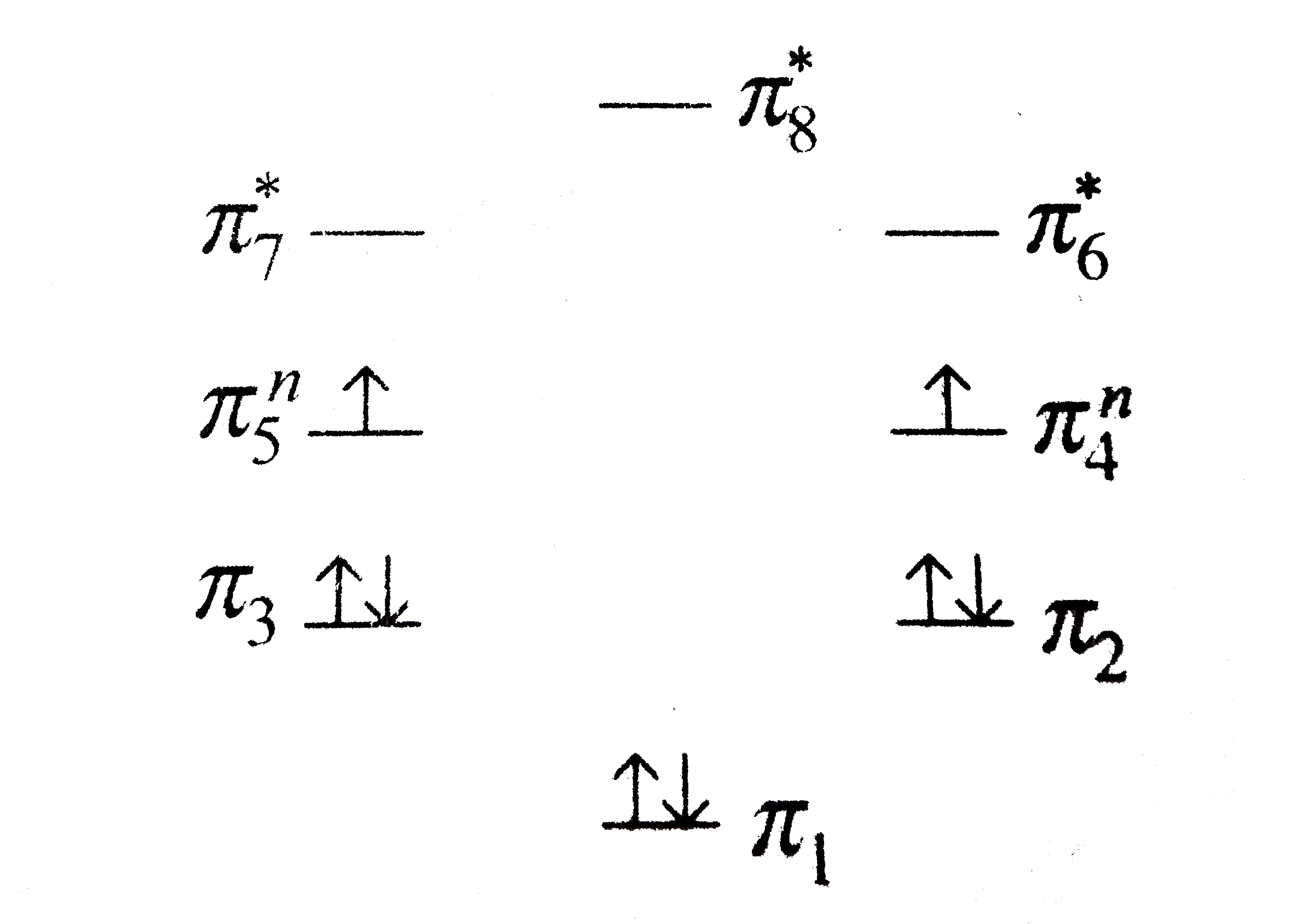 It is a (4n) `pi` ELECTRON molecule. In the ground STATE. The eight `pi` electrons of cyclooctetraene can be arranged in the `MO s` as shown: SINCE the nonbinding `MO s` are half-filled, a planar form of cyclooctatetraene would, if it existed, be antiaromatic. NOTE that it is in the TRIPLET state, this accounts for its high (olefinic) reactivity. |
|
| 32. |
Which one is used as bleaching agent for washing clothes ? |
|
Answer» TETRACHLOROETHANE |
|
| 33. |
Which quantity out of Delta_(r) G and Delta_(r) G^( Theta ) will be zero at equilibrium ? |
|
Answer» Solution :Gibbs energy for a REACTION in which all reactants and products are in standard state. `Delta_(r) G^( THETA )` is related to the EQUILIBRIUM constant of the reaction as FOLLOWS : `Delta_(r) G= Delta_(r) G^( Theta ) + "RT In K"` At equilibrium, `0= Delta_(r) G^( Theta ) + "RT In k" (because Delta_(r) G= 0)` OR `Delta_(r) G^( Theta ) =- "RT In k"` `Delta_(r) G^( Theta ) = 0 "when" K=1` For all other values of `K, Delta_(r) G^( Theta )` will be non-zero. |
|
| 34. |
Which of the following properties is not a function of state? |
|
Answer» CONCENTRATION |
|
| 35. |
What will be the oxidation state of copper in YBa_(2) Cu_(3) O_(7) , if oxidation state of Y is + 3? |
| Answer» ANSWER :A | |
| 36. |
Write ionization reaction of diprotic acid in aqueous solution. |
|
Answer» Solution :SUPPOSE, `H_2A` is DIPROTIC acid. So, its (i) First ionization (ii) second ionization and (iii) COMPLETE ionization equilibrium is as under. (i)`H_2A_((AQ))+H_2O_((l)) hArr HA_((aq))^(-) + H_3O_((aq))^(+)` (ii)`HA_((aq))^(-) + H_2O_((l)) hArr A_((aq))^(2-) + H_3O_((aq))^(+)` (iii)`H_2A_((aq)) + 2H_2O_((l)) hArr A_((aq))^(2-) + 2H_3O_((aq))^(+) ` Here , (iii) = (i)+(ii) |
|
| 37. |
What are the S.I prefix corresponding to following multipliers ? (a) 10^(-6) (b) 10^(9) (c) 10^(-12) (d) 10^(-2) |
|
Answer» |
|
| 38. |
Two particles A and B are moving with the same velocity but wavelength of A is found to be double than that of B. What do you conclude ? |
| Answer» SOLUTION :MASS of A is HALF that of B | |
| 39. |
The value of physical quantity is always equal to the multiple of numerical value and the.... |
|
Answer» mass |
|
| 40. |
The various types of hydrides and examples of each type are given below: Choose the correct matching from the codes given below: |
|
Answer» SOLUTION :Electron deficient `- B_2 H_6` Saline- LiH Electron precise -`CH_4` Interstitial - CrH Electron RICH - `NH_3` |
|
| 41. |
Volume correction constant 'b' for argon gas is 3.22 xx 10^(-5) m^(3) per mol. Calculate the diameter of argon molecule. |
|
Answer» |
|
| 42. |
What is the oxidation number of O in O_(2)F_(2) ? |
|
Answer» `-2` `O_(2)F_(2)rArr2(O)+2(F)=0` `therefore2(O)+2(-1)=0` `therefore2(O)=+2` `thereforeO=2/2=+1` |
|
| 43. |
When an electron in an excited state of Mo atom falls from L to K-shell, an X-ray is emitted. These X-rays are diffracted at angle of 7.75^@ by planes with a separation of 2.64 Å. What is the difference in energy between K-shell and L-shell in Mo, assuming a first order diffraction ? (sin 7.75^@ =0.1349) |
|
Answer» Solution :According to BRAGG's equation : `n lambda =2 d SIN theta` `1 xx lambda=2xx2.64 sin 7.75^@ =2xx2.64 xx0.1349` `lambda`=0.712 Å Energy DIFFERENCE between K and L-shell of Mo=`"hc"/lambda=(6.626xx10^(-34)Js xx 3xx10^8 MS^(-1))/(0.712xx10^(-10)m)` `=2.791xx10^(-15) J` |
|
| 44. |
Which of the following would produce three isomeric products when one more substituent is introduced (atleast theoretically) |
|
Answer»

|
|
| 45. |
Two buffer solutions P & Q with pH values 4.0 and 6.0 are prepared from acid HA and the salt KA . Both the buffer are 0.5 M in HA . The pH of the mixture of the solution obtained by mixing equal volumes of the two buffers is (pKa of acid =5) |
|
Answer» `5. 69` ` PH_2 =pKa +log "" (S_2)/(A) ` ` 6= pKa +log ""( S_2)/(0.5)= 5 +log ""(S_2)/( 0.5)` ` S_1 =0.05 ,S_2 =5` o mixing , pH =pKa ` + log ""(V_5 +0.05 V)/( 0.5 XX 2V) ` `= 5 +log ""( 5.05)/( 0.5 xx 2 ) = 5.7` |
|
| 46. |
What is the relation of pH and pOH ? |
| Answer» SOLUTION :pH+pOH=14.0 | |
| 47. |
Which of the following pairs of elements would have more negative electron gain enthalpy? (i) O or F (ii) F or CI. |
|
Answer» Solution :(i) O or F. Both O and Flie in 2nd period. As we move from O to F the atomic size decreases. Due to smaller size of F nuclear charge increases. Further, gain of ONE electron by `FtoF^(-)` F-ion has inert gas configuration, While the gain of one electron by `OtoO^(-)` GIVES `O^(-)` ion which does not have stable inert gas configuration. Consequently, the energy RELEASED is much higher in going from `FtoF^(-)` than going from `OtoO^(-)`. In other words electron gain enthalpy of F is much more negative than that of oxygen. (ii) The negative electron gain enthalpy of Cl(eg. `DeltaH= -349 KJ mol^(-1)`) is more than that of F(eg. `DeltaH= - 328 kJ mol^(-1)`). The reason for the deviation is due to the smaller size of F. Due to its small size, the electron repulsions in the relatively compact 2p-subshell are comparatively large and hence the attraction for incoming electron is less as in the case of Cl. |
|
| 48. |
The species which does not have a conjugate base is |
|
Answer» `H_3PO_4` |
|
| 49. |
Which of the following statements regarding compounds having molecular C_(5)H_(8) is right |
|
Answer» It can be an OPEN chain compound having one DOUBLE bond `(2n+2 - "no. of H.s")/(2) = D.U` ` rArr ((2 xx 5 + 2) - 8)/(2) = 4/2 = 2` |
|


