

Saved Bookmarks
This section includes 7 InterviewSolutions, each offering curated multiple-choice questions to sharpen your Current Affairs knowledge and support exam preparation. Choose a topic below to get started.
| 1. |
In the case of standing waves in organ pipe, the value of (deltay)/(deltax) at the open end is |
| Answer» Answer :C | |
| 2. |
A mass m suspended at the end of spring of spring constant k and oscillate at periodic time T. If spring is cut into two part of equal length and tow pails are now connected in parallel and a block is suspended at the end of the combined spring and oscillate then find new periodic time. |
|
Answer» `2T` The effective force constant in parallel combination of SPRING when spring is divided into two equal parts `k_(2)= 2K+ 2k` `THEREFORE k_(2)= 4K` Now, `(T_2)/(T_1)= sqrt((k_1)/(k_2))= sqrt((k)/(4k))= (1)/(2)` `therefore T_(2)= (T_1)/(2)`. 
|
|
| 3. |
In a stationary lift, a simple pendulum has a period T. How does the period change when the lift (i) moves up with (a) uniform velocity and (b) uniform acceleration and (ii) move down with (a) uniform velocity and (b) uniform acceleration. |
|
Answer» Solution :No CHANGE in period when the lift moves with uniform VELOCITY, up and down (i) (b) g. = g+a when lift accelerates upwards. `T. prop1//g.` . So period DECREASE (ii) (b)g.=g - a when lift accelerates downwards. So period increases. |
|
| 4. |
A particle of mass m is kept at the top of a smooth fixed sphere. It is given a horizontal velocity v then: |
|
Answer» it will start MOVING ALONG a circular path if `v LT sqrt(GR)` |
|
| 5. |
If velocity ,time and force were chosen as basic quantities, find the dimensions of mass |
|
Answer» Solution :Dimensionally,`FORCE` =` mass `xx` ACCELERATION `="mass"xx("VELOCITY")/("time")` (or) ` ="mass"=("force" xx "time") /("velocity")` (or) [mass]`= [FTV^(-1)]` |
|
| 6. |
A thin uniform rod of mass m and length l is free to rotate about its uppper end. When it is at rest, it receives an impulse J at its lowest point, normal to its length. Immediately, after impact |
|
Answer» the angular momentum of rod is Jl |
|
| 7. |
A standing wave arises on a string when two waves of equal amplitude , frequency and wavelength travelling in opposite superimose. If the frequency of oscillation of the standing waves |
|
Answer» gets doubled |
|
| 8. |
An ideal gas has a volume of 3 V at 2 atmosphere pressure. Keeping the temperature constant. Its pressure is doubled. The volume of the gas will be |
|
Answer» Solution :Given: Initial VOLUME `V_(1) = 3V` Initial pressure `P_(1) = 2` atmosphere Final pressure `P_(2) = 2P_(1) = 2 xx 2 = 4` atmosphere According to the Boyle's law we have `P_(1)V_(1) = P_(2)V_(2)` (where `V_(2)` is the final volume of gas) `or 2 xx 3V = 4xxV_(2)` or `V_(2) = 1.5V`. |
|
| 9. |
A ball of mass 'm' is rotated in a vertical circle with constant speed. The difference in tension at the top and bottom would be |
|
Answer» 6mg |
|
| 10. |
A ball moving with a velocity of 12ms^(-1)collideswith another identical stationary ball . After the collision they move as shown in figure . Find the speed of the balls after the collision . Also , decide whether the condition is elastic or not . |
|
Answer» SOLUTION :Supposethe mass of each ball BEM . Accordingto the law of conservation of momentum bytakingX - components , `mv_(1) =mv_(1) cos 30^(@) +mv_(2)cos 30^(@)` ` :. v_(1) = (sqrt(3))/2 v_(1)+(sqrt(3))/2 v_(2)""....(1)` TakingY - components ` p = mv_(1) sin 30^(@) - mv_(2) sin 30^(@)` ` 0 = (v_(1))/2 - (v_(2))/2 ` ` :. 0 = v_(1)-v_(2)` ` :. ` From equation (1) , Thevelocity before collision`v_(1) =12 m//sand v_(2) = 0 ` ` :. ` The kinetic energy of system before collision `K_(1)=1/2 mv_(1)^(2) +1/2 mv_(2)^(2)` `K_(1) =1/2 xxmxx (12)^(2)` ` K_(1) =72 m J ""....(1)` Velocity after collision `v_(1) =4sqrt(3) m//s and v_(2) = 4sqrt(3) m//s ` ` :. ` The kinetic after of system after collision . `K_(2) =1/2 m xx 48 +1/2 m xx 48` ` :. K_(2) =1/2 m xx 48 +1/2 m xx48` ` :. K_(2) = 24 m + 24 m ` ` :. K_(2) = 48 m J "".....(2)` ` :. ` From equation (1) and (2) , `K_(2) gt K_(2)` so the kinetic energy is not CONSERVED , the collision is not elastic . |
|
| 11. |
Static friction opposes impending motion. Write the mathematical equation connecting the limiting value of static friction with normal reaction. |
| Answer» SOLUTION :`f^max_s = MU _sN` | |
| 12. |
Find the moment of inertia of a uniform circular disc about an axis passing through its geometrical centre and perpendicular to its plane and radius of gyration. |
Answer» Solution :As shown in fig. consider a uniform circular disc with mass M and radius R. For the moment of inertia of this disc about the axis ZZ. passing through its geometrical centre, area of the disc `A=pir^(2)` and mass per unit area of the disc.  `THEREFORE SIGMA=("Mass of the disc")/("Area of the disc")` `(M)/(piR^(2))` Let imagine this disc consisting of serveral concentric rings with difference radii and their centre is O. Consider one of such rings with radius x and width dx as shown in the fig. Area of this ring `S=2pix.dx` and `therefore` mass `m=lambdaS` `=(M)/(piR^(2))xx2pixdx` `therefore m=(2Mxdx)/(R^(2))""...(1)` If dI is the moment of inertia of this ring about the axis ZZ. then `dI=mr^(2)=(2Mx^(3))/(R^(2))dx""....(2)` The total of the moment of inertia of such concentric rings with different radius GIVES the moment of inertia of the disc as a whole about the ZZ. axis. For this integrating EQN. (1) in the interval `x=0` to `x=R`, `I=intdl=underset(0)overset(R)int(2Mx^(3))/(R^(2))dx` `=(2M)/(R^(2))underset(0)overset(R)intx^(3)dx=(2M)/(R^(2))[(x^(4))/(4)]_(0)^(R)` `=(2M)/(R^(2))[(R^(4))/(4)-0]` `I=(MR^(2))/(2)` Now comparing the eqn. (3) with `I=MK^(2)` `k^(2)=(R^(2))/(2)` `therefore k=(R)/(sqrt(2))` is a radius of gyration |
|
| 13. |
Newton's law of cooling is a special case of |
|
Answer» WIEN's LAW |
|
| 14. |
Match list I with list II |
|
Answer» a-g, b-f, C-e, d-h |
|
| 15. |
Three point masses are at the corner of an equilateral triangle of side a. Their separations do not change when the system rotates about the centre of the triangle. For this, the time period of rotation must be proportional to (a) a^(3//2)(b) a (c) m (d) m^(-1//2) |
|
Answer» only a & C are TRUE |
|
| 16. |
Two rods of same length and material transfer a given amount of heat in 12s, when they are joined end to end. But they are joined length wise they will transfer same heat in same condition in |
| Answer» Answer :B | |
| 17. |
Verify the correctness of the equation v=u + a t |
|
Answer» Solution :In the dimensional form `[L^(1)T^(-1)] = [L^(1)T^(-1)] + [L^(1) T^(-2)] [T^(1)]= [L^(1)T^(-1)]` The dimension for L on both sides is 1 The dimension for T on both sides is `-1` Hence from the principle of homogeneity of dimensions the GIVEN EQUATION is correct. |
|
| 18. |
Physics is exciting in many ways. Some of the reasons can be |
|
Answer» Elegance and universality of basic THEORIES |
|
| 19. |
A ray of light is incident on the surfaces of a spherical glass paper- weight making an angle a with the normal and is refracted in the medium at an angle B. calculate the deviation. |
Answer» SOLUTION :Deviationn MEANS the angle through while the incident ray is turned in emerging from the medium. In figure if AB and DE are the incident and emergent rays respectively, the deviation will be `DELTA.`  Now as at B `ANGLEI= angle a and angler= B` So from Snell.s law `I sin a= mu sin B`........(1) Now from geometry of figure at D, `anglei= beta` So `mu sin beta= 1 sin gamma` Comparing Eqs. (1) and (2) `gamma = alpha` Now as in a triangle exterior angle is the sum of remaining two interior angles in `Delta ABCD`, `delta (a-B)+(a-B)=2(a-B)` |
|
| 20. |
If the Earth stops rotating about its own axis, g remains unchanged at |
|
Answer» EQUATOR |
|
| 21. |
Two identical piano strings of length 0.750 m are each tunned exactly to 440 Hz. The tension in one of the strings is then increased by 1.0 %. If they are now struck , what is the beat frequency between the fundamental of the two strings ? |
|
Answer» Solution :As the tension in one of the strings is changed , its fundamental frequency changes. THEREFORE, when both strings are played , they will have different frequencies and beats will be heard. We must combine our understanding of the waves under boundary conditions model for strings with our new knowledge of beats . Set up a ratio of the fundamental frequencies of the two strings using equation `(f_(2))/( f_(1)) = (( v_(2)// 2L))/(( v_(1) //2 L)) = ( v_(2))/( v_(1))` Use equation ` v = sqrt ( T//mu)` to substitute for the wave SPEEDS on the strings . `( f_(2))/( f_(1)) = ( sqrt (T_(2)//mu))/( sqrt (T_(1) //mu)) = sqrt((T_(2))/(T_(1)))` Incorporate that the tension in one string is `1.0 %` larger than the other , that is , `T_(2) = 1.010 T_(1)`. `(f_(2))/( f_(1)) = sqrt((1.010 T_(1))/( T_(1))) = 1.005` Solve for the frequency of the tightened string : `f_(2) = 1.005 f_(1) = 1.005 ( 440 Hz) = 442 Hz` Find the beat frequency using Eq. (iii) `f_(beat) = 442 Hz - 440 Hz = 2 Hz` Notice that a `1.0%` mistuning in tension leads to an easily audible beat frequency of `2 Hz`. A PIANO tuner can use beats to tune a stringed instrument by beating a note against a reference tone of known frequency . The tuner can then adjust equals the frequency . The tuner can adjust then adjust the string tension until the frequency of the sound it emits equals the frequency of the reference tone . The tuner does so by tightening or loosening the string until the beats produced by it and the reference source become too infrequent to notice. |
|
| 22. |
A particle of mass 'm' attached with one end of a light spring of stiffness (k) is pushed with a speed (v) on a smooth horizontal plane. If l_(0)= natural length of the spring and x_(0) = elongation of the spring at the given instant. |
|
Answer» `F_(c.p)= kx_(0)` |
|
| 23. |
Dimensional formula for Joule's mechanical equivalent is |
|
Answer» `[M^(-1)L^(-3)T^(4)A^(2)]` |
|
| 24. |
A car of mass Mis moving on a horizontal cirular path of radius r. At some instant its speed is v and in increasing at a rate a, then |
|
Answer» The acceleration of the car is towards the centre of the path |
|
| 25. |
One mole of a gas expands such that its volume 'v' changes with absolute temperature 'T' in accordance with the ralation V = HT^(2)where 'K' is a constant . If the temperature of the gas changes by60^(@) C , then work done by the gas is (R is universalgas constant ) . |
| Answer» ANSWER :A | |
| 26. |
A body is pushed up an inclined plane with an initial velocity of 14.6 cm.s^(-1). It takes 2 s to reach its maximumheight. How much time will it take to slide down ? What distance did the body cover? Find the coefficient of sliding friction betweenthe body and the inclined plane. Given the angle of inclination of the plane is 30^(@). |
|
Answer» |
|
| 27. |
ObtainNewton.s second law for system of particle and write it. |
|
Answer» Solution :Linear momentum of system of particle `vecp=mvecv""...(1)` Taking DIFFERENTION on both side with time `(dvecp)/(dt)=M(dvecv)/(dt)` (where M = constant) `therefore (dvecp)/(dt)=MvecA""...(2)` but `MvecA=vec(F)_(ext""…(3)` From equation (2) and (3), `(dvecp)/(dt)=vecF_(ext)""...(4)` is a Newton.s second LAW for the system of particles. The external force acting on a system is equal to rate of change of TOTAL linear momentum of the system... This is Newton.s second law for a system. |
|
| 28. |
A flask contains water and the other contains glycerine. Both are stirred vigorously and placed on the table. Which liquid comes to rent earlier and why? |
| Answer» SOLUTION :GLYCERINE, DUE to HIGH VISCOSITY. | |
| 29. |
Taking that earth revolves round the sun in circular orbit of radius 15 xx 10^(10)m with a time period of 1 year. The time taken by another planet which is at a distance of 540 xx 10^(10)m, to revolve round the sun in circular orbit one will be |
|
Answer» 216 years |
|
| 30. |
Orbital speed if geo-stationary satellite of earth is …... approximately. |
|
Answer» Orbital SPEED of SATELLITE `v_0=sqrt((GM_e)/R)` `G=6.67xx10^-11" SI unit", M_e=5.98xx10^24kg` and orbital RADIUS `r=42260xx10^3m` `:.v_0=sqrt((6.67xx10^-11xx5.98xx10^24)/(42260xx10^3))` `=sqrt((6.67xx5.98xx10^10)/(42260))` `sqrt(9.4xx10^6` `:.v_0=3xx10^3ms^-1` `=3kms^-1` |
|
| 31. |
Figure shows a lamina in x-y plane. Two axes z and z' pass perpendicular to its plane. A force F acts in the plane of lamina at point P as shown. Which of the following statements is incorrect ? (The point P is closer to z'-axis than the z-axis). . |
|
Answer» TORQUE`tau` causedby F aboutz- axisis along`-hatk` Torque`tau`aboutz-axis`tau=rxxf` whichis along `hatk`  (B)`tau'=r'xxF` whichis along `-hatk` (c )`|tau|_(z)=Fr_(bot )=` magnitudeoftorqueaboutz- axiswhere `r_(bot)` is perpendiculardistancebetweenF and z-axis. SImolarly,`|tau|_(z)'=Fr_(bot)'` Clearly `r_(bot)gtr_(bot)'implies|tau|_(zgt) |tau|_(z)'` (d)we are alwayscalculatingresltant torqueabouta commonaxis . HENCE, totaltorque `tau NE tau+tau'` because `tau and tau` arenotaboutcommon axis. |
|
| 32. |
In a car race, car A takes time t less than car B and passes the finishing point with a velocity v more than the velocity with which car B passes the point. Assuming that the cars start from rest and travel with constant accelerations a_(1)anda_(2), show that (v)/(t)=sqrt(a_(1)a_(2)). |
|
Answer» Solution :Let s be the distance covered by each car. Let the times taken by the two CARS to COMPLETE the journey be `t_(1)andt_(2)`, and their velocities at the finishing point be `v_(1) and v_(2)` respectively. According to the given PROBLEM, `v_(1)-v_(2)=V and t_(2)-t_(1)=t` Now, `(v)/(t)=(v_(1)-v_(2))/(t_(2)-t_(1))=(sqrt(2a_(1)s)-sqrt(2a_(2)s))/(sqrt((2s)/(a_(2)))-sqrt((2s)/(a_(1))))=(sqrt(a_(1))-sqrt(a_(2)))/(sqrt((1)/(a_(2)))-sqrt((1)/(a_(1))))` `therefore (V)/(t)=sqrt(a_(1)a_(2))` |
|
| 33. |
A uniform chain of length 'L' is placed on a smooth tabe of height 'h' (h gt L) with a length 'l' hanging from the edge of the table. The chain begins to slide down the table. When the end of the chain is about to leave the edge of the table its velocity is |
|
Answer» `sqrt((G(L+l))/(L))` |
|
| 34. |
A particle moving along x-axis has acceleration f,at time t,given by f=f_(0)(1-(t)/(T)),where f_(0) and T constants.The particle at t =0 has zero velocity .In the time interval between t=0 and the instant when f=0 ,the particle's velocity (V_(g)) is |
|
Answer» `1/2 f_(0) T^2` |
|
| 35. |
Two wires are fixed in a sonometer. Their tensions are in the ratio 8:1. The lengths are in the ratio 36:35. The diameter are in the ratio 4:1 Densities of the materials are in the ratio 1:2 If the lower frequency in the setting is 360 Hz. The beat frequency when the two wires are sounded together is |
|
Answer» 5 |
|
| 36. |
Five kilomoles of oxygen is heated at constant pressure. The temperature of the oxygen gas isincreased from 295K to 305K. If the molar heat capacity of oxygen at constant pressure is 6.994 kcal/kmole K. The amount of heat absorbed is in kcal, |
|
Answer» 249.7 |
|
| 37. |
One end of a uniform wire of length .L. and mass .M. is attached rigidly to a point in the roof and a load of mass .m. is suspended from its lower end. If A is the area of corss - section of the wire then find the stress in the wire at height .x. from its lower end (x lt L) |
Answer» SOLUTION : Tension in the STRING at point .P. is T=wt of load + wt of wire of LENGTH .x. `T = mg + M/L XG` stress at `P = T//A = (mg)/(A) + (Mxg)/(AL)` |
|
| 38. |
Mean kinetic energy (or average energy) per gm mole of a monoatomic gas is given by |
|
Answer» `3/2 RT` |
|
| 39. |
An engine pump is used to pump a liquid of density rho continuously through a pipe of cross-sectional area A. If the speed of flow of the liquid in the pipe is v, then the rate at which kinetic energy is being imparted to the liquid is |
|
Answer» `1/2 A RHO V^3` MASS flowing/second , `m = A vrho` Rate at which kinetic ENERGY is imparted to the LIQUID is `= 1/2 mv^2 = 1/2 (A vrho) v^2 = 1/2 A rho v^3`. |
|
| 40. |
Assertion : On reducing the value of a gas at constant temperature, the pressure of the gas increase. Reason : At constant temperature according to Boyle's law, volume is inversely proportional to pressure. |
|
Answer» If both assertion and reason are TRUE and the reason is correct explanation of the assertion. |
|
| 41. |
At what common temperature a block and a block of wood feel equally cold or equally hot on being touched by hand ? |
| Answer» Solution :When the TEMPERATURE of metal or wodden block of metal is same as that of temperature of HUMAN BODY, it is POSSIBLE. | |
| 42. |
Theefficiencyof aheatengineworkingbetweenthe freezingpointand boilingpointof wateris |
|
Answer» `6.25%` `:.` Efficiency, `ETA = 1 - (T_(L))/(T_(H)) = 1- (273)/(373) = 0.2681 , eta = 26.8%` |
|
| 43. |
A vehicle of mss 20kg is moving with a velocity of 4ms^(-1) . Find the magnitude of the force that is to be appliedon the vehicle so that the vehicle have a velocity of 1ms^(-1) after travelling a distance of 20m. |
|
Answer» |
|
| 44. |
(A) : During takeoff of an aeroplane, velocity of air above the wing is greater than velocity below the wing (R ) : Bernoulli's principle is based on law of conservation of energy |
|
Answer» Both (A) and (R ) are TRUE and (R ) is the correct explanation of (A) |
|
| 45. |
In the above problem, this horizontal distance between the two fragments when their position vectors are perpendicular to each other is |
|
Answer» 40m |
|
| 46. |
A thin uniform rod of mass m moves translationally with acceleration a due to two antiparallel forces of lever arm l. One force is of magnitude F and acts at one extreme end. The length of the rod is |
|
Answer» `(2(F+ma)l)/(ma)` |
|
| 47. |
Ewhen a stone is dropped into a well, the splash of water is heard after 4.25s. If the depth of the well is 80m , find the velocity of sound |
|
Answer» |
|
| 48. |
A block A of mass m_1 rests on a horizontal table. A light string connected to it passes over a frictionless pully at the edge of the table and from its other end another block B of mass m2 is suspended. The coefficient of kinetic friction between the block and the table is H. When the block A is sliding on the table, the tension in the string is |
|
Answer» `(m_1 m_2(1+mu _k ) g)/( (m_1 +m_2))` here`,N= m_1 g ,f = mu_k N = mu_k m_1g `…(i) Leta be theacceleationon BLOCKS . equationof MOTIONFOR AAND B ` T-f = m_1 a … (ii) ` `m_2 g - T =m_2 a…(III)` Addingequation(ii) and (iii) we get ` m_2 g- f = (m_1 +m_2) a` ` a =(m_2g-f)/( m_1 +m_2)` substitingvalueof ainequation(iii) ` T = m_2 g -m_2((m_2 g -f))/(m_1 +m_2)` `=(m_1 m_2g + m_1 m_2mu_s g)/(m_1 +m_2) = (m_1 m_2 (1 + mu _s ) g)/( m_1 +m_2)` ( using(i)) 
|
|
| 49. |
A ball of mass m collides with a stationary wedge of mass M, perpendicular to its inclined face, inclined at an angle as shown in the figure. If the coefficient of restitution between the wedge and ball is e, calculate the ratio of modulus of velocity of the ball immediately after and before collision. Also calculate the velocity of wedge just after collision. |
|
Answer» From Newoton's experimental law: ` e=(v_(2)sinalpha-(-v_(1)))/uimpliesv_(2)=(eu-v_(1))/(sinalpha)`.....i 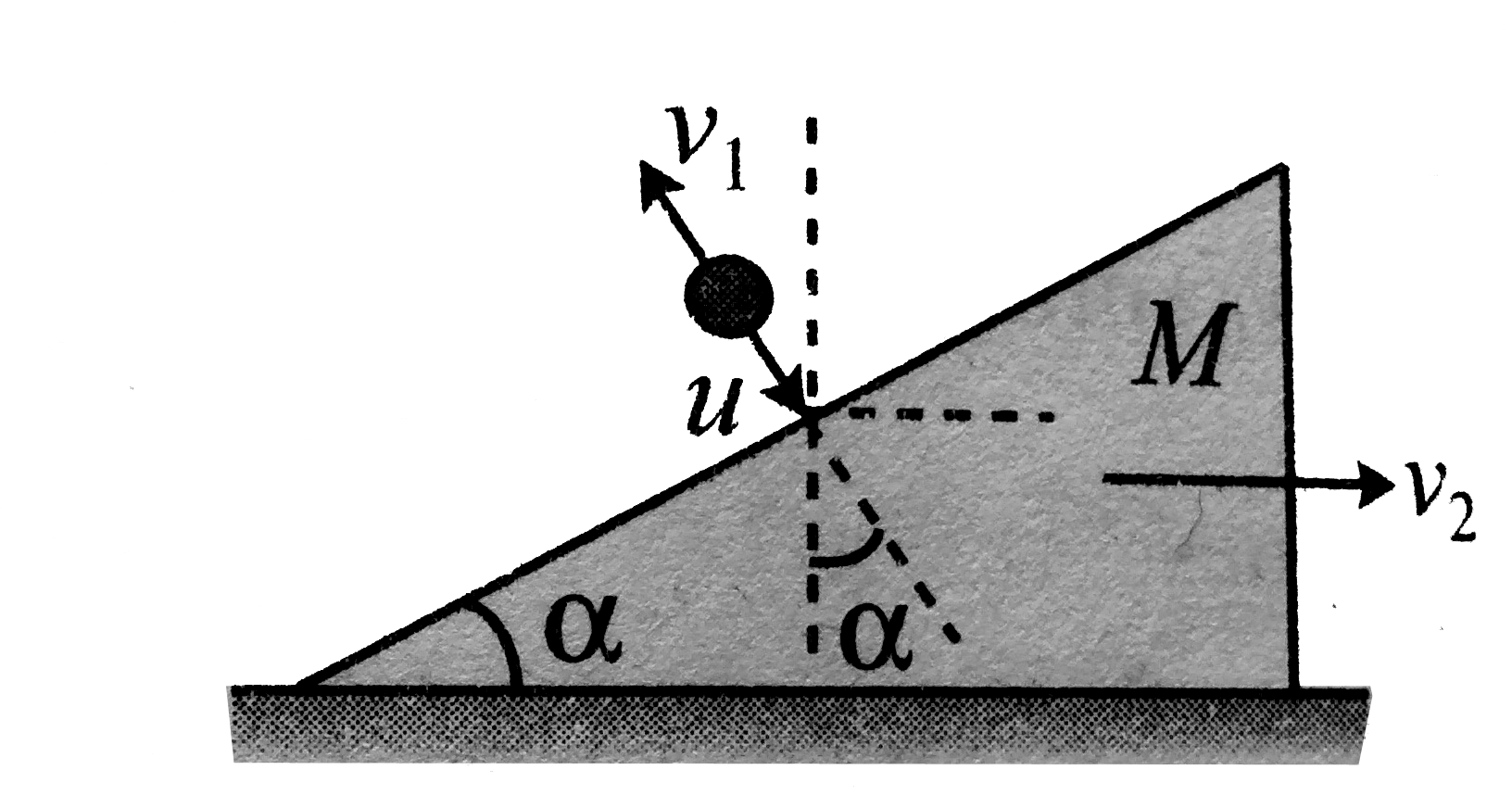 Conservastion of linear mometum along `x`-AXIS. `musinalpha=-mv_(1)sinalpha+Mv_(2)` ...........ii From i and ii `v_(1)/u=(Me-msin^(2)alpha)/(M+sin^(2)alpha)` Put the VALUE of `v_(1)` in eqn i to get `v_(2)` `v_(2)=1/(sinalpha)[eu-((Me-msin^(2)alpha)u)/(M+msin^(2)alpha)]=(musinalpha(e+1))/(M+msin^(2)alpha)` |
|