

Saved Bookmarks
This section includes 7 InterviewSolutions, each offering curated multiple-choice questions to sharpen your Current Affairs knowledge and support exam preparation. Choose a topic below to get started.
| 1. |
A load of mass M is attached to the bottom of a spring of mass M/3 and spring constnat K. If the system is set into oscillation, the time period of oscillation is |
|
Answer» `(2pi)/3sqrt((10M)/K)` |
|
| 2. |
Bernoulli theorem is based on conservation of |
|
Answer» mass |
|
| 3. |
A particle is moving in a plane with velocity given by u = u_(0)i+ (aomega cos omegat)j, where i and are j are unit vectors along x and yaxes respectively. If particle is at the origin at t = 0. (a) Calculate the trajectroy of the particle. (b) Find the distance form the origin at time 3pi//2omega. |
|
Answer» Solution :Given that `u = u_(0)I +(a omega cos omegat)j`, Hence, velocity along `x`-axis `u_(x) = u_(0) …(1)` Velocity along `y`-axis `u_(y) = a omega cos omegat …(2)` We know that `v=(ds)/(dt)` or `s - int v.dt` So from EQUATIONS (1) and (2), we have Displacement at time `t` in horizontal direction `x =int u_(0) dt =u_(0).t ...(3)` Displacement in VERTICAL direction `y = int a omega cos omegat = dt a SIN omegat ...(4)` Eliminating `t` form equaitons (3) and (4) we get `y =a sin (omegax//u_(0)) ...(5)` Equations (5) GIVES the trajectroy of the particle. (b) At time, `t = 3pi//2 omega` `x = u_(0) (3pi//2omega)` and `y = a sin 3pi//2 =-a` `:.` Distance of the particle form teh origin `=sqrt((x^(2)+y^(2)))=sqrt([((3piu_(0))/(2omega))^(2)+a^(2)])` |
|
| 4. |
A metal sphere is heated. Maximum percen- tage increase occurs in its |
|
Answer» Density |
|
| 5. |
(A) When a body is thrown into air, at its maximum height its KE is zero always.(B) If a body is moved along a rough circular path in the horizontal plane, work done by the force applied is zero. |
|
Answer» A is TRUE, B is FALSE |
|
| 6. |
The ratio of thermal conductivities of two rods of different material is 5 : 4. The two rods have same area of cross-section and same thermal resistance. They will have the lengths in the ratio |
|
Answer» `4:5` |
|
| 7. |
The acceleration of a bus is given by a_x(t)=at, where a=1.2ms^-2. a. If the bus's velocity at time t=1.0s is 5.0ms^-1, what is its velocity at time t=2.0s? b. If the bus's position at time t=1.0s is 6.0m, what is its position at time t=2.0s? c. Sketch a_x-t, v_x-t, and x-t graphs for the motion. |
|
Answer» SOLUTION :a. The VELOCITY `v_2` at time `t` `v_2=v_1+int_(t_1)^(t)atdt` `=v_1+alpha/2(t^2-t_1^2)` `=v_1-alpha/2t_1^2+alpha/2t^2` `=(5.0ms^-1)-(0.6ms^-3)(1.0s)^2+(0.6ms^-3)t^2` `=(4.40ms^-1)+(0.6ms^-3)t^2`. At `t_2=2.0s`, the velocity is `v_2=(4.40ms^-1)+(0.6ms^-3)(2.0s)^2` `=6.80ms^-1`, or `6.8ms^-1` to two significant figures. b. the POSITION `x_2` as a function of time is `x_2=x_1+int_(t_1)^tv_xdt` `=(6.0m)+int_(t_1)^t(4.40ms^-1)+(0.6ms^-3)t^(2))dt` `=(6.0m)+(4.40ms^-1)(t-t_1)+((0.6ms^-3))/(3)(t^3-t_1^3)` At `t=2.0s`, and with `t_1=1.0s`, `X=(6.0m)+(4.40ms^-1)[(2.0s)-(1.0s)]` `+(0.20ms^-3)[(2.0s)^3-(1.0s)^3]=11.8m` C. 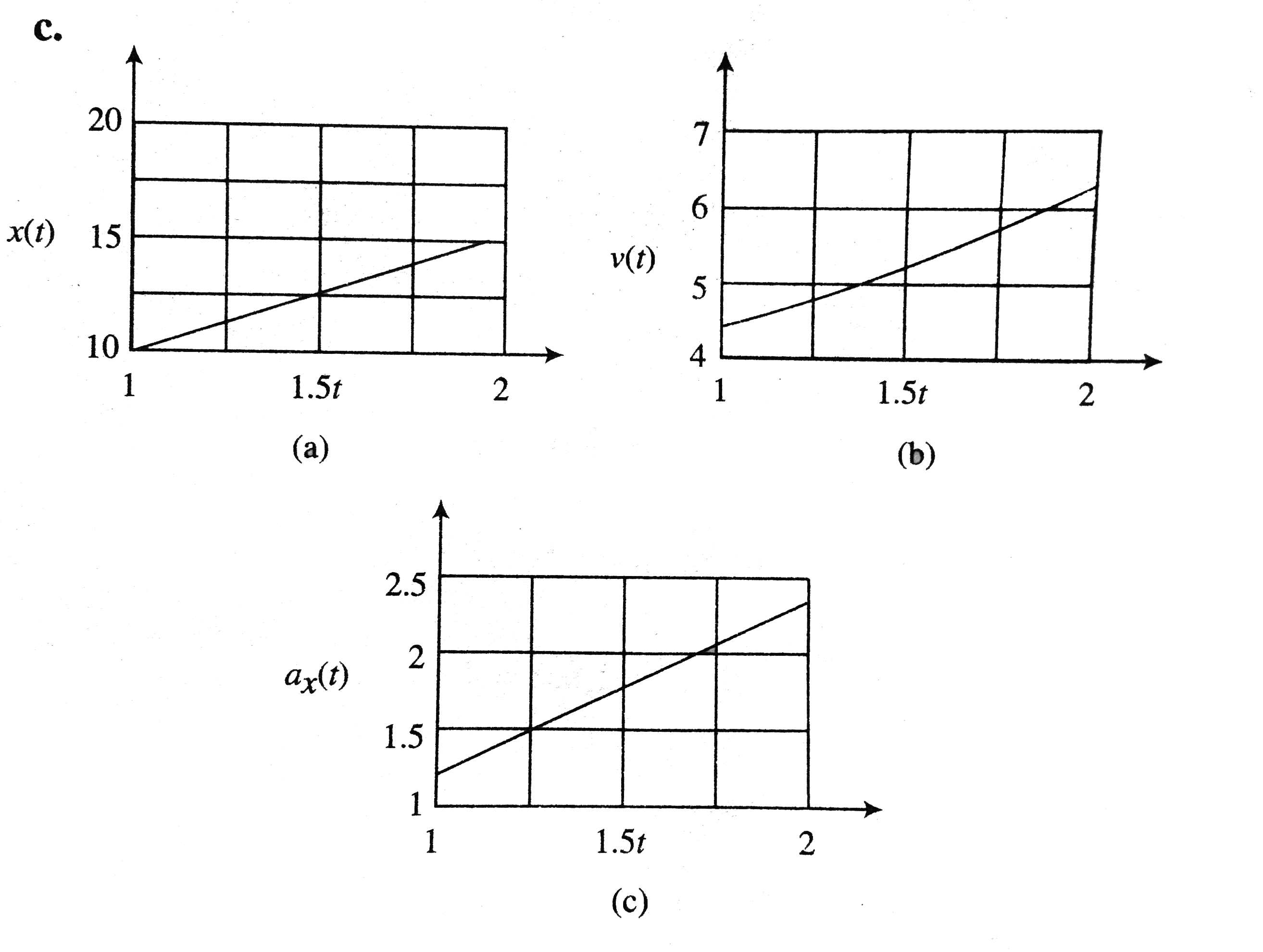
|
|
| 8. |
An ideal monoatomic gas undergoes different types of processes which are described in Table-1. Match the corresponding effects in Table-2. The letters have ususl meaning. |
|
Answer» |
|
| 9. |
A car of mass 1000 kg moves on a horizontal surface. If the road friction amounts to 10% of weight of the car and air resistance amounts to 2% of the weight, the power required to run the car at a uniform speed of 36 KMPH is |
| Answer» ANSWER :C | |
| 10. |
In an experiment to determine the value of acceleration due to gravity 'g' using a simple pendulum, the measured value of length of the pendulum is 31.4 cm known to 1 mm accuracy and the time period for 100 oscillations of pendulum is 112.0s known to 0.01s accuracy. The accuracy in determining the value of 'g' is. |
|
Answer» `(25.03 PM 0.58)CMS^(-2)` |
|
| 11. |
The magnitudes of the gravitational fields at distances r_(1) and r_(2) from the centre of a uniform sphere of radius R and mass M are F_(1) and F_(2) respectively then (a) (F_(1))/(F_(2)) = (r_(1))/(r_(2)) if r_(1) lt R and r_(2) lt R (b) (F_(1))/(F_(2)) = ((r_(2))/(r_(1)))^(2) if r_(1) gt R and r_(2) gt R (c) (F_(1))/(F_(2)) = (r_(1))/(r_(2)) if r_(1) gt R and r_(2) gt R (d) (F_(1))/(F_(2)) = ((r_(1))/(r_(2)))^(2) if r_(1) lt R and r_(2) lt R |
|
Answer» only a and B are TRUE |
|
| 12. |
Two particles of same mass fall down on to the surface of the earth one from infinity and the other from an altitude 3R. The ratio of velocities on reaching the earth is |
|
Answer» `2:3` |
|
| 13. |
A closed organ pipe and a open organ pipe have their first overtone identical in frequency. Their length are in the ratio |
|
Answer» `1:2` |
|
| 14. |
If second overtone of closed pipe and third overtone of open pipe are equal, then find ratio of lengths of both the pipes. |
|
Answer» SOLUTION :(i) For a closed pipe of length `L _(1),` second OVERTONE = third harmonic `= (2n -1) f _(1)` `= 5 XX ( v )/( 4 L _(1))` `(because ` Here `n = 3 and f _(1) = (v)/( 4 L _(1)))…(1)` (ii) For an open pipe of length `L _(2),` third overtone = FOURTH harmonic `= nf._(1)` `= 4 xx (v)/(2 L _(2))` `(because ` Here ` n =4 and f ._(1) = (v)/(2 L _(2)))` Now , as per the statement, `(5v)/( 4 L _(1)) = (4v )/( 2 L _(2))` `therefore (L _(1))/( L _(2)) = (10)/( 16) = 5/8` |
|
| 15. |
The angular velocity of the earth with which it has to rotate so that the acceleration due to gravity on 60^(@) latitude becomes zero. |
|
Answer» <P>`3sqrt((g_(p))/(R))` |
|
| 16. |
(A): A body thrown up from the top of a tower and another body thrown down from the same point strike the ground with the same velocity. (R) : Initial speed and acceleration are common for both. |
|
Answer» Both (A) and (R) are TRUE and (R) is the correct EXPLANATION of (A) |
|
| 17. |
A black coloured solid sphere of radius R and mass M is inside a cavity with vacuum inside. The walls of the cavity are maintained at temperature T_0. Theinitial temperature of the sphere is 3T_0. If the specific heat of the material of the sphere varies as alpha T^3 per unit mass with the temperature T of the sphere, where alpha is a constant, then the time taken for the sphere to cool down to temperature 2T_0 will be ( sigma is Stefan Boltzmann constant ) |
|
Answer» ` ( M alpha ) /( 16 PI R^(2) SIGMA) "In" ((16)/(3))` |
|
| 18. |
Gas exerts pressure on the walls of the container |
|
Answer» <P> Solution :EXPRESSION for pressure exerted by a gas : Consider a monoatomic gas of N molecules each having a mass m inside a cubical container of side l.The molecules of the gas are in random motion. They collide with each other an also with the walls of the container. As the collisions are elastic in nature, there is no loss of energy, but a change in momentum occurs. The molecules of the gas exert pressure on the walls of the container due to collision on it. During each collision, the molecules impart certain momentum to the wall. Due to transfer of momentum, the walls experience a continuous force. The force experienced per unit area of the walls of the container determines the pressure exerted by the gas. It is essential to determine the total momentum transferred by the molecules in a short interval of time. A molecule of mass m moving with a velocity `vecnu` having components `(nu_(x),nu_(y),nu_(z))` hits the right side wall. Since we have assumed that the collision is elastic, the PARTICLE rebounds with same speed and its x-component is reversed. This is shown in the figure. The components of velocity of the molecule after collision are `(-nu_(x),nu_(y),nu_(z))` The x-component of momentum of the molecule before collision `=mnu_(x)` The x-component of momentum of the molecule after collision ` =-mnu_(x)` The change in momentum of the molecule in x DIRECTION = Final momentum - initial momentum `=-mnu_(x)-mnu_(x)=-2` According to law of conservation of linear momentum, the change in momentum of the wall `=2mnu_(x)` The number of molecules hitting the right side wall in a small interval of time `Deltat` The number within the distance of `nu_(x)deltat` from the right side wall and moving towords the right will hit the wall in the time interval ` Deltat` The number of molecules that will hit the right side wall in a time interval ` Deltat` is equal to the product of volume `(Anu_(x)Deltat)` and number density of the molecules (n). Here A is area of the wall and n is number of molecules per unit volume `N/V` We have assumed that the number density is the same throughhout the cube. Not all the n molecules will move to the right, therefore on an average only half of the n molecules move to the right and the other half moves towards left side. The number of molecules that hit the right side wall in a time interval `Deltat` `=n/2Anu_(x)Deltat`....(1) In the same interval of time `Deltat`the total momentum transferred by the molecules `DeltaP=n/2Anu_(x)Deltatxx2mnu_(x)=Anu_(x)^(2) mnDeltat` ....(2) From Newton.s second law, the change in momentum in a small interval of time gives rise to force. The force exerted by the molecules on the wall in magnitude) `F=(DeltaP)/(Deltat)=nmAnu_(x)^(2)`...... (3) Pressure, P = force divided by the area of the wall `P=F/A=nmnu_(x)^(2)` ....(4) Since all the molecules are moving completely in random manner, they do not have speed. So we can replace the term `nu_(x)^bar(2)` by the average in equation (4). `P=nmnu_(x)^bar(2)` ....(5) Since the gas is assumed to move in random direction, it has no preferred directie of motion (the effect of gravity on the molecules is neglected). It implies that the molecule has same average speed in all the three direction. So, `nu_(x)^bar(2)=nu_(y)^bar(2)=nu_(z)^bar(2)`.The MEAN square speed is written is as average speed is written as `nu^bar(2)=nu_(x)^bar(2)+nu_(y)^bar(2)+nu_(z)^bar(2)=3nu_(z)^bar(2)`. `nu_(x)^bar(2)=1/3nu^bar(2)` Using this an equation (5), we get P=1/3nmnu^bar(2)` or P=1/3N/Vmnu^bar(2)` ........(6) `[n=N/V]`   
|
|
| 19. |
Two satellite A and B go round a planet P in circularorbits having radii 4R and R respectively. If the speed of the satellite A is 3v, the speed of the satellite B will be |
|
Answer» 12 v `:. (v_(A))/(v_(B))=(3v)/(v_(B))=(1)/(2)rArr v_(B)=6v`. |
|
| 20. |
The displacement of two identical particles executing SHM are represented by equations x_(1)= 4sin(10t+ (pi)/(6))and x_(2) =5 cosomega t For what value of omega energy of both the particles is same |
|
Answer» Solution :`E= (1)/(2)mA^(2)omega^(2) i.e., E PROP (Aomega)^(2)` `(A_(1)omega_(1))^(2)= (A_(2)omega_(2))^(2) "" A_(1)omega_(1)= A_(2)omega_(2)` `4 xx 10 = 5 xx omega"" omega= 8` UNIT |
|
| 21. |
A glass bulb 30^(@)C contains air at atmospheric pressure. If the bulb can withstand a pressure of 2 atm find the temperature at which it will burst? Neglect the expansion of the vessel. |
| Answer» Solution :`(P _(2) //P _(1)) ^( GAMMA - 1) = (T_(2) //T_(1)) ^( gamma) , (2) ^(1.4-1)= (T_(2) //303) ^(1.4) , T_(2) = 369 K` | |
| 22. |
In the above problem work done along path BCis: |
|
Answer» zero |
|
| 23. |
Is it possible to have constant of change of velocity when velocity changes both inmagnitude and direction? |
| Answer» Solution :YES, example -body moving upwards or downwards where ACCELERATION is constant while MAGNITUDE and DIRECTION CHANGES. | |
| 24. |
The focal length of the objective and the eye piece of a telescope are 50cm and 5cm respectively. IF a telescope is focussed for distinct vision on a scale distant 2m from its objective, then its magnifying power will be |
| Answer» ANSWER :D | |
| 25. |
A ball strikes a horizontal floor at an angle theta = 45^(@) with the normal to floor. The coefficient of restitution between the ball and the floor is e = 1/2. The fraction of its kinetic energy lost in collision is |
|
Answer» SOLUTION :Let u be the velocity of ball before COLLISION. Speed of the ball after collision will become `v= sqrt(u^(2)sin^(2)theta+e^(2)u^(2)cos^(2)theta)` `v = sqrt(((u)/(sqrt(2)))^(2)+((u)/(2sqrt(2)))^(2))=sqrt((5)/(8)).u` `therefore` Fraction of KE lost in collision `= ((1)/(2)m u^(2)-(1)/(2)MV^(2))/((1)/(2)m u^(2))=1-((v)/(u))^(2)=1-(5)/(8)=(3)/(8)` |
|
| 26. |
A spherical iron ball is placed on a large block of dry ice at 0^(@)C. The ball sinks into the ice until it is half subsmurged. What was the temperature of the iron? (Density of iron =7.7xx10^(3)kgm^(3), Density of ice =920kgm^(-3) specific heat capacity of iron =504Jkg^(-1)K^(-1), specific latent heat of fusion of ice =336xx10^(3)Jkg^(-1)) |
|
Answer» |
|
| 27. |
Select the correct alternative(s)a) Elastic forces are always conservative b) Elastic forces are not always conservative c) Elastic forces are conservative only when Hooke's law is obeyed d) Elastic forces may be conservative even when Hooke's law is not obeyed |
|
Answer» a,d |
|
| 28. |
A metallic wire of densilty d floats horizontal in water. The maximum radius of the wire so that the wire maynot sink is (surface tension of water =T) |
|
Answer» `sqrt((2T)/(pi d g))` |
|
| 29. |
Suppose unknowingly you wrote the universal gravitational constant value as G = 6.67 xx 10^(11) Instead of the correct value G = 6.67 xx 10^(-11), what is the acceleration due to this new acceleration due to gravity, what will be your weight W'? |
|
Answer» Solution :DATA: IncorrectGravitationalconstant ` G = 6.67 xx10^(11) "Nm"^(2) kg^(-2)` Massof the Earth `M_(e) = 5.972 xx10^(24) ` kg Radiusof the Earth `R_(e) = 6371"km (or) " 6371 xx10^(3)` m Acceleration due to gravityg. ` = (GM_(e))/(R_(e)^(2))` ` g. = (6.67 xx10^(11)xx5.97 xx10^(24))/((6371 xx10^(3))^(2))` ` = (39.8332 xx10^(35))/(4.0589641 xx10^(13)) = 9.81 xx10^(22)` `g . = 10^(22) g ` New weight `W. = Mg. = M (10^(22)g) = 10^(22) mg ` |
|
| 30. |
Time periods of a pendulum on two planets are in the ratio 3: 4. The acceleration due to gravity on them are in the ratio |
|
Answer» `9:16` |
|
| 31. |
A thermodynamic process is as shown in figure such that P_(A) = 3 xx 10^(4)Pa, P_(B) = 8 xx 10^(4) Pa, V_(A) = 2 xx 10^(-3) m^(3), V_(D) = 5 xx 10^(-3) m^(3) In procss AB, 600 J of heat is added to the system and in process BC, 200 J of heat is added to the system. The change in internal energy of the system in proess AC is |
|
Answer» 560 J `Delta W = W_(AB) + W_(BC) = 0 + P_(B)(V_(C )-V_(B)) = 8 xx 10^(4) xx (V_(D) - V_(A))` `= 8 xx 10^(4)(5 xx 10^(-3) - 2 xx 10^(-3)) = 240 J` `Delta U = Delta Q - Delta W = 800 - 240 = 560 J` |
|
| 32. |
The resultant of vec(A) and vec(B) makes angle alpha with vec(A) and beta " with " vec(B). Then: |
|
Answer» `alpha lt BETA` |
|
| 33. |
A block of mass m is kept on rough horizontal tum table at a distance r from centre of table. Coefficient of friction between turn table and block is mu. Now turn table starts rotating with uniform angular acceleration alpha. Find angle made by friction force with velocity at the point of slipping, |
|
Answer» `theta = tan^(-1)(alphat)` |
|
| 34. |
A spherical object of mass m is released on a smooth inclined plane which is inclined at anangle theta with the horizontal. State whether it will roll or slip. Give reasons in support of your answer. |
| Answer» Solution :No frictional FORCE acts on smooth plane. The only downward force ACTING on the centre on the centre MASS of the object along the INCLINED plane is m g sin`THETA` . But there is no torque about the centre of mass due to absence of the frictional force. So, the object will slip down without rolling with acceleration gsin `theta`. | |
| 35. |
Streamlined flow is more likely for liquids with ………….. . |
|
Answer» (a) HIGH density and LOW viscosity |
|
| 36. |
A body is thrownup with a velocity 40ms^(-1). At same time another body is droped from aheight 40m. Their relative acceleration after 1.3 seconds is |
|
Answer» 4g |
|
| 37. |
The radius of an air bubble found to be trebled on reaching the top from the bottom of a lake. If the atmospheric pressure is equal to the pressure of H meters of water column, find the depth of the lake (Assume that the temperature of water in the lake is uniform) |
|
Answer» |
|
| 38. |
If veca+vecb=vecc, and a+b=c then the angle betweenveca and vecb is |
| Answer» Answer :D | |
| 39. |
A lift of total mass M is raised by cables from rest through a height h . The greatest tension which the cables can safely bear is n Mg. The maximum speed of lift during journey if the ascent is to made shortest time is : |
|
Answer» `SQRT(2gh((N+1)/n))` |
|
| 40. |
Three sound sources A, B and C have frequencies 400, 401 and 402 H_(Z), respectively. Cacluated the number of beats noted per second. |
|
Answer» Beat time period for `A` and `B` is `1` s. It implies that `A` and `B` are in phase at time `t = 0`, they are again in phase after `1` s. Same is the case with `B` and `C` . But beat time period for `A` and `C` is `0.5`s. Therefore , beat time period for all together `A, B` and `C` will be `1` s. Because if , at `t = 0, A, B` and `C` all are in phase then after `1` s. (`A` and `B`) and (`B` and `C`) will again be in phase for the first time while (`A` and `C`) will be in phase for the second time. Or we can that all `A, B` and `C` are again in phase after `1` s. `:.` Beat time period , `T_(b) = 1 s` or Beat FREQUENCY , `f_(b) = (1)/(T_(b)) = H_(Z)` Suppose at time `t`, the equations of waves are `y_(1) = A_(1) sin 2 pif_(A)t``(omega = 2pi f)` `y_(2) = A_(2) sin 2pi f_(B) t` and `y_(3) = A_(3) sin 2pi f_(C) t` If they are beat time at some given instant of time `t`, then `2 pif_(A)t = 2 pi f_(B)t = 2pi f_(C)t` ...(i) Let `T_(b)` be the beat time period, i.e. after time `T_(b)` they all are again in phase. As `f_(C) gt f_(B) gt f_(A)` , so `2pi f_(C) (t + T_(b)) = 2 pi f_(A) (t + T_(b)) + 2 mpi` ...(ii) and `2pi f_(B) (t + T_(b)) = 2 pi f_(A) (t + T_(b)) + 2 npi` ....(III) Here, `m` and `n (lt m)` are positive INTEGERS. From Eqs. (i) and (ii) `(f_(C) - f_(A)) T_(b) = m` ...(iv) Similary, From Eqs. (i) and (ii) `(f_(B) - f_(A)) T_(b) = n` ...(v) DIVIDING Eq. (iv)by Eq. (v), `(m)/(n) = (f_(C) - f_(A))/(f_(B) -f_(A))= (402 - 400)/(401 - 400)= (2)/(1)` Thus, letting `m = 2` and `n = 1` `T_(b)= (m)/(f_(C) - f_(A))` [from Eq. (iv)] = `(2)/(2) = 1 H_(Z)` `:.` Beat frequency , `f_(b) = (1)/(T_(b)) = 1 H_(Z)` |
|
| 41. |
A uniform ball of mass M and radius R can rotate freely about any axis through its centre. Its angular velocity vector is directed along positive x axis. A bullet is fired along negative Z direction and it pierces through the ball along a line that is at a perpendicular distancer (le R) from the centre of the ball. The bullet passes quickly and its net effect is that it applies an impulse on the ball. Mass of the bullet is m and its velocity charges from u tov (le u) as it passes through the ball. As a result the ball stops rotating about X axis and begins to rotate about y axis. The angular speed of the ball before and after the hit is omega. Find r. |
|
Answer» |
|
| 42. |
Obtain coefficient of volume expansion from ideal gas equation. |
|
Answer» SOLUTION :Ideal gas EQUATION, `PV=muRT ""`. . .(1) Where P = PRESSURE, V = volume `mu=` no. of moles of gases R = gas constant T = absolute temperature At constant pressure, `PDeltaV=muRDeltaT""` . . . (2) By TAKING ratio of equation (2) and (1), `(DeltaV)/(V)=(DeltaT)/(T)` `:.(DeltaV)/(VDeltaT)=1/T` But `(DeltaV)/(V DeltaT)=alpha_(V)` (coefficient of volume expansion) `:.alpha_(V)=1/T` For ideal gas, `alpha_(V)=3.7xx10^(-3)K^(-1)` at `0^(@)C` which is GREATER than solid and liquid. For ideal gas `alpha_(V)` depend on temperature. It is inversely proportion to temperature. Hence it decrease with increase in temperature. For ideal gas, `alpha_(V)=3300xx10^(-6)K^(-1)` at room temperature which is much more greater than liquids. |
|
| 43. |
Explain the need for modulation. |
| Answer» Solution :In a leveled circularroadskiddingmainlydependson thecoefficientof staticfricition`mu_(s)` thecoefficientof staticfrictiondependson thenatureof thesurfacethat has amaximumlimitingvalue .Ifthe SPEEDOF carexceedsthe safespeedthen it startsto skidoutward.Butfrictionalforcecomesintoeffect. Ifthe SPEED OFTHE CAR is littlelesserthan safespeedthenis startsto skidinwardandfrictionalforce comesintoeffectthatreducescentripetalforceto preventinwardskidding. However ifthespeedof tehvehiclefrictionalforcecannotstopthe carfromskidding. | |
| 44. |
A block of mass m is kept on rough horizontal tum table at a distance r from centre of table. Coefficient of friction between turn table and block is mu. Now turn table starts rotating with uniform angular acceleration alpha. Find the time after which slippping occurs between block and turn table |
|
Answer» `t= ((mu^(2)g^(2)-alpha^(2)R^(2))/(alpha^(4)r^(2)))^(1//4)` |
|
| 45. |
In a planet a sucrose solution of coefficient of viscosity 0.0015N-Sm^(-2) is driven at a velocity of 10^(-3)ms^(-1) through xylem vessels of radius 2mum and length 5mum. The hydrostatic pressure difference across the length of xylem vessels in Nm^(-2) is |
|
Answer» 5 |
|
| 46. |
If a particle executes uniform circular motion in the xy plane in clock wise direction, then the angular velocity is in : |
|
Answer» `+`y DIRECTION ` sin THETA = (vec(r) xx vec(omega))/(|vec(r) xx vec (omega)|)` Here` theta = 90^(@) and hat(n)`acts along - z direction. `:. - ` z AXIS 
|
|
| 47. |
How much should the pressure of 1 atmosphere and 2 litre of nitrogen at a pressence of 0.5 atmosphere are introduced in a vessel of 1 litre capacity without any change in temperature The total pressure in atmosphere is |
|
Answer» `10%` `P prop (1)/(V), (P_(1))/(P_(2)) = (V_(2))/(V_(1)), (P_(2) - P_(1))/(P_(1)) = ((V_(1) - V_(2))/(V_(2))) XX 100` |
|
| 48. |
A physical quantity has unit ("Watt")/(m^(2)) write its dimension. |
| Answer» SOLUTION :`M^(1)L^(0)T^(-3)` | |
| 49. |
Two metal spheres of same material and radius 'r' are is contact with each other. The gravitational force of attraction between the spheres is given by |
|
Answer» `F = K r^(4)` |
|