

Saved Bookmarks
This section includes 7 InterviewSolutions, each offering curated multiple-choice questions to sharpen your Current Affairs knowledge and support exam preparation. Choose a topic below to get started.
| 1. |
A spring gun of spring constant 90 N cm^(-1) is compressed 12 cm by a ball of mass 16 g. If the trigger is pulled, the velocity of the ball is |
|
Answer» `50 m s^(-1)` `k = 90 N cm^(-1) = 90 xx 10 Nm^(-1)` `x = 12 cm = 12 xx 10^(-2) m` According to the law of CONSERVATION of energy, `1/2 mv^2 = 1/2 kx^2 " or " V^2 = (kx^2)/(m)` or `v = xsqrt(k/m) (12 xx 10^(-2)m) sqrt((90 xx 100 Nm^(-1))/(16 xx 10^(-3) kg)) = 90 ms^(-1)`. Thus the velocity of the ball `90 ms^(-1)`. |
|
| 2. |
The distance travelled by a body moving along a line in time t is proportional to t^3 . The acceleration - time (a, t) graph for the motion of the body will be |
|
Answer»
|
|
| 3. |
Three forces bar(F_(1)), bar(F_(2)) and bar(F_(3)) are simultaneously acting on a particle of mass 'm' and keep it in equilibrium. If bar(F_(1)) force is reversed in direction only, the acceleration of the particle will be. |
|
Answer» `bar(F_(1))//m` `vec(F_(1))=-(F_(1)+F_(2)), a=(-F_(1)+F_(2)+F_(3))/(m)` |
|
| 4. |
A sphere of radius 10 cm is hung inside an oven whose walls are at a temperature of 1000 K. Calculate total heat energy incident per second (in joules//sec) on the sphere, sigma=5.67xx10^(-8) mks units. |
|
Answer» `SIGMA= 5.67xx10^(-8)` mks units Heat energy incident/sec area`=sigma T^(4)` Total heat energy incident/sec `E=sigma T^(4)` x area of sphere `=sigma T^(4)xx4 pi r^(2)` `=5.67xx10^(-8)xx(10^(3))^(4)xx4xx(22)/(7)(10^(-1))^(2)` `E= 7128 j s^(-1)` |
|
| 5. |
Starting from rest a wheel rotates with uniform angular acceleration 2pi rad s^(-2). After 4s, if the angular acceleration ceases to act, its angular displacement in the next 4s is |
|
Answer» `8pi RAD` |
|
| 6. |
For a satellite moving in an orbit around the earth, the ratio of kinetic energy of potential |
|
Answer» Solution :`(GMm)/(R^2) = m omega^2 R` `KE = 1/2 I omega^2= 1/2 mR^2 omega^2 = (GMm)/(2R)` `PE= - (GMm)/(R )` `(KE)/(|P.E|) = (GMm)/(2R) XX (R )/(GMm) = 1/2 ` |
|
| 7. |
In a measurement, a choice of change of different units |
|
Answer» does not CHANGE the number of SIGNIFICANT FIGURES |
|
| 8. |
A force F =(6hati +2hatj -3hatk)acts on a particle and produces a displacement of vecs = (2hati-3hatj+xhatk). If work done is zero, the value of x is |
|
Answer» `-2` `= 12 - 6 - 3X` As W = 0 (Given) `:.` 12 - 6 - 3x= 0 or x = 2`. |
|
| 9. |
Explain the characteristics of elastic and inelastic collision. (OR) What is the condition for perfect inelastic collision ? |
Answer» SOLUTION :
|
|
| 10. |
Which of the following velocity-time graphs represent uniform motion |
|
Answer»
|
|
| 11. |
When a projectile is projected in oblique motion expressions for time of flight andrange of the projectile are given . Which of the following pairis correct ? |
|
Answer» `t_(F) = (u sin THETA)/(2G):R = (u^(2) sin 2 theta)/(2g)` |
|
| 12. |
A simple pendulum is suspended from the roof of a trolley that moves freely down a plane of inclination theta. What is the time period of oscillation ? What is the angle made by the string with the inclined plane in the mean position ? |
|
Answer» Solution :The effective ACCELEATION g. is the RESULTANT of g acting VERTICALLY downwards and the inertial acceleration g `sin theta` acting up the PLANE. `g. = sqrt(g^2 + g^2 sin^2 theta + 2(g)(g sin theta) cos (90^@ +theta))` `=gsqrt(1+sin^2theta - 2 sin^2 theta) = g cos theta` Time PERIOD T=` 2pi sqrt((1)/(g cos theta))` 
|
|
| 13. |
Water drops fall from the roof of a building 20m high at regular time intervals. If the first drop strikes the floor when the sixth drop begins to fall, the heights of the second and fourth drops from the ground atthat instant are (g=10ms^(-2)) |
|
Answer» 12.8 m and 3.2 m |
|
| 14. |
An ideal gas goes from state A to state B via three different processes as indicated in the P-V diagram. If Q_(1), Q_(2), Q_(3) indicate the heat absorbed by the gas along the three processes and Delta U_(1) , Delta U_(2), Delta U_(3) indicate the change in internal energy along the three processes respectively, then |
|
Answer» `Q_(1) GT Q_(2) gt Q_(3)` and `Delta U_(1) = Delta U_(2) = Delta U_(3)` |
|
| 15. |
An ideal gas system undergoes an isothermal process, then the work done during the process is |
|
Answer» `NRT ln ((V_(2))/(V_(1)))` |
|
| 16. |
If unit of mass is taken as 1kg, of time as 1 minute and that acceleration due to gravity is taken as 9.81ms^(-2), what is the unit of energy? |
|
Answer» Solution :New uunit of energy `= E_(1)` New UNIT of MASS `M_(2)= 1kg` New unit of time `T_(1)=1` minute = 60 sec New unit of length `=L_(1)` `E_(1)= [M_(1)L_(1) T_(1)^(-2)]` New unit of acceleration DUE gravity, `g_(1)= 9.81 ms^(-2)` `g_(1)= L_(1) T_(1)^(-2), L_(1)= g_(1)T_(1)^(-2)= 9.81 XX (60)^(2)` meter `E_(1)= [1kg xx (9.81 xx 60^(2))^(2) m^(2) (60)^(-2) S^(-2)]` `E_(1)= (1 xx 9.81 xx 60 xx 60 xx 9.81 xx 60 xx 60)/(60 xx 60) kg m^(2) s^(-2)` `E_(1)= 3.464 xx 10^(5) kg m^(2) sec^(-2)` `therefore` The new unit of energy `E_(1)= 3.464 xx 10^(5)` joule. |
|
| 17. |
A train of length 200m travelling at a speed of 30ms^(-1) overtakes another train of length 300m travelling ata speed of 20ms^(-1) in the same direction. The time taken by the first train to pass the second train is |
|
Answer» 50 s |
|
| 18. |
A ball is projected vertically upwards. Air resistance and variation in g may be neglected. The ball rises to its maximum height H in a time T, the height being h after a time t : (1) The graph of kinetic energy E_(k) of the ball against height h is shown in figure 1 (2) The graph of height h against time t is shown in figure 2 (3) The graph of gravitational energy E_(k)of the ball against height h is shown in figure 3 (1) (2)In the above situation the block wili have maximum velocity when: |
|
Answer» the SPRING force BECOMES ZERO |
|
| 19. |
A ball is projected vertically upwards. Air resistance and variation in g may be neglected. The ball rises to its maximum height H in a time T, the height being h after a time t : (1) The graph of kinetic energy E_(k) of the ball against height h is shown in figure 1 (2) The graph of height h against time t is shown in figure 2 (3) The graph of gravitational energy E_(k)of the ball against height h is shown in figure 3 (1) -Which the figure shows the correct answers ? |
|
Answer» 3 only |
|
| 20. |
The component of position vector vecr along x - axis will maximum value if |
|
Answer» `VECR` is ALONG x-axis |
|
| 21. |
Proveis therateof changeofangularmomentumofthe earthaboutthe sun ? |
|
Answer» Solution :Thearealvelocityof theearthaboutthe sum`=(1)/(2)VR =`constant(Kepler.ssecondlaw ) `therefore ` angularmomentum=mvr =constant . HENCETHE rateofchange ofangularmomentum oftheearthaboutthe SUN ISZERO . |
|
| 22. |
Match the statements, situations in Column I with that in Column II. One or more matching is possible. |
|
Answer» |
|
| 23. |
Passage - I : A massless inextensible string is wound arounf two indeentical discs A and B. Disc A is fixed at the centre but is free to rotate about its axis and B is free to fall down. If the string does not slip on either of the disc answer the following (Given mass of each disc is m and radius of each disc is R) The angular acceleration of disc A and tention in the string is |
|
Answer» `(g)/(3R),(2MG)/(3)` |
|
| 24. |
Passage - I : A massless inextensible string is wound arounf two indeentical discs A and B. Disc A is fixed at the centre but is free to rotate about its axis and B is free to fall down. If the string does not slip on either of the disc answer the following (Given mass of each disc is m and radius of each disc is R) The acceleration of disc B is |
|
Answer» `g/3` |
|
| 25. |
At a given temperature the root mean square velocities of oxygen and hydrogen molecules are in the ratio |
|
Answer» `16:1` |
|
| 26. |
The normal length of a steel spring is 8cm. Keeping one end of the spring fixed at a point, if a weight is attached to the other end, its length becomes 14 cm. The weight is pulled down slightly and then released. Find the time period of oscillation of the spring? |
|
Answer» Solution :Increase in LENGTH of the spring for the mass m is, l = 14 - 8 = 6 cm. So, FORCE constant k (force required for a unit increase in length) = `(mg)/6"DYN"*cm^(-1)`. Time PERIOD, `T=2pisqrt(m/k)=2pisqrt(m/((mg)/6))` = `2pisqrt(6/g)=2xx3.14xxsqrt(6/980)=0.49s`. |
|
| 27. |
In hot summerafter aboththe body's |
|
Answer» INTERNAL ENERGY DECREASES |
|
| 28. |
Mass m_(1) hits & sticks with m_(2) while sliding horizontally with velocity v along the common line of centres of the three equal masses (m_(1)=m_(2)=m_(3)=m). Initially masses m_(2) and m_(3) are stationary and the spring is unstretched. Find (a) the velocities of m_(1),m_(2) and m_(3) immediately after impact. (b) the maximum kinetic energy of m_(3). (c) the minimum kinetic energy of m_(2). (d) the maximum compression of the spring. |
Answer» 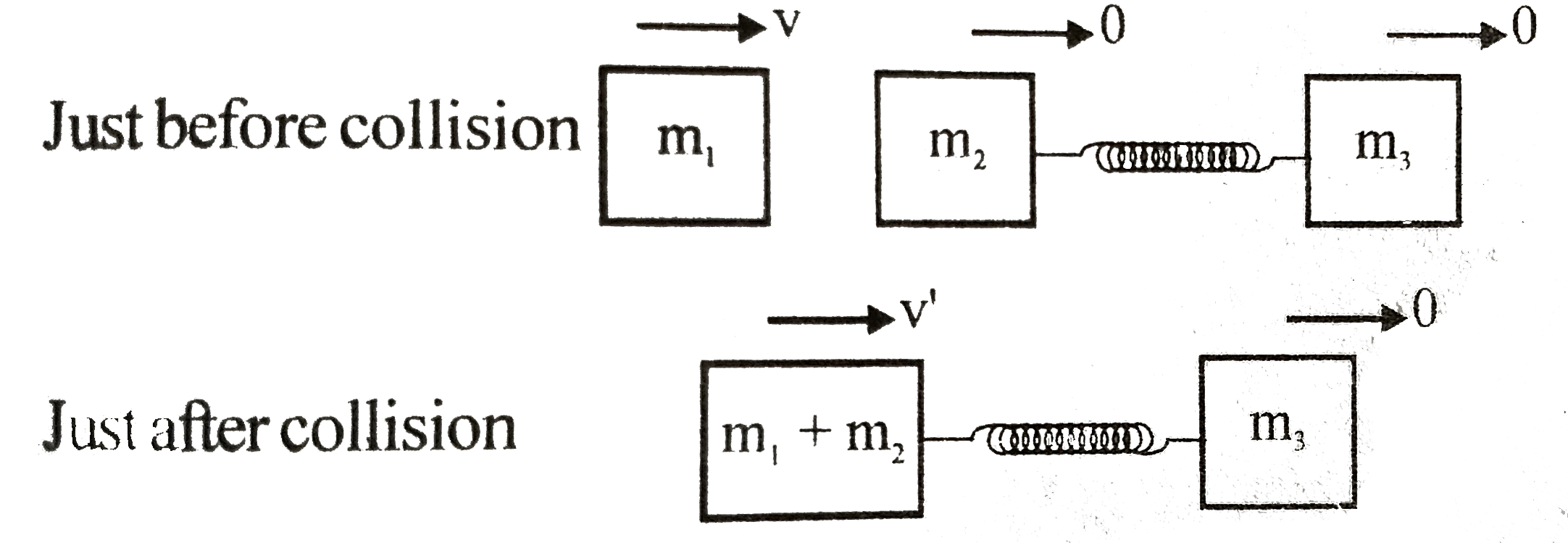 (a) We can use conservation of momentum as spring force is not an impulsive force. `rArrmv+0=(2m)V'rArr=(v)/(2)` `rArrv_(m_(1))=(v)/(2),v_(m_(2))=(v)/(2),v_(m_(3))=0` (b) Looking from CM FROME of refernce `v_(CM)=((2m)v'+m(0))/(2m+m)=(2)/(3)v'=(v)/(3)` 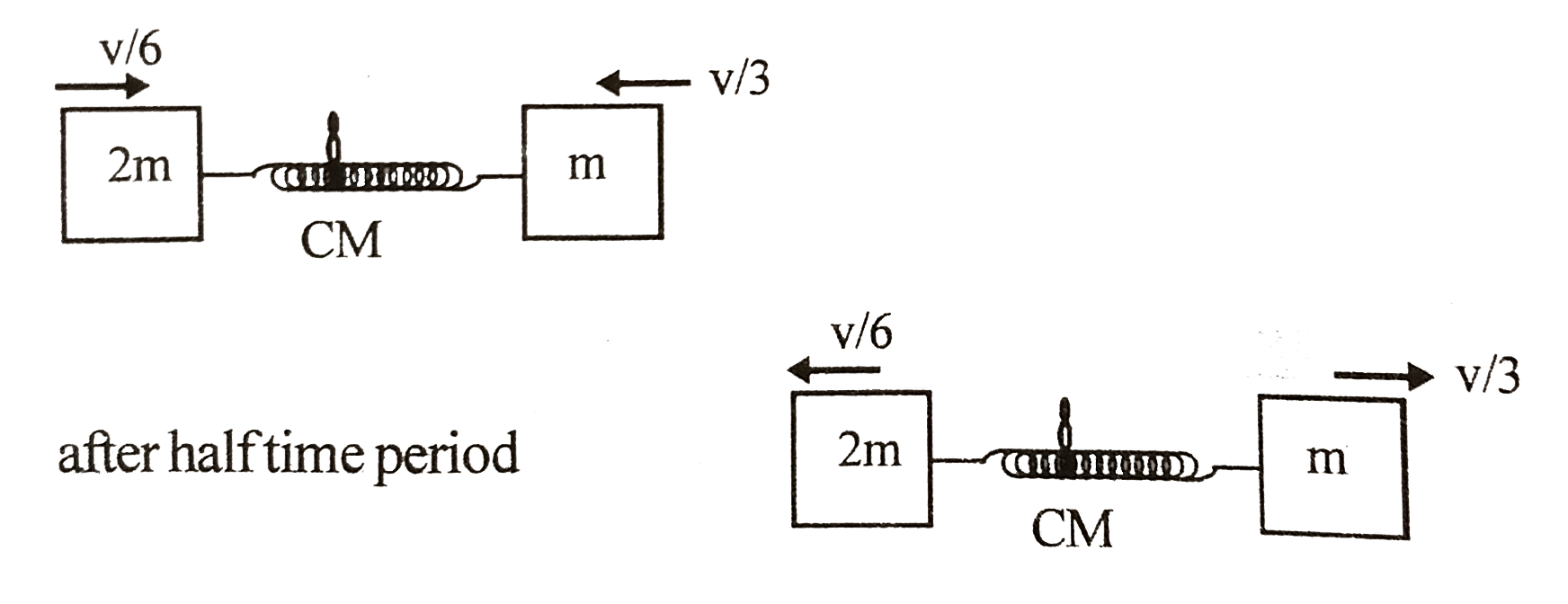 (Both the blocks will execute SHM of same time period in CM frome of reference) `rArr(v_(m_(3)))_(max)=(v)/(3)+v_(CM)=(v)/(3)+(v)/(3)=(2v)/(3)` `rArr(KE_(m_(3)))_(max)=(1)/(2)m(v_(3))_(max)^(2)=(1)/(2)m((2v)/(3))^(2)=(2mv^(2))/(9)` (c) `(v_(m_(2)))_(min)=(v)/(3)-(v)/(6)=(v)/(6)` `rArr(KE_(m_(2)))_(min)=(1)/(2)m(v_(2))_(min)^(2)=(1)/(2)m((v)/(6))^(2)=(MV^(2))/(72)` (d) At the time of maximum compression, both blacks will be at rest in CM frame of reference `rArr(1)/(2)kx_(max)^(2)=(1)/(2)(2m)((v)/(6))^(2)+(1)/(2)m((v)/(3))^(2)` `rArr(1)/(2)Kx_(max)^(2)=(1)/(12)mv^(2)` `rArrx_(max)=vsqrt((m)/(6k))` |
|
| 29. |
Mention the MKS and GGS unit of work and define them and also write the dimensional formula of work . |
|
Answer» Solution :MKS unit of work `("kg m"^(2))/(s^(2))` .It is also known as JOULE . Joule : Work done is said to be one joule, " When a force of one Newton actually moves a body through a distance of one metre in the direction of applied force . " ` :.1 "Joule " = 1 Nm = (1 " kg m"^(2))/(s^(2))` CGS unit of work is `(" g cm"^(2))/(s^(2))` .It alsoknown as ERG . Erg: Work daone is saidto beone erg . " When a force of one day DYNE actuallymoves a body through a distanceof one cm inthe direction of APPLIEDFORCE ". ` :. 1 "er = 1 dyne cm = 1 " ("g cm"^(2))/(s^(2))` SI unit of work is Joule (J) : J = Ns Dimensional formulaof work is`[M^(1)L^(2)T^(-2)]` [ Joule = `10^(7)`erg] Some practical units of work /energy shown in table (in Joule ) 
|
|
| 30. |
A steel wire has a length of 12.0m and a mass of 2.10kg. What should be the tension in the wire so that speed of a transverse wave on the wire equals the speed of sound in dry air at 20^(@)C= 343ms^(-1) |
| Answer» SOLUTION :`2.06 XX 10^(4)N` | |
| 31. |
Two moles of a monoatomic gas in state ‘A’ having critical pressure P_0 and temperature 3T_0is takento a state B having pressure 3P, and temperature T_0//3by the process of equation P^2T= constant. Then, state B is taken to state C keeping volume constant and comes back to initial state ‘A’ keeping temperature constant. Heat supplied to the gas during complete cycle is cycle is RT_0 [(18 logx) – 8] .Determine the value of .x.. |
|
Answer» |
|
| 32. |
If 484 J of energy is spent in increasing the speed of a wheel from 60 rpm to 360 rpm, the M.I. of the wheel is |
|
Answer» `1.6 KG m^(2)` |
|
| 33. |
Calculate the quantity of heat required to convert 10^(-2)kg of ice at 0^(@)C to steam at 100^(@)C. (Given L_("ice")=0.335xx10^(6)Jkg^(-1),L_("steam")=2.26xx10^(6)Jkg^(-1), Specific heat of water = 4186Jkg^(-1)K^(-1)). |
|
Answer» SOLUTION :Quantity of HEAT required to CONVERT ice into water at `0^(@)C(Q_(1))=mL_("ice")=10^(-2)xx0.335xx10^(6)=3350J` Quantity of heat required to raise the temperature of water from `0^(@)C" to "100^(@)C`. `(Q_(2))=mS_(W)(t_(2)-t_(1))=10^(-2)xx4186xx100=4186J` Quantity of heat required to convert water into steam at `100^(@)C` `(Q_(3))=mL_("steam")=10^(-2)xx2.26xx10^(6)=22600J` Total amont of heat required `(Q)=Q_(1)+Q_(2)+Q_(3)` = 3350 + 4186 + 22600 = 30136 J. |
|
| 34. |
A stream of water flowing horizontally with a speed of 15 m s^(-1) gushes out of a tube of cross-sectional area 10^(-2) m^2, and hits a vertical wall nearby. What is the force exerted on the wall by the impact of water, assuming it does not rebound? |
|
Answer» `1.25xx 10^3N` |
|
| 35. |
16 cc. of water per second through a capillary tube of radius r and length / when connected to a pressure head of hom of water. If a tube of the same length and radius r/2 is connected to the same pressure head, the quantity of water flowing through this tube per second in c.c will be ...... |
|
Answer» 16cc |
|
| 36. |
Give an equation state for an isochoric process. |
|
Answer» Solution :The EQUATION of state for an isochoric process is given by `P((muR)/(V))T` `"where"((muR)/(V))="Constant"` We can infer that the pressure is directly proportional to temperature. This implies that the `P-T` graph for an isochoric process is a straight LINE passing through origin. |
|
| 37. |
In figure shown, left arm of a U-tube is immersed in a hot water bath at temperature T, and right arm is immersed in a bath of melting ice, the height of monomeric liquid in respective columns is h_(t) and h_(0). Determine the coefficient of expansion of the liquid |
|
Answer» |
|
| 38. |
A body is projected at an angle thetaso that its range is maximum. If T is the time of flight then the value of maximum range is (acceleration due to gravity=g) |
|
Answer» `(g^2 T)/(2)` |
|
| 39. |
A body is moving in a circular path with accelerationaifits velocity gets doubledfind the ratio accelerationafter and before the change |
|
Answer» Solution :Centripetalacceleration`a=(V^(2))/(r )` Accelerationbeforechange `=a_(1)` Accelerationafter change `=a_(2)` `v_(1) =- v` `v_(2)=2 v` `(a_(2))/(a_(1))= ((2V)^(2))/(v^(2))= (4)/(1)` `a_(2) : a_(1)4:1` |
|
| 40. |
Two particles of same mass are projected simultaneously with same speed 20ms^(-1) from the top of a tower of height 20m. One is projected vertically upwards and other projected horizontally. The maximum height attained by centre of mass from the ground will be (g=10ms^(-2)) |
|
Answer» `10sqrt(2)m` |
|
| 41. |
Is viscosity a vector or a scalar ? |
| Answer» SOLUTION :It is the PROPERTY of LIQUID . So it has no DIRECTION it is a SCALAR. | |
| 42. |
The additional force required to lift a flat circular disc of radius 5 cm from the surface of water with surface tension 75 "dyne"cm^(-1). Will be |
|
Answer» 750 DYNE |
|
| 43. |
If a shell is fired from a cannon explodes in mid-air, then: |
|
Answer» TOTAL MOMENTUM INCREASES |
|
| 44. |
An object falling freely covers half of its total distance in last second, then find total height and total times g = 9.8 ms^(-2). |
|
Answer» Solution :Suppose, total time is T and total height is h, In `h = ut + 1/2 G g ^(2) , u = 0` `h = 1/2g t ^(2) ""…(1)` Now `t = (T-1) and h = h/2` `h /2 = 1/2 g (T -1) ^(2)` `therefore h = g (T - 1) ^(2) ""…(2)` By comparing equation (1) and (2). `therefore 1/2 g t ^(2) = g (T ^(2) - 2T +1)` `therefore T ^(2) = 2 T ^(2) - 4 T + 2` `therefore T ^(2) -4T + 2=0` `a = 1, B =- 4, c =2` `Delta = b ^(2) - 4ac` `=16-4 xx 1 xx 2 ` `=16 -8 =8` `therefore sqrtDelta = 2 SQRT2` `therefore` Solution `T = (-b pm sqrtDelta )/( 2a) = (4 pm 2 sqrt2)/(2)` `T = 2 pm sqrt2` `therefore T = 2 + 1.4.4 = 3.414s or 2-1414 = 0.586 s` But `T=0.586` s is not possible `therefore T = 3.414 s ` Now from equation `h = 1/2 g t ^(2) ` `h = 1/2 xx 9.8 xx (3.414) ^(2)` `therefore h = 57.11 m` |
|
| 45. |
How does the use of ball bearing reduces friction |
| Answer» SOLUTION :Ballbearingprovidesanothereffectiveway to reducethe kineticfirictionin MACHINES . Ifballbearingare fixedbetweentwosurfaceduringthe relativemotiononly therollingfrictioncometo effectand notkineticfriction. Sincethe rollingfrictionis MUCH smallerthankineticfricitionthe machinesare protectedfromwearandtearover THEYEARS. | |
| 46. |
The difference in the value of .g.at pole and at a lattitude is 3/4Romega^(2) then latitude angle is |
|
Answer» `60^(@)` |
|
| 47. |
Find the change in internal energy in joule, when 10g of air is heated from 30^(@)C" to " 40^(@)C (C_(V)=0.172"kcal/kg K", J=4200" J/kcal") |
|
Answer» 62.24 J |
|
| 48. |
A body of mass m is thrown up at a velocity u along a plane of inclination theta. If coefficient of friction between the body and the plane is mu, what would be the work done by friction when the body rises up to the highestpoint of itsmotion? |
|
Answer» |
|
| 49. |
the value of energy for the O_(2) molecule (rigidrotator) is |
|
Answer» `3/2 K_BT` |
|
| 50. |
Two persons are pulling a heavy block with the help of horizontal inextensible strings. At the instant shown, the velocities of the two persons are v_(1) and v_(2) directed along the respective strings with the strings making an angle of 60^(@) between them. (a) Find the speed of the block at the instant shown. (b) For what ratio of v_(1) and v_(2) the instantaneous velocity of the block will be along the direction of v_(1). |
|
Answer» |
|


