

Saved Bookmarks
This section includes 7 InterviewSolutions, each offering curated multiple-choice questions to sharpen your Current Affairs knowledge and support exam preparation. Choose a topic below to get started.
| 1. |
A steel ball of mass 0.1 kg falls freely from a height of 10m an bounces to a height of 5.4m from the ground. If the dissipated energy in this process is absorbed by the ball, the rise in ots temperature is (Specific heat of steel=460 JKg^(-1)K^(-1)) (g=10ms^(-2)). |
|
Answer» `0.01^(@)C` |
|
| 2. |
A person brings a mass of1kg from infinity to a point A. Initially the mass was at rest but it moves at a speed of 2m/s as it reaches A. The work done by the person on the mass is -3J. The potential at A is |
|
Answer» `-3J//kg` |
|
| 3. |
A solid cylinder rolls up an inclined plane of angle of inclination 30^(@) . At the bottom of the inclined plane the centre of mass of the cylinder has a speed of 5 "m.s"^(-1) . Time taken for the cylinder to return to the bottom is |
|
Answer» 3.5 s |
|
| 4. |
The amplitude of a damped oscillator decreases to 0.9 time its original value in 5s. In another 10s it will decreases to alpha times its original magnitude, where alpha is |
|
Answer» `0.81` |
|
| 5. |
{:(,"List - 1",,"List - 2"),((a),"Position of c.m of a triangle",(e ),"at one - forth of maximum height from the base"),((b),"Position of c.m of a square",(f),"at the point of intersection of medians"),((c ),"Position of c.m of a sphere",(g),"at the point of intersection of diogonals"),((d),"Postion of c.m of a conc.",(h),"at the centre"):}The correct match is |
|
Answer» a-f, b-g, c-h, d-e |
|
| 6. |
The linear velocity of a point on the surface of earth at a latitude of 60^(@) is |
|
Answer» `(800)/(3)m//"SEC"` |
|
| 7. |
A force of vecF = (4hati-3hatj+5hatk)N is applied at a point whose position vector is vec r = (7hati+4hatj-2hatk)m. Find the torque of force about the origin. |
|
Answer» Solution :`vecr = 7hati + 4hatj - 2HATK` `VECF = 4hati - 3hatj + 5hatk` TORQUE , `vectau = vecr xx vecF` `vectau = |{:(hati , HATJ , HATK),(7,4,-2),(4,-3,5):}|` `vectau = hati (20-6) -hatj(35+8) + hatk (-21-16)` `vectau = (14hati - 43 hatj - 37 hatk)`Nm |
|
| 8. |
The absolute temperature (Kelvin scale) T is related to the temperature t_(c) on the Celsius scale by t_(c)=T-273.15 Why do we have 273.15 in this relation, and not 273.16 ? |
|
Answer» SOLUTION :At normal PRESSURE, melting point of ICE on CELSIUS scale is `0^(@)C` and on kelvin scale it is `273.16K`. Triple point of water on kelvin scale is `273.16K`. Hence, in `t^(@)C=T-273.15,273.16` is not there. |
|
| 9. |
Using two light cords a bob is held in equilibrium at A. The horizontal cord is cut and the bob is allowed to swing as a pendulum. Calculate theratio of the tension in the supporting cord in positionB to that in position A. |
|
Answer» Solution :RESOLVING the TENSION `T_A` at A into two components `T(A) cos theta`balances MG and `T_(B) sin theta`balances the force F. `T_(A) cos theta = mg`…..(i) At By the weight of the bob is resolved into two components. The component `mg cos theta` balances, the tension `T_(A)` The components mg sin 6 ACTS as the RESTORING force. `T_(B)= mg cos theta`...........(ii) `T_(B)/T_(A) = (mg cos theta)/(mg//cos theta) = cos^(2) theta` `T_(B)/T_(A) = cos^(2) theta` |
|
| 10. |
A planet of mass .m. is in a elliptical orbit about the sun (mltltM) with an orbital time period .T.. If .A. be the area of the orbit then its angular momentum is |
| Answer» Answer :A | |
| 11. |
The triple point for water is |
|
Answer» `0^(@)`C at a pressure of 1 atmosphere |
|
| 12. |
A sealed tank containing a liquid of density rho moves with a horizontal acceleration a, as shown in the figure. The difference in pressure between the points A and B is |
|
Answer» `hrhog` |
|
| 13. |
Height of the body from the ground can be calculated by using the formula h=-ut+(1//2)g t^(2) in a) A body projected vertically with velocity 'u' from the top of tower, reaches the ground in 't' sec. b) A body dropped from a balloon moving up with uniform velocity, reaches the ground in 't' sec c) A body dropped from a helicopter moving up with uniform velocity, reaches the ground in 't' sec d) A body projected vertically from the ground reaches the ground in 't' sec. |
|
Answer» a, b and C are CORRECT |
|
| 14. |
When running boy jumps on to a rotating table, the quantity that is conserved is |
|
Answer» Linear MOMENTUM |
|
| 15. |
Two bodies A, B of masses m_(1), m_(2) are knotted to a mass less string at different points rotated along concentric circles in horizontal plane. The distances of A.B from common centre are 50cm, 1m. If the tensions in the string between centre to A and A to B are in the ratio 5:4, then the ratio of m_(1) to m_(2) is |
|
Answer» 2:3 |
|
| 16. |
A body of mass 8kg at rest explodes into three parts whose masses are in the ratio 1: 3: 4. The bigger parts travel with a velocity 10 m/s in perpendicular directions after the explosion. Velocity of the third part is |
|
Answer» 25m/s |
|
| 17. |
The length of wire increase by 1 mm under 1 kgf. What will be increase in length under (i) 2 kgf? (ii) under 100 kgf? |
| Answer» SOLUTION :The WIRE will BREAK, because the stretching FORCE is increased beyong breaking force. | |
| 18. |
A body of mass 'm' is raised from the surface of earth to a point which is at a height nR from the surface of earth. The change in PE is |
|
Answer» nmgR |
|
| 19. |
Two moles of a gas (gamma= 5/3) are initially at temperature 27^@Cand occupy a volume of 20 litres. The gas is first expanded at constant pressure returns to its initial value. a) Sketch the process on a P-V diagram b) What are final volume and pressure of the gas? c) What is the work done by the gas? |
|
Answer» |
|
| 20. |
Two point masses 3 kg and 5 kg are at 4 m and 8 m from the origin on X-axis. Locate the position of center of mass of the two point masses (from the origin and (1) from 3 kg mass. |
Answer» Solution :To FIND CENTER of mass from the origin. The point masses are at positions , `x_1 = 4 ` m, `x_2 = 8 ` m from the origin along x -axis. 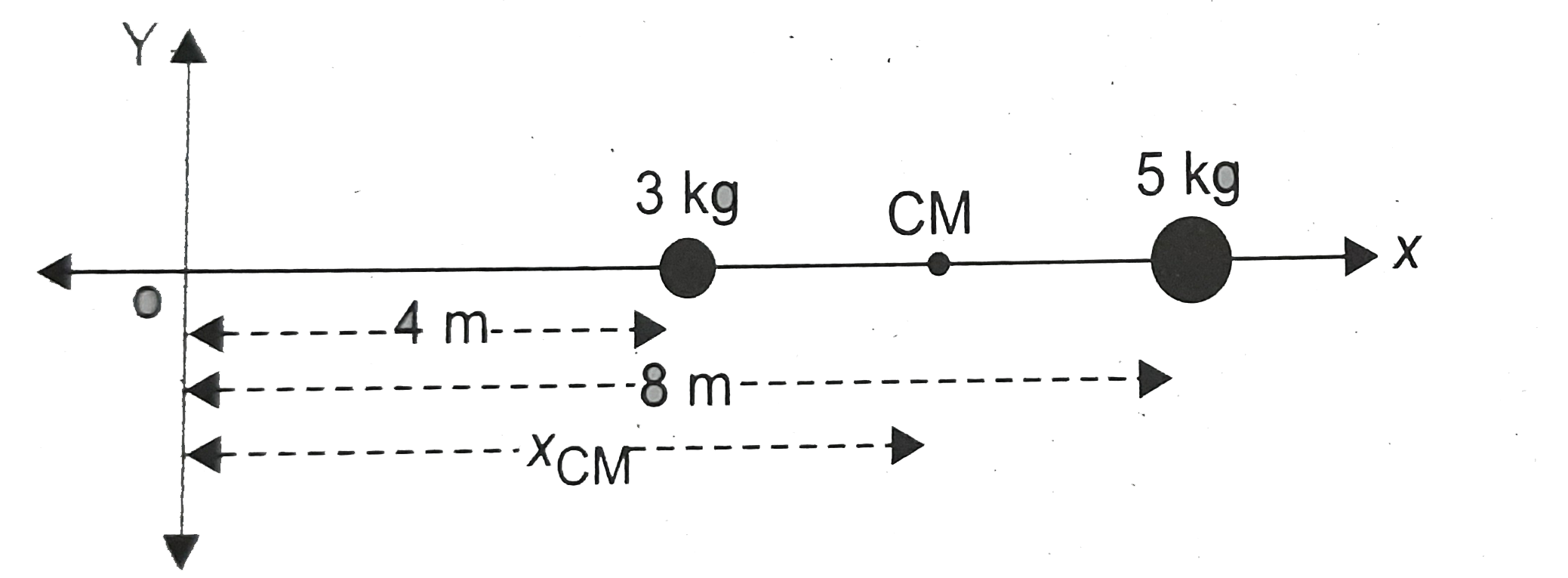 The center of mass `X_(CM)` is located 6.5 m from `x_(CM) = (m_1 x_1 + m_2 x_2)/(m_1 + m_2) ` `x_(CM) = ((3xx4) + (5xx8))/(3+5)` `x_(CM) = (12 + 40)/(8) = (52)/(8) = 6.5 m` |
|
| 21. |
A thin square plate is of mass m and the length of each of its sides is l. Find the moment of inertia of the plate when it is rotating about an axis (i) passing through its centre and perpendicular to its plane and (ii) passing through one of its corners and perpendicular to its plane. |
|
Answer» Solution :(i) Passing through its centre and perpendicular to its PLANE `I=(m(l^(2)+l^(2)))/(12)=(2ml^(2))/(12)=(ml^(2))/(6)` (II) Passing through one of its CORNERS and perpendicular to its plane `I=I_(G )+MR^(2)` `I=(ml^(2))/(6)+(ml^(2))/(2)=(ml^(2)+3ml^(2))/(6)impliesI=(4ml^(2))/(6)=(2ml^(2))/(3)` |
|
| 22. |
If the area swept by the line joining the sun and the earth from Feb 1 to Feb 7 is 'A', then the area swept by the radius vector from Feb 8 ti Feb 28 is |
|
Answer» A |
|
| 23. |
A ball is thrown vertically upwards from the top of a tower. Velocity at a point 'h' m vertically below the point of projection is twice the downward velocity at a point 'h' m vertically above the point of projection. The maximum height reached by the ball above the top of the tower is |
| Answer» Answer :D | |
| 24. |
A freely falling body traveled xm in n^(th) second distance travelled in n-1^(th) second is |
|
Answer» X |
|
| 25. |
Calculate the work done in bringing four particles each of mass 10 g at the vertices of a square having side 10 cm, assuming that the particles are brought from infinitely large distance to the respective locations. |
| Answer» SOLUTION :`36.11 XX 10^(-14) J` | |
| 26. |
…………. Tells us to what ………… the quantity is measured by a………….. . |
|
Answer» |
|
| 27. |
Obtain an expression for the expparent frequency of sound for an observer moving towards // away from a stationary source of sound. |
|
Answer» Solution :Let v be the velocity of SOUND in still air. Let `v_(0)` be the velocity of an observer. Let `T_(0)` be the TIME associated with observer in moving from 0 to 0. `t_(n+1) - t_(1)= nT_(0)-(nv_(0)T_(0))/( v_(0) +v) = nT_(0)[ (v_(0) + v- v_(0))/(v_(0) + v)]` i.e., `( t_(n+1)-t_(1)) =(nT_(0) v)/( v+ v(0))`  Apparent FREQUENCY of sound as heard by the observer `f =( 1)/( T )= ( v+ v_(0))/( T_(0)v)` i.e., `f= f_(0)"" (v+ v_(0))/(v)` Apparent wavelength `lambda = lambda_(0)` For an observer moving away from the SOURCE. `f = f_(0) ""(v-v_(0))/(v) ` and `Delta lambda = 0` |
|
| 28. |
A piece of ice slides down a 45^(@) incline in twice the time it takes to slide down a frictionless 45^(@) incline . What is the coefficient of friction between the ice and the incline ? . |
|
Answer» |
|
| 29. |
Two billiard balls each of mass 0.05 kg moving in opposite directions with speed 6 ms-1 collide and rebound with the same speed. What is the impulse imparted to each ball due to the other ? |
|
Answer» SOLUTION :Momentumbeforecollision `VEC(p )_(1)= mv` Momentumaftercollision `=mv ` `=-0.05xx 6` Impulseof forceof eachball `= p_(2)- p_(2)` `=0.6 kg MS^(-1)` `:.`Impulseof forceof each ballappliedin mutuallyoppositedirection=0.6kg`ms^(-1)` |
|
| 30. |
A man is standing beside a railway line listening to the whistle of a passing train. The whistle which hasfrequency of 1000 Hz suffers an apparent change of 100 Hz. What is the speed of the train ? Velocity of sound = 333.3 m s^(-1) |
|
Answer» |
|
| 31. |
The pressure exerted on the walls of the container by a gas is due to the fact that gas molecules are |
|
Answer» Losing their KINETIC walls |
|
| 32. |
Acceleration of centre of mass remains constant in law of conservation of momentum. |
|
Answer» |
|
| 33. |
A block of 2 kg is suspended from the ceiling through a massless spring of spring constant k = 100 N/m. What is the elongation of the spring? If another 1 kg is added to the block, what would be the further elongation? |
|
Answer» 0.2m, 0.1m |
|
| 34. |
Two rods X and Y of different metals have lengths l_1and l_2at a certain temperature. If l_1 - l_2 =4 cm at all temperatures and coefficients of linear expansion of X and Y are 1.5 xx 10^(-5) ""^@C and 2.0 xx 10^(-5) ""^@C^(-1)respectively, then |
|
Answer» `l_1=14 cm ` `Delta l_1 = l_1 alpha_1 Delta T` ` Delta l_2 = l_2 alpha_2 Delta T` Given`l_1 - l_2 = 4 cm ` at all T if `Delta l_1 = Delta l_2 ` , then `l_1 alpha_1 Delta T = l_2 alpha_2 Delta T` ` rArr l_1/l_2 = alpha_2/alpha_1 = (2.0 xx 10^(-5) )/(1.5 xx 10^(-5) ) = 4/3 ` ` rArr l_1 - l_2 = 4 cm ` `4/3 l_2 - l_2 = 4 cm ` `l_2 = 12 cm ` `l_1= 4/3 xx 12 = 16 cm ` |
|
| 35. |
One end of a uniform wire of length L and of weight W is attached rigidly to a point in the roof and a weight W_1 is suspended from its lower end. If 'S' is the area of cross- section of the wire, then find the stress in the wire at height (3L//4) from its lower end? |
|
Answer» `((w_(1) + (3W//4) )/( S) )` |
|
| 36. |
A liquid flows through a horizontal tube. The velocities of the liquid ind the two sections, which have areas of cross -section A_(1) and A_(2) are v_(1) and v_(2) respectively. The difference in the levels of the liquid in the two vertical tubes is h. a. The volume of the liquid flow through the tube in unit tims is A_(1)v_(1) b. v_(2)-v_(1)=sqrt(2gh) c. v_(2)^(2)-v_(1)^(2)=2gh d. The energy per unit mass of the liquid is the same in both sections of the tube. |
|
Answer» a,C and d are correct |
|
| 37. |
In the above example, calculate the amplitude of motion. |
|
Answer» Solution :Initial VELOCITY V = 5 `ms^(-1)` Final veloctiy of system = V After collision Using law of conservation of LINEAR momentum We have `mv = (m + M)V` m = 0.1 kg `M = 0.5` kg ` 0.1 XX 5 = (0.1 + 0.5)V` `(0.1 xx 5)/(0.6) = V` `0.83 ms^(-1)` = V Maximum kinetic energy of system `(1)/(2) (m + M)V^(2)` According to law of conversation of energy . Maximum K.E. = Maximum P.E. `(1)/(2)(m + M)V^(2) = (1)/(2)kv^(2)` `rArr a^(2) = (2)/(2) ((m + M)V^(2))/(k)` `a = Vsqrt((m + M)/(k)) = 0.83 SQRT((0.1 + 0.5))/(500)` = 0.02 m |
|
| 38. |
A body of mass 'm' kg starts falling from a point 2R above the Earth's surface. What is its K.E. When it has fallen to a point 'R' above the Earth's surface. |
|
Answer» Solution :Potentialenergy` U =(-GMM)/r= (GMm)/(R+h)` `U_("intial") = -(GMm)/randU_("final") = - (GMm)/(2R)` LOSS of P.E = gain in K.E = `(GMm)/(2R) - (GMm)/(3R) = (GMm)/(6R)` ` :. K.E = (GMm)/(6R)` |
|
| 39. |
When a projectile is at its maximum height, the direction of its velocity and acceleration are |
|
Answer» PARALLEL to each other |
|
| 40. |
Assertion:A reference frame attached to earth is an inertial frame of reference. Reason: The reference frame which has zero acceleration is called a non inertial frame of reference. |
|
Answer» If both assertion and REASON are true and the reason is the correct explanation of the assertion |
|
| 41. |
If a vector vec(A) makes angles 45^(@) and 60^(@) with x and y axis respectively then the angle made by it with z-axis is |
|
Answer» `30^(@)` |
|
| 42. |
Ultrasonic waves can be detected by................ . |
|
Answer» TELEPHONE |
|
| 43. |
A flat rail road car is accelariting along the positive x-axis with an acceleration a_(p). A sphere is placed over the car. The friction between the car and the sphere is not sufficent to support pure rolloing of sphere. The correct statement is |
|
Answer» The SPHERE will slip and force of FRICTION on sphere is ALONG -x direction |
|
| 44. |
A body of mass 'm' is rotating in a vertical circle of radius 'r' with critical speed at the highest point. The difference in its K.E. at the top and the bottom is |
|
Answer» 2mgr |
|
| 45. |
The gravitational field in a region is given by E= 10(hati+hatj)N"/"kg. The work done by an external agent to slowy shift a particle of mass 2kg from the point (0, 0) to a point (5m, 4m). |
|
Answer» `120 J` |
|
| 46. |
A large object at 273 K and another large object at 373 K. For a small amount of energy of about 8 J be spontaneously transferred from cold object to hot object. Then, choose the correct options. |
|
Answer» `Delta S_("hotobject") = 0.0214 JK^(-1)` |
|
| 47. |
A block of mass m is stationary with respecte to a rough wedge as shown in figure. Starting from rest in time t [m=1kg, theta=30^(@),a=2ms^(-2),t=4sec]. For workdone on the block, in Column-I match the answer in Column -IJ |
|
Answer» |
|
| 48. |
There have been suggestions that the value of the gravitational constant G becomes smaller when considered over very large time period (in billions of years) in the future. If that happens, for our earth |
|
Answer» nothing will change. |
|
| 49. |
Considering the pressure 'P' to be proportional to the density of air 'd', the pressure at height 'h' if the pressure on surface of earth is 'P_(0)' and density 'd_(0)', under isothermal conditions |
|
Answer» <P>`P_(0)E^(-(P_(0))/(d_(0))GH)` |
|
| 50. |
Consider a hypothetical velocity distribution of gas molecules shown in figure. The number of gas molecules dN per unit velocity range dv, is plotted against the velocity v. It is a parabola. The average and the most probable speeds will be |
|
Answer» `v_(0) , v_(0) ` |
|