

Saved Bookmarks
This section includes 7 InterviewSolutions, each offering curated multiple-choice questions to sharpen your Current Affairs knowledge and support exam preparation. Choose a topic below to get started.
| 1. |
The wettability of a surface by a liquid depends primarily on |
|
Answer» density |
|
| 2. |
Two blocks of mass 5 kg and 3 kg are attached to the ends of a string passing over a smooth pulley fixed to the ceiling of an elevator. A man inside the elevator accelerated upwards, finds the acceleration of the blocks to be (9)/(32)g. The acceleration of the elevator is |
|
Answer» `(g)/(3)`  `a_(r)=("Net PULLING force")/("Total MASS")` `=((5g+ga)-(3g+3a))/(8)` `implies "" (9)/(32)g((g+a))/(4)` `therefore"" a=(g)/(8)` |
|
| 3. |
Consider a drop of rain water having mass 1 g falling from a height of 1 km. It hits the ground with a speed of 50 ms^(-1). Take .g. constant with a value 10 ms^(-2). The work done by the (i) gravitational force and the (ii) resistive force of air is |
|
Answer» (i) `1.25 J "" `(II) `-8.25 J` `v =50 ms^(-1), g = 10 ms^(-2)`. (i) The work done by the gravitational force `= mgh = 10^(3) XX 10 xx 1000 = 10 J` (ii) The total work done by gravitational force and the resistive force of air is equal to charge in kinetic energy of rain DROP. `:. W_g + W_r = 1/2 mv^2 - 0` v `10 + W_r = 1/2 xx 10^(-3) xx 50 xx 50 " or W_r = - 8.75 J`. |
|
| 4. |
What is the fractional error? |
| Answer» Solution :RATIO of MEAN absolute ERROR to the mean VALUE (or) relative error or FRACTIONAL error = mean absoluteerror/mean value. | |
| 5. |
If the mean free path of atoms is doubled then the pressure of gas will become |
|
Answer» <P>`P//4` |
|
| 6. |
A rod AB moves towards the origin O of a fixed rectangu lar co-ordinate system, always perpendicu lar to the bisector of the angle XOY, witha velocity v. the speed of end B with respect to O will be. |
|
Answer» Solution :SPEED of end B is v' where `v' cos 45^(@)=v` `v'=sqrt(2)v` 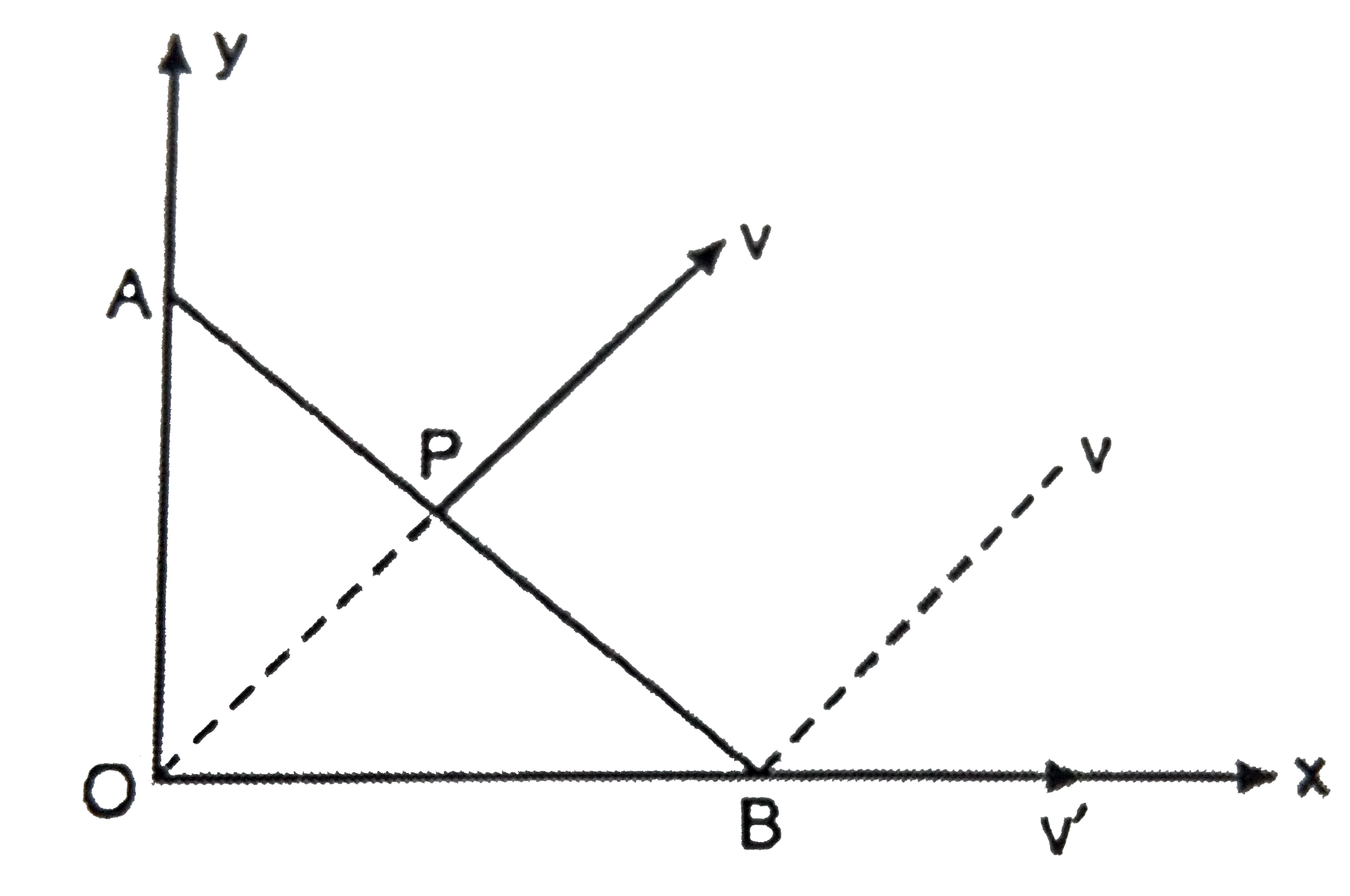
|
|
| 7. |
The mass of empty beaker (50.3+-0.2) g and mass of hall water breaker (59.4+0.2)g. By keeping error in mind, the mass of water will be...... |
|
Answer» |
|
| 8. |
An open U-tube of vertical limbs contains oil of specific gravity 0.8 and surface tension 28 dynecm^(-1). The radii of limbs are 1mm and 4 mm. If the angle of contact is assumed 0^(@), calculate the difference of levels of oils in the limbs. |
|
Answer» |
|
| 9. |
State of motion of the sphere at t = 0 is described in figure, Centre of the sphere is moving towards right with a speed u and angular velocity of the sphere is u/2r in the anticlockwise sense. Here is the radius of sphere. We can understand that it is a case of slipping and after some time sphere starts pure rolling due to friction from the surface. We can assume direction towards right as positive and thus clockwise sense should be treated positive for rotational motion. Assume ng coefficient of friction between sphere and the surface. Mass of sphere is m. What will be the speed of sphere when it starts pure rolling? |
|
Answer» `(4u)/(7)` `v=u-=(3u)/(7) RARR v=(4u)/(7)` HENCE option (a) is correct. |
|
| 10. |
State of motion of the sphere at t = 0 is described in figure, Centre of the sphere is moving towards right with a speed u and angular velocity of the sphere is u/2r in the anticlockwise sense. Here is the radius of sphere. We can understand that it is a case of slipping and after some time sphere starts pure rolling due to friction from the surface. We can assume direction towards right as positive and thus clockwise sense should be treated positive for rotational motion. Assume ng coefficient of friction between sphere and the surface. Mass of sphere is m. At what time sphere starts pure rolling? |
|
Answer» `(2u)/(7mug)` `u=u+at+ rArr u= v- mug t ""...(iii)` `omega= omega_(0)+ alpha t rArr omega=-(u)/(2r)+(5mug)/(2r) t""...(iv)` For pure ROLLING we have v rohence we can write the following: `u=r omega rArr u- mu g=-(u)/(2) +(5mug)/(2)t` `rArr mu"GT"=(3u)/(7) ""...(v)` Hence time to start pure rolling can be written from equation (v) `t=(3u)/(7 mug)` Hence OPTION (C) is correct. |
|
| 11. |
Consider the following statements (A) The co-efficient of friction between two surfaces will increase if the surfaces are made rough.(B) rolling friction is more than sliding friction |
|
Answer» Both A and B are TRUE |
|
| 12. |
A body isprojected with a velocity u at an angle of 60^(@) to the horizontal. The time interval after which it will be moving in a direction of30^(@)to the horizontal is |
|
Answer» `(U)/(sqrt(3)G)` |
|
| 13. |
A uniform circular disc of radius 50 cm at rest is free to turn about an axis which is perpendicular to its plane and passes through its centre . It is subjected to a torque which produces a constant angular acceleration of 2.0 rad s^(-2) . Its net acceleration in m s^(-2) at the end of 2.0 s is approximately |
|
Answer» `6.0` At the end of 2 s , Tangential acceleration , `a_(t) = r alpha = 0.5 xx 2 = 1 MS^(-2)` RADIAL acceleration , `a_(r) = omega_(2) r = (omega_(0) + alpha t)^(2) r` `= (0 + 2 xx 2)^(2) xx 0.5 = 8 m s^(-2)` `THEREFORE` Net acceleration , `a = sqrt(a_(t)^(2) + a_(r)^(2)) = sqrt(1^(2) + 8^(2)) = sqrt(65) = 8 m s^(-2)` |
|
| 14. |
Consider the following statements A and B. Identify the correct choice in the given answers A) In a one-dimensional perfectly elastic collision between two moving bodies of equal masses, the bodies exchange theirvelocities after the collision. . B) If a lighter body at rest suffers head - on and perfectly elastic collision with a very heavy body moving with a certain velocity, after the collision both travel with same velocity |
|
Answer» A and B are CORRECT |
|
| 15. |
Block A has a weight of 300 N and blcok B has weight of 50 N.Determine the distance B must raise from rest before. A obtains a speed of 2.5ms^(-1). Neglect the mass of cord and pulley? |
|
Answer» `1.2m` |
|
| 16. |
The errors due to imperfect design or calibration of the measuring instrument are |
|
Answer» RANDOM errors |
|
| 17. |
In an experiment to estimate the size of a molecule of oleicacid 1 mL of oleic acid is dissolved in 19 mL of alcohol. Then 1 mL of this solution is diluted to 20 mL by adding alcohol. Now, 1 drop of this diluted solution is placedon water in a shallow trough. The solution spreads over the surface of water forming one molecule thick layer. Now, lycopodium powderis sprinkled evenly over the film and its diameter is measured. Knowing the volume ofthedrop and area of the film we can calculate the thickness of the film which will give us the size of oleic acid molecule. Read the passage carefully and answer the following questions (a) Why do we dissolve oleic acid in alcohol ? (b) What is the role of lycopodium powder? (c) What would be the volume of oleic acid in each mL of solution prepared? (d) How will you calculate the volume of n drops of this solution of oleic acid ? (e) What will be the volume of oleic acid in one drop of this solution ? |
|
Answer» Solution :(a) Oleic acid does not dissolve in water hence,it is dissolved inalcohol. (b) Lycopodium powder spreads over the entire surface of water when it is SPRINKLED EVENLY. When a drop of PREPARED solution is dropped ONWATER, oleic acid does not dissolve in water. INSTEAD it spreads on the water surface pushing the lycopodium powder away to clear a circular area where the drop falls. We can therefore, measure the area over which oleic acid spreads. (c) In each mL of solution prepared volume of oleic acid =`1/20mLxx1/20=1/400mL` (d) Volume of n drops of this solution of oleic acid can be calculated by means of a burette and measuring cylinder and measuring the number of drops. (e)If n drops of thesolution make 1 mL, the volume of oleic acid in one drop will be `1/((400)n)mL.` |
|
| 18. |
An ideal gas undergoes four differentprocesses from the same intial state Four processes are adiabatic, isothermal, isobaric andisochoric. Out of 1,2,3 and 4 which one is adiabatic |
|
Answer» 4 |
|
| 19. |
A particle moving with uniform acceleration haas its final velocity (vartheta=sqrt(150+8x)) m//swhere x is the distance travelled by if . Then find its acceleration |
|
Answer» |
|
| 20. |
A Carnot refrigerator absorbs heat from water at 0^(@)C and gives it to room at 27^(@)C, when it converts 2 kg of water at 0^(@)C into ice at 0^(@)C, the work done is (latent heat of fusions of ice=(333xx10^(3) Jkg^(-1)) |
|
Answer» `25xx10^(3)J` |
|
| 21. |
A force F = 20 + 10 y acts on a particle in y-direction where F is in newton and y in meter. Work done by this force to move the particle form y = 0 to y = 1 m is |
|
Answer» Solution :GIVEN : `F = 20+ 10 y` work done, `W = int F.DY` `= int_0^1 (20 + 10 y) dy = [20 y + 10/(2 y^2)]_(0)^(1) = 20 + 10/2 = 25J`. |
|
| 22. |
Three copper rods and three steel rods each of length l = 10 cm and area of cross-section 1cm^(2) are connected as shown If ends A and E are maintained at temperatures 125^(@)C and 0^(@)C respectively, calculate the amount of heat flowing per second from the hot of cold function. [K_(Cu) = 400 W//m-K, K_(steel) = 50 W//m-K] |
|
Answer» Solution :`R_("steel") = (L)/(KA) = (10^(-1)m)/(50(W//m-^(@)C)xx10^(-4)m^(2)) = (1000)/(50).^(@)C//W`. Similarly `R_(Cu) = (1000)/(400).^(@)C//W` Junction `C` and `D` are identical in EVERY respect and both will have same temperature. Consequently. The ROD `CD` is in thermal equilibrium and no heat will flow through it. Hence it can be neglected in further analysis. Now rod `BC` and `CE` are in series their equilvalet RESISTANCE is `R_(1) = R_(s) +R_(Cu)` similarly rods `BD` and `DE` are in series with same equilvalent resistance `R_(1) = R_(s) +R_(Cu)` these two are in parallel giving an equilvalent resistance of `(R_(1))/(2) = (R_(S)+R_(Cu))/(2)` This resistance is connected in series with rod `AB`. Hence the net equilvalent of COMBINATION is `R = R_(steel) +(R_(1))/(2) (3R_(steel)+R_(Cu))/(2) = 500 ((3)/(50)+(1)/(400)).^(@)C//W` Now, `i = (T_(H)-T_(C))/(R) =(125^(@)C)/(500((3)/(50)+(1)/(400)).^(@)C//W)=4`watt. |
|
| 23. |
Find the distance covered by the particles in the following figures, and while a particle travels from A to B as shown by the arrows |
|
Answer» Solution :ACTUAL LENGTH of the PATH traversed is = `AC+CD+BD` `=AC+CD +DBrArr a+(pia)/2+a` `[:. "Circumference of a Circle" =`pixx"DIAMETER"]=2a=(pia)/2` |
|
| 24. |
Gravitational acceleration increases at depth d from surface of Earth. |
|
Answer» |
|
| 25. |
The maximum load a wire can withstand without breaking when its length is reduced to half of its original length, will ....... |
|
Answer» be doube `= ("Breaking force")/("Area of cross SECTION")` when the change in length of WIRE occur its cross sectional area does not change much. Breaking force depend on the area of cross section. |
|
| 26. |
An iron ball of diameter 6cm and is 0.01 mm too large to pass through a hole in a brass plate when the ball and plate are at a temperature of 20^(@)C. The temperature at which (both for ball and plate) the ball just pass through the hole is (alpha_("iron")=12xx10^(-6)//1^(@)C,alpha_("brass")=18xx10^(-6)//1^(@)C) |
|
Answer» `68^(@)C` |
|
| 27. |
The surface area of a solid cyclinder of radius 2.0 cm and height 10.0 cm is equal to ……….. (mm)^(2) |
| Answer» SOLUTION :`1.5xx10^(4)` | |
| 29. |
Let V and E be the gravitational potential and gravitational field at a distance r from the centre of a uniform spherical shell. Consider the following two statements : (A) The polt of V against r is discontinuous (B) The polt of E against r is discontinuous |
|
Answer» Both A and B are CORRECT |
|
| 30. |
When a tree is cut, the cut is made on the side facing the direction in which the tree is required to fall. Why? |
| Answer» Solution :Because the side on whcilh the cut is made is no longer SUPPORTED by the normal force from the bottom, THEREFORE torque ACTS on the tree such that it FALLS on the side as antitipated. The torque about the point where the cut is made CAUSES rotation of the tree about the point. | |
| 31. |
The position vector of a particle is given by r = 3t^(2)hati + 4t^(2)hatj + 7hatk m at a given time 't'. The net displacement of the particle after 10s is |
|
Answer» 500 m |
|
| 32. |
A container has one mole of monoatomic ideal gas. Each molecule has f degrees of freedom. What is the ratio of gamma=(C_(P))/(C_(V)) |
|
Answer» f `C_(v)=f/2 R` `C_(P)=(1+f/2)R` `GAMMA=C_(P)/C_(V)+((1+f/2))/(f/2)=((2+f/2))/((f/2)), gamma =(f+2)/f` |
|
| 33. |
What are the factors which effect Brownian motion? |
|
Answer» Solution :`(i)` Brownian MOTION increases with INCREASING temperature. `(ii)` Brownian motion DECREASE with bigger particle size, high viscosity and density of the liquid (or) gas. |
|
| 34. |
What is elastic hysteresis? |
| Answer» SOLUTION :The fact that the stress-STRAIN curve is not RETRACED on reversing the strain (RUBBER) is CALLED elastic hysteresis. | |
| 35. |
Passage - II: A copper rod of length I_1 and a steel rod of length I_(2), both having the same area of cross-section, are placed end to end between two rigid supports X and Y such that their system just fits between the supports with no initial stress in the rods. Temperature of the rods is now increased by Delta T. If Y_( Cu) is the Young's modulus of copper and alpha_(Cu) its coefficient of linear expansion, while Y_(St) is the Young's modulus of steel and alpha_(St) its coefficient of linear expansion, answer the following questions. (Assume that area of cross-section does not change and the rods do not bend. Also assume that there is no deformation of the supports.) As the temperature is increased, stress in the steel rod can be expressed as |
|
Answer» `Y_(St) alpha_(St) DELTA T` |
|
| 36. |
Passage - II: A copper rod of length I_1 and a steel rod of length I_(2), both having the same area of cross-section, are placed end to end between two rigid supports X and Y such that their system just fits between the supports with no initial stress in the rods. Temperature of the rods is now increased by Delta T. If Y_( Cu) is the Young's modulus of copper and alpha_(Cu) its coefficient of linear expansion, while Y_(St) is the Young's modulus of steel and alpha_(St) its coefficient of linear expansion, answer the following questions. (Assume that area of cross-section does not change and the rods do not bend. Also assume that there is no deformation of the supports.) As the temperature is increased by Delta t, length of the copper rod will be |
|
Answer» `I_(2)` |
|
| 37. |
Passage - II: A copper rod of length I_1 and a steel rod of length I_(2), both having the same area of cross-section, are placed end to end between two rigid supports X and Y such that their system just fits between the supports with no initial stress in the rods. Temperature of the rods is now increased by Delta T. If Y_( Cu) is the Young's modulus of copper and alpha_(Cu) its coefficient of linear expansion, while Y_(St) is the Young's modulus of steel and alpha_(St) its coefficient of linear expansion, answer the following questions. (Assume that area of cross-section does not change and the rods do not bend. Also assume that there is no deformation of the supports.) As the temperature is increased |
|
Answer» the length of the COMPOSITE rod (copper + STEEL) does not CHANGE but that of each individual rod changes |
|
| 38. |
Is the value of temperature coefficient is always positive ? |
| Answer» SOLUTION :In general ist value is POSITIVE, but some definite cases like EXPANSION of water between `0^(@)C` to `4^(@)C`, it is negative. | |
| 39. |
A mason worker throws the bricks to a height of 10 m, at which the bricks reach with a velocity of 6ms^(-1). The percentage of energy he is wasting is nearly |
| Answer» ANSWER :A | |
| 40. |
A particle of mass 'm' is projected with an initial velocity u at an angle 'theta' to horizontal. The torque due to gravity on projectile at maximum height about the point projection is |
|
Answer» `("mgu"^(2)SIN2THETA)/(2)` |
|
| 41. |
An iron ball of radius 0.2 cm and density 7.8 g/cm""^(3) falls through a tank of oil of density =1.5 xx 10^(3)" kg/m"^(3) and viscosity 9.92 poise. What will the terminal velocity of the iron ball in the oil? Also, determine its terminal velocity in water of viscosity 10^(-3)" Nsm"^(-2). |
|
Answer» <P> Solution :Given, r=0.2 CM`p_(i)=7.8 g//cm^(3)` `p_(0)=1.5 xx 10^(3) kg//m^(3)=1.5 g//cm^(3)` `eta=99/2 Nsm^(-2)` Terminal velocity of iron ball in oil is `V=(2r^(2) g(p_(i)-p_(o)))/(9eta)` `=(2 xx (0.2)^(2) xx 980 xx (7.8-1.5))/(9 xx 9.92)` =5.53 cm/s Terminal velocity of iron ball in water `p_(W)=10^(3) kg//m^(3)=1 g//cm^(3), eta=10^(-3) Nsm^(-2)` `=10^(-2) "poise"` `v^(2)=(2r^(2) g(p_(i)-p_(w)))/(9 eta)` `=(2 xx (0.2)^(2) xx 980 xx (7.8 -1))/(9 xx 10^(-2))` =5923.55 cm/s |
|
| 42. |
Two simple pendulums of length 100 m and 121 m start swinging together in the same directionvith same phase.They will swing together again in same phase after. |
|
Answer» the LONGER pendulum MAKES 10 oscillation |
|
| 43. |
A body moves a distance of 20 m along a striaght line under the action of a force of 10N. If the work done is 100J, the angle between force and displacement vectors is |
|
Answer» `0^(@)` |
|
| 44. |
A body is projected vertically up with velocity u from a tower. It reaches the ground with velocity nu. The height of the tower is H=(u^(2))/(2g)(n^(2)-1) |
|
Answer» Solution :`v^(2)-u^(2)=2AS` Here `u=u,v=n u,a=-g,s=-H` `(n u)^(2)-u^(2)=2gH, (n^(2)-1)u^(2)=2gH` `THEREFORE H=(u^(2))/(2G)(n^(2)-1)` |
|
| 45. |
A disc of radius R is cut out from a larger disc of radius 2R in such a way that the edge of the hole touches the edge of the disc. Locate the centre of mass of the remaing portion. |
|
Answer» |
|
| 46. |
A body starts from rest from a point distance R_0 from the centre of the earth. The velocity acquired by the body when it reaches the surface of the earth will be (R to Radius of the earth) (R_(0) gt R) |
|
Answer» `2GM((1)/(R )-(1)/(R_0))` |
|
| 47. |
An open organ pipe of length 1m contains a gas whose density is twice the density of the atmosphere at STP. Find the difference between its fundamental and second harmonic frequencies if the speed of sound in atmosphere is 300m/s. |
|
Answer» 150.75Hz `:. (v_("PIPE"))/(v_("air")) = (sqrt((B)/(2 rho)))/(sqrt((B)/(rho)))= (1)/(sqrt2) = v_("pipe") = (v_("air"))/(sqrt2)` `f_(N) = ((n+1))/(2l) v_("pipe")` `:. F_(1)= (2v_("pipe"))/(2l) and f_(0) = (v_("pipe"))/(2l)` `:. f_(1) - f_(0) = (2v_("pipe"))/(2l) - (v_("pipe"))/(2l)= (v_("pipe"))/(2l)` `= (v_("pipe"))/(sqrt2 xx 2l) = (300)/( sqrt2 xx 2 xx 1)` `=(300)/(2 sqrt2)` `=(300)/(2 xx 1.414) = 106.08Hz` |
|
| 49. |
In one stationary wave if distance between consecutive node and antinode is 5 cm then find distance between two consecutive antinodes. |
|
Answer» Solution :In a stationary WAVE, DISTANCE between CONSECUTIVE node and ANTINODE is `(lamda )/(4)` which is given here 5 cm. f Hence, `(lamda )/(4) = 5 cm IMPLIES lamda =20 cm ` |
|
| 50. |
Calculate the root mean square speed of smoking practices of mass 5xx10^(-17) kg in their Brownian motion in air at S.T.P |
|
Answer» Solution :Given `K = 1.38xx10^(-23) ` J/K Here, `m = 5 xx10^(-17) KG, k = 1.38xx10^(-23)J//K` `T = 0^@C=(0+273)K=273K,v_(rms)=? ` `v_(rms)=SQRT((3RT)/M)=sqrt((3kNT)/(mN))` `=sqrt((3KT)/m)` `sqrt((3xx1.38xx10^(-23)xx273)/(5xx10^(-17)))` `v_(rms)=1.5xx10^(-2)m//s=1.5cm//s` |
|