

Saved Bookmarks
This section includes 7 InterviewSolutions, each offering curated multiple-choice questions to sharpen your Current Affairs knowledge and support exam preparation. Choose a topic below to get started.
| 1. |
"It is difficult to run fast on sand ". Why? |
| Answer» Solution :When we RUN on sand the IRREGULARITIES formed are deep. So friction is increased. HENCE running is DIFFICULT. | |
| 2. |
What do you udnderstand by errors measurement ? Discuss briefly the verious types of erros. |
| Answer» SOLUTION :1 (E ).1 | |
| 3. |
Find the efficiency of the thermo-dynamic cycle shown in figure for an ideal diatomic gas. |
|
Answer» Solution :Let n be the number of moles of the gas and the temperature be `T_0` in the state A. Now, work done during the cycle `= W=1/2 xx (2 V_0-V_0) ( 2P_0 -P_0) =1/2P_0 V_0` For the heat `(Delta Q_1)` GIVEN during the process `A toB`, we have ` Delta Q_1- Delta W_(AB ) +Delta U_(AB )` `Delta W_(AB ) =` area under the straight line `AB =1/2(P_0 +2P_0 ) (2V_0-V_0) =(3 P_0 V_0)/(2)` Applying EQUATION of state for the gas in the state A and B. `(P_0V_0) /(T_0 ) = ((2P_0) (2V_0))/(T_B) =T_B= 4T_0thereforeU_(AB )= nC_v =Delta T =n ((5R)/( 2) ) (4 T_0-T_0 ) = ( 15nRT_0)/( 2) = ( 15P_0 V_0)/(2)` ` thereforeDeltaQ_1= 3/2P_0V_0+ (15)/(2)P_0 V_0= 9 P_0 V_0` Obviously, the processes B `to` C and C `to` A involve the extraction of heat from the gas. ` therefore ` Efficiency (`eta `) of the cycle `=("WORKDONE percycle ")/( "Total heat supplied per cycle")i.e., eta =(1/2 P_0 V_0 )/(9 p_0 V_0) = 1/(18)` |
|
| 4. |
the work done by applied force is |
|
Answer» Solution :Work DONE by applied force is W=Fd= 10 N x 10 m =100 J |
|
| 5. |
Calculate the angular momentum and rotational kinetic energy of the earth about its own axis. Given mass of the earth is 6 xx 10^(24)kg and its radius = 6.4 xx 10^3 km. [Moment of inertia of the earth about its axis of rotation is 2/5 mr^(2)] |
| Answer» Solution :`T =24h, L = (2//5) mr^(2) xx(2pi//T) = 7.14 xx 10^(23)Js, K.E. (1//2) Iomega^(2) = (1//2)L omega = (pi)(L//T) = 2.6 xx 10^(29)` J | |
| 6. |
Given a + b + c + d = 0 which of the following statement is incorrect |
|
Answer» a,B,c and d must each be a null vector. |
|
| 7. |
A boat of mass 40 kg is floating on water. A boy of mass 10 kg on the boat moves by 8 m towards the shore. The distance by which the boat moves away from the shore is |
|
Answer» 4 m |
|
| 8. |
The temperature difference between the two ends of a bar 1.0 m long is 50^(@)C and that for the other bar 1.25 m long 75^(@)C. Both the bars have same area of cross-section. If the rates of conduction of heat in the two bars are the same, find the ratio of the coefficients of thermal conductivity of the materials of the two bars. |
|
Answer» |
|
| 9. |
When person cycling on rough horizontal surface then which of the following are correct |
|
Answer» retardation `a=(F)/(m)= mu g` |
|
| 10. |
A rigid body rotates about a fixed axis with variable angular velocity equal to alpha-betat, at time t where alpha, beta are constants. The angle through which it rotates before its stops: |
|
Answer» `(ALPHA^(2))/(2beta)` |
|
| 11. |
A wire of density 9 xx 10^(3) kg//m^(3) is stretched between two clamps1m apart and is stretched to an extension of 4.9 xx 10^(-4) m. Young's modulus of material is 9 xx 10^(10) N//m^(2). |
|
Answer» The lowest frequency of STANDING wave is `35 Hz` `V = sqrt((T)/(rho A)) = sqrt(( Y Delta l)/( l) A xx (1)/( rho A)) = sqrt(( Y Delta l)/( l rho))` Maximum frequency , that means fundamental MODE . ` f = (V)/(lambda) = (V)/(2 l) = (1)/( 2l) sqrt((Y Delta l)/( l rho)) = 35 Hz` Stress ` = Y (Delta l)/( l)` `= 9 xx 10^(10) xx (4.9 xx 10^(-4))/( 1)` `= 4.41 xx 10^(7) N//m^(2)` and frequency of first overtone ` = 70 Hz`. 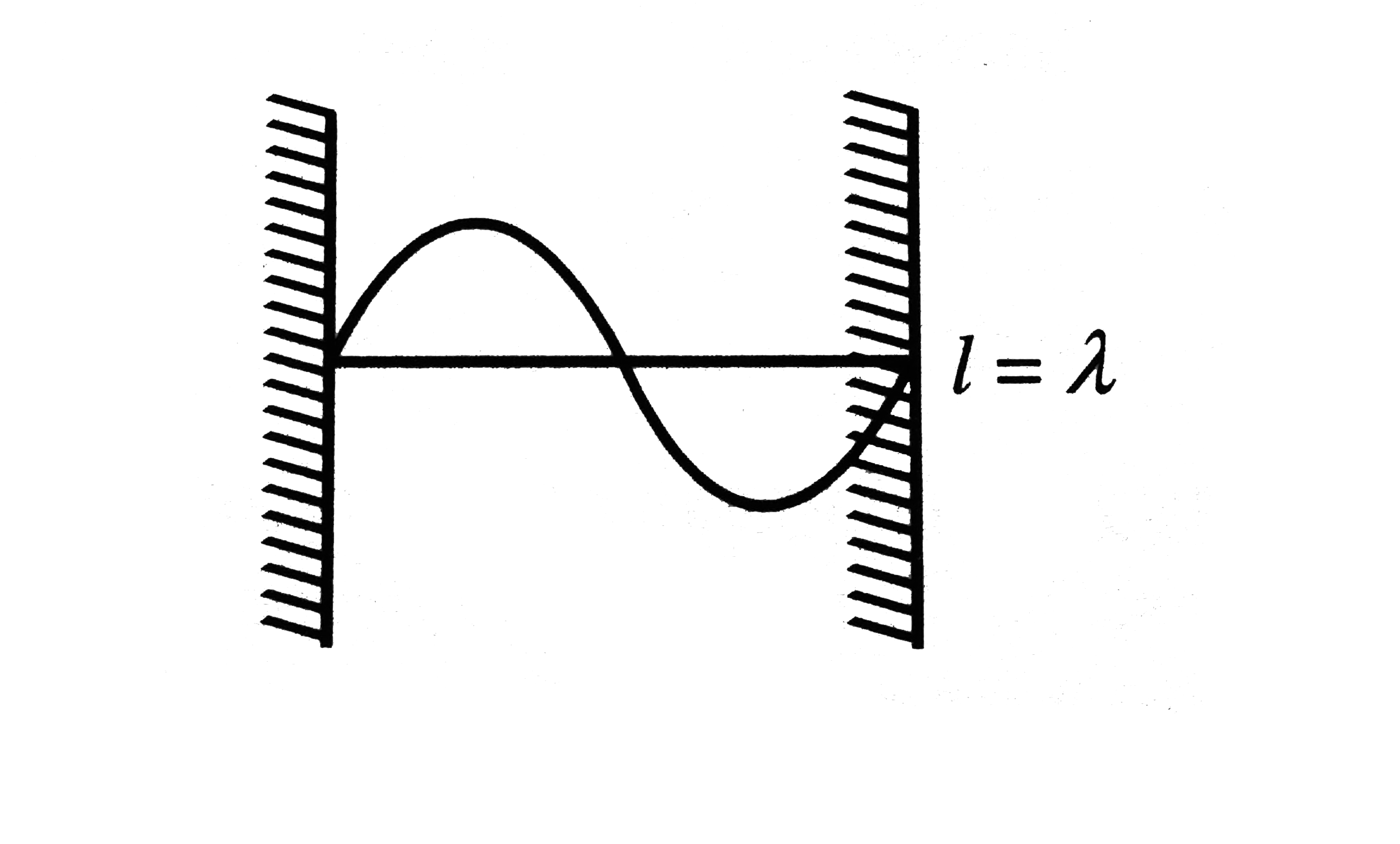
|
|
| 12. |
A bat is flitting about in a cave, navigating via ultrasonic beeps. Assume that the sound emission frequency of the bat is 40kHz. During one fast swoop directly toward a flat wall surface, the bat is moving at 0.03 times the speed of sound in air. What frequency does the bat hear reflected off the wall? |
| Answer» SOLUTION :42.47 KHZ | |
| 13. |
When a body is whirled in a vertical circle such that its total mechanical energy is constant with critical velocities then tension in the string changes with time. Arrange the following in increasing order of tension when (i) String is horizontal (ii) String makes an angle 0^(@) with downward vertical (iii) String makes an angle of 180^(@) with downward vertical (d) String makes an angle 120^(@) with downward vertical |
| Answer» Answer :A | |
| 14. |
A carnot engine operating between temperatures T_1 and T_2has efficiency 1/6When T, is lowered by 62 K, its efficiency increases to 1/3. Then T_1 and T_2are, respectively: |
|
Answer» 372 K and 310 K |
|
| 15. |
A double star is a system of two stars of masses m and 2 m, revolving about their centre of mass only under their mutual gravitational attraction. If r is the separation between these two stars then their time period of rotation about their centre of mass will be proportional to |
|
Answer» `R^(3//2)` |
|
| 16. |
The potential energy U of two atoms of a diatomic molecule as a function of distance r between the atoms as shown in the given figure. Read the following statement carefully. 1. The equilibrium separation distance between the atoms is equal to r_(2). 2. At r = r_(1), the force between the atom is repulsive. . For r gt r_(2), the force between the atoms is attractive Whichof the above statements is true ? |
|
Answer» 1 only |
|
| 17. |
The efficiency of a carnot engine eta = 1/10. This carnot engine used as refrigerator. If work done on system is 10 J, then heat absorbed from sink will be ……. |
|
Answer» 100 J `ETA=(T_1-T_2)/T_1=(Q_1-Q_2)/Q_1` COEFFICIENT of performance of refrigerator , `beta=Q_2/(Q_1-Q_2)` `beta=(1-eta)/eta` `therefore beta=(1-1/10)/(1/10)=(9/10)/(1/10)=9` but `beta=Q_2/W` `therefore Q_2=betaW` `therefore Q_2=9xx10=90` J |
|
| 18. |
A body is projected at 60^(@) with the horizontal with velocity of 10ms^(-1). Find the velocity of the projectile when it moves perpendicular to its initial direction. |
|
Answer» |
|
| 19. |
Force is required to lift a body from the ground to a height h and work is measured as the product of force and magnitude as the product of force and magnitude of displacement. A man of mass 60 kg carries a stone of mass 20 kg to the top of a multistorey building of height 50 m. Calculate the total energy spent by him? |
| Answer» Solution :TOTAL energy = MGH = `(60 + 20)XX 9.8 xx 50 = 39200 J` | |
| 20. |
Force is required to lift a body from the ground to a height h and work is measured as the product of force and magnitude as the product of force and magnitude of displacement. Name the energy possessed by the body at maximum height. Write on equation for it. |
| Answer» SOLUTION :POTENTIAL ENERGY. PE = MGH | |
| 21. |
The scalar product vecA.vecB is equal to |
|
Answer» `vecB+vecA` |
|
| 22. |
The internal energy of a system changes when it undergoes |
|
Answer» a cyclic process |
|
| 23. |
A projectile is any body that is given an initial velocity and then follows a path determined entriely by the effects of gruaitional acceleration and air resistance.Derive an expression for time to reach maximum height and hence the time off light of a projectille, |
| Answer» Solution :TIME TAKER! to reach the maximum HEIGHT `v_y=u_y+a_utalpha=usintheta-"GT"t=(usintheta)/g` SINCE time of ascend is equal to time of descend ,`T=2t=(2usintheta)/g` | |
| 24. |
A rectangular block of dimensions 6m xx 4m xx 2m and of density 1.5 gm/c.c is lying on horizontal ground with the face of largest area in contact with the ground. The work done in arranging it with its smallest area in contact with the ground is, (g = 10ms^(-2)) |
|
Answer» 2880 kj |
|
| 25. |
A projectile is any body that is given an initial velocity and then follows a path determined entriely by the effects of gruaitional acceleration and air resistance. The path of a projectile is ------- |
|
Answer» STRAIGHT line |
|
| 26. |
If a simple pendulum ia arranged in an artificial satellite its (a) Time period becomes infinity (b) Frequency becomes infinity (c) Both time period and frequency become infinity (d) It does not oscillate |
|
Answer» a and d are correct |
|
| 27. |
A boat moves perpendicular to the bank witha velocity of 7.2 km/h. The current carries it 150 m dowstream, find the velocity of the current. (The width of the river is 0.5 km). |
|
Answer» `0.4 MS^(-1)` |
|
| 28. |
Maximum absolute error in difference of two quantites is equal to ….. Of the absolute errors in the indinvidual quantites. Fill in the blanks. |
| Answer» SOLUTION :SUM. | |
| 29. |
In the question number 35, the acceleration of the particle at t = 1 is |
|
Answer» `2hatjm s^(-2)` `therefore ` Acceleration, `veca = (dvecv)/(dt) = 4hatj ms^(-2)` Acceleration of the PARTICLE remains CONSTANT at all times. |
|
| 30. |
A stationary sourceis emitting sound at a fixed frequencyf_(0)which is reflected by two cars approaching the source . The difference between thefrequencies of sound reflected from the cars is1.2%off_(0). What is the differernce in the speeds of the cars ( in km per hour) to nearest interger ? The cars are moving at constant speeds much smaller then the speed of sound which is 330 ms^(-1) . |
|
Answer» |
|
| 31. |
Which of the following functions represent SHM : sin omega t+ 2 cos omega t |
|
Answer» Solution :(a) ` X = A sin omega t + B cos 2 omega t` `(dx)/(dt) = A omega cos omega t - B (2 omega) sin 2 omega t ` ` (d^2 x)/(dt^2) = - omega^2 (A sin omega t + 4B cos 2 omega t )` `(d^2 x)/(dt^2) ne - omega^2 x ` . This differential equation is not LIKE the differential equation of a SH M. There for `x = A sin omega t+ B cos 2 omega t ` does not REPRESENT SHM (b) ` x = AE^(i omega t) ` `(dx)/(dt) = A omega e^(i omega t)` `(d^2 x)/(dt^2) = - A omega^2 e^(i omega t) = - omega^2 x ` This differential equation is like the differential equation of SHM. Therefore, `x = A e^(i omega t)`represents SHM. (iv) `x = A ln omega t` ` (dx)/(dt) = ( (A)/(omega t) ) omega = A/t` `(d^2x)/(dt^2) = ( (A)/(omega t) ) omega = A/t` `(d^2 x)/(dt^2) = - (A)/(t^2) rArr (d^2x)/(dt^2) ne - omega^2 x ` This differential equation is not like the differential equation of a SHM. Therefore, x = `A ln omega t `does not represent SHM |
|
| 32. |
Four particles, each of mass 1kg, are placed at the corners of a square OABC of side 1m. O is at the origin of the coordinate system. OA and OC are aligned along positive x-axis and positive y-axis respectively. The position vector of the centre of mass is (in 'm' ) |
|
Answer» `hati+hatj` |
|
| 33. |
If R is the Rydberg constant , C is the velocity and h is the planck's constant , the RCh has the dimesions of |
|
Answer» Power |
|
| 34. |
A particle performs uniform circular motion with an angular momentum L . If the frequency of particle's motion is doubled and its kinetic energy is halved , then find the new angular momentum in terms of L. |
|
Answer» SOLUTION :`E_(k) = (1)/(2) I OMEGA^(2) = (1)/(2) (I omega) (2 PI epsilon)` `E_(k) = pi epsilon L implies L = (E_(k))/(pi * epsilon)` If `epsilon` is DOUBLED and `E_(k)` is halved , then `L. = ((E_(k) //2))/(pi (2epsilon)) = (1)/(4) ((E_(k))/(pi epsilon))= (L)/(4)` |
|
| 35. |
When a mass of 0.5 kg is suspended from the free end of a spring, it stretches the spring by 0.2m. This mass is removed and 0.25kg mass is attached to the same free end of the spring. If the mass is pulled down and released, what is its time period? (g= 10 ms^(-2)) |
|
Answer» SOLUTION :When 0.3 kg mass is suspended, extension of the SPRING is 0.2m. Since in equilibrium mg `=kx`(or `0.5 XX 10 = k xx 0.2 implies k = 25` N/m The time period of spring block system is `T= 2pi sqrt(m/k) = 2pi sqrt((0.25)/(25)) = 0.63 s ` |
|
| 36. |
A block of mass m is pulled along a horizontal surface by applying a force at an angle q with the horizontal. If the block travels with a uniform velocity and has a displacement d and the coefficient of friction is mu then the work done by the applied force is |
|
Answer» `(MU mgd)/(cos theta + mu SIN theta)` |
|
| 37. |
A body of mass 0.1kg released from a height of 50m reaches the ground with a velocity of 10ms^(-1). The work done againest air resistance is (g= 10 m"/"s^(2)) |
| Answer» ANSWER :D | |
| 38. |
Two identical loudspeakers are driven in phase by a common oscillator at 800 Hz and face each other at a distance of 1.25 m. Locate the points along the line joining the two speakers where relative minimum of sound pressure amplitude would be expected. ( Use v = 343 m//s.) |
|
Answer» Solution :TWO identical WAVES moving in opposite directions constitute a standing WAVE .We must find the nodes. The wavelengthis ` lambda = (v)/(f) = ( 343 m//s)/( 800 Hz) = 0.429 m` The two waves moving in opposite directions along the line between the two speakers will add to produce a standing wave within this distance between nodes. Distance node to node ` = lambda//2 = 0.214 m` Because the speakers vibrate in phase , air compressions from each will simultaneously reach the POINT halfway between the speakers, to produce antinode of pressure here . A node of pressure will be located at this distance on either side of the midpoint. Distance node to antinode ` = lambda //4 = 0.107 m` Therefore nodes of sound pressure will appear at these distances from either speaker. `[ 1//2 ( 1.25 m) + 0.107 m = 0.732 m` and `1//2 ( 1.25 m) - 0.107 m = 0.518 m ]` The standing wave CONTAINS a chain of equally spaced nodes at distances from either of the speakers `0.732 m + 0.214 m = 0.946 m` ` 0.947 m + 0.214 m = 1.16 m` also at ` 0.518 m - 0.214 m = 0.303 m` `0.303 m - 0.214 m = 0.089 m` The standing wave exists only along the line segment between the speakers . No nodes or antinodes appear at distances greater than `1.252 m` or less than `0`, because waves add to gives standing wave only if they are travelling in opposite directions and not in the same direction . Thus , the distances from either of the speakers to the nodes of pressure between the speakers are `0.089 m , 0.303 m , 0.732 m , 0.946 m and 1.16 m` |
|
| 39. |
Hot water cools from 60^@Cto50^@C in the first 10 minute and to 42^@C in the next 10 minutes.Then,the tempreature of the surroundings is |
| Answer» ANSWER :D | |
| 40. |
A particle whose speed is 50 m/s moves along the line from A(2,1) to B(9, 25). Find its velocity vector in the form of a hat(i) + b hat(j) |
|
Answer» `2(7 HAT(i) + 24 hat(J))` |
|
| 41. |
In projectile motion, the modulus of rate of change of speed |
|
Answer» is constant |
|
| 42. |
In the above problem, the time taken by the displacement vectors of the fragments to become perpendicular to each other is |
|
Answer» 1s |
|
| 43. |
If the particle is moving along a straight line given by the relation x=2-3t +4t^3 where s is in cms., and t in sec. Its average velocity during the third sec is |
|
Answer» 73cm/s |
|
| 44. |
A cylinderor radius R and lengthl ismade up of a substance, whosethermalconductivityK varieswith thedistancex from theaxisas K = K_(1)x + K_(2) . Determineof the effective thermalconductivitybetweenthe flatfaces of the cylinder . |
|
Answer» Solution :Let us subdividel the entirecylinderinto a numberof COAXIAL cylindricalshells of infinitensimally smallthickness DX . Cross sectionalarea of the shell ` 2pi x dx `. `K_("eff") =(sumA_(i)K_(i))/(sumA_(i)) ` we have`K_("eff") = (1)/(SUM A_(i)) int_(0)^(R) K (2 PI x dx)` ` = (1)/(piR^(2)) int_(0)^(R) (k_(1)x + k_(2))2pix dx = (2)/(R^(2)) int_(0)^(R) (k_(1)x^(2) + K_(2)x)dx= (2)/(R^(2)) [K_(1).(x^(3))/(3) + K_(2) .(x^(2))/(2)]_(0)^(R) = (1)/(3) (2K_(1) R + 3K_(2))` |
|
| 45. |
If a flute sounds a note with 450 Hz , what are the frequencies of the second , third , and fourth harmonics of this pitch ? If the clarinet sounds with a same note as 450 Hz , then what are the frequencies of the lowest three harmonics produced ? |
|
Answer» Solution :For a FLUTE which is an OPEN PIPE , we have Second harmonics `"" f_(2) = 2f_(1) = 900` Hz THIRD harmonics `"" f_(3) = 3 f_(1) = 1350` Hz Fourth harmonics `"" f_4 = 4 f_1 = 1800` Hz For a clarinet which is a closed pipe , we have Second harmonics `"" f_(2) = 3f_(1) = 1350` Hz Third harmonics `"" f_(3) = 5f_(1) = 2250` Hz Fourth harmonics `"" f_(4) = 7 f_(1) = 3150` Hz |
|
| 46. |
A sphere of 0.047 kg aluminium is placed for sufficient time in a vessel containing boiling water , so that the sphere is at 100 ^(@) C . It is then immediately transferred to 0.14 kgcopper calorimeter containing 0.25 kg water at 20^(@) C . The temperature of water rises and attains a steady state at 23 ^(@) C. Calculate the specific heat capacity of aluminium. |
|
Answer» Solution :In solving this example, we shall use the fact that at a steady STATE, heat given by an aluminium sphere will be equal to the heat absorbed by the water and calorimeter. Mass of aluminium sphere`(m_(1)) = 0.047 ` kgInitial temperature of aluminium sphere`= 100 ^(@) C` Final temperature`= 23^(@) C` Change in temperature `(DELTA T) = (100 ^(@) C - 23 ^(@) C) = 77 ^(@) C` LET specific heat capacity of aluminium be `s_(Al)`. Theamount of heat lost by the aluminium sphere = `m_(1) s_(Al) Delta T = 0.047 kg xx s_(Al) xx 77 ^(@) C` Massof water `(m_(2)) = 0.25 kg` Mass of calorimeter `(m_(3)) = 0.14 kg` Initialtemperature of water and calorimeter = `20^(@) C` Final temperature of the mixture ` = 23 ^(@) C` Change in temperature `(Delta T_(2)) = 23 ^(@) C - 20 ^(@) C = 3 ^(@) C` Specific heat capacity of copper calorimeter ` = 0.386 xx 10^(3) J kg^(-1) K^(-1)` Specific heat capacity of copper calorimeter ` = 0.386 xx 10^(3) J kg^(-1) K^(-1)` The amount of heat GAINED by water and calorimeter ` = m_(2) s_(w) Delta T_(2) + m_(3) s_(cu) Delta T_(2)` `= (m_(2) s_(w) + m_(3) s_(su)) (Delta T_(2))` ` = (0.25 kg xx 4.18 xx 10^(3) J kg ^(-1) K^(-1) + 0.14 kg xx 0.386 xx 10^(3) J kg^(-1) K^(-1) (23 ^(@) C - 20 ^(@) C)` In the steady state heat lost by the aluminium sphere = heat gained by water `+ ` heat gained by calorimeter. So, `0.047 kg xx s_(Al) xx 77^(@) C` ` = (0.25 kg xx 4.18 xx 10^(3) J kg^(-1) K^(-1) + 0.14 kg xx 0.386 xx 10^(3) J kg^(-1) K^(-1)) ( 3^(@) C)` ` s_(Al) = 0.911 kJ kg^(-1) K^(-1)` |
|
| 47. |
What is simple harmonic motion ? Give one example . |
| Answer» SOLUTION :e.g. periodic OSCILLATION of a SIMPLE PENDULUM is simple harmonic . | |
| 48. |
A body of mass 20 kg is resting on a table. A light string is attached to it and passed over a smooth pulley at the edge of the table and a mass 3kg is attached at the free end. What is the acceleration of the system of the coefficient of kinetic friction between the massand the table is 0.04 ? What is the tension in the string ? |
|
Answer» |
|
| 49. |
A thin uniform circular disc of mass M and radius R is rotating in a horizonatl plane about an axis passing through its centre and perpendicular to its plane with an angular velocity omega. Another disc of same thickness and radius but ofmass (1)/(8) M is placed gently on the first disc coaxially. The anuglar velocity of the system is now |
|
Answer» `(8)/(9)omega` |
|
| 50. |
How much work done in pulling up a block of wood weighing 2kN for length of 10 m on smooth incline plane at angle 15^(@) with horizontal ? |
|
Answer» `9.82`J `F = ma = MG sin alpha = W sin alpha ` Now `sin alpha =sin 15^(@) XX 0.2588` ` F = 0.5176 xx10^(3)N` ` :. "Work W" =F.d ` `= 0.5176 xx10^(3) xx10` ` =5.17 xx10^(3) xx10` ` = 5.17 xx10^(3)J = 5.17 kJ ` |
|