Saved Bookmarks
This section includes 7 InterviewSolutions, each offering curated multiple-choice questions to sharpen your Current Affairs knowledge and support exam preparation. Choose a topic below to get started.
| 1. |
There is a small hole near the bottom of an open tank filled with a liquid. The speed of the water ejected does not depend on a) area of the hole b) density of the liquid c) height of the liquid form the hole d) acceleration due to gravity |
|
Answer» a and b are CORRECT |
|
| 2. |
What is thermal expansion ? Write only its types. |
|
Answer» SOLUTION :It is our common experience that most SUBSTANCES EXPAND on heating and contract on cooling. A change in the temperature of a body causes change in its dimensions. The increase in the dimensions of a body DUE to the increase in its temperature is called thermal EXPANSION There are three types of thermal expansion : (a) Linear expansion : The expansion in length is called Linear expansion. (b) Area expansion : The expansion in area is called Area expansion. Volume expansion :The expansion in volume is called Volume expansion. All are shown in the figure as below. 
|
|
| 3. |
Einstein's mass-energy relation emerging out of his famous theory of relativity relates mass (m) to energy (E) as E = mc^(2) where c is speed of light in vacuum. At the nuclear level, the magnitudes of energy are very small. The energy at nuclear level is usually measured in MeV, where I MeV = 1.6 xx 10^(-13)Jthe masses are measured in unified atomic mass unit (u) where, 1u = 1.67 xx 10^(-27) kg . (a) Show that the energy equivalent of luis 931.5 MeV. (b) A student writes the relation as lu = 931.5 MeV. The teacher points out that the relation is dimensionally incorrect. Write the correct relation. |
|
Answer» Solution :We know that, 1 amu=`1u=1.67xx10^(-27)KG` ENERGY `=E=(1.67xx10^(-27))(3xx10^(8))^(2)J` `=1.67xx9xx10^(-11)J` `E=(1.67xx9xx10^(-11))/(1.6xx10^(-13))MeV` `=939.4 MeV~~931.5 MeV` (b) The DIMENSIONALLY correct relation is , 1 amu `xx c^(2)=1uxxc^(2)=931.5 MeV` |
|
| 4. |
A uniform wire of 20 cm long is bent into a circle. It is placed gently on the surface of water of surface tension 0.07Nm^(-1). The extra force than its weight required to pull it out of the water is |
|
Answer» `0.014N` |
|
| 5. |
To what temperature should the hydrogen at 327°C be cooled at constant pressure, so that the root mean square velocity of its molecules become half of its previous value |
|
Answer» `-123^(@)C` |
|
| 6. |
Three mass points m_(1)m_(2) amd m_(3) are located at the vertices of an equilateral triangle of length a. What is the moment of inertia of the system about an axis along the altitude of the triangle passing through m_(1)? |
|
Answer» Solution :`I= UNDERSET(i=I) overset(N) SUM m_(i)r_(i)^(2)` `=m_(1)xx0+m_(2)xx(BD)^(2)m_(3)xx(DC)^(2)` `=0+m_(2)((a)/(2))^(2)+m_(3)((a^(2))/(2))` `I=(1)/(4)(m_(2)+m_(3))a^(3)` |
|
| 7. |
Two identical particle are attached at the ends of a light string which passes through a holeat the centre of a table anotherparticle on the table is made to revolve with angular velocity omega_(1) . One of the particles is made to move in a horizontal circle as a conical pendulum with angular velocity omega_(2) . If l_(1) and l_(2) are the length of the string over and under the table , then in order that particle under the table neither moves down nor moves up the ratio (l_(1))/(l_(2)) is : |
|
Answer» `(omega_(1))/(omega_(2))`  For the particle under the table T sin `theta = m omega_(2)^(2) R` = `m omega_(2)^(2)l_(2) "sin" theta" or" T = momega_(2)^(2) l_(2)` `therefore "" momega_(1)^(2)l_(1) = m omega_(2)^(2) l_(2)` or `(l_(1))/(l_(2)) = (omega_(2)^(2))/(omega_(1)^(2))` |
|
| 8. |
A solid sphere rolls without slipping on an inclined plane of angle theta. Find its linear acceleration in the direction parallel to the surface of the inclined plane. |
|
Answer» `(5)/(7)gsintheta` `a=(gsintheta)/(1+(K^(2))/(R^(2)))` but for sphere `k^(2)=(2)/(5)R^(2)` `therefore a=(gsintheta)/(1+(2R^(2))/(5R^(2)))` `therefore a=(5gsintheta)/(7)` |
|
| 9. |
A ball whose density is 0.4xx10^(3)kg//m^(3) falls into water from a height of 9m. To what maximum depth in metre does the ball sink ? |
|
Answer» 9 cm |
|
| 10. |
Rain drops of different sizes strike the earth with |
|
Answer» Same acceleration |
|
| 11. |
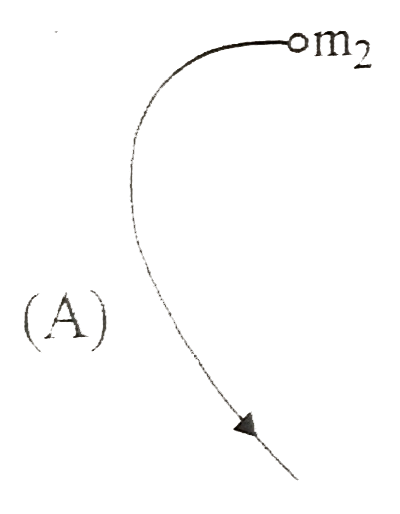
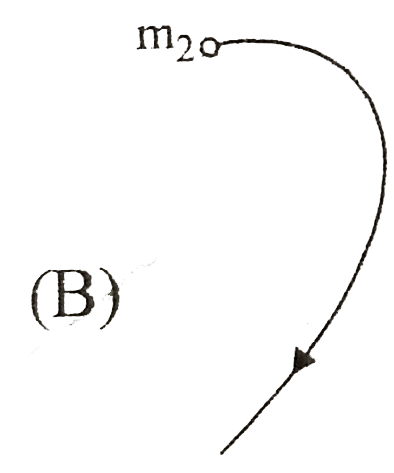
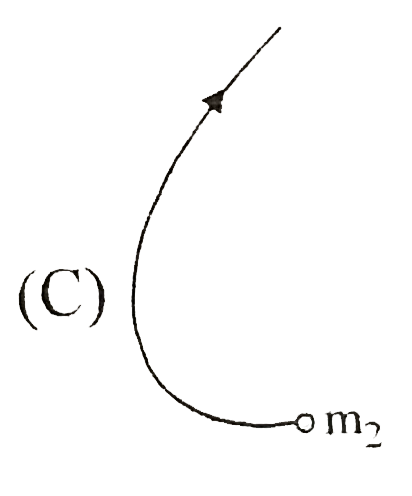
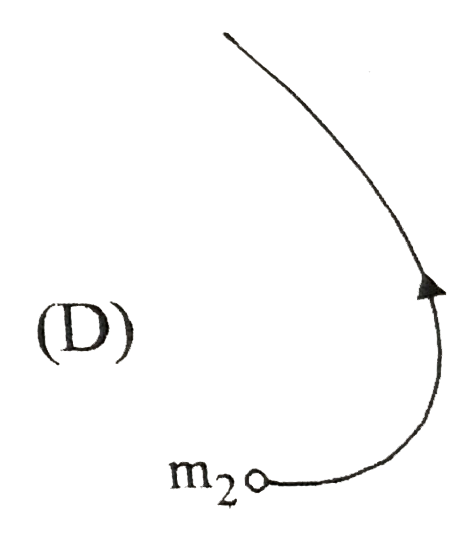
Two interacting particles form a closed system whose centre of mass is at rest. Fig. illustrates the positions of both particles at a certain moment and the trajectory of the particle of mass m_(1). Select the trajectory of the particle of mass m_(2) if m_(2)=m_(1). |
|
Answer»
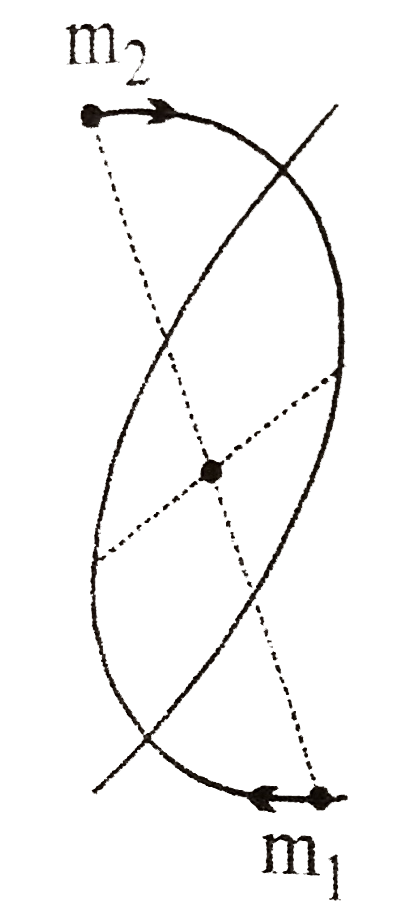
|
|
| 12. |
The frequency of oscillations of a mass m suspended by spring is v_(1). If the length of the spring is cut to one- third, the same mass oscillates with frequency v_(2). Determine the value of (v_(2))/(v_(1)). |
|
Answer» SOLUTION :Let k be the spring constant of FULL spring. Then, `v_(1)=(1)/(2pi) sqrt((k)/(m)) ""....(1)` When the spring is cut one- thirdd of its LENGTH, its spring constant k=3k. Now `v_(2)=(1)/(2pi) sqrt((k')/(m))` `=(1)/(2pi) sqrt((3k)/(m))` `:. (v_(2))/(v_(1))= sqrt(3)` |
|
| 13. |
A simple pedulum consisting of a mass M is attached to a string of length L. Its released from an angle alpha. A pin is located at a distance IltL, below the suspension. If theta is the maximum angle which the string makes after hitting the pin, find cos theta |
|
Answer» `(L COS alpha+l)/(L+l)` |
|
| 14. |
Find the depth at which the value of g becomes 25% of that at the surface of the earth . (Radius of the earth = 6400 km) |
|
Answer» Solution :g at a DEPTH , `g_(d) =g (1-d/R)` In this problem , `g_(d) = (25)/100 g = 0.25 g ` Substituting `g_(d)=0.25g and R = 6400` KM we get d = 4800 km |
|
| 15. |
In a region, electric field depends on X-axis as E ~~ E_(0)x^(2).There is a club of edge a as shown. Then find the charge enclosed in the cube. |
| Answer» SOLUTION :`5 in_(0) a^(4)E_(0)` | |
| 16. |
In pure rolling, rotational velocity of points at its edges is equal to |
|
Answer» `R OMEGA` |
|
| 17. |
In a certain region of space, there are only 5 molecules per cm^(3) on an average. The temperature is 3K. What is the average pressure of this very dilute gas ?"" (K = 1.38 xx 10^(-23)" J/mol K") |
|
Answer» Solution :According to ideal gas equation PV = N KT where N is number of molecules (or) P = `(NKT)/(V) ` here `(N)/(V)` = 5 molecules /`cm^(3)` = 5 molecules / `(10^(-7)m)^(3)= 5 XX 10^(6)` molecules / `m^(3)` So P = `(5 xx 10^(6)) (1.38 xx 10^(-23))(3)` = `2.07 xx 10^(-16)` Pa |
|
| 18. |
In which of the following cases the centre of mass of a rod is certainly not at its centre (A) The density continuously increases from left to right (B) The density continuously decreaes from left to right (C) The density decreases from left to right upto centre and then increases (D) The density increases from left to right upto centre and then decreases |
|
Answer» A &B |
|
| 19. |
A man of mass 60 kg is standing in a lift at rest. What will be the reaction force on the man when the lift is (i) stationary, (ii) moving up with an acceleration of 4.9 m cdot s^(-2) , (iii) moving up at a constant speed, and (iv) moving up with a retardation of 4.9 mcdot s^(2)? [ g = 9.8 mcdot s^(2)] |
|
Answer» Solution :Reaction of the LIFT floor when the lift is stationary, R = mg = `60 xx 9.8 N ` = 588 N. (ii) The lift is moving up with an acceleration, a = 4.9 m`cdot s^(2)`. Reaction, R = m(g + a) = 60(9.8 + 4.9) N =882 N. (iii)When the lift is moving up at a constant speed, a = 0 . `therefore"" R = "mg" = 60 xx 9.8 N = 588` N. (iv) When the lift MOVES up with a retardation of 4.9 m`cdot s^(-2)`, R = m[g + (-a)] = m(g - a) = 60(9.8 - 4.9) N = 294 N. |
|
| 20. |
Which of the processes described below are irreversible ? |
|
Answer» The increase in temperature of an iron rod by hammering it. B) The heat of bigger container transfer to smaller container at temperature `T_2` to `T_1` the process cannot be retraced itself. (C) A quasi-static isothermal EXPENSION of an ideal gas in cylinder fitted with a frictionless pistion. (D) As the weight is added to the cylinder arrangement in the form of external pressure HENCE, it cannot be reversed back itself. |
|
| 22. |
A gun fires a large number of bullets upward.Due to shaking of hands some bullets deviate as much as 1° from the vertical. The muzzle speed of the gun is 150 m//s and the height of gun above the ground is negligible. The radius of the head of the person firing the gun is 10cm. You can assume that acceleration due to gravity is nearly constantfor heights involved and its value is g = 10 m//s^(2). The gun fires 1000 bullets and they fall uniformly over a circle of radius r. Neglect air resistance.You can use the fact sin theta ~= theta when theta is small. (a) Find the approximate value of r.(b)What is the probability that a bullet will fall on the person’s head who is firing? |
|
Answer» |
|
| 23. |
How does the wave y = sin ( x -a) for a = 0 , a = (pi)/(4) , a = (pi)/(2) , a = (3pi)/(2) anda = pi look like ? |
Answer» Solution : From the above picture we observe that y = sin (X - a) for a = 0 . `a = (pi)/(4) , a = (pi)/(2) , a = (3pi)/(2)` and `a = pi` , the function y = sin (x - a) shifts towards right . Further , we can take a = vt and v `= (pi)/(4)` , and SKETCHING for different times t = 0s , t = 1 s , t = 2s etc . , we once again observe that y = sin ( x - vt) moves towards the right . If y = sin (x + vt) then the travelling (or progressive) wave moves towards the left . thus , any arbitrary function of TYPE y = f (x - vt) characterising the wave must move towards right and similarly , any arbitrary function of type y = f (x + vt) characterizing the wave must move towards left . |
|
| 24. |
A student perform experiment to measure thickness of slab by using vernier caliper. 50 scale of vernier is equal to 49 scale of main scale. He observes that zero of vernier is between 7.00 cm and 7.05 cm 23rd division of vernier coincide with main scale. What will be thickness of slab measured by student? |
|
Answer» `7.73 cm` No. of division on vernier scale = B = 50 Least COUNT `=((b-a)/(b))M` where `M=7.05-7.00 =0.05 m` `=(50-49)/(50)M` `=(1)/(50)xx0.05` `=0.001 cm` `:.` THICKNESS of SLAB `=7.00+I.C` (No of division) `=7.00+0.001xx23` `=7.00+0.23=7.023 cm` |
|
| 25. |
A lift of mass 1000 kg moves up with an acceleration 1 ms^(-1) in upward direction. Find the tension developed in supporting string. |
|
Answer» Solution :If LIFT MOVES up with acceleration .a. T = m (G + a) `= 1000[10+1]=11000N` 
|
|
| 26. |
The moment of inertia of a fly wheel making 300 revolutions per minute is 0.3kgm^(3), find torque required to bring it to rest in 20 s. |
|
Answer» Solution :TORQUE `TAU=Ialpha=I((omega_(2)-omega_(1)))/(t)` `:.tau=(0.3xx(0-10pi))/(20)` `=-0.15pi=-0.471Nm` |
|
| 27. |
A uniform metallic rod rotates about its perpendicular bisector with constant angular speed. If it is heated uniformly to raise its temperature slightly |
|
Answer» its speed of rotation increases |
|
| 28. |
The equation of motion for an oscillating particle is given by X=3sin(4pit)+4cos(4pit), where Xis in mm and t is in second- |
|
Answer» The motion is simple harmonic |
|
| 29. |
The angular frequency of a fan of moment of inertia 0.1 kg m^(2) is increased from 30 rpm to 60 rpm when a torque of 0.03 Nm acts on it. Find the number revolutions made by the fan while the angular frequency is increased from 30 rpm to 60 rpm. |
|
Answer» SOLUTION :Work done `=(1)/(2)I(omega_(f)^(2)-omega_(i)^(2)) "" TAU theta = (1)/(2)I(omega_(f)^(2)-omega_(i)^(2))` `theta=(1)/(2)((I)/(tau))(omega_(f)^(2)-omega_(i)^(2))=(0.1)/(2xx0.03)((2pi)^(2)-PI^(2))=5PI^(2)` The number of revolutions, `(theta)/(2pi)=(5pi^(2))/(2pi)=(5pi)/(2)=7.855` rev. |
|
| 30. |
The Moon subtends an angle of 1^(@) 55' at the base line equal to the diameter of the Earth. What is the distance of the Moon from the Earth? (Radius of the Earth is 6.4 xx 10^(6) m) |
|
Answer» SOLUTION :ANGLE `theta = 1^(@) 55.= 115. = (115xx 60).. xx (4.85xx10^(-6))` rad = `3.34 xx 10^(-2)` rad Since 1" = `4.85 xx 10^(-6)` rad Radius of the Earth = `6.4 xx 10^(6)` m From the Figure 1.5 AB is the diameter of the Earth (b) = `2 xx 6.4 xx 10^(6)` m Distance of the Moon from the Earth x = ? `x = (b)/(theta) = (2xx6.4xx10^(6))/(3.34xx10^(-2))` x = `3.83 xx 10^(8)` m |
|
| 31. |
If a body have weight 1 N, then its mass ..... |
|
Answer» Solution :`IMPLIES W = MG:. M = W/g =1 /(9.8)` `:.m = 0.102 KG` |
|
| 32. |
(A): Mass and energy are not conserved separately, but are conserved as a single entity called mass - energy. . (R): Mass and energy conservation can be obtained by Einstein equation for energy |
|
Answer» Both .A. and .R. are TRUE and .R. is the CORRECT explanation of .A. |
|
| 33. |
A bucket filled with water weighing 20kg is raised from a well of depth 20m. If the linear density of the rope is 0.2kg per meter, the amount of work done is, (g= 10 ms^(-2)) |
|
Answer» 4000J |
|
| 34. |
When an empty lift is moving down with an acceleration of g/4 ms^(-2)the tension in the cableis 9000N. When the lift is moving up with anacceleration of g/3 ms^(-2)the tension in the cableis |
|
Answer» 16,000N |
|
| 35. |
A vessel is completely filled with water at 39.2°F. Now it is cooled. Then |
|
Answer» WATER SPILLS out |
|
| 36. |
A simple pendulum from earth is shifted to moon (g_(m)= g_(E )"/"6). Foreign minute on earth, the time on the moon as measured by the pendulum is |
|
Answer» `24.5 SEC` |
|
| 37. |
Under steady state of conduction, the temperature at a cross-section of a body |
|
Answer» Decreases with TIME |
|
| 38. |
One end of a uniform ladder rests against a smooth vertical wall and the other end is on rough ground. A man of 80-kg weight stands on the ladder at (1)/(4)th up its lengt. Angle of theladder with the horizontal is 30^(@) . Find the reaction of thewall and the coefficient of friction betweenthe ladder and theground. The mass of the ladder is 40 kg. |
|
Answer» |
|
| 39. |
A solid sphere, a hollow sphere and a disc, all having mass and radius, are placed at the top of a smooth incline and released. Least time will be taken in reaching the bottom by |
|
Answer» the SOLID sphere |
|
| 40. |
A train is moving on a straight track with speed 20 m cdot s^(-1), It is blowing its shistle at the frequency of 1000 Hz. The percentage change in the frequency heard by a person standing near the track as the train passes him is ( speed of sound = 320 m cdot s^(-1)) close to |
|
Answer» `6%` Velocity of the train, `v_(s) = 20 m//s` So, APPARENT frequency when the train moves towards the listener, `n_(2) = V/(v-(-v_(s)))=320/(320+20) xx1000 = 941.2` HZ HENCE, percentage change in the apparent frequency `=(n_(1)-n_(2))/nxx100 = (1066.7-941.2)/1000xx100` `= 12. 55 % approx12 %` The option (B) is correct. |
|
| 41. |
A solid and a hollow sphere of the same mass have the same outer radius. Which one has a larger radius of gyration? |
| Answer» Solution :The MASS of the solid sphere is distributed uniformly from its centre. On the other hand the mass of the hollow sphere is distributed over a comparatively further distance. More the distance of the mass distribution from the axis of ratation of two bodies of IDENTICAL mass having the same outer radius more the radius of gyration. In this SENSE, mass of the hollow sphere is distributed over a comparatively larger distance from the axis of rotation than that of the solid sphere and hence the radius of gyration of the hollow sphere will be greater. | |
| 42. |
Is it possible that the brakes of a car are so parfect that carstops instantaneously . If not give reason. |
| Answer» SOLUTION :No. If the car stops instantaneously, this means that the VELOCITY is REDUCED to ZERO is an infinitesimally small interval of time. This would further mean that the car has infinite . deceleration.This is not possible. Thus, we cannot have a car which can STOP instantaneously. | |
| 43. |
Two masses 2 kg and 4 kg are tied at the ends of a massless string and which is passing over a frictionless pulley. The tension in the string is |
|
Answer» 3.68 N `T = (2 xx 2 xx 4)/(2 +4) xx 9.8 = 16/6 xx 9.8 = 26.13 N` |
|
| 44. |
A rod of length 1 is held vertically stationary with its lower end located at a point .P., on the horizontal plane. When the rod is released to topple about .P., the velocity of the upper end of the rod with which it hits the ground is |
|
Answer» `sqrt((g)/(L))` |
|
| 45. |
A uniform solid sphere is rolled up a fixed rough inclined surface with an initial speed of u.Assuming that there is no slip find the maximum height reached by the sphere over the incline. |
|
Answer» Solution :When there is no slip between the INCLINE and the sphere, mechanical energy can be conserved. INITIAL kinetic energy of the sphere `=(1)/(2)"mu"^(2)+(1)/(2)I_(cm)omega^(2)=(1)/(2)"mu"^(2)(1+(2)/(5))=(7)/(10)"mu"^(2)` Final gravitatonal POTENTIAL energy with respect to the initial position is mgh. Therefore, MAXIMUM height reached is `(7u^(2))/(10g)`. |
|
| 46. |
What should be the velocity of a source of sound so that the apparent frequency to a listener will be half the actual frequency of the source? Velocity of sound in air = v . |
|
Answer» Solution :If n is the actual frequency , APPARENT frequency ` = n/2` Here the listener is stationary, i.e., ` u_(o) = 0 ` Again decrease of frequency means that the source is RECEDING from the listener . So the velocity of the source ` u_(s) ` is negative Therefore, from the relation ` n. = (v + u_(0))/( v - u_(s))xx n ` , we have , ` n/2 = (v)/(v + u_(s)) xx n " or " , v + u_(s) = 2V " or " , u_(s) = v ` i.e., the source is receding from the listener with the velocityof sound . |
|
| 47. |
When a body is taken from the equator to the poles, its weight |
|
Answer» REMAINS same |
|
| 48. |
A sound wave whose frequency is 5000 Hz travels in air and then hits the water surface. The ratio of its wavelength in water and air is |
|
Answer» `4.30` Frequency of sound,f = 5000 Hz Velocity of sound in air,`v_(a) = 343 ms^(-1)` Velocity of sound in water,`v_(W) = 1480 ms^(-1)` The ratio of WAVELENGTH `(lambda_(a))/(lambda_(w)) = (v_(w))/(f) xx (f)/(v_(a)) = (1480)/(5000) xx (5000)/(343) = (1480)/(343)` `= 4.31` |
|
| 49. |
A car covers half of its journey with a speed of 10ms^(-1) and the other half by 20 ms^(-1) . The average speed of car during the total journey is |
|
Answer» `70ms^(-1)` Time to COVER 1sthalf `=(x//2)/(10)` Time to cover 2nd half `=(x//2)/(20)` AVERAGE SPEED `=(x)/((x)/(20)+(x)/(40))=(1)/(((3)/(40)))=13.33ms^(-1)` |
|
| 50. |
A child is standing with folded hands at the centre of a platform rotating about its central axis. The K.E of the system is K. The child now stretches his arms so that the M.I of the system doubles. The K.E of the system now is |
|
Answer» 2K |
|