

Saved Bookmarks
This section includes 7 InterviewSolutions, each offering curated multiple-choice questions to sharpen your Current Affairs knowledge and support exam preparation. Choose a topic below to get started.
| 1. |
A satellite ofmass m revolves around the earth in a circular orbit of radius r. Find the angular momentum of the satellite with respect to the centre of the orbit. |
|
Answer» SOLUTION :Angular MOMENTUM of the satellite about the centre of the orbit is L = mvr, where , v isthe ORBITAL speed of the satellite . For motion in a fixed orbit, centripetal force = force of attraction due to gravity `or, (mv^2)/r =(GMm)/(r^2)` or, `mv^2r=GMm or, (mvr)^2=GMm^2r` or, `mvr =m SQRT(GMr)` `THEREFORE L=msqrt(GMr)`. |
|
| 2. |
The speed v of a particle moving along a straight line, when it is at a distance (x) from a fixed point of the line is given by v^2 = 108 - 9x^2 (all quantities are in CGS units): |
|
Answer» the motion is uniformly ACCELERATED along the straight line |
|
| 3. |
A lift is moving upwards as shown in figure in figure A block of mass m s placed ona wedge inside the left and it is statioary with to lift if f be the force of friction and N the normal reaction then chose the wrong option. |
|
Answer» ` F cos THETA =N sintheta` |
|
| 4. |
If an object is thrown vertically up with initial speed u from the ground, then the time taken by the object to return back to ground is |
| Answer» Answer :B | |
| 5. |
(A): In an isolated system the entropy increases.(R ): The process in an isolated system are adiabatic. (2006) |
|
Answer» Both (A) and(R ) are TRUE and (R ) is the correct explanation of (A) |
|
| 6. |
AnobjectA is movingwith5 m/sandB ismovingwith20m/sin thedirection. (positivex-axis)findvelocityof Awithrespect to B . |
|
Answer» SOLUTION :(a) `VEC(V)_(B) = 20hat(i) m//s , vec(V)_(A) = 5hat(i)m//s`, `vec(V)_(B) - vec(V)_(B) = 15 HAT(i) m//s` (b) `vec(V)_(B) = 20 hat(i) m//s, vec(V)_(B) = 5hat(i) m//s`, `vec(V)_(AB) = vec(V)_(A) - vec(V)_(B) = -15 hat(i) m//s` |
|
| 7. |
The direction of projectile at certain instant is inclined at angle a to the horizontal. After t sec, if it is inclined at an angle betathen the horizontal component of velocity is |
|
Answer» `(g)/(tan ALPHA - tan beta)` |
|
| 8. |
In a book, the answer for a particular question is expressed as. b=(ma)/(l)[sqrt(1+(2kl)/(ma)]. Here m represents mass, 'a' represents acceleration, l represents length. The unit of 'b' should be in SI system) |
|
Answer» m/s |
|
| 9. |
Find thePE of three objects of masses 1 kg,2 kg and 3 kg placed at the three vertices of an equilateral triangle of side 20 cm. |
| Answer» Answer :B | |
| 10. |
The ratio of the specific heats C_P/C_V = gamma in terms of degrees of freedom(n) is given by : |
|
Answer» <P>`(1+(n)/(3))` |
|
| 11. |
In elastic collision |
|
Answer» both momentum and KINETIC ENERGY are conserved. |
|
| 12. |
What is mean free path? Derive an expression for mean free path. |
|
Answer» Solution :Let us CONSIDER a system of molecules each with diameter d. Let n be the number of molecules per unit volume . It is assumed that only one molecule is in motion and all other are at rest as shown in the figure.  `implies` Mean free path If a molecule moves with average speed v in a timet , the distance travelled is vt. In this time t, let us consider the molecule to move in an imaginary cylinder of volume `pid^2vt`. It collides with any molecule whose centre is within this cylinder . Hence , the number ofcollisions is equal to the number of molecules in the volume of the imaginary cylinder. It is equation of `pid^2vtn.` The total path length DIVIDED by the number of collision in time t is the mean free path . Mean free path, `lamda = ("distance travelled")/("Number of collisions")` `lamda=(vt)/(npid^2vt) =1/(npid^2) "" ....(1)` It is assumed that only one molecule is MOVING at a time and other molecules are at rest. But in actual practice all the molecules are in random motion . Hence the average relative speed of one molecule with respect to other molecules has to be taken into account. After some detailed calculations the correct. expression for mean free path, `lamda=1/(sqrt2npid^2)""..(2)` It is implied from the equation that the mean free path is inversely PROPORTIONAL to number density. When the number density increases the molecular collisions increases. Hence it decreases the distance travelled bu the molecule before collisions. Rearranging the equation (2) using 'm' (mass of the molecule) `:. lamda=m/(sqrt2pid^2mn)` But mn= mass per unit volume = `rho` (density of the gas) `lamda=m/(sqrt2pid^2rho) ""...(3)` Also we know that PV = NkT `P = N/V kT = nkT "" [:.n=N/v]` `:. n=P/(kT)` Substituting `n= P/(kT)` in equation (2), we get `lamda(kT)/(sqrt2pid^2P)` |
|
| 13. |
Two bodies of masses 4m and 9m are separated by a distance r.. The gravitational potential at a point on this line joining them where the gravitational field becomes zero is |
|
Answer» `(-4GM)/R` |
|
| 14. |
The fractional change in volume per unit increase in pressure is called …………. . |
|
Answer» PRESSURE co-efficient |
|
| 15. |
A homogenous rod of length l=etax and mass M is lying on a smooth horizontal floor. A bullet of mass m hits the rod at a distance x from the middle of the rod at avelocity v_(0) perpendicular to the rod and comes to rest after collision. If the velocity of the farther end of the rod just after the impact is in the opposite direction of v_(0) then: |
|
Answer» `ETA gt 3` |
|
| 16. |
As disc is rotating with angular speed omega. If a child sits on it, what is conserved? |
|
Answer» LINEAR MOMENTUM is zero. |
|
| 17. |
How does an ice-skater, a ballet dancer or an acrobat take advantage of the principle of conservation of angular momentum ? |
| Answer» SOLUTION :The ANGULAR MOMENTUM `L=Iomega` of the PERFORMER is CONSERVED. | |
| 18. |
An object falls from a bridge which is 45m above the water. It falls directly into a small row - boat moving with constant velocity that was 12m from the point of impact when the object was released. What was the speed of the boat? |
|
Answer» Solution :VELOCITY of boat = `V=(s)/(t)` Here, `s=12m` t = time of fall of OBJECT from bridge `=sqrt((2h)/(g))=sqrt((2xx45)/(10))=3s therefore V=(12)/(3)=4ms^(-1)` |
|
| 19. |
The string of a simple pendulum can with stand a maximum tension equal to 4 times the weight of bob suspended to it. The string is made horizontal and bob is released from rest then: |
|
Answer» STRING will break SOMEWHERE during the motion and will then follow STRAIGHT line path |
|
| 20. |
A body is sliding down an inclined plane have coefficient of friction 0.5. If he normal reaction is twice that of resultant downward force along the incline. Find the angle between the inclined plane and the horizontal. |
|
Answer» Solution :`MU = 0.5` `N=2mg(sin THETA-mu cos theta)` `mg cos theta = 2mg (sin theta - mu cos theta)` `cos theta = 2 cos theta(tan theta - mu)` `(1)/(2)=tan theta-(1)/(2)` `rArr tan theta = 1 rArr = 45^(@)` |
|
| 21. |
A pieceof stoneweight18gin water. 20 n in gerosence( relativedensityof kerosence= 0.8) .Find(I )massof stone- piece , (ii )volumeof stone- pieceand (iii )densityof stone- piece . |
|
Answer» Solution :InCGSsystem ,themagnitudesfo densityandspecificgravityare same.Morover , themagnitudesof massM expressedin unita andweightWexpressedin unitg- wtare same. Letmassof stone= M , volume= V `therefore ` WEIGHTOF samevolumeof water`= V xx 1 = V =` Apparentlossofweightof stoneinwater, Given, `M- V = 18` similarlyin CASEOF kerosene`, M- 0.8V=200 ` Subtracting(1)from(2), we get `0.2V=2 ` or , `V=(2)/(0.2) = 10cm^(3) ` subsitingin EQUATION(1) `M-10= 18or ,M=28g ` density ofstone`=(M)/(v )= (28) /(10)= 2.8* CM ^(-3)` `therefore ` densityof stone`=( M )/(v ) =(28) /(10)= 2.8g * cm ^(-3)` |
|
| 22. |
What will be the speed of sound in a perfectly rigid rod? |
| Answer» Solution :The SPEED of sound in a PERFECTLY RIGID ROD will be INFINITE. | |
| 23. |
A thick tumbler and a thin tumbler of glass are filled with hot water. The thick tumbler cracks but not the thin tumbler. Why? |
| Answer» Solution :The THICK tumbler cracks due to uneven EXPANSION of its inner and OUTER SURFACES whereas the thin tumbler does not crack due to uniform expansion of its inner and outer surfaces. | |
| 24. |
Find the average velocity in the time intervals (a)0 to 2s,(b)0 to 4s, (c)2s to 4 s, (d)4 s to 7 s , (e) 0 to 8 s.Find instantaneous velocity at (a)t=1.0s (b)t=3.0s(c) t=4.5 s (d)t=7.5 s in the graph. |
|
Answer» (a)`5ms^(-1);`(b)`-2.5ms^(-1);`(c) 0; (d)`5.0 ms^(-1)` |
|
| 25. |
We would like to increase the length of a 15 cm long copper a rod of cross-section 4mm^(2) by 1 mm. The energy absorbed by the rod if it is heated is E_(1). The energy absorbed by the rod if it is stretcheed slowly is E_(2). Then the value of (E_(1))/(E_(2)) is 5xx10^(n). Find n. [Various parameters of copper are : Density =9xx10^(3)"kg"//"m"^(3), Thermal coefficient of linear expansion =16xx10^(-6)K^(-1), Young.s modulus =135xx10^(9) Pa, Specific heat =400J//kg-K] |
|
Answer» |
|
| 26. |
In a carbon monoxide molecule, the carbon and oxygen atoms are separated by a distance of 1.12 xx 10^(-10) m. The distance of the centre of mass from the carbon atom is |
|
Answer» `0.48 xx 10^(-10)` m `R_(CM) = (12 + 0 xx 16 + 1.12 xx 10^(-10))/(12 + 16) = 0.64 xx 10^(-10) m` |
|
| 27. |
A ball is thrown vertically upward. For the motion of the ball till it returns to ground, draw the (i)height vs time graph (ii) velocity vs time graph (iii) acceleration vs time graph (iv) velocity vs height graph |
Answer» SOLUTION : 
|
|
| 28. |
A ball is a thrown from the top of a tower of 61 mhigh with a velocity 24.4 ms^(-1) at an elevation of 30^(@) above the horizontal. What is the distance from the foot of the tower to the point where the ball hits the ground ? |
Answer» Solution : `h = (1)/(2)g t^(2) - (u SIN THETA)t rArr t = 5 "seconds"` ALSO, `d = (u COS theta)t = 105.65 m` |
|
| 29. |
What is elongation ? |
| Answer» Solution :When a planet and the earth revolves around the SUN, ANGLE made by LINE joining the Sun and the Earth with line joining the planet and the Earth is CALLED elongation. | |
| 30. |
A solid cylinder of mass m and radius r starts rolling down an inclined plane inclination theta. Friction is enough to prevent slipping. Find the speed of its centre of mass, when its centre of mass has fallen a height sqrt(("xgh")/(3)) where 'x' is |
|
Answer» |
|
| 31. |
For a planet having mass equal to the Earth but radius is one fourth of radius of the Earth, then escape velocity for this planet will be………… |
|
Answer» 11.2 km/s Escape velocity of planet `= sqrt(2(4R)G) = 2sqrt(2Rg)` `=2xx 11.2 = 22.4 km//s` (Escape velocity of earth = 11.2 `km s^(-1)` |
|
| 32. |
Two bodies A & B are at top and bottom of a tower of height h respectively. A is projected down with a speed u and B with a speed u vertically along the same the simultaneously. Mark the correct option(s) |
|
Answer» The change in velocity of the bodies in a time INTERVAL `t_(0)` is same for both the bodies |
|
| 33. |
If the liquid rises to the same height in two capillaries of the same material at the same temperature |
|
Answer» the weight of liquid in both capillariesmust be EQUAL |
|
| 34. |
Explain measurement of mass of body. |
|
Answer» Solution :GENERALLY mass of body is measured by common (physical) balance. Large mass in UNIVERSE (like PLANET or stars) is based on Newton.s universal law of gravitation `[ m(Fr^(2))/(GM_(e))]` To measure very small mass (like atom) mass SPECTROMETER is used. In this instrument radius of the trajectory is proportional to the mass of charged particle moving in uniform electric and magnetic field. |
|
| 35. |
The internal energy of a solid also increases when heat is transferred to it from its surroundings. A 5 kg solid bar is heated at atmospheric pressure. Its temperature increases from 20^(@)C " to "70^@C . The linear expansion coefficient of solid bar is 1 xx 10^(-3)//KgC^@. The density of solid bar is 50 kg//m^3.The specific heat capacity of solid bar is 200 J//Kg C^@ The atmospheric pressure is 1xx10^(5)N//m^2 The increase in the internal energy of the solid bar is |
|
Answer» 49500 J |
|
| 36. |
The internal energy of a solid also increases when heat is transferred to it from its surroundings. A 5 kg solid bar is heated at atmospheric pressure. Its temperature increases from 20^(@)C " to "70^@C . The linear expansion coefficient of solid bar is 1 xx 10^(-3)//KgC^@. The density of solid bar is 50 kg//m^3.The specific heat capacity of solid bar is 200 J//Kg C^@ The atmospheric pressure is 1xx10^(5)N//m^2 The work done by the solid bar due to thermal expansion, under atmospheric pressure is |
|
Answer» 500 J |
|
| 37. |
The internal energy of a solid also increases when heat is transferred to it from its surroundings. A 5 kg solid bar is heated at atmospheric pressure. Its temperature increases from 20^(@)C " to "70^@C . The linear expansion coefficient of solid bar is 1 xx 10^(-3)//KgC^@. The density of solid bar is 50 kg//m^3.The specific heat capacity of solid bar is 200 J//Kg C^@ The atmospheric pressure is 1xx10^(5)N//m^2 The heat transferred to be solid bar is |
|
Answer» 49000 J |
|
| 38. |
What is Young's modulus ? Explain. |
|
Answer» Solution :Experimental observation show that for a GIVEN material the magnitude of the strain PRODUCED is same whether the stress is tensile or compressive. The ratio of tensile (or compressive) stress `(sigma)` to the longitudinal strain `(epsi)` is difined as Young.s modulus and is denoted by the symbol Y. Young modulus = `("Tensile stress"(sigma))/("Longitudinal strain"(epsi))` `Y=(sigma)/(epsi)` `therefore Y = ((F//A))/((Delta L //L))= ((F xx L))/((A xx Delta L))` Here, strain is a dimensionless quantity, the UNIT of Young.s modulus is the same as that of stress. Mean `Nm^(-2)` or Pascal (Pa). Dimensional formula`:[M^(1) L^(-1) T ^(-2)].` Young.s MODULI, elastic limit and tensile strength of some materials are given below. 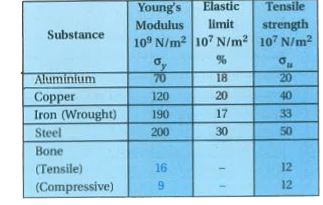 For metals Young.s moduli are large therefore these materials require a large force produce small change in length. Steel is more elastic than copper, brass and aluminium. It is for this reason that steel is preferred in heavy-duty machines and in structural designs. Wood, bone, concrete and glass have RATHER small Young.s moduli. |
|
| 39. |
A particle moves along a horizontal circle with constant speed. If .a. is its acceleration and .E. is its kinetic energy (A) a is constant (B) E is constant ( C)a si variable (D) E is variable |
|
Answer» A and B are CORRECT |
|
| 40. |
What is the difference between wave velocity and particle velocity ? |
| Answer» SOLUTION :WAVE velocity is GIVEN by `v=flambda,` itis contant for a given medium. Particle velocity CHANGES sinusoidally with time. | |
| 41. |
If the Earth shrinks such that its density becomes 8 times to the present value, then the new during of the day in hours will be |
|
Answer» 24 |
|
| 42. |
lambda is maximum wavelength of a transverse wave that travels along a stretched wire whose two ends are fixed. The length of that wire is |
|
Answer» `2lambda` |
|
| 43. |
If polar ice caps melt the length of the day |
|
Answer» will increase |
|
| 44. |
A body is suspended from a spring balance kept in a satellite the reading of the balance is W_(1) when the satellite goes in an orbit of radius R and is W_(2) when it goes in an orbit of radius 2R |
|
Answer» `w_1 = w_2` |
|
| 45. |
A block is kept on the floor of an elevator at rest. The elevator starts descending with an acceleration of 12 m//s^2 . Find the displacement of the block during the first 0.2 s after the start. Take g = 10 m//s^2 |
|
Answer» 40cm |
|
| 46. |
The viscous force acting on a solid ball of surface area A moving with terminal velocity v is proportional to |
|
Answer» A |
|
| 47. |
Two blocks of masses m_1 and m_2 (m_1 gtm_2)in contact with each other on frictionless, horizontal surface. If a horizontal force F is given on m_1set into motion with acceleration a, then reaction force on mass m_1 by m_2is |
|
Answer» `(Fm_1)/(m_1 + m_2)` |
|
| 48. |
A progressive wave is represented by |
|
Answer» `asinomegat` |
|
| 49. |
A small stone is inside a ice block which floats in water. When the ice fully melts the level water |
|
Answer» INCREASES |
|
| 50. |
A mild steel wire of length 1.0 m and cross-sectional area 0.50 xx 10^(-2) cm^(-2) is stretched, well within its elastic limit, horizontally between two pillars. A mass of 100 g is suspended from the mid-point of the wire. Calculate the depression at the mid-point. |
|
Answer» Solution :`X=[(Mg)/(YA)]^(1//3)` Here `2l=1m, l=0.5 mA=0.50xx10^(-6)m^(2), M=0.1 kg` `Y=2xx10^(11)N//m^(2) and g=10m//s^(2) "" :. "Dpression " x=1.074xx10^(-2)m` |
|