

Saved Bookmarks
This section includes 7 InterviewSolutions, each offering curated multiple-choice questions to sharpen your Current Affairs knowledge and support exam preparation. Choose a topic below to get started.
| 1. |
If x= (a)/(b), then the maximum percentage error in the measurement of 'x' will be |
|
Answer» `((DELTA)/(a))/((Delta b)/(b)) XX 100` |
|
| 2. |
A weight mg is suspended from the middle of a rope whose ends are at the same level. The rope is no longer horizontal. What is the minimum tension required to completely straighten the rope is |
|
Answer» Solution :From the diagram `2T sin theta = MG` `T = (mg)/(2 sin theta)` The rope will be straight when `theta = 0` `T = (mg)/(2 sin 0^(@)) = ALPHA` The tension REQUIRED to completely STRAIGHTEN the rope is INFINITY. 
|
|
| 3. |
A circular disc rotates freely about a vertical axis through its centre with angular velocity omega_(1).A ring having the same mass and radius as the disc is placed on the disc and the system now rotates with an angular velocity omega_(2)about the same vertical axis. Then omega_(2)//omega_(1) is: |
|
Answer» `1/3` |
|
| 4. |
A particle moves along a straight line and its velocity depends on time at V=4t-t^(2). Then for first 5S. |
|
Answer» AVERAGE velocity is `(25)/(3)` m/s |
|
| 5. |
What is the pressure inside the drop of mercury of radius 3.00mm at room temperature? Surface tension of mercury at that temperature (20^@C) is 4.65 times 10^-1 N m^-1. The atmospheric pressure is 1.01 times 10^5 Pa. Also give the excess pressure inside the drop. |
|
Answer» |
|
| 6. |
A force of (2hati+3hatj+5hatk)N is is applied at a point whose position vector is(7hati+4hatj-2hatk)m. Find thetorque of force about the origin. |
|
Answer» SOLUTION :`vecr=7 hati+4hatj-2hatk` `vecF=4hati-3hatj+5hatk` TORQUE, `VEC tau= vec r XX vec F` `vectau=|{:(hati, hatj, hatk),(7,4,-2),(4,-3,5):}|` `tau=hati(20-6)-hatj(35+8)+hatk(-21-16)` `tau=(14hati-43hatk-37hatk) Nm` |
|
| 7. |
(A) : During change of state of a substanceinternal energy of a substance remainsconstant (R) : During isothermal process of an idealgas change in internal energy is zero |
|
Answer» If both (A) and (R) are TRUE and (R) is thecorrect EXPLANATION of (A) |
|
| 8. |
Solar constant may be defined as the amount of solar energy received per cm^(2) per minute. The dimensions of solar constant is |
|
Answer» `[ML^(2)T^(-3)]` |
|
| 9. |
Three liquids of densities rho_(1),rho_(2)andrho_(3) (with rho_(1)gtrho_(2)gtrho_(3)), having the same value of surface tension T, rise to the same height in three identical capillaries. The angles of contact theta_(1), theta_(2) and theta_(3) obey |
|
Answer» `(pi)/(2)gttheta_(1)gttheta_(2)gttheta_(3)ge0` |
|
| 10. |
The age of the universe is about 10^(10) years whereas the mean life for human existance is 10^(6) years. Find the physical meaning of the time interval which is approximately half way between these two on a lagarithmic scale. |
|
Answer» Solution :Mean life of HUMAN existance `t_(1)= 10^(6)` YEARS Mean life of universe, `t_(2)= 10^(10)` years It is the time INTERVAL, which is half way between `t_(1) " and "t_(2)`, then `log t =(1)/(2) [log t_(1)+log t_(2)]` `=(1)/(2)[log 10^(6)+log 10^(10)]` `=(1)/(2)[6+10]=8` `t= 10^(8)` years which is equal to the travel time for light from the NEAREST star. |
|
| 11. |
A rectangular parallelepiped of mass m has three sides of length l,2l and 3l respectively. State with reason, in which position the block should be kept at rest on a horizontal floor so as to attain the highest stability of equilibrium. |
| Answer» Solution :The longer sides` 2l` and `3l` should FORM the horizontal base of the parallelepiped. In this position maximum STABILITY of equilibrium can be achieved. CENTRE of gravity is at its LOWEST possible position i.e., at a HEIGHT of `(l)/(2)` from the base and the base area is maximum. | |
| 12. |
A body moving with a speed of 54kmph is brought to rest in a distances. If the coefficient of friction between the body and the surface is 0.3. Calculate the distance travelled by the body ? |
|
Answer» Solution :`u=54` KMPH `=15m//s`, `s=?`, `mu_(k)=0.3` FINAL velocity `=0` The KINETIC energy of the BODY is used to do work against friction. `(1)/(2)"MU"^(2)=mu_(k)` mgs , `s=(u^(2))/(2mu_(k)g)=(15xx15)/(2xx0.3xx9.8)=38.3m` |
|
| 13. |
can a quantity have unit , but no dimension ? |
| Answer» Solution :YES It is possible for a PHYSICAL quantity dimensionless but still having unit foer EXAMLE ANGLE is dimensionlessbut its unit is RADIAN | |
| 14. |
Match the Column I with Column II. |
|
Answer» <P>A - p, B - q, C - s, D - R |
|
| 15. |
A body executing S.H.M has maximum acceleration equal to 24m/sec and maximum velocity equal to16/sec. The amplitude of S.H.M is |
|
Answer» `3/32m` |
|
| 16. |
A car moves up a hill of incline 1 in 50 with a velocity of 15KMPH. The resistance due to friction is (1)/(25)th of weight of the car. The speed of the car while moving down hill using same power is |
|
Answer» `15 KMPH` |
|
| 17. |
The focal length of the eyepiece and the objective of an astronomical telescope are 2cm and 100cm respectively. Find the magnifying power of the telescope for normal adjustment and the length of the telescope. |
|
Answer» 50,102cm |
|
| 18. |
The rate of steady volume flow of water through a capillary tube of length 'l' and radius 'r' under a pressure difference of P is V. This tube is connected with another tube of the same length but half the radius in series. Then the rate of steady volume flow through them is (The pressure difference across the combination is P) |
|
Answer» `V/16` |
|
| 19. |
When the bulb of standard gas thermometer is placed in melting ice, the pressure recorded is 83 cm of Hg and when immersed in boiling water, it is 113 cm of Hg. When the bulb is placed in another boiling liquid, the pressure recorded is 143 cm of Hg. Find the boiling point of the liquid. |
|
Answer» Solution :Pressure of the gas at `0^(@)C=83` cm of Hg `(P_(0))` , Pressure of the gas at `100^(@)C=113` cm of Hg `(P_(100))` Pressure of the gas at the BOILING point of the LIQUID `(t^(0)C)=143` cm of Hg `(P_(t))` At `0^(0)C` and `100^(0)C`, the pressure of the gas are considered Pressure coefficient, `beta=(P_(100)-P_(0))/(P_(0) times 100)`, At `0^(0)C" and "t_(0)C` the pressure of the gas are considered, `beta=(P_(t)-P_(0))/(P_(0)t)" "THEREFORE (P_(100)-P_(0))/(P_(0) times 100)=(P_(1)-P_(0))/(P_(0)t) rArr t=(P_(t)-P_(0))/(P_(100)-P_(0)) times 100=(143-83)/(113-83) times 100=63/30 times 100=200^(0)C` |
|
| 20. |
A body of mass 2kg is dropped from a height of 4m. If the average resistance offered by the ground is 4020N, the distance through which the body penetrates in to the ground before coming to rest is (g = 10ms^(-2)) |
|
Answer» 0.02 CM |
|
| 21. |
The period of oscillation of a simple pendulum of length L suspended from the ceiling of a vehicle moves with out friction down in an inclined plane of inclination alpha is given by |
|
Answer» `2PI sqrt((L)/(g COS alpha))` |
|
| 22. |
A uniform rod of length 2m and mass 5kg is lying on a horizontal surface. The work done in raising one end of the rod with the other end in contact with the surface until the rod makes anangle 30^(@) with the horizontal is (g=10ms^(-2)) |
|
Answer» 25 J |
|
| 23. |
Find the power of an engine which can draw a train of 400 metric ton up the inclined plane of 1 in 98 at the rate of 10 ms^(-1). The resistance due to friction acting on the train is 10 N per ton. |
|
Answer» 350 kW |
|
| 24. |
An iron block of sides 50cm xx 8cm xx 15cm has to be pushed along the floor. The force required will be minimum when the surface in contact with ground is |
|
Answer» `8"cm"xx15"cm surface"` |
|
| 25. |
Showthat the projectionof uniform circular motionon a diameteris SHM. |
|
Answer» <P> Solution :(a) Consider a particlemovingalongthe y cirumferenceof a circleof radius a and centre O,withuniformspeed, v in anticlockwisedirection ,LET xx' and yy'be the two perpendicularx diameters. Suppose the particleis at p after a TIME t. If ` omega` is the angularvelcoitythenthe angular displacemetn ` theta`in time t is givenby ` theta = - omega t` From P draw PNperendicularto yy' . As theparticlesmovesfrom X to y , footof the perpendicularN movesfrom 0 to y.As it movesfurther from y to x' , thenfromx' and y' and backagain to x,the POINTN movesfromy to 0 , from 0 to y' and backagainto 0 . Whenthe particle completersone revolution alongthe cirumference, the pointN completersone vibration N alongthe diameter yy' is simpleharmonic. Hence the projection of a unifromcircular motion on a diameterof sidein simple harmonicmotion . |
|
| 26. |
A solid sphere is rolling down in the inclined plane, from rest without slipping. The angle of inclination with horizontal is 30^(@). The linear acceleration of the sphere is___(Assume g=10ms^(-2)) |
|
Answer» (a) `28 ms^(-2)` `:.(k^(2))/(R^(2))` for solid SPHERE `=(2)/(5)` `a=(10xx(1)/(2))/((7)/(5))=(25)/(7)=3.6 ms^(-2)` |
|
| 27. |
The equivalent capacitance in the circuit shown in figure will be |
| Answer» Solution :`C_(eq)=2+4+2= 8 muC` | |
| 28. |
A cubical block of mass m is sliding on an inclined right angle trough as shown in the figure. If coefficient of friction is mu , find the acceleration of the block. |
|
Answer» Solution :For the CUBICAL block , `N_(1) = N_(2) = N` RESULTANT reaction `N' = sqrt(2) N` `_|_^(ar) to JK : N' mg cos theta RARR sqrt(2) N = mg cos theta` `rArr N = (mg cos theta)/(sqrt(2))` Along the plane : `mg sin theta - mu N_(1) - mu N_(2) = ma` `mg sin theta - 2 mu N = ma` `mg sin theta - 2 mu (mg cos theta)/(sqrt(2)) = ma` ` a = g[ sin theta - sqrt(2) mu cos theta]` 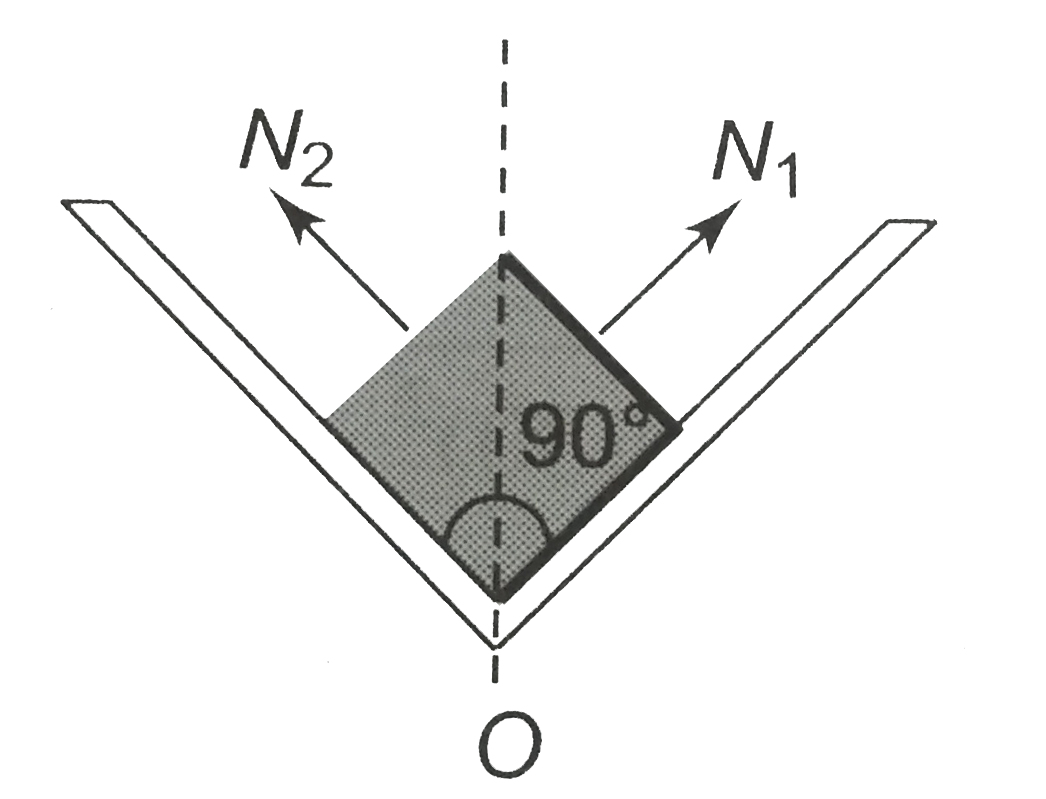 
|
|
| 29. |
Thermometers which are not kept in touch with the body to measure temperatures are |
|
Answer» PYROMETERS |
|
| 30. |
Astone is projected from the ground with a velocity of 20 m/s at angle 30^(@) with the horizontal. After one second it clears a wall then find height of the wall. (g=10 ms^(-2)) |
|
Answer» 10m |
|
| 31. |
The M.I. of a thin rod about a normal axis through its centre is I. It bent at the centre such that, the two parts are perpendicular to each other and perpendicular to the axis. The M.I. of the system about the same axis will be |
|
Answer» 2I |
|
| 32. |
In a process on a system, the initial pressure and volume are equal to the final pressure and volume. |
|
Answer» The initial temperature must be equal to the final temperature |
|
| 33. |
A wall clock uses a vertical spring mass system to measure the time. Each time the mass reaches an extreme position, the clock advances by a second. The clock gives correct time at the equator. If the clock is taken to the poles it will |
| Answer» Answer :D | |
| 34. |
In the figure sown in the concept, find (a) Equilbrium extension x_(@) (=AB) (b) Maximum extension x_(m) (=AC) (c)Maximum speed at point B. |
|
Answer» `F_("NET") =0` `rArr kx_(0) =mg` `rArr x_(0) mg/K`  . From A to C `(v_(A)=v_(C) =0)` Decreasing in gravitational potential energy = incrasing in spring energy. `:. mgx_(m)=-1/2Kx_(m)^(2) , AC=x_(m)` `rArr x_(m)=2mg/K` (c) FORM A to B Dereasing ingravitational potential energy = increasing in (spring potential energy + kinetic energy) `rArr mg x_(0) =1/2 Kx_(0)^(2) +1/2mv_("max")^(2)` Substituting the value of `x_(0) =mg/K` in the above eqation, we get `v_("max")=(SQRT(m/K))g`. |
|
| 35. |
During the melting of a slab of ice at 273 K at atmospheric pressure: |
|
Answer» POSITIVE work is DONE by he ice-water SYSTEM on the atmosphere |
|
| 36. |
A partical is subjected to an acceleration a= alpha t^(1) + beta t^(2) , where alpha and beta are constants. The velocity of the partical at t = 0 is v0. What is the expressions for velocity v of the particle at time t? |
| Answer» SOLUTION :`V = v_(0)+(1)/(2)alphat^(2)+(1)/(3)betat^(3), x = x_(0)+v_(0)t+(1)/(6)alphat^(3)+(1)/(12)betat^(4)` | |
| 37. |
Two moles of an ideal gas was heated isobarically so that its temperature was raised by 100 K. The heat absorbed during the process was 4000 J. Calculate (i) the work done by the gas, (ii) the increase in internal energy and (ii) the value of y for the gas [R =8.31 J mol ^(-1) K ^(-1) ]. |
|
Answer» Solution :`n = 2, Delta T = 100 K, Q = 4000 J` Work done by the GAS `= n R Delta T` `Delta W = 2 xx 8. 31 xx 100 = 1662 J` Increases in internal ENERGY `= Delta U = Q - Delta W` `= 4000 - 1662 = 2338 J` Also `Delta U = (R Delta T)/(gamma -1) = 2338` ` gamma -1 = (8. 31 xx 100)/(2338) = 0.35` `gamma = 1. 35` |
|
| 38. |
From a point on the ground at a distance 2m from the foot of a vertical wall, a ball is thrown at an angle of 45^@of which just clears the top, of the wall and afterward strikes the ground at a distance 4m on the other side. The height of the wall is |
|
Answer» 2/3 m |
|
| 39. |
A fractional change in volume of oil is 1 percent when a pressure of 2 xx10^7 Nm^(-2)is applied. Calculate the bulk modulus and its compressibility |
|
Answer» `3xx10^(8)NM^(-2), 0.33xx10^(-9)m^(2)N^(-1)` |
|
| 40. |
A 2 kg ball moving at 24 ms^(-1) undergoes head on collision with a 4 kg ball moving in the opposite direction at 48 m s^(-1). If the coefficient of restitution is 2/3, their velocities in m s^(-1) after collision are |
|
Answer» `- 56, - 8` `u_1 = 24 MS^(-1) , u_2= -48 ms^(-1) = -2u_1` where `u_1` and `u_2` be the velocities of masses `m_1` and `m_2` before collision. According to the law of conservation of linear momentum , we GET `m_1 u_1 + m_2 u_2 = m_1 v_1 + m_2v_2 , m_1 u_1 + 2m_1(-2u_1) = m_1 v_1 + 2m_1 v_2` `= -3 u_1 = v_1 + 2v_2 "".........(i)` Coefficient of restitution , `E = (v_2 - v_1)/(u_1 - u_2)` `v_2 - v_1 = e(u_1 - u_2)= e(u_1 - (-2u_1))` `v_2 - v_1 = 3u_1 e"" ....(ii)` Adding (i) and (ii), we get `3v_2 = 3u_1 e - 3u_1 " or " v_2 = u_1 (e - 1) "" .......(iii)` Substituting this value of `v_2` in (i), we get `v_1 = -u_1 (1 + 2e) "" ......(iv)` Substiting the given VALUES in (iii) and (iv), we get `v_2 = 24 (2/3 - 1) = -8 ms^(-1)` and `v_1 = -24(1 + 2 xx 2/3) = -56 ms^(-1)` . |
|
| 41. |
What provides the restoring force for simple harmonic oscillations in the following cases : Spring |
| Answer» SOLUTION :ELASTICITY | |
| 42. |
The temperature of n moles of an ideal gas is increased from T to 4T through a process for which pressure P = aT^(-1) where a is a constant. Then, the work done by the gas is |
|
Answer» nRT `PV = nRT` or `V = (nRT)/(P) :. P = (a)/(T)` (GIVEN) …(i) `:. V = (nRT^(2))/(a)` or `dV = (2nRT)/(a) DT` …(ii) WORK DONE by the gas, dW = PdW or `W = underset(T)overset(4T)int (a)/(T) (2nRT)/(a) dT = [2nRT]_(T)^(4T) = 6nRT` (Using (i) and (ii)) |
|
| 43. |
What physical quantity does the area under the force-displacement curve represent? |
| Answer» SOLUTION :WORK DONE by the BODY. | |
| 44. |
R and r are the radii of the earth and moon respectively , p_e and P_m are densities of earth and mon respectively . The ratio of the acceleration due to geavity on the surfaces of moon and earth is |
|
Answer» `R/r rho_e/rho_m` |
|
| 45. |
How much work is done by agent in forcing 3m^(3) of water through a pipe of radius 2cm, if the difference in pressure at the two ends of the pipe is10^(4) Pa? |
| Answer» SOLUTION :`3XX10^(6)J` | |
| 46. |
Write dimensional formula of universal constant of gravitation (G). |
|
Answer» `MLT` `[G] = ([F][r^2])/([m_1] [m_2] ) = (M^(1) T^(-2) xxL^(2))/(M^(1) xxM^(1))` `[G] = M^(-1) L^(-3) T^(-2)` |
|
| 47. |
Explain by drawing graphs of displacement x(t) to t, velocity v(t) to t and acceleration a(t) to t of SHM for initial phase zero. |
|
Answer» SOLUTION :The following graphs of the displacement `x(t) = A cos omega t`, velocity `v(t)= -A omega sin omega t` and acceleration `a(t)= -A omega cos omega t` versus TIME t of SHM for initial phase zero are shown in figures. These graphs of displacement, velocity and acceleration of a particle in simple harmonic motion have the same period T, but they differ in phase. All the quantities CHANGE periodically with time according to sine. In this graphs for all three quantities have their maxima differ and differ in phase. x VARIES between `-A" to "+A, v(t)` varies from `-A omega" to "A omega" and "a(t)` from `-A omega^(2)" to "+A omega^(2)`. With respect to displacement plot, velocity plot has a phase DIFFERENCE of `(pi)/(2)` and acceleration plot has a phase difference of `pi`. 
|
|
| 49. |
When the planet Jupiter is at a distance of 824.7 million.kilometers from the Earth, its angular diameter is measured to be 35.72" of arc. Calculate the diameter of a Jupiter. |
| Answer» SOLUTION :`D=824.7xx10^6xx10^3=824.7xx10^9ma=(35.72)/(60xx60)XX(PI)/180=1.731xx10^-4radd=Dalpha=824.7xx10^9xx1.731xx10^-4=1.4275xx10^8m` | |
| 50. |
A body , starting from rest and moving with constant acceleration , covers 10 m in the first second. Find the distance travelled by it in the next second. |
|
Answer» SOLUTION :Using the equation for the DISTANCE TRAVELLED in the `n^(th)` second , `viz,. S_(n)=u+a/2(2n-1)` We have for thefirst second , `10=0+2/2(2xx2-1)=30m. ` Noth: FOLLOWING this procedure it can be SHOWN that the distance travelled in equal time intervals will be in the ratio `1:3:5:7:`.... |
|