

Saved Bookmarks
This section includes 7 InterviewSolutions, each offering curated multiple-choice questions to sharpen your Current Affairs knowledge and support exam preparation. Choose a topic below to get started.
| 1. |
The speed-time graph of a particle moving along a fixed direction is shown in Fig. Obtain the distance traversed by the particle between (a) t = 0 s to 10 s, (b) t = 2s to 6s.What is the average speed of the particle over the intervals in (a) and (b) ? |
| Answer» Solution :(a) `60 m, 6 MS^(-1)` , (B)`36 m, 9 ms^(-1)` | |
| 2. |
A pipe which can be swiveled in a vertical plane in mounted on a cart. The cart moves uniformly along a horizontal path with a velocity v_(1)=2m//s. A what angle alphato the horizontal should the pipe be placed so that drops of rain falling vertically with a velocity v_(2)=6m//s move parallel to the walls of the pipe without touching them. |
|
Answer» |
|
| 3. |
A metal piece of mass 120g is stretched to form a plane rectangular sheet of area of cross section 0.54m^(2). If length and breadth of this sheet are in the ratio 1:6, find its moment of inertia about an axis passing through its centre and perpendicular to its plane. |
|
Answer» SOLUTION :Mass `M=120g=120xx10^(-3)kg` area `=lb=0.54m^(2)` `(l)/(b)=(1)/(6)` `:.l=(b)/(6)` `lb=0.54`, `(b)/(6).b=0.54` `b^(2)=0.54xx6impliesb=sqrt(3.24)=1.8m` SIMILARLY `l=(0.54)/(1.8)=0.3m` Moment of Inertia `I=(M(l^(2)+b^(2)))/(12)=(120xx10^(-3)[(0.3)^(2)+(1.8)^(2)])/(12)` `I=33.3xx10^(-3)kgm^(2)` |
|
| 4. |
A person in a car tends to fall back when it suddenly starts is an example for |
|
Answer» INERTIA of REST |
|
| 5. |
A mason worker throws the bricks to a height of 10m, at which the bricks reach with a velocity of 6 ms^(-1). The precentage of energy he is wasting is nearly (g= 10 ms^(-1)) |
| Answer» ANSWER :A | |
| 6. |
How high most a body be lifted to gain an amount of P.E. equal to K.E. is when moving at speed 20ms^(-1).(The value of acceleration des to grity at a place is (9.83ms^(-2)) |
|
Answer» so h=20.2m |
|
| 7. |
The Moon lo orbits Jupiter once in 1.769 days. The orbital radius of the Moon lo is 421700 km. Calculate the mass of Jupiter? |
|
Answer» Solution :`{:("TIME period of"),("the moon T"):}}=1.769"days"` `{:("Orbital radius"),("of the Moon"):}}=4217xx10^(2)km` Time period `T^(2)=(4pi^2)/(GM_J)(R_(M)+h)^(3)` `M_(J)` = Mass of Jupiter `GM_(J)=(4pi^(2)R_(M)^(3))/(T^2)[hltltR_(E)]` `{:("MEAN radius of"),("the moon" R_(M)):}}=1.737.1xx10^(3)m` `M_(J)=(4pi^(2)R_(M)^(3))/(GT^2)` Mass Jupiter `M_(J)=(4xx(3x14)^(2)xx(1737xx10^3)^(3))/(6.67xx10^(-11)xx(1.769)^(2))` `=(20668xx10^(27))/(20872xx10^(-11))` `=0.99022xx10^(27+11)` `=990226xx10^(38-5)` `=990226xx10^(33)` `=0.990226xx10^(27)` `~=1xx10^(27)kg` |
|
| 8. |
A satellite is moving in a circular orbit around the earth with a speed equalt to half the escape speed from the earth. If .R. is the radius of the earth then the height of the satellite above the surface of the earth is |
| Answer» ANSWER :C | |
| 9. |
Locate the centre of mass of a system of three particles 1,2 and 3 each of mass m situated at the vertices of a right angled triangle as shown in figure. |
|
Answer» |
|
| 10. |
A Black metal foil receives radiation of power P from a bot sphere at absolute temperature T, kept at a distance d. If the temperature is doubled and distance is doubled, then Power will be |
|
Answer» 64P |
|
| 11. |
shows (upsilon_(x) , t)and (upsilon_(x) , t) diagramsfor a body of unit mass Find the force as a funactionof time . |
|
Answer» Solution :As is clear from `{:(v_(X)=2t",","for",0 LT t lt 1s,|,v_(y)=t,"for",0 lt t lt 1s),(v_(x)=2(2-t)",","for",1 lt t lt 2s,v_(y)=1,"for",0 lt t,),(v_(x)=2(2-t)",","for",2 lt t,,,,):}` ` :. F_(x) = ma_(x) = m(d upsilon_(x))/(dt)""F_(y) = ma _(y) = m(dupsilon_(y))/(dt)` `{:(=1 xx 2,"for",0 lt t LT1 s,|,=1 xx 1,"for",0 lt t lt 1s),(=1(-2),"for",1 lt tlt 2s,=0,"for",1 lt t,),(=0,"for",2 lt t,,,,):}` Hence `VEC(F) = - 2 hati + hatj`for `0 lt t lt 1 s ` `vecF = - 2 hati` for `1 lt t lt2s` `vec(F) = vec(0)` for `2 lt t ` 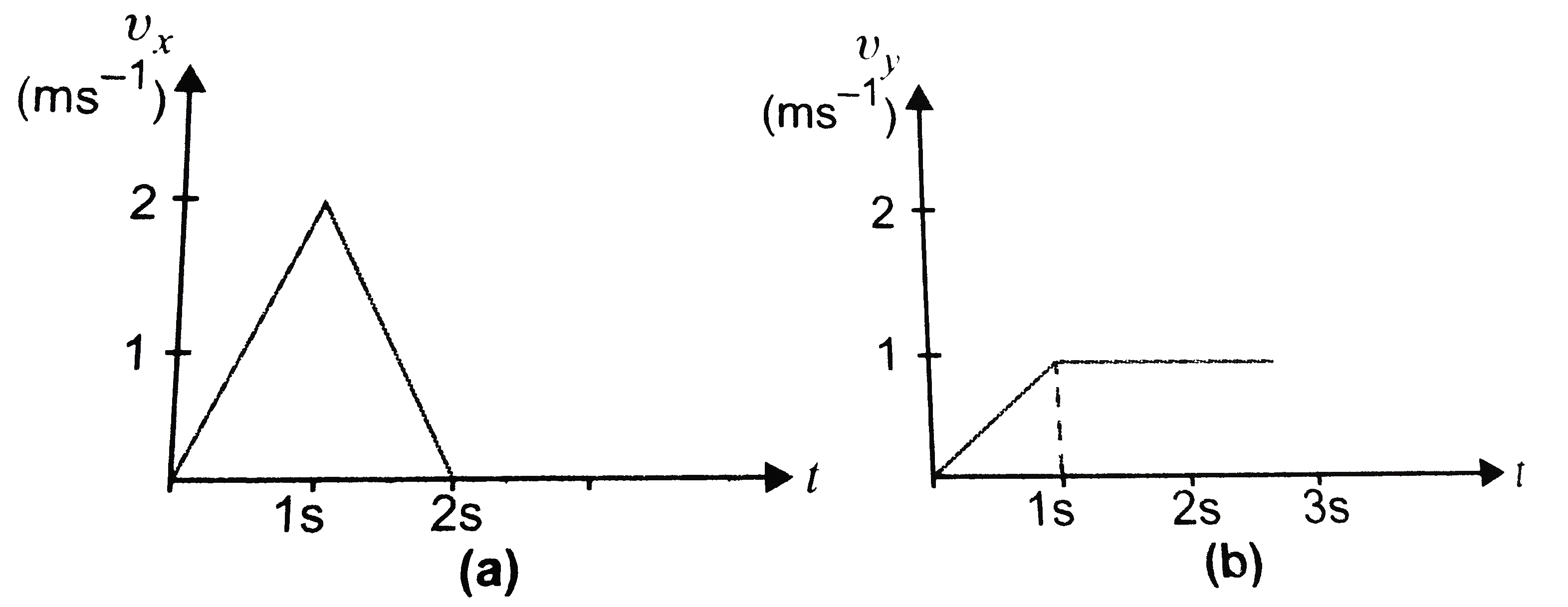 . .
|
|
| 12. |
Chinawares are warpped in straw paper before packing. Why ? |
| Answer» Solution :The straw paper between chinawaves INCREASES the time of JERK during TRANSPORTATION. Hence they collide with each other with less force and are less LIKELY to be damaged. | |
| 13. |
A metal cube of side length 8.0cm has its upper surface displaced with· respect to the bottom by 0.10 mm when tangential force of 4 xx 10^(4) N is applied at the top with bottom surface fixed. The rigidity modulus of the material of the cube is |
|
Answer» `4 XX 10^(9) NM^(-2)` |
|
| 14. |
(A): Displacement of a body may be zero when distance travelled by it is not zero. (R) : The displacement is the longest distance between initial and final positions.. |
|
Answer» Both (A) and (R) are TRUE and (R) is the CORRECT explanation of (A) |
|
| 15. |
Show that y=sin^(2)omegat does not represent simple harmonic but periodic. What is the period of the given function. |
|
Answer» Solution :Given, `y=sin^(2)omegat` or `y=(1)/(2)(1-cos 2omegat)` Velocity of the particle `V=(DY)/(dx)=(1)/(2)[0+(sin2omegat)(2OMEGA)]` `v=(omega)sin2omegat` Particle ACCELERATION `a=(dv)/(dt)=2omega^(2)cos2omega t` Hence `y=sin^(2)omegat` is periodic but does not execute S.H.M. Acceleration is not proportional to the displacement. |
|
| 16. |
A vector makes angle with X,Y and Z axer that are in the ratio 1:2:1 respectively. The angle made by the vector with Y-axis is |
|
Answer» |
|
| 17. |
A small block isrotating in a horizontal circle at the end of a thread which passes down through a hole at the centre of table top. If the system is rotating at 2.5 rps in a circle of 30 m radius what will be the speed of rotation when the thread is pulled inwards to decrease the radius to 10 m? |
|
Answer» |
|
| 18. |
Automobile tyres are generally proviedwith irregualr projection over their surfaces why |
| Answer» SOLUTION :Irregularprojectionsincreasethefrictionbetween therubber tyresand THEROAD. Thisprovides afirmgripbetweenthe tyresand the roadpreventsslipping. | |
| 19. |
Two inclined frictionless tracks, one gradual and the other steep meet at A from where two stones are allowed to slide down from rest, one on each track (Fig. 6.16). Will the stones reach the bottom at the same time? Will they reach there with the same speed? Explain. Given theta_(1)= 30^(@), theta_(2)= 60^(@)" and "h= 10m, what are the speeds and times taken by the two stones? |
|
Answer» Solution :No, the stone on the steep plane reaches the bottom EARLIER, yes, they reach with the same SPEED V, [since `mgh= (1"/"2)MV^(2)`] `v_(B)= v_(c )= 14.1 ms^(-1), t_(B)= 2sqrt(2)s, t_(c )= 2sqrt(2)s`. |
|
| 20. |
If vec(A) = 3 hat(i) + 4 hat(j) and vec(B) = 7 hat(i) + 24 hat(j) , then find a vector having the same magnitudes as vec(B)and parallel to vec(A) . |
|
Answer» Solution :`|vec(A)| = sqrt(3^(2) + 4^(2)) = 5` Unit vectorint he direction of `vec(A)`is `HAT(A) = (vec(A))/(|vec(A)|)= (1)/(5) (3 hat(i) + 4 hat(J))` Also`|vec(B)| = sqty(7^(2) + 24^(2)) = 25` The vector having the same magnitude as `vec(B)` and parallel to `vec(A)` . `= |vec(B)| hat(A) = 25 XX (1)/(5) (3 hat(i) + 4 hat(j))` `= 5 ( 3 hat(i) + 4 hat(j)) = 15 hat(i) + 20 hat(j)` |
|
| 21. |
A ring of mass M and radius R is rotating about its axis with angular velocity omega. Two dentical bodies each o mass m are now gently attached at the two ends of a diameter of the ring. Because of this, the kinetic energy loss will be: |
|
Answer» `(m(M+2m))/(M) omega^(2)R^(2)` |
|
| 22. |
A disc revolves with a speed of 33 (1)/(3) rev/min, and has a radius of 15 cm. Two coins are placed at 4 cm and 14 cm away from the centre of the record. If the coefficient of friction between the coins and the record is 0.15, which of the coins will revolve with the record ? |
|
Answer» Solution :For the COIN to revolve with be DISC, the force of friction should be enough to provide the necessary centripetal force, i.e., `(mv^(2))/(r ) le mu MG`. Now `v = r omega`, where `omega = (2pi)/(T)` is the angular frequency of the disc. For a GIVEN `mu` and `omega`, the condition is `r le (mu g)/(omega^(2))` The condition is satisfied by the nearer coin (4 cm from the CENTRE). |
|
| 23. |
A cylindrical piece of cork of height 4.9 cm floats in water with its axis vertical and is made to execute slın. Calculate its time period of oscillation if its density is 0.2 gm/cc ? |
|
Answer» |
|
| 24. |
A long block A is at rest on a smooth horizontal surface. A small block B whose mass is half of A, is placed on A at one end projected along A with some velocity v. The coefficient of friction between the block ismu |
|
Answer» |
|
| 25. |
Pick the odd one from the following: |
|
Answer» mass |
|
| 26. |
An ideal heat engine operates between 222^@C and 127^@ C. It absorbs 6kcal at higher temperature. The amount of heat (in Kcal) converted into work is equal to |
|
Answer» 4.8 |
|
| 27. |
A wire suspended vertically from one ofits ends is stretched by attaching a weight of 200 N to the lower ends. The weight stretches the wire by 1 mm. What is the elastic energy stored in the wire? |
|
Answer» |
|
| 28. |
The inclined sufaces of two movable wedges of same mass M are smoothly conjugated with the horizontal plane as shown in figure. A washer of mass m slides down the left wedge from a height h. To what maximum height will the washer rise along the right wedge ? Neglect friction. |
|
Answer» `(H)/((M+m)^(2))` |
|
| 29. |
What is the torque of the force vecF=3hati-2hatj+4hatk acting at a point vecr=2hati+3hatj+5hatk about the origin? |
|
Answer» Solution :`vec tau= vec r XX vecF = |(hati,HATJ,hatk),(2,3,5),(3,-2,4)|` `tau = (12 - (-10)) hati + (15 - 8) hatj + (-4 -9) hatk ` ` tau = 22 hati + 7 hatj - 13 hatk ` |
|
| 30. |
Which of the following behaves like water between 0^(@) and 4^(@) C . |
| Answer» ANSWER :A | |
| 31. |
A spring mass system is hanging from the ceiling of an elevator in equilibrium . The elevator suddenly starts acceleration upwards with acceleration a, find the amplitude of the resulting S.H.M. |
| Answer» SOLUTION :`(ma)/(K)` | |
| 32. |
A particle slides along a track with elevated ends and a flat central part as shown in Fig. The flat part has a length l = 3.0 m. The curved portions of the truck are fricionless. For the flat part the coefficient of kinetic friction is mu_(k) = 0.20, the particle is released at point A which is at height h = 1.5 m above the flat part of the track. Where does the particle finally come to rest ? |
|
Answer» Solution :As initial ME of the particle is mgh and final is zero, so loos in ME = mgh. This ME is lost in doing work against friction in the flat part, so LOSS in ME WD against friction mgh = `mu MGS`  `i.e., s = (h)/(mu) = (1.5)/(0.2)=7.5m` After starting from B the particle will each C and then will rise up till the remaining KE at C is converted into potential energy. It will then again descend and at C will have the same from C to B, the same will be repeated and FINALLY the particle will COME to rest at E such that `BC+CB+BE=7.5 =3+3+BE=7.5` BE = 1.5 So the particle comes to rest at the centre of the flat part. |
|
| 33. |
A spring mass system is hanging from the ceiling of an elevator in equilibrium . The elevator suddenly starts acceleration upwards with acceleration a, find the frequency . |
| Answer» SOLUTION :`1/(2PI)SQRT(k/m)` | |
| 34. |
What are the factors on which modulus of elasticity depends ? |
| Answer» Solution :TYPES of materials and KINDS of DEFORMATION in WIRE. | |
| 35. |
Dynamic lift is related to |
|
Answer» PASCAL's law |
|
| 36. |
Name a device in which wave properties of electrons is used. |
| Answer» SOLUTION :ELECTRON microscope. It has a resolution far greater than OPTICAL microscope ( about ONE MILLION times that of optical microscope ). | |
| 37. |
Two particles are executing SHM in a straight line. Amplitude A and time period T of both the particles are equal. At time t = 0, one particle is at displacement x_(1) = +A and the other at x_(2) = (-A)/(2)and they are approaching towards each other. After what time they cross each other? |
|
Answer» Solution : Equations can be written as : `x_(1)= A cosomegat` and `x_(2)= A sin(omegat-pi//6)`Here `OMEGA= (2pi)/(T)` Equating `x_(1)= x_(2) "" Sin(omegat- (pi)/(6))= cos omegat` `Sinomegatcos((pi)/(6))-sin((pi)/(6))cosomegat= cosomegat` `SINOMEGAT(sqrt(3))/(2)-(1)/(2)cosomegat= cosomegat` `tan omegat= sqrt(3), omega= (2pi)/(T), t= (pi)/(3),` we get `t= T//6` |
|
| 38. |
Calculate rate of flow of glycerin of density 1.25xx10^(3)kg//m^(3) through the conical section of a horizontal pipe, if the radii of its ends are 0.1m and 0.04m and pressure drop across its length is 10N//m^(2). |
|
Answer» Solution :According to CONTINUITY EQUATION, `(V_(2))/(V_(1))=(A_(1))/(A_(2))=(r_(1)^(2))/(r_(2)^(2))=((0.1)^(2))/((0.04)^(2))=(25)/(4)` and, according to Bernoulli.s equation for a horizontal tube, `P_(1)+(1)/(2)rhoV_(1)^(2)=P_(2)+(1)/(2)rhoV_(2)^(2)`. `V_(2)^(2)-V_(1)^(2)=2((P_(1)-P_(2)))/(rho)=2xx((10N//m^(2)))/((1.25xx10^(3)kg//m^(3)))` `=16xx10^(-3)m^(2)//s^(2)` but `V_(2)=(25)/(4)V_(1)=6.25V_(1)` `therefore [(6.25)^(2)-1^(2)]V_(1)^(2)=16xx10^(-3)m^(2)//s^(2)orV_(1)~~0.0205m//s`. the rate of volume flow = `A_(1)V_(1)=pi(0.1)^(2)xx(0.02)` `=6.28xx10^(-4)m^(3)//s` And the rate of mass flow is `(dm)/(dt)=rhoAV`. `=(1.25xx10^(3)kg//m^(3))xx(6.28xx10^(-4)m^(3)//s)=0.785kg//s` |
|
| 39. |
The radius of orbit of a planet is two times that of Earth. The time period of planet is ...........years. |
|
Answer» 4.2 |
|
| 40. |
A train travels in 3 minutes a distance of 3.15 km from rest at one station to rest at another station. It is uniformly accelerated for the 1st 30 seconds and uniformly retarded for the last 15 seconds, the speed being constant for the remaining time. Find the maximum velocity, acceleration and retardation. Use v-t graph to solve th problem. |
|
Answer» Solution :LET v = maxspeed ATTAINED by the train. From t =0 to t = 30s, acceleration is positive, from t = 30s to t = 165s, acceleration is zero and from t = 165s to t = 180s, acceleration is negative Area under OABC = DISTANCE covered `(1)/(2) (OC+ AB)v = 3150`  `(1)/(2) (OC + AB)v = 3150` `rArr v =20m//s` Slope of OA = acceleration in 1ST part ` = v//30 = 2//3 = 0.667 m//s^(2)` Slope of BC = acceleration in IIND part ` = v//15 = -20//15 = 1.334 m//s^(2)` |
|
| 41. |
The component of vec(A) " along" vec(B) " is " sqrt3 times that of the component of vec(B) " along" vec(A). Then A: B is |
|
Answer» `1: SQRT3` |
|
| 43. |
In. . . ..process, gravitation is necessary for transfer of heat energy. |
|
Answer» conduction |
|
| 44. |
One of the two clocks on earth is controlled by a pendulum and other by a spring. If both the clocks be taken to the moon, then which clock will same time as that on earth |
|
Answer» SPRING clock |
|
| 45. |
What is the force responsible for the oscillations of a loaded spring? |
| Answer» SOLUTION :The ELASTIC force is RESPONSIBLE for the OSCILLATIONS of a loaded SPRING. | |
| 46. |
The type of errors that can never be completely eliminated are |
|
Answer» DETERMINATE error |
|
| 47. |
A clean body of mass 100 g starts with a velocity of 2 m/s on a smooth horizontal plane, accumulating dust at the rate of 5 g/s. Find the velocity at the end of 20 seconds and the distance travelled during that period. |
|
Answer» |
|
| 48. |
Motion of an oscillating liquid column in a U-tube is…….. |
|
Answer» periodic but not simple harmonic If the density of liquid is p and coss-section of arms is A. Here the restoring force is provided by the HYDROSTATIC pressure difference `F= -mg` `= -Vpg = -(Axx 2y)pg` `therefore F= -(2A p g)y` `therefore F propto -y` The motion of liquid COLUMN is SHM. and force constant `K= 2A pg` and periodic time `T= 2pi sqrt((m)/(k))` `=2pi sqrt((Axx 2y xx p)/(2A pg))` `therefore T= 2pi sqrt((y)/(g))` Putting `y= l` `therefore T= 2pi sqrt((l)/(g))` Time period is independent of the density of the liquid. 
|
|
| 49. |
When 20 J of work was done on a gas, 40J of heat energy wasreleased. If the initial internal energy of the gas was 70J, what is the final internal energy? |
|
Answer» 50J |
|
| 50. |
State and explain the theorem of perpendicular axis with an example. |
|
Answer» Solution :Statement : The moment of inertia about an AXIS perpendicular to TWO other axes acting in the same plane with their point of INTERSECTION being a point on it and the (third) axis passing through the common point, is EQUAL to the sum of moments of inertia about the two axes e.g: `I_z=I_x+I_y` Let M be the mass of the disck of radiusR. M.I. about a point passing through the centre and perpendicular to the plane containing X and Y is `I_z=(MR^2)/(2)` Since X and Y are in the same plane `I_x=I_y` `:." " I_z=I_x+I_y` becomes `I_z=2I_x` HENCE `I_x=(I_z)/(2)=(MR^2)/4` i.e. moment of inertia of a circular disc about the diameter `=(MR^2)/4` 
|
|